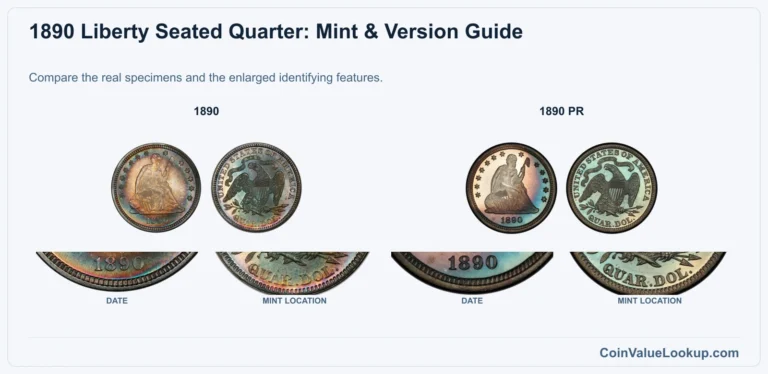
1820 Capped Bust Quarter Coin Value: How Much Is It Worth?
The 1820 Capped Bust Quarter is a classic early American silver coin struck only at the Philadelphia Mint. Guide estimates from USA Coin Book range from about $164.00 to $12,162.00 depending on the specific version and grade.
That spread is not one number for every coin — your quarter's value depends on which "0" variety it is, its condition, and whether it has original surfaces.
Fast Way to Identify Your 1820 Capped Bust Quarter
The quickest way to start figuring out what you have is to upload clear photos of both sides of your coin. A front and back image lets us provide a preliminary identification of the version, finish and general condition.
Snap the photos in even lighting without flash glare, and make sure the date and any lettering are legible.
1820 Capped Bust Quarter Value
Upload both sides of your 1820 Capped Bust Quarter.
Front Obverse
Upload photo
Back Reverse
Upload photo
Which 1820 Capped Bust Quarter Versions Are Worth Money?
- 1820 Large 0 — highest guide anchor at $12,162.00 in MS63; even in G4 condition it lists at $164.00.
- 1820 Small 0 — guide estimates reach $8,591.00 in MS63, making uncirculated examples particularly desirable.
- 1820 Medium 0 — same guide anchors as the Small 0, with MS63 at $8,591.00; correct identification of the zero variety is essential.
- 1820 Proof — extremely rare early proof striking with no adopted price range; individual assessment by a professional service is needed.
Step 1: Identify Your 1820 Capped Bust Quarter Mint Mark and Version
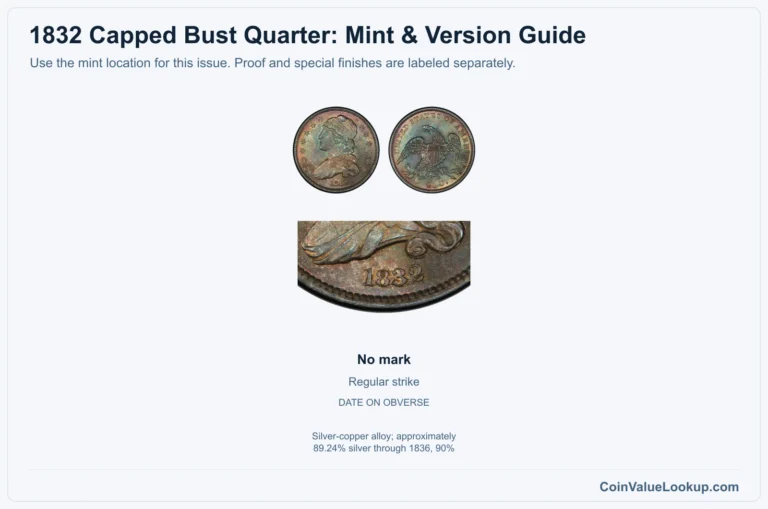
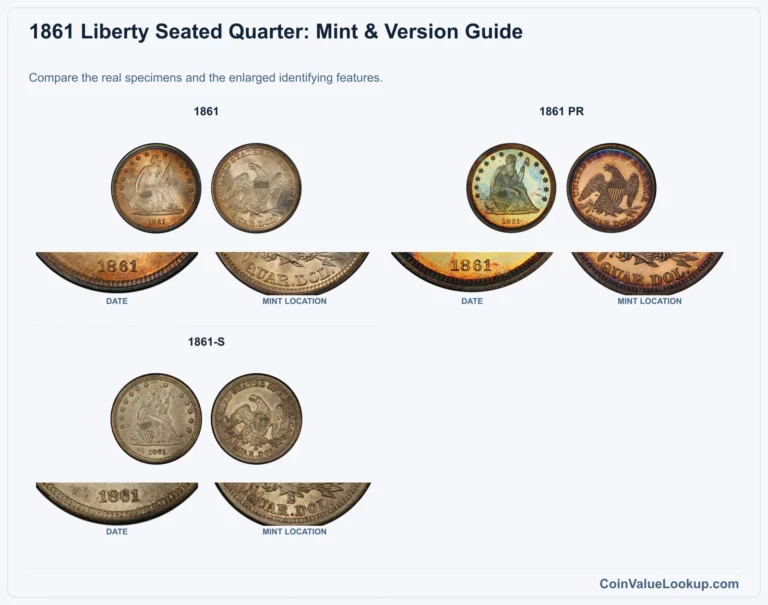
Every 1820 quarter was struck at Philadelphia, so there is no mintmark to hunt for. The design is the large-diameter Capped Bust type with E PLURIBUS UNUM on the reverse scroll above the eagle.
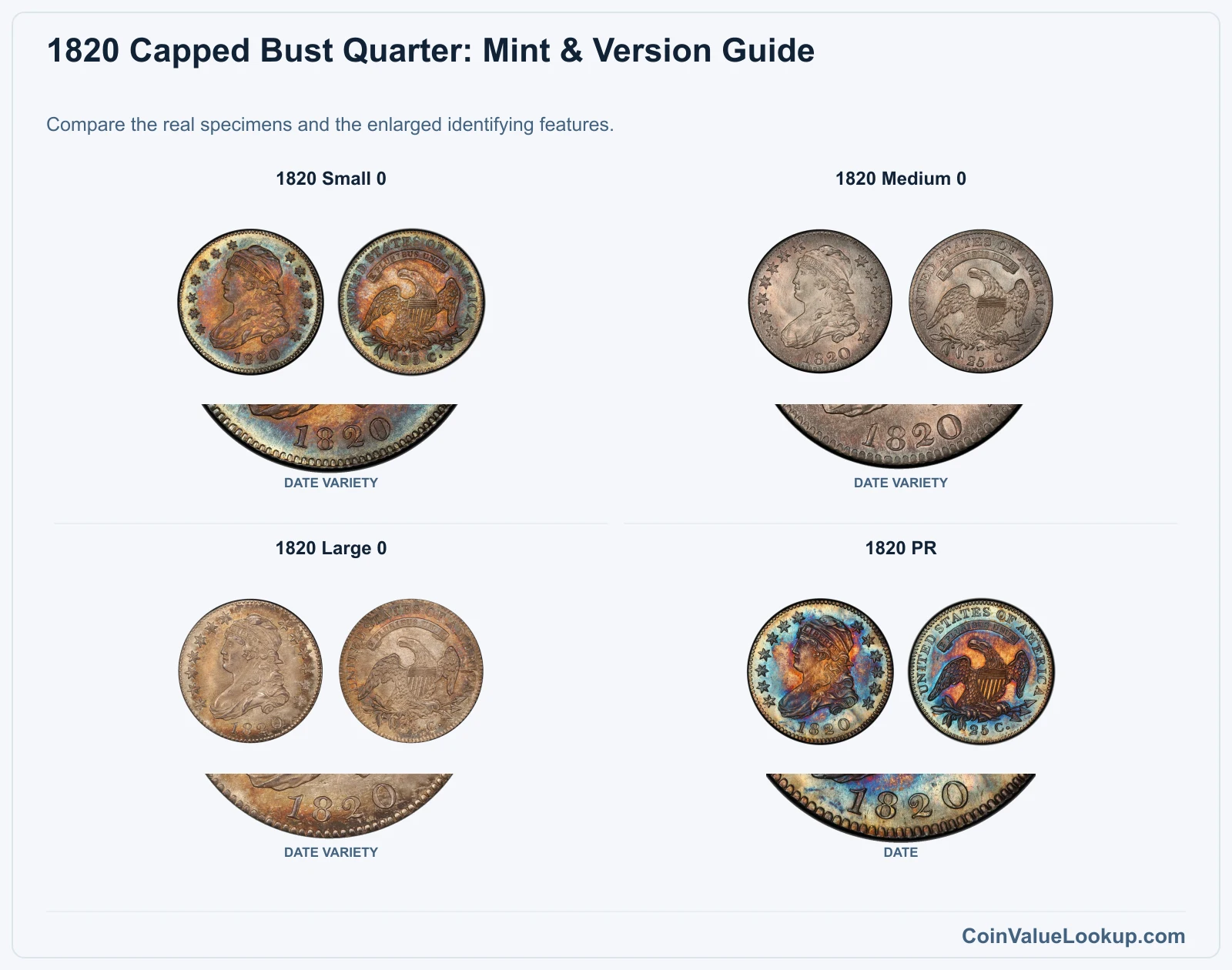
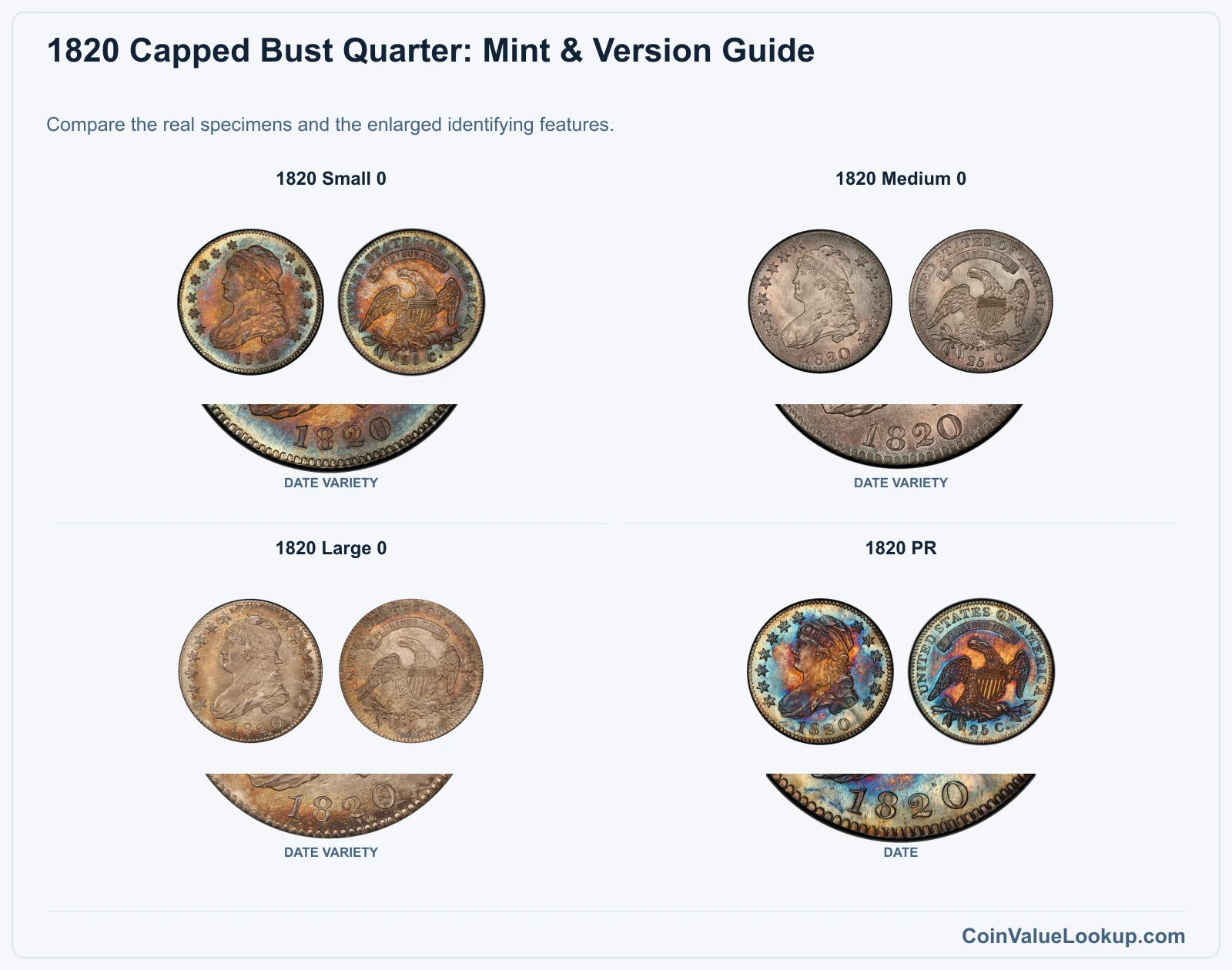
The year breaks into three business-strike varieties based on the size of the "0" in the date: Small 0, Medium 0, and Large 0. Grab a loupe and compare the zero against known examples — the size difference is subtle but real once you see them side by side.
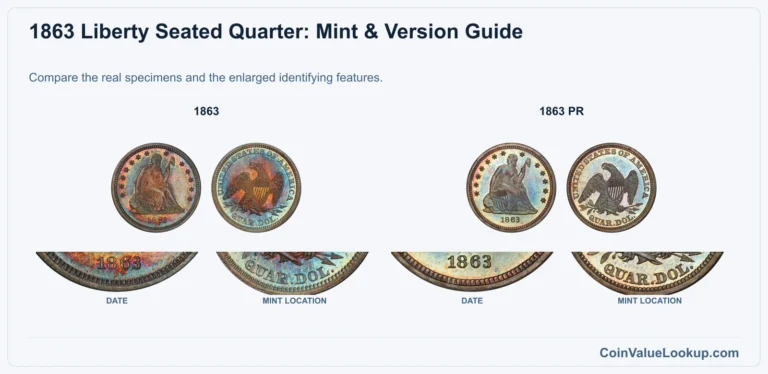
A proof version also exists for 1820, though these are extremely rare early proof strikes. Do not assume a shiny coin is a proof; genuine proofs have a distinctive mirrored surface quality that differs from a polished or lightly circulated business strike.
The coin is a silver-copper alloy, approximately 89.24% silver. If your piece is not silver, it is not genuine.
Step 2: Check Your 1820 Capped Bust Quarter Grade
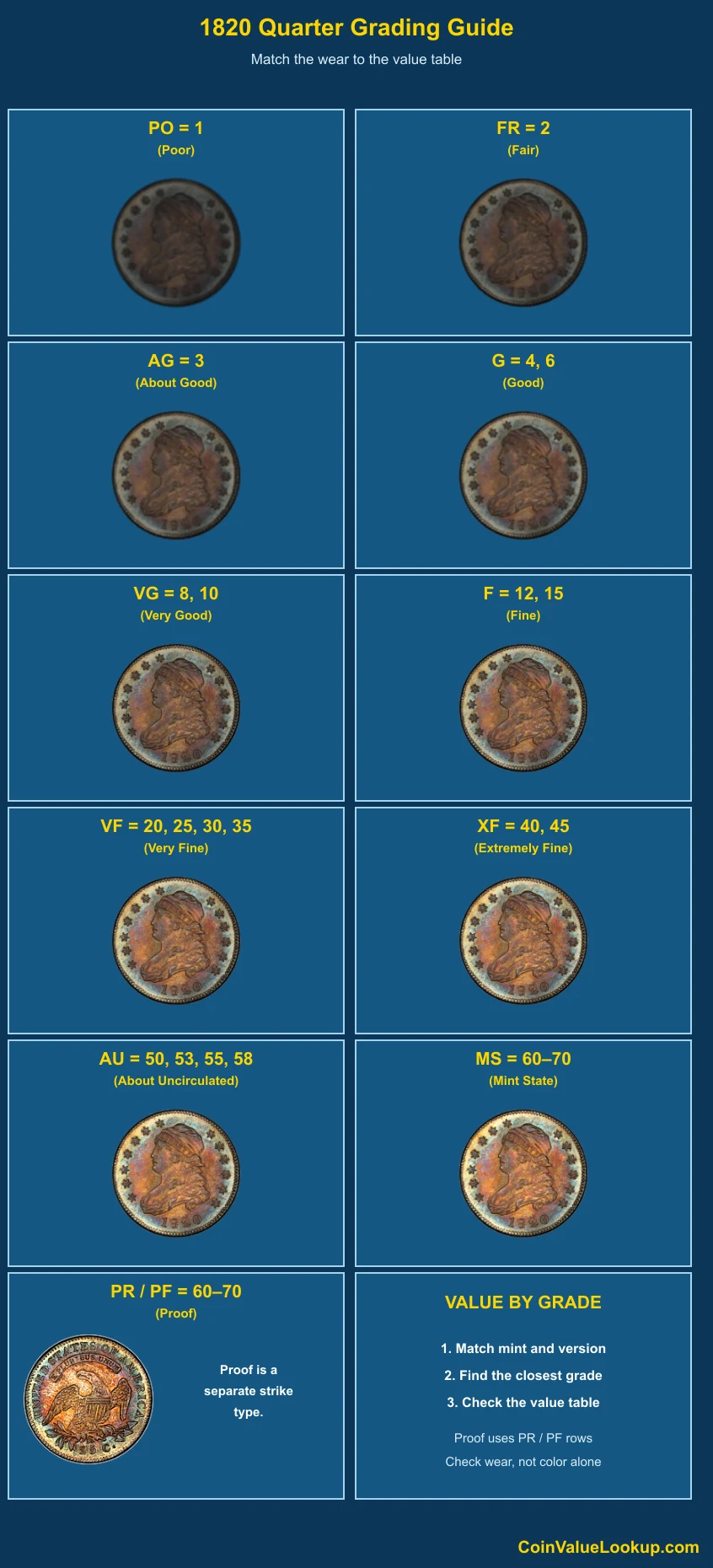
Start with Liberty's hair above the ear. On a well-worn coin, the strands merge into a flat mass.
On a lightly circulated example, individual curls remain visible even if the highest points show slight smoothing.
Next check the cap folds and Liberty's cheek. These are high-relief areas that lose detail first.
On the reverse, the eagle's breast feathers and wing tips wear down before the surrounding design.
Strike quality matters here — some 1820 quarters came off the press with soft detail in the hair or stars, even brand new. Compare your coin against the reference image to separate manufacturing softness from actual circulation wear.
Luster is your other big clue. An unworn coin retains its original cartwheel sheen across the fields.
A coin that has been cleaned may look bright but will lack that natural flow of reflected light. Cleaning or damage can significantly reduce collector value regardless of how much design detail survives.
Step 3: Check 1820 Capped Bust Quarter Value by Mint and Version
1820 Capped Bust Quarter — Small 0
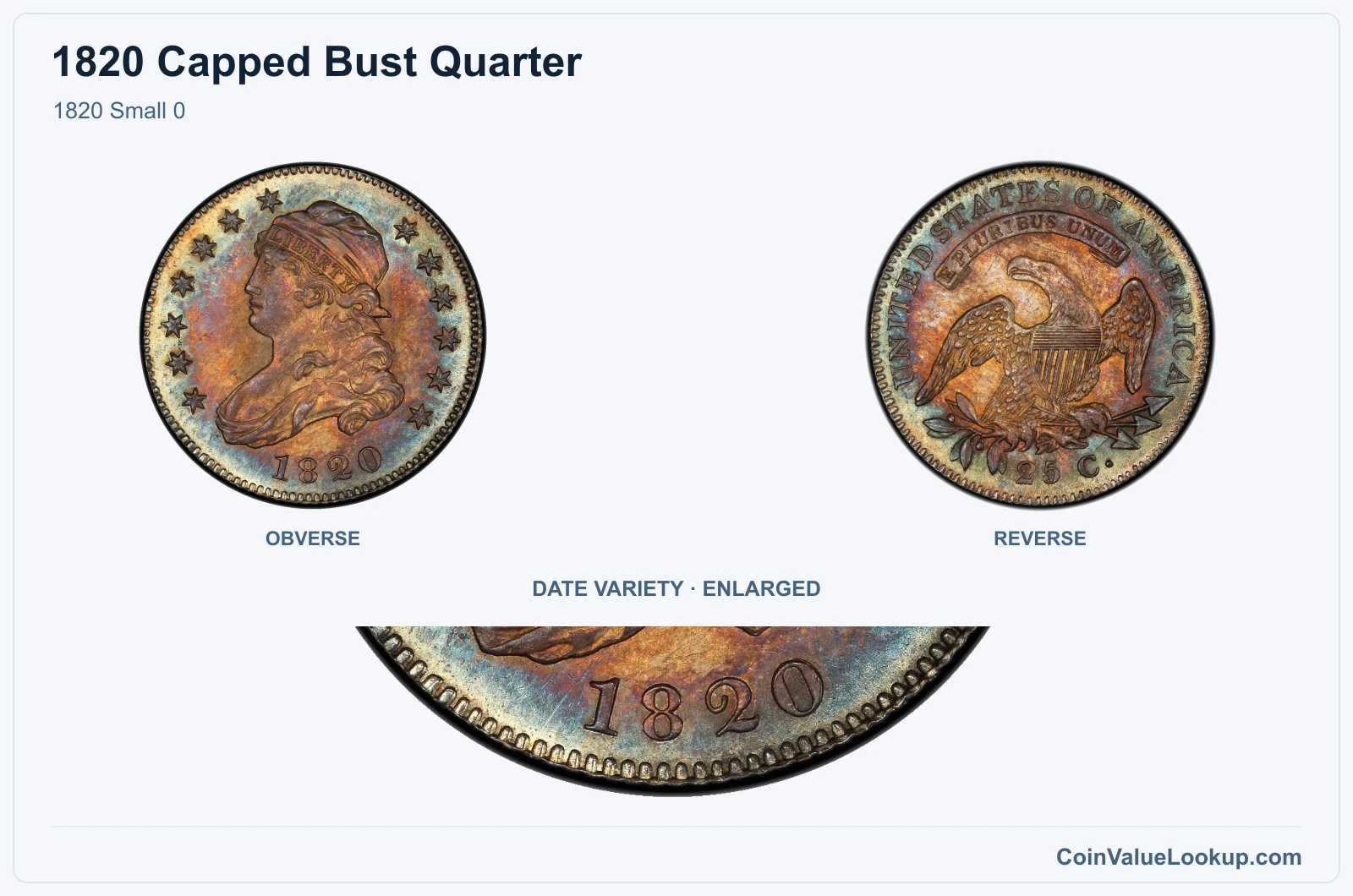
The Small 0 variety has the smallest zero in the 1820 date. To identify it, compare the height and width of the "0" against the "2" — on a Small 0, the zero is noticeably narrower and shorter relative to the other digits.
USA Coin Book guide estimates place this version at $164.00 in G4 (a heavily worn but identifiable grade), $5,630.00 in MS60 (uncirculated with visible bag marks), and $8,591.00 in MS63 (a choice uncirculated coin with good eye appeal). These are guide estimates, not guaranteed sale prices.
Original surfaces and the absence of cleaning matter a lot at every grade level.
Range Grade
Price Auction Records Appraisal PO PO 1
—
Coin Identifier FR FR 2
Coin Identifier AG AG 3
Coin Identifier G G 4
Coin Identifier
G 6
Coin Identifier VG VG 8
Coin Identifier
VG 10
Coin Identifier F F 12
Coin Identifier
F 15
Coin Identifier VF VF 20
Coin Identifier
VF 25
Coin Identifier
VF 30
Coin Identifier
VF 35
Coin Identifier XF XF 40
Coin Identifier
XF 45
Coin Identifier AU AU 50
—
Coin Identifier
AU 53
Coin Identifier
AU 55
Coin Identifier
AU 58
Coin Identifier MS MS 60
—
Coin Identifier
MS 61
—
Coin Identifier
MS 62
Coin Identifier
MS 63
—
Coin Identifier
MS 64
—
Coin Identifier
MS 65
—
Coin Identifier
MS 66
Coin Identifier
MS 67
—
—
—
MS 68
—
—
—
MS 69
—
—
—
MS 70
—
—
—
1820 Capped Bust Quarter — Medium 0
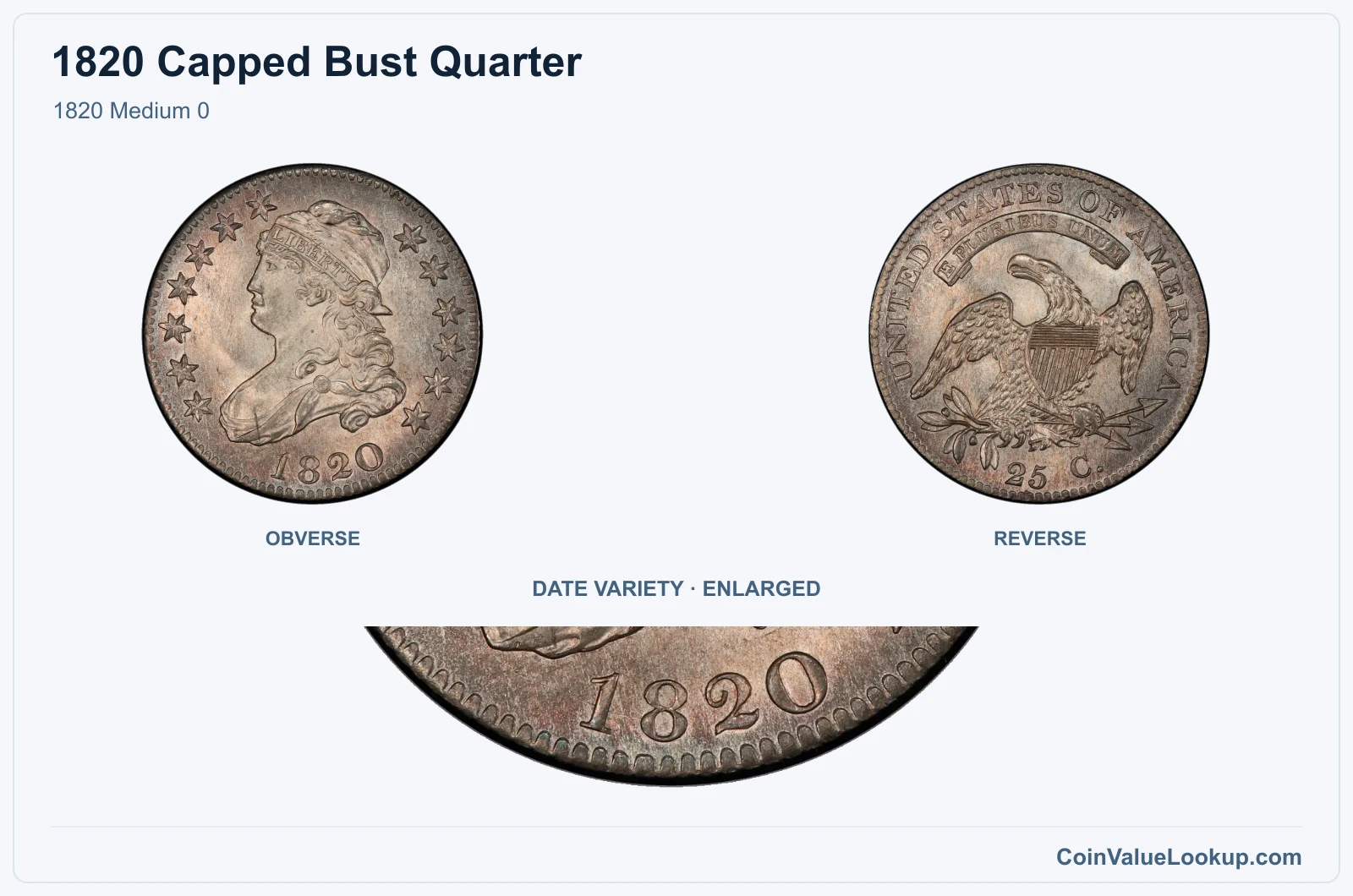
The Medium 0 sits between the Small and Large versions in overall zero size. Distinguishing it from the other two takes a careful side-by-side comparison under magnification, since the difference can be slight to the naked eye.
Guide estimates from USA Coin Book match the Small 0: $164.00 in G4, $5,630.00 in MS60, and $8,591.00 in MS63. Make sure you have correctly matched the variety before assuming a value — misidentifying the zero size is one of the most common mistakes with this date.
Cleaning or surface damage will pull the real-world price well below these guide figures.
Coin Value Lookup is a good starting point if you want to look up other Capped Bust quarter dates and compare what different years and varieties are worth.
Range Grade
Price Auction Records Appraisal PO PO 1
—
Coin Identifier FR FR 2
—
Coin Identifier AG AG 3
—
Coin Identifier G G 4
—
Coin Identifier
G 6
—
Coin Identifier VG VG 8
Coin Identifier
VG 10
Coin Identifier F F 12
Coin Identifier
F 15
Coin Identifier VF VF 20
—
Coin Identifier
VF 25
—
Coin Identifier
VF 30
Coin Identifier
VF 35
—
Coin Identifier XF XF 40
—
Coin Identifier
XF 45
—
Coin Identifier AU AU 50
—
Coin Identifier
AU 53
—
Coin Identifier
AU 55
—
Coin Identifier
AU 58
Coin Identifier MS MS 60
—
Coin Identifier
MS 61
—
Coin Identifier
MS 62
—
Coin Identifier
MS 63
Coin Identifier
MS 64
—
Coin Identifier
MS 65
—
Coin Identifier
MS 66
—
Coin Identifier
MS 67
—
—
—
MS 68
—
—
—
MS 69
—
—
—
MS 70
—
—
—
1820 Capped Bust Quarter — Large 0
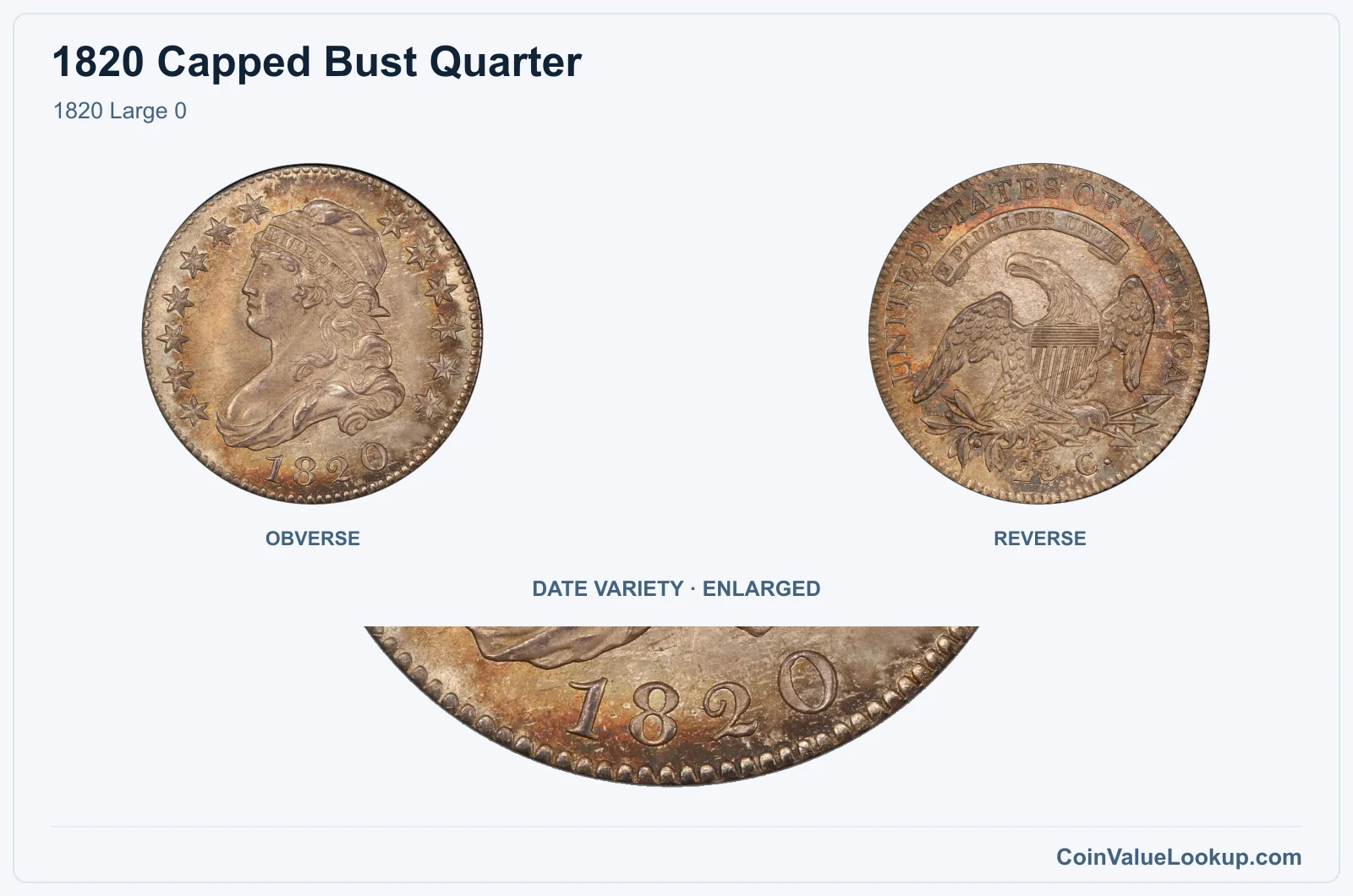
The Large 0 variety is the one that stands out most easily. The zero in the date is visibly taller and rounder than on the other two versions, often approaching or matching the height of the "8."
This version carries the highest guide estimates of the three business-strike varieties. USA Coin Book lists it at $164.00 in G4, $7,819.00 in MS60, and $12,162.00 in MS63.
The jump from MS60 to MS63 reflects how scarce truly choice examples are — surface quality and eye appeal separate the two grades.
As with any early quarter, confirm the variety first and check for original surfaces. A Large 0 that has been harshly cleaned will not command anywhere near those guide figures.
Range Grade
Price Auction Records Appraisal PO PO 1
—
Coin Identifier FR FR 2
—
Coin Identifier AG AG 3
Coin Identifier G G 4
—
Coin Identifier
G 6
Coin Identifier VG VG 8
Coin Identifier
VG 10
Coin Identifier F F 12
Coin Identifier
F 15
Coin Identifier VF VF 20
Coin Identifier
VF 25
Coin Identifier
VF 30
Coin Identifier
VF 35
Coin Identifier XF XF 40
Coin Identifier
XF 45
Coin Identifier AU AU 50
Coin Identifier
AU 53
Coin Identifier
AU 55
Coin Identifier
AU 58
Coin Identifier MS MS 60
—
Coin Identifier
MS 61
Coin Identifier
MS 62
—
Coin Identifier
MS 63
Coin Identifier
MS 64
Coin Identifier
MS 65
—
Coin Identifier
MS 66
Coin Identifier
MS 67
—
—
—
MS 68
—
—
—
MS 69
—
—
—
MS 70
—
—
—
1820 Capped Bust Quarter — PR
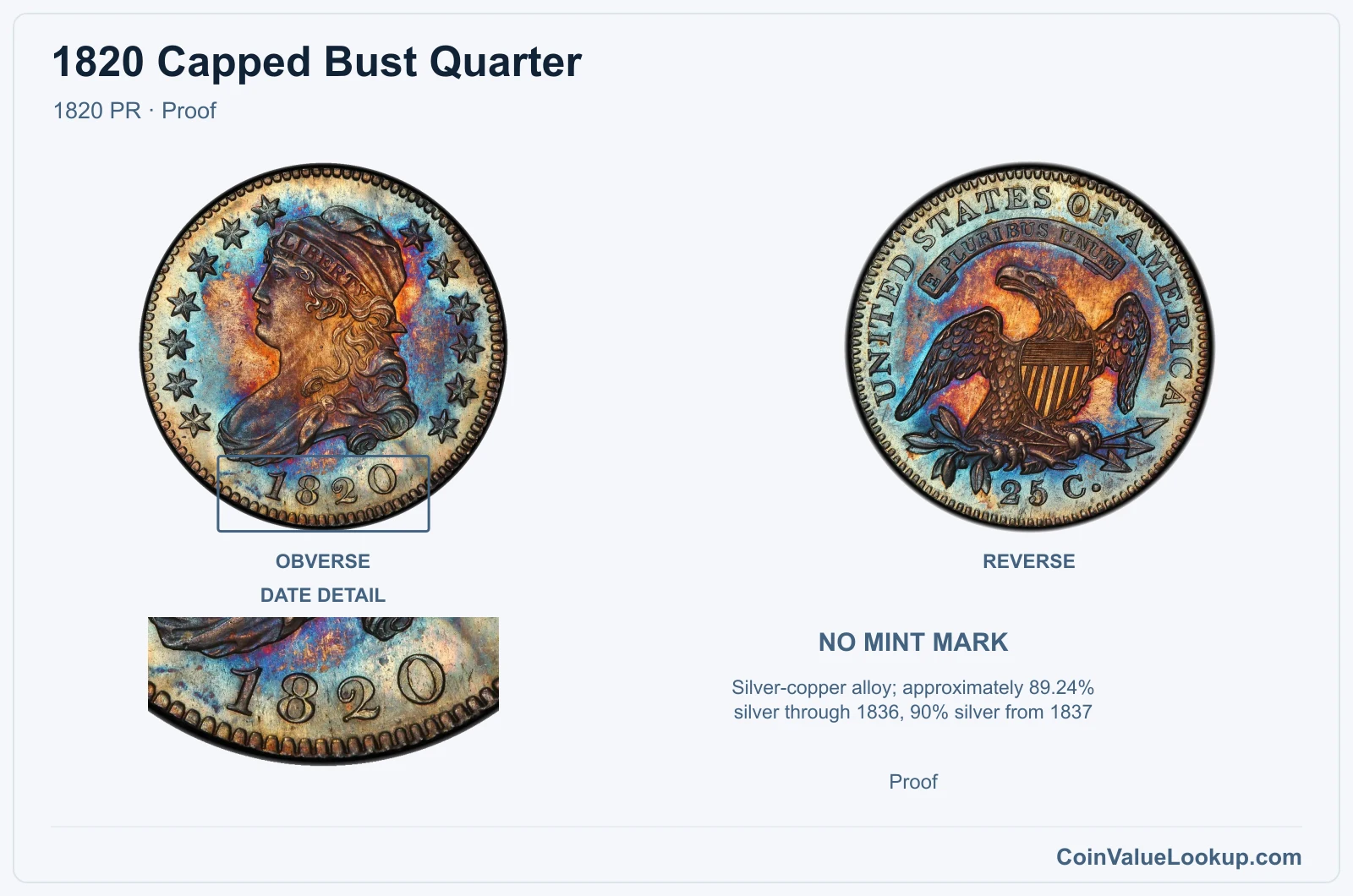
The 1820 Proof is an early Philadelphia Mint proof striking and is genuinely rare. Proof manufacture is a specific process — coins struck on polished planchets with specially prepared dies — not just a coin that happens to look shiny.
No supported price range has been adopted for this version. Any 1820 proof quarter would need individual assessment by a recognized authentication and grading service.
Surface haze, hairlines, and the degree of original mirror finish all affect collector value significantly.
Do not assume a bright, uncirculated business strike is a proof. The mirrored fields and sharp rims of a true proof are distinct from a lustrous regular issue.
Range Grade
Price Auction Records Appraisal PR PR 1
—
Coin Identifier
PR 2
—
Coin Identifier
PR 3
—
Coin Identifier
PR 4
—
Coin Identifier
PR 6
—
Coin Identifier
PR 8
—
Coin Identifier
PR 10
—
Coin Identifier
PR 12
—
Coin Identifier
PR 15
—
Coin Identifier
PR 20
—
Coin Identifier
PR 25
—
Coin Identifier
PR 30
—
Coin Identifier
PR 35
—
Coin Identifier
PR 40
—
Coin Identifier
PR 45
—
Coin Identifier
PR 50
—
Coin Identifier
PR 53
—
Coin Identifier
PR 55
—
Coin Identifier
PR 58
—
Coin Identifier
PR 60
—
Coin Identifier
PR 61
—
Coin Identifier
PR 62
—
Coin Identifier
PR 63
—
Coin Identifier
PR 64
Coin Identifier
PR 65
—
Coin Identifier
PR 66
Coin Identifier
PR 67
Coin Identifier
PR 68
—
—
—
PR 69
—
—
—
PR 70
—
—
—
1820 Capped Bust Quarter Error List
1. 1820 Capped Bust Quarter — Overdate
Overdates on the 1820 Capped Bust Quarter occur when a die originally engraved with a different date was re-entered with 1820 numerals. The earlier date's contours survive partially beneath the final digits, most visible under magnification around the tops and bases of the numbers.
Look for ghostly outlines of a different numeral sitting underneath one or more digits in the date. The remnants are raised, part of the die's design, and consistent across multiple coins struck from the same die.
Do not confuse an overdate with a damaged or corroded date. Post-strike scratches and hits will appear incuse (pressed into the surface), while an overdate shows raised traces that are part of the original strike.
Condition, the clarity of the underlying date, and overall eye appeal all influence what an overdate example is worth, though no specific price range has been adopted here.
2. 1820 Capped Bust Quarter — Repunched Date
A repunched date on the 1820 quarter happens when the date punch was applied to the die more than once in slightly different positions. The result is remnants of an earlier punch position visible beside or overlapping the final numerals — look for doubled serifs or offset outlines on individual digits.
This is different from machine doubling, which affects the entire design with flat, shelf-like distortion. A repunched date shows crisp, raised traces limited to the date area because only the date punch was re-entered.
Also distinguish it from simple damage. A hit or scratch across the date digits will be incuse and irregular, while a repunched date produces consistent, raised extra impressions.
The value of a repunched date depends on how dramatic and visible the repunching is, plus the coin's overall condition. No specific price range has been adopted for this variety.
3. 1820 Capped Bust Quarter — Misplaced Date
A misplaced date variety shows remnants of one or more date digits punched into an abnormal location on the die — often partially visible in the denticles, within a letter, or embedded in Liberty's bust. The normal date still appears in its correct position as well.
These traces are raised and consistent from coin to coin because they originate from the die itself, not from post-strike damage. Under magnification, you may see the curve of a numeral where no design element belongs.
Be careful not to confuse a misplaced date with a random scratch, die crack, or small dent. Scratches are incuse and irregular.
Die cracks follow stress lines in the metal. A misplaced date fragment will match the shape of a specific digit.
The value depends on the visibility of the misplaced element and the coin's preservation, though no adopted price range is available for this category.
4. 1820 Capped Bust Quarter — Die Crack / Die Chip
Die cracks on the 1820 Capped Bust Quarter have been reported on the obverse, running around the left side of the coin and connecting the left-side stars as well as the 1 and 8 in the date. These appear as thin, raised lines on the coin's surface — they are raised because the crack in the die allowed metal to flow into the gap during striking.
A die chip is a small raised blob where a piece of the die surface broke away. If a crack reaches the rim and a chunk of die metal falls out, the result is called a cud — a flat, featureless raised area at the rim.
Do not mistake incuse scratches, corrosion spots, or dirt for die cracks. Scratches cut into the surface rather than rising above it.
True die cracks are consistent across all coins struck from that damaged die. Value depends on the crack's prominence and the coin's overall condition; no specific price has been adopted for this variety.