1825 Capped Bust Quarter Coin Value: How Much Is It Worth?
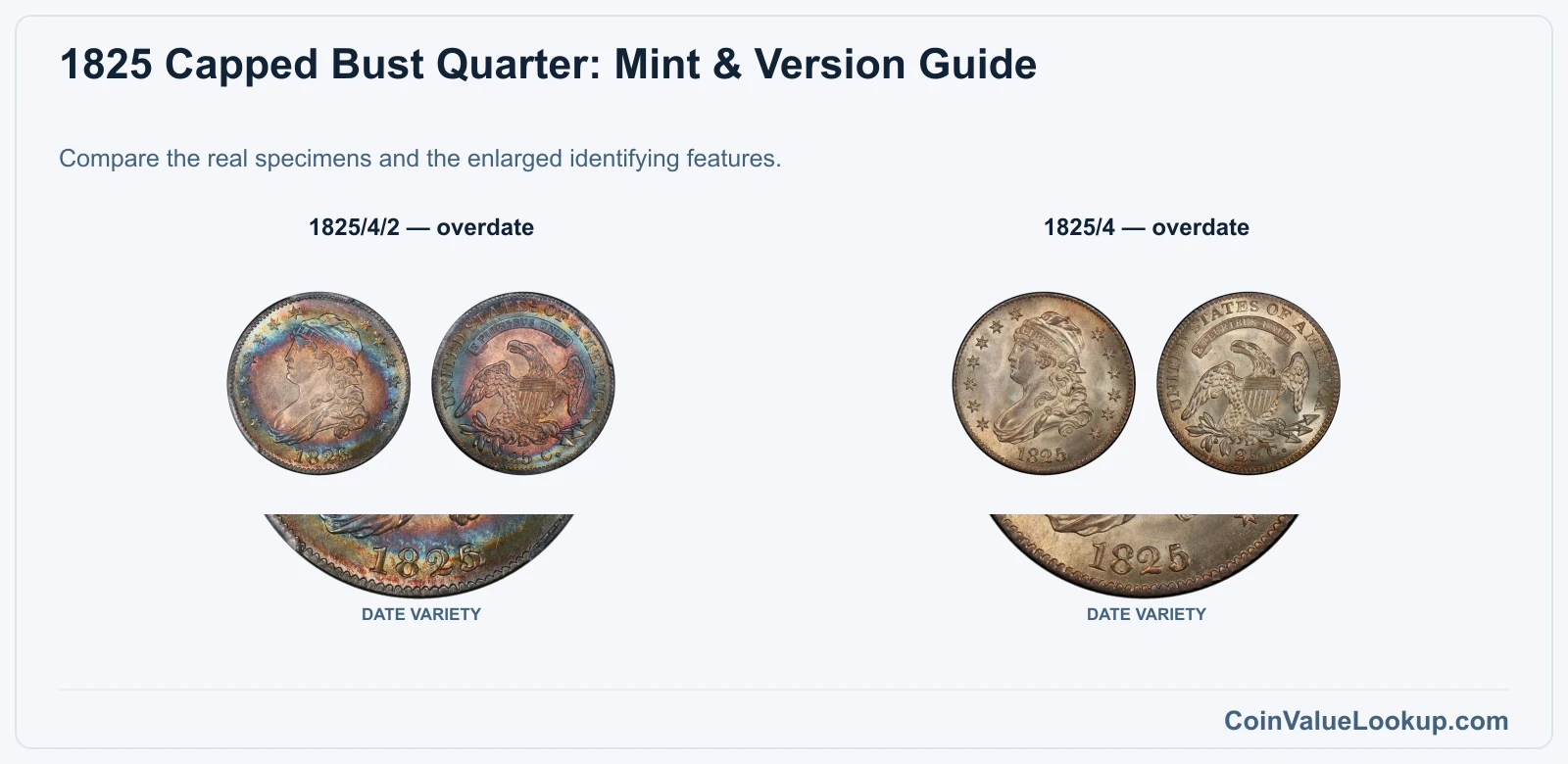
The 1825 Capped Bust Quarter is a scarce early American silver coin struck only at the Philadelphia Mint. Both recognized versions are overdates, making every surviving example a die variety worth examining closely.
USA Coin Book guide estimates range from $164.00 in Good-4 to $7,340.00 in MS63, depending on which overdate variety you have and its condition. Mint, surface quality and the specific overdate determine where your coin falls within that guide.
Fast Way to Identify Your 1825 Capped Bust Quarter
Snap clear photos of both sides of your quarter and upload them here for a preliminary identification. Good lighting at a slight angle helps reveal the overdate details hiding beneath the final digit.
This is not a substitute for professional certification, but it can point you toward which variety you may be holding and what to examine next.
1825 Capped Bust Quarter Value
Upload both sides of your 1825 Capped Bust Quarter.
Front Obverse
Upload photo
Back Reverse
Upload photo
Which 1825 Capped Bust Quarter Versions Are Worth Money?
- 1825/4/2 overdate — double overdate with traces of both a 2 and a 4 beneath the 5; guide estimates reach $7,340.00 at MS63.
- 1825/4 overdate — single overdate showing a 4 beneath the 5; guide estimates also reach $7,340.00 at MS63.
- Both versions start at $164.00 in Good-4 condition per the USA Coin Book guide; condition and original surfaces matter enormously.
- Check mint and finish first; damage, wear or a bright cleaned surface does not establish a rare version.
Step 1: Identify Your 1825 Capped Bust Quarter Mint Mark and Version
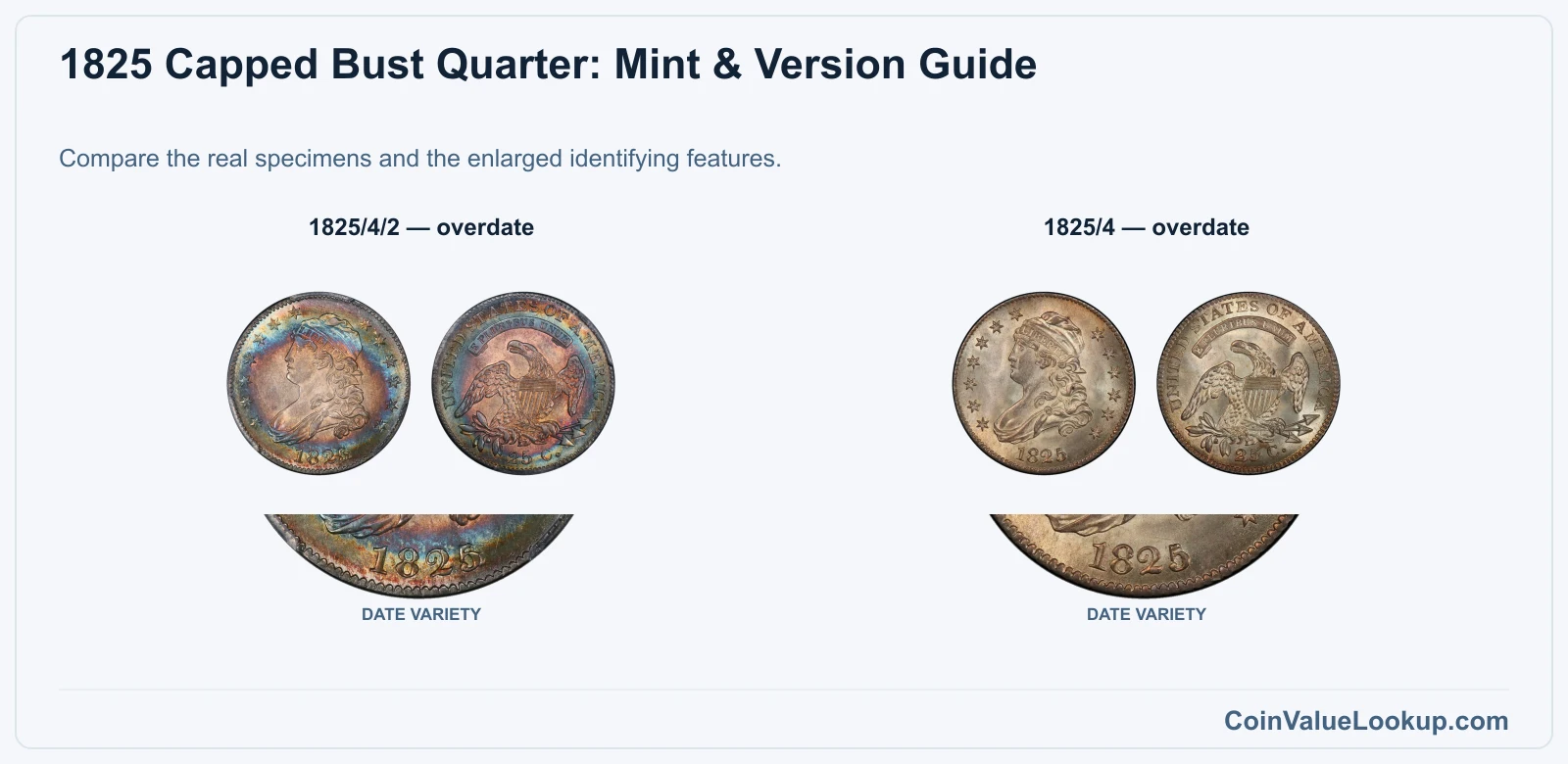
Every 1825 Capped Bust Quarter was struck in Philadelphia, so there is no mintmark to look for. The coin is composed of a silver-copper alloy, approximately 89.24% silver.
The obverse shows Liberty wearing a capped bonnet, facing left. The reverse features a large-diameter heraldic eagle with E PLURIBUS UNUM on a ribbon above, consistent with the pre-1828 design.
The key question for 1825 is which overdate you have. Both versions show remnants of earlier digits beneath the final "5" in the date.
On the 1825/4/2 variety, traces of both a "2" and a "4" survive under the "5," making it a double overdate. The 1825/4 variety shows a "4" beneath the "5" without the additional earlier digit.
Examine the date under magnification, focusing on the lower curves and serifs of the final numeral. Original, uncleaned surfaces make these remnants easier to spot.
A coin that has been harshly cleaned or damaged may still be identifiable, but its value drops significantly regardless of variety.
Step 2: Check Your 1825 Capped Bust Quarter Grade
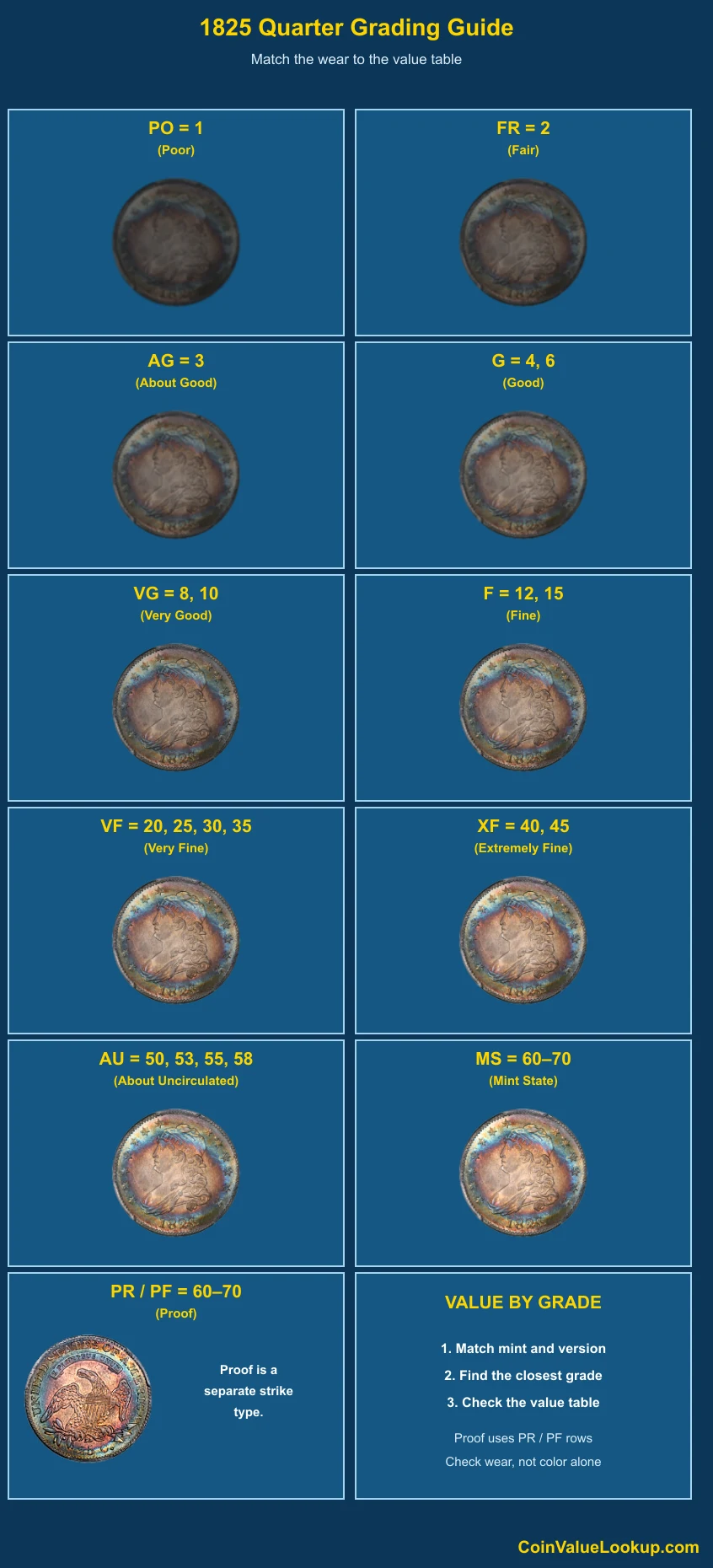
Start with Liberty's hair directly above the ear. On a well-preserved coin, individual curls remain sharp and separated.
As wear increases, these curls merge into a flat mass. The cap folds just above the forehead are the next checkpoint.
On the reverse, the eagle's breast feathers and the tops of the wings show wear first. A coin grading Good-4 will have a readable date and outline of the design, but most interior detail is gone.
Don't confuse a weak strike with heavy wear. Some 1825 quarters came off the press with soft detail in the hair or eagle feathers even though they were never circulated.
Luster is your friend here: a weakly struck but uncirculated coin still shows cartwheel reflectivity under a light, while a worn coin does not. Use the comparison image to match your coin's wear pattern against known grade benchmarks.
Coin Value Lookup is a good starting point if you want to look up other dates or denominations in this series. Bookmarking the guide for the Capped Bust Quarter type can save you time as you work through a group of coins.
Step 3: Check 1825 Capped Bust Quarter Value by Mint and Version
1825 Capped Bust Quarter — /4/2 — overdate
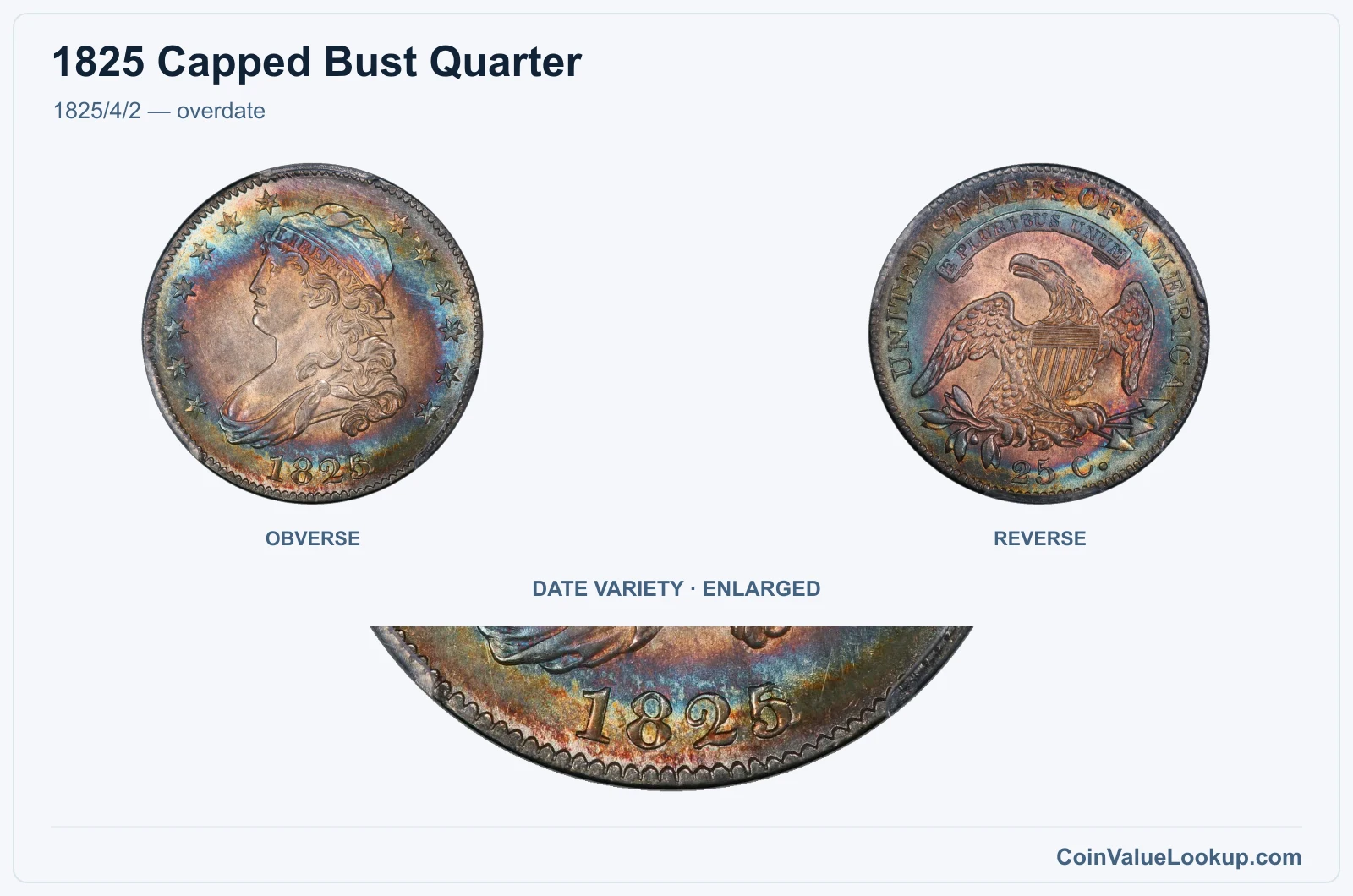
The 1825/4/2 is a double overdate. Look beneath the final "5" in the date for faint remnants of both a "2" and a "4" — evidence the Mint reused this die across multiple years.
Under magnification, the lower curve of the "2" often appears first, with the angular base of the "4" layered between it and the "5."
This is a Philadelphia business strike on a large-diameter planchet, composed of approximately 89.24% silver. USA Coin Book guide estimates place a Good-4 example at $164.00, an MS60 at $4,255.00, and an MS63 at $7,340.00.
These are guide estimates, not guaranteed offers. Original surfaces with natural toning make identification easier and support stronger values.
Cleaning or damage can sharply reduce what a buyer will pay, even if the overdate is clearly visible.
Range Grade
Price Auction Records Appraisal PO PO 1
—
Coin Identifier FR FR 2
Coin Identifier AG AG 3
Coin Identifier G G 4
Coin Identifier
G 6
—
Coin Identifier VG VG 8
—
Coin Identifier
VG 10
Coin Identifier F F 12
Coin Identifier
F 15
Coin Identifier VF VF 20
Coin Identifier
VF 25
Coin Identifier
VF 30
Coin Identifier
VF 35
—
Coin Identifier XF XF 40
Coin Identifier
XF 45
Coin Identifier AU AU 50
Coin Identifier
AU 53
Coin Identifier
AU 55
Coin Identifier
AU 58
Coin Identifier MS MS 60
—
—
—
MS 61
—
—
—
MS 62
—
—
—
MS 63
—
—
—
MS 64
Coin Identifier
MS 65
—
—
—
MS 66
—
—
—
MS 67
—
—
—
MS 68
—
—
—
MS 69
—
—
—
MS 70
—
—
—
1825 Capped Bust Quarter — /4 — overdate
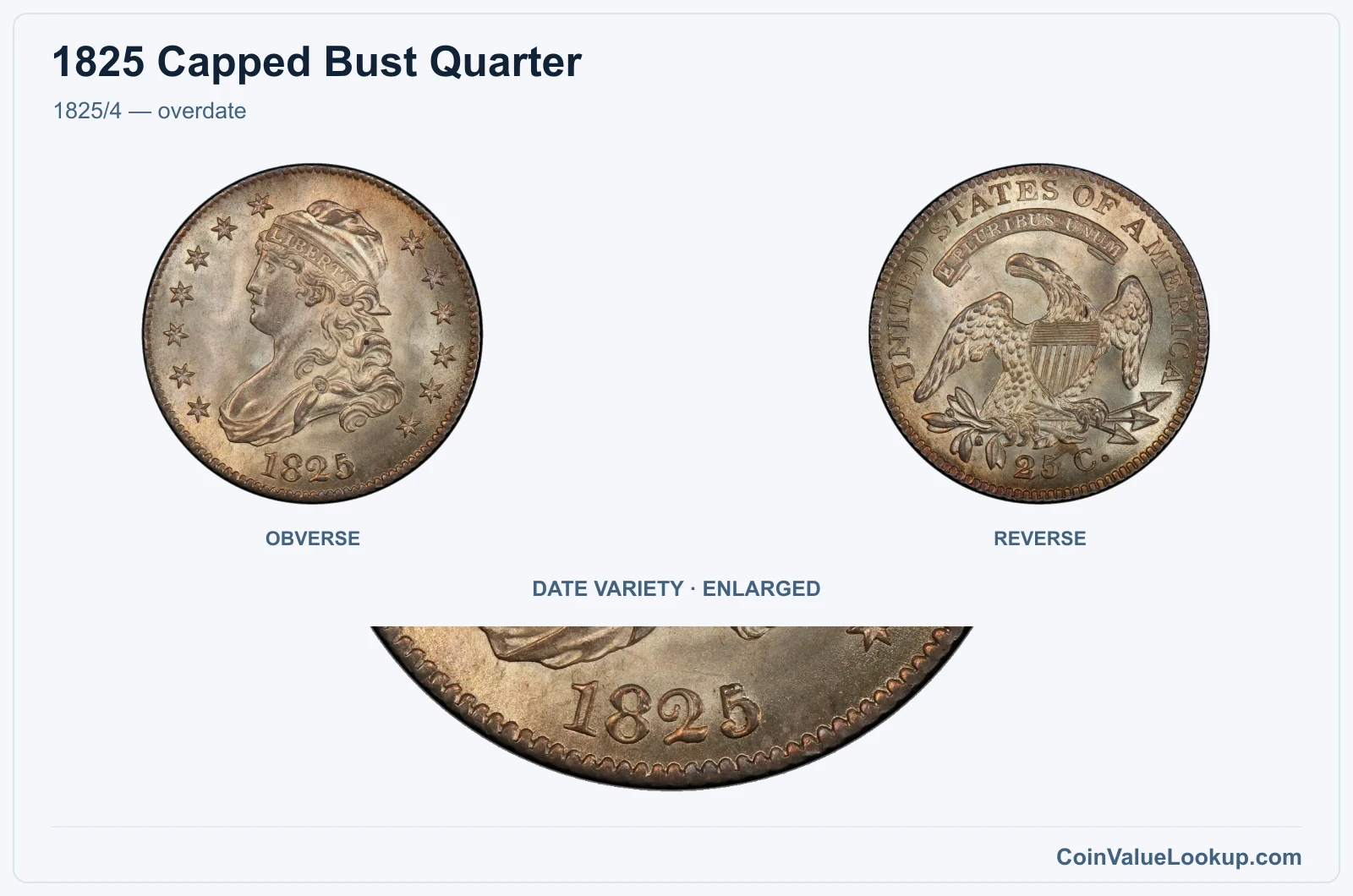
The 1825/4 is a single overdate. The "4" beneath the final "5" is the key diagnostic.
Without the additional traces of a "2," this variety is distinguished from the 1825/4/2 by what you do not see rather than what you do. Tilt the coin under a strong light and focus on the lower left portion of the "5" — the angular serif of the underlying "4" should be visible.
Also struck at Philadelphia in silver-copper alloy, approximately 89.24% silver. USA Coin Book guide estimates match those of the 1825/4/2: $164.00 in Good-4, $4,255.00 in MS60, and $7,340.00 in MS63.
Again, these are estimates, not guaranteed sale prices. Confirm which overdate you hold before comparing to any price reference, since mixing up the two varieties is easy without magnification.
Separate attributed varieties: The columns below show the specifically named varieties separately. Use only the column that matches the authenticated attribution of your coin.
Range Grade
Price1825/4/(2) Capped Bust Quarter — Browning 2 Price1825/4/(2) Capped Bust Quarter — Browning 3 Auction Records Appraisal PO PO 1
—
Coin Identifier FR FR 2
Coin Identifier AG AG 3
Coin Identifier G G 4
Coin Identifier
G 6
Coin Identifier VG VG 8
Coin Identifier
VG 10
Coin Identifier F F 12
Coin Identifier
F 15
Coin Identifier VF VF 20
Coin Identifier
VF 25
Coin Identifier
VF 30
Coin Identifier
VF 35
Coin Identifier XF XF 40
Coin Identifier
XF 45
Coin Identifier AU AU 50
Coin Identifier
AU 53
Coin Identifier
AU 55
Coin Identifier
AU 58
Coin Identifier MS MS 60
—
Coin Identifier
MS 61
Coin Identifier
MS 62
Coin Identifier
MS 63
Coin Identifier
MS 64
Coin Identifier
MS 65
Coin Identifier
MS 66
Coin Identifier
MS 67
—
Coin Identifier
MS 68
—
—
—
—
MS 69
—
—
—
—
MS 70
—
—
—
—
1825 Capped Bust Quarter Error List
1. 1825 Capped Bust Quarter — Overdate
The 1825 Capped Bust Quarter is itself an overdate issue, and this die variety has been cataloged by PCGS. The diagnostic is the survival of earlier date numerals beneath the final "5." On well-preserved examples, you can trace the outlines of the older digits — curves, serifs, and crossbars that do not belong to a "5" — sitting slightly offset under the top punch.
Do not confuse a damaged or corroded date with an overdate. Machine doubling can also create shelf-like secondary outlines, but those appear flat and mechanical rather than showing the distinct shapes of a different numeral.
A true overdate has recognizable anatomy of the underlying digit.
Condition, the clarity of the surviving underdigit, and overall surface preservation all affect what a collector will pay. No specific price range is adopted here, so individual assessment by a grading service is the safest route for establishing value.
2. 1825 Capped Bust Quarter — Clashed Dies
A lightly clashed die variety has been reported for the 1825 Capped Bust Quarter. Die clashing happens when the obverse and reverse dies strike each other without a planchet between them, transferring faint ghost impressions of the opposite design onto each die face.
On the obverse, look near Liberty's neck and bust for traces of the eagle's wing outlines. On the reverse, faint elements of the cap or hair curls may appear in the fields around the eagle.
These transferred impressions follow the expected alignment of the opposing die — that is how you separate a genuine clash from random scratches or raised lines. A brockage, which involves a struck coin acting as a die, leaves a much more dramatic and misaligned impression.
No specific price is adopted for this variety. Value depends on how visible the clash marks are, the coin's overall grade, and surface quality.
A clear, undamaged example with strong clash evidence will draw more collector interest than a worn one where the marks are ambiguous.