1839 Liberty Seated Quarter Coin Value: How Much Is It Worth?
The 1839 Liberty Seated Quarter is a first-year issue for this long-running series, and it commands respect even in well-worn condition. A USA Coin Book guide places the regular Philadelphia business strike around $70 in G4, climbing to roughly $5,228 at MS63.
Early proofs and named die varieties exist in separate specialist markets with very different pricing. Identifying your exact version and honest grade is the essential first step.
Fast Way to Identify Your 1839 Liberty Seated Quarter
Snap clear, well-lit photos of both the front and back of your 1839 quarter and upload them here. Our identifier can offer a preliminary read on your coin's design type, mint, and general condition from those images alone.
It is not a substitute for professional authentication or precise grading, but it gives you a solid starting point before you dig deeper.
1839 Liberty Seated Quarter Value
Upload both sides of your 1839 Liberty Seated Quarter.
Front Obverse
Upload photo
Back Reverse
Upload photo
Which 1839 Liberty Seated Quarter Versions Are Worth Money?
- Philadelphia business strikes in original, problem-free condition at higher grades carry strong guide values, reaching around $5,228 at MS63.
- Authenticated early Philadelphia proofs are extreme rarities; a PR65 example sold for $517,500 at auction in April 2008.
- The Very Long Claws reverse variety is visually distinct and actively sought by specialists — check those eagle talons carefully.
- Obverse and reverse die cracks on business strikes add collector interest, though no independent crack premium is established.
Step 1: Identify Your 1839 Liberty Seated Quarter Mint Mark and Version
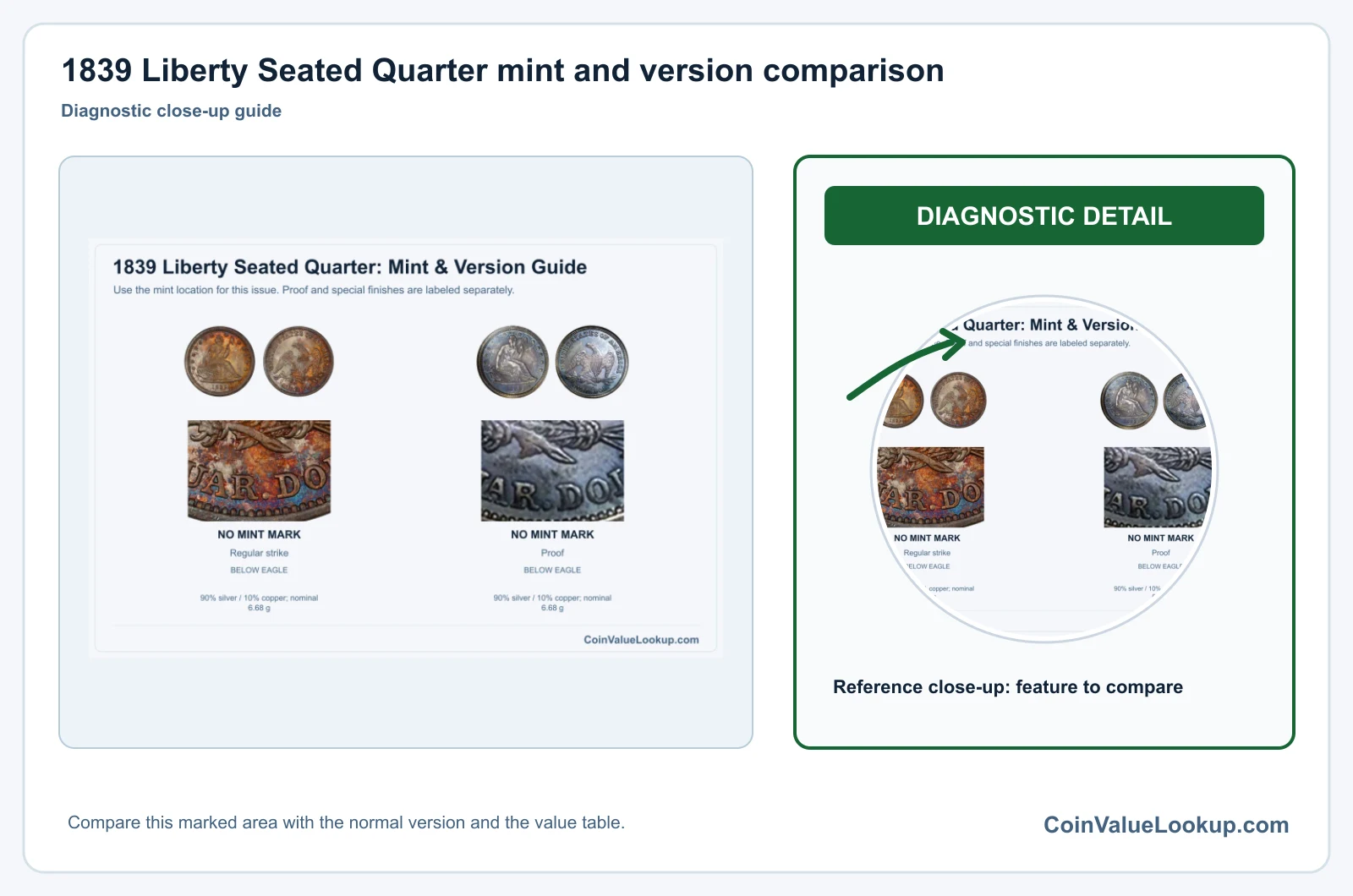
Every 1839 Seated quarter was struck in Philadelphia — there is no mintmark on this date. The obverse shows Liberty seated on a rock, holding a pole with a cap, with no drapery flowing from her elbow.
The reverse features a spread eagle with no motto above it.
Composition is 90% silver and 10% copper, with a nominal weight of 6.68 g and a diameter of about 24.3 mm. Worn coins may weigh slightly less due to metal loss.
A key sub-variety is the Very Long Claws reverse, where the eagle's talons are visibly elongated compared to the standard die. This version also shows a distinctive bead-like border on the obverse.
Weak detail on Liberty's head and legs can be a normal strike characteristic on these coins, so do not confuse softness for proof status or extreme wear.
Early proof 1839 quarters do exist, but they are extraordinarily rare specialist pieces. A reflective surface on a business strike is not proof attribution — that determination requires expert die-matching and provenance research.
Step 2: Check Your 1839 Liberty Seated Quarter Grade
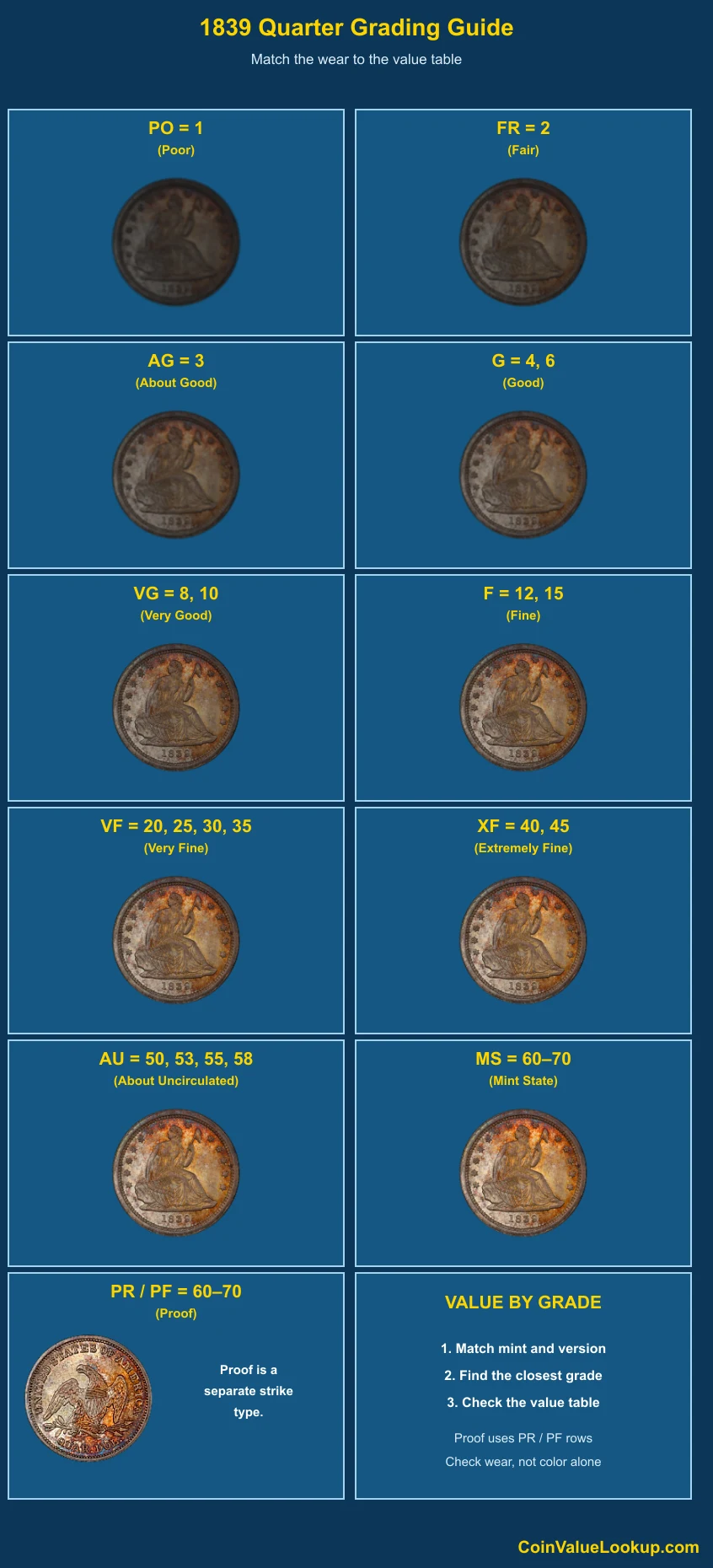
Start with Liberty's head on the obverse. In lower grades the hair detail above the forehead disappears first, followed by the breast and knee areas.
Check the shield — its horizontal and vertical lines wear at different rates, but shield lettering alone does not pin down a numerical grade.
Flip the coin over. The eagle's breast feathers, individual wing feathers, and claw details tell you how much life the reverse retains.
Separating a weak strike from genuine wear is the real trick on these. Look at luster: a weakly struck coin may still show original mint sheen in protected areas, while a worn coin loses that glow progressively.
The comparison image alongside your coin is your best friend here.
Hairlines from old cleanings, smoothed fields, holes, and green or dark environmental damage all reduce a coin's desirability and price. If you suspect you have a proof, you need expert die analysis and documented provenance — not just a shiny surface.
Step 3: Check 1839 Liberty Seated Quarter Value by Mint and Version
1839 Liberty Seated Quarter — Philadelphia Business Strike
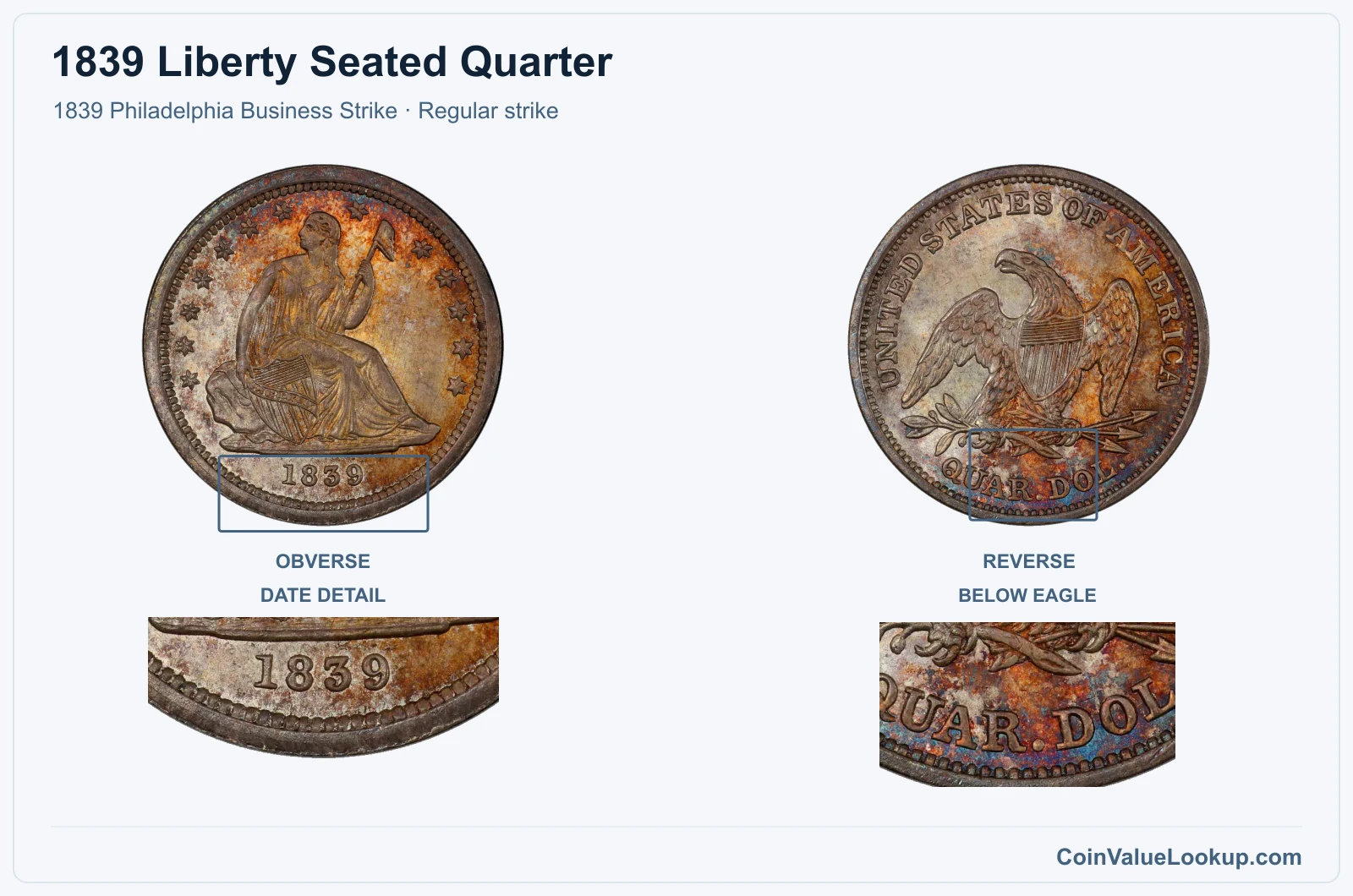
This is the standard 1839 Philadelphia business strike — no mintmark, No Drapery obverse, spread eagle reverse. It was struck in 90% silver at a nominal 6.68 g.
The USA Coin Book guide places it around $70 in G4, about $226 in VF20, and roughly $5,228 at MS63.
The No Drapery design means Liberty's elbow has no flowing cloth beneath it — later years added that detail. Some examples also show the Very Long Claws reverse die, which is a named sub-variety worth examining separately.
Weak detail on Liberty's head or legs can be inherent to the strike, not necessarily a sign of heavy wear.
Coin Value Lookup is a good place to start when you want to look up guide values for other dates and denominations in the Seated quarter series.
| Range | Grade | Price | Auction Records | Appraisal |
|---|---|---|---|---|
| PO | PO 1 | — | Coin Identifier | |
| FR | FR 2 | — | Coin Identifier | |
| AG | AG 3 | — | Coin Identifier | |
| G | G 4 | — | Coin Identifier | |
| G 6 | — | Coin Identifier | ||
| VG | VG 8 | — | Coin Identifier | |
| VG 10 | — | Coin Identifier | ||
| F | F 12 | — | Coin Identifier | |
| F 15 | Coin Identifier | |||
| VF | VF 20 | Coin Identifier | ||
| VF 25 | Coin Identifier | |||
| VF 30 | Coin Identifier | |||
| VF 35 | Coin Identifier | |||
| XF | XF 40 | Coin Identifier | ||
| XF 45 | Coin Identifier | |||
| AU | AU 50 | Coin Identifier | ||
| AU 53 | Coin Identifier | |||
| AU 55 | Coin Identifier | |||
| AU 58 | Coin Identifier | |||
| MS | MS 60 | — | Coin Identifier | |
| MS 61 | Coin Identifier | |||
| MS 62 | Coin Identifier | |||
| MS 63 | Coin Identifier | |||
| MS 64 | Coin Identifier | |||
| MS 65 | Coin Identifier | |||
| MS 66 | Coin Identifier | |||
| MS 67 | — | — | — | |
| MS 68 | — | — | — | |
| MS 69 | — | — | — | |
| MS 70 | — | — | — |
1839 Liberty Seated Quarter — Proof Philadelphia
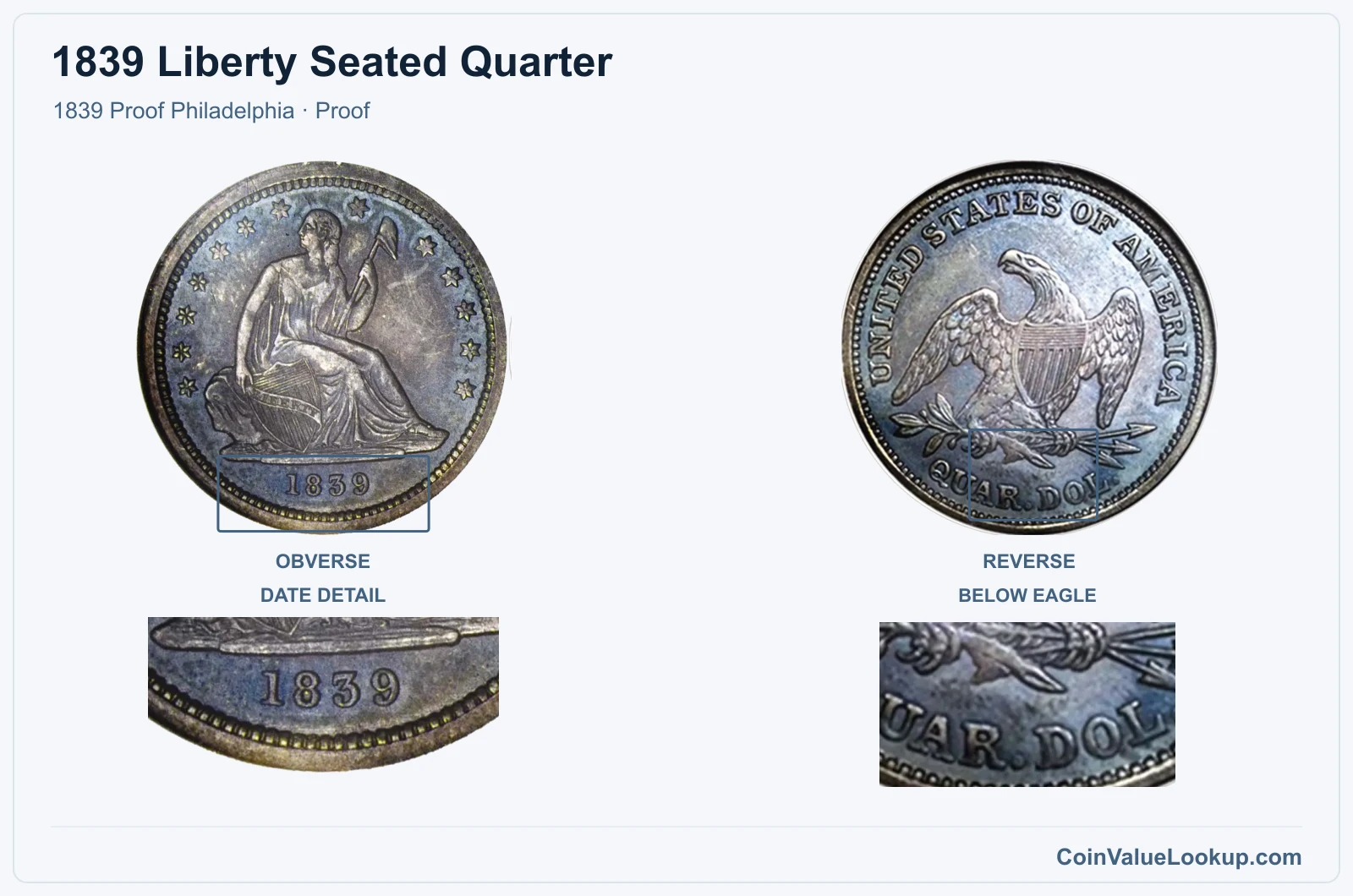
Early Philadelphia proofs of 1839 are among the rarest coins in the entire Seated quarter series. These were not struck for general sale the way later proofs were — attribution requires careful die analysis and solid provenance, not just a reflective surface.
The most prominent recorded sale is a PCGS PR65 example that brought $517,500 at auction in April 2008. That is a single historical result for one exceptional coin, not a current quote or a price you should expect for a random shiny 1839 quarter.
If you genuinely believe you have one, professional authentication is essential before drawing any value conclusions.
Like the business strikes, the proof uses the No Drapery obverse and the spread eagle reverse, struck in 90% silver at a nominal 6.68 g.
| Range | Grade | Price | Auction Records | Appraisal |
|---|---|---|---|---|
| PR | PR 1 | — | Coin Identifier | |
| PR 2 | — | Coin Identifier | ||
| PR 3 | — | Coin Identifier | ||
| PR 4 | — | Coin Identifier | ||
| PR 6 | — | Coin Identifier | ||
| PR 8 | — | Coin Identifier | ||
| PR 10 | — | Coin Identifier | ||
| PR 12 | — | Coin Identifier | ||
| PR 15 | — | Coin Identifier | ||
| PR 20 | — | Coin Identifier | ||
| PR 25 | — | Coin Identifier | ||
| PR 30 | — | Coin Identifier | ||
| PR 35 | — | Coin Identifier | ||
| PR 40 | — | Coin Identifier | ||
| PR 45 | — | Coin Identifier | ||
| PR 50 | — | Coin Identifier | ||
| PR 53 | — | Coin Identifier | ||
| PR 55 | — | Coin Identifier | ||
| PR 58 | — | Coin Identifier | ||
| PR 60 | — | Coin Identifier | ||
| PR 61 | — | Coin Identifier | ||
| PR 62 | — | Coin Identifier | ||
| PR 63 | — | Coin Identifier | ||
| PR 64 | — | Coin Identifier | ||
| PR 65 | Coin Identifier | |||
| PR 66 | — | — | — | |
| PR 67 | — | — | — | |
| PR 68 | — | — | — | |
| PR 69 | — | — | — | |
| PR 70 | — | — | — |
1839 Liberty Seated Quarter — Very Long Claws
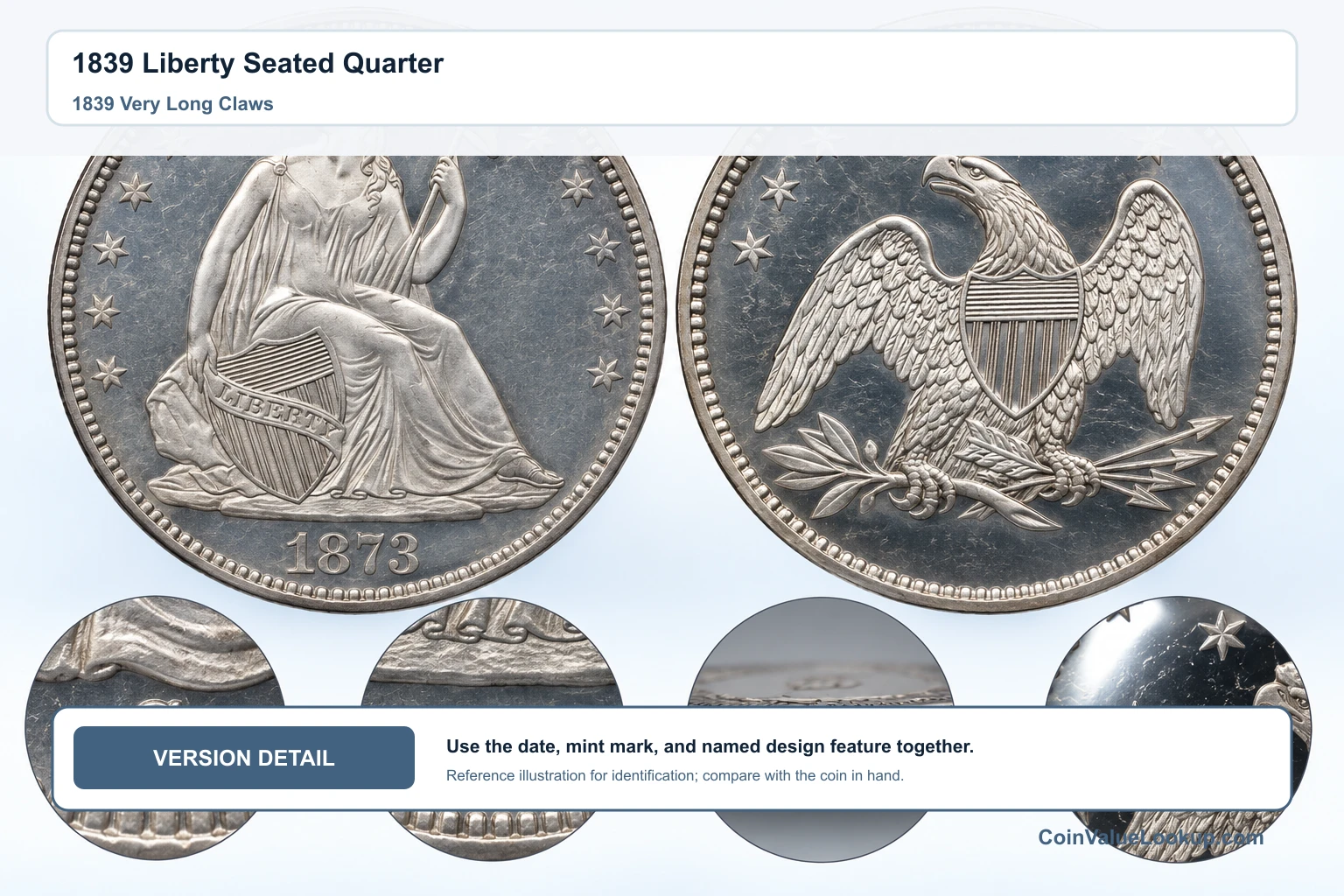
The Very Long Claws variety is identified by examining the eagle's talons on the reverse. They are noticeably elongated compared to the standard die — once you see a confirmed example side by side with a normal one, the difference is hard to miss.
The obverse also features a distinctive bead-like border along the rim.
Weak detail on Liberty's head and legs can be normal strike softness on this particular die pair, so do not jump to conclusions about grade based on those areas alone.
No numeric price range is adopted for this variety. Value depends on authenticated identity and the coin's individual condition, so a professional assessment of your specific piece is the way to go.
The variety is recognized by Seated quarter specialists and carries collector interest beyond a standard 1839 strike.
Range Grade
Price Auction Records Appraisal PO PO 1
—
Coin Identifier FR FR 2
—
Coin Identifier AG AG 3
—
Coin Identifier G G 4
—
Coin Identifier
G 6
—
Coin Identifier VG VG 8
—
Coin Identifier
VG 10
—
Coin Identifier F F 12
—
Coin Identifier
F 15
Coin Identifier VF VF 20
Coin Identifier
VF 25
Coin Identifier
VF 30
Coin Identifier
VF 35
Coin Identifier XF XF 40
Coin Identifier
XF 45
Coin Identifier AU AU 50
Coin Identifier
AU 53
Coin Identifier
AU 55
Coin Identifier
AU 58
Coin Identifier MS MS 60
—
Coin Identifier
MS 61
Coin Identifier
MS 62
Coin Identifier
MS 63
Coin Identifier
MS 64
Coin Identifier
MS 65
Coin Identifier
MS 66
Coin Identifier
MS 67
—
—
—
MS 68
—
—
—
MS 69
—
—
—
MS 70
—
—
—
1839 Liberty Seated Quarter Error List
1. 1839 Liberty Seated Quarter — Obverse and Reverse Die Cracks
Some 1839 No Drapery business strikes show raised die cracks on both sides. On the obverse, look for a crack running from the lower rim upward toward the left side of the rock Liberty sits on.
The reverse crack is more dramatic — it passes through the T in UNITED, then continues across the left-facing wing and into the shield area.
These cracks are raised lines caused by the die itself fracturing during use. Do not confuse them with incuse scratches, which are cut into the surface rather than standing above it.
The cited PCGS MS64 specimen also has a holder scratch near the letters ES and O on the reverse — that kind of mark is unrelated to the die crack.
A PCGS MS64 coin showing both cracks sold for $8,625 in April 2012 at Heritage Auctions, but that price reflects the full coin's grade and eye appeal. No independent premium for the die cracks alone has been established, so treat the crack as an interesting diagnostic feature rather than an automatic price multiplier.