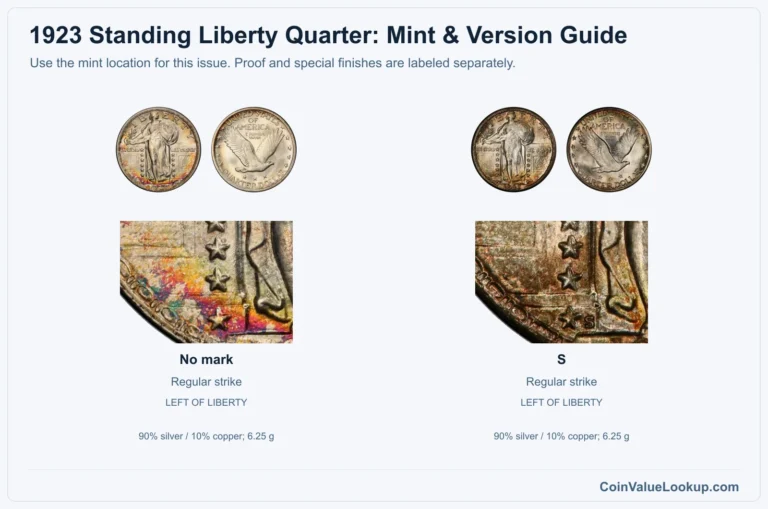
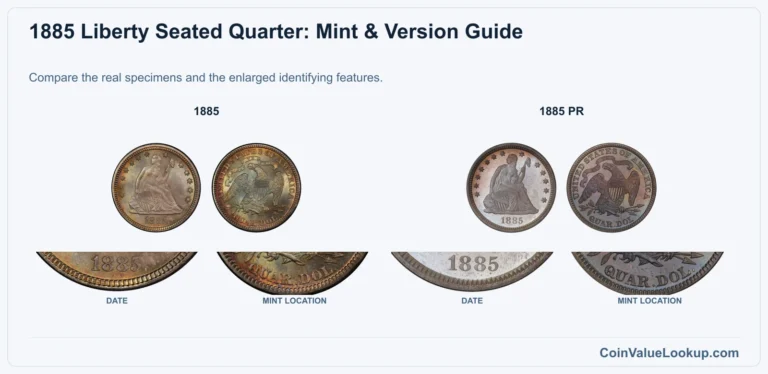
1919 Standing Liberty Quarter Coin Value: How Much Is It Worth?
The 1919 Standing Liberty quarter is a 90% silver coin that attracts steady collector interest across three mint versions. Guide estimates from USA Coin Book range from $39.00 to $3,094.00 depending on mint, condition and strike quality — not every coin falls in that window.
Where your quarter lands depends on its specific mintmark, surface preservation and whether it earned a Full Head designation.
Fast Way to Identify Your 1919 Standing Liberty Quarter
The fastest way to start figuring out what your 1919 quarter is worth is to upload clear photos of the front and back. Our identifier can give you a preliminary read on the mint version and general condition.
Grab a well-lit shot of each side — that alone narrows the field considerably.
1919 Standing Liberty Quarter Value
Upload both sides of your 1919 Standing Liberty Quarter.
Front Obverse
Upload photo
Back Reverse
Upload photo
Which 1919 Standing Liberty Quarter Versions Are Worth Money?
- 1919-S quarter: USA Coin Book guide estimates reach $3,094.00 at MS63 — the highest anchor among all three mints this year, driven by lower survival rates in upper grades.
- 1919-D quarter: guide estimates reach $2,506.00 at MS63; the Denver issue commands strong premiums above circulated grades.
- 1919 Philadelphia quarter: more available than its branch-mint siblings, but still lists at $321.00 in MS63 per the guide.
- Check the mintmark first. Damage, cleaning or heavy wear does not make a coin rare — original surfaces and accurate identification do.
Step 1: Identify Your 1919 Standing Liberty Quarter Mint Mark and Version
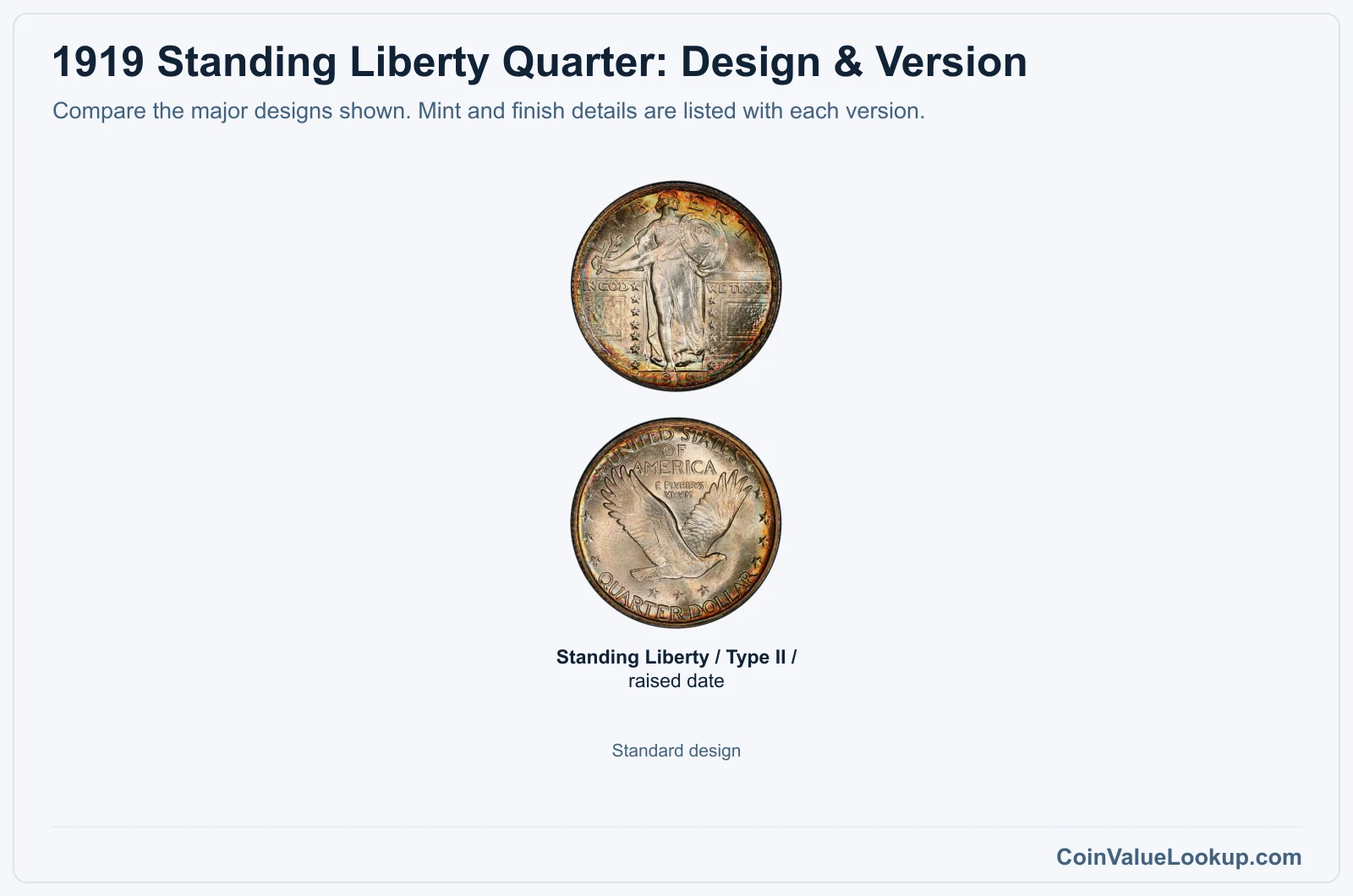
All three 1919 Standing Liberty quarters use the Type II design: Liberty wears protective chain mail on her chest and three stars appear below the eagle on the reverse. If your coin shows an exposed breast and no stars beneath the eagle, that is a Type I design from an earlier year, not 1919.
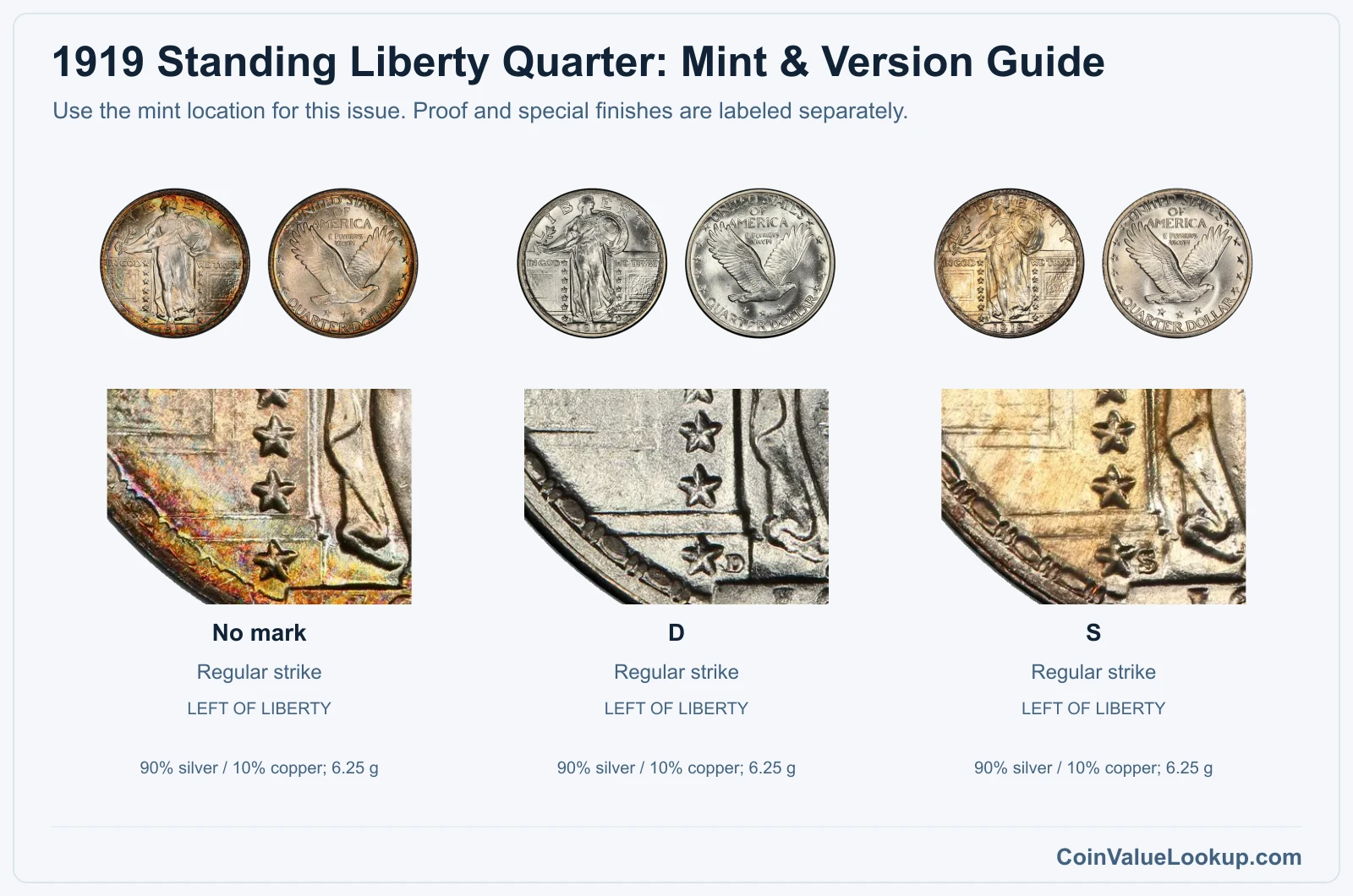
To find the mintmark, look at the obverse near the left base of the wall where Liberty stands. A "D" means Denver, an "S" means San Francisco, and no letter at all means Philadelphia.
The mark can be small and worn, so good lighting matters.
The 1919 date is raised, which means it wears down over time. Later issues starting in 1925 have a recessed date that holds up better.
Every version weighs 6.25 grams and is struck in 90% silver with 10% copper.
Step 2: Check Your 1919 Standing Liberty Quarter Grade
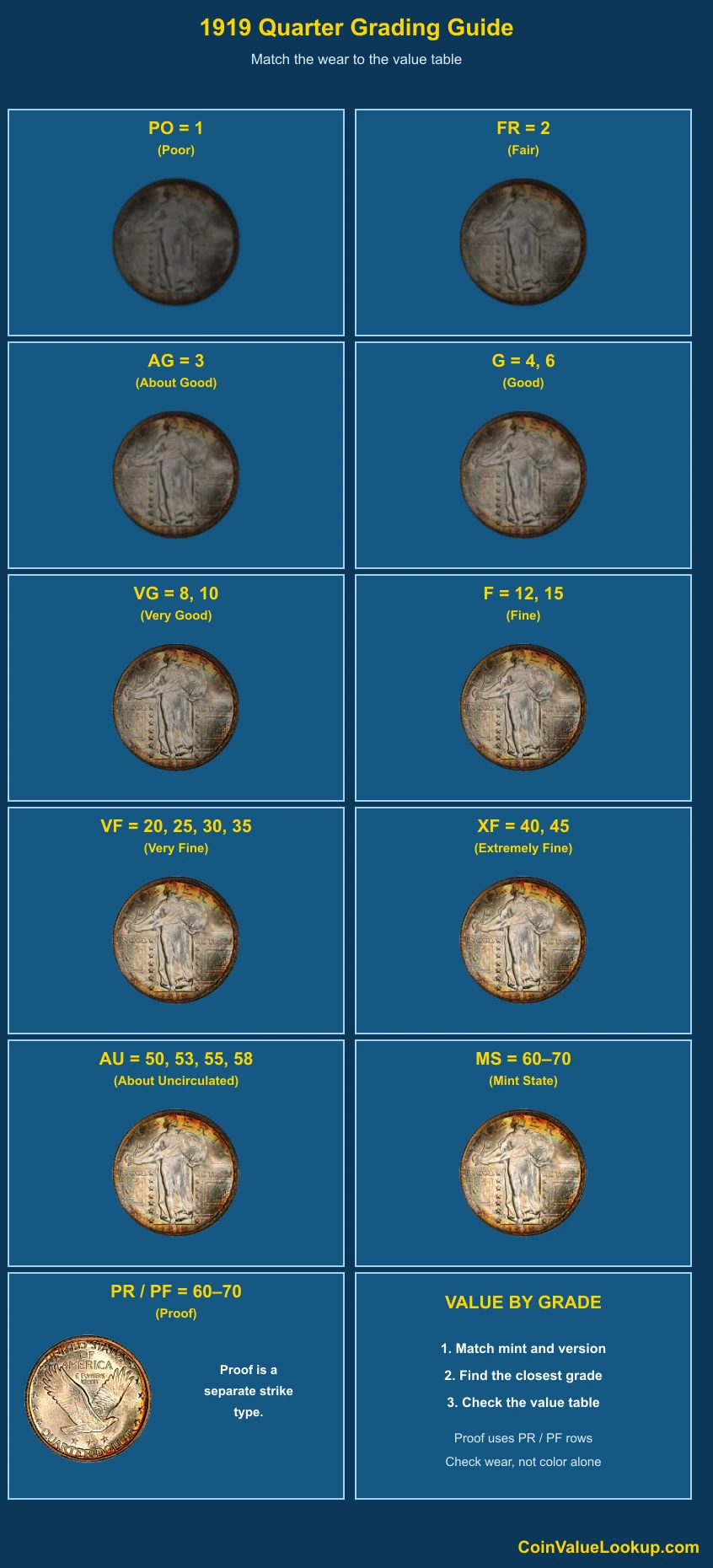
Focus on four areas of Liberty: the head, breast, shield and knee. On the reverse, check the eagle's breast feathers and wing tips.
These are the first spots to lose detail as the coin circulates.
A coin grading Good (G4) will show a flat outline of Liberty with little interior detail. At Mint State (MS60), you should see full luster with no wear, though contact marks and a weak strike are still possible.
Full Head is a strike-quality designation, not a grade. It means the three leaves in Liberty's hair are fully separated and distinct.
A coin can be technically uncirculated yet lack a Full Head because the dies did not strike it sharply enough. Do not confuse brightness or cleaning with strike completeness.
Compare your coin's wear pattern against the reference image. Look at both surfaces together — luster should be consistent across the coin.
A cleaned coin often shows a bright, unnaturally uniform sheen that experienced graders spot immediately.
Step 3: Check 1919 Standing Liberty Quarter Value by Mint and Version
1919 Standing Liberty Quarter
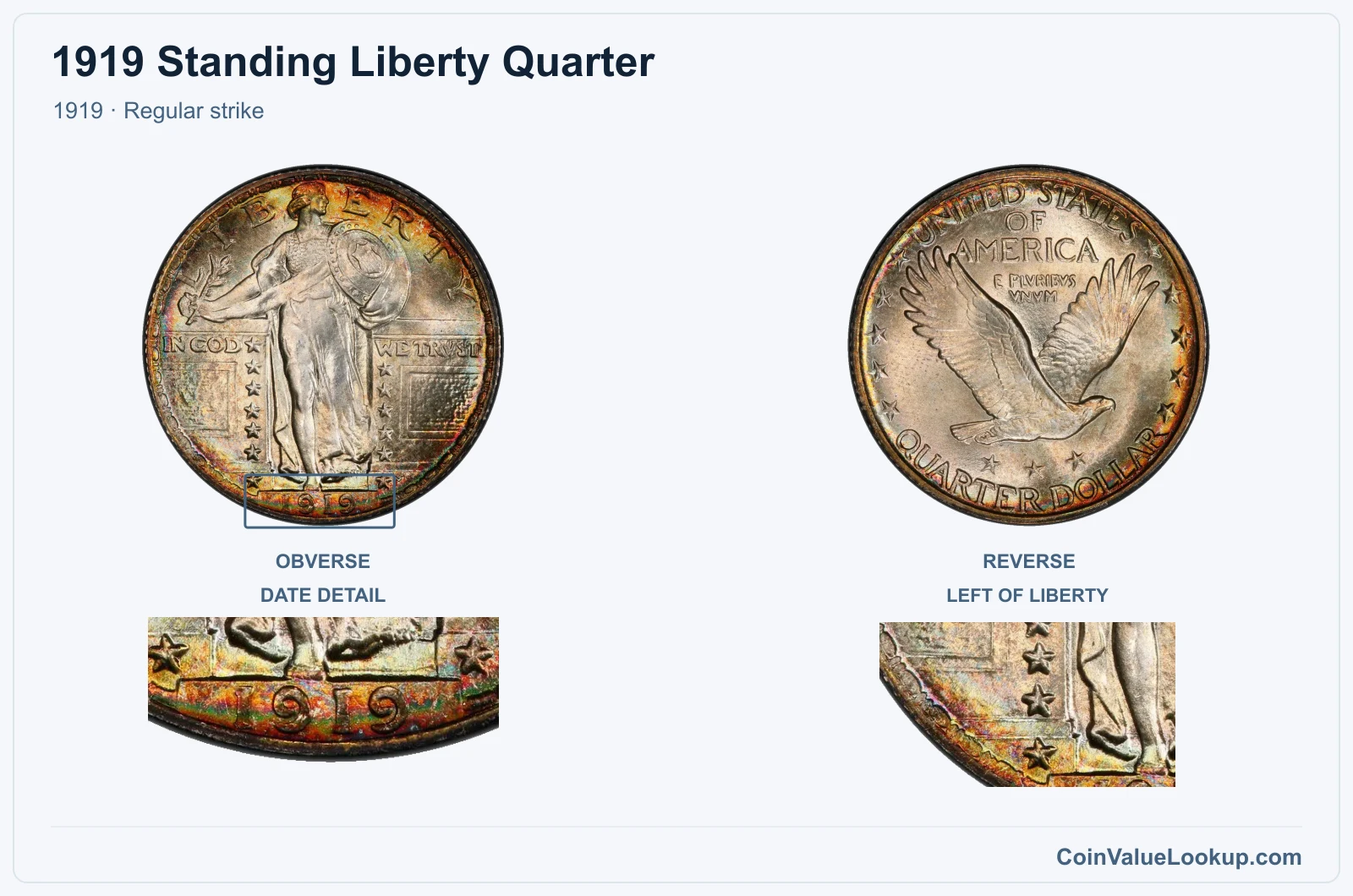
The 1919 Philadelphia quarter has no mintmark. It is the most commonly encountered version this year but still carries real value in better condition.
USA Coin Book guide estimates place it at $39.00 in G4, $194.00 in MS60 and $321.00 in MS63. These are guide estimates, not guaranteed offers.
Before comparing prices, confirm the Type II design — chain mail on Liberty's chest, three stars below the eagle. Original surfaces matter here.
A coin that has been cleaned or damaged will not command these guide figures even if it otherwise looks sharp. Strike quality varies; a weak strike can leave Liberty's head details soft even on an unworn example.
Range Grade
Price Auction Records Appraisal PO PO 1
—
Coin Identifier FR FR 2
—
Coin Identifier AG AG 3
—
Coin Identifier G G 4
—
Coin Identifier
G 6
—
Coin Identifier VG VG 8
—
Coin Identifier
VG 10
—
Coin Identifier F F 12
—
Coin Identifier
F 15
Coin Identifier VF VF 20
—
Coin Identifier
VF 25
Coin Identifier
VF 30
Coin Identifier
VF 35
Coin Identifier XF XF 40
Coin Identifier
XF 45
Coin Identifier AU AU 50
Coin Identifier
AU 53
Coin Identifier
AU 55
Coin Identifier
AU 58
Coin Identifier MS MS 60
—
Coin Identifier
MS 61
Coin Identifier
MS 62
Coin Identifier
MS 63
Coin Identifier
MS 64
Coin Identifier
MS 65
Coin Identifier
MS 66
Coin Identifier
MS 67
Coin Identifier
MS 68
Coin Identifier
MS 69
—
—
—
MS 70
—
—
—
1919 Standing Liberty Quarter — D
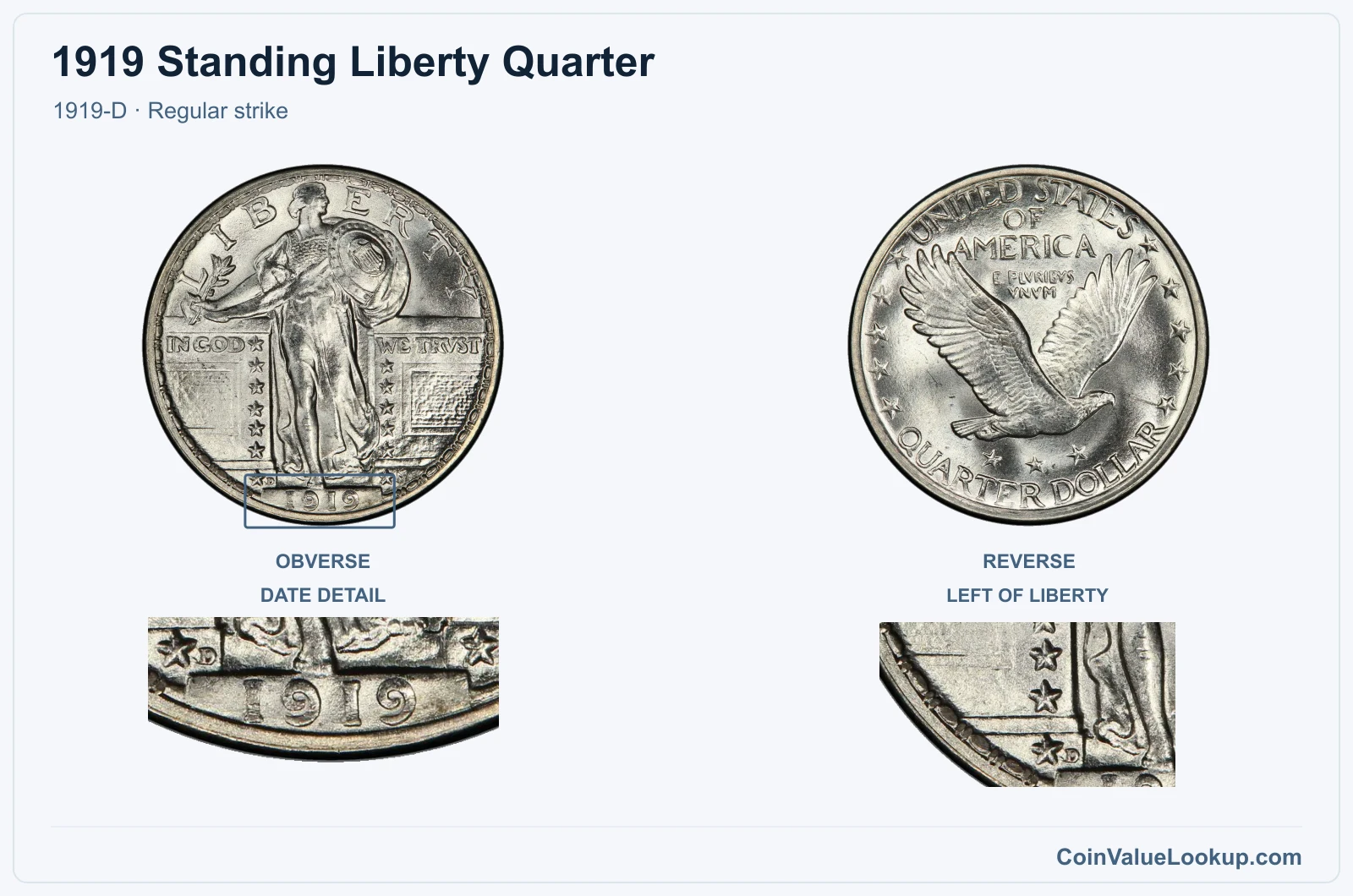
The 1919-D carries a small "D" mintmark near the left base of the wall on the obverse. Denver quarters from this year are scarce in higher grades, and the guide reflects that jump.
USA Coin Book lists $100.00 at G4, $1,531.00 at MS60 and $2,506.00 at MS63.
That leap from G4 to MS60 is dramatic — the difference between a well-worn pocket coin and one that never circulated. Cleaning or environmental damage will pull the value back toward the lower end regardless of remaining detail.
If your D-mint coin still shows full, original luster and a sharp strike, it is worth having professionally evaluated.
Coin Value Lookup is a good starting point if you want to look up guides for other dates and denominations in the Standing Liberty series.
Range Grade
Price Auction Records Appraisal PO PO 1
—
Coin Identifier FR FR 2
—
Coin Identifier AG AG 3
—
Coin Identifier G G 4
—
Coin Identifier
G 6
Coin Identifier VG VG 8
Coin Identifier
VG 10
Coin Identifier F F 12
Coin Identifier
F 15
Coin Identifier VF VF 20
Coin Identifier
VF 25
Coin Identifier
VF 30
Coin Identifier
VF 35
Coin Identifier XF XF 40
Coin Identifier
XF 45
Coin Identifier AU AU 50
Coin Identifier
AU 53
Coin Identifier
AU 55
Coin Identifier
AU 58
Coin Identifier MS MS 60
Coin Identifier
MS 61
Coin Identifier
MS 62
Coin Identifier
MS 63
Coin Identifier
MS 64
Coin Identifier
MS 65
Coin Identifier
MS 66
Coin Identifier
MS 67
Coin Identifier
MS 68
—
—
—
MS 69
—
—
—
MS 70
—
—
—
1919 Standing Liberty Quarter — S
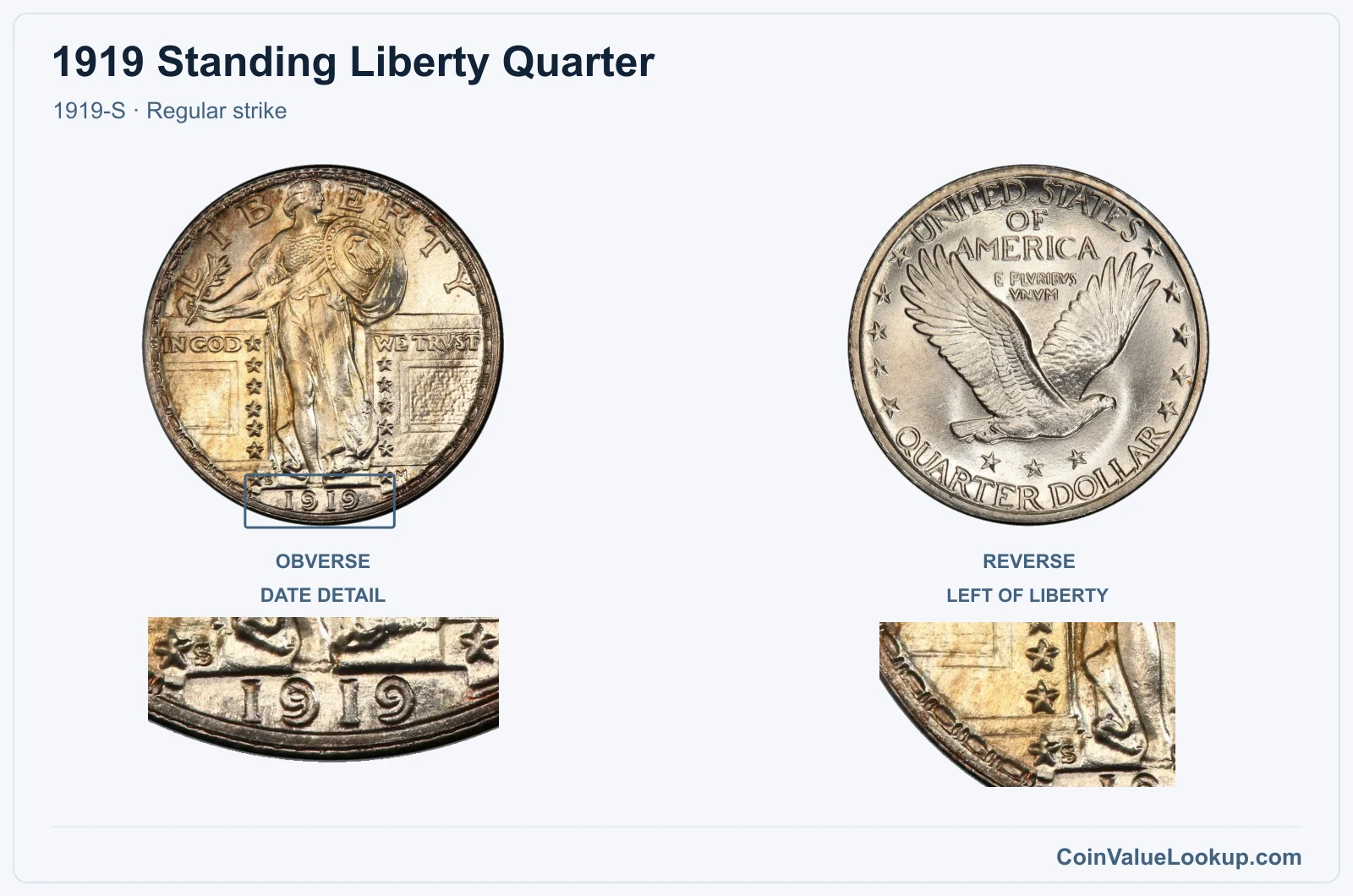
The 1919-S is the San Francisco issue, identified by a small "S" at the left base of the wall. It carries the highest guide anchors among 1919 quarters.
USA Coin Book estimates $100.00 at G4, $2,042.00 at MS60 and $3,094.00 at MS63.
San Francisco coins from this era frequently come weakly struck, so finding a genuine Full Head example is tougher than it sounds. That scarcity in well-struck, original-surface condition is what pushes the upper guide figures so high.
Even a circulated 1919-S in honest, problem-free condition at G4 is a $100.00 coin per the guide. Confirm the mintmark under magnification — a worn S can look ambiguous.
Range Grade
Price Auction Records Appraisal PO PO 1
—
Coin Identifier FR FR 2
—
Coin Identifier AG AG 3
—
Coin Identifier G G 4
—
Coin Identifier
G 6
Coin Identifier VG VG 8
Coin Identifier
VG 10
Coin Identifier F F 12
Coin Identifier
F 15
Coin Identifier VF VF 20
Coin Identifier
VF 25
Coin Identifier
VF 30
Coin Identifier
VF 35
Coin Identifier XF XF 40
Coin Identifier
XF 45
Coin Identifier AU AU 50
Coin Identifier
AU 53
Coin Identifier
AU 55
Coin Identifier
AU 58
Coin Identifier MS MS 60
—
Coin Identifier
MS 61
Coin Identifier
MS 62
Coin Identifier
MS 63
Coin Identifier
MS 64
Coin Identifier
MS 65
Coin Identifier
MS 66
Coin Identifier
MS 67
Coin Identifier
MS 68
—
—
—
MS 69
—
—
—
MS 70
—
—
—
1919 Standing Liberty Quarter Error List
1. 1919 Standing Liberty Quarter — Clashed Dies
A clashed die error happens when the obverse and reverse dies strike each other without a planchet between them. The impact transfers ghost-like traces of the opposite design onto each die, and those traces then appear on subsequently struck coins.
On a 1919 Standing Liberty quarter, look for faint outlines of the eagle on Liberty's side or vice versa — the transferred image will be aligned with where the opposing design would normally sit.
Do not confuse random scratches, bag marks or raised lines from a damaged die with a true clash. Genuine clash marks follow the geometry of the opposite die and repeat in predictable locations.
Condition and how clearly the clash shows affect what a clashed example is worth. No specific price data is available for this error on 1919 quarters, so individual assessment is essential.
2. 1919 Standing Liberty Quarter — Lamination / Split Planchet
A lamination error occurs when layers within the planchet separate, creating a visible flap, peel or void in the metal surface. On a 1919 quarter, look for a section where the silver alloy appears to lift away or where a thin layer is missing entirely.
Photograph the edge alongside the affected face — edge views often reveal the split most clearly.
This is not the same as post-mint corrosion, scraping or someone deliberately cutting into the surface. Genuine lamination flaws follow the natural layering of the alloy and usually have smooth, rounded edges rather than sharp tool marks.
The size, location and visibility of the separation all influence collector interest. No adopted price range is available for this error on 1919 quarters, so each piece needs to be evaluated on its own merits.
3. 1919 Standing Liberty Quarter — Off-Center Strike
An off-center strike means the planchet was not properly seated in the collar when the dies came together, resulting in a shifted design and an unstruck crescent of blank metal along one edge. On a 1919 Standing Liberty quarter, the key question is whether the date is still visible — date-readable off-center errors are far more desirable than ones where the date has shifted off the flan entirely.
Do not confuse a clipped planchet, a slightly misaligned die or post-mint flattening with a true off-center strike. A genuine off-center will show the entire design displaced in one direction with a corresponding blank area on the opposite side.
Value depends on the percentage off center, date visibility and overall condition, but no specific adopted price data is available for 1919 off-center quarters.