1929 Standing Liberty Quarter Coin Value: How Much Is It Worth?
The 1929 Standing Liberty quarter is a 90% silver coin struck at three mints, and its value depends heavily on which mint produced it, how much wear it shows, and whether the strike was strong enough to earn a Full Head designation. Guide estimates from USA Coin Book range from about $17.23 in well-worn Good condition up to $290.00 at the MS63 grade level, depending on the specific version.
Fast Way to Identify Your 1929 Standing Liberty Quarter
The quickest way to start figuring out what your 1929 quarter is worth is to upload clear photos of both the front and back. Our identifier can give you a preliminary read on the mint, design type, and approximate condition.
Snap both sides in good light against a plain background, and you will have a useful starting point for further research.
1929 Standing Liberty Quarter Value
Upload both sides of your 1929 Standing Liberty Quarter.
Front Obverse
Upload photo
Back Reverse
Upload photo
Which 1929 Standing Liberty Quarter Versions Are Worth Money?
- 1929-S: USA Coin Book estimates up to $290.00 at MS63; the San Francisco mint version is worth checking in higher grades.
- 1929-D: Also guided at $290.00 at MS63 by USA Coin Book; Denver strikes can show weak head detail, making sharp examples more desirable.
- 1929 Philadelphia: Matches the $290.00 MS63 guide estimate; no mintmark coins in strong condition hold solid collector interest.
- Check mint and finish first. Damage, heavy wear, or a bright cleaned surface do not make a coin rare or valuable.
Step 1: Identify Your 1929 Standing Liberty Quarter Mint Mark and Version
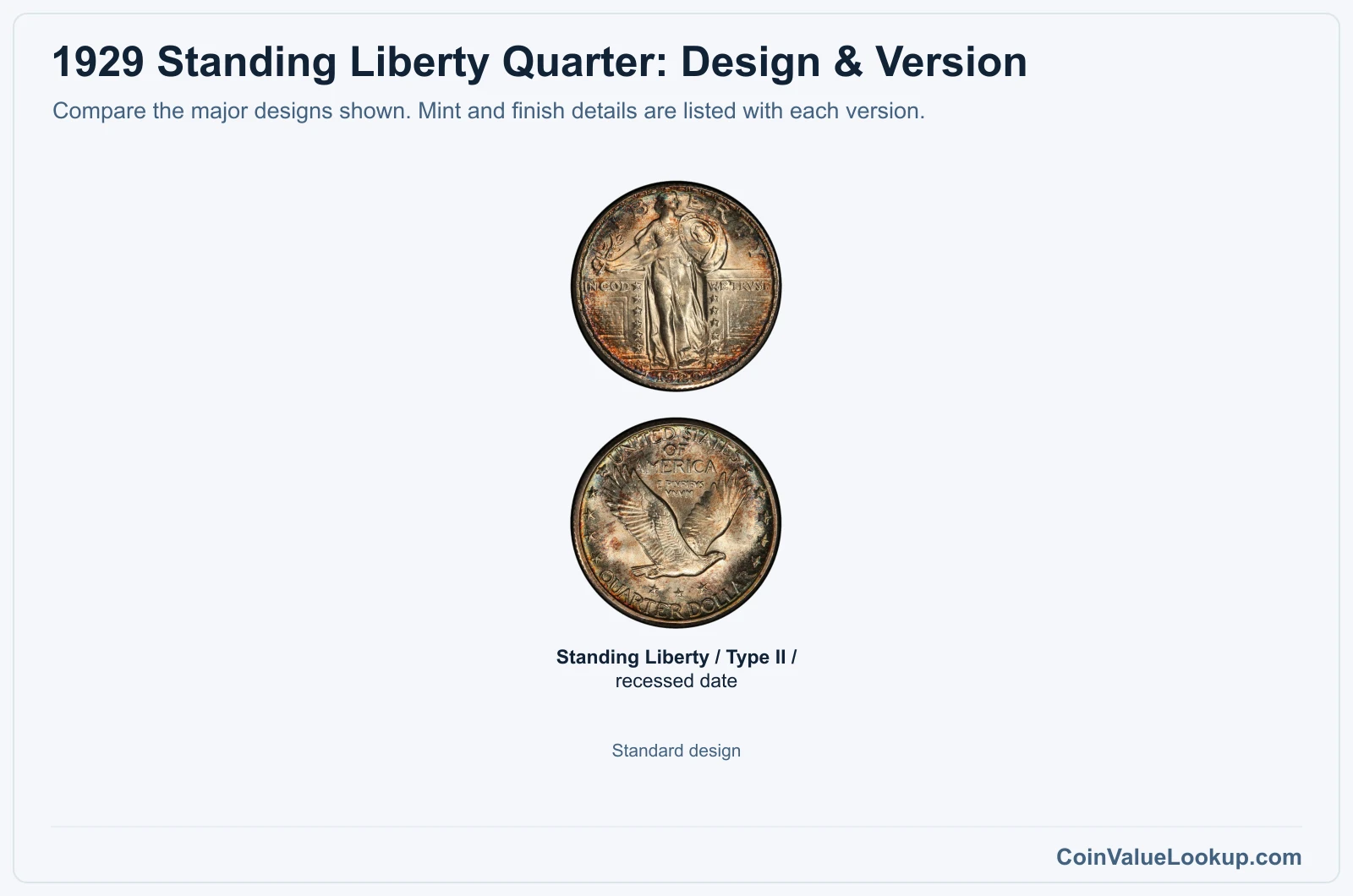
All three 1929 Standing Liberty quarters use the Type II design: Liberty wears protective chain mail on her chest, and three stars appear below the eagle on the reverse. The date is recessed into the design, a change made in 1925 to reduce wear on the numerals.
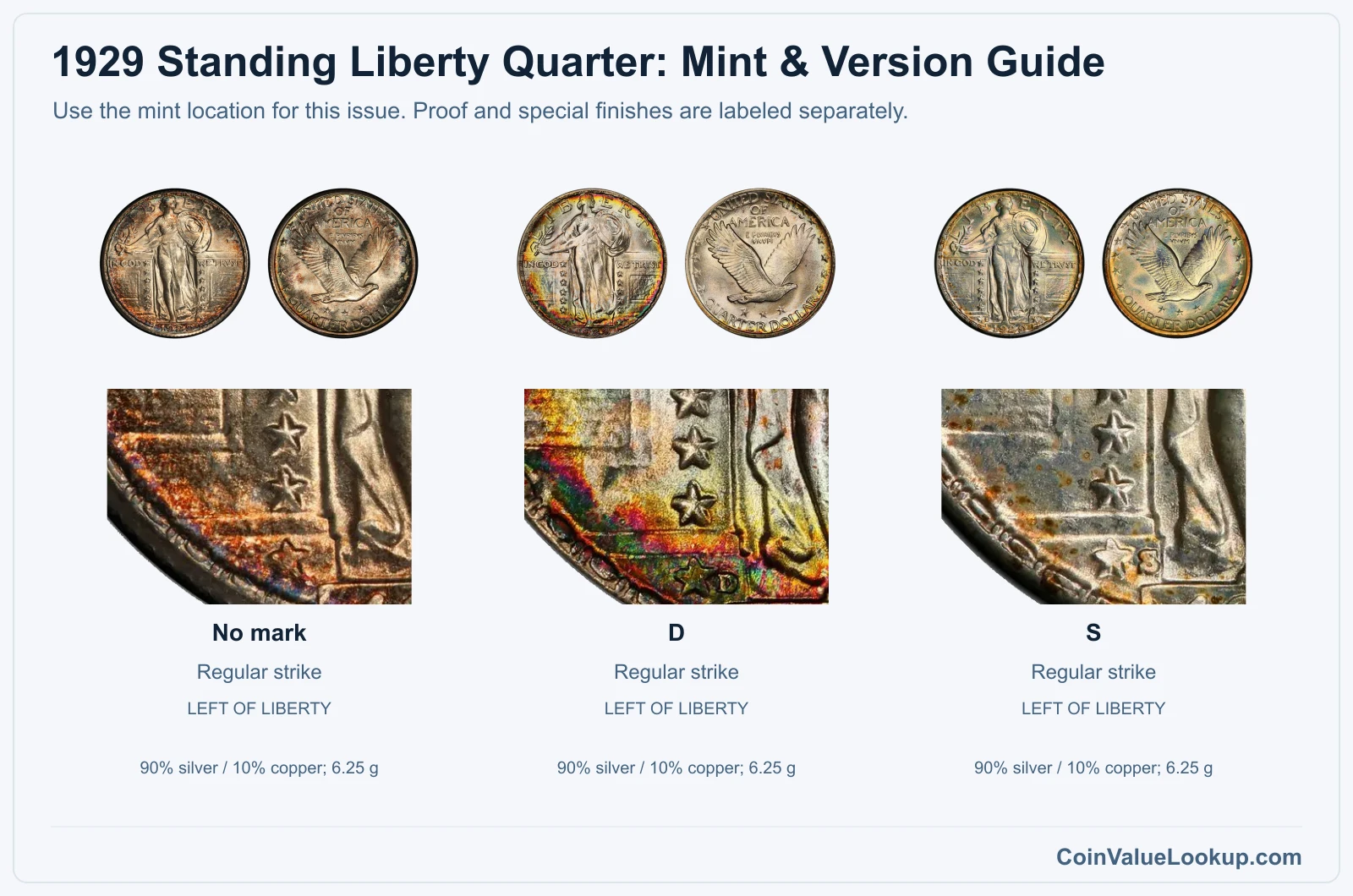
To find the mintmark, look at the obverse near the left base of the wall where Liberty stands. A "D" means Denver, an "S" means San Francisco, and no letter at all means Philadelphia.
The mark is small, so a loupe or magnifying glass helps.
Each coin weighs 6.25 grams and is struck in 90% silver with 10% copper. If yours feels light or does not pass a magnet test, it could be a counterfeit.
Confirm the mint first, then move on to grading.
Step 2: Check Your 1929 Standing Liberty Quarter Grade
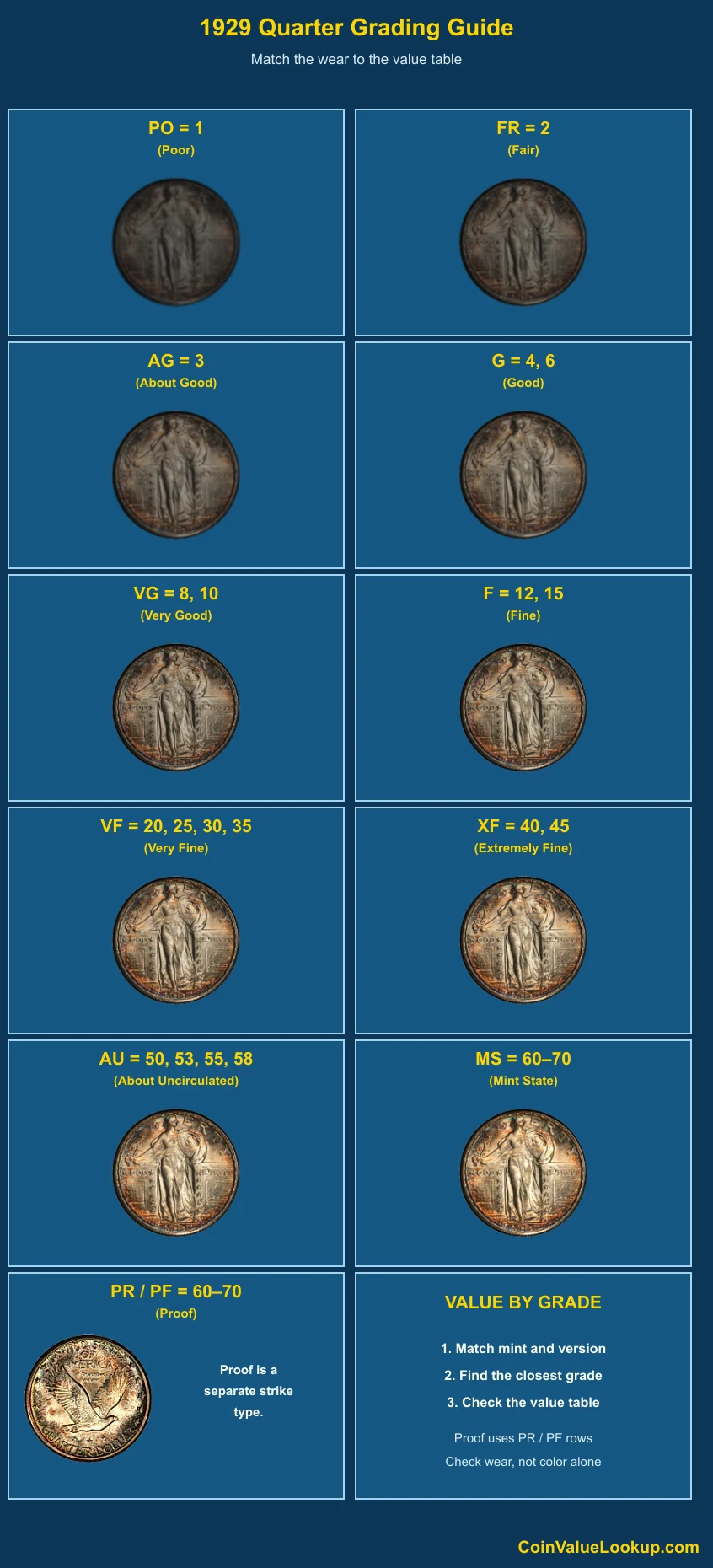
Standing Liberty quarters lose detail in a predictable order. On the obverse, check Liberty's head first, then the breast area, the shield, and finally the knee.
On the reverse, the eagle's breast feathers and wing tips wear down earliest.
A coin graded Good-4 will have a readable date and an outline of Liberty, but most fine detail is gone. At MS60, no wear is present, though the surface may show bag marks and lack eye appeal.
MS63 means a nicer uncirculated coin with fewer distracting marks.
Full Head is a strike designation, not a grade. It means the three leaves in Liberty's head detail are fully separated and sharp.
A weakly struck coin can be technically uncirculated yet still lack Full Head definition, so do not confuse brightness with strike quality. Use the comparison image to judge your coin's wear against known grade examples, and always evaluate luster alongside surface detail.
Step 3: Check 1929 Standing Liberty Quarter Value by Mint and Version
1929 Standing Liberty Quarter
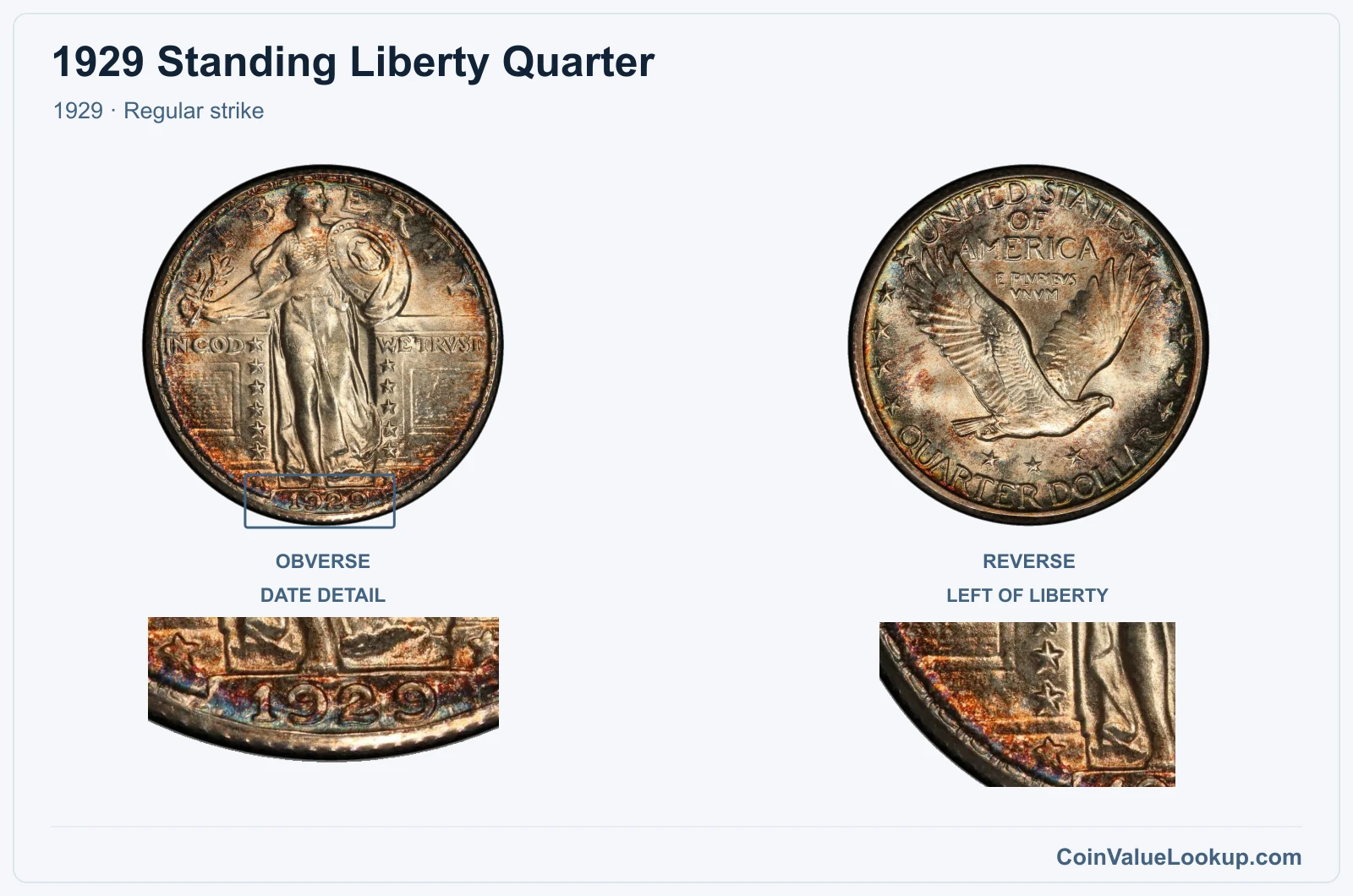
The 1929 Philadelphia quarter has no mintmark. Look at the left base of the wall on the obverse and confirm the spot is blank.
This is a Type II Standing Liberty design with the recessed date. USA Coin Book estimates about $17.23 at G4, $171.00 at MS60, and $290.00 at MS63.
These are guide figures, not guaranteed sale prices. Original, uncleaned surfaces matter more than you might think.
A coin that has been polished or dipped will often trade below guide levels even if the remaining detail looks decent. Cleaning leaves tiny hairlines visible under magnification and strips the original luster that graders and collectors look for.
Coin Value Lookup is a handy place to look up quarter values and other coin guides when you want a quick reference for what you are holding.
Range Grade
Price Auction Records Appraisal PO PO 1
—
Coin Identifier FR FR 2
—
Coin Identifier AG AG 3
—
Coin Identifier G G 4
—
Coin Identifier
G 6
—
Coin Identifier VG VG 8
—
Coin Identifier
VG 10
—
Coin Identifier F F 12
—
Coin Identifier
F 15
—
Coin Identifier VF VF 20
—
Coin Identifier
VF 25
—
Coin Identifier
VF 30
—
Coin Identifier
VF 35
—
Coin Identifier XF XF 40
Coin Identifier
XF 45
Coin Identifier AU AU 50
Coin Identifier
AU 53
Coin Identifier
AU 55
Coin Identifier
AU 58
Coin Identifier MS MS 60
—
Coin Identifier
MS 61
Coin Identifier
MS 62
Coin Identifier
MS 63
Coin Identifier
MS 64
Coin Identifier
MS 65
Coin Identifier
MS 66
Coin Identifier
MS 67
Coin Identifier
MS 68
—
—
—
MS 69
—
—
—
MS 70
—
—
—
1929 Standing Liberty Quarter — D
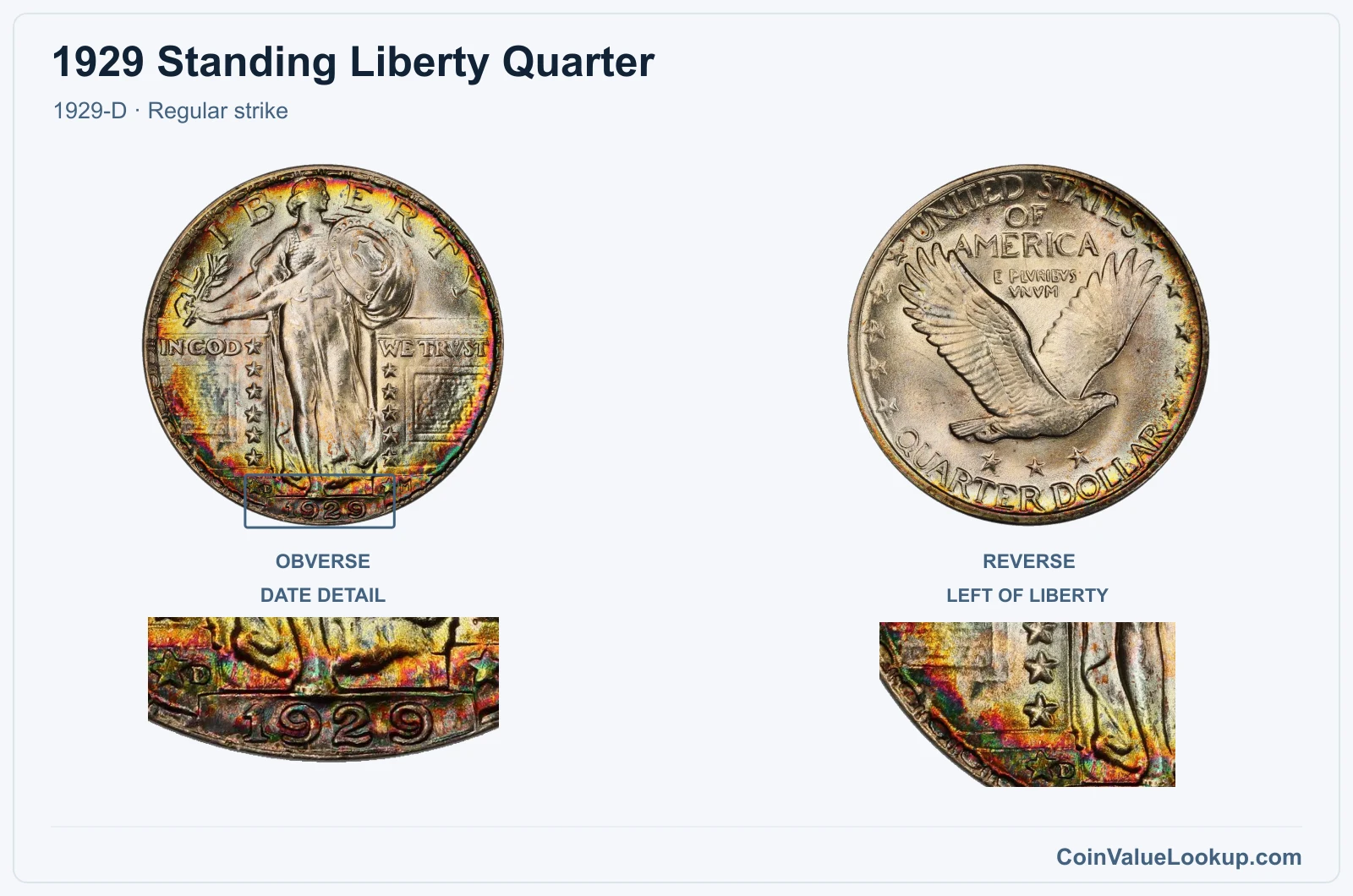
The 1929-D carries a small "D" mintmark near the left base of the wall on the obverse. Denver-struck Standing Liberty quarters from this era are sometimes weakly struck in the head area, so a coin with full, sharp head detail can command extra attention even compared to an otherwise similar Philadelphia piece.
USA Coin Book places the 1929-D at approximately $17.23 in G4, $171.00 in MS60, and $290.00 in MS63. These are guide estimates.
Actual transaction prices depend on strike sharpness, surface quality, and whether the coin retains original toning or has been cleaned. Damage or cleaning can knock value well below these figures regardless of remaining detail.
Range Grade
Price Auction Records Appraisal PO PO 1
—
Coin Identifier FR FR 2
—
Coin Identifier AG AG 3
—
Coin Identifier G G 4
—
Coin Identifier
G 6
—
Coin Identifier VG VG 8
—
Coin Identifier
VG 10
Coin Identifier F F 12
—
Coin Identifier
F 15
—
Coin Identifier VF VF 20
Coin Identifier
VF 25
—
Coin Identifier
VF 30
—
Coin Identifier
VF 35
Coin Identifier XF XF 40
—
Coin Identifier
XF 45
Coin Identifier AU AU 50
Coin Identifier
AU 53
Coin Identifier
AU 55
Coin Identifier
AU 58
Coin Identifier MS MS 60
—
Coin Identifier
MS 61
Coin Identifier
MS 62
Coin Identifier
MS 63
Coin Identifier
MS 64
Coin Identifier
MS 65
Coin Identifier
MS 66
Coin Identifier
MS 67
Coin Identifier
MS 68
—
—
—
MS 69
—
—
—
MS 70
—
—
—
1929 Standing Liberty Quarter — S
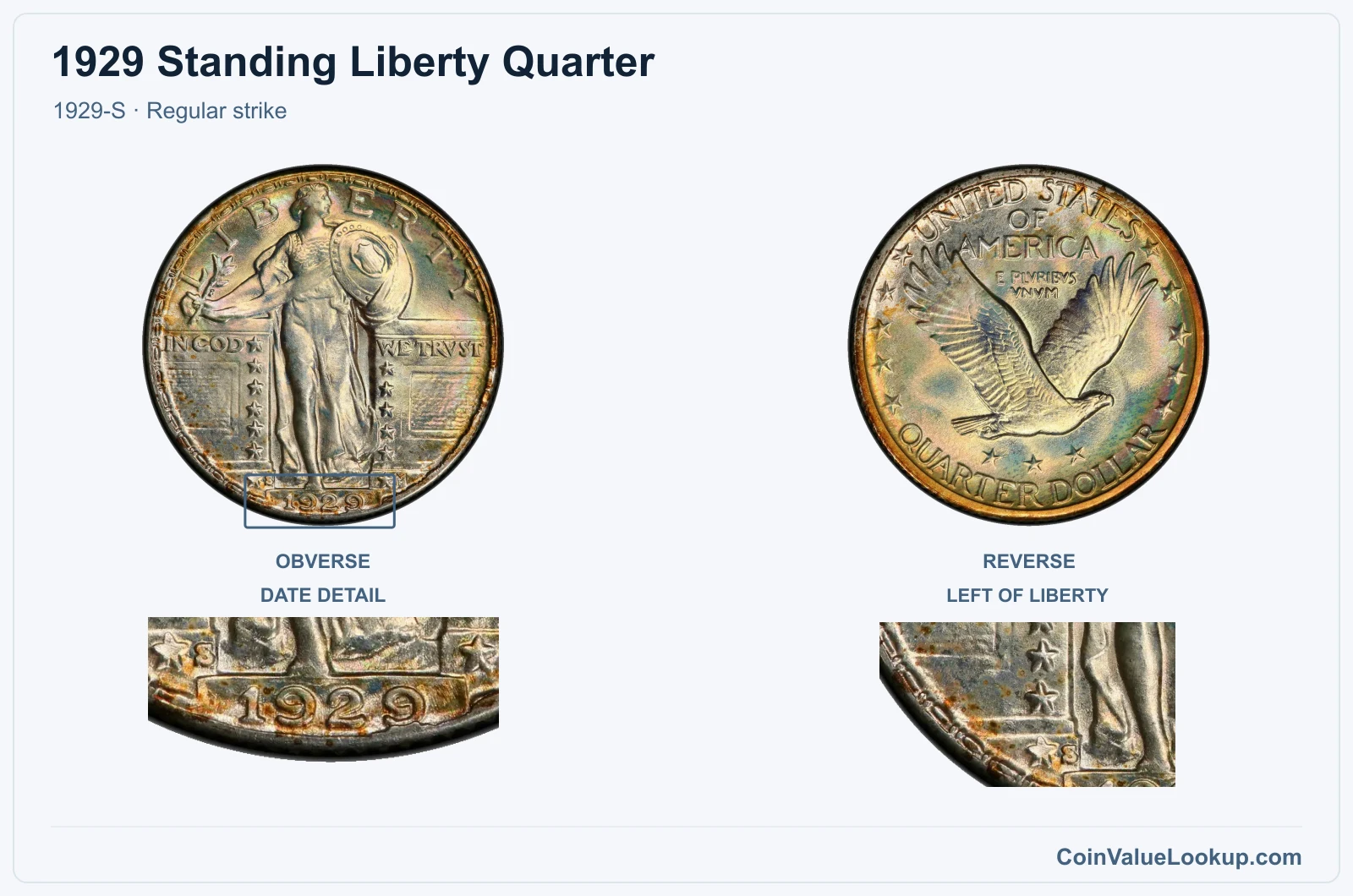
The 1929-S has an "S" mintmark near the left base of the wall on the obverse. San Francisco issues from the late 1920s tend to attract collector attention, especially when the strike is sharp enough for a Full Head designation.
USA Coin Book estimates about $17.23 at G4, $171.00 at MS60, and $290.00 at MS63. As with the other mints, these are retail guide estimates and not guaranteed offers.
Condition and originality drive real-world pricing. A coin with honest wear and original surfaces is typically preferred over one that has been harshly cleaned, even if the cleaned piece initially appears shinier.
Always compare your coin's detail against known grade references before assuming a value.
Range Grade
Price Auction Records Appraisal PO PO 1
—
Coin Identifier FR FR 2
—
Coin Identifier AG AG 3
—
Coin Identifier G G 4
—
Coin Identifier
G 6
—
Coin Identifier VG VG 8
Coin Identifier
VG 10
—
Coin Identifier F F 12
Coin Identifier
F 15
—
Coin Identifier VF VF 20
—
Coin Identifier
VF 25
—
Coin Identifier
VF 30
—
Coin Identifier
VF 35
Coin Identifier XF XF 40
Coin Identifier
XF 45
Coin Identifier AU AU 50
Coin Identifier
AU 53
Coin Identifier
AU 55
Coin Identifier
AU 58
Coin Identifier MS MS 60
—
Coin Identifier
MS 61
Coin Identifier
MS 62
Coin Identifier
MS 63
Coin Identifier
MS 64
Coin Identifier
MS 65
Coin Identifier
MS 66
Coin Identifier
MS 67
Coin Identifier
MS 68
Coin Identifier
MS 69
—
—
—
MS 70
—
—
—
1929 Standing Liberty Quarter Error List
1. 1929 Standing Liberty Quarter — Clashed Dies
A clashed die error on the 1929-S Standing Liberty quarter occurs when the obverse and reverse dies strike each other without a planchet between them, leaving traces of the opposing design impressed into each die. On subsequent coins struck from those dies, you may see ghostly outlines of the eagle on Liberty's side, or elements of Liberty on the eagle's side, in areas that should be flat or carry a different design.
Look carefully under magnification for design traces that align with the opposite face of the coin. Random scratches, contact marks, or raised lines from a damaged die are not the same thing.
True clash marks follow the geometry of the opposing die and appear in consistent positions.
No specific price data is available for this variety. Value depends on the visibility of the clash, the coin's overall condition, and collector demand for the specific die pair.
2. 1929 Standing Liberty Quarter — Repunched Mintmark
Repunched mintmark varieties have been reported on 1929 Standing Liberty quarters. These happen when the mintmark punch was applied more than once in slightly different positions, leaving remnants of an earlier impression visible alongside the final letter.
To check, examine the "D" or "S" mintmark under magnification. Look for a secondary outline, a shadow, or a partial letter offset from the main mark.
Compare your coin against a normal example at the same magnification so you can see the difference clearly. Machine doubling, small die chips, and corrosion around the mintmark area can all mimic a repunched mintmark to the untrained eye, so be cautious before drawing conclusions.
No adopted price data is available for these varieties. The coin's grade, the clarity of the repunching, and collector interest in the specific die all influence what it might bring.
3. 1929 Standing Liberty Quarter — Doubled Die
Doubled die varieties have been reported for 1929 Standing Liberty quarters. A doubled die is created during the die-making process when a misalignment between hub impressions leaves parts of the design slightly duplicated.
The result is consistent doubling that appears on every coin struck from that die.
Compare lettering, stars, and date numerals against a normal 1929 quarter. Look for separation, notching, or a distinct secondary image on design elements.
The doubling should be uniform and repeatable in the same locations on other examples from the same die.
Do not confuse this with machine doubling, which produces flat, shelf-like distortion rather than a true secondary image. Reflections from lighting or post-mint damage can also mislead.
No specific price data is available for these varieties, so individual assessment based on condition, the strength of the doubling, and the specific die involved is necessary.