1886 Morgan Silver Dollar Coin Value: How Much Is It Worth?
The 1886 Morgan Silver Dollar is a coin that rewards careful identification. Guide estimates from USA Coin Book range from about $74.00 in well-worn Good-4 condition to as high as $187,875.00 for a top-grade example of the scarce 1886-O, though most coins fall far below that ceiling.
Your coin's actual worth depends on its mint, finish, surface quality and grade, so sorting those details out comes first.
Fast Way to Identify Your 1886 Morgan Silver Dollar
The quickest way to start is to upload clear photos of both the front and back of your 1886 Morgan Dollar. Our identifier can give you a preliminary read on mint, version and general condition from those images alone.
It does not replace professional authentication or precise grading, but it points you in the right direction before you dig deeper.
1886 Morgan Silver Dollar Value
Upload both sides of your 1886 Morgan Silver Dollar.
Front Obverse
Upload photo
Back Reverse
Upload photo
Which 1886 Morgan Silver Dollar Versions Are Worth Money?
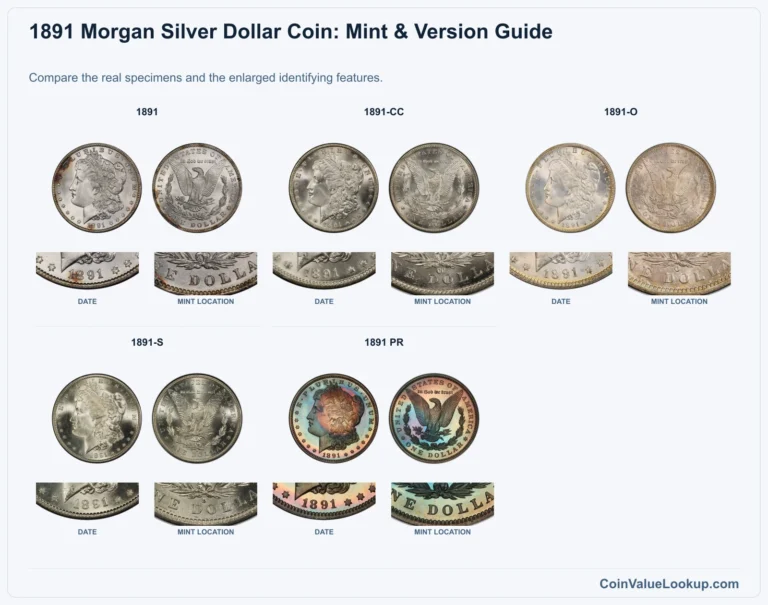
- The 1886-O in high Mint State grades commands enormous premiums, with a USA Coin Book guide estimate of $187,875.00 at MS65 — locate the small "O" mintmark below the wreath bow.
- The 1886-S starts higher in lower grades at $117.00 in G4 and reaches $2,378.00 at MS65, making it worth identifying carefully by its "S" mintmark.
- The 1886 Philadelphia business strike is the most common version but still carries silver value and collector demand, estimated at $302.00 at MS65.
- The 1886 proof is a distinct manufacturing finish with no adopted numerical range; authentication matters before assuming proof status.
- Prooflike or deep-mirror prooflike surface designations on business strikes can affect value — a shiny surface alone does not qualify.
Step 1: Identify Your 1886 Morgan Silver Dollar Mint Mark and Version
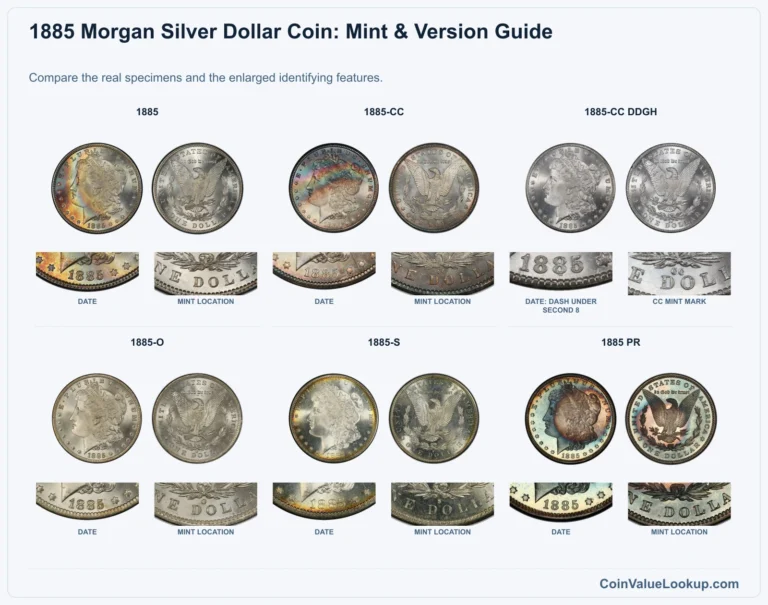
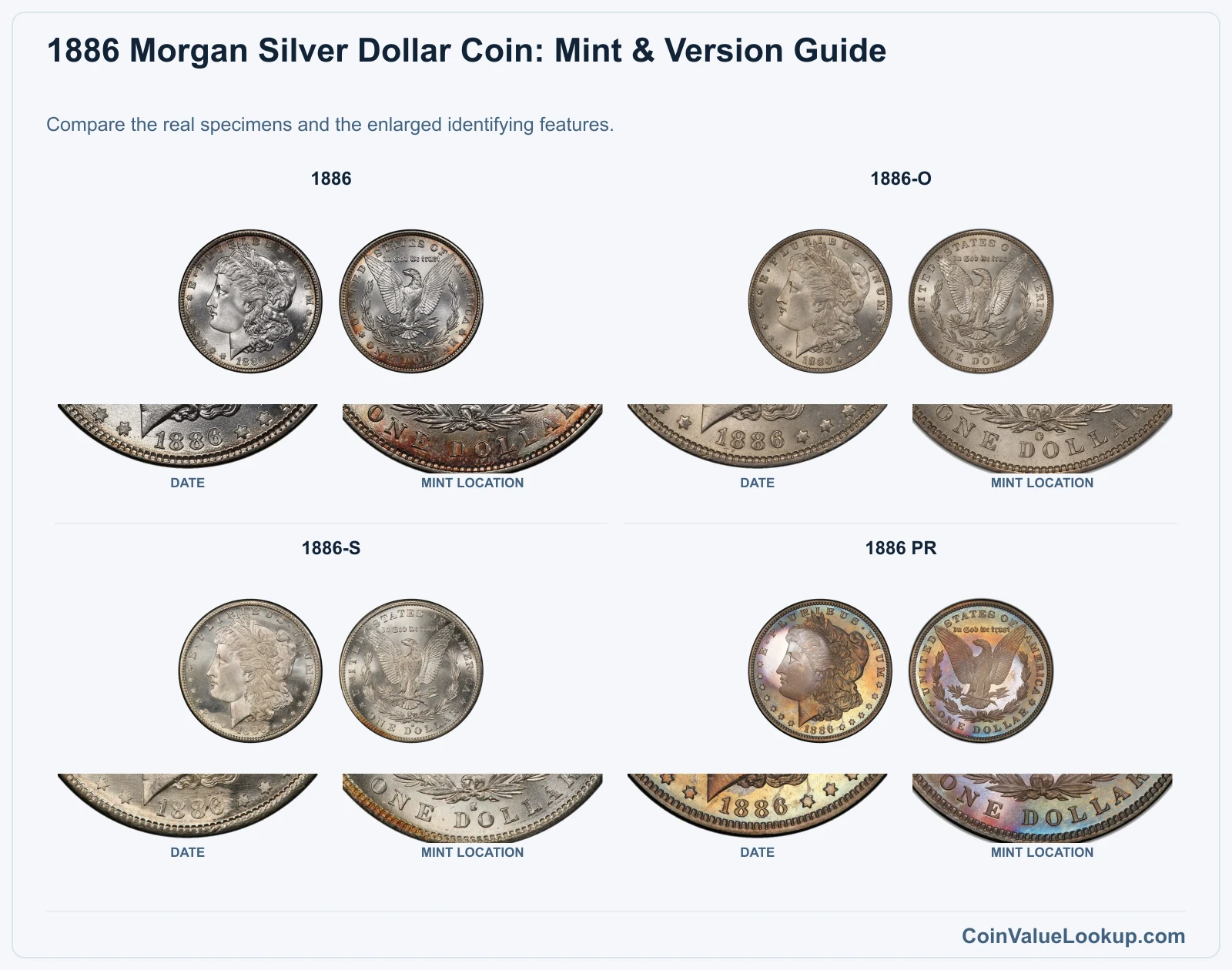
Flip the coin to the reverse and look below the bow that ties the wreath. A small "O" means New Orleans.
A small "S" means San Francisco. No mintmark at all means Philadelphia.
The 1886 Morgan Dollar was struck at three mints: Philadelphia (no mark), New Orleans (O) and San Francisco (S). Philadelphia also produced a limited number of proof strikes that year.
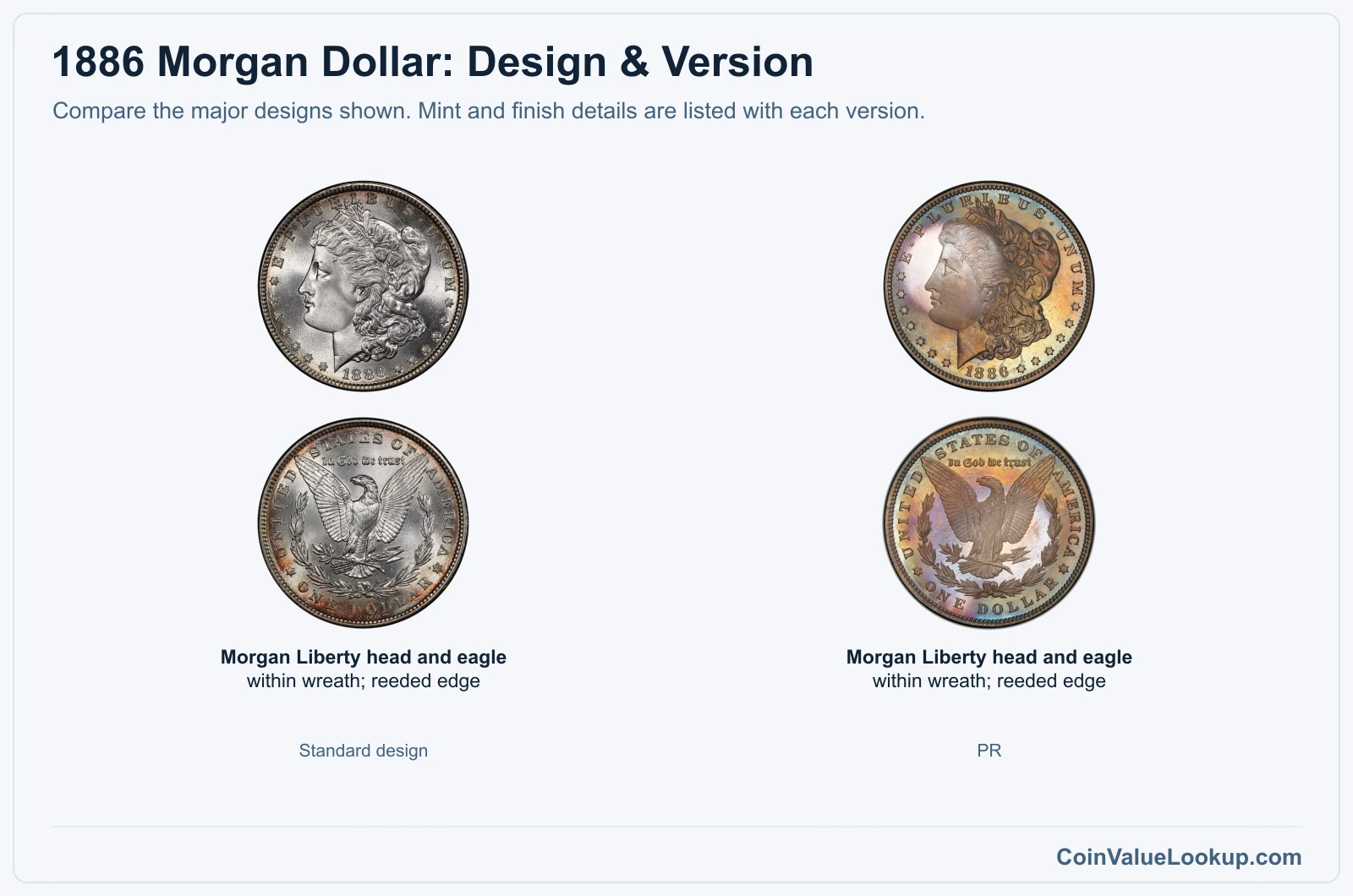
All versions share the same Morgan Liberty head obverse and eagle-in-wreath reverse, struck on a 26.73-gram planchet of 90% silver and 10% copper with a reeded edge.
Proofs are a special manufacturing finish, not simply a shiny coin. A business strike that happens to look reflective may have prooflike or deep-mirror prooflike surfaces, but those are surface designations on regular coins, not proof manufacture.
Cleaned coins and coins with plating or glare can fool the eye, so be cautious before assuming you hold something special.
Step 2: Check Your 1886 Morgan Silver Dollar Grade
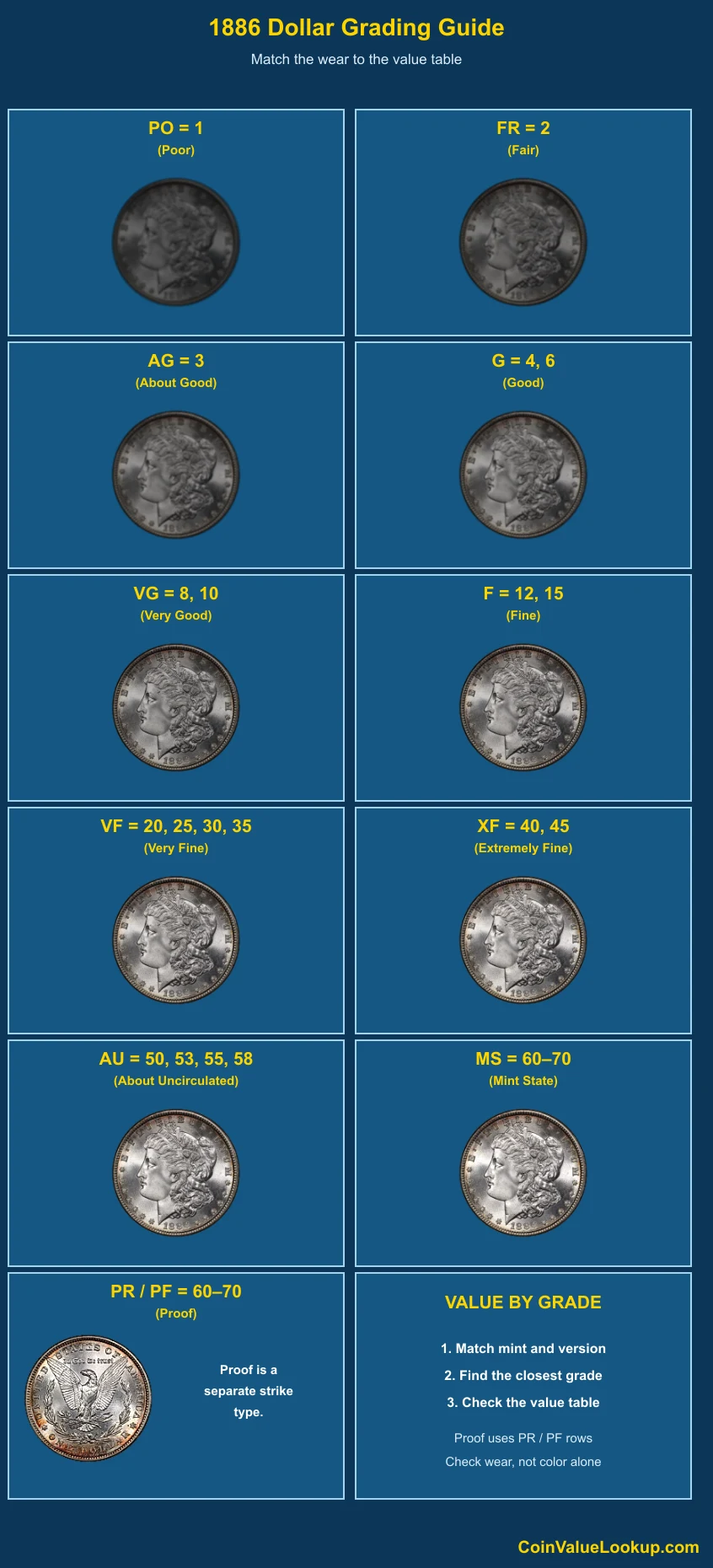
Start with Liberty's hair above the ear and the cap detail on the obverse. On a heavily circulated coin these areas are flat and featureless.
As grade improves you will see more individual hair strands and sharper cap folds.
The cheek is a key contact point. Bag marks — those little nicks from coins banging together in mint bags — show up there even on uncirculated pieces and will push the grade down within Mint State levels.
On the reverse, check the eagle's breast feathers. A coin with full, separated feathers and strong luster is in a higher Mint State grade than one with mushy breast detail.
Compare your coin side by side with the grading image to judge where it falls across circulated, About Uncirculated and Mint State tiers.
Proof coins should be evaluated separately from business strikes. Their mirrored fields and sharp rims are part of the manufacturing process, not wear characteristics.
Step 3: Check 1886 Morgan Silver Dollar Value by Mint and Version
1886 Morgan Silver Dollar
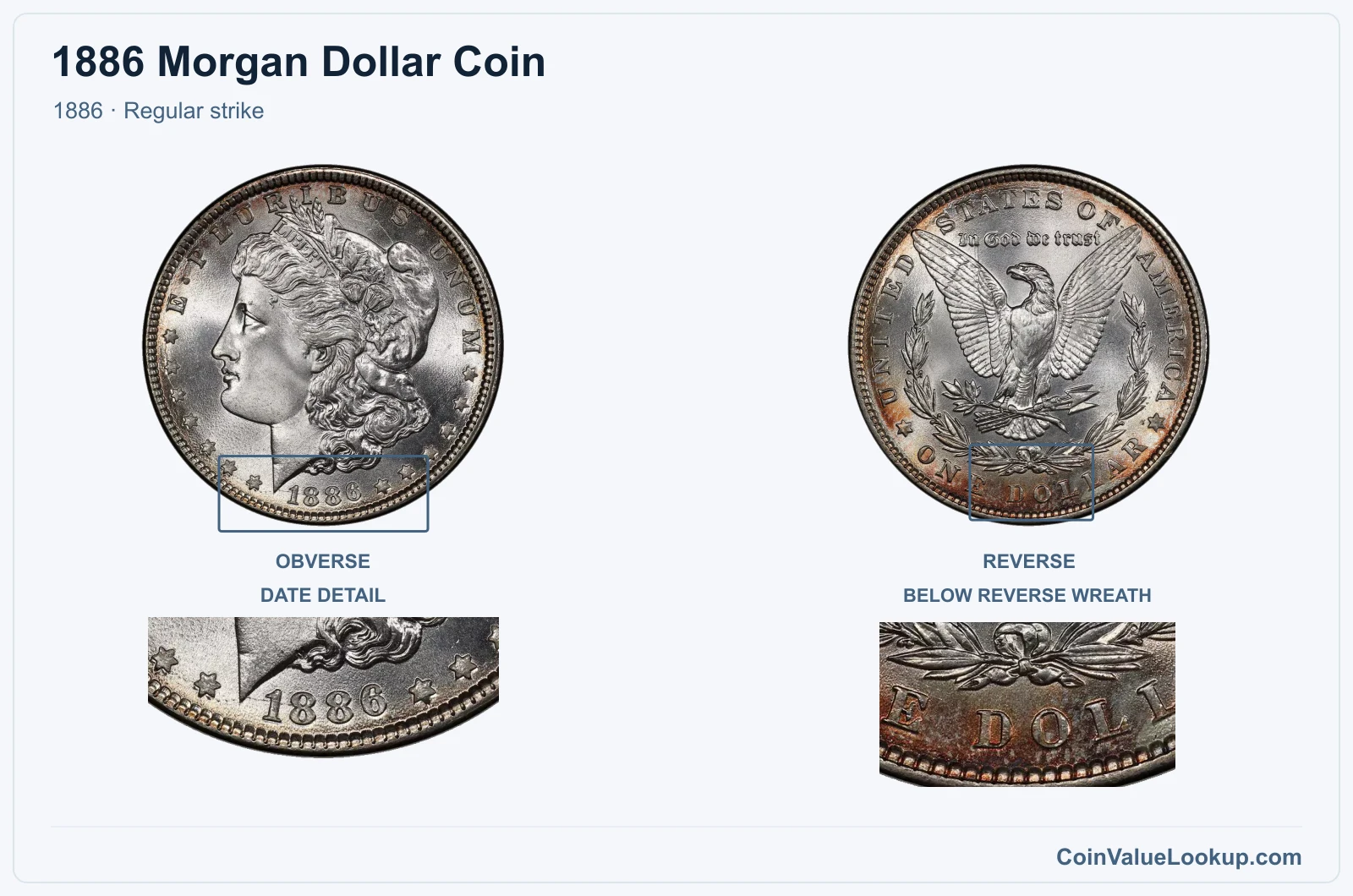
The 1886 Philadelphia Morgan Dollar carries no mintmark. It is the most readily available version of the date and a staple of Morgan Dollar collections.
USA Coin Book estimates place it at about $74.00 in Good-4 and $302.00 in MS65. Those are guide figures, not guaranteed sale prices.
Original, uncleaned surfaces matter a lot here — a harshly polished coin loses comparability to published guides. Some Philadelphia strikes show prooflike or deep-mirror prooflike reflectivity; those are surface designations applied to eligible business strikes, not proof coins.
Range Grade
Price Auction Records Appraisal PO PO 1
—
Coin Identifier FR FR 2
—
Coin Identifier AG AG 3
—
Coin Identifier G G 4
—
Coin Identifier
G 6
—
Coin Identifier VG VG 8
—
Coin Identifier
VG 10
—
Coin Identifier F F 12
—
Coin Identifier
F 15
—
Coin Identifier VF VF 20
—
Coin Identifier
VF 25
—
Coin Identifier
VF 30
—
Coin Identifier
VF 35
Coin Identifier XF XF 40
Coin Identifier
XF 45
—
Coin Identifier AU AU 50
—
Coin Identifier
AU 53
Coin Identifier
AU 55
Coin Identifier
AU 58
Coin Identifier MS MS 60
Coin Identifier
MS 61
Coin Identifier
MS 62
Coin Identifier
MS 63
Coin Identifier
MS 64
Coin Identifier
MS 65
Coin Identifier
MS 66
Coin Identifier
MS 67
Coin Identifier
MS 68
Coin Identifier
MS 69
—
—
—
MS 70
—
—
—
1886 Morgan Silver Dollar — O
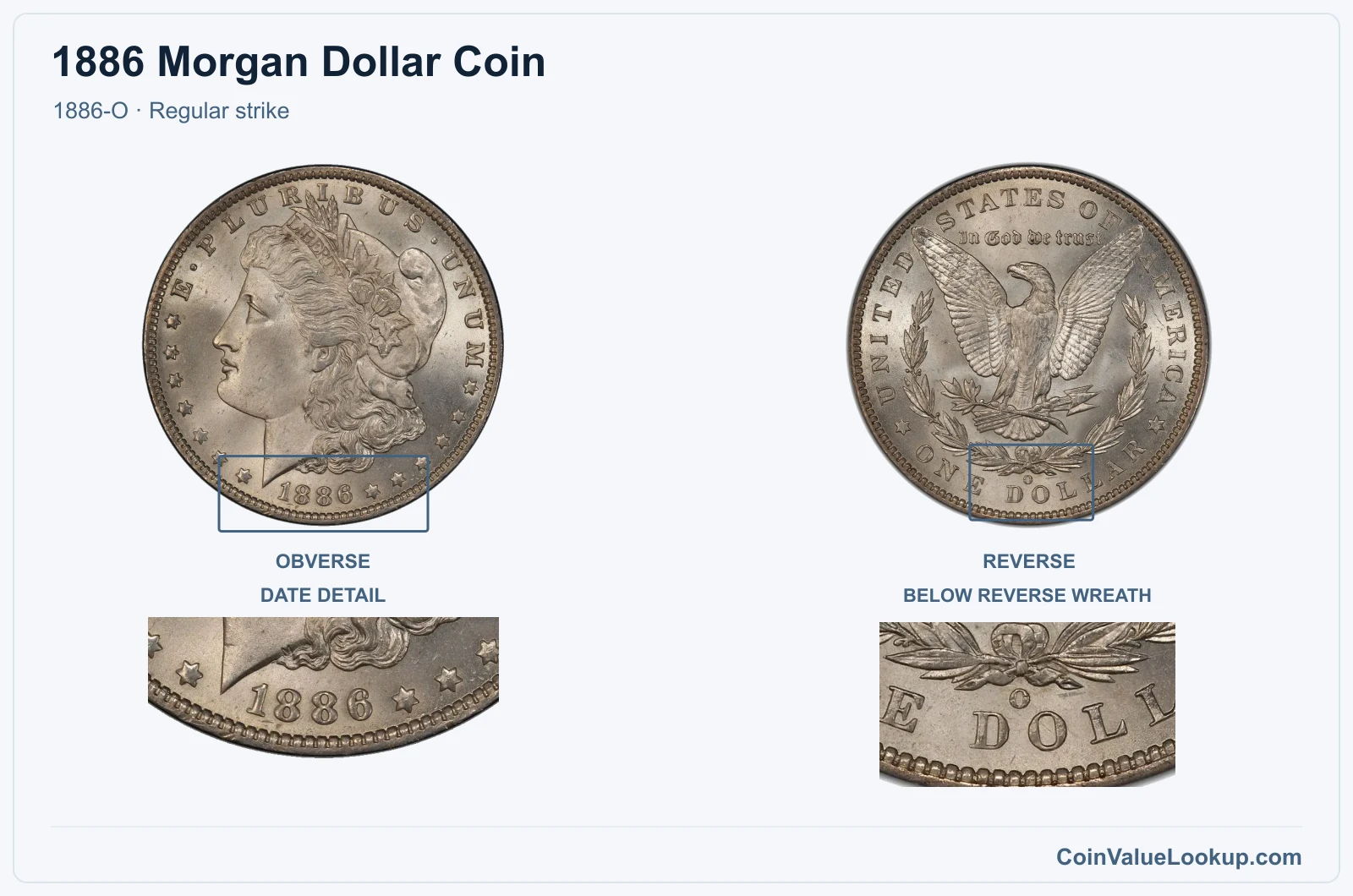
The 1886-O was struck at the New Orleans Mint and is identified by the small "O" below the wreath bow on the reverse. This is the version with the widest spread between low and high grades.
A well-worn Good-4 example carries a guide estimate of about $74.00 from USA Coin Book, the same ballpark as the Philadelphia coin. But an MS65 example jumps to a staggering $187,875.00 estimate, reflecting extreme rarity in gem uncirculated condition.
Most surviving 1886-O dollars saw heavy circulation, so finding one with full original luster and minimal marks is genuinely difficult. Confirm the mintmark carefully and have the coin professionally graded before assuming a high Mint State designation.
Coin Value Lookup is a good place to start when you want to look up guide values for other Morgan Dollar dates and mints alongside this one.
Range Grade
Price Auction Records Appraisal PO PO 1
Coin Identifier FR FR 2
Coin Identifier AG AG 3
Coin Identifier G G 4
—
Coin Identifier
G 6
—
Coin Identifier VG VG 8
—
Coin Identifier
VG 10
—
Coin Identifier F F 12
Coin Identifier
F 15
Coin Identifier VF VF 20
Coin Identifier
VF 25
Coin Identifier
VF 30
Coin Identifier
VF 35
Coin Identifier XF XF 40
Coin Identifier
XF 45
Coin Identifier AU AU 50
Coin Identifier
AU 53
Coin Identifier
AU 55
Coin Identifier
AU 58
Coin Identifier MS MS 60
Coin Identifier
MS 61
Coin Identifier
MS 62
Coin Identifier
MS 63
Coin Identifier
MS 64
Coin Identifier
MS 65
Coin Identifier
MS 66
—
—
—
MS 67
—
—
—
MS 68
—
—
—
MS 69
—
—
—
MS 70
—
—
—
1886 Morgan Silver Dollar — S
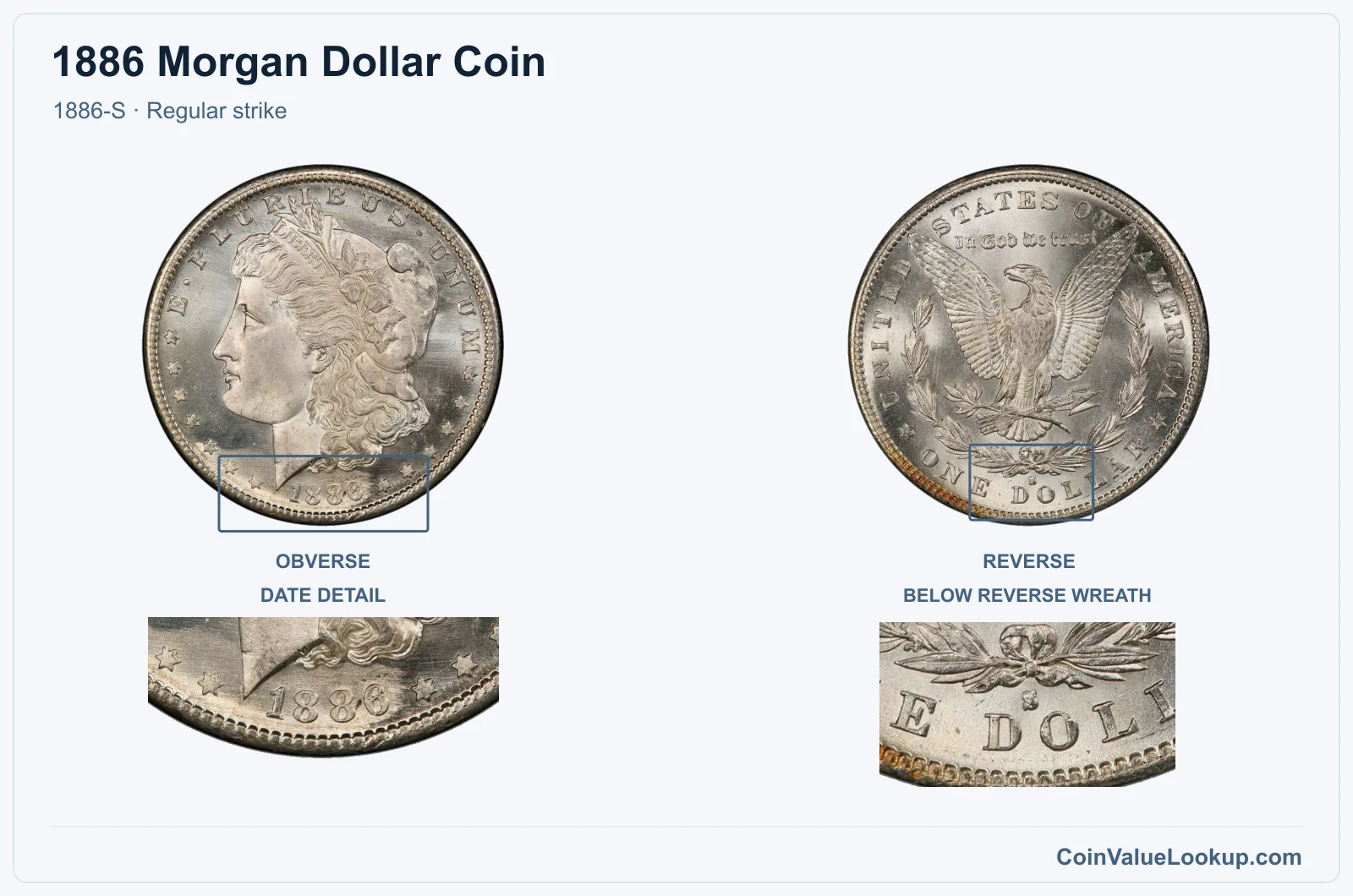
Look for the "S" mintmark below the wreath bow to confirm the San Francisco issue. The 1886-S stands a step above the Philadelphia coin in lower grades.
USA Coin Book estimates it at $117.00 in Good-4 and $2,378.00 in MS65. That higher baseline reflects somewhat lower surviving populations in collector hands.
As with any Morgan, cleaning or polishing will undermine its standing relative to published guide figures. Original toning and undisturbed surfaces are what graders and buyers want to see.
Range Grade
Price Auction Records Appraisal PO PO 1
—
Coin Identifier FR FR 2
—
Coin Identifier AG AG 3
—
Coin Identifier G G 4
—
Coin Identifier
G 6
—
Coin Identifier VG VG 8
—
Coin Identifier
VG 10
Coin Identifier F F 12
Coin Identifier
F 15
Coin Identifier VF VF 20
Coin Identifier
VF 25
—
Coin Identifier
VF 30
Coin Identifier
VF 35
Coin Identifier XF XF 40
Coin Identifier
XF 45
Coin Identifier AU AU 50
Coin Identifier
AU 53
Coin Identifier
AU 55
Coin Identifier
AU 58
Coin Identifier MS MS 60
Coin Identifier
MS 61
Coin Identifier
MS 62
Coin Identifier
MS 63
Coin Identifier
MS 64
Coin Identifier
MS 65
Coin Identifier
MS 66
Coin Identifier
MS 67
Coin Identifier
MS 68
—
—
—
MS 69
—
—
—
MS 70
—
—
—
1886 Morgan Silver Dollar — PR
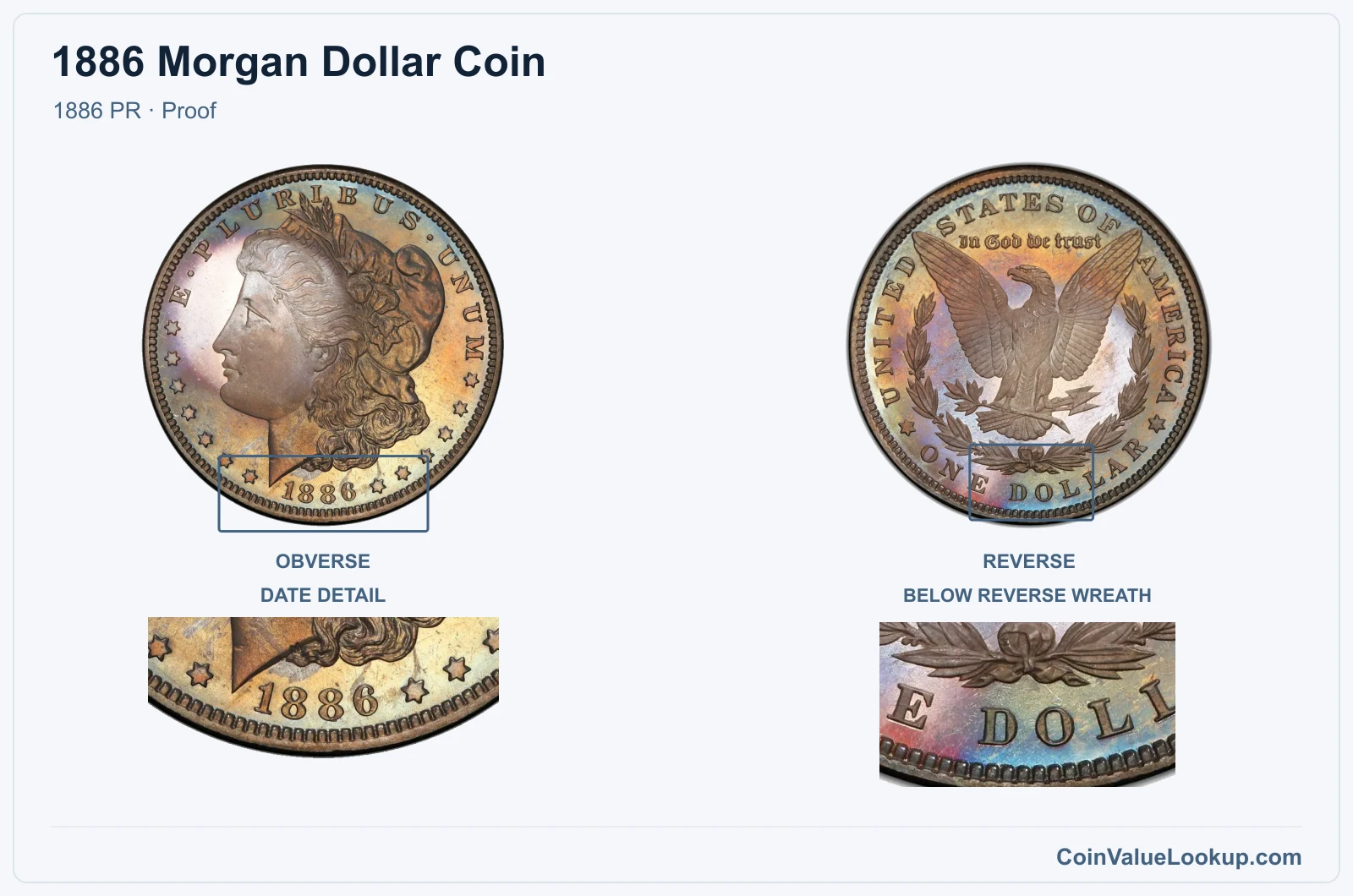
The 1886 proof Morgan Dollar was produced at Philadelphia with a special manufacturing process — mirrored fields, sharp detail and carefully prepared dies. It carries no mintmark, just like the business strike, so the distinction is in how the coin was made, not where.
No supported numerical price range has been adopted for this version. Value depends on authenticated identity, surface preservation, cameo contrast and any imperfections.
Professional certification is essential before treating any 1886 Morgan as a proof. A shiny business strike, even one with prooflike surfaces, is not the same thing.
Range Grade
Price Auction Records Appraisal PR PR 1
—
Coin Identifier
PR 2
—
Coin Identifier
PR 3
—
Coin Identifier
PR 4
—
Coin Identifier
PR 6
—
Coin Identifier
PR 8
—
Coin Identifier
PR 10
—
Coin Identifier
PR 12
—
Coin Identifier
PR 15
—
Coin Identifier
PR 20
—
Coin Identifier
PR 25
—
Coin Identifier
PR 30
—
Coin Identifier
PR 35
—
Coin Identifier
PR 40
—
Coin Identifier
PR 45
—
Coin Identifier
PR 55
—
Coin Identifier
PR 58
Coin Identifier
PR 60
Coin Identifier
PR 61
Coin Identifier
PR 62
Coin Identifier
PR 63
Coin Identifier
PR 64
Coin Identifier
PR 65
Coin Identifier
PR 66
Coin Identifier
PR 67
Coin Identifier
PR 68
—
Coin Identifier
PR 69
—
—
—
PR 70
—
—
—
1886 Morgan Silver Dollar Error List
1. 1886 Morgan Silver Dollar — Misplaced Date
A misplaced date error on the 1886 Morgan Dollar shows remnants of date-punch digits in a position away from where the final date sits. The reported variety involves a line visible in or near the "M" area.
To check, examine the area around the date numerals and nearby letters under magnification. You are looking for faint ghost impressions of numbers where they should not appear.
These are caused by an errant punch before the die was corrected.
Do not confuse scratches, die cracks or random dents with a genuine misplaced date. The displaced digits should match the style and scale of the normal date.
No adopted price range exists for this variety; value depends on the specific error, its visibility and the coin's overall condition. Professional authentication is recommended.
2. 1886 Morgan Silver Dollar — Clashed Dies
Clashed dies occur when the obverse and reverse dies strike each other without a planchet between them, leaving ghost impressions of the opposite design on each die. The reported variety for 1886 involves a reverse clash.
Look at the reverse fields for traces of Liberty's portrait or hair detail transferred from the obverse die. These impressions will be aligned consistently with the opposing design, not randomly scattered.
Scratches, stray raised lines or brockage marks can mimic a clash. True clash marks follow predictable positions dictated by the opposing die's design.
No numerical price range has been adopted; value varies with the strength of the clash, the coin's grade and overall eye appeal.
3. 1886 Morgan Silver Dollar — Rotated Dies
A rotated die error means the reverse die was not properly locked in alignment during striking. Normal U.S. coins use medal or coin alignment — hold the obverse upright, flip top to bottom, and the reverse should appear upright too.
If the reverse is tilted at an angle, you may have a rotated reverse die. The reported variety for 1886 describes exactly this condition.
Greater rotation generally attracts more collector interest.
Be careful: a photograph taken at an odd angle can create the illusion of rotation. Always check the physical coin in hand.
No adopted numerical price exists for this error; value depends on the degree of rotation, the coin's condition and how dramatically the misalignment presents.
4. 1886 Morgan Silver Dollar — Partial Collar Strike
A partial collar strike happens when the planchet is not fully seated inside the collar die during striking. Part of the coin gets the normal reeded edge while part spreads outward, creating a visible step or ledge on the rim.
For the 1886 Morgan Dollar, check the edge profile all the way around. One section will show normal reeding; the opposite section may be smooth, expanded or stepped.
Compare with a normal coin's uniform rim.
Do not confuse post-mint edge damage, a flattened rim from a drop, or a complete broadstrike with a partial collar. The key diagnostic is that stepped transition from restrained to unrestrained metal.
No numerical price has been adopted; the error's value depends on how dramatic the displacement is and the coin's preservation.
5. 1886 Morgan Silver Dollar — Doubled Die
Doubled die varieties on the 1886 Morgan Dollar have been reported for Philadelphia strikes. The doubling appears as consistent separation or notching on design elements — lettering, the date or Liberty's features.
Examine the coin under magnification and compare it with a normal strike. Genuine die doubling shows uniform displacement across affected areas because it originated in the die itself.
Machine doubling, which is flat and shelf-like, is the most common lookalike. Reflections under strong light and post-mint impressions can also trick you.
True doubled dies show raised, rounded secondary images rather than flattened shelves. No adopted price range exists; value hinges on the specific variety, strength of doubling and overall grade.
Authentication by a professional service is strongly recommended.
6. 1886 Morgan Silver Dollar — Off-Center Strike
An off-center strike occurs when the planchet is not centered between the dies, producing a coin with part of the design missing and a blank crescent where metal was never struck. For the 1886 Morgan Dollar, this error has been reported alongside partial collar varieties.
The date should still be visible for the coin to carry strong collector value. Look for a clearly displaced design — not just weak detail on one side, but an actual blank area with no impression.
A clipped planchet or post-mint flattening can look similar at first glance. The difference is that an off-center strike shows a complete design shift with a corresponding unstruck area, while clips show a curved bite.
No numerical price has been adopted; the percentage of off-center displacement, date visibility and grade all influence value.
7. 1886 Morgan Silver Dollar — Lamination / Split Planchet
Lamination errors on the 1886 Morgan Dollar appear as peeling, flaking or separation within the silver alloy. You may see a retained flap of metal still attached to the surface, or a void where a layer has broken away entirely.
Photograph the affected face and the edge together. Lamination flaws will show a split running parallel to the coin's surface, unlike a gouge or scratch that cuts across the metal.
Corrosion pitting, deliberate scraping and cut coins can mimic lamination. The key distinction is that a genuine lamination follows the natural plane of the alloy and typically has smooth interior surfaces.
No adopted price exists; the size and location of the flaw, along with the coin's overall condition, determine how much a collector would pay.
8. 1886 Morgan Silver Dollar — Struck-Through Error
A struck-through error results when foreign material — grease, wire, cloth or debris — sits between the die and the planchet during striking. This leaves a localized depression or incomplete design area on the finished coin.
On an 1886 Morgan Dollar, look for a smooth depression that does not match normal wear patterns. Grease fill-ins tend to produce soft, rounded missing detail, while a retained foreign object may leave a distinct shape pressed into the surface.
Wear from circulation, cleaning and ordinary weak strikes can all mimic a struck-through error. The distinguishing factor is that the affected area is clearly recessed or shows an impression that does not match the die's design.
No numerical price range has been adopted; value depends on what caused the obstruction, its size and the coin's grade.
9. 1886 Morgan Silver Dollar — Die Cap / Capped-Die Strike
A die cap error is among the most dramatic minting mistakes. It occurs when a struck coin sticks to the upper die and acts as a cap, striking subsequent planchets through its own reverse.
The capped coin itself becomes progressively cupped and distorted.
For the 1886 Morgan Dollar, you need to distinguish between the coin that became the cap and the coins struck underneath it. The cap coin will show deep cupping and a mirrored brockage impression.
Coins struck through the cap display a weakened, spread-out impression of the obverse on one side.
A coin that was simply bent, squeezed in a vise or weakly struck is not a die cap. True caps have distinctive progressive distortion and a corresponding brockage.
No adopted price range exists; value varies widely by the stage of capping and the coin's overall condition.