1984 Lincoln Penny Coin Value: How Much Is It Worth?
Most 1984 Lincoln pennies you pull from a jar are worth one cent. Normal uncirculated examples in MS65 grade list around $0.36 in the USA Coin Book guide, while S proofs in PR65 sit near $4.96.
The coin to watch for is the 1984 Doubled Ear variety, which carries a guide estimate of $281 in MS65. Before you get excited about every beat-up cent, read on.
Fast Way to Identify Your 1984 Lincoln Penny
Snap a clear photo of the front and back of your 1984 penny and upload both images to our identifier. It will give you a preliminary identification of your coin's version and mint, helping you figure out which price chart applies.
Good lighting and a steady hand go a long way toward a useful result.
1984 Penny Value
Upload both sides of your 1984 Lincoln Penny.
Front Obverse
Upload photo
Back Reverse
Upload photo
Which 1984 Lincoln Penny Versions Are Worth Money?
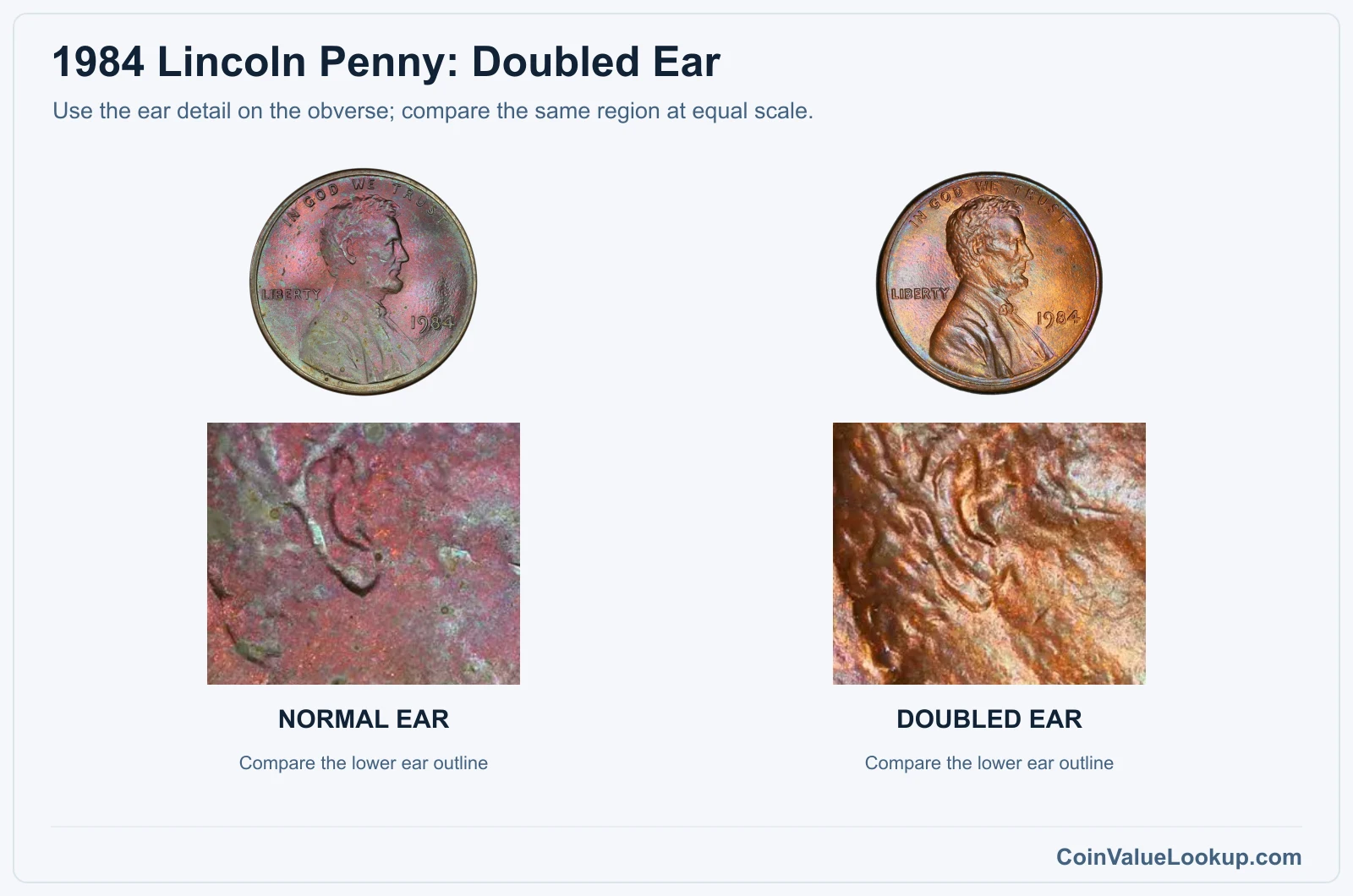
- The 1984 Doubled Ear variety (no mintmark, Philadelphia) carries a USA Coin Book guide estimate of $281 at MS65. Look for a clearly doubled lower ear outline, plus related doubling on the beard and bowtie.
- Uncirculated MS65 examples of the normal 1984 and 1984-D cents list around $0.36 each, while S proofs in PR65 are about $4.96, so only pristine or variety coins carry meaningful premiums.
- Significant mint errors such as off-center strikes, double strikes, and clipped planchets have sold individually at auction and should be evaluated on their own merits, not on the normal cent chart.
Step 1: Identify Your 1984 Lincoln Penny Mint Mark and Version
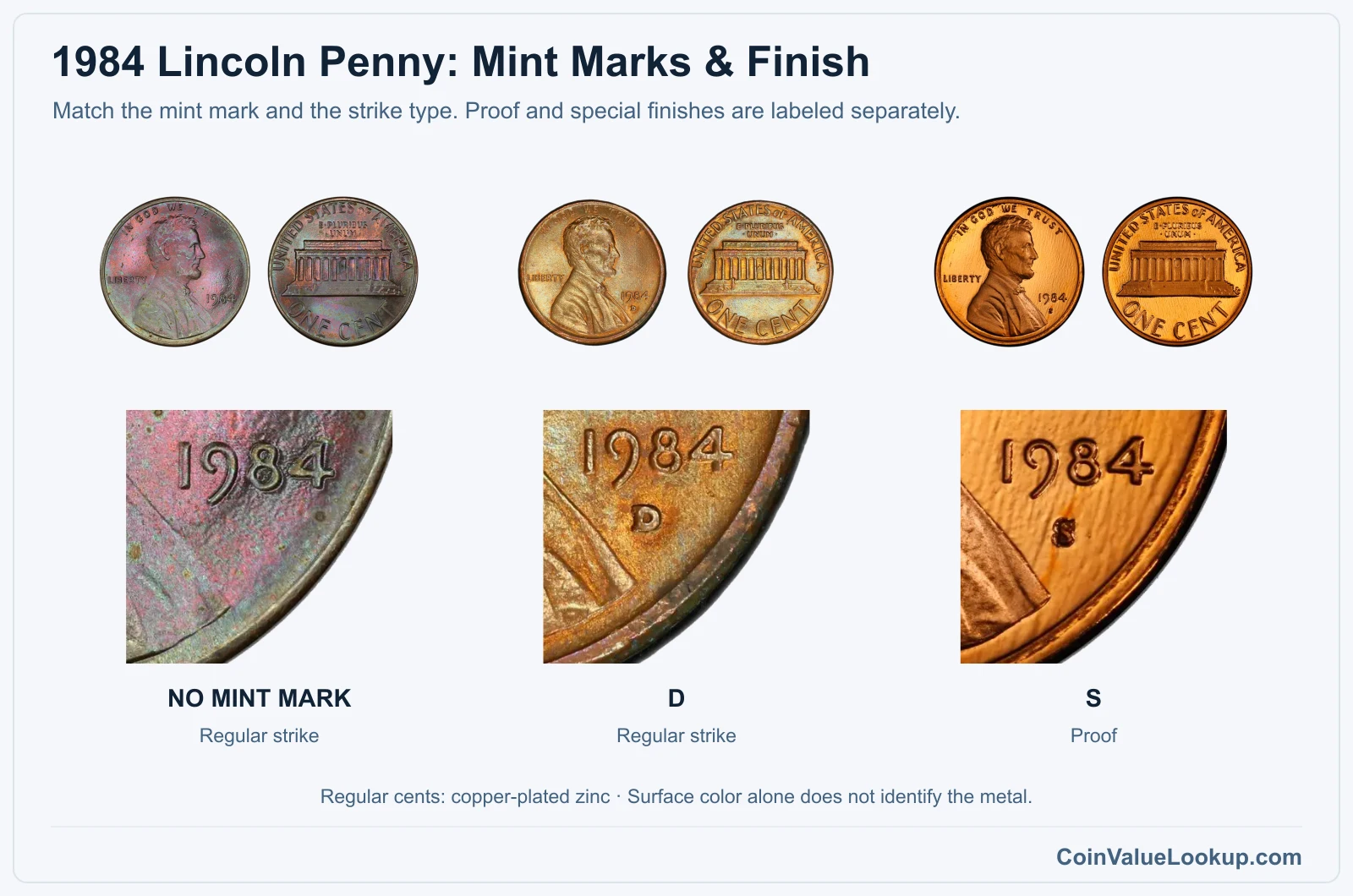
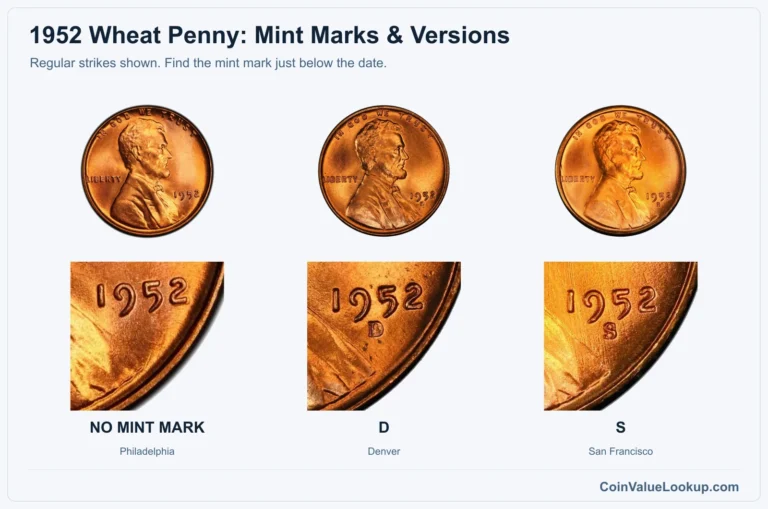
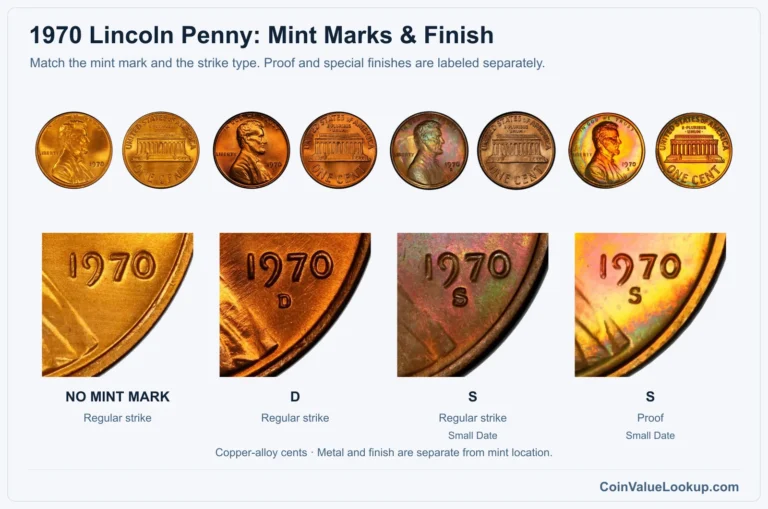
All 1984 Lincoln cents show Lincoln's portrait on the front and the Lincoln Memorial on the back. Flip the coin over and read the date, then look directly below it for a small letter.
No letter means Philadelphia, a D means Denver, and an S means it is a proof from San Francisco.
Every regular 1984 cent is copper-plated zinc, weighing about 2.50 grams. The copper color is just a thin plating layer, not solid bronze.
A shiny coin you found in pocket change is not a proof; proofs were specially struck at the San Francisco Mint with mirror-like surfaces and were sold in collector sets.
Before checking any value chart, decide whether your coin is a normal business strike, a genuine proof, or potentially the Doubled Ear variety. These are different branches with very different values.
Mixing them up is the fastest way to disappointment.
Step 2: Check Your 1984 Lincoln Penny Grade
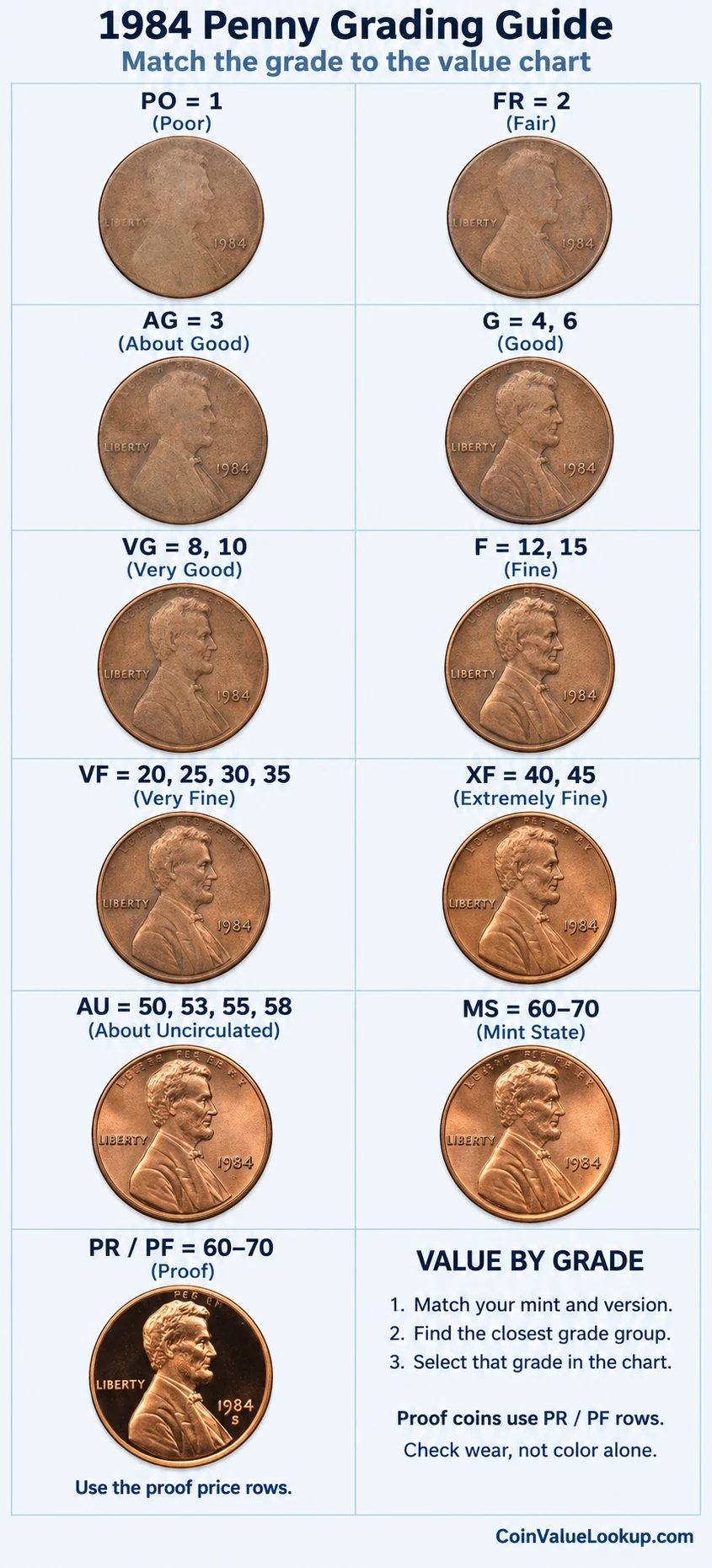
Start with Lincoln's cheekbone and jawline on the front. On a well-worn coin these areas flatten first, losing fine detail.
Hair strands above the ear disappear next. On the reverse, the Memorial's columns and horizontal lines at the base show wear early.
Don't confuse a weak strike with heavy wear. A weakly struck coin can still have original luster across the high points, while a worn coin loses that shine.
Color designations matter for uncirculated cents. BN means brown, RB is red-brown, and RD is full original red.
These labels describe toning, not condition. A brown MS65 and a red MS65 are the same grade but can differ in collector appeal.
Use the comparison image to match your coin's wear level. Cleaning a coin to make it look red again will damage the surface and reduce its value.
Corrosion, dark spots, and stripped plating all count against a coin's grade even if the underlying design is sharp.
Step 3: Check 1984 Lincoln Penny Value by Mint and Version
1984 Lincoln Penny — No Mint Mark — Normal Circulation Strike
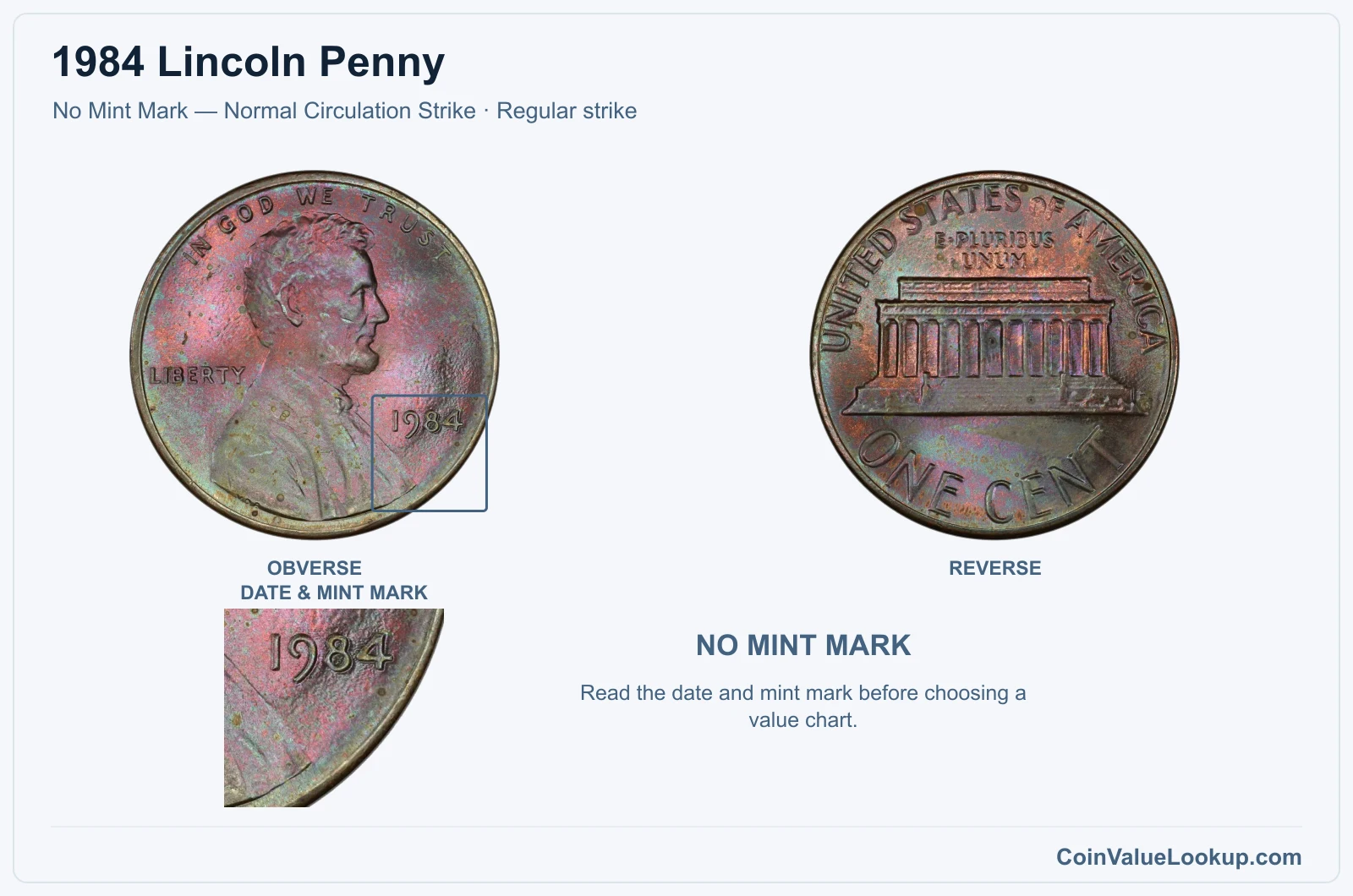
The 1984 Philadelphia cent has no mintmark below the date. It is the most common version of this year's penny and was struck in huge numbers for general circulation.
In typical worn condition these are worth face value. The USA Coin Book guide lists an MS65 example at $0.36.
To reach that level a coin needs full, sharp detail with original luster and minimal contact marks. If yours has any wear on Lincoln's cheek or jaw, it grades below Mint State and is a spender.
Range Grade
Price1984 No Mint Mark — Normal Circulation Strike (BN) Price1984 No Mint Mark — Normal Circulation Strike (RB) Price1984 No Mint Mark — Normal Circulation Strike (RD) Auction Records Appraisal PO PO 1
—
Coin Identifier FR FR 2
—
Coin Identifier AG AG 3
—
Coin Identifier G G 4
—
Coin Identifier
G 6
—
Coin Identifier VG VG 8
—
Coin Identifier
VG 10
—
Coin Identifier F F 12
—
Coin Identifier
F 15
—
Coin Identifier VF VF 20
—
Coin Identifier
VF 25
—
Coin Identifier
VF 30
—
Coin Identifier
VF 35
—
Coin Identifier XF XF 40
—
Coin Identifier
XF 45
—
Coin Identifier AU AU 50
—
Coin Identifier
AU 53
—
Coin Identifier
AU 55
—
Coin Identifier
AU 58
—
Coin Identifier MS MS 60
—
Coin Identifier
MS 61
—
Coin Identifier
MS 62
—
Coin Identifier
MS 63
—
Coin Identifier
MS 64
Coin Identifier
MS 65
Coin Identifier
MS 66
Coin Identifier
MS 67
—
Coin Identifier
MS 68
—
—
Coin Identifier
MS 69
—
—
Coin Identifier
MS 70
—
—
—
—
—
1984 Lincoln Penny — D — Normal Circulation Strike
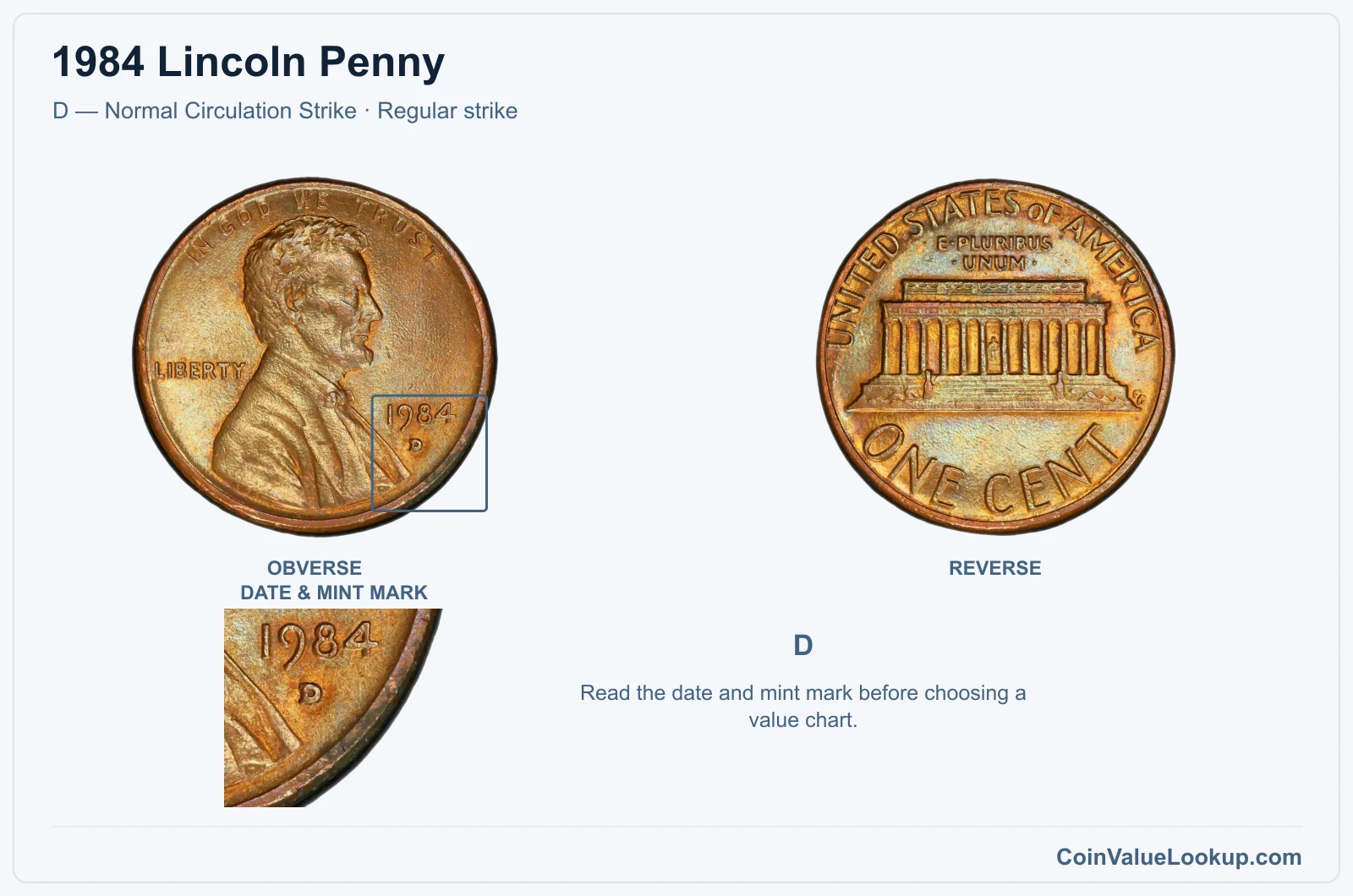
Look for the small D below the date. Denver struck its own enormous run of 1984 cents, and like the Philadelphia issue, circulated examples are worth one cent.
The USA Coin Book guide also lists the 1984-D at $0.36 in MS65. Finding one in that condition from pocket change is tough.
Most survivors show at least light wear. A truly gem example would need to come from an original roll or set that was stored carefully since 1984.
Range Grade
Price1984 D — Normal Circulation Strike (BN) Price1984 D — Normal Circulation Strike (RB) Price1984 D — Normal Circulation Strike (RD) Auction Records Appraisal PO PO 1
—
Coin Identifier FR FR 2
—
Coin Identifier AG AG 3
—
Coin Identifier G G 4
—
Coin Identifier
G 6
—
Coin Identifier VG VG 8
—
Coin Identifier
VG 10
—
Coin Identifier F F 12
—
Coin Identifier
F 15
—
Coin Identifier VF VF 20
—
Coin Identifier
VF 25
—
Coin Identifier
VF 30
—
Coin Identifier
VF 35
—
Coin Identifier XF XF 40
—
Coin Identifier
XF 45
—
Coin Identifier AU AU 50
—
Coin Identifier
AU 53
—
Coin Identifier
AU 55
—
Coin Identifier
AU 58
—
Coin Identifier MS MS 60
—
Coin Identifier
MS 61
—
Coin Identifier
MS 62
—
Coin Identifier
MS 63
—
Coin Identifier
MS 64
—
Coin Identifier
MS 65
Coin Identifier
MS 66
Coin Identifier
MS 67
Coin Identifier
MS 68
—
—
Coin Identifier
MS 69
—
—
Coin Identifier
MS 70
—
—
—
—
—
1984 Lincoln Penny — S — Proof
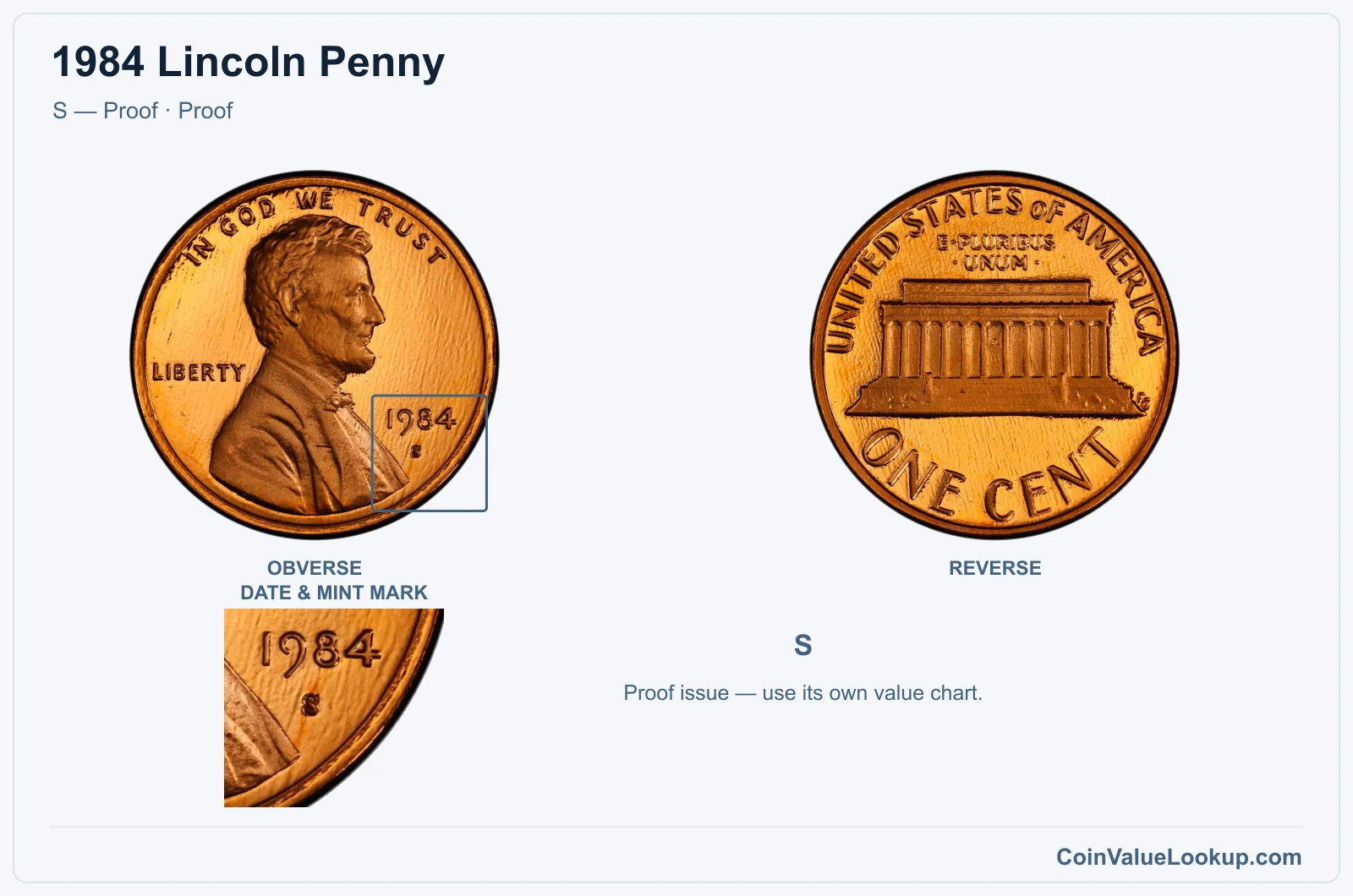
The 1984-S proof was made at the San Francisco Mint exclusively for collector sets. It carries an S mintmark below the date and has mirror-like fields with sharply struck devices.
These were never released into circulation.
The USA Coin Book guide places a PR65 at $4.96. Higher grades and cameo or deep-cameo designations can filter values further, but no specific cameo pricing was adopted here.
If your coin has an S but shows wear or dull surfaces, it may have been removed from its holder and mishandled, which hurts its appeal.
Range Grade
Price Auction Records Appraisal PR PR 1
—
Coin Identifier
PR 2
—
Coin Identifier
PR 3
—
Coin Identifier
PR 4
—
Coin Identifier
PR 6
—
Coin Identifier
PR 8
—
Coin Identifier
PR 10
—
Coin Identifier
PR 12
—
Coin Identifier
PR 15
—
Coin Identifier
PR 20
—
Coin Identifier
PR 25
—
Coin Identifier
PR 30
—
Coin Identifier
PR 35
—
Coin Identifier
PR 40
—
Coin Identifier
PR 45
—
Coin Identifier
PR 50
—
Coin Identifier
PR 53
—
Coin Identifier
PR 55
—
Coin Identifier
PR 58
—
Coin Identifier
PR 60
—
Coin Identifier
PR 61
—
Coin Identifier
PR 62
—
Coin Identifier
PR 63
—
Coin Identifier
PR 64
—
Coin Identifier
PR 65
—
Coin Identifier
PR 66
Coin Identifier
PR 67
—
Coin Identifier
PR 68
Coin Identifier
PR 69
Coin Identifier
PR 70
Coin Identifier
1984 Lincoln Penny — No Mint Mark — Doubled Ear
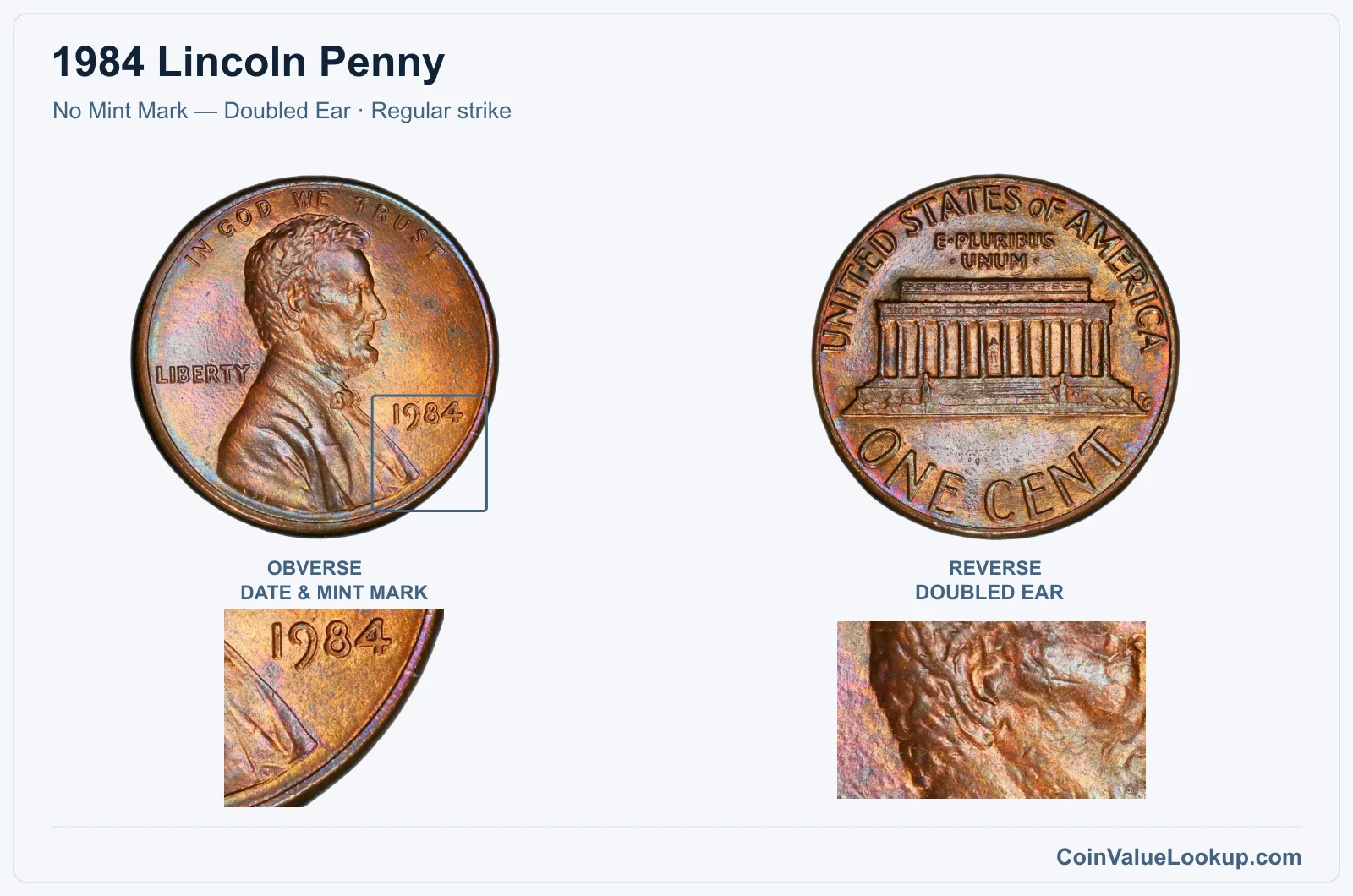
This is the one everyone searches for. The 1984 Doubled Ear variety is a Philadelphia coin, no mintmark, showing a clear second outline along the lower edge of Lincoln's ear.
The doubling also appears on parts of the beard and the bowtie knot, though the ear is the most obvious checkpoint.
The USA Coin Book guide estimates $281 at MS65, with color unspecified. That means the estimate is not specifically for a full-red example, and actual results can vary by color and surface quality.
Coin Value Lookup is a good starting point if you want to compare this variety against other Lincoln cent years and see which dates carry similar premiums.
Do not confuse machine doubling or plating blisters near the ear with a genuine doubled die. The real thing shows a consistent, shelf-like secondary image, not a mushy flat spread.
If in doubt, a third-party grading service can make the call.
Range Grade
Price1984 No Mint Mark — Doubled Ear (BN) Price1984 No Mint Mark — Doubled Ear (RB) Price1984 No Mint Mark — Doubled Ear (RD) Auction Records Appraisal PO PO 1
—
Coin Identifier FR FR 2
—
Coin Identifier AG AG 3
—
Coin Identifier G G 4
—
Coin Identifier
G 6
—
Coin Identifier VG VG 8
—
Coin Identifier
VG 10
—
Coin Identifier F F 12
—
Coin Identifier
F 15
—
Coin Identifier VF VF 20
—
Coin Identifier
VF 25
—
Coin Identifier
VF 30
—
Coin Identifier
VF 35
—
Coin Identifier XF XF 40
—
Coin Identifier
XF 45
—
Coin Identifier AU AU 50
—
Coin Identifier
AU 53
—
Coin Identifier
AU 55
Coin Identifier
AU 58
—
Coin Identifier MS MS 60
—
Coin Identifier
MS 61
—
Coin Identifier
MS 62
Coin Identifier
MS 63
Coin Identifier
MS 64
Coin Identifier
MS 65
Coin Identifier
MS 66
Coin Identifier
MS 67
Coin Identifier
MS 68
Coin Identifier
MS 69
—
—
—
—
—
MS 70
—
—
—
—
—
1984 Lincoln Penny Error List
1. 1984 Lincoln Penny — Doubled Ear Obverse
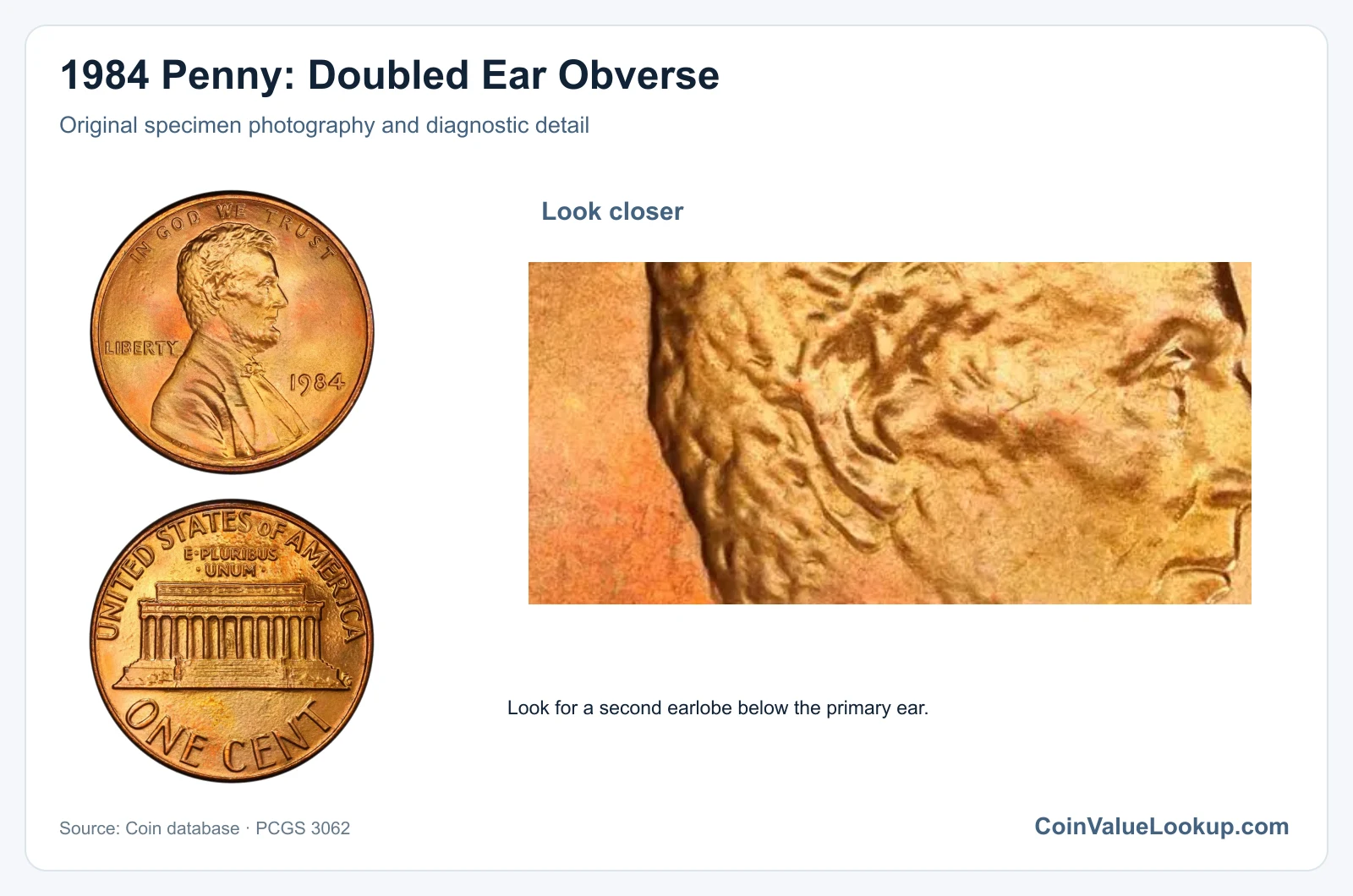
The 1984 Doubled Ear is a doubled die obverse found on Philadelphia (no mintmark) cents. The key diagnostic is an extra contour running along the south side of Lincoln's earlobe.
Tilt the coin under a light and look for a distinct secondary line that follows the ear's curve. Related doubling appears on the beard lines and the bowtie.
The USA Coin Book guide lists this at $281 in MS65, color unspecified. Condition, surface quality, and the degree of remaining original copper color all influence what a specific coin brings.
The biggest lookalike problem is machine doubling, which leaves a flat, shelf-like distortion without the raised secondary contour of a genuine doubled die. Plating blisters near the ear can also fool beginners.
If you see a slightly puffy ear but no consistent doubling on the beard or bowtie, be skeptical.
2. 1984 Lincoln Penny — Off-Center Strike
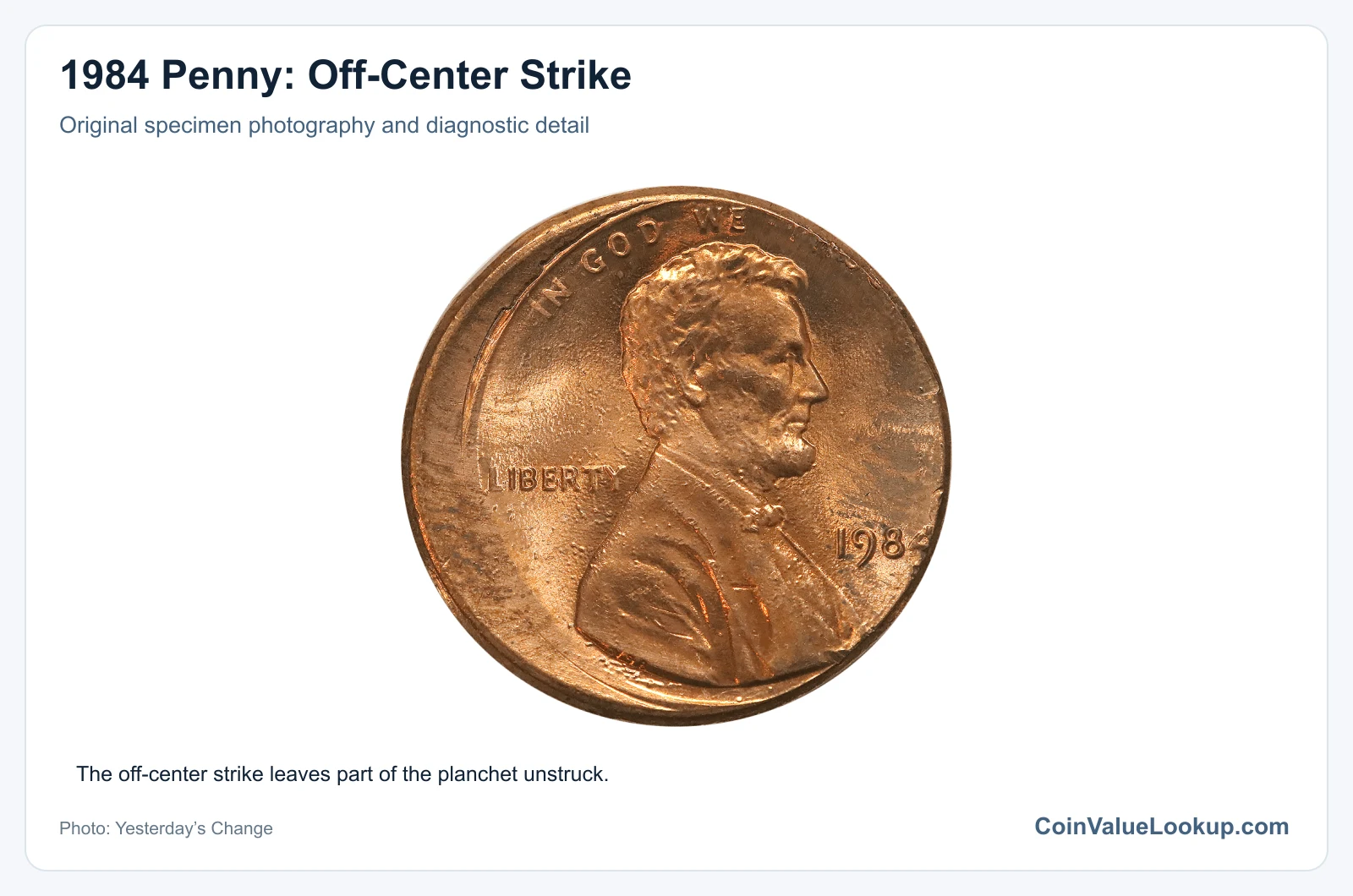
An off-center strike happens when the planchet isn't seated properly in the collar, leaving a blank crescent on one side of the coin. The more dramatic the shift, the more unusual the piece, but the date and mintmark must remain visible for it to attract serious collector interest.
A 1984-D cent struck 55% off center, graded PCGS MS61 RB, sold for $41 at Heritage Auctions in September 2024. That gives you a single data point, not a market range.
Your coin's value depends on the percentage of off-center shift, whether the date and D are fully legible, and overall condition.
Don't confuse a misaligned die, which shifts just one face slightly, with a true off-center error. Also watch for coins that were deliberately hammered or pressed after leaving the mint to fake the displaced look.
3. 1984 Lincoln Penny — Double Strike
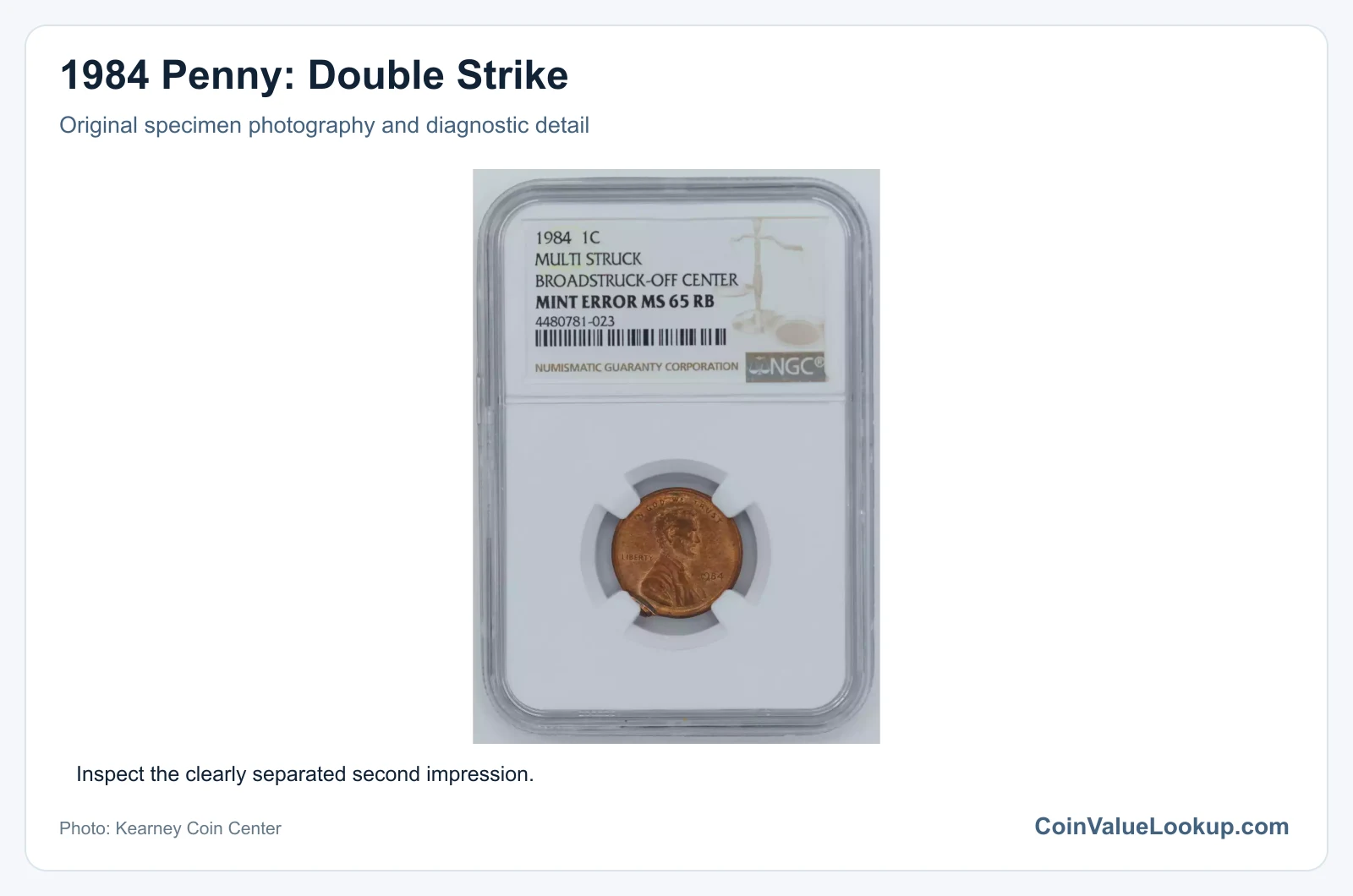
A double-struck coin received two separate impressions from the dies, leaving overlapping or displaced designs. On a flipover double strike the coin was flipped between hits, so you can see elements of one face superimposed on the other.
It is a dramatic and unmistakable error.
A 1984-D flipover double strike graded NGC MS62 RB sold for $456 at Heritage Auctions in September 2020. That is one auction result for one specific coin, not a blanket price for all double strikes.
The critical distinction: a doubled die repeats fine details in a localized area, while a double strike duplicates or rotates the entire design. If only one small feature looks doubled, you are probably looking at die doubling, not a second strike.
Genuine double strikes are obvious even to the naked eye.
4. 1984 Lincoln Penny — Clipped Planchet
A clipped planchet error occurs when the blank is punched from an area of strip that overlaps a previously punched hole, leaving a curved bite out of the finished coin. The missing section is formed before the coin is struck, so the remaining design flows toward the gap in a characteristic way called the Blakesley effect, where the rim opposite the clip is weak.
One 1984-D cent with three curved clips combined with an off-center strike, graded NGC MS63 RB, brought $156 at Heritage in October 2019. Because that coin carried multiple errors, do not treat $156 as a clip-only price.
Look carefully at the edge. Filed, cut, or corroded edges can mimic a clip.
A genuine clip has a smooth, curved boundary and shows design distortion consistent with the missing metal.
5. 1984 Lincoln Penny — Repunched Mintmark
A repunched mintmark results from the mintmark punch being applied more than once in slightly different positions on the working die. On a 1984 cent this would appear as a trace of a second D (or partial letter remnant) near the primary mintmark below the date.
The category has been reported for the 1984 cent, though no specific numerical price was adopted here. Value depends on the visibility of the repunch, the coin's grade, and overall eye appeal.
To check, examine the mintmark area under magnification and compare it to a known normal example at the same zoom level. Machine doubling can create a flat shelf around the letter, while die chips add shapeless lumps.
Corrosion or environmental damage near the mark can also mimic a repunch. A true repunched mintmark shows a distinct, separately positioned letter image.
6. 1984 Lincoln Penny — BIE Die Break
A BIE error is a specific type of die break that leaves a raised vertical line between the letters B and E in LIBERTY. It forms when a small piece of the die surface cracks and falls away, allowing metal to fill the void during striking.
This category has been reported for the 1984 cent. No numerical price was adopted, so value depends on the size and clarity of the break, the coin's overall condition, and collector demand for die-break varieties.
Look between the B and E under magnification. A genuine BIE is a raised, roughly vertical bar that is part of the coin's surface.
Dirt lodged between letters, surface scratches, or glued debris can look similar but won't have the same raised, metallic character as a true die break.
7. 1984 Lincoln Penny — Unplated / Partly Unplated Planchet
An unplated or partly unplated 1984 cent is one that was struck on a zinc planchet missing some or all of its copper plating. Since normal 1984 cents are copper-plated zinc, a missing-plating error gives the coin a dull gray or silvery appearance instead of the expected copper tone.
No specific price was adopted for this category. The coin's value depends on how much plating is absent, whether the error is clearly mint-made, and the coin's condition.
The main lookalike is a normal cent that has had its plating chemically stripped or worn away through environmental damage after leaving the mint. Weight can help: a fully plated and an unplated zinc cent weigh very close to the same, but edge examination under magnification can reveal whether plating was ever present.
Corrosion on zinc cents is common and should not be mistaken for a plating error.
8. 1984 Lincoln Penny — Die Break / Cud
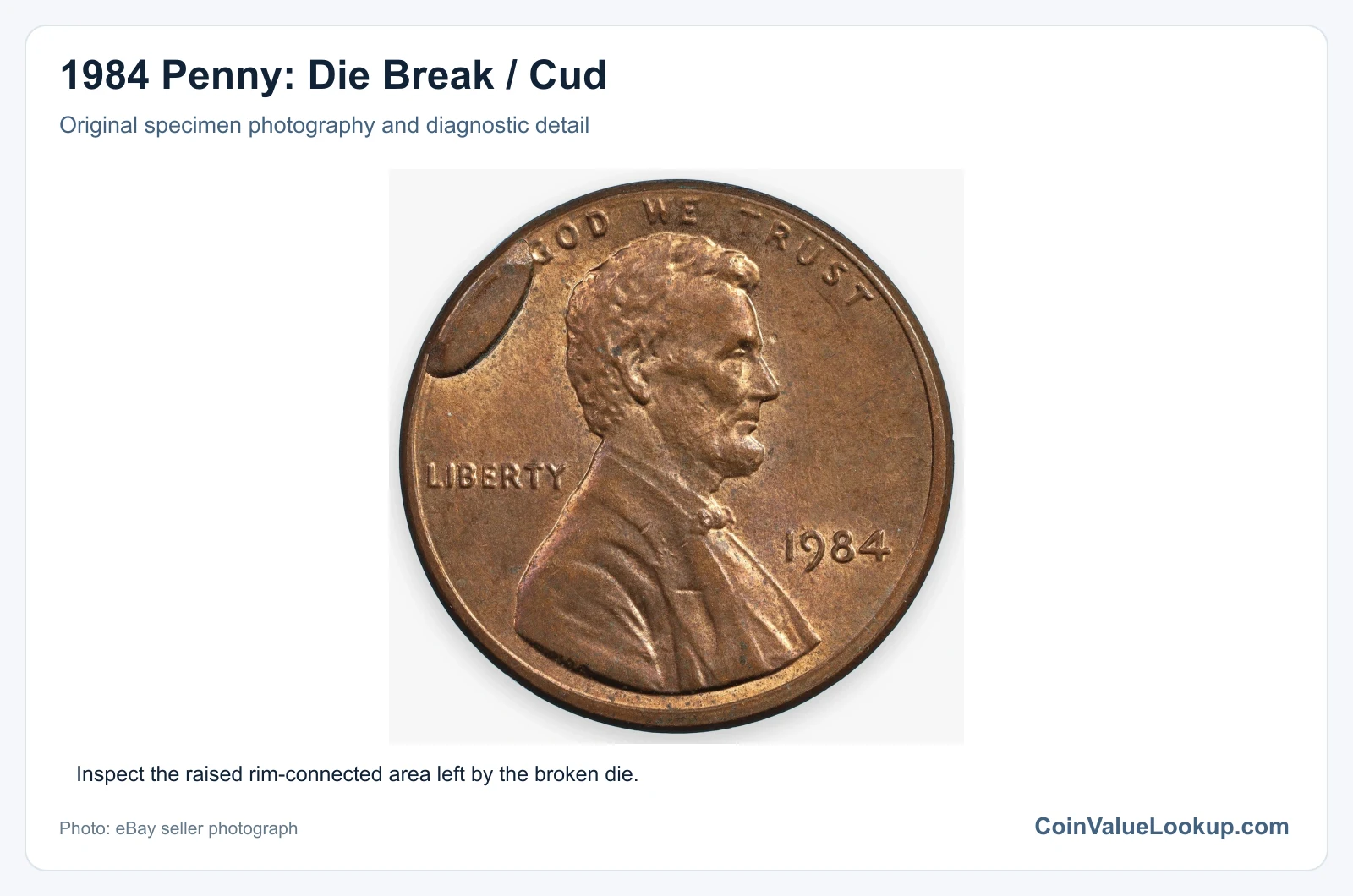
A die break, or cud, happens when a chunk of the die fractures away. On the struck coin this appears as a raised, featureless blob.
A true cud connects to the rim, while smaller interior breaks are called retained die breaks or die chips.
This category has been reported for the 1984 cent. No numerical price was adopted, so value varies based on the size and location of the break and the coin's grade.
Check the coin's rim and nearby design for a smooth, raised lump that replaces normal detail. Compare both sides: a cud affects only the side whose die was damaged.
A rim dent or post-mint damage pushes metal inward and disrupts the opposite face, while a cud stands proud of the surface and has clearly defined die-break boundaries.
9. 1984 Lincoln Penny — Struck on a Bronze Planchet
A 1984 cent struck on a bronze (copper-alloy) planchet would mean the coin was produced on leftover pre-1982 stock instead of the standard copper-plated zinc blank. The category has been reported for the 1984 cent, though no rarity claim or numerical price was adopted.
The key diagnostic is weight. A normal 1984 copper-plated zinc cent weighs about 2.50 grams, while a solid bronze planchet would weigh roughly 3.1 grams.
An accurate scale is essential because the difference is small but measurable.
The biggest lookalike trap is a normal zinc cent that simply looks more coppery than usual, since the plating is copper. A suspiciously heavy reading from an inaccurate household scale can also mislead.
Professional authentication is important for any bronze-planchet claim because altering a coin's weight or appearance is not difficult.