1900 Indian Head Penny Coin Value: How Much Is It Worth?
The 1900 Indian Head penny is a common-date Philadelphia issue that still draws collector interest at every grade level. A guide estimate from USA Coin Book places a well-worn example around $2.50 at G4, while an uncirculated piece at MS63 runs roughly $81.
Proofs, major die varieties, and mint errors require separate evaluation beyond those benchmarks.
Fast Way to Identify Your 1900 Indian Head Penny
Want a quick read on your 1900 Indian Head cent? Upload clear photos of the front and back, and the identifier can offer a preliminary look at your coin's version and approximate condition.
It is not a substitute for professional authentication or certified grading, but it is a solid starting point before you dig deeper.
1900 Indian Head Penny Value
Upload both sides of your 1900 Indian Head Penny.
Front Obverse
Upload photo
Back Reverse
Upload photo
Which 1900 Indian Head Penny Versions Are Worth Money?
- The 1900 proof has a USA Coin Book guide value around $313 at PR63, well above the business-strike range, so confirming proof status is worth the effort.
- Business strikes in original uncirculated condition with strong remaining copper color bring a clear premium over circulated examples.
- Doubled die reverse, repunched date, and misplaced date varieties have been documented for this year and can add value when authenticated.
- Off-center strikes, wrong-planchet errors, and die breaks (cuds) are reported and individually assessed based on severity and condition.
Step 1: Identify Your 1900 Indian Head Penny Mint Mark and Version
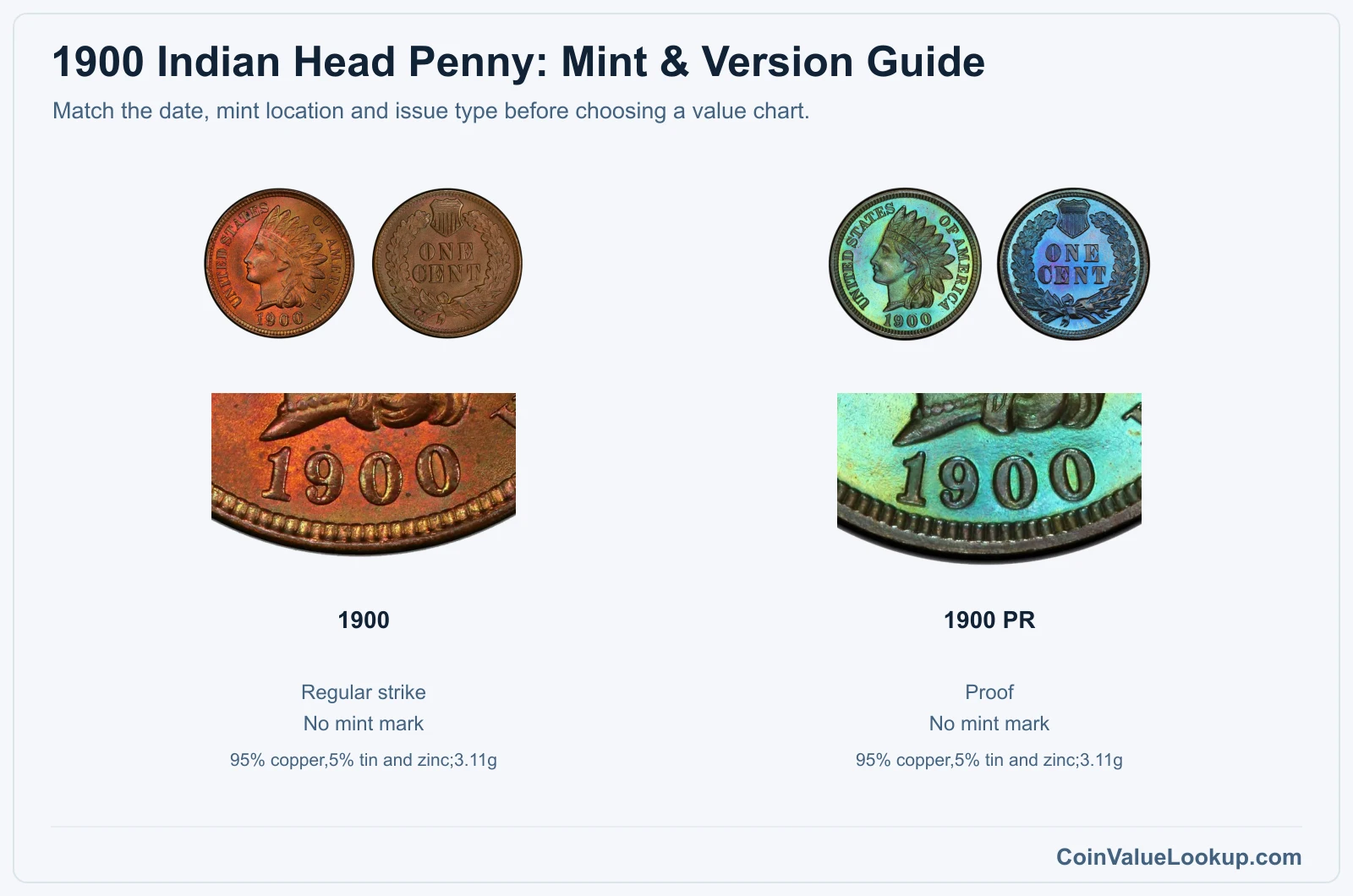
Every regular 1900 Indian Head cent was struck at the Philadelphia Mint. There is no mintmark on this coin, and the small "L" you may spot on the ribbon behind the portrait is the designer's initial, not a mintmark.
The obverse shows a Liberty head wearing a feathered headdress with the word LIBERTY spelled across the headband. The reverse features an oak wreath enclosing the denomination, topped by a small shield.
If your coin has a wheat-ear reverse or a different portrait, you are looking at a Lincoln cent or another series entirely.
This year comes in two manufacturing types: the standard business strike made for everyday commerce, and the proof, a specially produced coin with polished dies and carefully handled planchets. A proof is not simply a high-grade coin.
Mirrored surfaces alone do not confirm proof origin; rim geometry, strike sharpness, and provenance all matter. A cleaned or polished business strike can mimic reflective fields, so authentication is important before assigning proof status.
The metal composition is 95% copper with 5% tin and zinc, weighing 3.11 grams. Bronze toning designations like BN, RB, and RD describe how much original copper color remains, not a different alloy.
Step 2: Check Your 1900 Indian Head Penny Grade
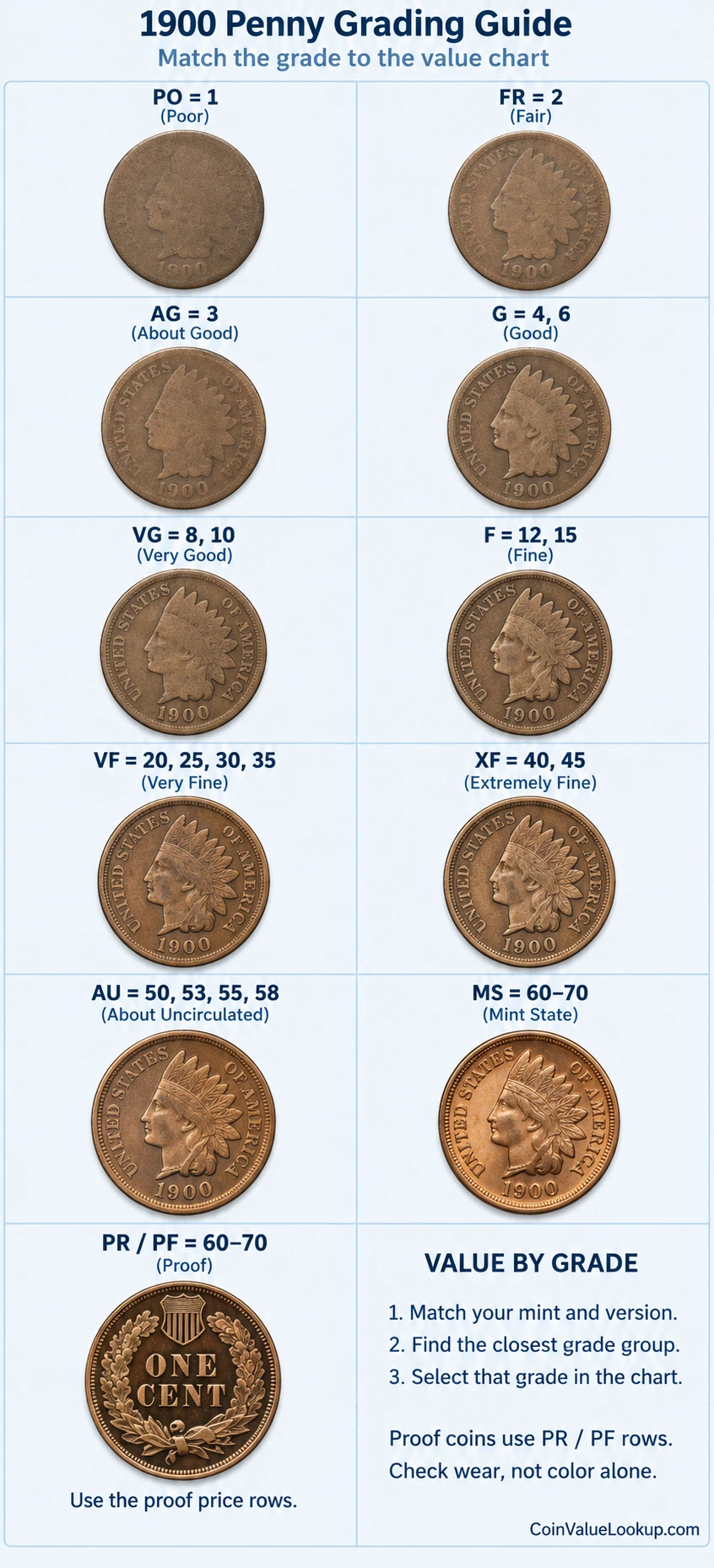
Start with the headband. On a well-worn coin the word LIBERTY will be partially or fully gone; on a higher-grade piece every letter is sharp and complete.
That said, do not grade from LIBERTY alone.
Check the feather tips above the headdress and the hair curls below the ear. These are high points that show wear first.
On the reverse, look at the leaves near the top of the wreath and the shield detail.
A soft original strike from the mint can leave feathers and hair looking mushy even on an unworn coin. Compare your coin to the grading reference image to separate strike weakness from actual circulation wear.
Luster matters at the upper end. An MS63 coin should show original mint bloom across most surfaces with only minor contact marks.
Any signs of cleaning, tooling, or artificial toning will hurt desirability regardless of remaining detail.
Retaining original red copper color pushes value higher at uncirculated grades, while a fully brown coin at the same technical grade typically sells for less.
Step 3: Check 1900 Indian Head Penny Value by Mint and Version
1900 Indian Head Penny
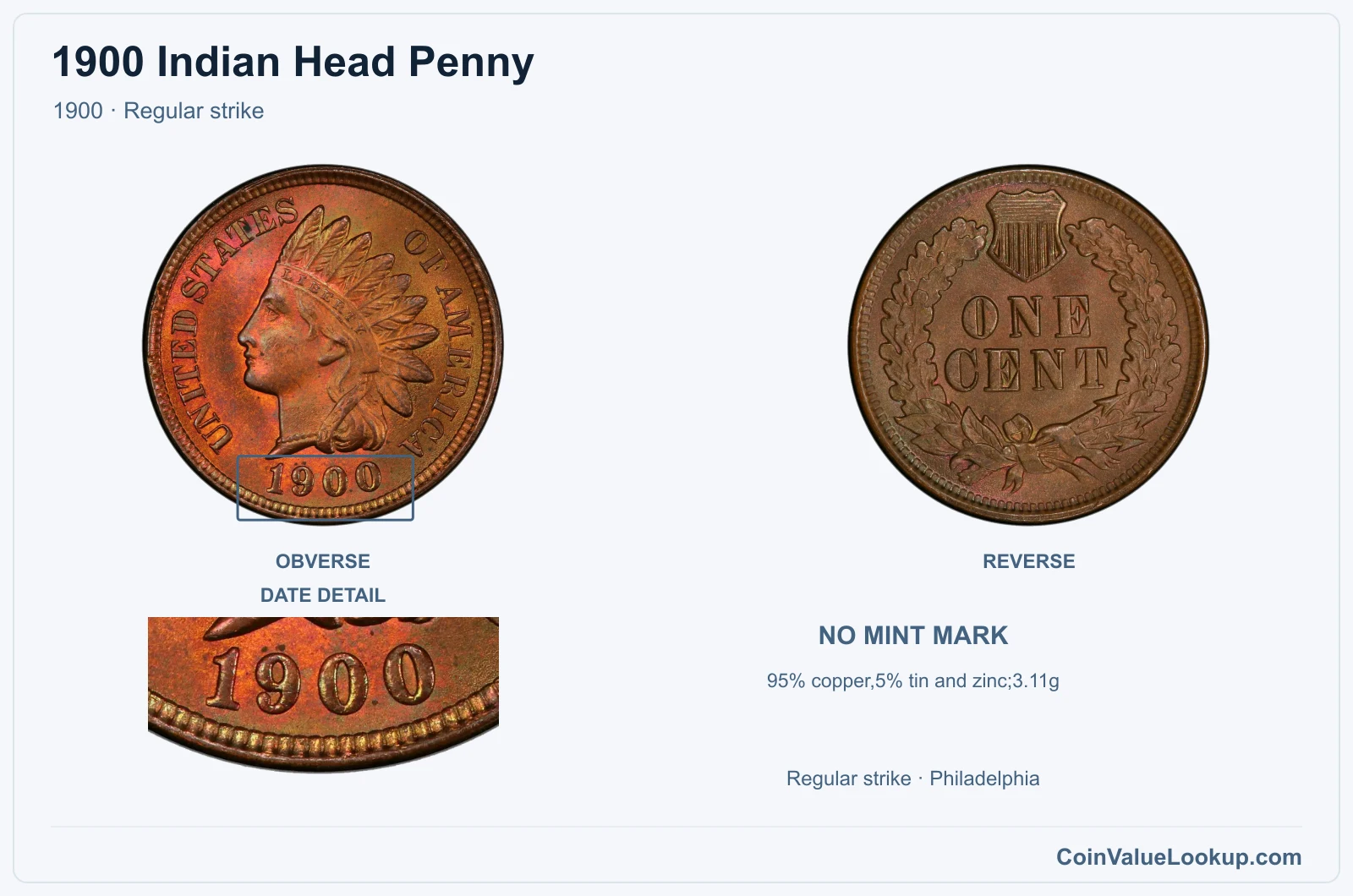
The regular 1900 Indian Head cent is a Philadelphia business strike on a bronze planchet weighing 3.11 grams. No mintmark appears on the coin.
USA Coin Book lists a guide value near $2.50 in G4, a grade where LIBERTY on the headband is mostly worn away, and around $81 at MS63, where full detail and original luster remain with only minor marks.
Coin Value Lookup is a handy place to look up guide values for this and other Indian Head cent dates when you are sorting through a collection or comparing what you have.
Original surfaces matter here. A cleaned coin or one with environmental damage will trade below these guide figures even if the remaining detail looks decent.
Compare like-grade, problem-free examples before setting expectations.
| Range | Grade | Price | Auction Records | Appraisal |
|---|---|---|---|---|
| PO | PO 1 | — | Coin Identifier | |
| FR | FR 2 | — | Coin Identifier | |
| AG | AG 3 | — | Coin Identifier | |
| G | G 4 | — | Coin Identifier | |
| G 6 | — | Coin Identifier | ||
| VG | VG 8 | — | Coin Identifier | |
| VG 10 | — | Coin Identifier | ||
| F | F 12 | — | Coin Identifier | |
| F 15 | — | Coin Identifier | ||
| VF | VF 20 | — | Coin Identifier | |
| VF 25 | — | Coin Identifier | ||
| VF 30 | — | Coin Identifier | ||
| VF 35 | Coin Identifier | |||
| XF | XF 40 | Coin Identifier | ||
| XF 45 | Coin Identifier | |||
| AU | AU 50 | — | Coin Identifier | |
| AU 53 | — | Coin Identifier | ||
| AU 55 | — | Coin Identifier | ||
| AU 58 | Coin Identifier | |||
| MS | MS 60 | — | Coin Identifier | |
| MS 61 | — | Coin Identifier | ||
| MS 62 | — | Coin Identifier | ||
| MS 63 | Coin Identifier | |||
| MS 64 | Coin Identifier | |||
| MS 65 | Coin Identifier | |||
| MS 66 | Coin Identifier | |||
| MS 67 | — | Coin Identifier | ||
| MS 68 | — | — | — | |
| MS 69 | — | — | — | |
| MS 70 | — | — | — |
1900 Indian Head Penny — PR
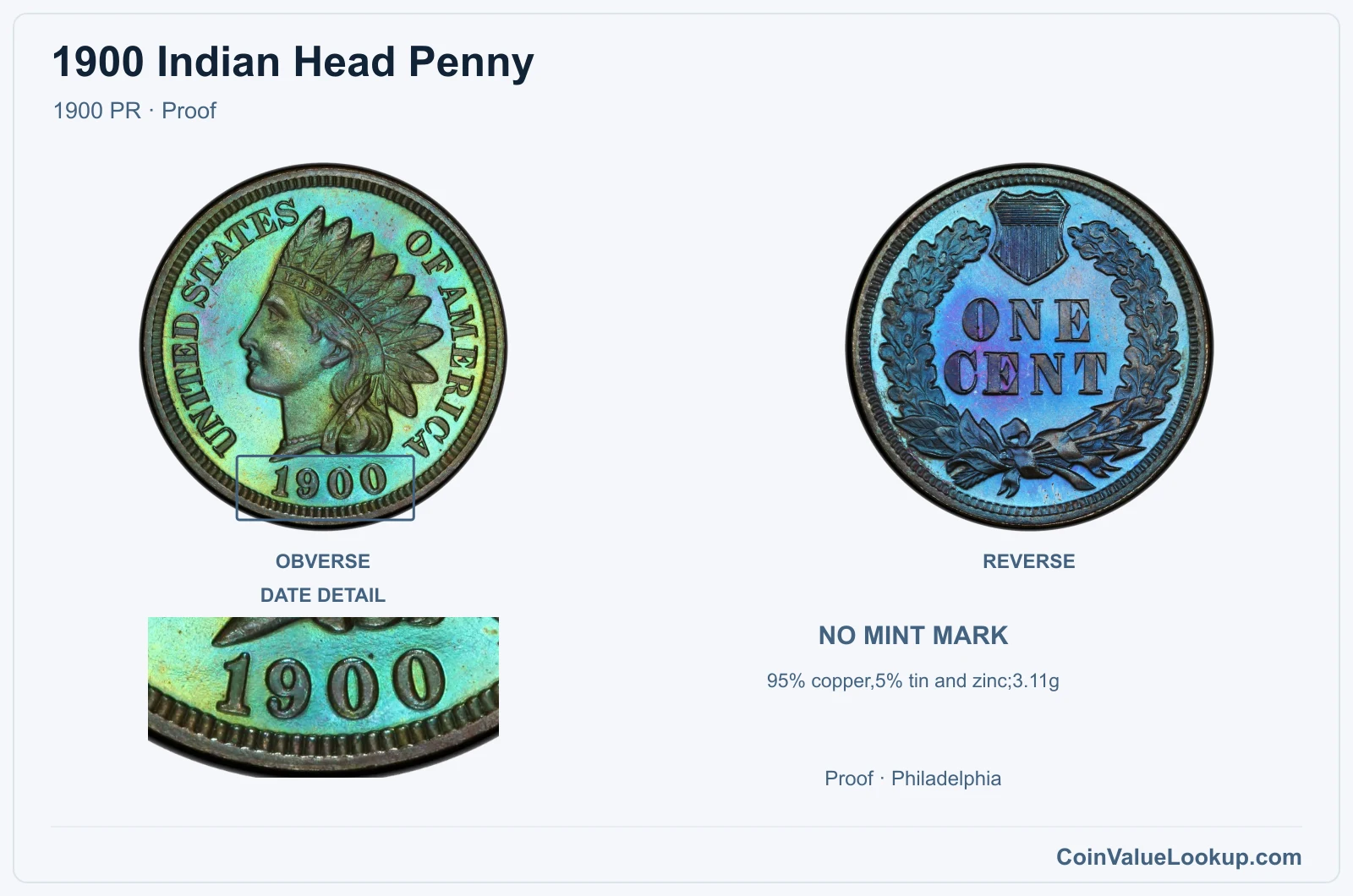
The 1900 proof Indian Head cent was a limited production coin struck at Philadelphia on the same bronze composition as the business issue. USA Coin Book places a PR63 example at roughly $313.
Proof Indian cents were made with polished dies and hand-fed planchets, producing sharp strikes and mirror-like fields. The rims tend to be squared and well-defined compared to the rounded rims typical of business strikes.
Do not assume any shiny Indian cent is a proof; years of polishing a business strike can create a superficially similar look.
Authentication by a recognized grading service is the reliable way to confirm proof manufacture. Color retention also matters at auction, and a proof with original red-orange surfaces will typically bring more attention than a fully toned brown example at the same certified grade.
| Range | Grade | Price | Auction Records | Appraisal |
|---|---|---|---|---|
| PR | PR 1 | — | Coin Identifier | |
| PR 2 | — | Coin Identifier | ||
| PR 3 | — | Coin Identifier | ||
| PR 4 | — | Coin Identifier | ||
| PR 6 | — | Coin Identifier | ||
| PR 8 | — | Coin Identifier | ||
| PR 10 | — | Coin Identifier | ||
| PR 12 | — | Coin Identifier | ||
| PR 15 | — | Coin Identifier | ||
| PR 20 | — | Coin Identifier | ||
| PR 25 | — | Coin Identifier | ||
| PR 30 | — | Coin Identifier | ||
| PR 35 | — | Coin Identifier | ||
| PR 40 | — | Coin Identifier | ||
| PR 45 | — | Coin Identifier | ||
| PR 50 | — | Coin Identifier | ||
| PR 53 | — | Coin Identifier | ||
| PR 55 | — | Coin Identifier | ||
| PR 58 | — | Coin Identifier | ||
| PR 60 | Coin Identifier | |||
| PR 61 | Coin Identifier | |||
| PR 62 | — | Coin Identifier | ||
| PR 63 | Coin Identifier | |||
| PR 64 | Coin Identifier | |||
| PR 65 | Coin Identifier | |||
| PR 66 | Coin Identifier | |||
| PR 67 | Coin Identifier | |||
| PR 68 | — | — | — | |
| PR 69 | — | — | — | |
| PR 70 | — | — | — |
1900 Indian Head Penny Error List
1. 1900 Indian Head Penny — Doubled Die Reverse
A doubled die reverse on the 1900 Indian Head cent shows extra design contours or lettering on the wreath side of the coin. To check, compare your reverse legends and wreath elements closely against a known normal example under magnification.
The doubling originates in the die-making process and will appear consistently across the entire affected area, not just one or two letters.
Machine doubling is the most common lookalike. It tends to produce flat, shelf-like displacement on raised elements rather than the rounded secondary image of a true doubled die.
Random scratches and light reflections can also trick the eye at lower magnification. No supported price range is available for this variety; value depends on authenticated identity, the strength of the doubling, and the coin's overall condition.
2. 1900 Indian Head Penny — Misplaced Date
A misplaced date occurs when partial impressions of one or more date digits appear somewhere they do not belong, such as embedded in the denticles along the rim or partially tucked into the portrait area away from the final date position. On a 1900 cent, look carefully at the border area near the date for faint outlines of a numeral.
Die chips, minor scratches, and random bumps can look similar under low magnification, so compare any suspected digit fragment against the known shape and serif style of the 1900 numerals. The partial impression should match a recognizable portion of a specific digit.
No supported price range is available. Each example is individually assessed based on authentication, clarity of the misplaced digit, and the coin's grade.
3. 1900 Indian Head Penny — Repunched Date
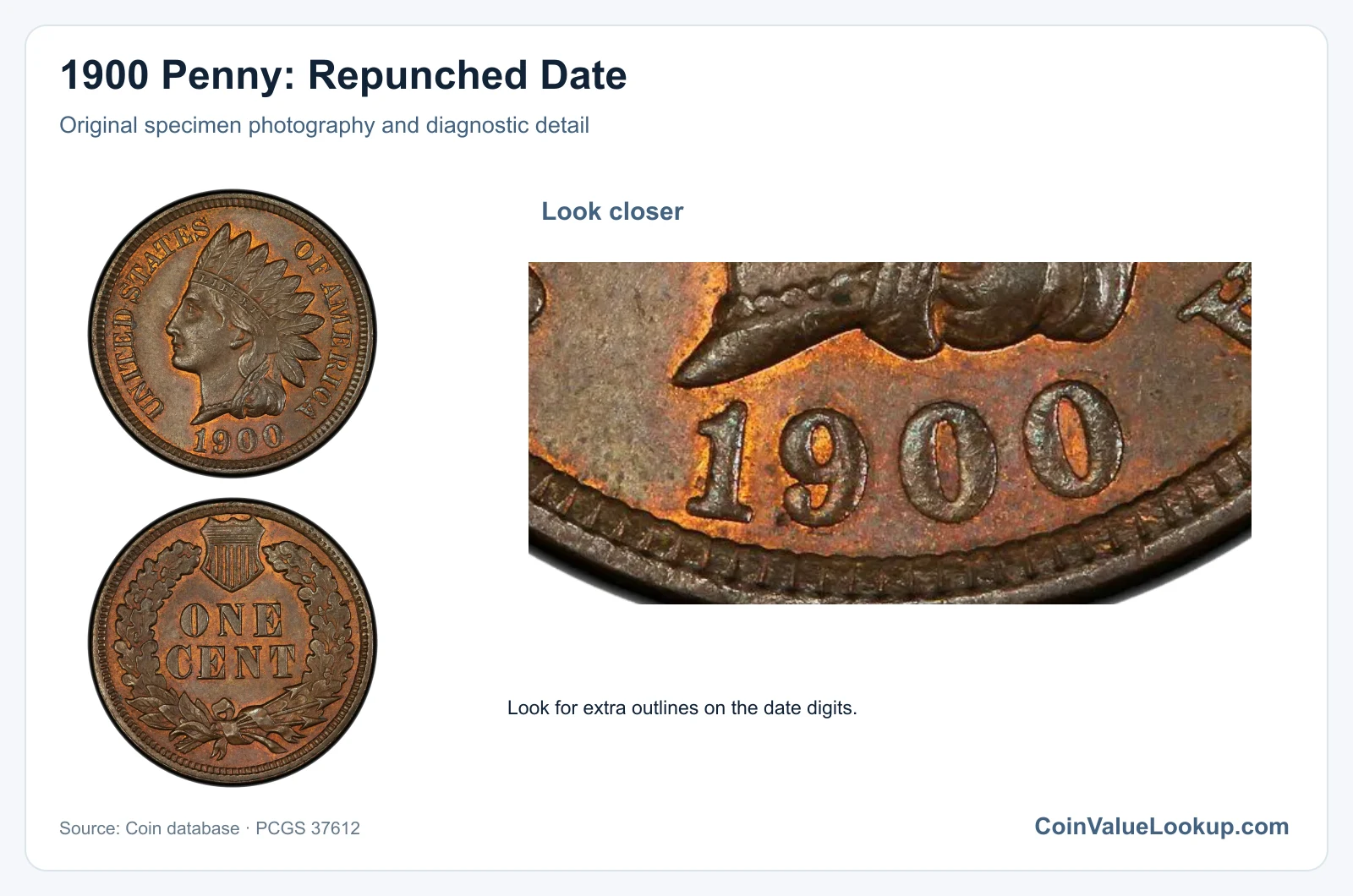
A repunched date shows traces of an earlier punch position beside or overlapping the final date numerals. On a 1900 cent, you might see a shadow or partial outline next to one or more digits, most visible at the tops or bases of the numbers.
This is distinct from a doubled die, which affects the entire design from hub doubling. A repunched date is limited to the date area because individual numeral punches were repositioned during die preparation.
Look for consistent extra serif marks or partial numeral shapes that do not match random damage.
Damaged dates and machine doubling are common lookalikes. Damage tends to be irregular and directionally inconsistent, while machine doubling usually shows flat shelf-like distortion.
No adopted price range exists; value is assessed individually by authentication, visibility of the repunching, and overall coin condition.
4. 1900 Indian Head Penny — Die Crack
Die cracks appear as raised lines running across the surface of the coin. They form when a working die develops a fracture from repeated use and stress.
On a 1900 Indian cent, a crack may cross open fields, cut through lettering, or run along the rim.
The key diagnostic: the line is raised, not incuse. A scratch or scrape cuts into the metal and sits below the surface.
A die crack pushes metal up. Run a fingernail or a toothpick across the line if magnification is not conclusive.
Corrosion lines and displaced-metal scrapes are common lookalikes. Neither will show the clean, continuous raised profile of a genuine crack.
No supported price range is adopted for this category; significance depends on size, location, and the coin's overall condition, assessed on a case-by-case basis.
5. 1900 Indian Head Penny — Wrong Planchet / Off-Metal Strike
A wrong-planchet or off-metal strike means the 1900 Indian cent dies struck a blank intended for a different denomination or composition. Because the planchet is wrong, the coin's weight, diameter, or edge will differ from the standard 3.11-gram bronze specification.
To check, weigh your coin on a precision scale and measure its diameter. If it deviates significantly from normal and the design is complete or nearly so, a wrong-planchet error is possible.
Incomplete design coverage may indicate the blank was smaller than intended.
Plating, corrosion, acid damage, and deliberate alteration can all change a coin's appearance and apparent metal. These are the most common sources of confusion.
Professional authentication is essential for any suspected off-metal strike. No supported price range is available; each example is valued individually based on confirmed identity, the host planchet, and condition.
6. 1900 Indian Head Penny — Double / Multiple Strike
A double or multiple strike shows two or more separate impressions of the design on the same planchet, typically displaced or rotated from one another. On a 1900 Indian cent, look for a second distinct image of the portrait or wreath shifted away from the primary strike.
This is different from a doubled die, where the doubling is baked into the die itself and appears identically on every coin from that die. A double strike affects only the individual coin because it was struck more than once in the press.
The two impressions may overlap partially or sit far apart.
Lookalikes include doubled dies and post-mint impressions made outside the Mint. No supported price range exists; value depends on authentication, the degree of displacement, and whether key design elements like the date remain visible.
7. 1900 Indian Head Penny — Off-Center Strike
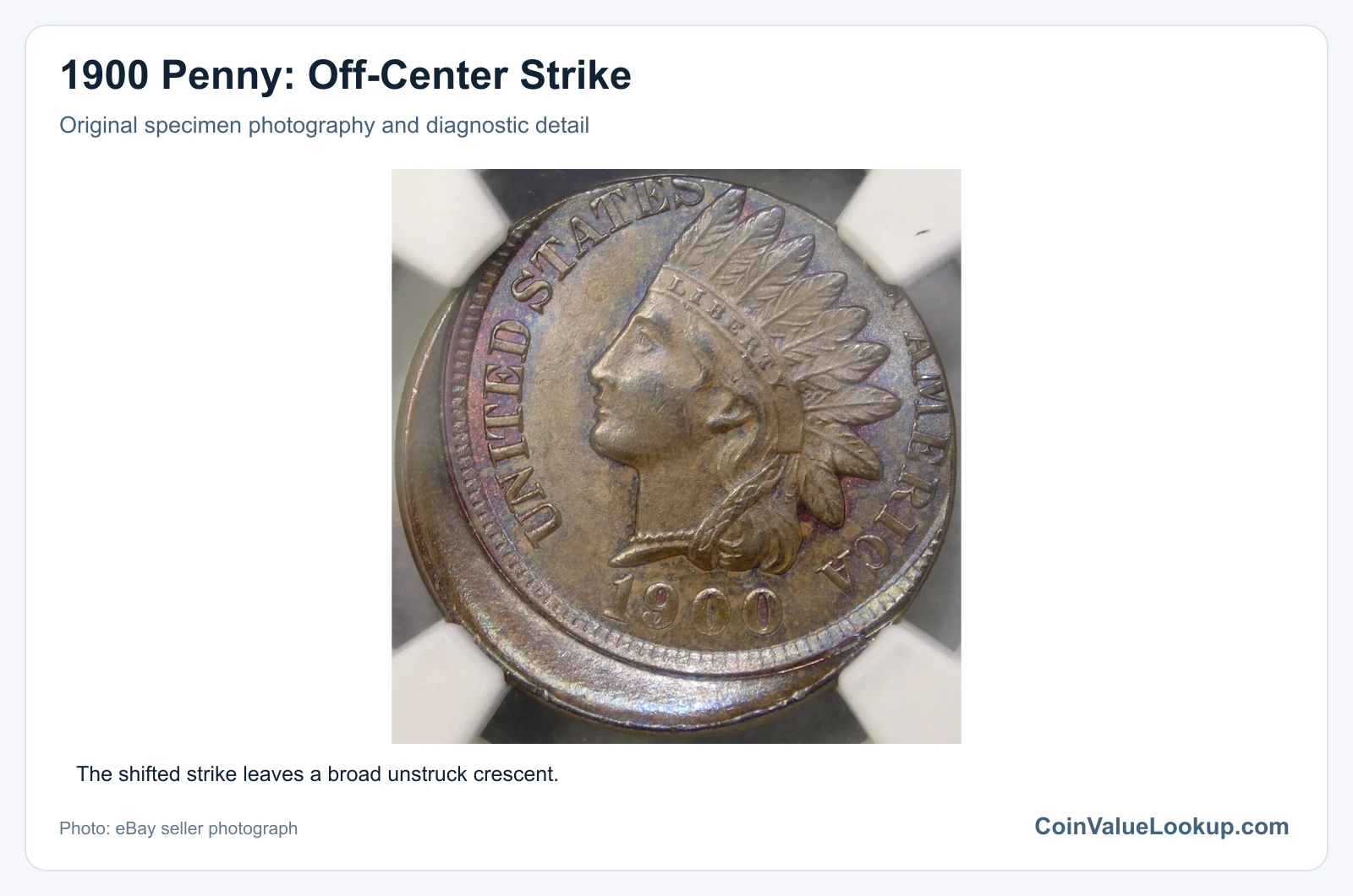
An off-center strike happens when the planchet is not properly seated between the dies, so the design is shifted to one side and an unstruck crescent of blank metal appears on the opposite edge. On a 1900 Indian cent, the percentage of offset and whether the date is still visible are the two biggest factors collectors care about.
A coin struck 10% off-center with a full date is more collectible than one struck 50% off with the date missing. Look for the blank crescent: it should be smooth, not clipped or filed.
Lookalikes include clipped planchets, which show a curved bite from the blank rather than a shifted design, and coins flattened after leaving the Mint. No adopted price range is available; each piece is assessed individually based on authentication, percentage of offset, date visibility, and overall condition.
8. 1900 Indian Head Penny — Broadstrike
A broadstrike occurs when the collar die that normally constrains the planchet is absent or not engaged during striking. The result is a coin that spreads outward, appearing wider than normal with a distorted or missing rim.
The design is centered but the edge lacks the usual containment.
On a 1900 Indian cent, compare the diameter and edge profile to a normal example. A broadstruck coin should still show a complete, centered design but with noticeable metal spread beyond the standard diameter.
The edge will look rounded or irregular instead of sharply defined.
Post-mint flattening from a vise or hammer can mimic a broadstrike, but usually distorts the design unevenly. Off-center strikes move the design to one side, which is a separate category.
No supported price range is adopted; each broadstrike is individually valued based on its authenticated identity, spread, and condition.
9. 1900 Indian Head Penny — Die Break / Cud
A die break that connects to the rim produces a raised blob of metal called a cud. It happens when a chunk of the die physically breaks away, leaving a void that fills with metal under striking pressure.
On a 1900 Indian cent, a cud will appear as a raised, featureless lump along the rim, replacing whatever design element was in that area.
Smaller interior die breaks that do not reach the rim also exist but are not technically cuds. Both show a raised area where normal design detail is missing.
Lookalikes include rim dents from post-mint damage, which push metal inward rather than raising it, and corrosion buildups, which have a different texture. No supported price range is available; cuds are assessed individually based on size, location, sharpness, and the coin's overall grade.