1958 Jefferson Nickel Coin Value: How Much Is It Worth?
The 1958 Jefferson Nickel is a common mid-century issue that most people will find in pocket change or old jars. Worn examples carry only modest collector value.
Uncirculated pieces are more interesting, with USA Coin Book guide estimates ranging from about $0.49 at MS60 up to $30 at MS65 depending on mint and condition. Proof and rare error coins follow their own separate pricing.
Fast Way to Identify Your 1958 Jefferson Nickel
The quickest way to start figuring out what your 1958 nickel is worth is to upload clear photos of the front and back. Our identification tool uses those images for a preliminary look at the mint, finish, and general condition of your coin.
It is not a substitute for professional authentication or certified grading, but it gives you a solid starting point.
1958 Jefferson Nickel Value
Upload both sides of your 1958 Jefferson Nickel.
Front Obverse
Upload photo
Back Reverse
Upload photo
Which 1958 Jefferson Nickel Versions Are Worth Money?
- The 1958 Philadelphia business strike in MS65 condition lists around $30 in the USA Coin Book guide, making gem examples the most rewarding regular-issue pieces to find.
- A 1958 nickel struck on a silver dime planchet sold for $646.25 at Heritage Auctions in October 2012, graded NGC MS65. Confirm the undersized blank and silver composition before assuming you have one.
- The 1958-D/D Inverted D repunched mintmark variety can carry a premium. Look for traces of a second, inverted D beneath or overlapping the primary mintmark.
Step 1: Identify Your 1958 Jefferson Nickel Mint Mark and Version
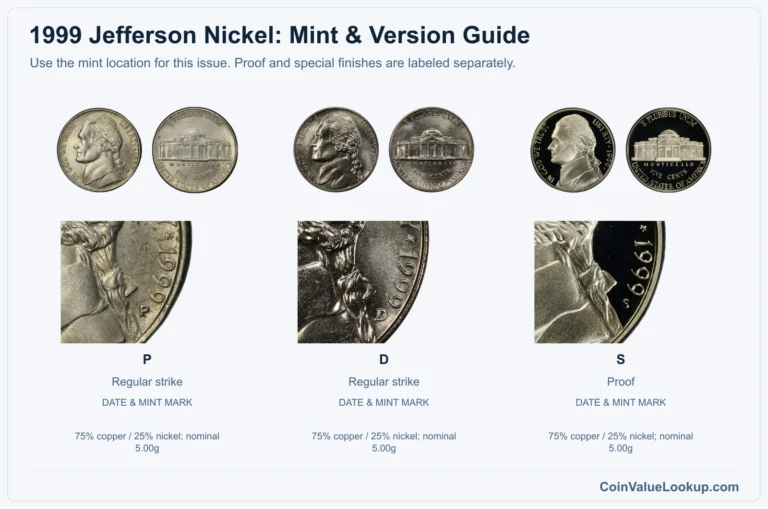
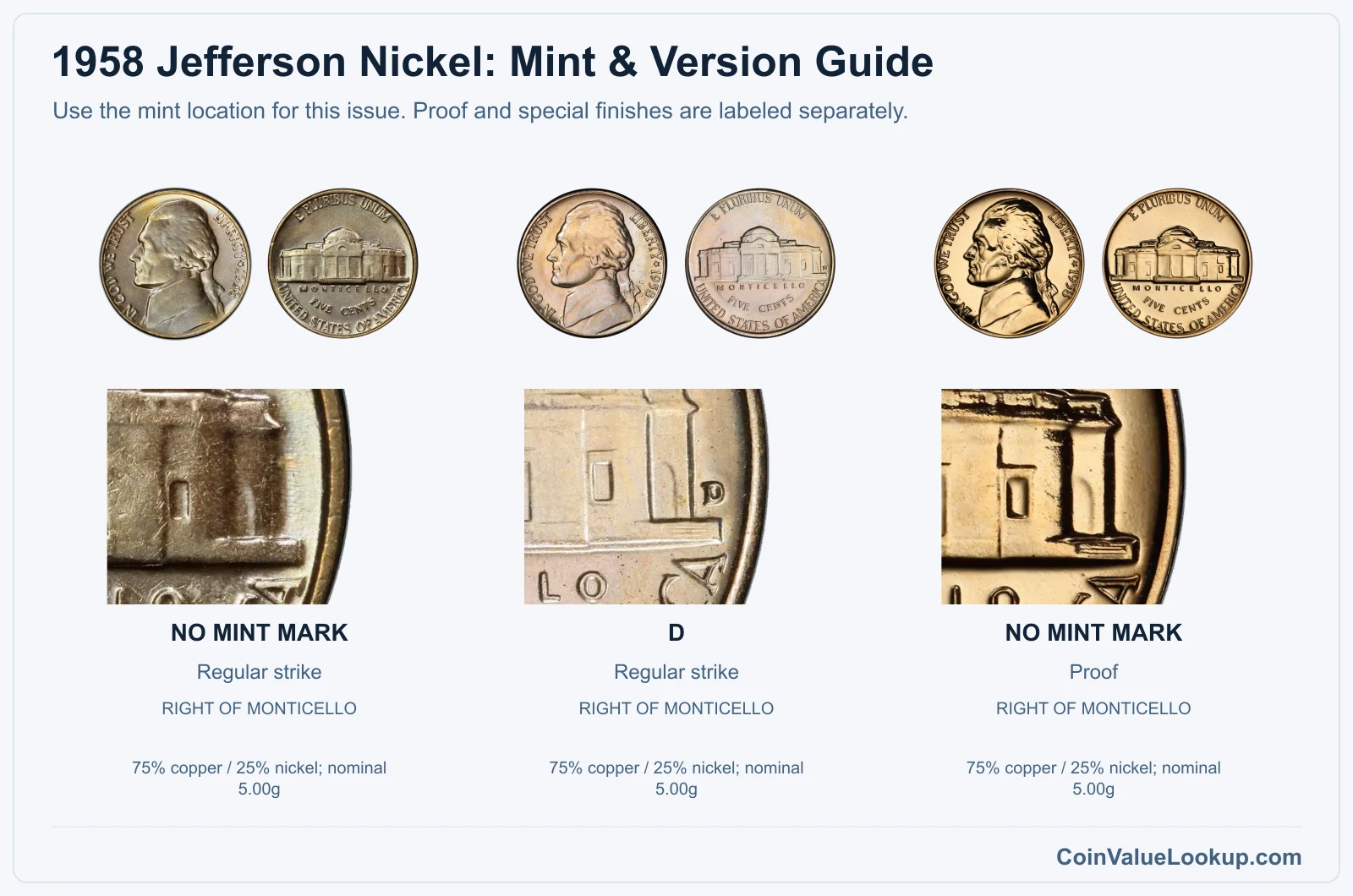
There are three main versions of the 1958 Jefferson Nickel. Philadelphia business strikes carry no mintmark at all.
The Denver issue has a small "D" to the right of Monticello on the reverse. Proof coins were also struck at Philadelphia and likewise show no mintmark, but their mirror-like fields and sharp details set them apart from regular strikes.
All 1958 nickels are 75% copper and 25% nickel, weigh about 5.00 grams, and have a plain edge. This is a solid alloy, not a clad sandwich, so there are no exposed layers to look for.
Weighing a suspect coin can help screen for wrong-planchet errors, but it cannot authenticate one on its own.
Before looking up a value, record the date, check for a mintmark on the reverse, and note the finish. A proof will have deeply reflective surfaces that a business strike simply does not.
Step 2: Check Your 1958 Jefferson Nickel Grade
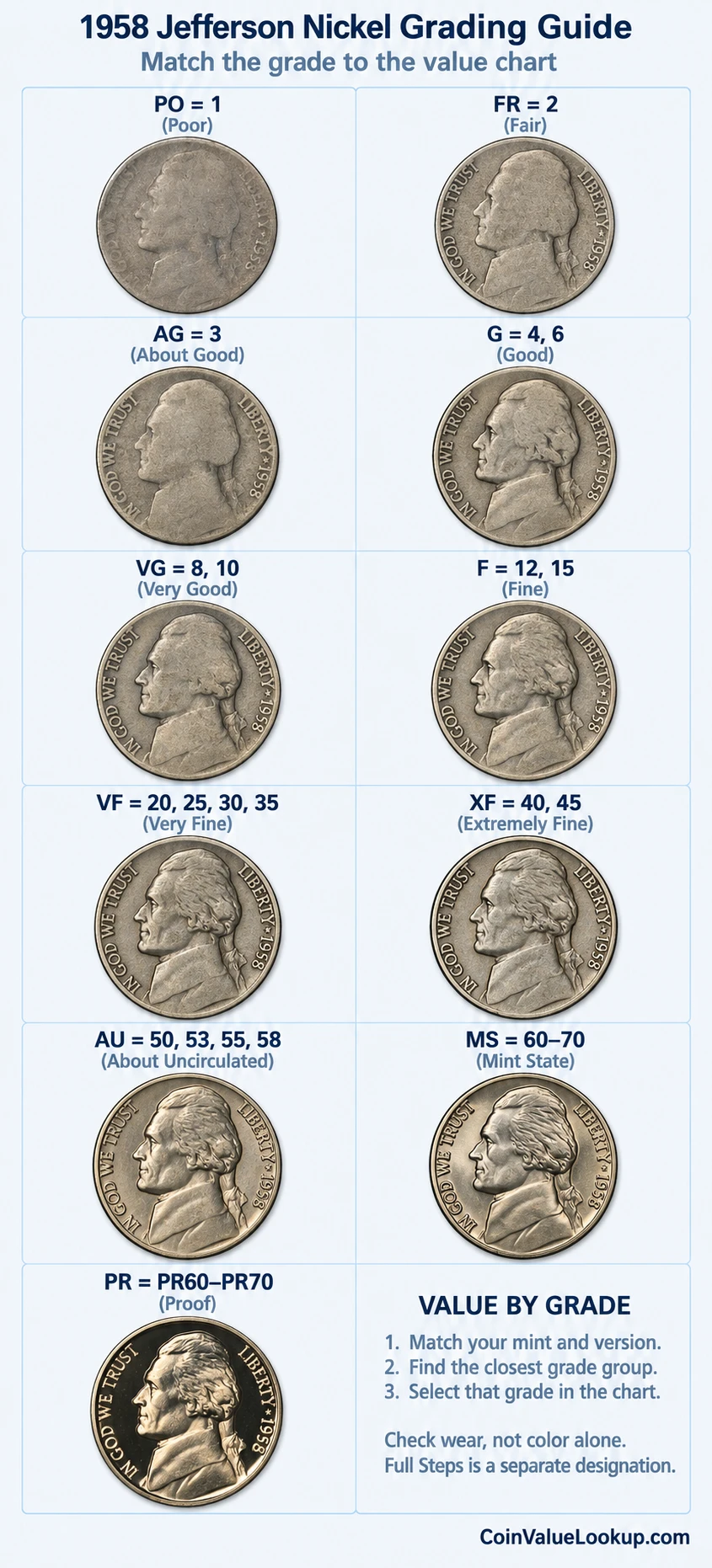
Start with Jefferson's cheek and the hair detail above his ear. On a lightly circulated coin, these are the first areas to show flatness and loss of luster.
A coin that still has full hair strands and original mint shine is likely in Mint State territory.
On the reverse, check the roof line and columns of Monticello. These wear down relatively quickly in circulation, so sharp columns support a higher grade.
Keep in mind that a weak strike can mimic wear. If the coin has no contact marks or friction on the high points but the steps of Monticello are mushy, you may be looking at a strike issue rather than actual wear.
Full Steps is a separate designation applied only to Mint State business strikes where the horizontal lines on Monticello's steps are complete and unbroken. It is a strike-quality filter, not a grade.
Use the comparison image to match your coin's wear level against known grade examples.
Step 3: Check 1958 Jefferson Nickel Value by Mint and Version
1958 Jefferson Nickel — No mintmark (Philadelphia) Business strike
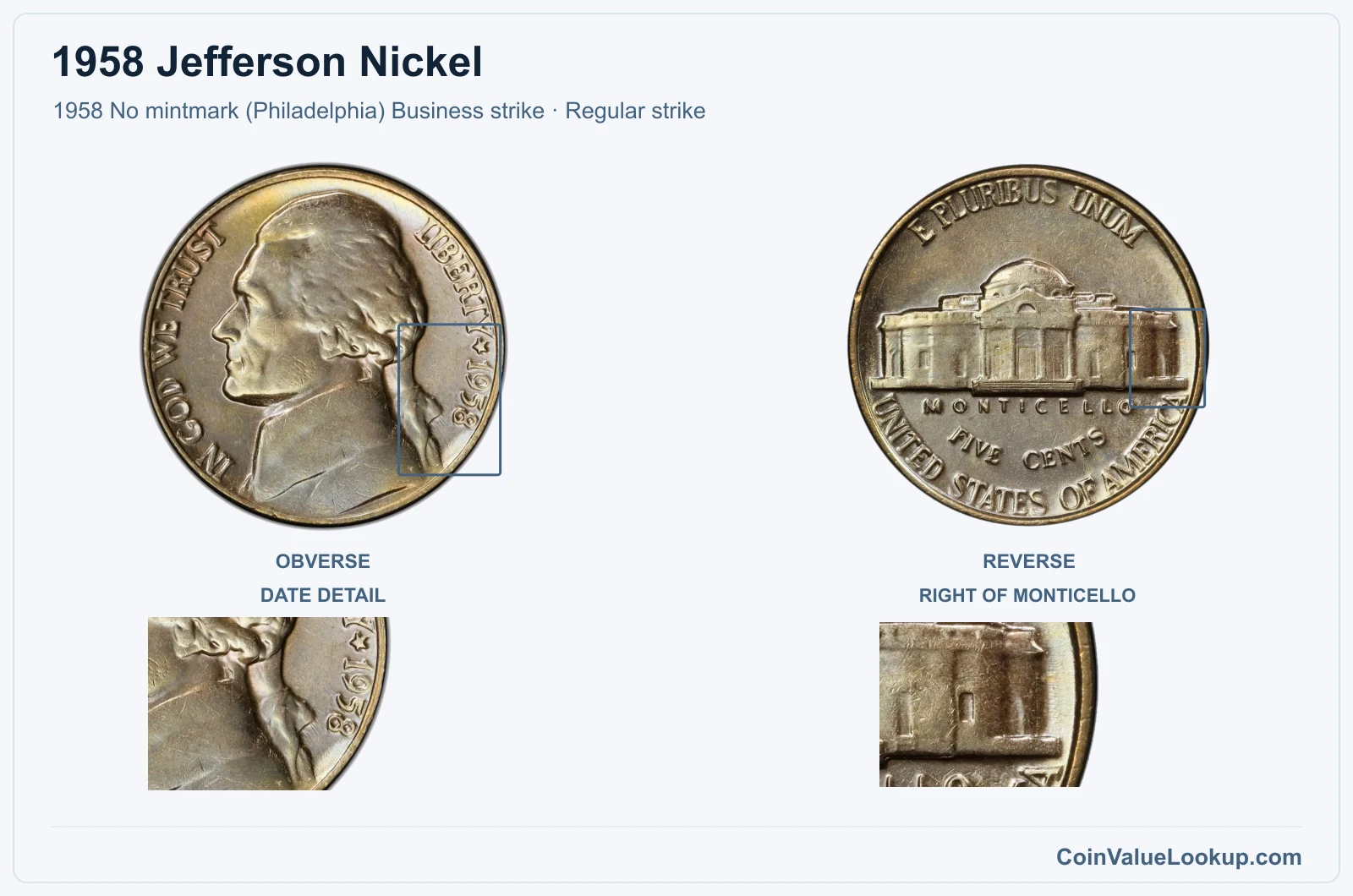
The 1958 Philadelphia business strike has no mintmark anywhere on the coin. Look at the reverse, to the right of Monticello, and confirm blank space where a "D" would otherwise appear.
This version is struck in 75% copper and 25% nickel at a nominal 5.00 grams with a plain edge.
USA Coin Book lists guide estimates of about $1.24 at MS60 and $30 at MS65. Worn circulated examples carry only face value in most cases.
Full Steps specimens, where Monticello's staircase lines are complete, command their own separate premiums beyond these figures.
| Range | Grade | Price | Auction Records | Appraisal |
|---|---|---|---|---|
| PO | PO 1 | — | Coin Identifier | |
| FR | FR 2 | — | — | — |
| AG | AG 3 | — | — | — |
| G | G 4 | — | — | — |
| G 6 | — | — | — | |
| VG | VG 8 | — | — | — |
| VG 10 | — | — | — | |
| F | F 12 | — | — | — |
| F 15 | — | — | — | |
| VF | VF 20 | — | — | — |
| VF 25 | — | — | — | |
| VF 30 | — | — | — | |
| VF 35 | — | — | — | |
| XF | XF 40 | — | Coin Identifier | |
| XF 45 | — | Coin Identifier | ||
| AU | AU 50 | — | Coin Identifier | |
| AU 53 | — | Coin Identifier | ||
| AU 55 | — | Coin Identifier | ||
| AU 58 | — | Coin Identifier | ||
| MS | MS 60 | — | Coin Identifier | |
| MS 61 | — | Coin Identifier | ||
| MS 62 | — | Coin Identifier | ||
| MS 63 | Coin Identifier | |||
| MS 64 | Coin Identifier | |||
| MS 65 | Coin Identifier | |||
| MS 66 | Coin Identifier | |||
| MS 67 | — | — | — | |
| MS 68 | — | — | — | |
| MS 69 | — | — | — | |
| MS 70 | — | — | — |
1958 Jefferson Nickel — No mintmark (Philadelphia) Proof
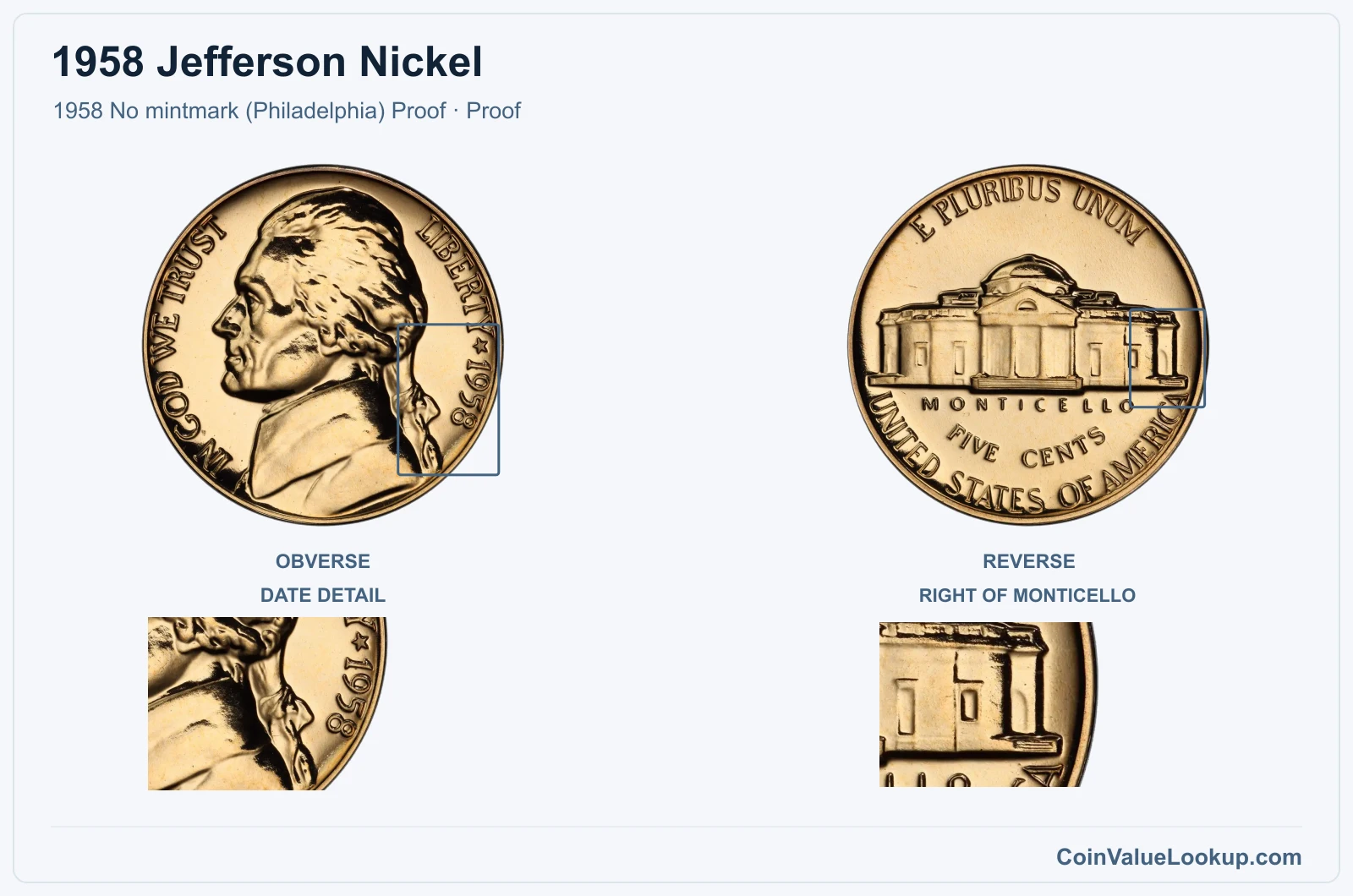
The 1958 Proof was struck at Philadelphia and also carries no mintmark, so it can be confused with the business strike if you are not paying attention to the finish. Proofs have deeply mirrored fields and razor-sharp design details that a regular strike cannot match, even in high Mint State grades.
USA Coin Book places a PR65 example at about $10. Some certified proofs carry a cameo or deep cameo designation when the frosted devices contrast sharply against the mirror fields, and those tend to bring higher prices.
A proof is a method of manufacture, not a grade above Mint State, so proof and business-strike coins are graded on separate scales.
Coin Value Lookup is a good place to start if you want to compare your proof against other Jefferson Nickel years and mints. You can browse guides organized by series and denomination.
| Range | Grade | Price | Auction Records | Appraisal |
|---|---|---|---|---|
| PR | PR 1 | — | Coin Identifier | |
| PR 2 | — | Coin Identifier | ||
| PR 3 | — | Coin Identifier | ||
| PR 4 | — | Coin Identifier | ||
| PR 6 | — | Coin Identifier | ||
| PR 8 | — | Coin Identifier | ||
| PR 10 | — | Coin Identifier | ||
| PR 12 | — | Coin Identifier | ||
| PR 15 | — | Coin Identifier | ||
| PR 20 | — | Coin Identifier | ||
| PR 25 | — | Coin Identifier | ||
| PR 30 | — | Coin Identifier | ||
| PR 35 | — | Coin Identifier | ||
| PR 40 | — | Coin Identifier | ||
| PR 45 | — | Coin Identifier | ||
| PR 50 | — | Coin Identifier | ||
| PR 53 | — | Coin Identifier | ||
| PR 55 | — | Coin Identifier | ||
| PR 58 | — | Coin Identifier | ||
| PR 60 | — | Coin Identifier | ||
| PR 61 | — | Coin Identifier | ||
| PR 62 | — | Coin Identifier | ||
| PR 63 | — | Coin Identifier | ||
| PR 64 | Coin Identifier | |||
| PR 65 | Coin Identifier | |||
| PR 66 | Coin Identifier | |||
| PR 67 | Coin Identifier | |||
| PR 68 | Coin Identifier | |||
| PR 69 | Coin Identifier | |||
| PR 70 | — | — | — |
1958 Jefferson Nickel — D Business strike
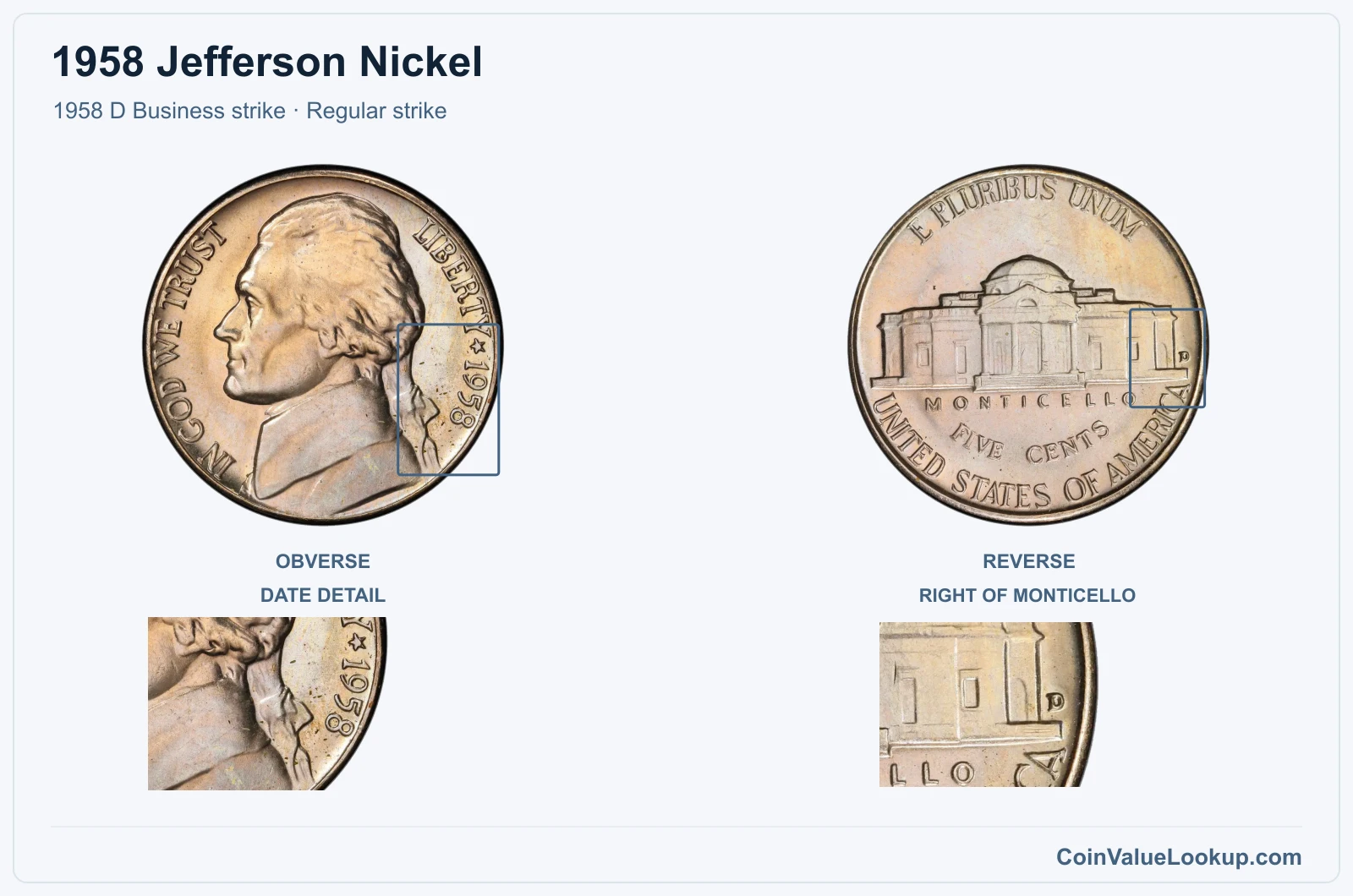
The 1958-D was struck at Denver and shows a small "D" mintmark to the right of Monticello on the reverse. Same alloy, same weight, same plain edge as the Philadelphia issue.
USA Coin Book guide estimates place the 1958-D at roughly $0.49 in MS60 and $15 in MS65. Circulated examples are worth face value.
This is also the only 1958 mint that can host the repunched mintmark variety, so take a close look at that "D" with magnification before moving on.
| Range | Grade | Price | Auction Records | Appraisal |
|---|---|---|---|---|
| PO | PO 1 | — | Coin Identifier | |
| FR | FR 2 | — | — | — |
| AG | AG 3 | — | — | — |
| G | G 4 | — | — | — |
| G 6 | — | — | — | |
| VG | VG 8 | — | — | — |
| VG 10 | — | — | — | |
| F | F 12 | — | — | — |
| F 15 | — | — | — | |
| VF | VF 20 | — | — | — |
| VF 25 | — | — | — | |
| VF 30 | — | — | — | |
| VF 35 | — | — | — | |
| XF | XF 40 | — | Coin Identifier | |
| XF 45 | — | Coin Identifier | ||
| AU | AU 50 | — | Coin Identifier | |
| AU 53 | — | Coin Identifier | ||
| AU 55 | — | Coin Identifier | ||
| AU 58 | Coin Identifier | |||
| MS | MS 60 | — | Coin Identifier | |
| MS 61 | — | Coin Identifier | ||
| MS 62 | — | Coin Identifier | ||
| MS 63 | — | Coin Identifier | ||
| MS 64 | — | Coin Identifier | ||
| MS 65 | Coin Identifier | |||
| MS 66 | Coin Identifier | |||
| MS 67 | Coin Identifier | |||
| MS 68 | — | — | — | |
| MS 69 | — | — | — | |
| MS 70 | — | — | — |
1958 Jefferson Nickel Error List
1. 1958 Jefferson Nickel — Struck on a silver dime planchet
A 1958 Jefferson nickel struck on a silver dime planchet is a dramatic wrong-planchet error. The coin weighs approximately 2.5 grams instead of the normal 5.00 grams, and the design is visibly cropped because the dime blank is smaller than a nickel.
Outer legends such as parts of UNITED STATES OF AMERICA or E PLURIBUS UNUM may be missing or truncated.
One example, graded NGC MS65, sold at Heritage Auctions in October 2012 for $646.25. That is a single authenticated sale, not a guaranteed market price for every specimen.
The key diagnostic is the combination of undersized diameter, silver composition, and cropped nickel design. A nickel that merely looks silvery could just be a normal white-toned piece or one that has been silver-plated after leaving the mint.
Professional authentication is essential.
2. 1958 Jefferson Nickel — Struck on a Cuban1-centavo blank
This error involves a 1958 Jefferson nickel struck on a Cuban 1-centavo blank. The known example, graded NGC MS62, weighs about 2.5 grams, well under the normal 5-gram nickel weight.
The date and part of LIBERTY are visible, but peripheral legends run off the undersized flan.
Do not assume a coin was struck on a Cuban blank just because it appears gray or off-color. Copper plating, chemical toning, or a deliberately ground-down nickel can all mimic the look.
Identification of the blank's nationality requires professional attribution. No standard price range is established for this error; value depends on the authenticated identity of the blank, the coin's condition, and overall error severity.
Individual assessment by a grading service is the way to go.
3. 1958 Jefferson Nickel — Struck on a cent planchet
A 1958 nickel struck on a cent planchet is a copper-colored wrong-planchet error. The known Philadelphia example was graded PCGS MS63 Brown.
It shows nickel design elements on a cent-sized copper blank, resulting in cropped or stretched legends and a noticeably lower weight than 5.00 grams.
Check the edge. A genuine wrong-planchet strike will show copper throughout, not a thin copper coating over a nickel core.
Copper plating, chemical toning, and coins that have been filed down are common lookalikes. No standard price range is established for this variety; its value depends on the authenticated identity of the planchet, the coin's condition, and the severity of the error.
Professional certification is critical before drawing conclusions.
4. 1958 Jefferson Nickel — Repunched Mintmark
The 1958-D/D Inverted D is a repunched mintmark variety exclusive to the Denver mint. Under magnification, you should see traces of a second "D" that was punched in an inverted orientation beneath or overlapping the final mintmark position.
Compare your coin's mintmark against a normal 1958-D at the same magnification to spot the extra punch.
Machine doubling, die chips, and corrosion around the mintmark can all create marks that resemble a repunched mintmark but are not. True repunching shows a distinct secondary impression with its own serifs or contours.
No standard price range is established; value depends on the visibility and specific nature of the repunching, as well as overall condition.
5. 1958 Jefferson Nickel — Off-Center Strike
An off-center strike happens when the blank is not properly seated between the dies. The result is a displaced design with an unstruck crescent of bare metal along one edge.
The most collectible examples retain the full date despite the shift.
Do not confuse an off-center strike with a clipped planchet, a one-sided die misalignment, or a coin that was flattened or damaged after leaving the mint. A genuine off-center strike shows the full design displaced in one direction with corresponding blank space opposite.
No set price range exists for 1958 off-center nickels; value varies with the degree of off-center shift, date visibility, and overall condition.
6. 1958 Jefferson Nickel — Double / Multiple Strike
A double or multiple strike error means the coin was struck more than once inside the press, producing two or more overlapping impressions of the design. On a 1958 nickel, look for a clearly displaced or rotated second impression layered over the first.
The relationship between the two strikes, such as the angle of rotation or the amount of displacement, is what makes each example unique.
This is not the same as a doubled die, which shows doubling within a single strike from a defective die. Post-mint damage, like a vise or hammer mark, can also create a false second impression.
No established price range exists; value depends on the number and severity of strikes and the coin's condition.
7. 1958 Jefferson Nickel — Struck-Through Error
A struck-through error occurs when foreign material, such as grease, a metal fragment, or thread, sits between the die and the blank during striking. The result is a localized depression, an impression of the obstruction, or incomplete design detail in the affected area.
Grease-filled dies and retained foreign objects produce distinctly different appearances, so describe what you see carefully. Wear, scratches, cleaning marks, and ordinary weak strikes can all mimic a struck-through at first glance.
The difference is that a genuine struck-through impression is recessed into the coin's surface in a way that matches the striking process. No set price range is available; value depends on what caused the obstruction, where it appears, and the coin's grade.
8. 1958 Jefferson Nickel — Die Crack / Die Chip
Die cracks and die chips appear as raised lines or small raised lumps on the coin's surface. They result from a fracture or break in the die itself.
On a 1958 nickel, look for thin raised lines running across the design or small raised blobs, especially near lettering or the rim.
A crack that connects to the rim and produces a flat, featureless raised area is called a cud, which is generally more desirable to collectors. Incuse scratches, corrosion, and foreign material stuck to the surface are common lookalikes.
The key distinction is that die cracks are raised above the surrounding surface and repeat from coin to coin on the same die. No established price range exists; value depends on size, location, and prominence of the break.
9. 1958 Jefferson Nickel — Broadstrike
A broadstrike occurs when the coin is struck without the normal collar die that constrains its diameter. The result is a coin with outward metal spread, a slightly larger-than-normal diameter, and a weakened or missing rim.
The design is generally centered, which distinguishes it from an off-center strike.
Check the edge profile. A broadstruck coin will have a flat or irregular edge rather than the usual reeded or plain-with-collar finish.
Coins that have been flattened by machinery or deliberate damage after minting can look similar but will show other telltale signs of post-mint abuse. No price range is established for 1958 broadstrike nickels; value varies with the degree of spread and overall condition.
10. 1958 Jefferson Nickel — Lamination / Split Planchet
A lamination error shows up as peeling metal, a retained flap, or visible separation within the coin's alloy. On a 1958 nickel, look for a thin layer of metal lifting away from the surface or a crack that reveals a gap between layers of the alloy.
Photograph the edge alongside the affected face to document the depth and extent of the separation. Scraping, corrosion, and deliberately cut or gouged coins can all resemble a lamination.
The difference is that a genuine lamination follows the contour of the metal's internal structure rather than showing sharp tool marks. No price range is established; value depends on the size and visibility of the lamination and the coin's overall condition.
11. 1958 Jefferson Nickel — Clipped Planchet
A clipped planchet error occurs when the blank is punched from strip metal that overlaps a previously punched hole, resulting in a missing curved, straight, or ragged section. On a 1958 nickel, the clip is typically a curved bite out of one edge.
Look for the Blakesley effect, which is a weakness in the design directly opposite the clip caused by incomplete metal flow during striking. That feature helps confirm a genuine clip versus an edge that was filed, cut, or corroded after minting.
Compare the edge texture at the clip to the rest of the coin; a genuine clip has the same surface quality as the struck edge. No standard price range exists; value depends on the size and type of clip and the coin's grade.