1949 Wheat Penny Coin Value: How Much Is It Worth?
A 1949 Wheat Penny in circulated condition typically books around $0.06 at Fine-12, while an uncirculated example can reach roughly $4.96 at MS63 depending on the mint. Those guide figures come from USA Coin Book and cover the three circulation branches — Philadelphia, Denver and San Francisco.
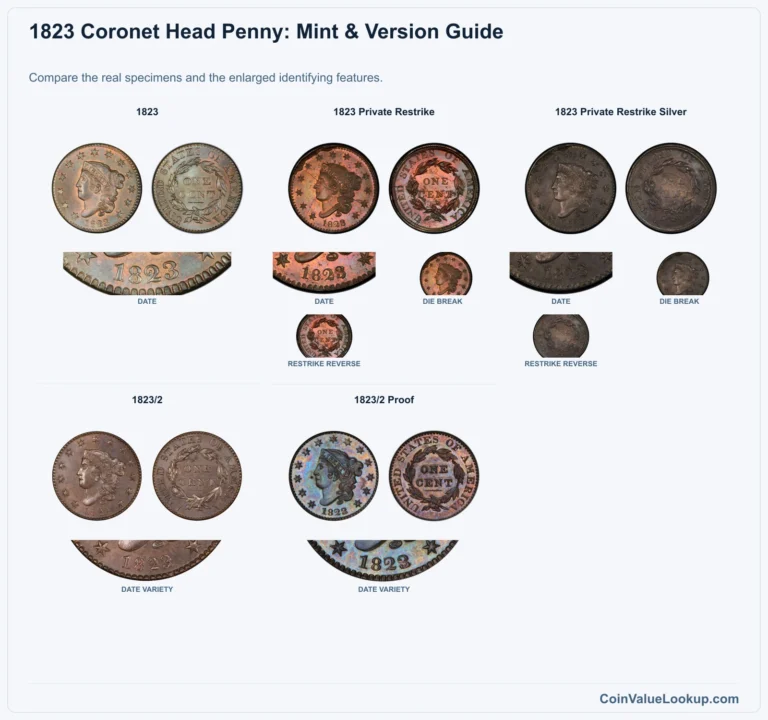
No regular proof cents were produced this year. Actual offers depend on original surfaces, wear, color and whether a collectible error is present.
Fast Way to Identify Your 1949 Wheat Penny
Snap a clear photo of the front and back of your 1949 penny and upload both images. Our identifier can give you a preliminary read on which mint branch you have and point you toward the right value range.
It is not a substitute for professional authentication or certified grading, but it is a solid first step before you dig deeper.
1949 Wheat Penny Value
Upload both sides of your 1949 Wheat Penny.
Front Obverse
Upload photo
Back Reverse
Upload photo
Which 1949 Wheat Penny Versions Are Worth Money?
- Philadelphia (no mintmark) 1949 cents range from about $0.06 in Fine-12 to $3.62 at MS63 — check for strong original luster on uncirculated examples.
- Denver (D mintmark) 1949-D cents share a similar guide range of $0.06 to $3.62, Fine-12 through MS63.
- San Francisco (S mintmark) 1949-S cents book from $0.06 in Good-4 up to $4.96 at MS63, the highest listed anchor of the three mints.
- Repunched mintmark errors on D or S examples can carry a premium that depends on severity and authentication.
- Doubled die obverse, off-center strikes and BIE die breaks are reported error categories worth inspecting for.
Step 1: Identify Your 1949 Wheat Penny Mint Mark and Version
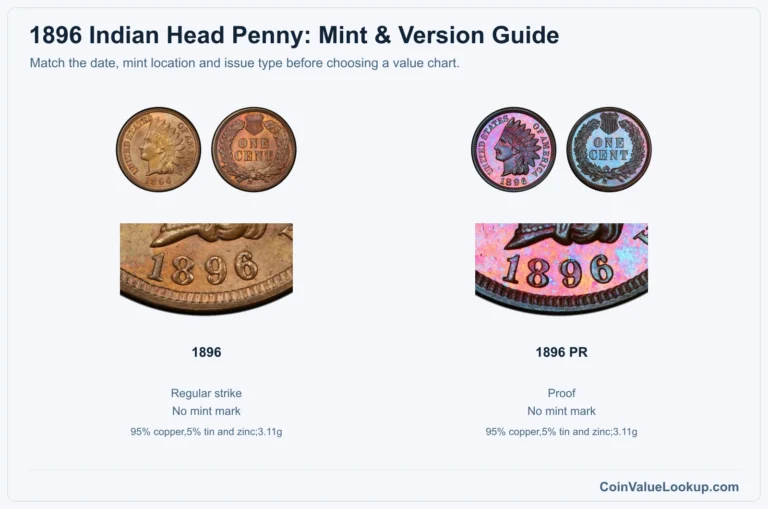
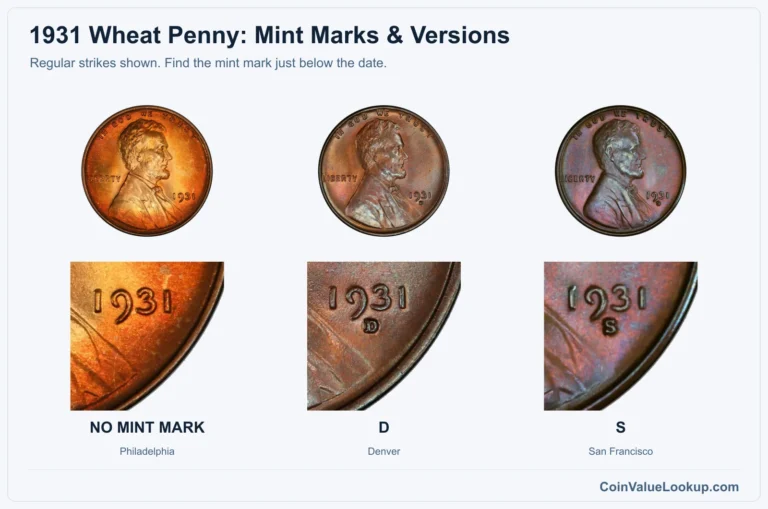
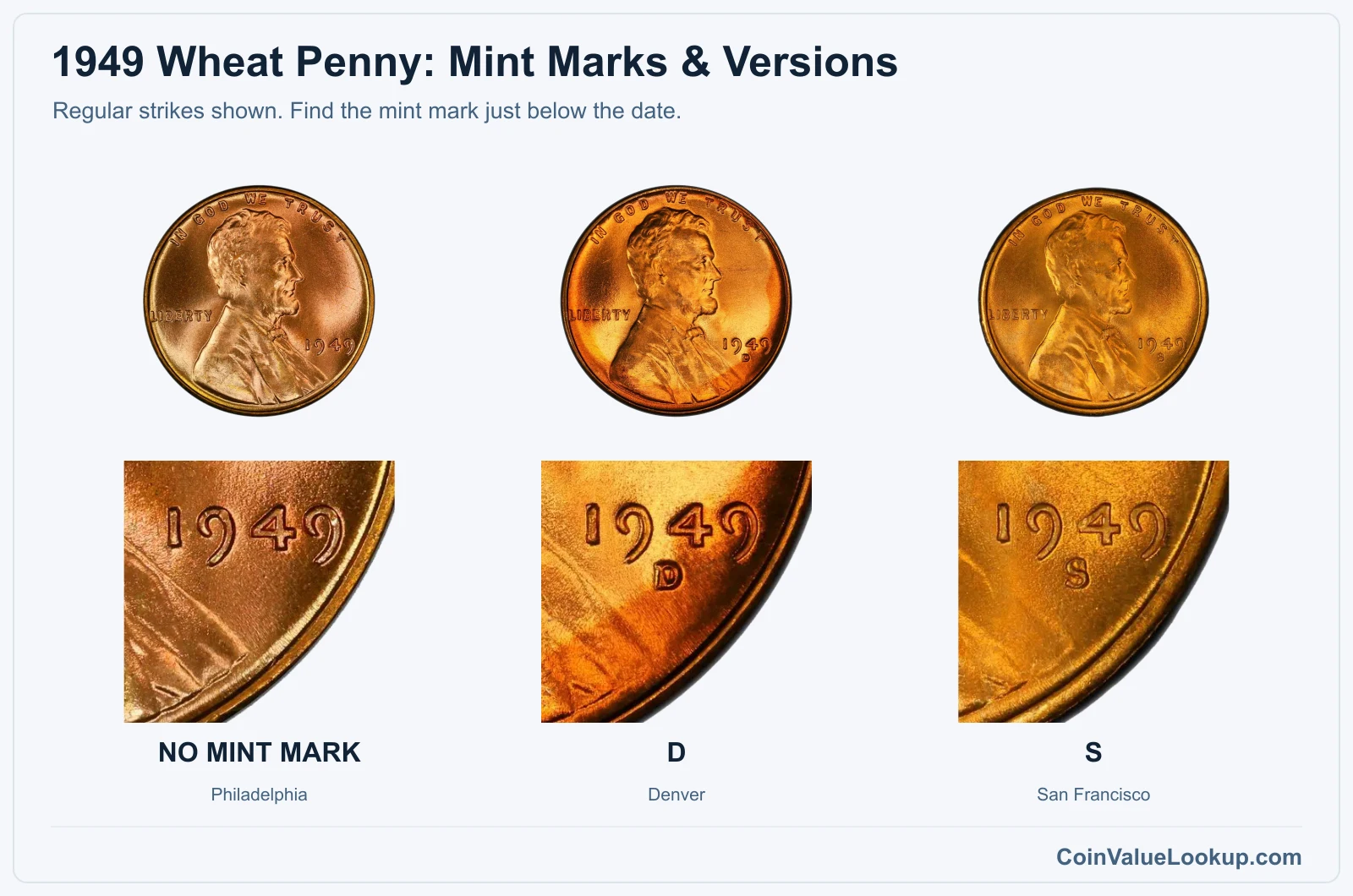
Flip your coin over and look just below the date on the obverse. If there is no small letter, you have a Philadelphia strike.
A tiny "D" means Denver, and an "S" means San Francisco. All three mints produced business strikes only in 1949 — no proofs.
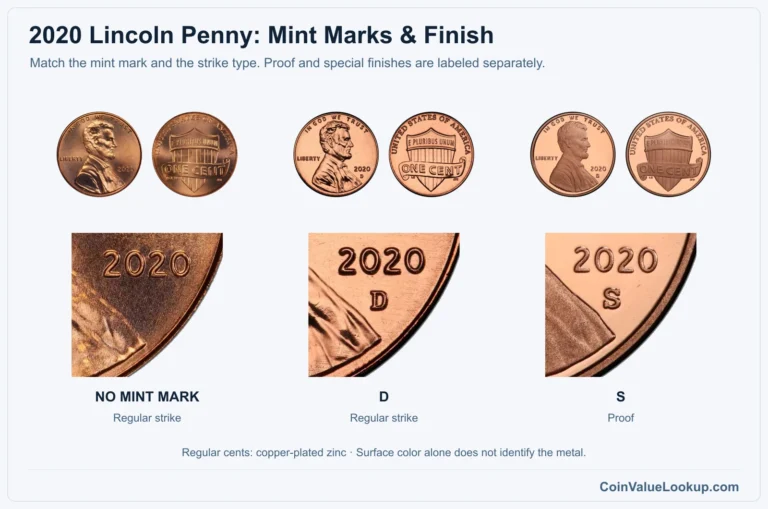
The coin should show Lincoln's portrait on the front and two wheat ears framing "ONE CENT" on the back. It weighs about 3.11 grams, is made of 95% copper with 5% tin and zinc, and has a plain (smooth) edge.
If your coin is noticeably lighter or has a reeded edge, it is something else entirely.
Color matters but does not determine grade by itself. A coin can be full red, red-brown or brown; each color commands a different premium in the marketplace.
Cleaning or corrosion will reduce appeal regardless of how much detail remains.
Step 2: Check Your 1949 Wheat Penny Grade
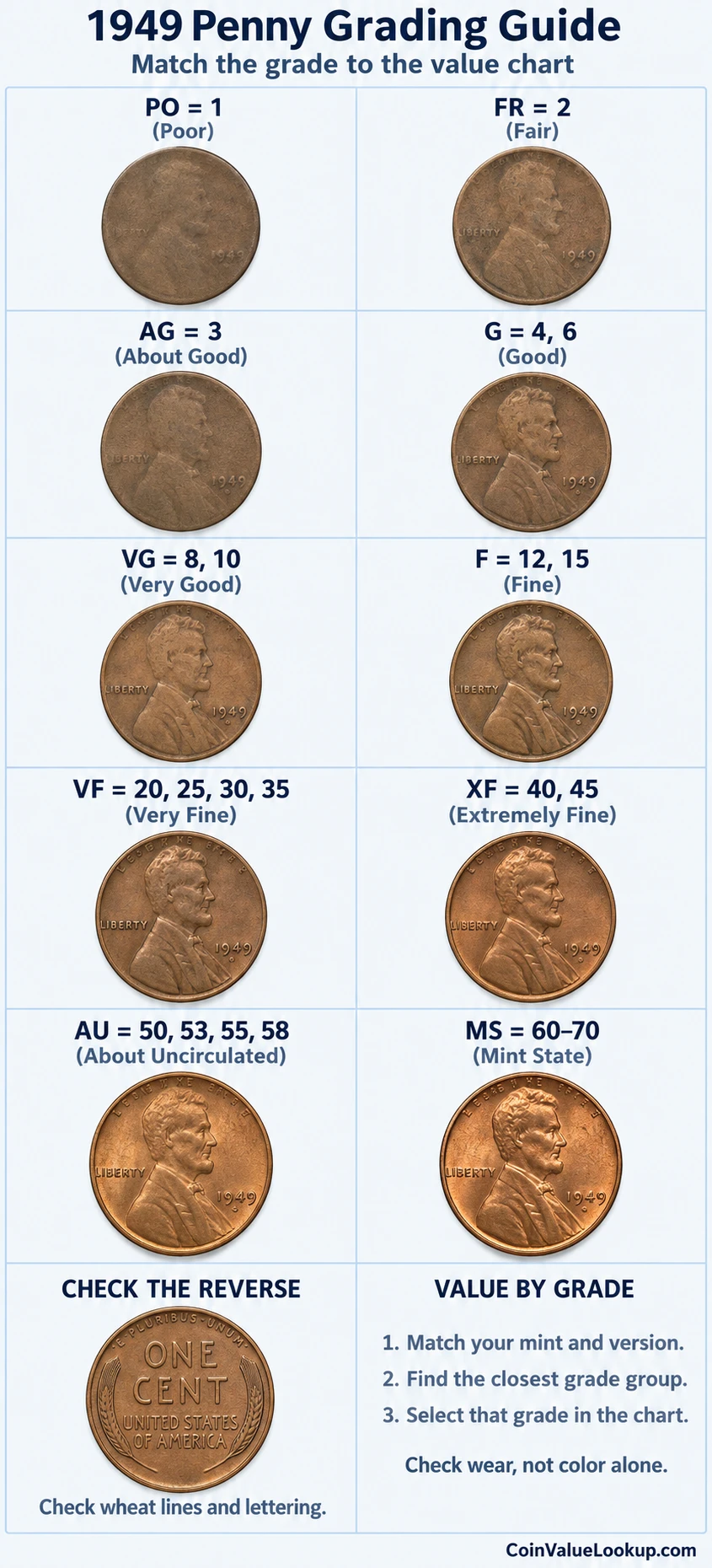
Start with Lincoln's cheekbone and jawline — these are the highest points on the obverse and the first places to show wear. On a well-circulated coin, the cheek will be flat and the hair above the ear will merge together.
A coin grading Fine-12 still shows clear separation in the major hair strands but the high points are noticeably smooth.
On the reverse, check the individual wheat grains and the parallel lines between the stalks. These fine details fade early, so a coin with sharp grain lines and full luster is heading toward Mint State territory.
Use the comparison image to match your coin's wear pattern rather than guessing a number. A weak original strike can leave soft detail that mimics wear, so look for luster in the fields as a clue.
Spots, fingerprints and old cleaning are separate value factors — a coin can have plenty of detail but still trade at a discount because of surface problems.
Step 3: Check 1949 Wheat Penny Value by Mint and Version
1949 Wheat Penny
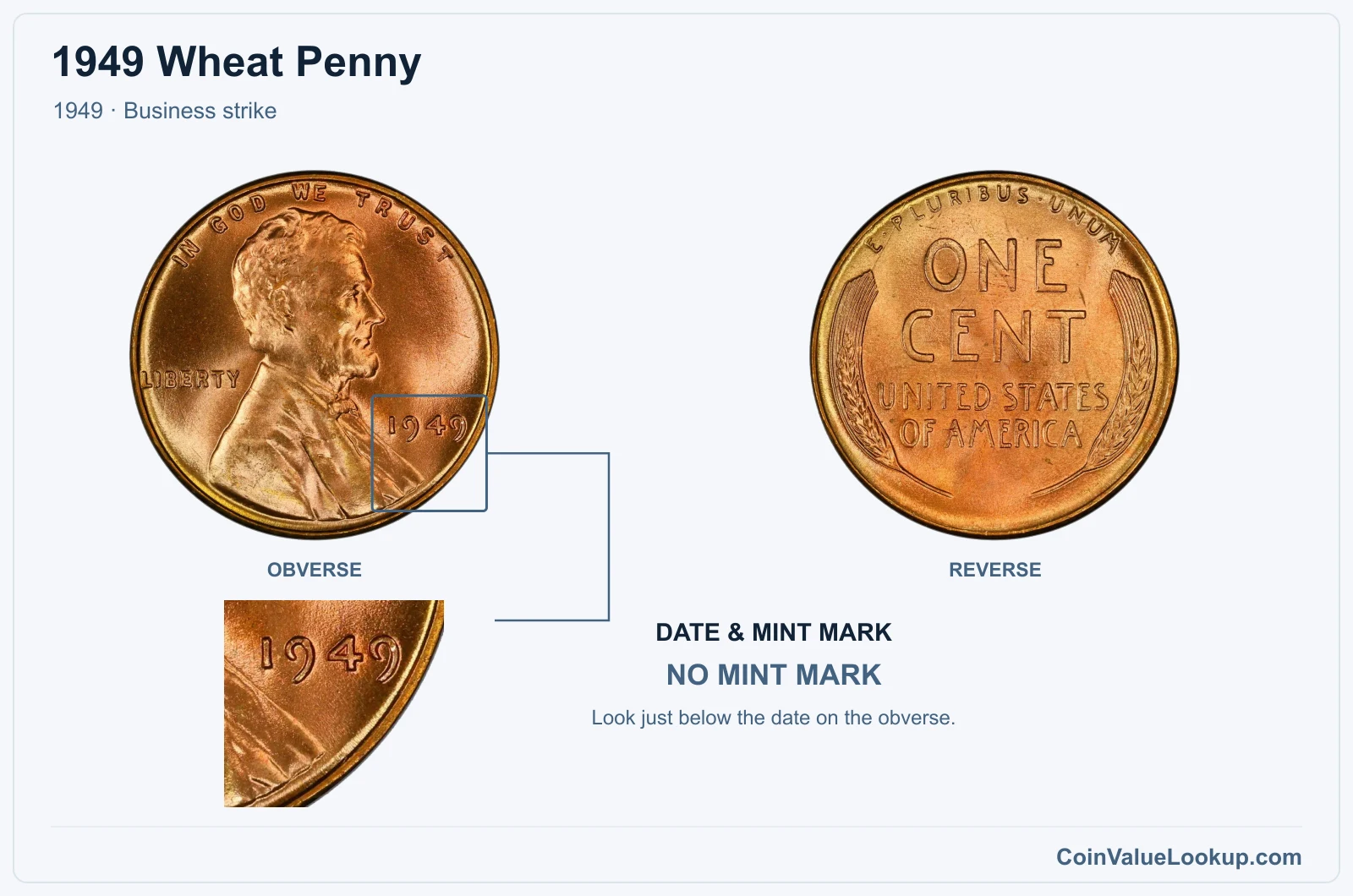
The 1949 Philadelphia cent carries no mintmark — the space below the date is blank. This is the standard business strike from the main mint.
In circulated grades it books around $0.06 at Fine-12 per the USA Coin Book guide, climbing to roughly $3.62 at MS63 in uncirculated condition.
Because the guide does not specify color, those uncirculated figures should not be read as certified Red prices. A brown or spotted MS63 will trade differently from a blazing red one.
Look for unbroken cartwheel luster across both sides and an absence of contact marks to confirm an uncirculated piece.
| Range | Grade | Price | Auction Records | Appraisal |
|---|---|---|---|---|
| PO | PO 1 | — | Coin Identifier | |
| FR | FR 2 | — | Coin Identifier | |
| AG | AG 3 | — | Coin Identifier | |
| G | G 4 | — | Coin Identifier | |
| G 6 | — | Coin Identifier | ||
| VG | VG 8 | — | Coin Identifier | |
| VG 10 | — | Coin Identifier | ||
| F | F 12 | — | Coin Identifier | |
| F 15 | — | Coin Identifier | ||
| VF | VF 20 | — | Coin Identifier | |
| VF 25 | — | Coin Identifier | ||
| VF 30 | — | Coin Identifier | ||
| VF 35 | — | Coin Identifier | ||
| XF | XF 40 | — | Coin Identifier | |
| XF 45 | — | Coin Identifier | ||
| AU | AU 50 | — | Coin Identifier | |
| AU 53 | — | Coin Identifier | ||
| AU 55 | — | Coin Identifier | ||
| AU 58 | — | Coin Identifier | ||
| MS | MS 60 | — | Coin Identifier | |
| MS 61 | — | Coin Identifier | ||
| MS 62 | — | Coin Identifier | ||
| MS 63 | Coin Identifier | |||
| MS 64 | Coin Identifier | |||
| MS 65 | Coin Identifier | |||
| MS 66 | Coin Identifier | |||
| MS 67 | Coin Identifier | |||
| MS 68 | — | — | — | |
| MS 69 | — | — | — | |
| MS 70 | — | — | — |
1949 Wheat Penny — D
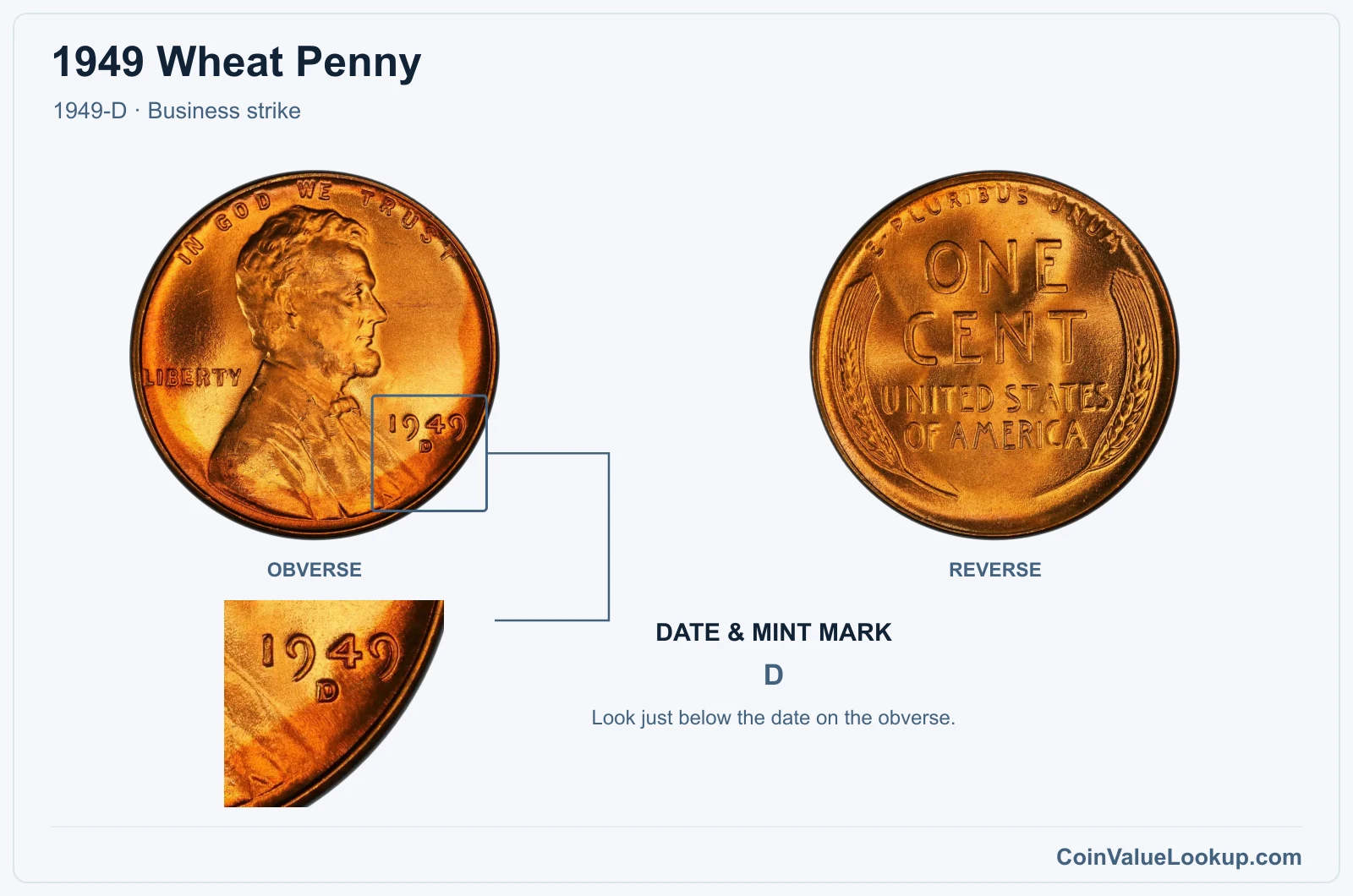
Look for a small "D" below the date to confirm a Denver strike. The 1949-D shares the same guide anchors as the Philadelphia issue — about $0.06 at Fine-12 and $3.62 at MS63 — but market demand can differ once you factor in color and eye appeal.
Denver cents from this era sometimes show softer strikes than Philadelphia coins, so do not confuse a mushy original impression with heavy wear. Check for remaining luster in the fields before downgrading.
Also inspect the D mintmark itself: if you see traces of a second punch position, you may have a repunched mintmark variety worth further examination.
Coin Value Lookup is a handy starting point when you want to look up guide values for other dates and mints in the Wheat cent series.
| Range | Grade | Price | Auction Records | Appraisal |
|---|---|---|---|---|
| PO | PO 1 | — | Coin Identifier | |
| FR | FR 2 | — | Coin Identifier | |
| AG | AG 3 | — | Coin Identifier | |
| G | G 4 | — | Coin Identifier | |
| G 6 | — | Coin Identifier | ||
| VG | VG 8 | — | Coin Identifier | |
| VG 10 | — | Coin Identifier | ||
| F | F 12 | — | Coin Identifier | |
| F 15 | — | Coin Identifier | ||
| VF | VF 20 | — | Coin Identifier | |
| VF 25 | — | Coin Identifier | ||
| VF 30 | — | Coin Identifier | ||
| VF 35 | — | Coin Identifier | ||
| XF | XF 40 | — | Coin Identifier | |
| XF 45 | — | Coin Identifier | ||
| AU | AU 50 | — | Coin Identifier | |
| AU 53 | — | Coin Identifier | ||
| AU 55 | — | Coin Identifier | ||
| AU 58 | — | Coin Identifier | ||
| MS | MS 60 | — | Coin Identifier | |
| MS 61 | — | Coin Identifier | ||
| MS 62 | — | Coin Identifier | ||
| MS 63 | Coin Identifier | |||
| MS 64 | Coin Identifier | |||
| MS 65 | Coin Identifier | |||
| MS 66 | Coin Identifier | |||
| MS 67 | Coin Identifier | |||
| MS 68 | — | — | — | |
| MS 69 | — | — | — | |
| MS 70 | — | — | — |
1949 Wheat Penny — S
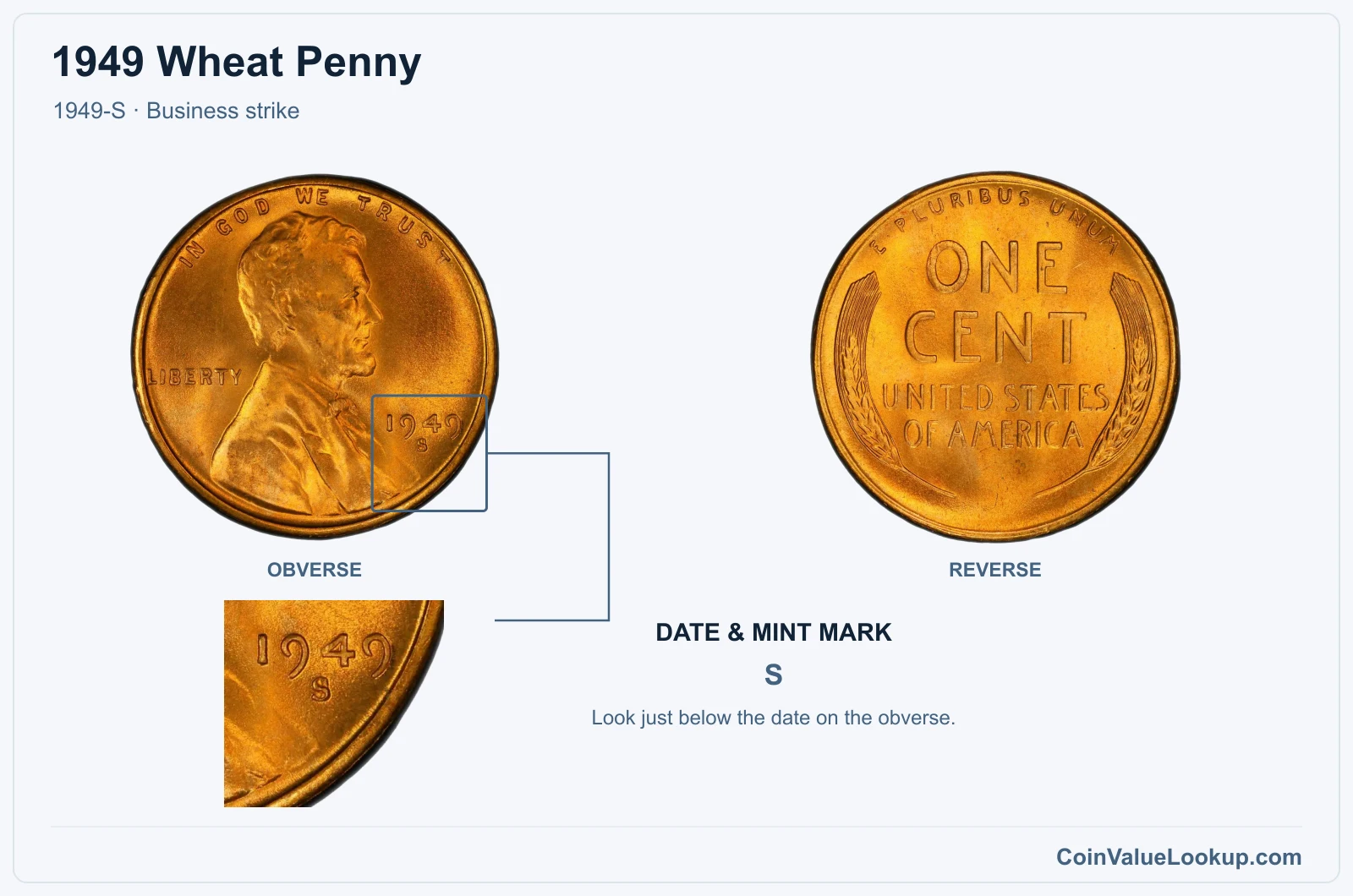
A small "S" below the date identifies the San Francisco branch. The 1949-S carries the highest listed anchor of the three mints, ranging from about $0.06 in Good-4 up to $4.96 at MS63 in the USA Coin Book guide.
That wider spread reflects the slightly stronger demand for choice uncirculated San Francisco cents of this vintage.
As with the other mints, the guide does not break out color, so treat these as general starting points. Original copper surfaces that have not been cleaned or artificially toned will always command more attention.
The S mintmark should also be checked carefully for repunching — any doubling or offset in the letter is worth a closer look under magnification.
| Range | Grade | Price | Auction Records | Appraisal |
|---|---|---|---|---|
| PO | PO 1 | — | Coin Identifier | |
| FR | FR 2 | — | Coin Identifier | |
| AG | AG 3 | — | Coin Identifier | |
| G | G 4 | — | Coin Identifier | |
| G 6 | — | Coin Identifier | ||
| VG | VG 8 | — | Coin Identifier | |
| VG 10 | — | Coin Identifier | ||
| F | F 12 | — | Coin Identifier | |
| F 15 | — | Coin Identifier | ||
| VF | VF 20 | — | Coin Identifier | |
| VF 25 | — | Coin Identifier | ||
| VF 30 | — | Coin Identifier | ||
| VF 35 | — | Coin Identifier | ||
| XF | XF 40 | — | Coin Identifier | |
| XF 45 | — | Coin Identifier | ||
| AU | AU 50 | — | Coin Identifier | |
| AU 53 | — | Coin Identifier | ||
| AU 55 | — | Coin Identifier | ||
| AU 58 | — | Coin Identifier | ||
| MS | MS 60 | — | Coin Identifier | |
| MS 61 | — | Coin Identifier | ||
| MS 62 | — | Coin Identifier | ||
| MS 63 | — | Coin Identifier | ||
| MS 64 | Coin Identifier | |||
| MS 65 | Coin Identifier | |||
| MS 66 | Coin Identifier | |||
| MS 67 | Coin Identifier | |||
| MS 68 | — | — | — | |
| MS 69 | — | — | — | |
| MS 70 | — | — | — |
1949 Wheat Penny Error List
1. 1949 Wheat Penny — Repunched Mintmark
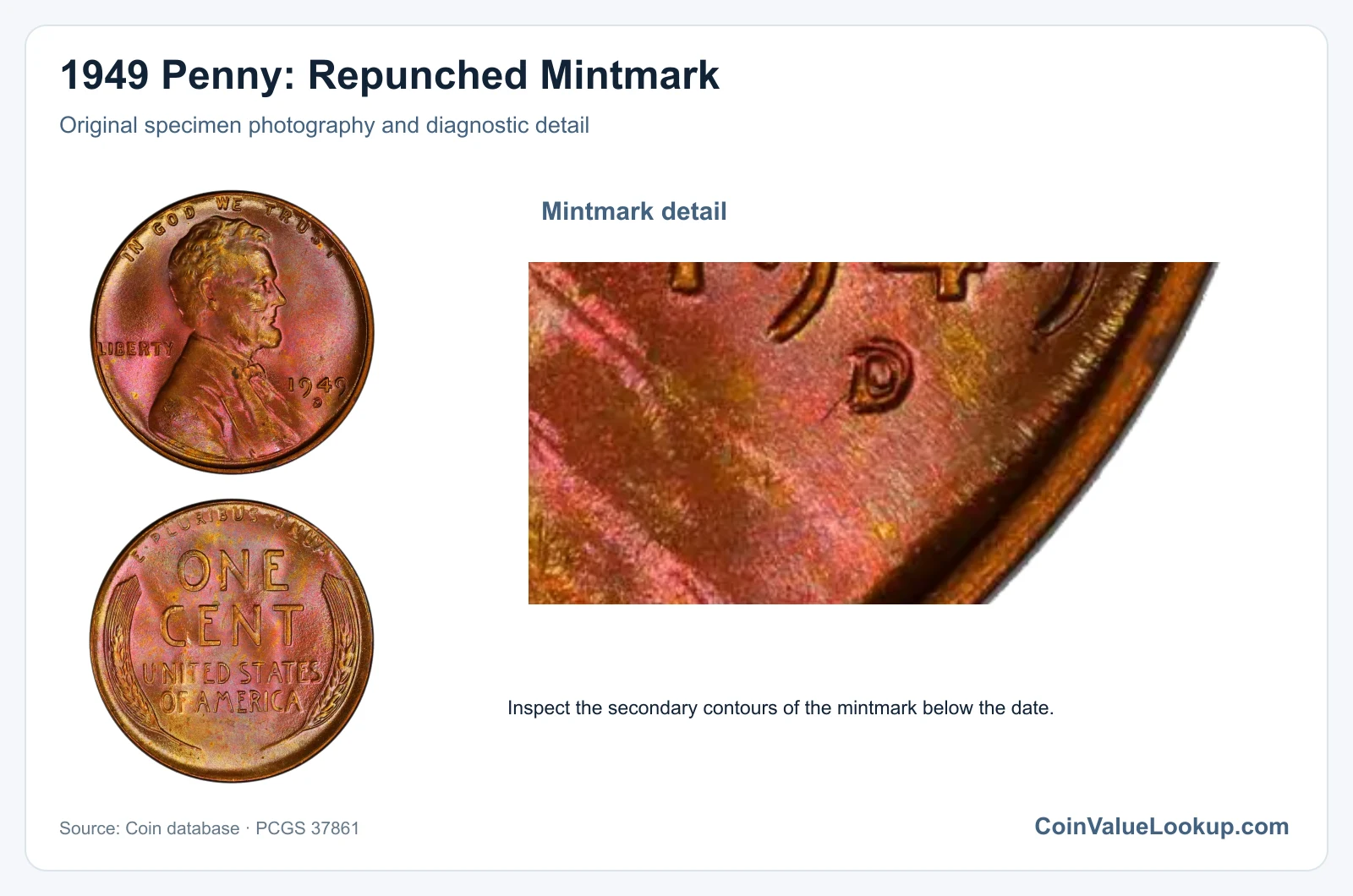
Repunched mintmark errors apply only to the Denver and San Francisco strikes — Philadelphia coins have no mintmark to repunch. To spot one, examine the D or S under at least 5x magnification.
You are looking for a ghost image, a notch, or a secondary impression of the letter slightly offset from the primary punch.
Compare your mintmark to a normal example photographed at the same angle and lighting. Machine doubling can create a flat, shelf-like echo that mimics an RPM but lacks the rounded, independent contour of a genuine second punch.
Die chips and corrosion near the letter can also fool you.
There is no adopted price range for 1949 RPM varieties in our sources. Value depends on the specific repunching, how dramatic the displacement is, the coin's overall condition, and whether a third-party grading service has attributed the variety.
2. 1949 Wheat Penny — Doubled Die Obverse
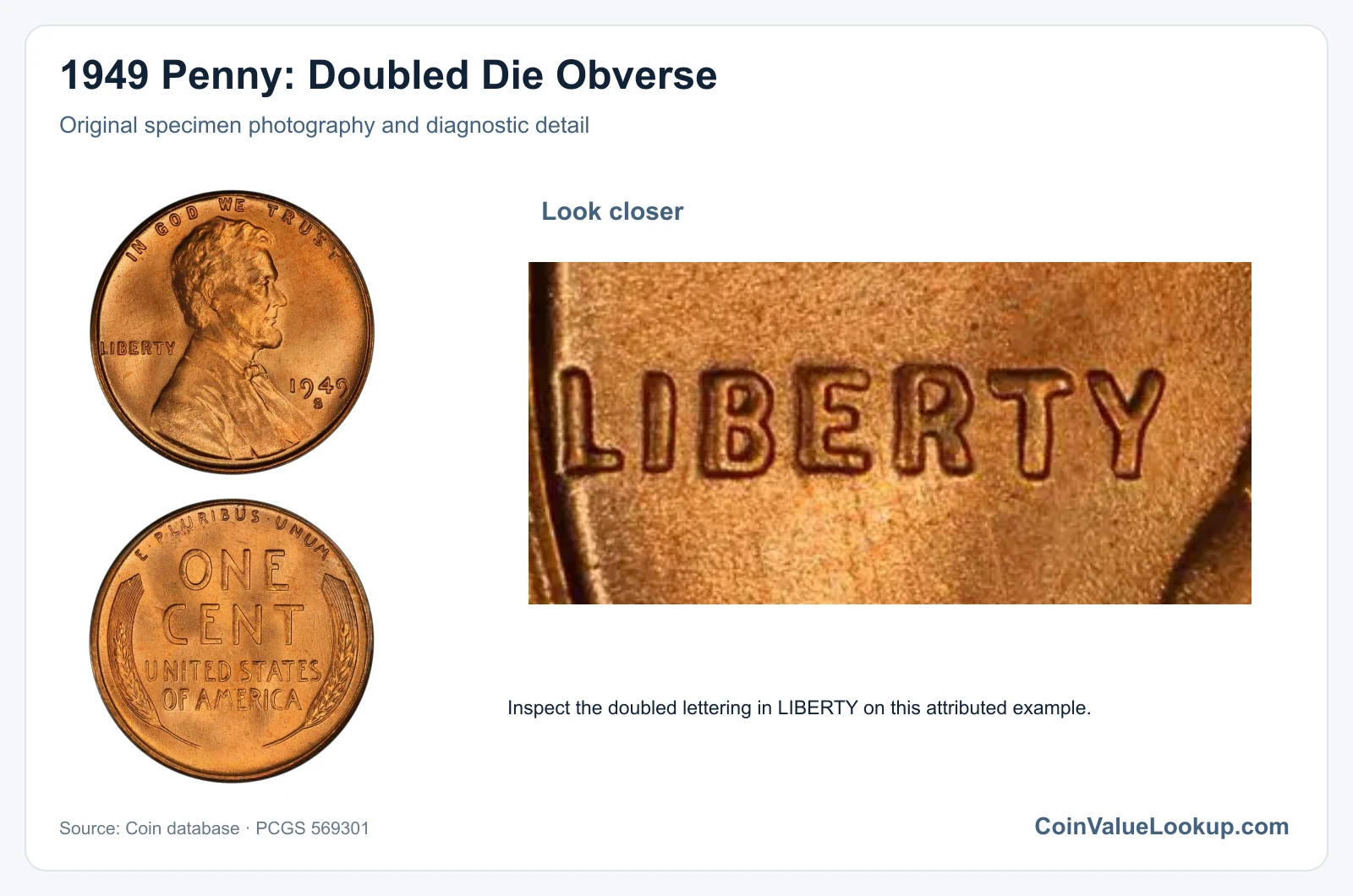
A doubled die obverse on a 1949 Wheat cent shows consistent separation or notching on design elements like the lettering in LIBERTY, IN GOD WE TRUST, or the date numerals. The key word is consistent: every affected letter should show the doubling in the same direction and to a similar degree.
Machine doubling — the common lookalike — tends to produce a flat shelf on one side of the letters without any real depth or raised separation. Worn dies and odd reflections under strong lighting can also create illusions.
Always compare against a known normal coin under matching conditions before getting excited.
No specific price range is adopted for 1949 doubled die obverse cents in our research. The value of a genuine example hinges on how strong the doubling is, which elements are affected, the coin's grade, and professional attribution by a recognized grading service.
3. 1949 Wheat Penny — Off-Center Strike
An off-center strike happens when the planchet is not seated properly between the dies, producing a crescent-shaped blank area on one side and a shifted design on the other. For collectors, the magic combination is a significant percentage off center — usually 10% or more — with the full date still visible.
Do not confuse an off-center strike with a clipped planchet, which leaves a curved bite out of the rim but keeps the design centered. Post-mint damage from a vise or hammer can also flatten one edge and push the design sideways, but it will show telltale contact marks rather than a clean unstruck area.
No adopted price range exists for 1949 off-center Wheat cents in our sources. Each piece is evaluated individually based on the percentage of displacement, whether the date survives, the coin's condition, and third-party authentication.
4. 1949 Wheat Penny — BIE Die Break
The BIE die break is a popular Wheat cent collectible. It shows up as a small raised vertical line or blob between the letters B and E in LIBERTY, caused by a crack in the die that fills with metal during striking.
The result looks like an extra letter "I" wedged in where it does not belong.
Check under magnification — the raised area should be part of the coin's surface, not sitting on top of it like a piece of debris. Dirt lodged between the letters, a thin scratch, or adhesive residue can all mimic a BIE at first glance.
A genuine die break will have the same metal texture and color as the surrounding field.
No specific price range is adopted for 1949 BIE errors in our research. These are generally modest-premium pieces, but value depends on the size and clarity of the break, the coin's overall condition, and whether it has been authenticated.