1961 Jefferson Nickel Coin Value: How Much Is It Worth?
The 1961 Jefferson Nickel is a common date, and most circulated examples trade for face value or close to it. Uncirculated pieces carry modest premiums, with USA Coin Book guide estimates running from about $0.30 at MS60 up to $25–$30 at MS65 depending on mint.
Proof and Full Steps coins follow separate pricing tracks, and certain striking errors can push values well beyond those guide anchors.
Fast Way to Identify Your 1961 Jefferson Nickel
The quickest way to start is to snap clear photos of both sides of your coin and upload them here. A preliminary identification can help you figure out whether you have a Philadelphia or Denver strike, a proof, or a potential error.
Good lighting and a steady hand go a long way toward getting useful feedback from your images.
1961 Jefferson Nickel Value
Upload both sides of your 1961 Jefferson Nickel.
Front Obverse
Upload photo
Back Reverse
Upload photo
Which 1961 Jefferson Nickel Versions Are Worth Money?
- The 1961-D business strike lists at about $30 in MS65 guide value, making gem examples the higher-value regular issue for this year.
- Philadelphia business strikes in MS65 guide at roughly $25 — still worth checking your change jar for pristine survivors.
- Proof coins follow their own pricing curve; a PR65 guides near $3.62, with cameo contrast potentially adding a premium.
- Wrong-planchet errors — such as a nickel struck on a silver dime blank or a copper cent blank — are rare and individually assessed by authentication services.
- A 30% off-center proof has been certified by NGC, representing an unusual combination of proof finish and dramatic misalignment.
Step 1: Identify Your 1961 Jefferson Nickel Mint Mark and Version
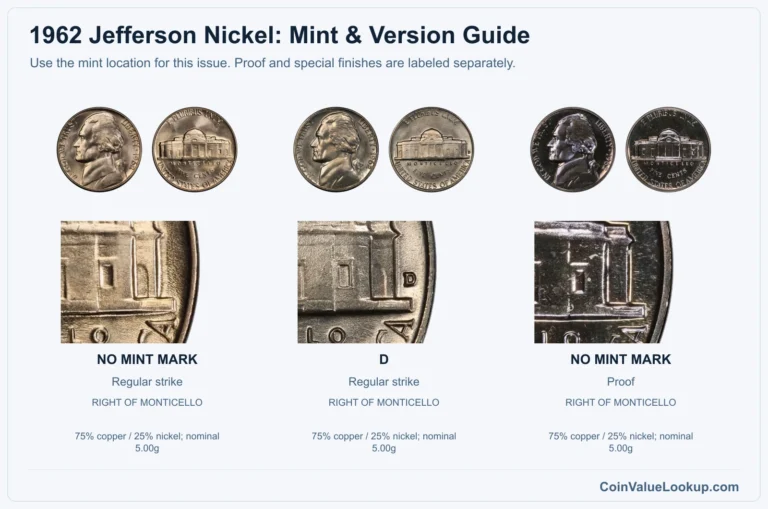
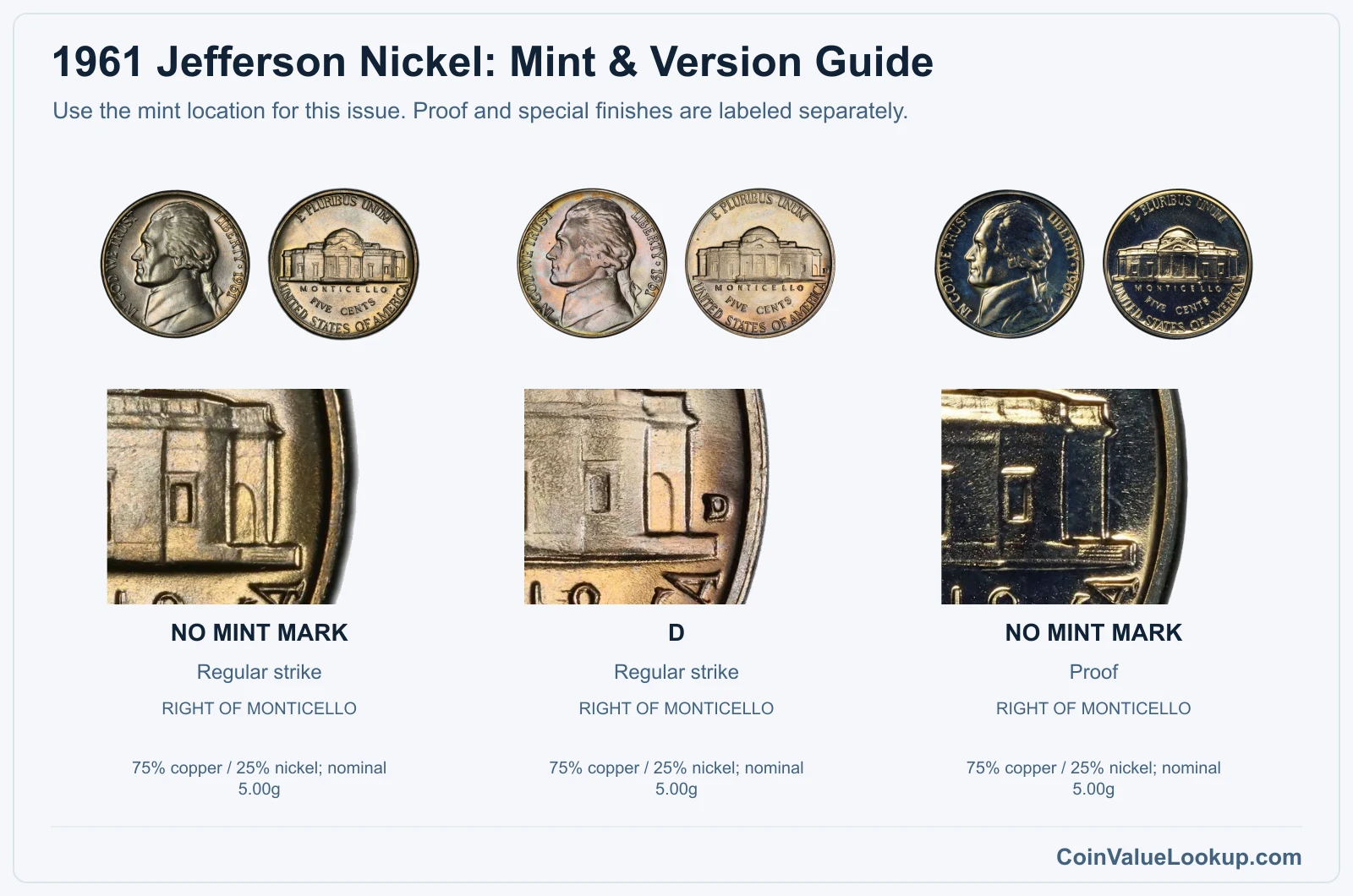
Two business-strike versions exist for 1961. Philadelphia coins carry no mintmark at all, while Denver coins show a small "D" to the right of Monticello on the reverse.
Proofs were struck only at Philadelphia and also lack a mintmark, so finish is the distinguishing factor: proofs display mirror-like fields and sharply defined rims that circulated strikes do not.
The standard specs are 75% copper and 25% nickel, weighing 5.00 grams with a 21.2 mm diameter and a plain edge. A coin that looks too small, too light, or the wrong color may have been struck on the wrong planchet — a genuinely collectible error if authenticated.
Before looking up values, record the date, mintmark presence or absence, finish type, and condition of both faces. That combination determines which price track applies to your specific coin.
Step 2: Check Your 1961 Jefferson Nickel Grade
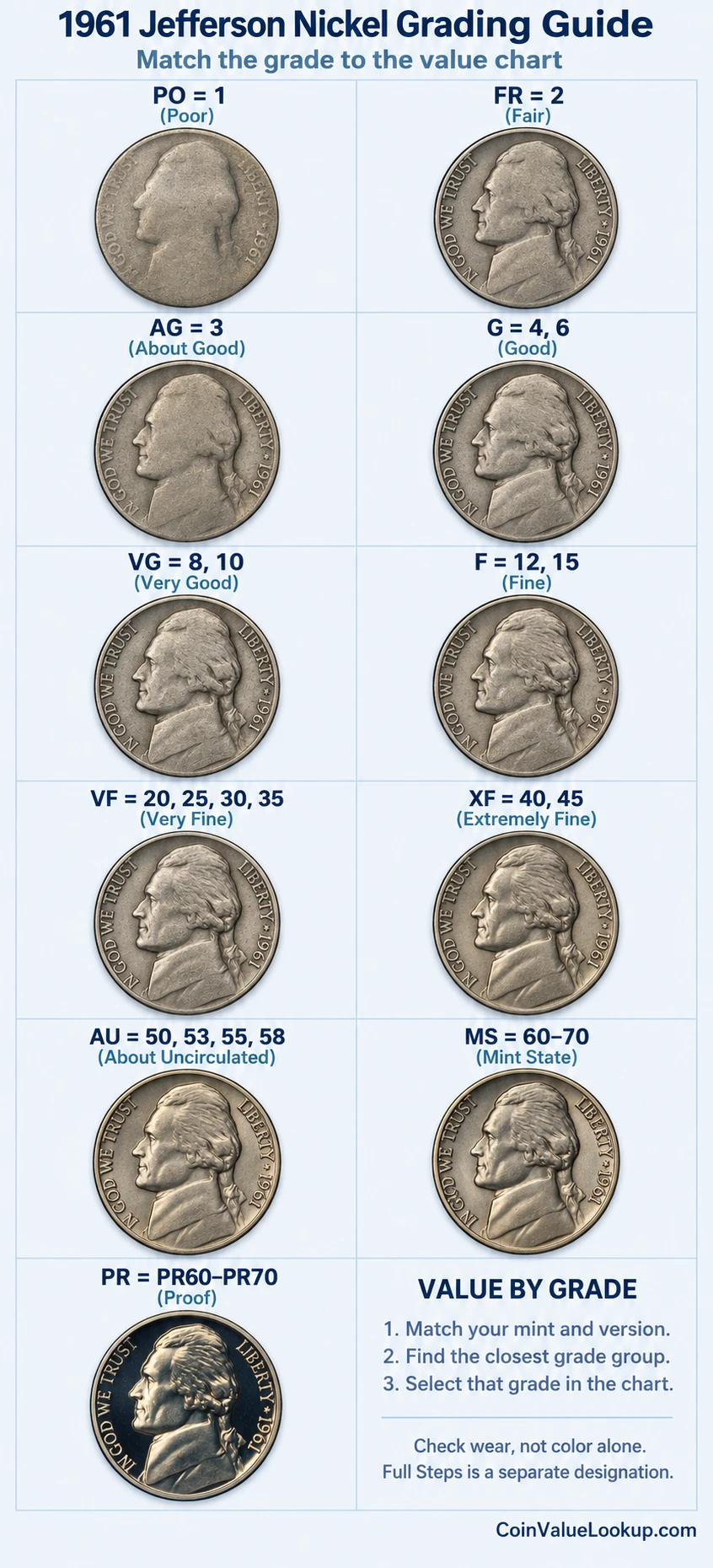
Start with Jefferson's cheek and the hair above his ear. On a well-struck uncirculated coin these areas show full luster and no flat spots.
As a coin circulates, the cheekbone flattens first, followed by the hair detail — compare yours to the grading image to gauge where it falls.
On the reverse, check Monticello's roof and the four columns. Loss of sharpness there confirms wear rather than a weak strike.
A shallow strike can mimic light wear, so look at the luster in the fields: original mint bloom versus dull, uniform tone tells you a lot.
Full Steps is a separate designation applied only to Mint State business strikes. It requires uninterrupted horizontal lines across the base of Monticello.
A coin can grade MS65 and still not earn Full Steps if those lines are incomplete, so treat strike quality and preservation as two independent questions.
Step 3: Check 1961 Jefferson Nickel Value by Mint and Version
1961 Jefferson Nickel — No mintmark (Philadelphia) Business strike
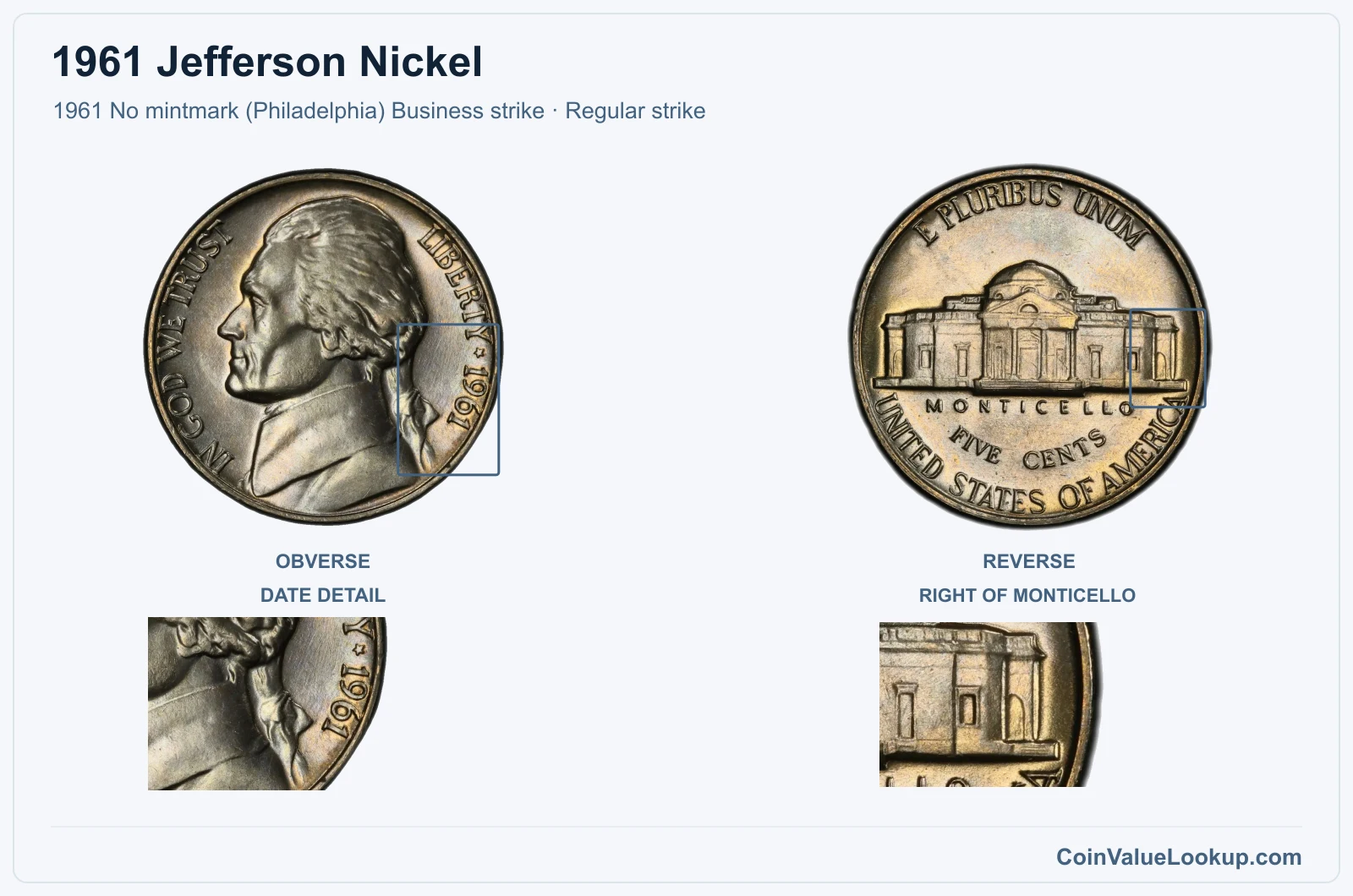
The 1961 Philadelphia business strike carries no mintmark. You will find Jefferson's portrait on the obverse and Monticello on the reverse, standard for the series.
USA Coin Book estimates place this version at about $0.30 in MS60 and around $25 in MS65.
Circulated examples are extremely common and rarely worth more than face value. The jump happens in higher uncirculated grades where clean surfaces and strong strikes become harder to find.
Full Steps designation, when applicable, commands its own separate premium above these base guide figures.
| Range | Grade | Price | Auction Records | Appraisal |
|---|---|---|---|---|
| PO | PO 1 | — | Coin Identifier | |
| FR | FR 2 | — | — | — |
| AG | AG 3 | — | — | — |
| G | G 4 | — | — | — |
| G 6 | — | — | — | |
| VG | VG 8 | — | — | — |
| VG 10 | — | — | — | |
| F | F 12 | — | — | — |
| F 15 | — | — | — | |
| VF | VF 20 | — | — | — |
| VF 25 | — | — | — | |
| VF 30 | — | — | — | |
| VF 35 | — | — | — | |
| XF | XF 40 | — | Coin Identifier | |
| XF 45 | — | Coin Identifier | ||
| AU | AU 50 | — | Coin Identifier | |
| AU 53 | — | Coin Identifier | ||
| AU 55 | — | Coin Identifier | ||
| AU 58 | — | Coin Identifier | ||
| MS | MS 60 | — | Coin Identifier | |
| MS 61 | — | Coin Identifier | ||
| MS 62 | — | Coin Identifier | ||
| MS 63 | — | Coin Identifier | ||
| MS 64 | Coin Identifier | |||
| MS 65 | Coin Identifier | |||
| MS 66 | Coin Identifier | |||
| MS 67 | Coin Identifier | |||
| MS 68 | — | — | — | |
| MS 69 | — | — | — | |
| MS 70 | — | — | — |
1961 Jefferson Nickel — No mintmark (Philadelphia) Proof
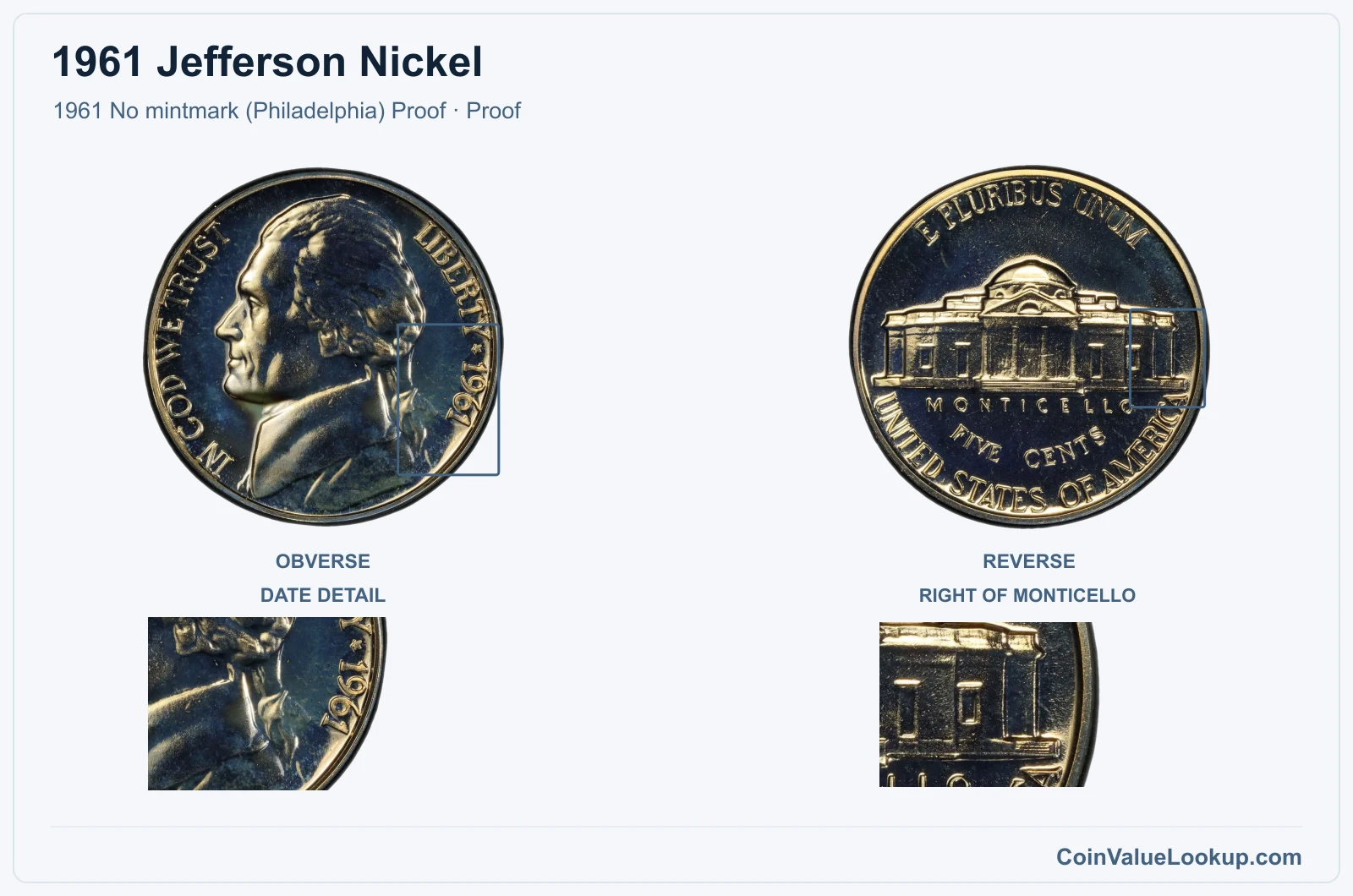
Philadelphia also produced proof nickels in 1961, sold in proof sets to collectors. These have mirror fields and razor-sharp design details that set them apart from any business strike, no matter how nice.
There is no mintmark on these coins, same as the regular Philadelphia issue, so the finish itself is your identifier.
Coin Value Lookup is a handy starting point if you want to compare your proof against other Jefferson Nickel years and denominations.
A PR65 example guides at approximately $3.62 according to USA Coin Book. Certified examples with cameo or deep cameo contrast may trade at different levels, but those designations require separate evaluation.
Do not confuse a shiny business strike for a proof — the difference is in the manufacturing process, not the grade number.
| Range | Grade | Price | Auction Records | Appraisal |
|---|---|---|---|---|
| PR | PR 1 | — | Coin Identifier | |
| PR 2 | — | Coin Identifier | ||
| PR 3 | — | Coin Identifier | ||
| PR 4 | — | Coin Identifier | ||
| PR 6 | — | Coin Identifier | ||
| PR 8 | — | Coin Identifier | ||
| PR 10 | — | Coin Identifier | ||
| PR 12 | — | Coin Identifier | ||
| PR 15 | — | Coin Identifier | ||
| PR 20 | — | Coin Identifier | ||
| PR 25 | — | Coin Identifier | ||
| PR 30 | — | Coin Identifier | ||
| PR 35 | — | Coin Identifier | ||
| PR 40 | — | Coin Identifier | ||
| PR 45 | — | Coin Identifier | ||
| PR 50 | — | Coin Identifier | ||
| PR 53 | — | Coin Identifier | ||
| PR 55 | — | Coin Identifier | ||
| PR 58 | — | Coin Identifier | ||
| PR 60 | — | Coin Identifier | ||
| PR 61 | — | Coin Identifier | ||
| PR 62 | — | Coin Identifier | ||
| PR 63 | — | Coin Identifier | ||
| PR 64 | Coin Identifier | |||
| PR 65 | Coin Identifier | |||
| PR 66 | Coin Identifier | |||
| PR 67 | Coin Identifier | |||
| PR 68 | Coin Identifier | |||
| PR 69 | Coin Identifier | |||
| PR 70 | — | — | — |
1961 Jefferson Nickel — D Business strike
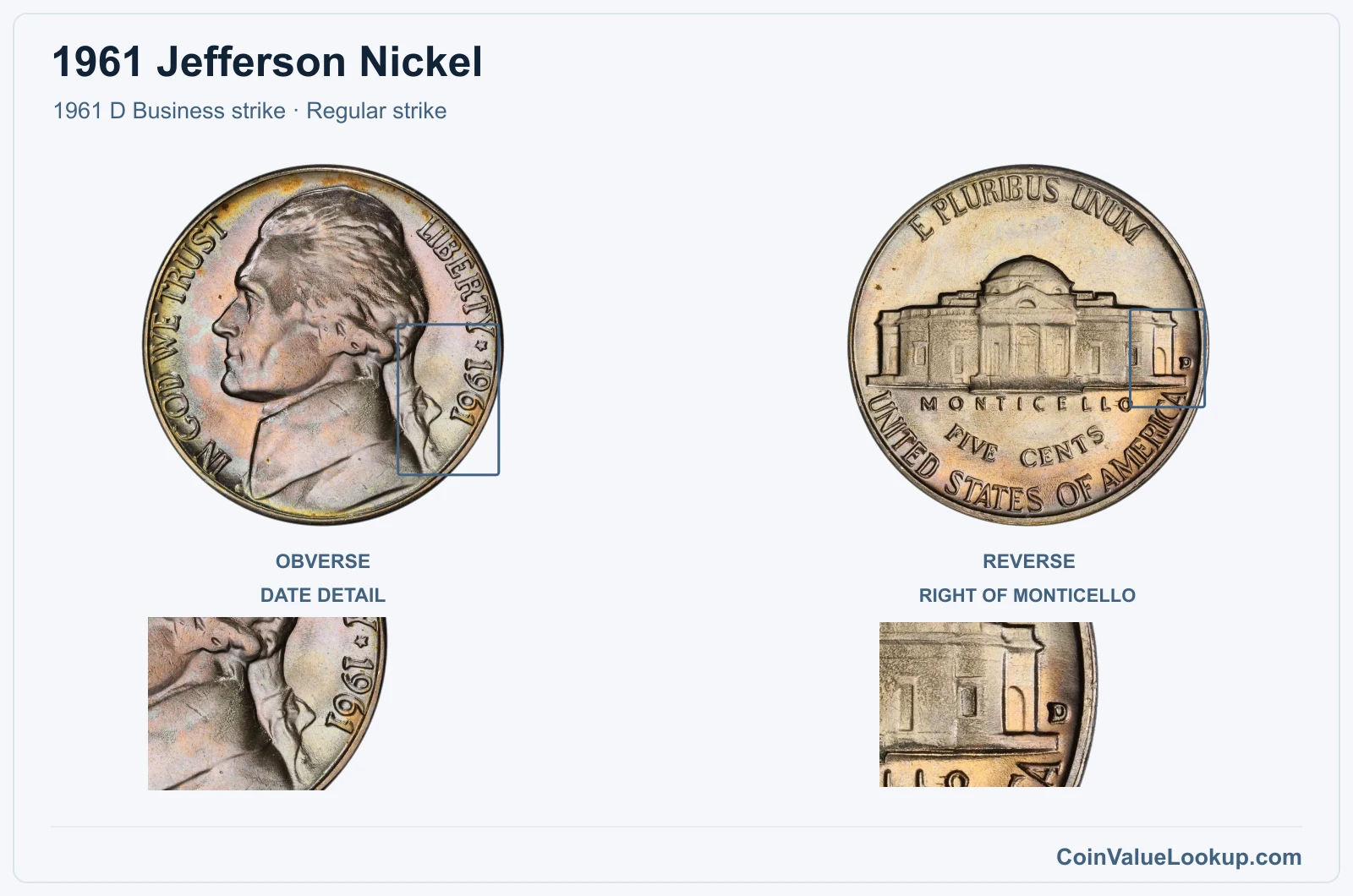
The 1961-D was struck at the Denver Mint and displays a small "D" mintmark to the right of Monticello on the reverse. Same composition and size as the Philadelphia issue: 75% copper, 25% nickel, 5.00 grams, plain edge.
USA Coin Book guides this version at about $0.30 in MS60 and roughly $30 in MS65, making the Denver coin the slightly higher-valued regular strike in top uncirculated condition. Worn pieces are plentiful and not scarce.
The value only starts climbing once you reach solidly uncirculated territory with minimal contact marks and good eye appeal.
| Range | Grade | Price | Auction Records | Appraisal |
|---|---|---|---|---|
| PO | PO 1 | — | Coin Identifier | |
| FR | FR 2 | — | — | — |
| AG | AG 3 | — | — | — |
| G | G 4 | — | — | — |
| G 6 | — | — | — | |
| VG | VG 8 | — | — | — |
| VG 10 | — | — | — | |
| F | F 12 | — | — | — |
| F 15 | — | — | — | |
| VF | VF 20 | — | — | — |
| VF 25 | — | — | — | |
| VF 30 | — | — | — | |
| VF 35 | — | — | — | |
| XF | XF 40 | — | Coin Identifier | |
| XF 45 | — | Coin Identifier | ||
| AU | AU 50 | — | Coin Identifier | |
| AU 53 | — | Coin Identifier | ||
| AU 55 | — | Coin Identifier | ||
| AU 58 | — | Coin Identifier | ||
| MS | MS 60 | — | Coin Identifier | |
| MS 61 | — | Coin Identifier | ||
| MS 62 | — | Coin Identifier | ||
| MS 63 | — | Coin Identifier | ||
| MS 64 | Coin Identifier | |||
| MS 65 | Coin Identifier | |||
| MS 66 | Coin Identifier | |||
| MS 67 | Coin Identifier | |||
| MS 68 | — | — | — | |
| MS 69 | — | — | — | |
| MS 70 | — | — | — |
1961 Jefferson Nickel Error List
1. 1961 Jefferson Nickel — Struck on a silver dime planchet
A 1961-D nickel struck on a silver dime planchet has been authenticated by ANACS at MS60. The dime blank is noticeably smaller than a standard nickel, so the design runs off the edge and portions of the legends are missing.
The coin also shows a silver-white color rather than the typical nickel-copper tone.
To check yours, measure the diameter and weigh it. A normal nickel is 21.2 mm and 5.00 grams; a dime planchet is smaller and lighter.
If those numbers are off, you might have something real.
Look out for coins that have simply been silver-plated or happen to have an unusual sheen from the normal copper-nickel alloy. Plating will often show wear-through at high points.
Authentic wrong-planchet errors need professional authentication, and each is individually assessed based on the confirmed planchet, condition, and severity.
2. 1961 Jefferson Nickel — Off-center proof
An off-center proof is a scarce combination. NGC has certified a 1961 Philadelphia proof nickel struck approximately 30% off center at PR66.
The coin shows a displaced design with an unstruck crescent along one side and a lost border on the opposite edge. Because it retains proof finish, it cannot be compared to ordinary business-strike off-center errors.
If you suspect you have one, look for the mirror fields and sharp detail that confirm proof manufacture, along with the telltale crescent of blank metal. A single-die misalignment or a weak strike can sometimes mimic a slight off-center appearance, but a true 30% shift is dramatic and unmistakable.
Value depends on the degree of offset, completeness of the date, and the certified grade. Each specimen is individually assessed by the grading service.
3. 1961 Jefferson Nickel — Struck on a cent planchet
A 1961 Philadelphia nickel struck on a Lincoln cent planchet has been certified by PCGS as MS63 Brown. The coin is copper-colored and cent-sized, yet carries the full Jefferson nickel design — stretched and cropped at the edges because the blank is too small for the nickel dies.
A normal nickel weighs 5.00 grams; a cent planchet weighs roughly 3.1 grams. That weight difference is the fastest screening tool.
Also examine the edge: a copper cent blank has a distinctly different edge profile from a nickel.
Do not confuse this with a nickel that has been copper-plated, chemically toned, or ground down in diameter after leaving the mint. Post-mint alterations lack the design distortion and missing rim portions that a genuine wrong-planchet strike displays.
Professional authentication is essential for this type of error, and value is assessed individually based on the specific piece.
4. 1961 Jefferson Nickel — Double / Multiple Strike
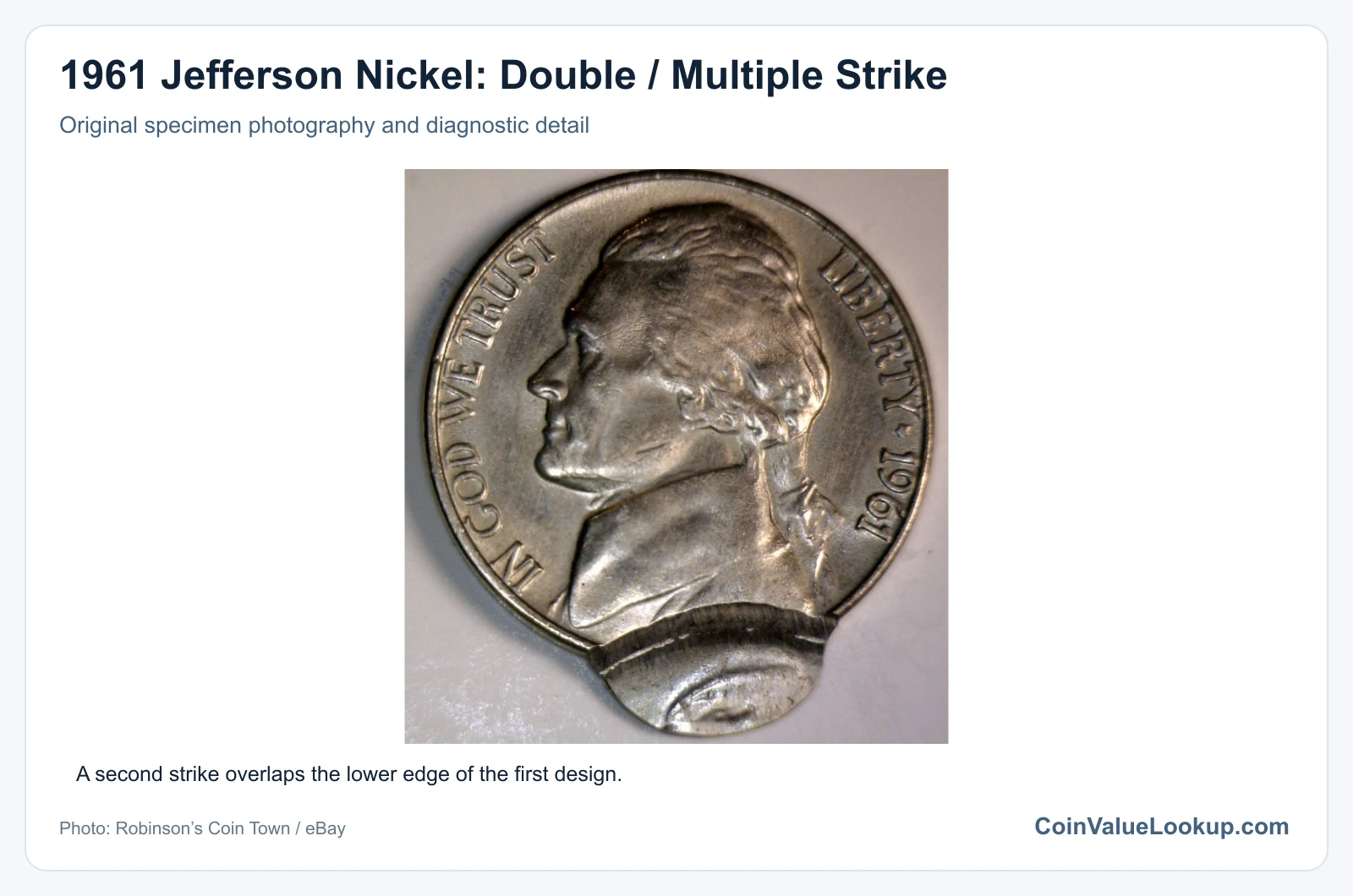
Double-struck 1961 nickels show two separate impressions of the design, with the second strike displaced or rotated relative to the first. You will see overlapping or shifted elements — a second partial portrait, duplicated legends at a different angle, or a clearly visible second rim.
This is different from a doubled die, where the doubling occurs on the die itself and every coin from that die shows identical doubling. A double strike happens to a single coin that failed to eject and was hit again.
It is also different from impressions added after minting, such as vise marks or deliberate damage.
Condition, the degree of visible displacement, and whether the date remains readable all influence how a double-struck coin is evaluated. Professional certification helps establish that the second strike occurred during the minting process.
5. 1961 Jefferson Nickel — Doubled Die Reverse
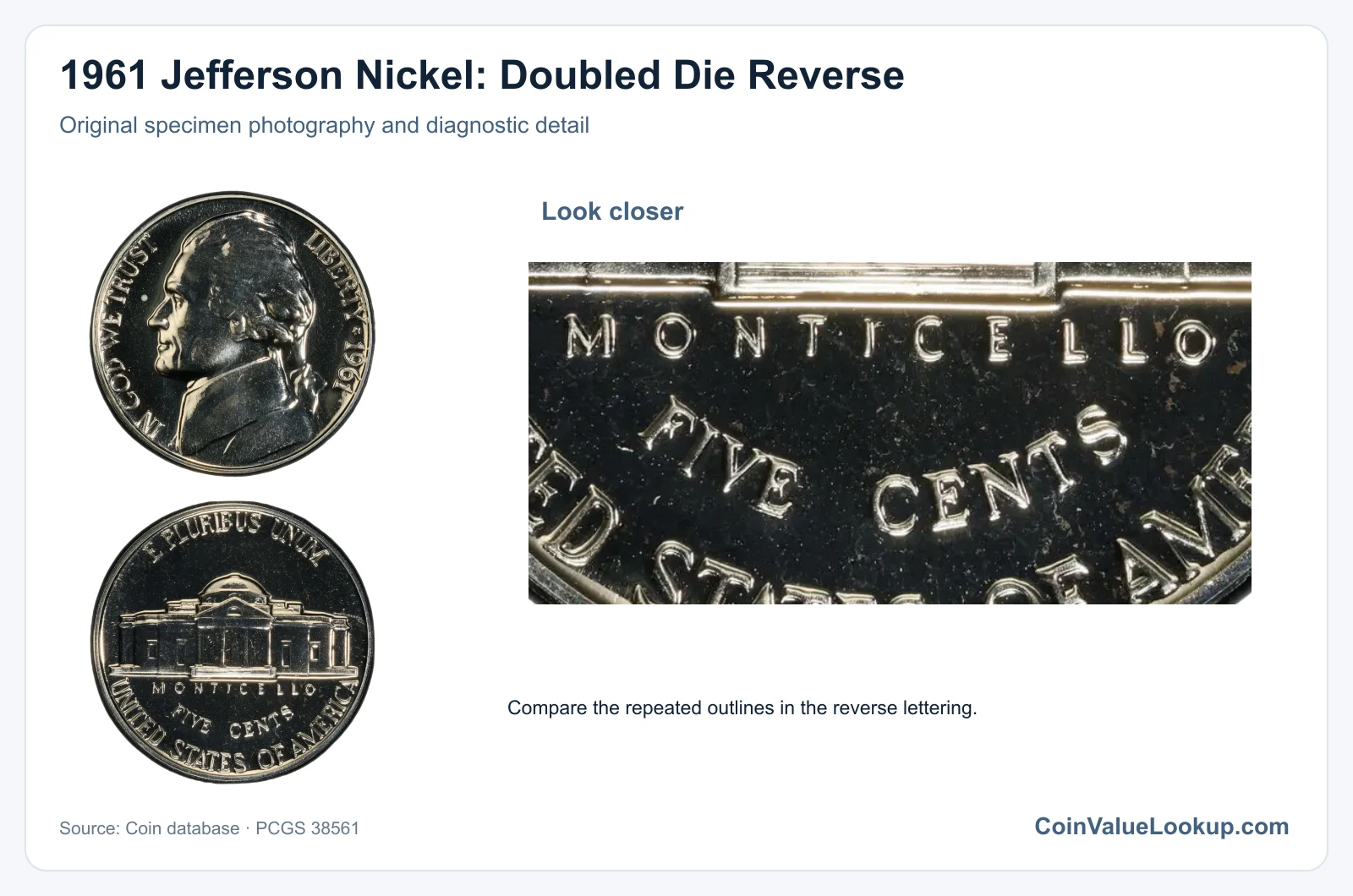
A Doubled Die Reverse on a 1961 nickel shows consistent doubling in the reverse lettering or design elements. Under magnification, compare the letters of MONTICELLO, E PLURIBUS UNUM, or FIVE CENTS with a known normal coin.
True die doubling produces uniform separation or notching that repeats in the same direction across affected areas.
Machine doubling — a much more common occurrence — produces a flat, shelf-like appearance without the raised, distinct secondary image of a genuine doubled die. Reflections and lighting angles can also trick the eye, so steady illumination and a reference coin are your best friends.
Value depends on the strength and location of the doubling as well as the coin's overall condition. Each doubled die variety is assessed on its own merits by collectors and grading services.
6. 1961 Jefferson Nickel — Clipped Planchet
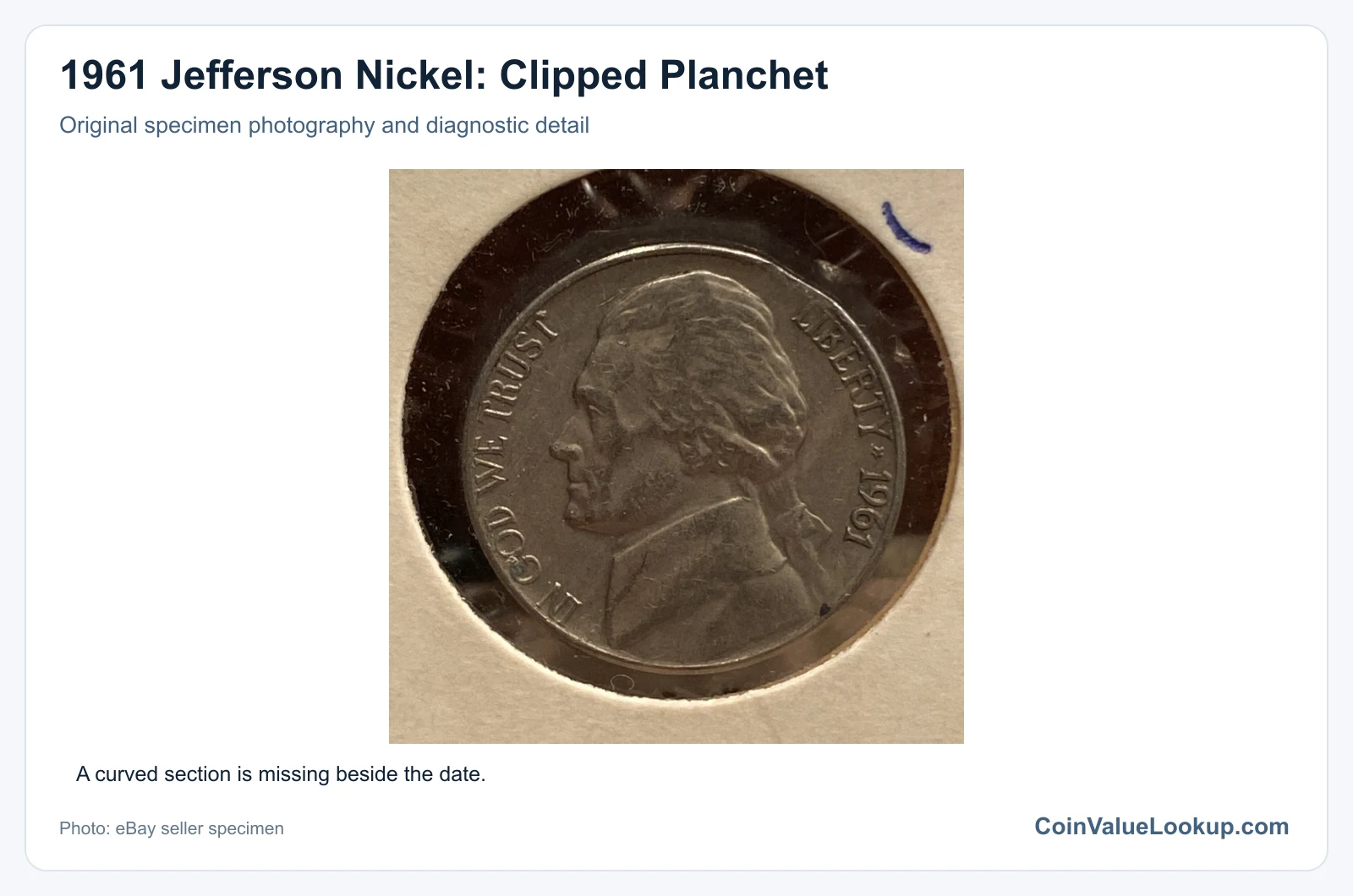
A clipped planchet error on a 1961 nickel means the blank was punched from strip metal in a way that overlapped a previously punched hole or the edge of the strip. The result is a missing curved or straight section of the coin's rim and adjacent design.
Look for a corresponding area of weakness on the opposite side of the coin, where metal did not flow fully into the die. The edge at the clip site should show a natural break in the planchet rather than a filed or cut surface.
Do not confuse a genuine clip with post-mint damage: filed notches, corrosion eating into the edge, or coins that have been deliberately cut. Authentic clips typically show smooth, gently curved missing areas with a Blakesley effect — a weak area directly opposite the clip.
Condition and clip size factor into how these are valued.
7. 1961 Jefferson Nickel — Die Crack / Die Chip
Die cracks and die chips appear as raised lines or small raised blobs on the coin's surface. They form when the steel die develops fractures from repeated use.
On a 1961 nickel, these can appear anywhere on either side.
An interior die crack shows up as a thin raised line crossing the design. A rim-connected break that removes part of the design is sometimes called a cud — a flat, unstruck area at the rim.
Small die chips produce tiny raised bumps, often found inside letters.
Do not confuse these with incuse scratches, which are recessed into the surface rather than raised. Corrosion pitting or foreign material stuck to the coin can also mimic raised features but will not follow the consistent, sharp profile of a die crack.
Value varies by size, location, and overall condition of the coin.
8. 1961 Jefferson Nickel — Doubled Die Obverse
A Doubled Die Obverse on a 1961 nickel will show consistent doubling on the obverse lettering or design. Check IN GOD WE TRUST, LIBERTY, and the date under magnification, comparing them to a normal example.
Genuine die doubling produces a raised, distinct secondary image with separation that appears in the same direction on every affected element.
Machine doubling is far more common and looks different: it creates a flat, shelf-like displacement without truly separated raised features. Worn die contours and odd lighting reflections can also simulate doubling to the untrained eye.
When examining your coin, use consistent overhead lighting and compare multiple letters. If the doubling is only visible on one letter and not others in the same area, it is more likely damage or machine doubling.
Condition and the strength of the doubling determine how these are valued individually.