1965 Lincoln Penny Coin Value: How Much Is It Worth?
Most 1965 Lincoln pennies you pull from a jar are worth about what you paid for a gumball in 1985 — not much beyond face value. A USA Coin Book guide estimate places an ordinary uncirculated example at about $1.24 in MS65 grade.
The real action starts when you can confirm a Special Mint Set finish or an authenticated striking error. Original copper color and careful preservation push values higher, but the coin has to earn it.
Fast Way to Identify Your 1965 Lincoln Penny
Want a quick read on what you have? Upload clear photos of the front and back of your 1965 penny and our identifier will give you a preliminary idea of which version and condition range you might be looking at.
Good lighting and a steady hand help — blurry shots make identification harder for everyone.
1965 Penny Value
Upload both sides of your 1965 Lincoln Penny.
Front Obverse
Upload photo
Back Reverse
Upload photo
Which 1965 Lincoln Penny Versions Are Worth Money?
- Compare your 1965 penny against known Special Mint Set examples — SMS coins require authenticated identification and are valued individually based on condition, color and any cameo contrast.
- Authenticated striking errors such as double strikes, off-center impressions and wrong-planchet strikes can carry meaningful premiums over ordinary cents — one compound double-strike with broadstrike sold for $186 in NGC MS64 Red.
Step 1: Identify Your 1965 Lincoln Penny Mint Mark and Version
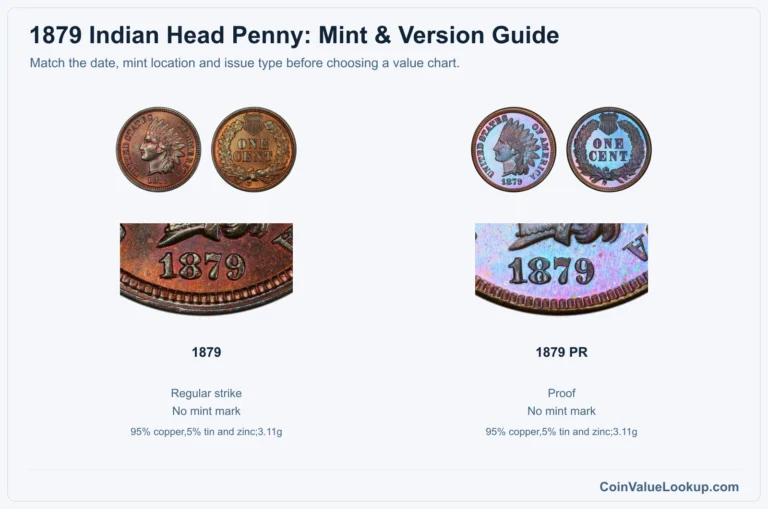
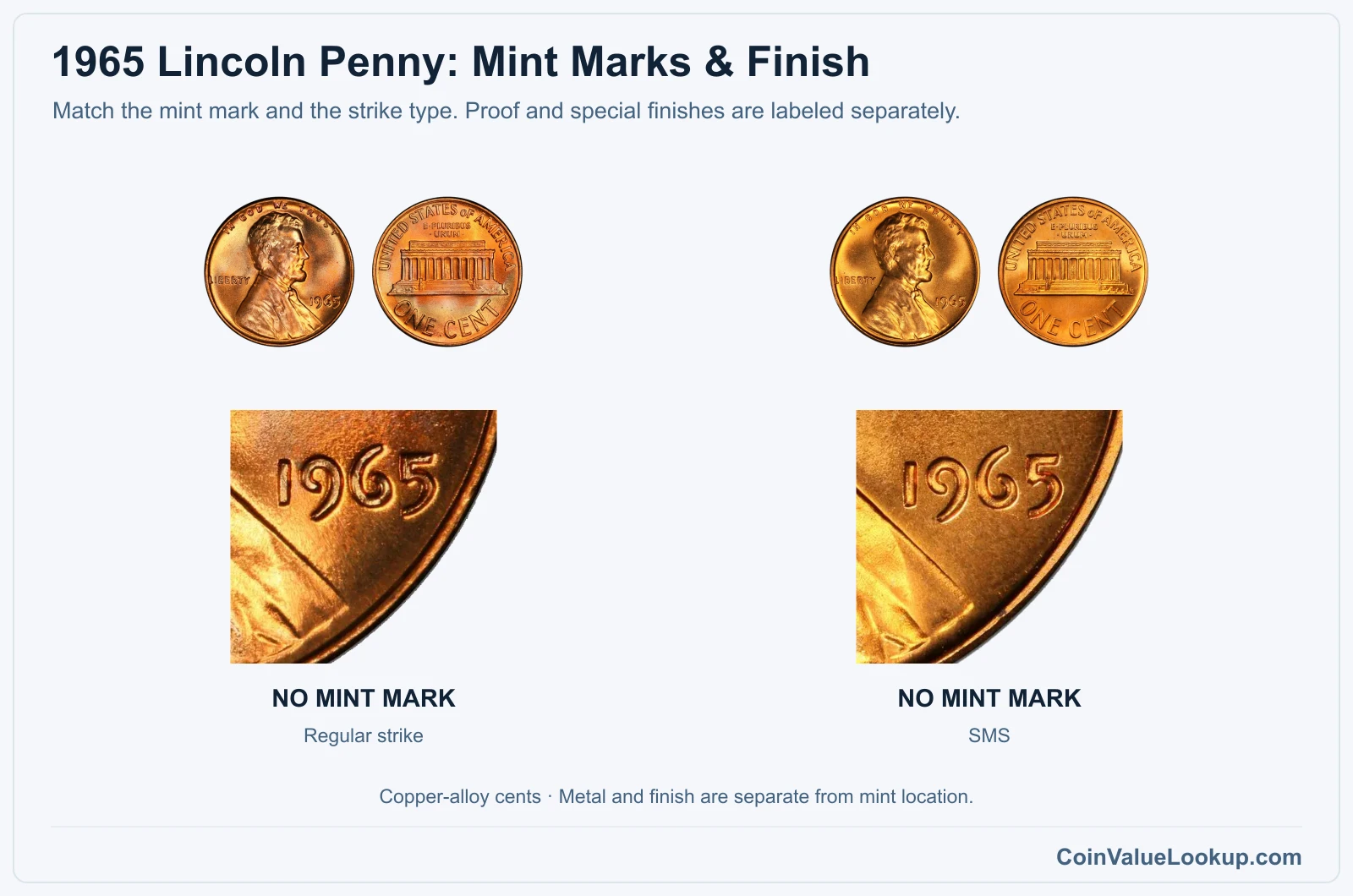
The 1965 Lincoln cent carries Lincoln's portrait on the front and the Lincoln Memorial on the back. It is struck in 95% copper and 5% zinc, weighing about 3.11 grams.
These are not the copper-plated zinc cents that came later.
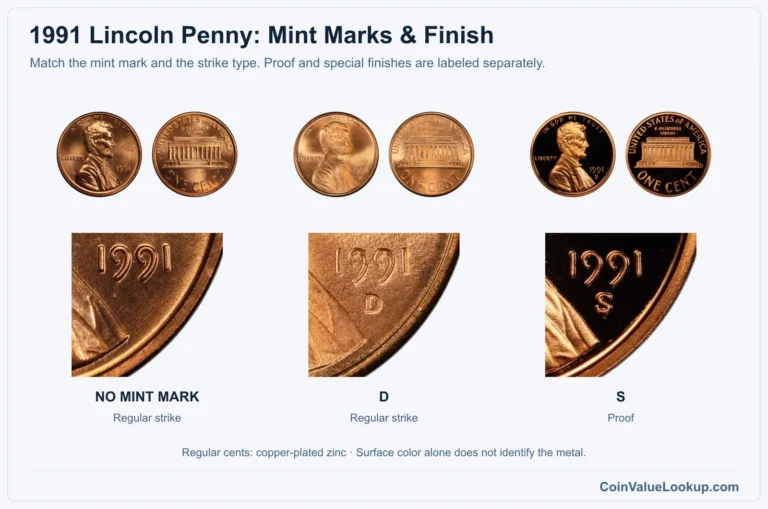
Every regular 1965 cent lacks a mintmark, so the absence of a letter below the date tells you nothing about which facility struck it. There was no annual proof issue this year.
Special Mint Set coins were produced at San Francisco, also without a mintmark, as a replacement for the usual proof and uncirculated sets.
Copper color designations — Red, Red-Brown and Brown — describe how much original surface color remains, not different metals. A coin can be dark brown and still uncirculated; a bright penny may have been cleaned.
Always check for unnatural shine or hairlines under magnification.
SMS coins generally show a sharper strike and distinctive surface quality, but finish varies from coin to coin. Comparing yours against a certified SMS example is much more reliable than guessing based on brightness alone.
Altered, plated or chemically cleaned coins are not errors.
Step 2: Check Your 1965 Lincoln Penny Grade
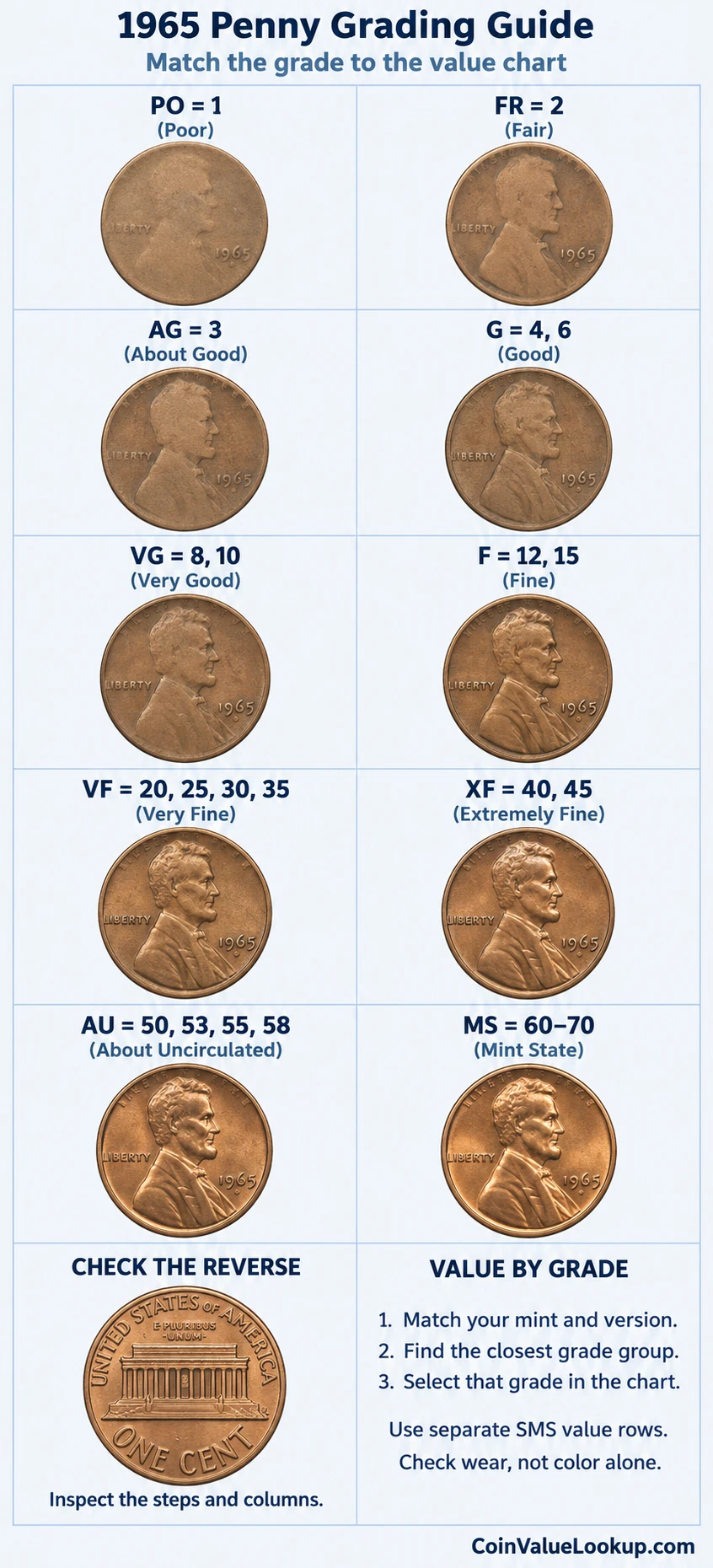
Start on the obverse. Lincoln's cheek, jawline and the hair just above his ear lose detail first when a coin circulates.
Flip it over and check the Memorial's horizontal roof line and the columns — soft or flat spots there confirm wear.
Contact marks are not the same as wear. A coin can be technically uncirculated but covered in bag marks from bouncing around with thousands of siblings at the mint.
Remaining luster helps you separate honest wear from simple handling.
Use the comparison image to match your coin's detail level against known grade examples. A dark, toned penny is not automatically low grade, and a suspiciously shiny one may have been cleaned.
SMS finish and copper-color designation are tracked separately from the numeric grade, so keep those filters in mind when looking up values.
Step 3: Check 1965 Lincoln Penny Value by Mint and Version
1965 Lincoln Penny — No Mint Mark — Business
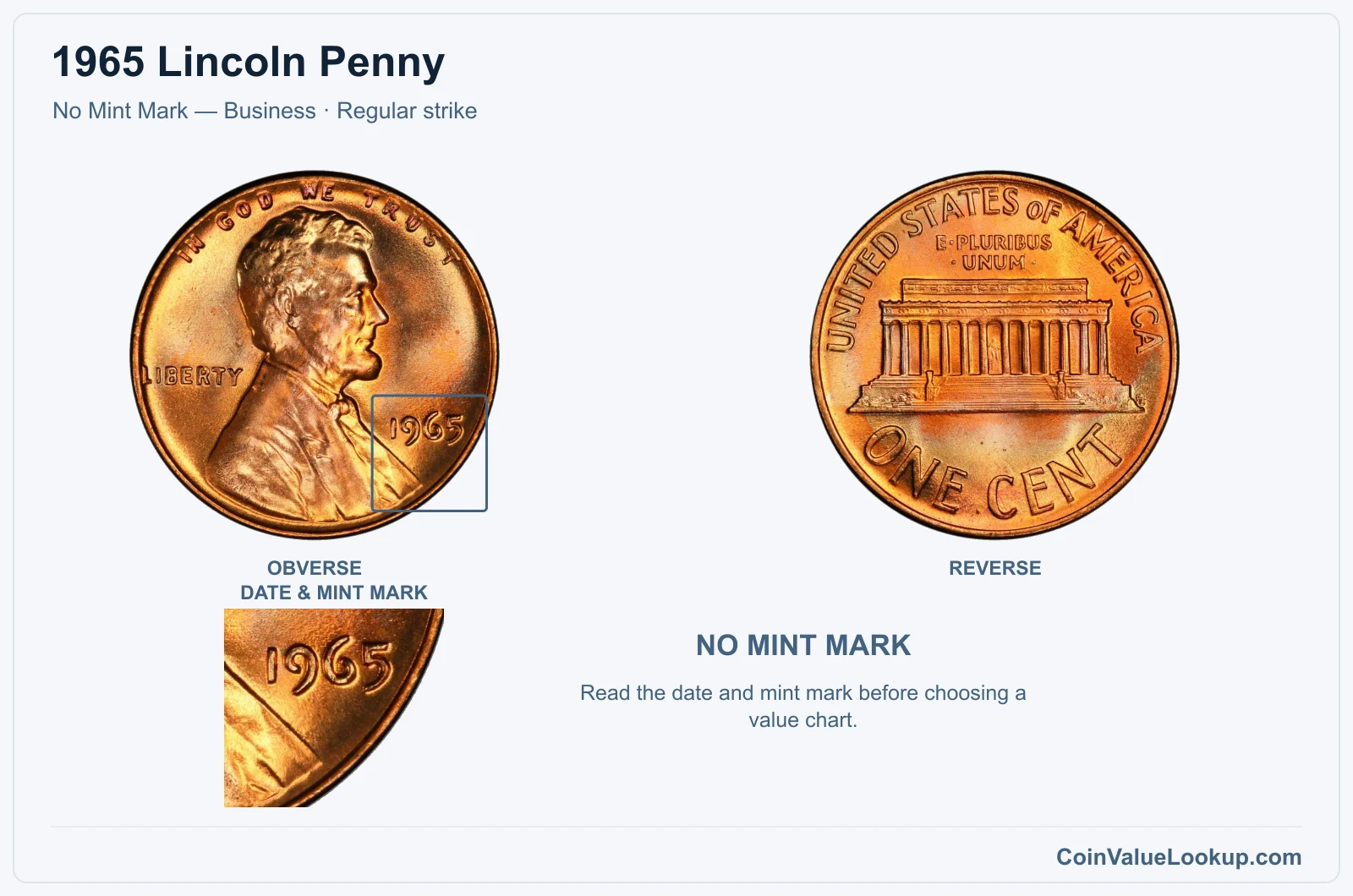
This is the standard 1965 Lincoln cent struck for circulation. It has no mintmark, a plain edge and weighs about 3.11 grams in 95% copper / 5% zinc.
A USA Coin Book guide estimate puts an MS65 example at roughly $1.24. Copper-color designation matters: a full Red coin in high grade will outperform a Brown one at the same numeric grade.
Most circulated examples trade near face value, so condition is the entire ballpark here.
Range Grade
Price1965 No Mint Mark — Business (BN) Price1965 No Mint Mark — Business (RB) Price1965 No Mint Mark — Business (RD) Auction Records Appraisal PO PO 1
—
Coin Identifier FR FR 2
—
Coin Identifier AG AG 3
—
Coin Identifier G G 4
—
Coin Identifier
G 6
—
Coin Identifier VG VG 8
—
Coin Identifier
VG 10
—
Coin Identifier F F 12
—
Coin Identifier
F 15
—
Coin Identifier VF VF 20
—
Coin Identifier
VF 25
—
Coin Identifier
VF 30
—
Coin Identifier
VF 35
—
Coin Identifier XF XF 40
—
Coin Identifier
XF 45
—
Coin Identifier AU AU 50
—
Coin Identifier
AU 53
—
Coin Identifier
AU 55
—
Coin Identifier
AU 58
—
Coin Identifier MS MS 60
—
—
Coin Identifier
MS 61
—
—
Coin Identifier
MS 62
—
Coin Identifier
MS 63
—
Coin Identifier
MS 64
Coin Identifier
MS 65
Coin Identifier
MS 66
Coin Identifier
MS 67
—
Coin Identifier
MS 68
—
—
—
Coin Identifier
MS 69
—
—
—
—
—
MS 70
—
—
—
—
—
1965 Lincoln Penny — No Mint Mark — Special Mint Set
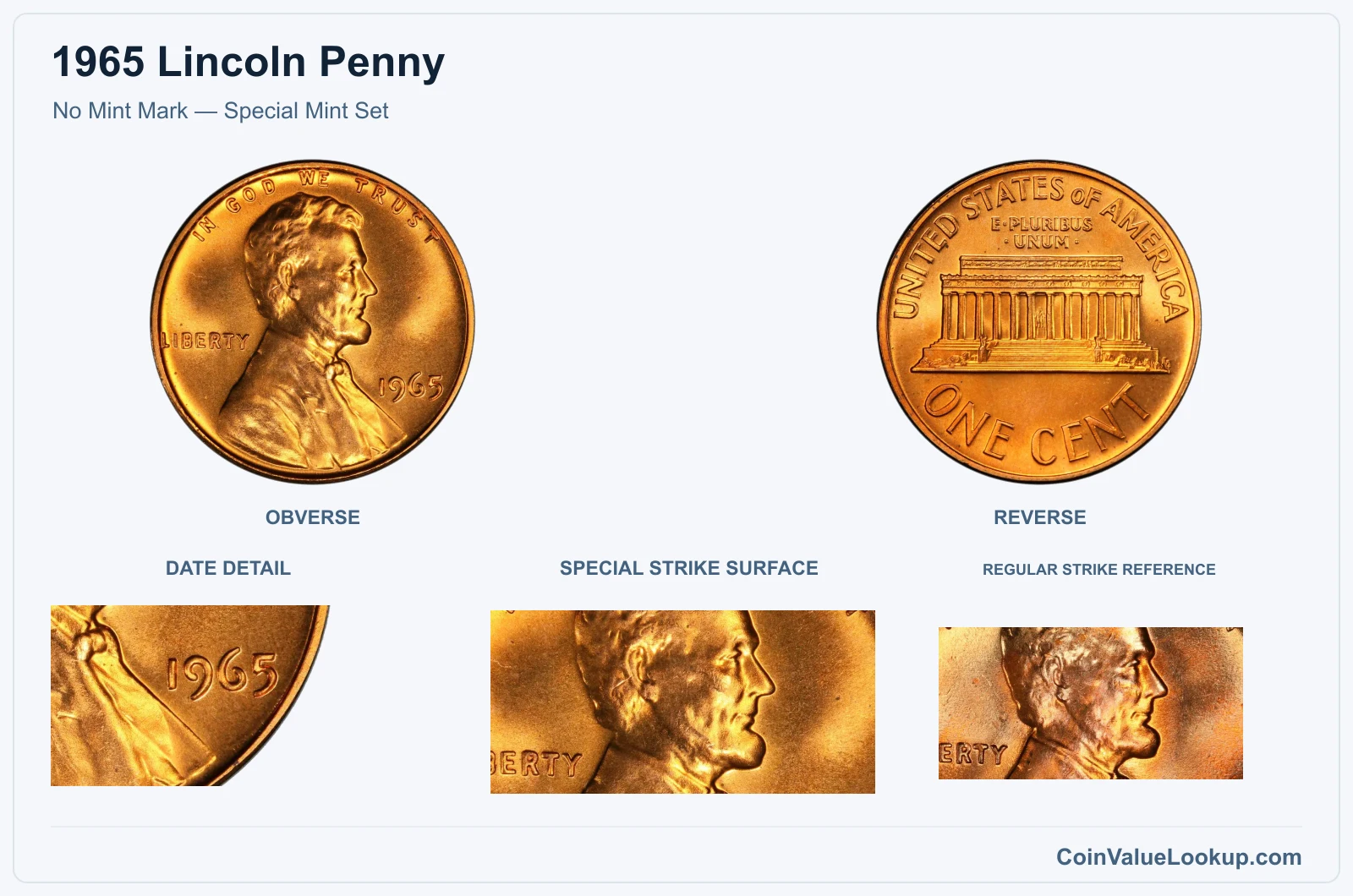
Special Mint Set coins were produced at San Francisco starting in 1965 as a stand-in for the suspended proof and uncirculated set programs. They carry no mintmark, same as ordinary business strikes, which makes visual comparison to certified examples essential.
SMS pieces generally display sharper strikes and a distinctive surface quality, though finish varies.
Coin Value Lookup is a good starting point if you want to compare your coin against other Lincoln cent year guides before deciding whether professional authentication is worthwhile.
No single adopted price range covers all SMS coins of this date. Value depends on authenticated identity, numeric grade, copper-color designation and whether the coin shows cameo contrast.
Professional certification is the practical way to confirm you actually have an SMS coin rather than a nice business strike.
Range Grade
Price Auction Records Appraisal SP SP 1
—
Coin Identifier
SP 2
—
Coin Identifier
SP 3
—
Coin Identifier
SP 4
—
Coin Identifier
SP 6
—
Coin Identifier
SP 8
—
Coin Identifier
SP 10
—
Coin Identifier
SP 12
—
Coin Identifier
SP 15
—
Coin Identifier
SP 20
—
Coin Identifier
SP 25
—
Coin Identifier
SP 30
—
Coin Identifier
SP 35
—
Coin Identifier
SP 40
—
Coin Identifier
SP 45
—
Coin Identifier
SP 50
—
Coin Identifier
SP 53
—
Coin Identifier
SP 55
—
Coin Identifier
SP 58
—
Coin Identifier
SP 60
—
Coin Identifier
SP 61
—
Coin Identifier
SP 62
—
Coin Identifier
SP 63
—
Coin Identifier
SP 64
Coin Identifier
SP 65
Coin Identifier
SP 66
Coin Identifier
SP 67
Coin Identifier
SP 68
Coin Identifier
SP 69
—
—
—
SP 70
—
—
—
1965 Lincoln Penny Error List
1. 1965 Lincoln Penny — Double Strike with Broadstrike
A double-struck 1965 cent shows two distinct impressions where the coin was hit by the dies more than once. The second strike is displaced, so you see overlapping or shifted design elements on one or both sides.
This particular reported type combines the double strike with a broadstrike — meaning the collar was absent, allowing the metal to spread outward.
Do not confuse this with a doubled die, which is a different category entirely. Post-mint damage from a vise or press can also mimic a second strike, but genuine examples show full design detail in both impressions.
An NGC MS64 Red compound-error example sold for $186 in April 2020, though that price reflects that specific coin's combination of errors, grade and color.
2. 1965 Lincoln Penny — Clashed Dies
Clashed dies happen when the obverse and reverse dies slam together without a blank between them. Each die picks up a faint ghost of the opposite design, and those outlines transfer to subsequent coins.
On a 1965 cent, look for displaced design remnants behind Lincoln's head or within the Memorial reverse — partial outlines that do not belong.
This is not a doubled die or a double strike. Scratches, another coin pressed into the surface after minting, or simple contact marks can look similar at a glance.
An NGC MS65 Red-Brown example has been certified for this date. No adopted price range is available; value depends on the strength of the clash, the coin's grade and authenticated identity.
3. 1965 Lincoln Penny — Ragged Clip with Off-Center Strike
This compound error combines a ragged clip — where the blank was cut from an irregular section of strip metal — with an off-center strike. The result is a coin missing a chunk of its expected edge and showing design elements shifted away from center.
Distinguish the original clipped edge, which is rough and irregular, from the unstruck crescent that results from the off-center placement. A cut or filed edge after minting will show tool marks rather than the natural break pattern.
A PCGS AU58 example with a 4% ragged clip and 5% off-center strike sold for $79 in March 2025. That sale reflects one specific coin's condition and error combination.
4. 1965 Lincoln Penny — Doubled Die Obverse
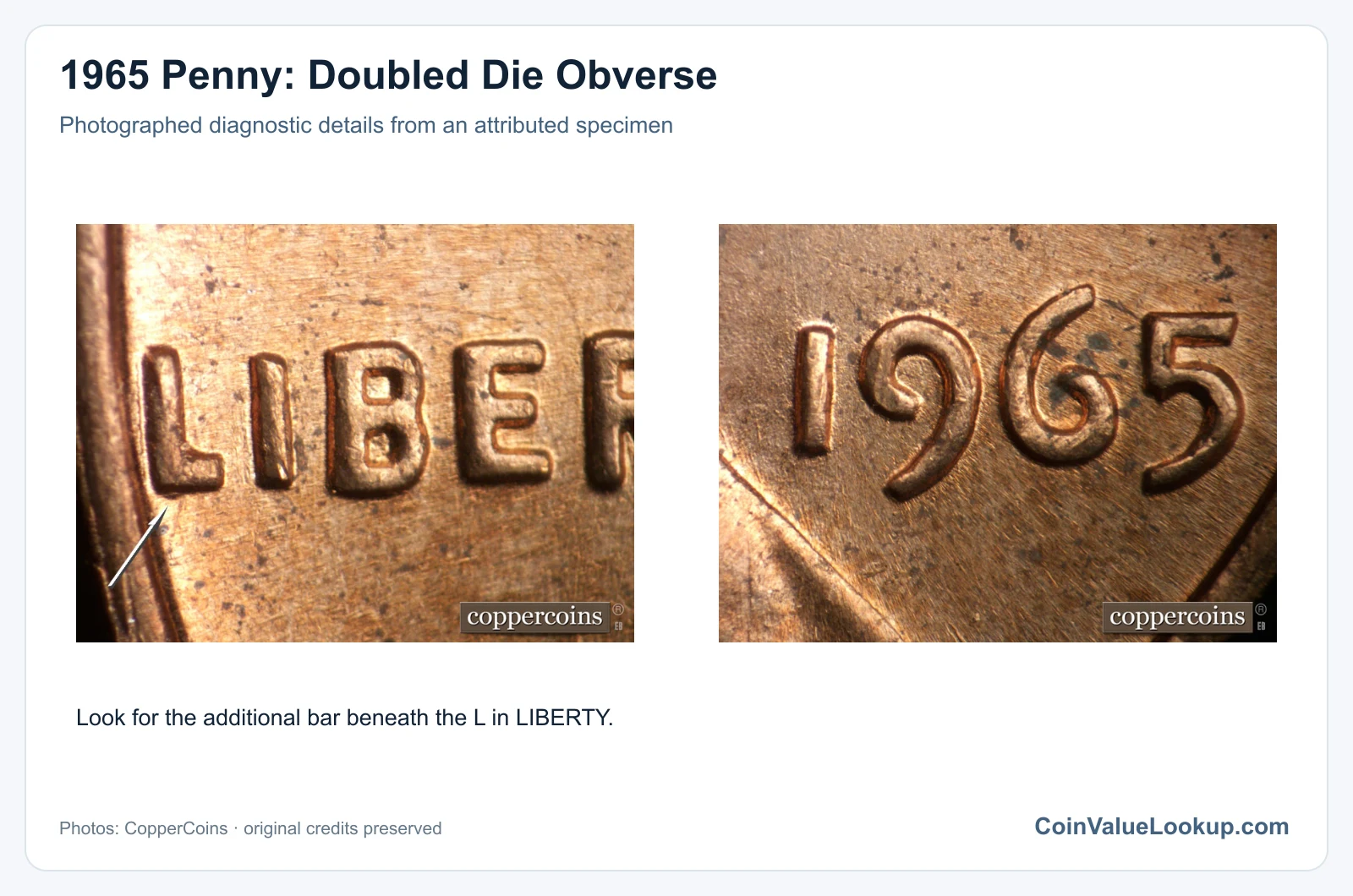
A doubled die obverse on a 1965 cent means the die itself carried a doubled image before it ever struck a coin. Look at the obverse lettering — LIBERTY, IN GOD WE TRUST and the date — under magnification for consistent separation or notching on the same side of each letter.
The doubling should repeat in the same direction across multiple design elements.
Machine doubling is the common lookalike. It produces a flat, shelf-like distortion rather than distinct raised separation.
Reflections under certain lighting can also fool you. No adopted price range is available for this variety; value depends on the specific die, visibility of the doubling and the coin's authenticated grade.
5. 1965 Lincoln Penny — BIE Die Break
A BIE die break shows up as a small raised bump or bridge between the letters B and E in LIBERTY. It forms when a crack develops in the die face and metal fills the gap during striking.
The result is a tiny vertical line, blob or connecting bar in that specific spot.
Dirt wedged between the letters, a scratch or an added piece of metal can mimic this. A genuine BIE is raised above the field, uniform in texture with the surrounding design and does not scrape off.
No adopted price range is available; the error's value depends on its size, clarity and the coin's overall condition and grade.
6. 1965 Lincoln Penny — Die Break / Cud
A die break or cud appears when part of the die face chips away. The missing section leaves a raised, featureless blob on the struck coin.
A true cud connects to the rim, while interior die breaks sit within the design field.
Look for a smooth, raised area with clearly defined boundaries where normal design detail is displaced or absent. Rim dents from post-mint damage push metal inward and downward rather than raising it.
Corrosion can create rough lumps, but these lack the clean boundary of a genuine die break. No adopted price range is available for this error on 1965 cents; value depends on size, location and the coin's authenticated condition.
7. 1965 Lincoln Penny — Struck on a Dime Planchet
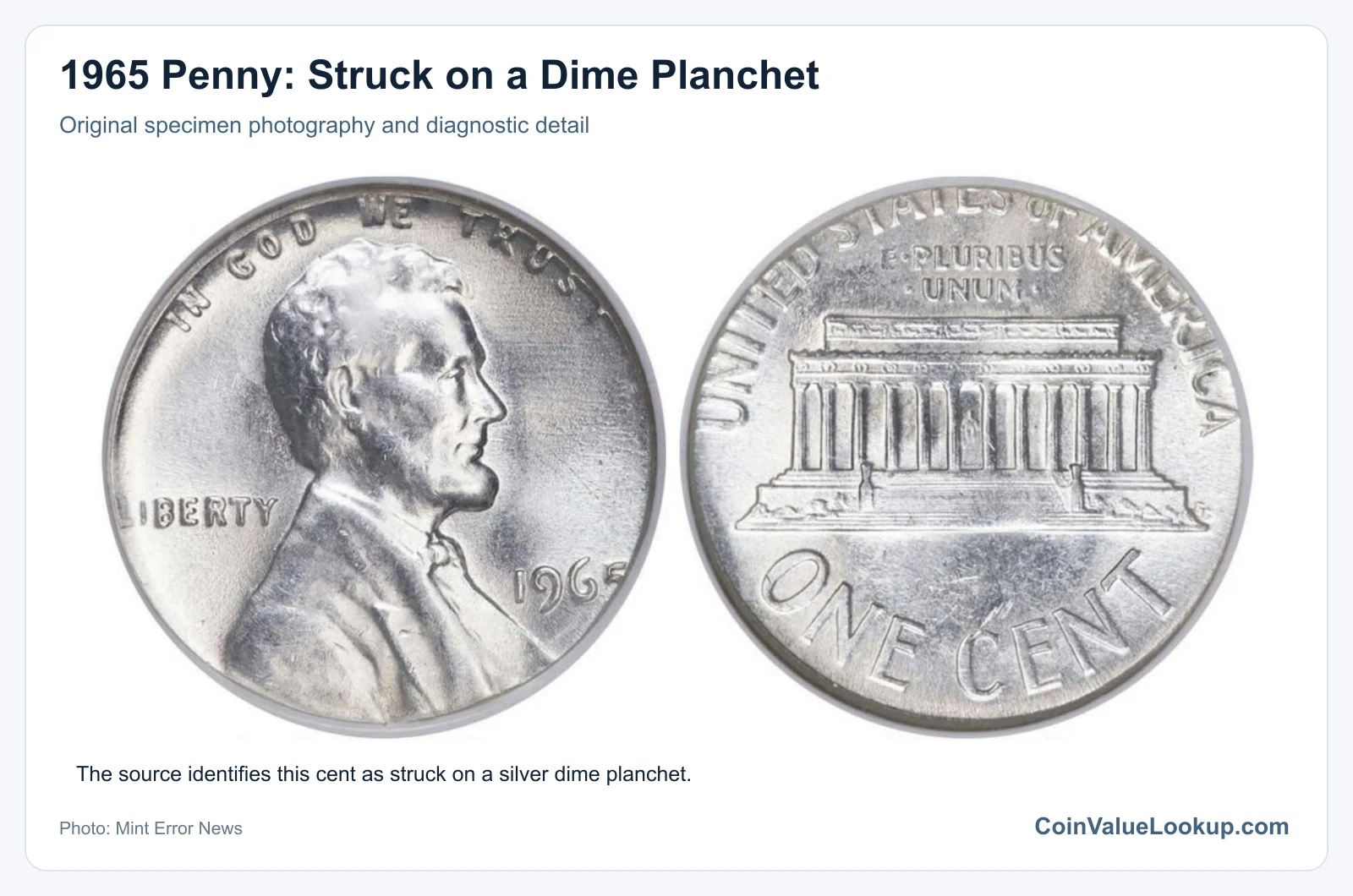
A 1965 cent struck on a dime planchet is a wrong-planchet error — a dime-sized blank ended up in the cent press. Both silver and clad dime blanks have been reported for this date, so the metal matters.
A silver dime planchet will weigh about 2.5 grams and show a solid silver edge; a clad dime planchet weighs roughly 2.27 grams and reveals layered edge material.
Compare your coin's weight, diameter and edge against a normal 1965 cent (3.11 grams, 19 mm, plain edge). Plated, acid-thinned or otherwise altered cents can look lighter and different, but the edge and measured weight will not match a genuine wrong-planchet strike.
No adopted price range is available; value depends on planchet type, authenticated identity and condition.
8. 1965 Lincoln Penny — Die Cap / Capped-Die Strike
A die cap forms when a struck coin sticks to one of the dies and gets carried along for subsequent strikes. That stuck coin eventually cups around the die like a bottle cap, and the coins struck beneath it receive a distorted, mirrored impression from the cap's underside.
You are looking for a dramatically cupped coin with one normal side and one progressively distorted side, or a flat coin showing the transferred brockage image from a cap above it. A coin that is simply bent, squeezed in a vise or weakly struck will not show that characteristic cupping with retained design transfer.
No adopted price range is available; value depends on the stage of the cap, authenticated identity and overall condition.
9. 1965 Lincoln Penny — Broadstrike
A broadstrike occurs when the retaining collar fails to contain the blank during striking. The coin spreads outward, producing a wider-than-normal piece with a complete but slightly expanded design.
The rim may be weak or absent, and the edge profile will lack the sharp definition of a normally struck cent.
This is different from an off-center strike, where the design is shifted and partially missing. A coin flattened after minting by a railroad track or a hammer will show distortion and surface damage that a genuine broadstrike does not.
Any wheel marks or other post-mint damage on a broadstruck coin are separate from the error itself. No adopted price range is available; value depends on authenticated identity and condition.