1946 Roosevelt Dime Coin Value: How Much Is It Worth?
The 1946 Roosevelt dime is the first year of a design that has run for decades, and every regular-issue example is struck in 90% silver. Guide estimates place these coins from about $5.81 in well-worn Good-4 condition up to roughly $29 for an uncirculated MS65, depending on the mint.
Those are grade-specific retail reference points from USA Coin Book, not guaranteed buy prices, and the silver content means values shift with the metal market.
Fast Way to Identify Your 1946 Roosevelt Dime
Want a quick read on your 1946 dime? Upload clear photos of the front and back, and our identifier can give you a preliminary take on which mint version you have and its general condition.
Good lighting and a steady shot help — try to capture the mintmark area near the torch base on the reverse.
1946 Roosevelt Dime Value
Upload both sides of your 1946 Roosevelt Dime.
Front Obverse
Upload photo
Back Reverse
Upload photo
Which 1946 Roosevelt Dime Versions Are Worth Money?
- Uncirculated examples (MS65 and above) with strong, fully separated torch bands and original surfaces command the best premiums for this date.
- A broadstrike error on a 1946 Philadelphia dime — look for an abnormally expanded rim with full design still visible on both sides.
- A 1946-S doubled reverse combined with a repunched S mintmark — one certified MS67 example sold for $247 at auction in November 2016.
- An off-center strike on a 1946 Philadelphia dime can be dramatic; a certified 65% off-center example has appeared at auction.
- A 1946-S broadstrike combined with a straight clip is an unusual two-error coin worth professional evaluation.
Step 1: Identify Your 1946 Roosevelt Dime Mint Mark and Version
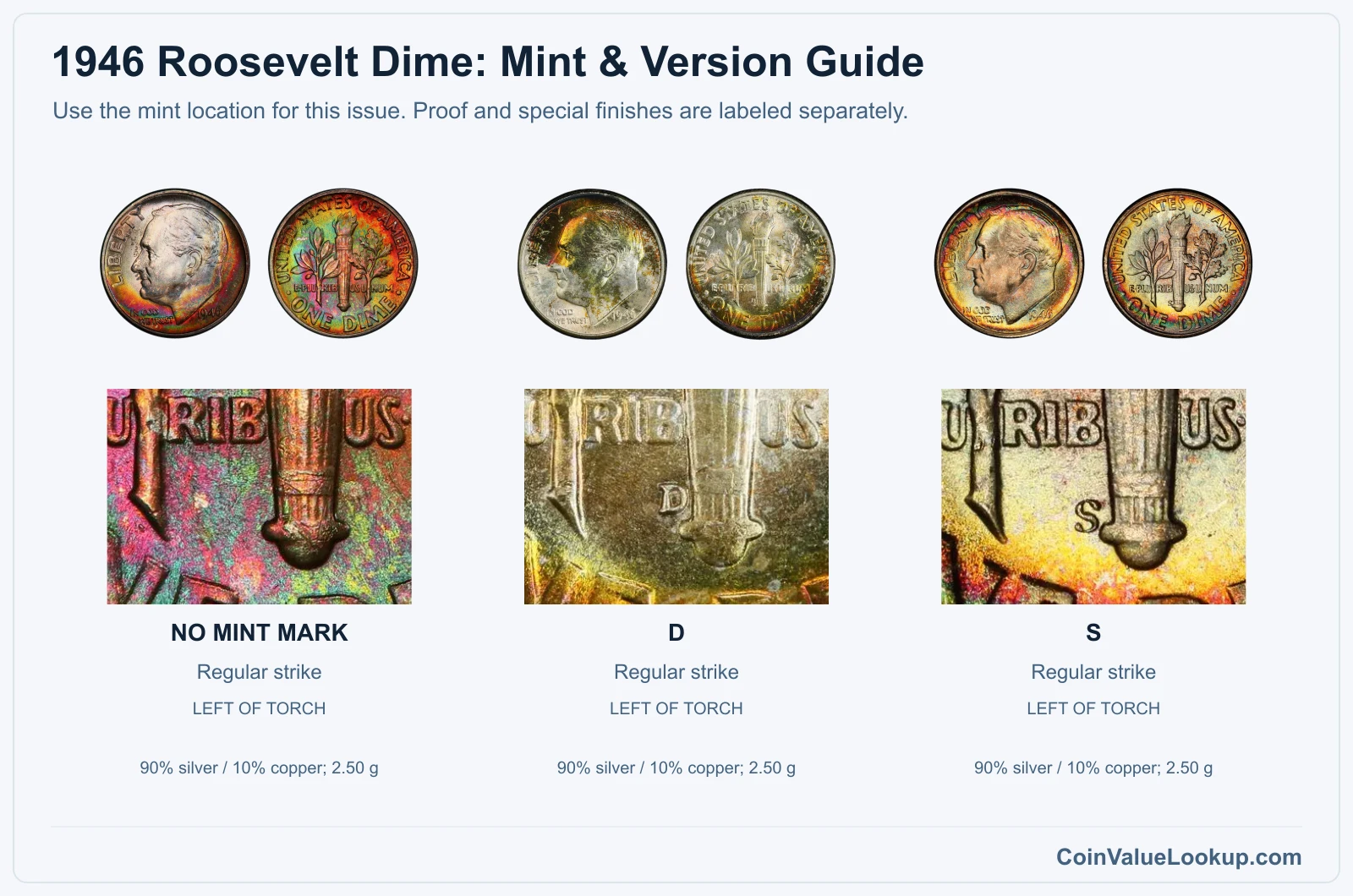
Every standard 1946 dime is 90% silver, 10% copper, weighing about 2.50 grams and measuring roughly 17.9 mm across. There is no normal clad version for this date.
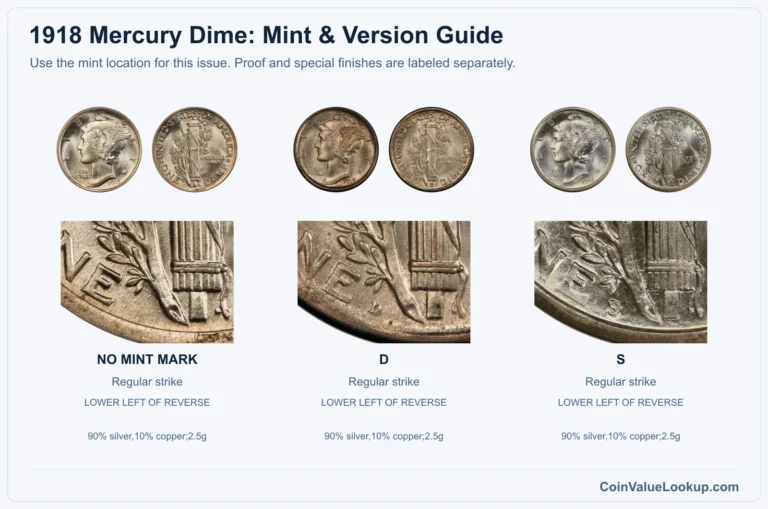
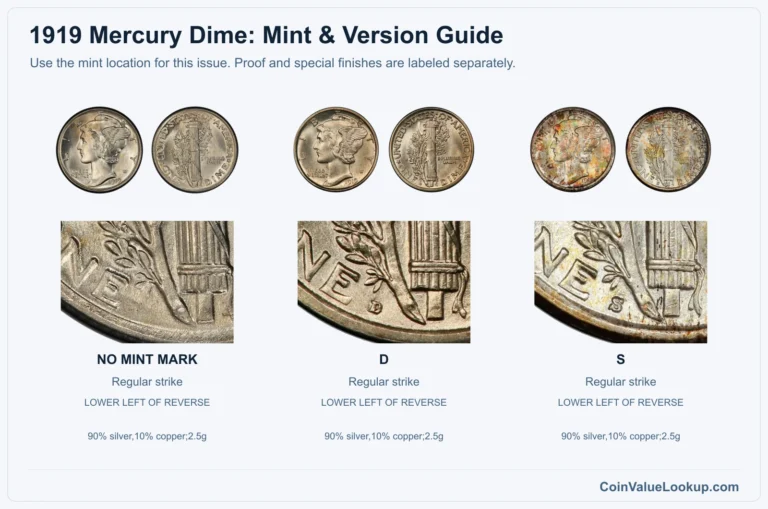
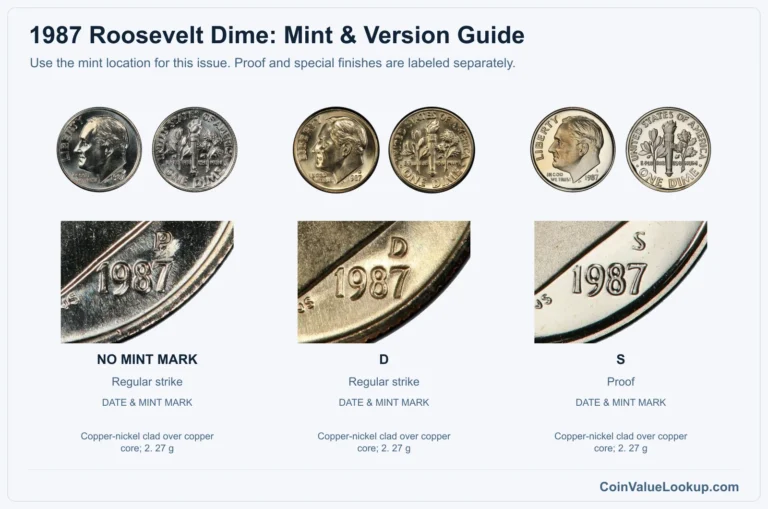
Flip to the reverse and look near the base of the torch. A "D" means Denver, an "S" means San Francisco, and no letter at all means Philadelphia.
The absence of a mintmark on Philadelphia coins is completely normal — it is not a missing-mintmark error.
The obverse shows Roosevelt's portrait facing left, and the reverse features a torch flanked by olive and oak branches. This was the inaugural year for the design, replacing the Mercury (Winged Liberty Head) dime.
Step 2: Check Your 1946 Roosevelt Dime Grade
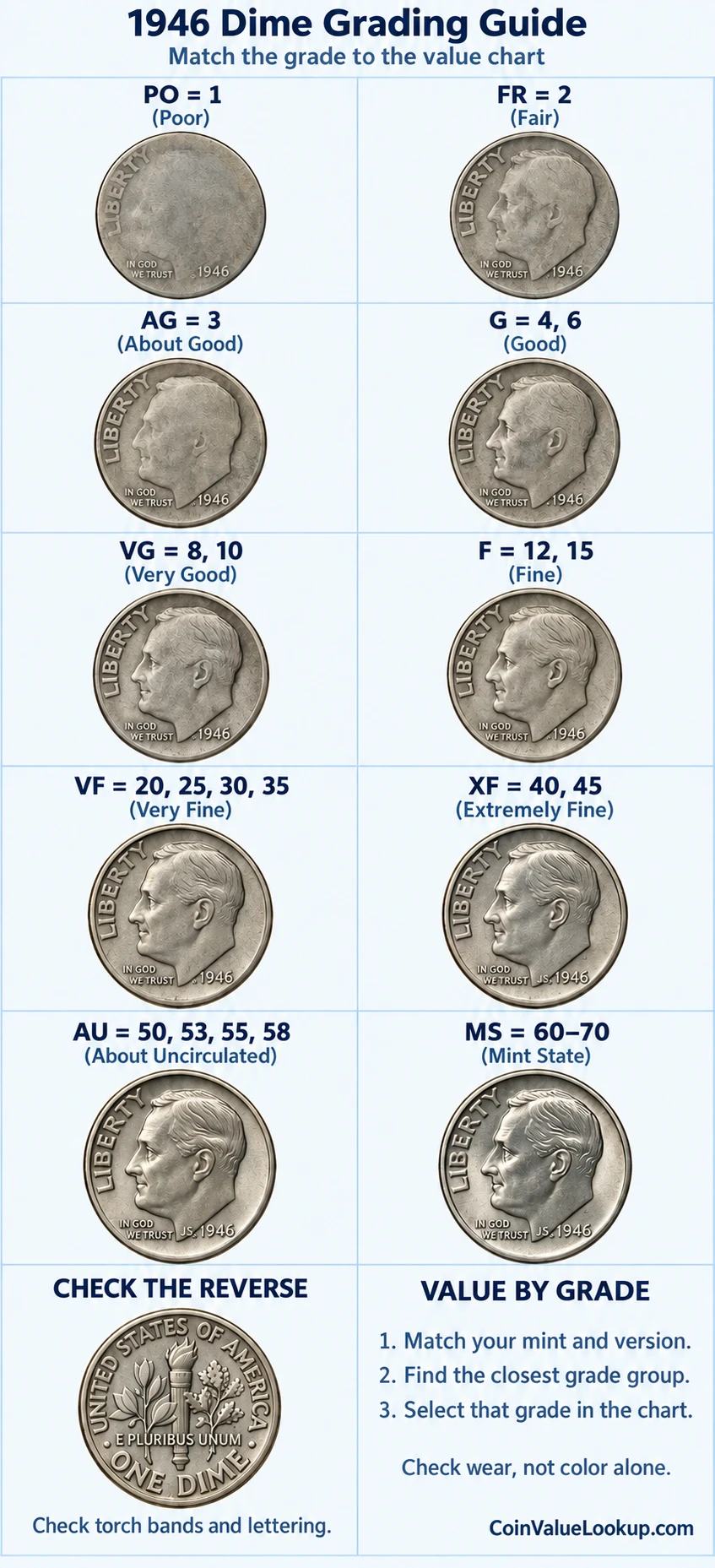
Start on the obverse. Roosevelt's cheekbone, the hair directly above the ear, and the jawline are the first places to lose detail.
Even light wear will dull the hair strands and flatten the cheek.
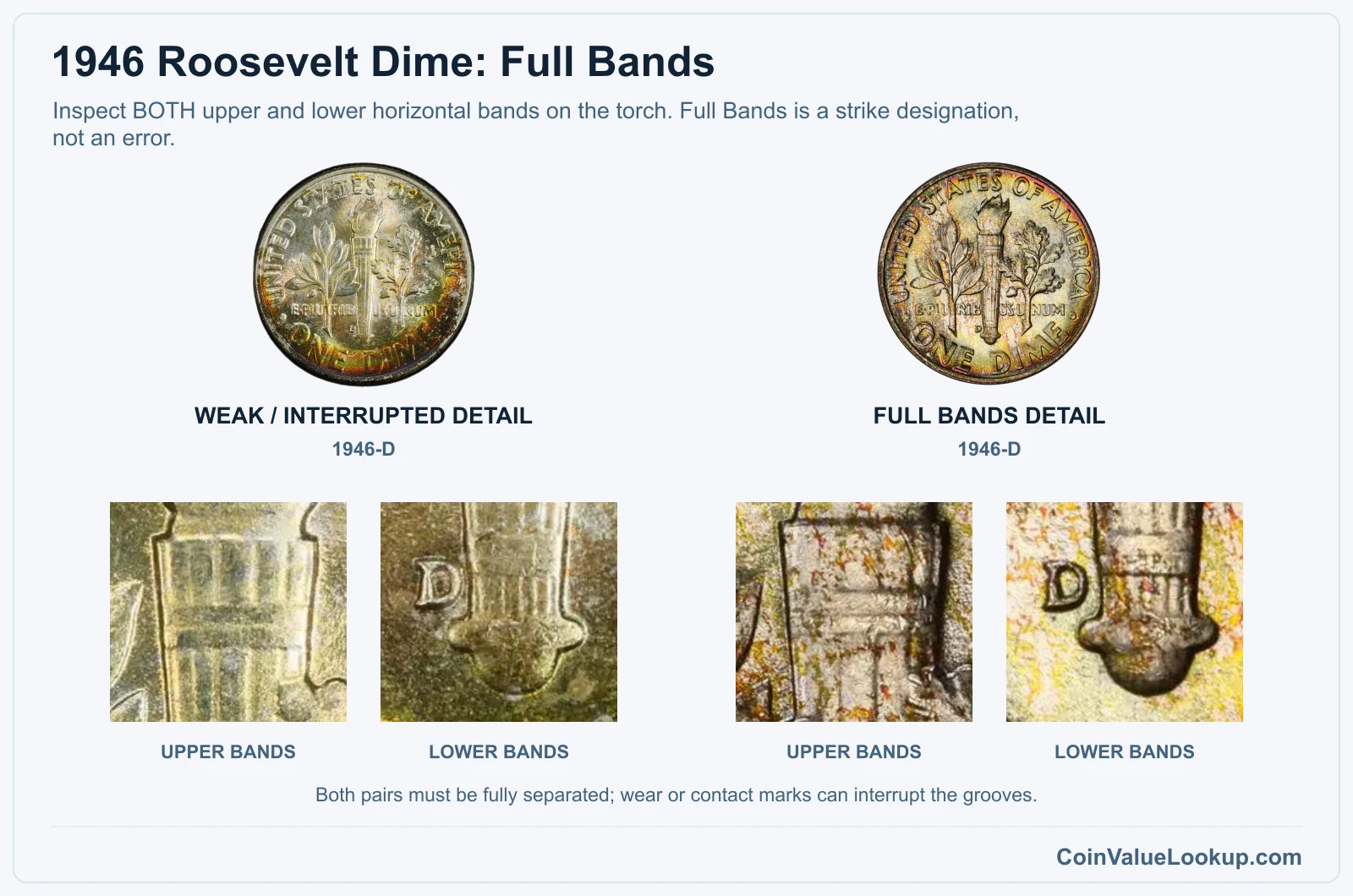
On the reverse, check the upper torch and the leaf clusters. The horizontal bands across the torch are a key indicator: when both pairs show full, unbroken separation the coin may qualify for the Full Bands designation, which adds a premium in mint-state grades.
A soft torch band does not always mean circulation wear. Some 1946 dimes left the press with incomplete strikes, so compare your coin's overall surfaces and luster before assuming it circulated.
Use the comparison image to match your coin's wear level against known grade benchmarks, and keep Full Bands comparisons within the same mint and numerical grade for a fair evaluation.
Step 3: Check 1946 Roosevelt Dime Value by Mint and Version
1946 Roosevelt Dime — No Mintmark / Philadelphia
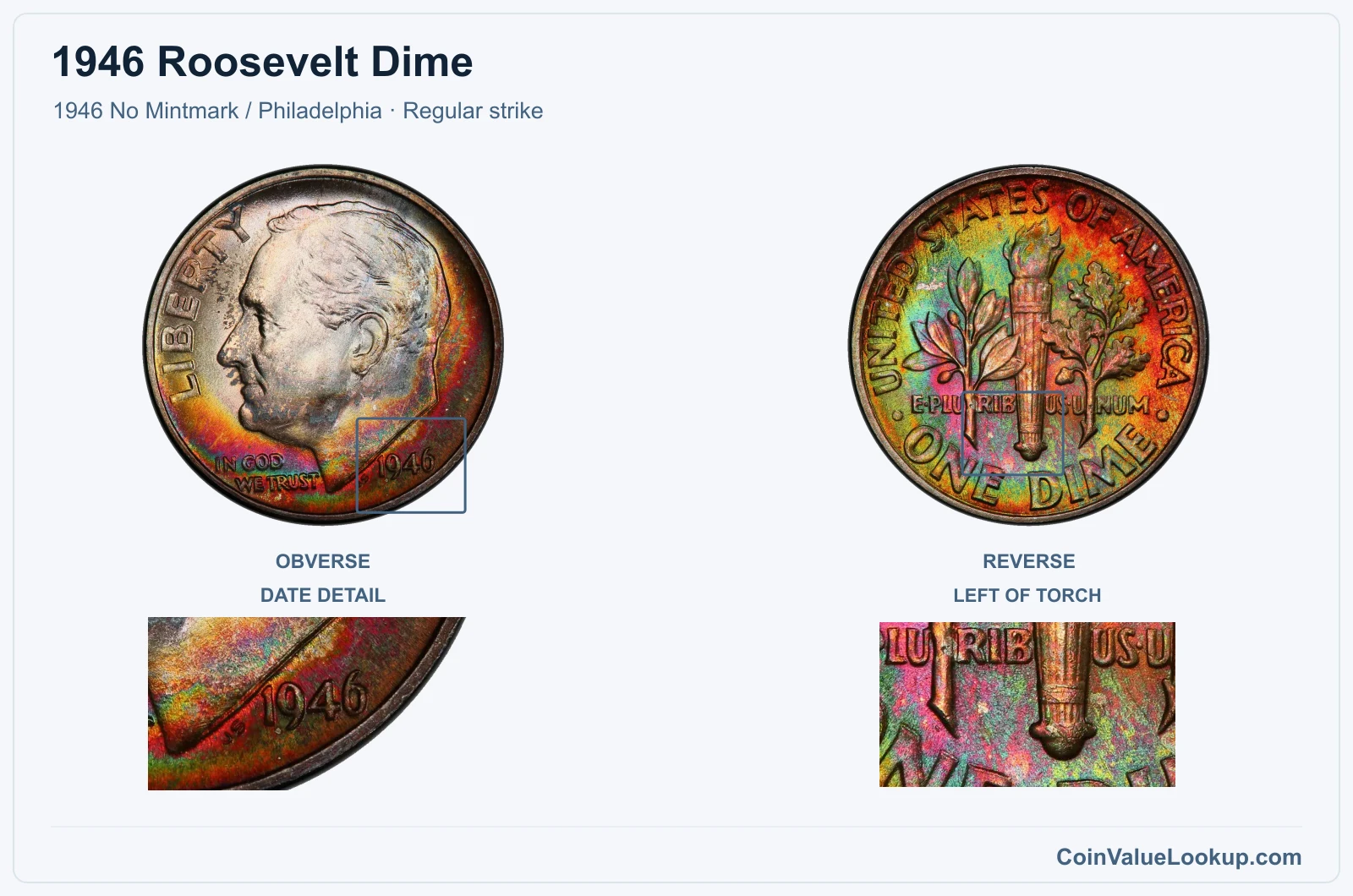
The 1946 Philadelphia dime carries no mintmark. It is a 90% silver business strike weighing about 2.50 grams.
This is the most commonly encountered version of the first-year Roosevelt dime.
USA Coin Book lists a guide value near $5.81 in Good-4 and around $18 in MS65. Coins with fully separated torch bands — the Full Bands designation — typically carry a premium over flat-strike examples at the same numerical grade.
Keep original surfaces intact; cleaning a silver dime almost always hurts its value more than any perceived improvement in appearance.
If you are exploring values for other dates and mints, Coin Value Lookup is a handy starting point for looking up coin guides across the series.
Range Grade
Price Auction Records Appraisal PO PO 1
—
Coin Identifier FR FR 2
—
Coin Identifier AG AG 3
—
Coin Identifier G G 4
—
Coin Identifier
G 6
—
Coin Identifier VG VG 8
—
Coin Identifier
VG 10
—
Coin Identifier F F 12
—
Coin Identifier
F 15
—
Coin Identifier VF VF 20
—
Coin Identifier
VF 25
—
Coin Identifier
VF 30
—
Coin Identifier
VF 35
—
Coin Identifier XF XF 40
—
Coin Identifier
XF 45
—
Coin Identifier AU AU 50
—
Coin Identifier
AU 53
—
Coin Identifier
AU 55
—
Coin Identifier
AU 58
—
Coin Identifier MS MS 60
—
Coin Identifier
MS 61
—
Coin Identifier
MS 62
—
Coin Identifier
MS 63
Coin Identifier
MS 64
Coin Identifier
MS 65
Coin Identifier
MS 66
Coin Identifier
MS 67
Coin Identifier
MS 68
Coin Identifier
MS 69
—
—
—
MS 70
—
—
—
1946 Roosevelt Dime — D / Denver
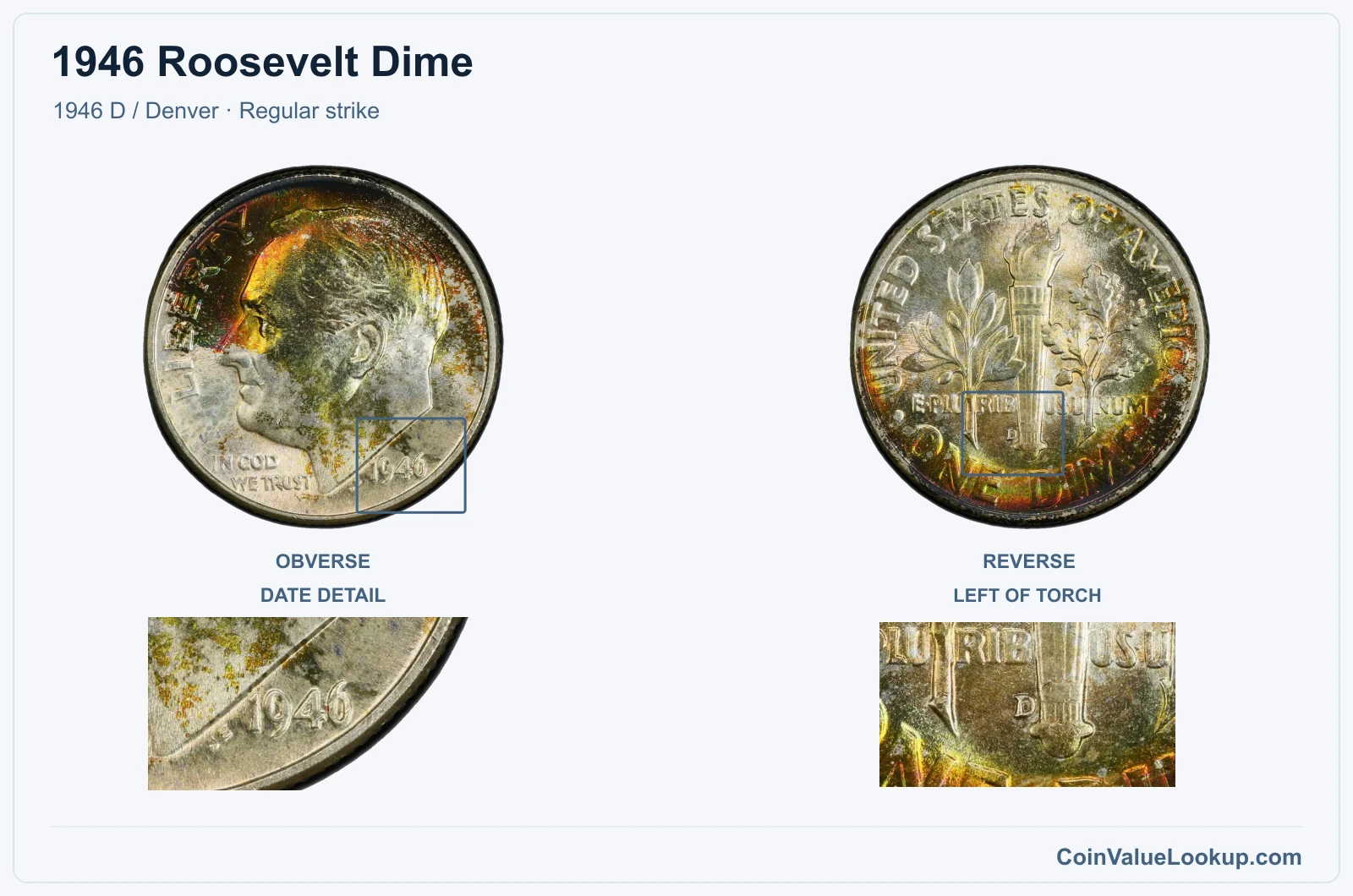
Look for a small "D" on the reverse near the torch base. The 1946-D is a Denver business strike in 90% silver, same 2.50-gram spec as the Philadelphia issue.
Guide values run about $5.81 in Good-4 up to roughly $21 in MS65 per USA Coin Book. In practice, the D-mint sometimes turns up with better average strike quality than the Philadelphia issue, so Full Bands examples may be a little easier to find — though every individual coin varies.
Preserve the original luster and avoid cleaning.
Range Grade
Price Auction Records Appraisal PO PO 1
—
Coin Identifier FR FR 2
—
Coin Identifier AG AG 3
—
Coin Identifier G G 4
—
Coin Identifier
G 6
—
Coin Identifier VG VG 8
—
Coin Identifier
VG 10
—
Coin Identifier F F 12
—
Coin Identifier
F 15
—
Coin Identifier VF VF 20
—
Coin Identifier
VF 25
—
Coin Identifier
VF 30
—
Coin Identifier
VF 35
—
Coin Identifier XF XF 40
—
Coin Identifier
XF 45
—
Coin Identifier AU AU 50
—
Coin Identifier
AU 53
—
Coin Identifier
AU 55
—
Coin Identifier
AU 58
—
Coin Identifier MS MS 60
—
Coin Identifier
MS 61
—
Coin Identifier
MS 62
—
Coin Identifier
MS 63
Coin Identifier
MS 64
—
Coin Identifier
MS 65
Coin Identifier
MS 66
Coin Identifier
MS 67
Coin Identifier
MS 68
Coin Identifier
MS 69
—
—
—
MS 70
—
—
—
1946 Roosevelt Dime — S / San Francisco
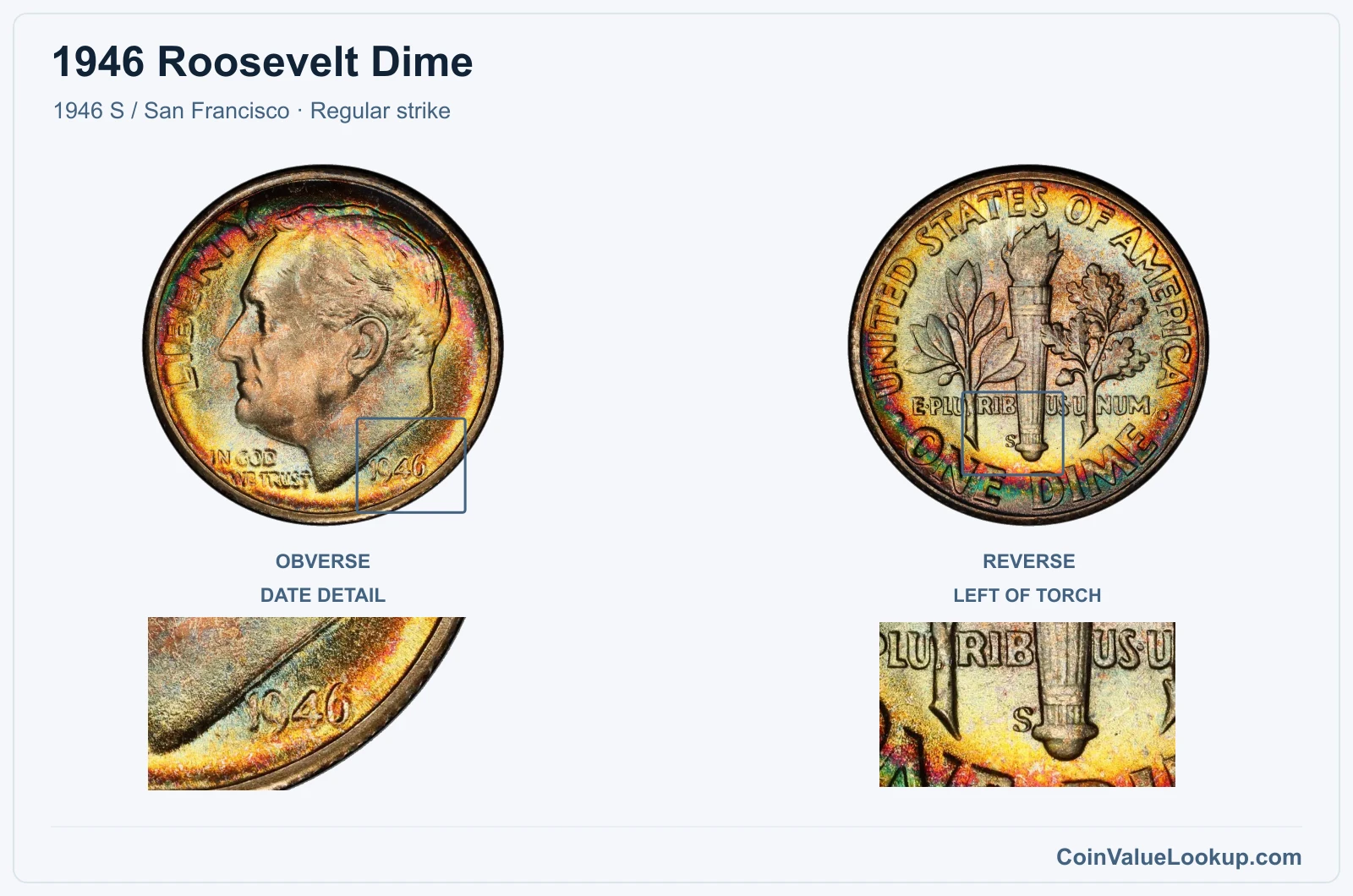
The San Francisco version shows an "S" beside the torch base. Same 90% silver composition, same 2.50-gram weight, business-strike finish only — no proofs were made at any mint until 1950.
USA Coin Book estimates about $5.81 in Good-4 and roughly $29 in MS65, the highest guide figure among the three 1946 mints at that grade. The S-mint's slightly higher MS65 estimate reflects typical market preference, though actual prices depend on the individual coin's surfaces and strike.
Full Bands designation matters here just as much as with the other mints: compare torch-band separation carefully before assuming a premium applies.
Range Grade
Price Auction Records Appraisal PO PO 1
—
Coin Identifier FR FR 2
—
Coin Identifier AG AG 3
—
Coin Identifier G G 4
—
Coin Identifier
G 6
—
Coin Identifier VG VG 8
—
Coin Identifier
VG 10
—
Coin Identifier F F 12
—
Coin Identifier
F 15
—
Coin Identifier VF VF 20
—
Coin Identifier
VF 25
—
Coin Identifier
VF 30
—
Coin Identifier
VF 35
—
Coin Identifier XF XF 40
—
Coin Identifier
XF 45
—
Coin Identifier AU AU 50
—
Coin Identifier
AU 53
—
Coin Identifier
AU 55
—
Coin Identifier
AU 58
—
Coin Identifier MS MS 60
—
Coin Identifier
MS 61
—
Coin Identifier
MS 62
—
Coin Identifier
MS 63
Coin Identifier
MS 64
Coin Identifier
MS 65
Coin Identifier
MS 66
Coin Identifier
MS 67
Coin Identifier
MS 68
Coin Identifier
MS 69
—
—
—
MS 70
—
—
—
1946 Roosevelt Dime Error List
1. 1946 Roosevelt Dime — Broadstrike
A broadstrike happens when the restraining collar fails during striking, letting the planchet spread outward. The result is a dime that looks noticeably wider than normal, with a flattened or absent rim, yet the full design is still present on both faces.
The reported example is a 1946 Philadelphia business strike graded NGC MS66 Full Bands. To check your coin, compare its diameter and rim profile to a normal dime.
The design should extend farther toward the edge than usual, and you should see no normal raised rim.
Watch out for lookalikes. A coin with a worn-down rim from circulation, one that was squeezed in a vise, or a slightly misaligned die strike can mimic a broadstrike at first glance.
No supported price range is available; value depends on the authenticated identity, condition, and severity of the error.
2. 1946 Roosevelt Dime — Doubled Reverse with Repunched S
This is a combined die variety on the 1946-S: both a doubled reverse and a repunched mintmark on the same die. Start by examining the S mintmark under magnification — you should see a secondary, slightly offset rounded S image.
Then look at the torch shaft and adjacent olive-leaf edges for consistent separation or notching that indicates die doubling.
Both features must be present for a full attribution. A thick or blobby S alone is not enough, and neither is doubling on the reverse without the repunched mintmark.
Machine doubling — a flat, shelf-like distortion — is the most common lookalike. Dirt packed beside the S or fine scratches can also fool you.
One PCGS-certified MS67 example sold for $247 in a November 2016 auction. That is a single dated result for a high-grade specimen, not a price guide for every 1946-S dime with a funny-looking S.
3. 1946 Roosevelt Dime — Off-Center Strike
An off-center strike occurs when the planchet is not seated properly in the press, so the dies land partly on empty space. The result is a crescent of blank metal on one side and the design shifted in the opposite direction.
The cataloged example is a 1946 Philadelphia dime struck roughly 65% off center, graded NGC MS65. That is a dramatic shift — most of the design is missing.
For any off-center coin, the date must still be visible for a firm attribution to 1946. An undated off-center dime cannot be reliably assigned to a specific year.
Lookalikes include a misaligned die (where both sides show full design but one is slightly off), a coin that has been physically cut, or a dateless error given an arbitrary year. No supported price range is adopted; individual assessment depends on the degree of offset, surviving date visibility, and authenticated condition.
4. 1946 Roosevelt Dime — Broadstrike with Straight Clip
This 1946-S coin combines two errors: a broadstrike and a straight clip. The straight clip means a portion of the planchet was sheared off before striking, leaving a flat edge rather than a curved one.
The broadstrike component means the collar also failed, allowing the remaining metal to spread outward.
The cataloged specimen is attributed by NGC as Uncirculated Details with a 20% straight clip and a recorded weight of 2.1 grams — lighter than the standard 2.50 grams because of the missing metal. A wheel mark noted on the coin is later damage, not part of the original mint error.
A filed edge or a post-mint flattening can look similar. Check that the straight edge and the expanded strike are consistent across both sides.
No supported price range is available; a professional evaluation considers the combined error identity, authentication, and overall condition.
5. 1946 Roosevelt Dime — Doubled Die Obverse
A doubled die obverse has been reported for the 1946 dime, described as a combined doubled die obverse and doubled die reverse variety. This means both sides of the coin were produced from a die that received a secondary, slightly misaligned hubbing impression.
To check, compare the obverse lettering and design elements against a normal 1946 dime under the same lighting. Genuine doubling shows consistent separation or notching on affected letters and features — not a flat shelf along one side of the lettering, which is the hallmark of machine doubling.
Machine doubling, reflections from tilted lighting, and worn die contours are the usual lookalikes. No numerical price range is adopted for this variety.
Value depends on the visibility of the doubling, the coin's overall condition, and the specific die match confirmed through professional attribution.