1938 Wheat Penny Coin Value: How Much Is It Worth?
A 1938 Wheat Penny in ordinary circulated condition starts around $0.18 at Good-4 and can reach roughly $8.64 at MS63, depending on the mint branch. Those guide figures cover the three circulation issues from Philadelphia, Denver and San Francisco.
Proofs, major varieties and recognized errors are priced on a different basis entirely. Original surfaces, degree of wear and color all influence what a buyer will actually pay.
Fast Way to Identify Your 1938 Wheat Penny
Snap a clear photo of the front and back of your 1938 penny and upload both images. The identifier can give you a preliminary read on which mint issued it and its approximate condition.
It is not a substitute for professional authentication or certified grading, but it is a solid first step before you dig deeper.
1938 Wheat Penny Value
Upload both sides of your 1938 Wheat Penny.
Front Obverse
Upload photo
Back Reverse
Upload photo
Which 1938 Wheat Penny Versions Are Worth Money?
- The 1938-S carries the highest circulated floor at $0.49 in Good-4, making it the priciest of the three business-strike mints at lower grades.
- Philadelphia brilliant proofs from 1938 guide at about $73 in PR63, well above any circulation strike of the same date.
- A repunched mintmark on a 1938-D or 1938-S can add collector interest; value depends on authenticated identity and severity.
- Doubled die obverse or reverse varieties are reported for this year and are worth checking under magnification.
- Off-center strikes with a visible date are a recognized error category that can carry individual premiums based on condition and displacement.
Step 1: Identify Your 1938 Wheat Penny Mint Mark and Version
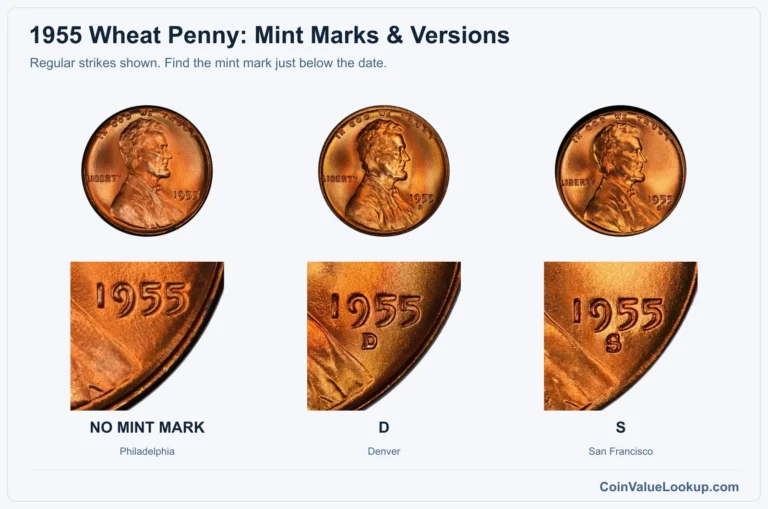
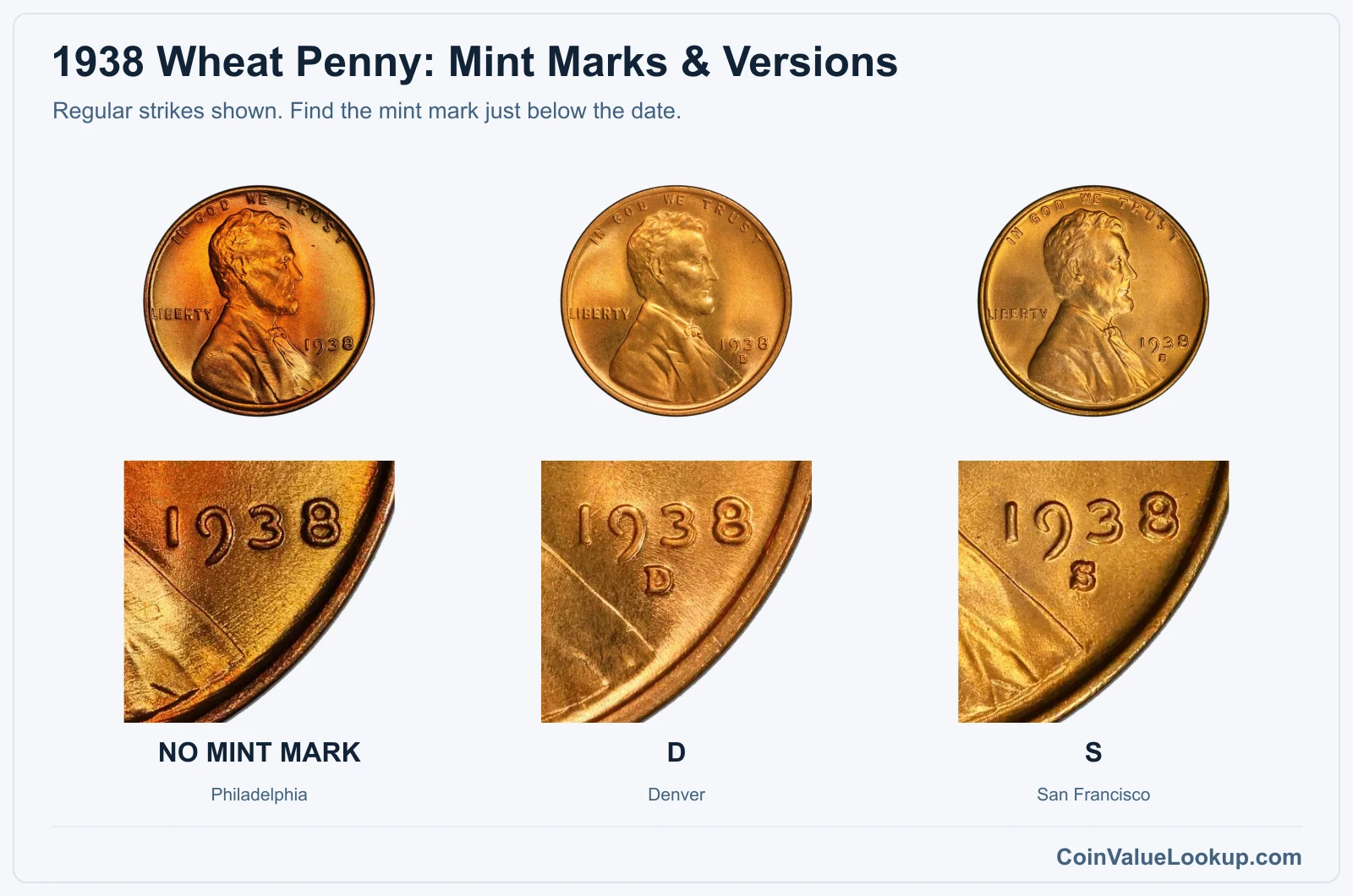
Flip your coin over and look just below the date on the obverse. If there is no small letter there, it came from Philadelphia.
A tiny "D" means Denver, and an "S" means San Francisco. All three mints struck business-strike cents this year.
Philadelphia also produced brilliant proof cents in 1938. These have deeply mirrored fields and sharp, squared-off rims that look nothing like a regular strike, no matter how nice.
A polished circulation coin is not a proof, so do not confuse shine from cleaning with the mirror finish of a genuine proof.
Every 1938 Wheat cent is 95% copper with 5% tin and zinc, weighs about 3.11 grams and has a plain edge. The obverse carries Lincoln's portrait; the reverse shows two wheat ears framing ONE CENT.
If your coin is noticeably lighter or a different color than expected, that is worth investigating further.
Cameo contrast, sometimes listed as CAM or DCAM, is a proof surface designation describing frosted devices against mirror fields. It is not a different metal or a separate error.
Step 2: Check Your 1938 Wheat Penny Grade
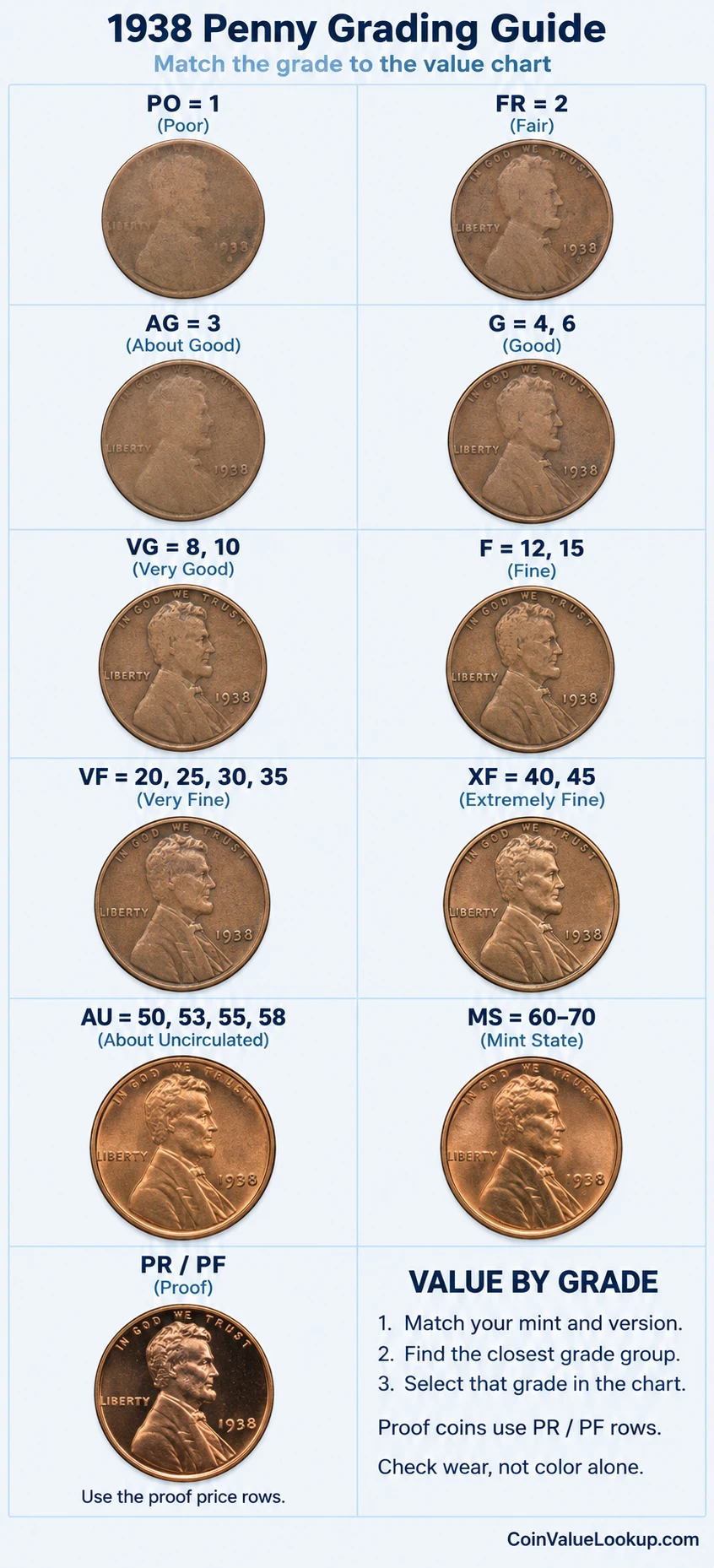
Start with Lincoln's cheekbone and jawline. Those are the first spots to show wear, and even light circulation softens them.
Then check the hair detail above his ear: strong individual strands mean a higher grade, while a flat mass of hair suggests heavy wear.
On the reverse, look at the wheat stalks. The individual grain lines and the fine horizontal lines between the stalks wear away progressively.
A coin with full, sharp wheat detail and unbroken luster across both sides is in mint-state territory.
Compare your coin side by side with the grading comparison image. A weak original strike can leave soft spots that look like wear but are not, so check whether the softness appears evenly across the design or only on the highest points.
Color matters separately from wear. A coin can be technically uncirculated but toned dark brown, which places it in a different market bracket than a full red example.
Spots, corrosion and evidence of cleaning also reduce desirability regardless of the grade. Do not assume a bright coin is automatically worth more; original toning is often preferred over a cleaned surface.
Step 3: Check 1938 Wheat Penny Value by Mint and Version
1938 Wheat Penny
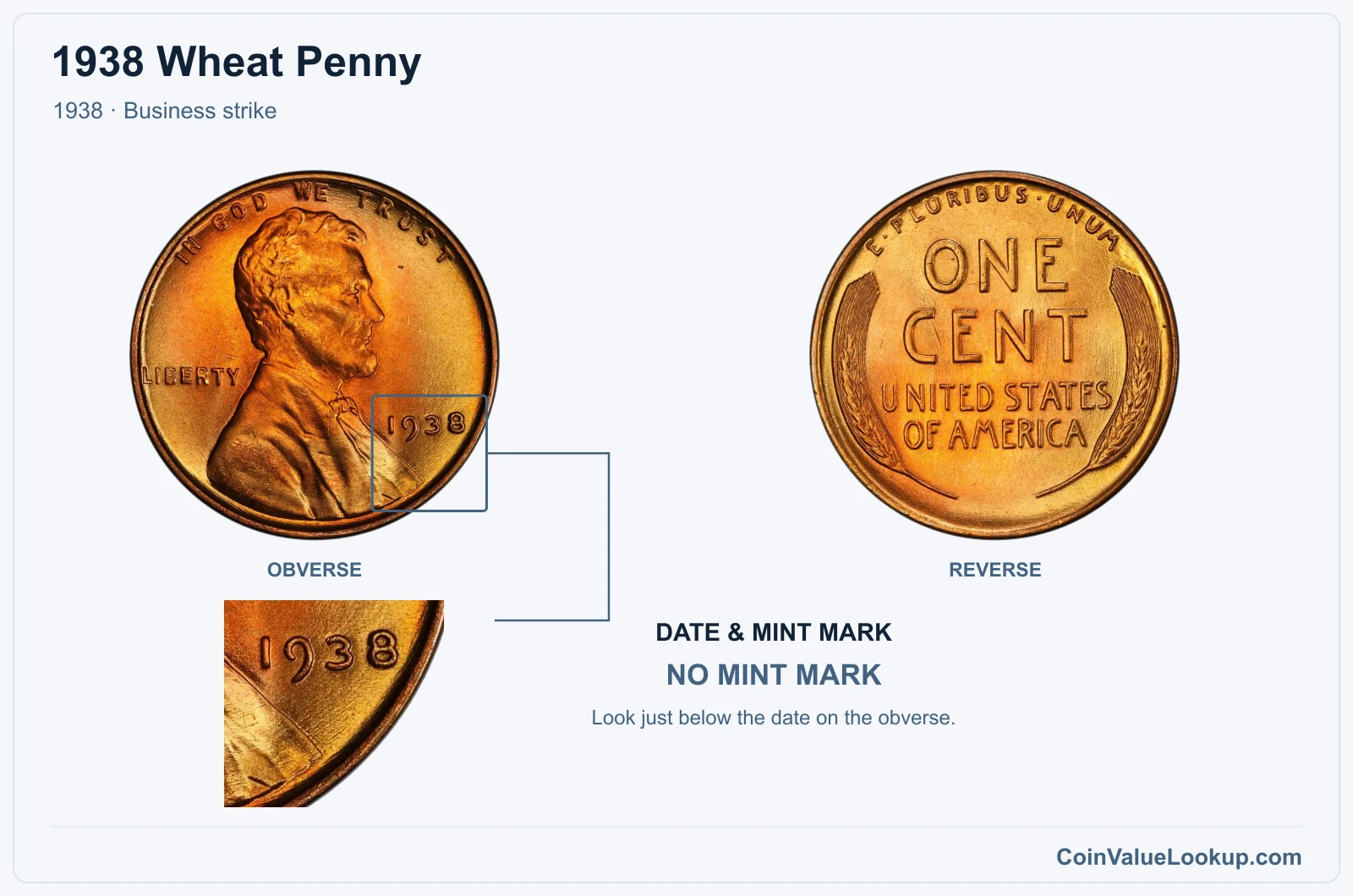
The 1938 Philadelphia cent has no mintmark below the date. It guides at roughly $0.18 in Good-4 and around $8.64 at MS63, per USA Coin Book estimates.
These are not certified red-color prices, because the guide table does not specify color.
Philadelphia struck a large number of these, so finding one in circulated grades is easy. The challenge is locating a genuinely original, attractive uncirculated example.
Look for unbroken cartwheel luster and clean fields free of spots or contact marks. Cleaned coins lose that natural surface and trade for less even when technically undamaged.
| Range | Grade | Price | Auction Records | Appraisal |
|---|---|---|---|---|
| PO | PO 1 | — | Coin Identifier | |
| FR | FR 2 | — | Coin Identifier | |
| AG | AG 3 | — | Coin Identifier | |
| G | G 4 | — | Coin Identifier | |
| G 6 | — | Coin Identifier | ||
| VG | VG 8 | — | Coin Identifier | |
| VG 10 | — | Coin Identifier | ||
| F | F 12 | — | Coin Identifier | |
| F 15 | — | Coin Identifier | ||
| VF | VF 20 | — | Coin Identifier | |
| VF 25 | — | Coin Identifier | ||
| VF 30 | — | Coin Identifier | ||
| VF 35 | — | Coin Identifier | ||
| XF | XF 40 | — | Coin Identifier | |
| XF 45 | — | Coin Identifier | ||
| AU | AU 50 | — | Coin Identifier | |
| AU 53 | — | Coin Identifier | ||
| AU 55 | — | Coin Identifier | ||
| AU 58 | — | Coin Identifier | ||
| MS | MS 60 | — | Coin Identifier | |
| MS 61 | — | Coin Identifier | ||
| MS 62 | — | Coin Identifier | ||
| MS 63 | — | Coin Identifier | ||
| MS 64 | Coin Identifier | |||
| MS 65 | Coin Identifier | |||
| MS 66 | Coin Identifier | |||
| MS 67 | Coin Identifier | |||
| MS 68 | Coin Identifier | |||
| MS 69 | — | — | — | |
| MS 70 | — | — | — |
1938 Wheat Penny — D
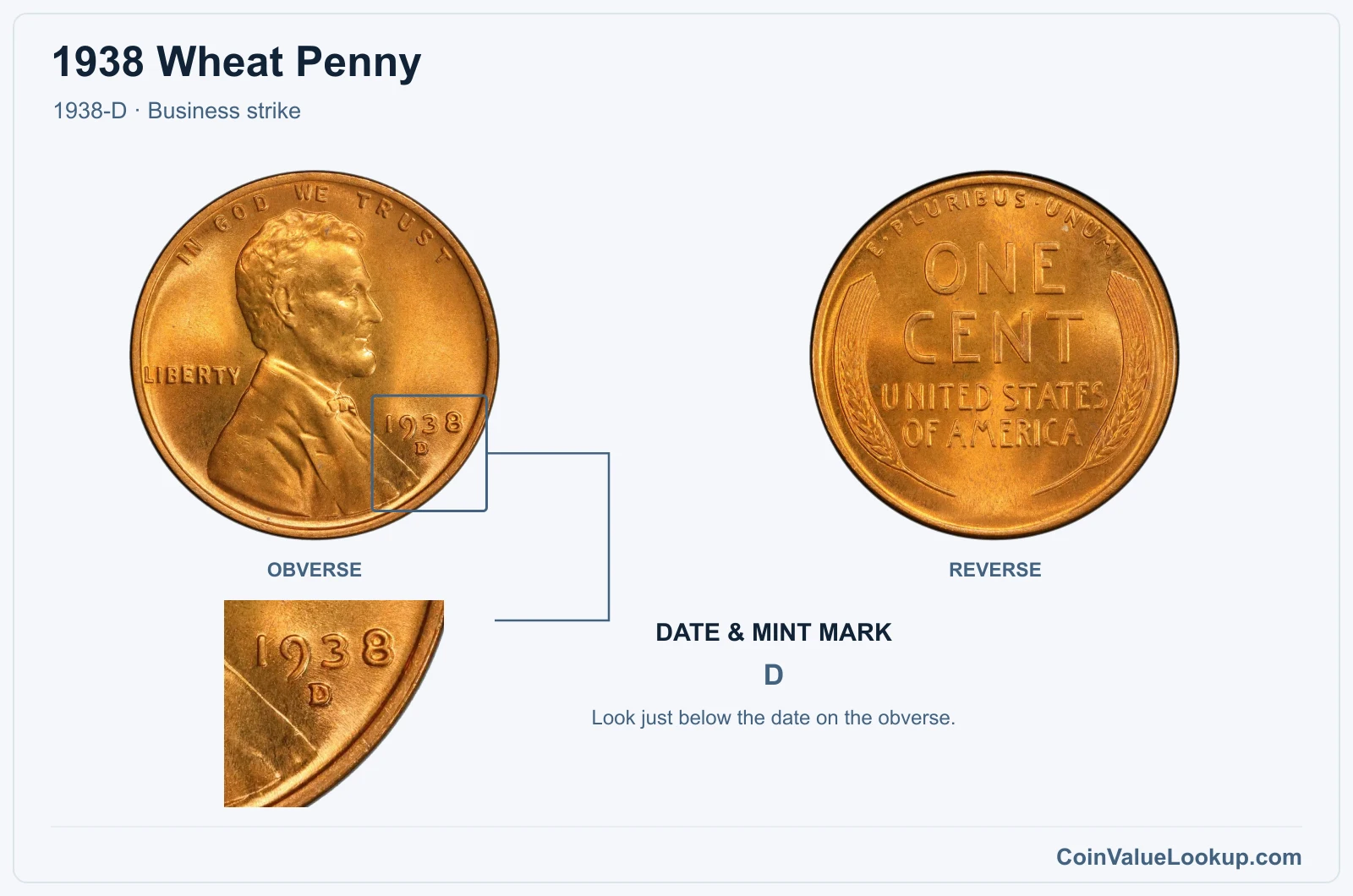
Look for a small "D" below the date. The 1938-D guides at about $0.24 in Good-4 and $8.64 at MS63, essentially matching the Philadelphia issue at the upper end.
In lower grades the Denver coin runs slightly above the no-mintmark Philadelphia piece. That gap narrows as condition improves.
For collectors building a complete Wheat set, a nice original 1938-D is a straightforward pickup, not a scarce date by any stretch. Still, a fully lustrous example with strong strike detail holds more appeal than a dull, weakly struck one at the same technical grade.
| Range | Grade | Price | Auction Records | Appraisal |
|---|---|---|---|---|
| PO | PO 1 | — | Coin Identifier | |
| FR | FR 2 | — | Coin Identifier | |
| AG | AG 3 | — | Coin Identifier | |
| G | G 4 | — | Coin Identifier | |
| G 6 | — | Coin Identifier | ||
| VG | VG 8 | — | Coin Identifier | |
| VG 10 | — | Coin Identifier | ||
| F | F 12 | — | Coin Identifier | |
| F 15 | — | Coin Identifier | ||
| VF | VF 20 | — | Coin Identifier | |
| VF 25 | — | Coin Identifier | ||
| VF 30 | — | Coin Identifier | ||
| VF 35 | — | Coin Identifier | ||
| XF | XF 40 | — | Coin Identifier | |
| XF 45 | — | Coin Identifier | ||
| AU | AU 50 | — | Coin Identifier | |
| AU 53 | — | Coin Identifier | ||
| AU 55 | — | Coin Identifier | ||
| AU 58 | — | Coin Identifier | ||
| MS | MS 60 | — | Coin Identifier | |
| MS 61 | — | Coin Identifier | ||
| MS 62 | — | Coin Identifier | ||
| MS 63 | — | Coin Identifier | ||
| MS 64 | Coin Identifier | |||
| MS 65 | Coin Identifier | |||
| MS 66 | Coin Identifier | |||
| MS 67 | Coin Identifier | |||
| MS 68 | Coin Identifier | |||
| MS 69 | — | — | — | |
| MS 70 | — | — | — |
1938 Wheat Penny — S
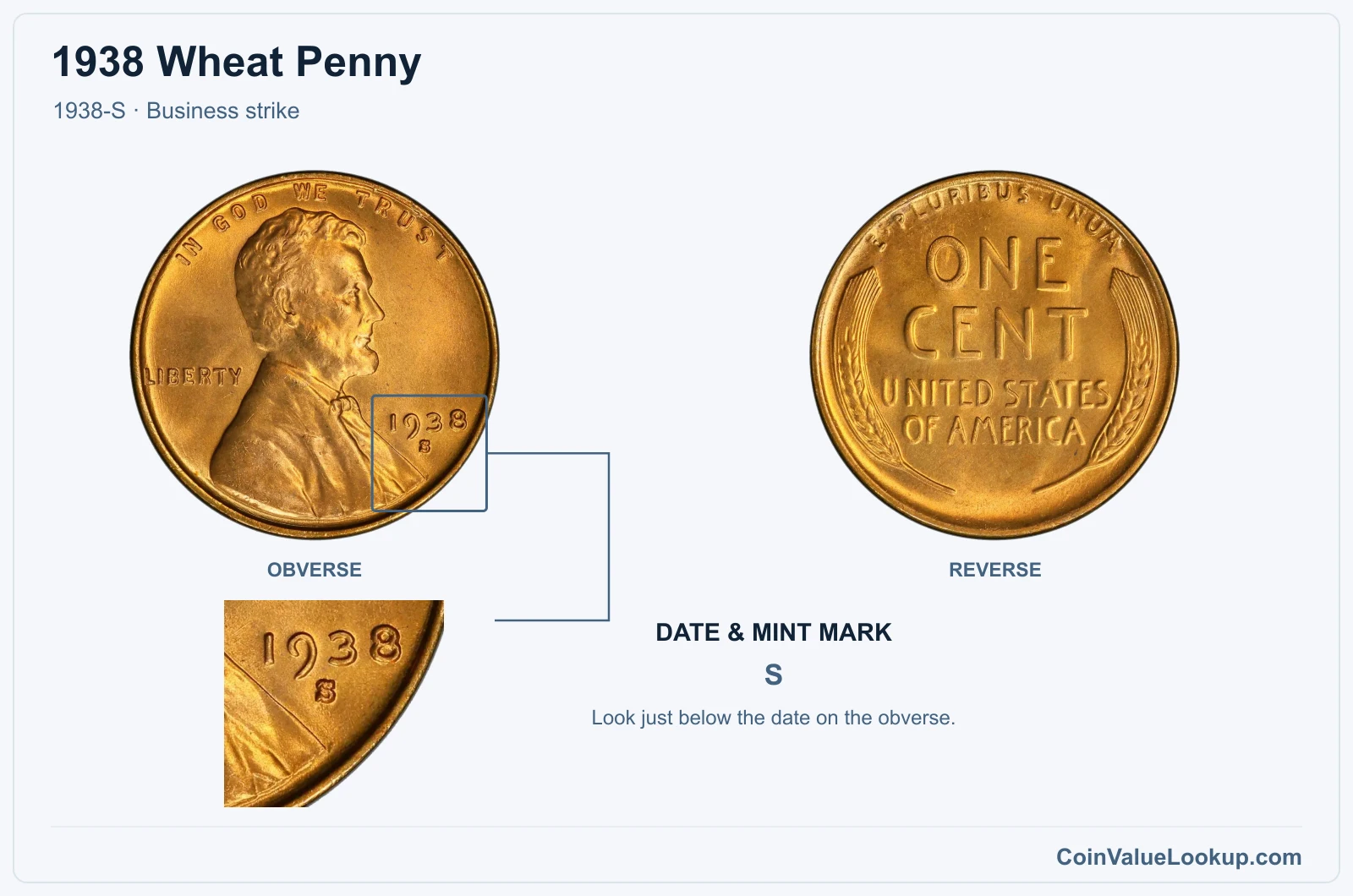
The 1938-S carries a small "S" mintmark below the date. It guides at about $0.49 in Good-4 and roughly $7.29 at MS63, giving it the highest circulated-grade floor among the three business strikes this year.
San Francisco cents from this era sometimes show softer strikes, so compare carefully before assuming wear. A reverse doubled die variety has been reported for the 1938-S; that is covered in the error section below.
For the standard issue, focus on original surfaces and clear detail across Lincoln's portrait and the wheat stalks.
Coin Value Lookup is a good starting point if you are researching other dates or denominations in the Wheat cent series. You can look up guides organized by year and mint to compare values quickly.
| Range | Grade | Price | Auction Records | Appraisal |
|---|---|---|---|---|
| PO | PO 1 | — | Coin Identifier | |
| FR | FR 2 | — | Coin Identifier | |
| AG | AG 3 | — | Coin Identifier | |
| G | G 4 | — | Coin Identifier | |
| G 6 | — | Coin Identifier | ||
| VG | VG 8 | — | Coin Identifier | |
| VG 10 | — | Coin Identifier | ||
| F | F 12 | — | Coin Identifier | |
| F 15 | — | Coin Identifier | ||
| VF | VF 20 | — | Coin Identifier | |
| VF 25 | — | Coin Identifier | ||
| VF 30 | — | Coin Identifier | ||
| VF 35 | — | Coin Identifier | ||
| XF | XF 40 | — | Coin Identifier | |
| XF 45 | — | Coin Identifier | ||
| AU | AU 50 | — | Coin Identifier | |
| AU 53 | — | Coin Identifier | ||
| AU 55 | — | Coin Identifier | ||
| AU 58 | — | Coin Identifier | ||
| MS | MS 60 | — | Coin Identifier | |
| MS 61 | — | Coin Identifier | ||
| MS 62 | — | Coin Identifier | ||
| MS 63 | — | Coin Identifier | ||
| MS 64 | Coin Identifier | |||
| MS 65 | Coin Identifier | |||
| MS 66 | Coin Identifier | |||
| MS 67 | Coin Identifier | |||
| MS 68 | Coin Identifier | |||
| MS 69 | — | — | — | |
| MS 70 | — | — | — |
1938 Wheat Penny — PR
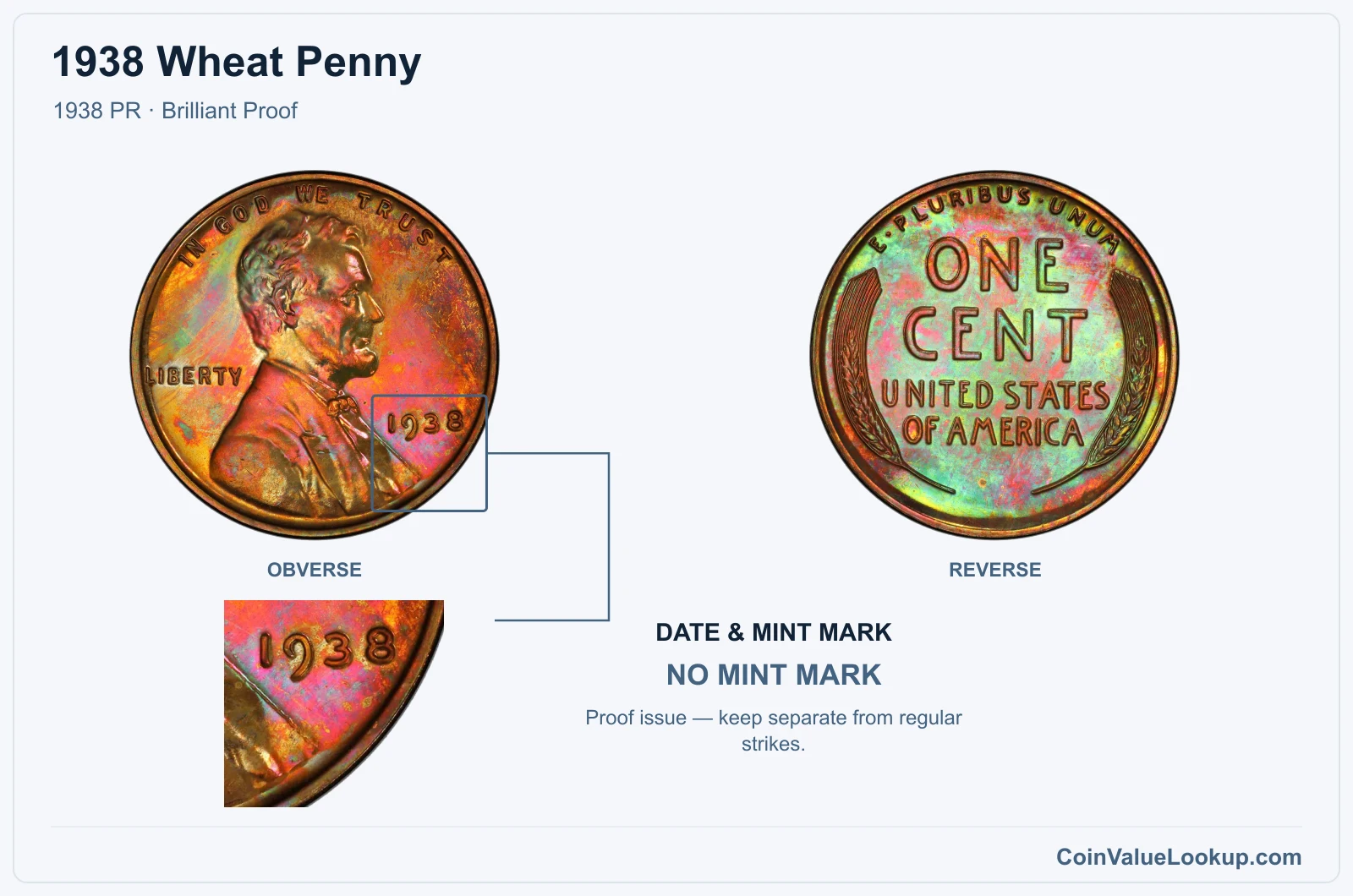
Philadelphia also struck brilliant proof cents in 1938, continuing a run that began in the mid-1930s. These have deeply mirrored fields and crisp, squared-off rims that are immediately distinguishable from even the sharpest business strike.
The guide price is about $73 at PR63.
Proof is a method of manufacture, not a grade above mint state. A PR63 coin may show light contact marks or hazing that keep it below the gem tier, but the mirrored finish and sharp devices are still obvious.
Cameo and deep cameo designations refer to contrast between frosted devices and mirror fields; they are surface descriptions, not errors or separate metals.
A polished or cleaned circulation cent can fool beginners. True proofs have a distinctive liquid-mirror look in the fields and razor-sharp design edges that no amount of polishing can replicate on a business strike.
| Range | Grade | Price | Auction Records | Appraisal |
|---|---|---|---|---|
| PR | PR 1 | — | Coin Identifier | |
| PR 2 | — | Coin Identifier | ||
| PR 3 | — | Coin Identifier | ||
| PR 4 | — | Coin Identifier | ||
| PR 6 | — | Coin Identifier | ||
| PR 8 | — | Coin Identifier | ||
| PR 10 | — | Coin Identifier | ||
| PR 12 | — | Coin Identifier | ||
| PR 15 | — | Coin Identifier | ||
| PR 20 | — | Coin Identifier | ||
| PR 25 | — | Coin Identifier | ||
| PR 30 | — | Coin Identifier | ||
| PR 35 | — | Coin Identifier | ||
| PR 40 | — | Coin Identifier | ||
| PR 45 | — | Coin Identifier | ||
| PR 50 | — | Coin Identifier | ||
| PR 53 | — | Coin Identifier | ||
| PR 55 | — | Coin Identifier | ||
| PR 58 | — | Coin Identifier | ||
| PR 60 | — | Coin Identifier | ||
| PR 61 | — | Coin Identifier | ||
| PR 62 | — | Coin Identifier | ||
| PR 63 | Coin Identifier | |||
| PR 64 | Coin Identifier | |||
| PR 65 | — | Coin Identifier | ||
| PR 66 | — | — | — | |
| PR 67 | — | — | — | |
| PR 68 | — | — | — | |
| PR 69 | — | — | — | |
| PR 70 | — | — | — |
1938 Wheat Penny Error List
1. 1938 Wheat Penny — Repunched Mintmark
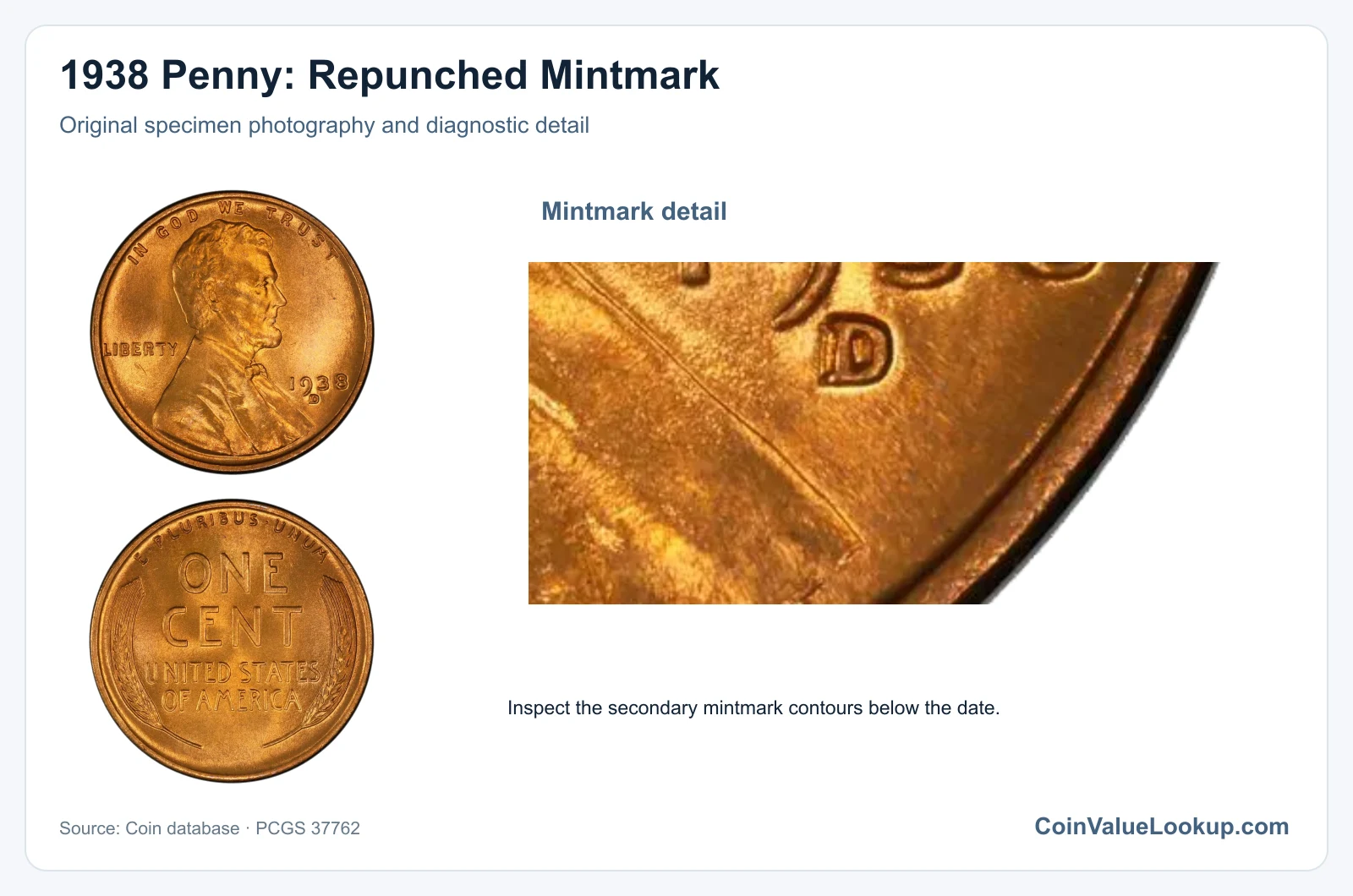
A repunched mintmark occurs when the mintmark punch was applied more than once in slightly different positions, leaving traces of the earlier impression. On a 1938-D or 1938-S cent, look closely at the mintmark for a secondary outline, a notch or a shadow that does not belong to the primary letter.
Philadelphia cents carry no mintmark, so an RPM is not possible on the no-mark issue.
Use magnification and compare directly to a known normal mintmark at the same angle and lighting. Machine doubling, die chips and corrosion around the letter can all mimic the look of a repunched mark.
Value for a confirmed RPM depends on the specific variety, its visual strength and the coin's overall condition, so individual assessment by a third-party grading service is the reliable path.
2. 1938 Wheat Penny — BIE Die Break
A BIE die break shows up as a small raised bump or bridge between the letters B and E in LIBERTY. It is caused by a crack in the die that fills with metal during striking, leaving a raised blob that can look like a capital I between those two letters.
Check the area carefully under magnification. Dirt, a scratch or a piece of foreign metal stuck to the surface can imitate the look.
A genuine BIE is raised and uniform, blending into the field rather than sitting loosely on top. The value of a BIE variety depends on the size and clarity of the break and the coin's grade; no standard price range is established for this date, so authenticated examples are assessed individually.
3. 1938 Wheat Penny — Doubled Die Obverse
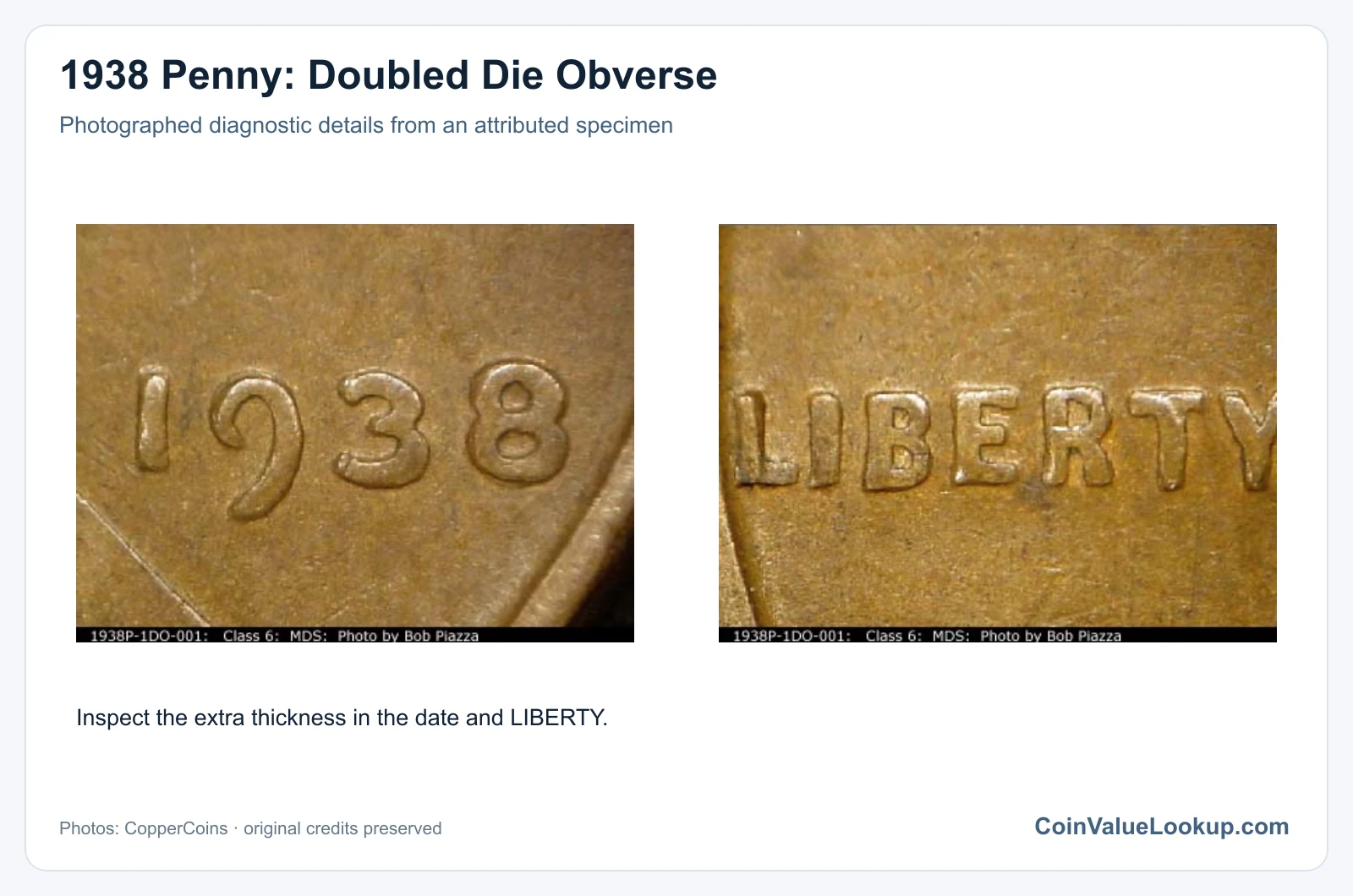
A doubled die obverse on a 1938 Wheat cent would show consistent doubling on the obverse lettering, date or design elements. The key word is consistent: true hub doubling produces separation or notching that repeats in the same direction across multiple features.
Compare your coin's obverse inscriptions, especially IN GOD WE TRUST, LIBERTY and the date, against a known normal example under the same lighting. Machine doubling produces a flat, shelf-like distortion rather than the rounded, separated profiles of a genuine doubled die.
Reflections from the coin's surface can also create the illusion of doubling that disappears when you change the angle. No specific price range is established for this date, so a confirmed doubled die obverse would need individual evaluation based on its strength and overall condition.
4. 1938 Wheat Penny — Doubled Die Reverse
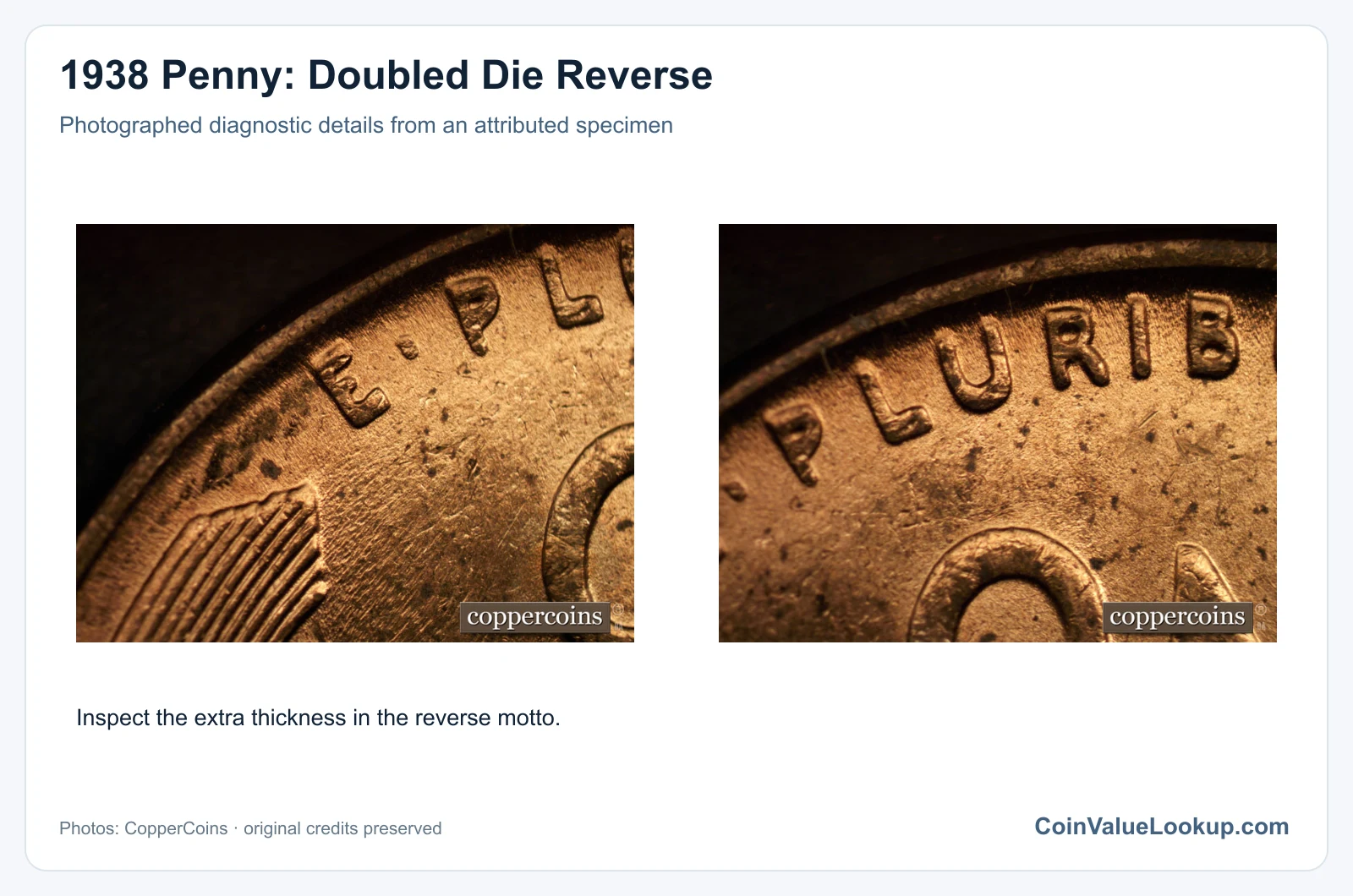
A doubled die reverse shows consistent doubling on the reverse legends or design, most commonly visible in ONE CENT, E PLURIBUS UNUM or the wheat stalk details. Reports exist for the 1938-S in particular, though any mint's die could theoretically carry the defect.
Look for separation or notching that appears uniformly across multiple letters or design elements. If the doubling is flat and shelf-like, it is more likely machine doubling, which has little collector premium.
Random nicks or damage also do not qualify. True doubled die varieties are the result of a misaligned hub impression and show clean, rounded secondary images.
No established price range exists for this error on the 1938 date. A coin suspected of being a doubled die reverse should be evaluated individually by a recognized grading service.
5. 1938 Wheat Penny — Off-Center Strike
An off-center strike happens when the planchet is not seated properly in the collar, causing the dies to impress the design in a shifted position. The result is a crescent-shaped blank area on one side of the coin where no design was struck.
The key detail for value is whether the date remains fully visible. A 1938 cent struck, say, 10-15% off center with a complete date is more desirable than a dramatically off-center piece with the date missing.
Compare against coins that have a clipped edge, one-sided die misalignment or post-mint flattening, all of which can superficially resemble an off-center strike but have different characteristics.
No specific price range is established for 1938 off-center cents. Each piece is assessed individually based on the degree of displacement, date visibility and overall condition.
6. 1938 Wheat Penny — Wrong Planchet / Off-Metal Strike
A wrong-planchet or off-metal strike means the 1938 cent dies struck a blank intended for a different denomination or even a different country's coin. These are dramatic errors and genuinely scarce.
To check, weigh your coin and measure its diameter. A normal 1938 Wheat cent weighs about 3.11 grams on a 19 mm copper-alloy planchet with a plain edge.
If your coin is noticeably lighter, heavier, smaller or has a reeded edge, that is a red flag worth investigating. The design on a wrong-planchet strike may appear incomplete or distorted because the blank was the wrong size for the dies.
Be cautious: plating loss, acid damage, corrosion and deliberate alteration can all change a coin's appearance and weight. No established price range exists for this category on the 1938 date, so professional authentication is essential.