1955 Wheat Penny Coin Value: How Much Is It Worth?
A 1955 Wheat Penny in ordinary circulated condition runs about $0.06 at Fine-12, while uncirculated examples reach around $3.62 at MS63, depending on the mint branch. Those figures cover the Philadelphia, Denver and San Francisco business strikes only.
Proofs, the famous Doubled-Die Obverse variety and error coins are priced on a different scale entirely. Original surfaces, color and wear all affect what a buyer will actually pay.
Fast Way to Identify Your 1955 Wheat Penny
Want a quick read on your 1955 penny? Upload clear photos of both the front and back of your coin.
Our identifier can offer a preliminary identification of your coin's mint branch and general type based on those images. It will not authenticate errors, assign a certified grade or guarantee a price, but it gives you a solid starting point before digging deeper.
1955 Wheat Penny Value
Upload both sides of your 1955 Wheat Penny.
Front Obverse
Upload photo
Back Reverse
Upload photo
Which 1955 Wheat Penny Versions Are Worth Money?
- The 1955 Doubled-Die Obverse (Philadelphia) shows dramatic doubling on the date and motto, with guide values from roughly $790 at G4 to around $18,707 at MS63.
- The 1955-S San Francisco branch carries slightly higher guide values than Philadelphia or Denver normal strikes, about $0.12 at F12 and $3.62 at MS63.
- The 1955 brilliant proof from Philadelphia is listed around $22 at PR63, a collectible finish distinct from any circulation strike.
- Coins with authenticated error varieties such as repunched mintmarks or die breaks can carry individual premiums beyond standard guide prices.
Step 1: Identify Your 1955 Wheat Penny Mint Mark and Version
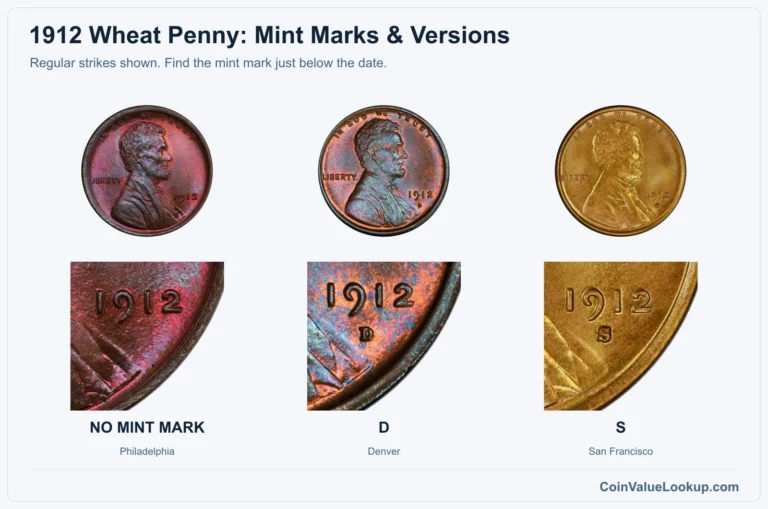
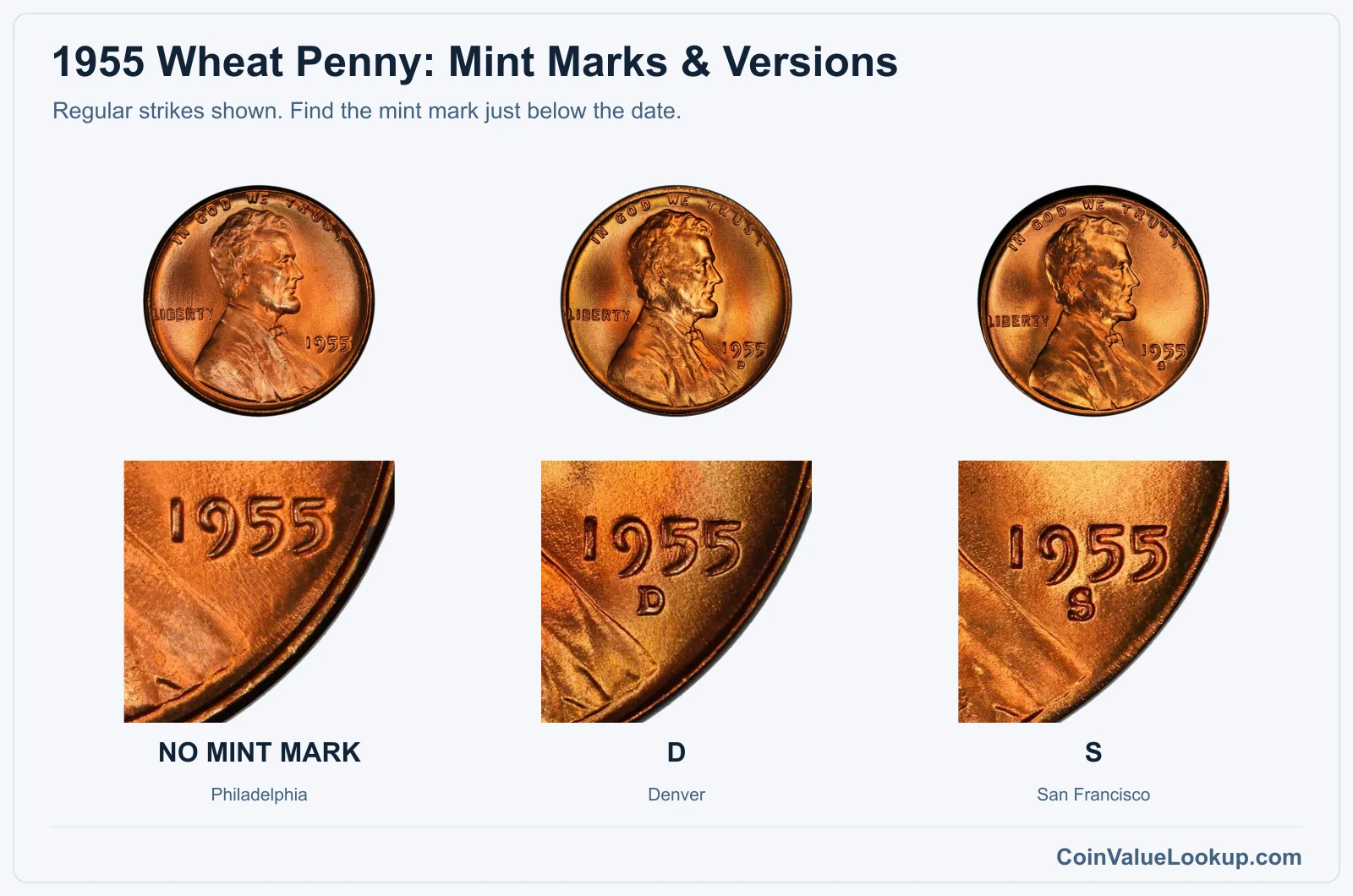
Flip your coin over and look just below the date on the obverse. If there is no small letter, you have a Philadelphia strike.
A tiny "D" means Denver, and an "S" means San Francisco. All three mints produced business-strike cents in 1955, and Philadelphia also made brilliant proof cents sold directly to collectors.
Every 1955 Wheat cent should weigh about 3.11 grams and have a plain edge. The composition is 95% copper with 5% tin and zinc.
If your coin is noticeably lighter, magnetic or a different color than expected, it may be damaged or a different year entirely.
The big question with any 1955 Philadelphia cent is whether it shows the bold Doubled-Die Obverse variety. On the genuine DDO, the date and inscriptions like LIBERTY and IN GOD WE TRUST show clear, dramatic doubling visible even without magnification.
Do not confuse this with common die-deterioration doubling, sometimes called "poor man's doubling," which produces a flat, shelf-like appearance rather than crisp separated lettering.
Proof cents from 1955 have brilliant mirrored fields and were struck with polished dies on polished planchets. A shiny circulation cent that someone buffed on a cloth is not a proof.
Color designations like red, red-brown and brown describe toning, not manufacturing method or grade level.
Step 2: Check Your 1955 Wheat Penny Grade
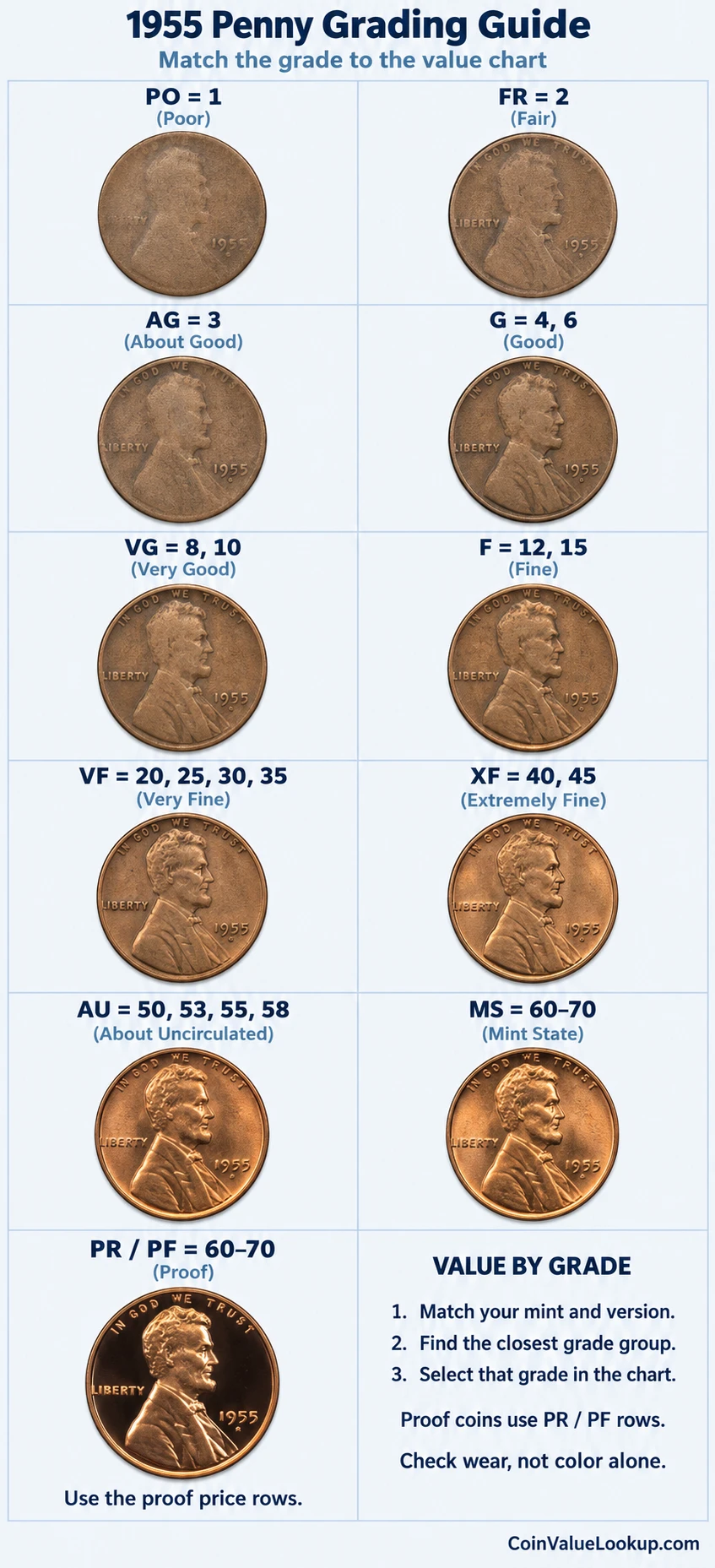
Start with Lincoln's cheek and jawline on the obverse. These are the highest points and the first places wear shows.
In Fine condition, some hair detail remains but the cheek is noticeably flat. At About Uncirculated, only the faintest rub appears on those high spots, and original luster survives in protected areas.
On the reverse, check the wheat stalks and the horizontal lines between them. A well-worn coin will have mushy, blended grain lines, while an uncirculated example keeps them sharp and distinct.
Use the comparison image to match your coin's wear pattern against known grade benchmarks. Keep in mind that a weakly struck coin can look worn even if it never circulated.
Look for luster breaks and contact marks, not just soft detail, to tell the difference.
Color, spots, corrosion and signs of cleaning are separate value factors. A brown uncirculated cent is still uncirculated, just worth less than one with full original red surfaces.
The guide prices referenced here do not specify color, so treat them as general benchmarks rather than quotes for a certified red coin.
Step 3: Check 1955 Wheat Penny Value by Mint and Version
1955 Wheat Penny
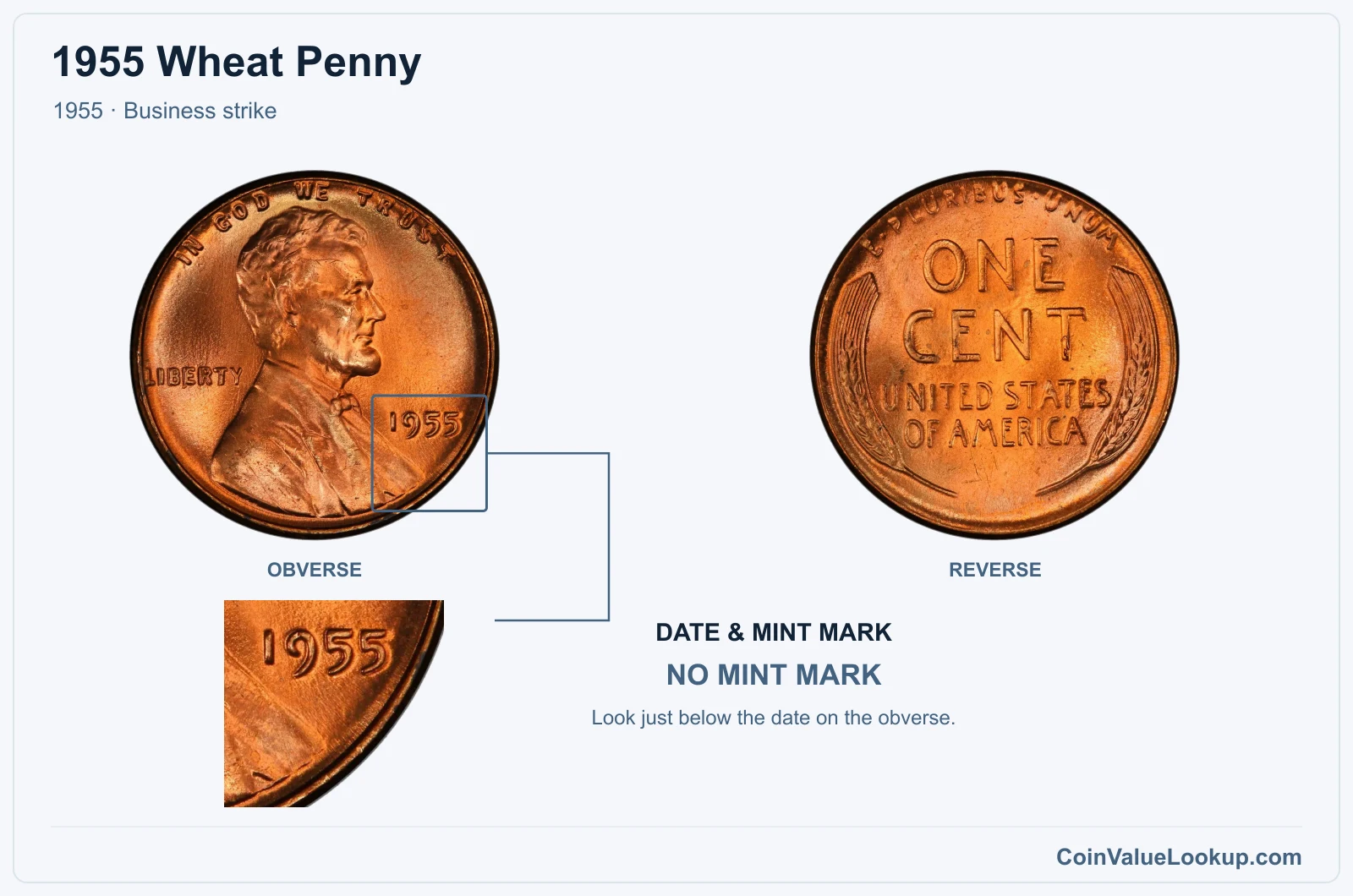
The 1955 Philadelphia cent has no mintmark below the date. It is the standard business strike, composed of 95% copper with 5% tin and zinc, weighing about 3.11 grams.
Guide estimates place this coin at roughly $0.06 in Fine-12 condition and around $1.24 at MS63, according to USA Coin Book. Most surviving examples are well circulated, so finding one with full original luster takes some patience.
Do not confuse this ordinary issue with the far more valuable Doubled-Die Obverse variety, which is a separate entry.
| Range | Grade | Price | Auction Records | Appraisal |
|---|---|---|---|---|
| PO | PO 1 | — | Coin Identifier | |
| FR | FR 2 | — | Coin Identifier | |
| AG | AG 3 | — | Coin Identifier | |
| G | G 4 | — | Coin Identifier | |
| G 6 | — | Coin Identifier | ||
| VG | VG 8 | — | Coin Identifier | |
| VG 10 | — | Coin Identifier | ||
| F | F 12 | — | Coin Identifier | |
| F 15 | — | Coin Identifier | ||
| VF | VF 20 | — | Coin Identifier | |
| VF 25 | — | Coin Identifier | ||
| VF 30 | — | Coin Identifier | ||
| VF 35 | — | Coin Identifier | ||
| XF | XF 40 | — | Coin Identifier | |
| XF 45 | — | Coin Identifier | ||
| AU | AU 50 | — | Coin Identifier | |
| AU 53 | — | Coin Identifier | ||
| AU 55 | — | Coin Identifier | ||
| AU 58 | — | Coin Identifier | ||
| MS | MS 60 | — | Coin Identifier | |
| MS 61 | — | Coin Identifier | ||
| MS 62 | — | Coin Identifier | ||
| MS 63 | Coin Identifier | |||
| MS 64 | Coin Identifier | |||
| MS 65 | Coin Identifier | |||
| MS 66 | Coin Identifier | |||
| MS 67 | Coin Identifier | |||
| MS 68 | — | — | — | |
| MS 69 | — | — | — | |
| MS 70 | — | — | — |
1955 Wheat Penny — DDO
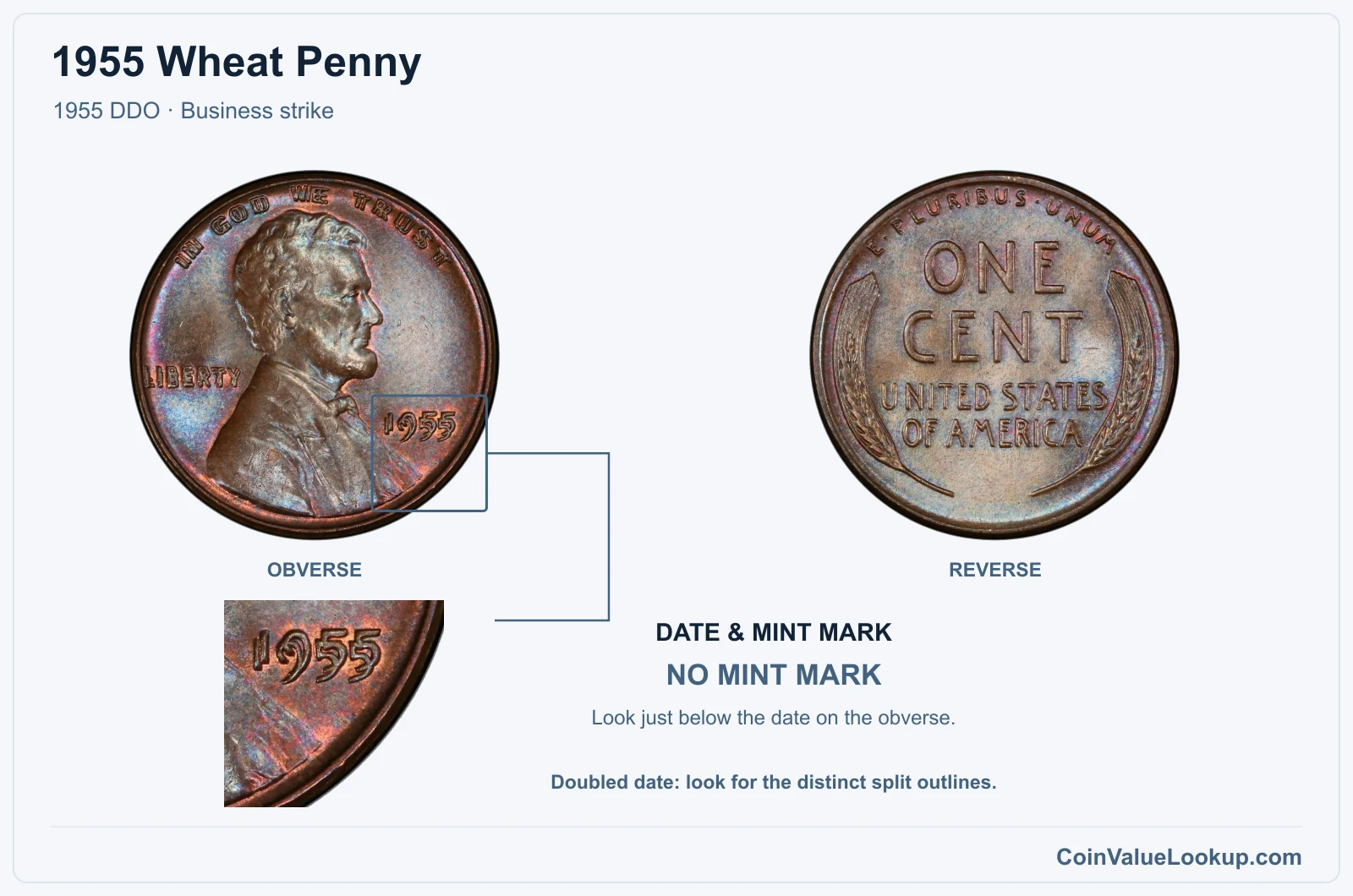
This is the one everybody wants. The 1955 Doubled-Die Obverse is a Philadelphia business strike where a misaligned hub impression left bold, visible doubling across the date, LIBERTY and IN GOD WE TRUST.
You do not need a loupe to see it on a genuine example. The separation is dramatic and consistent across all affected design elements.
Guide estimates from USA Coin Book place this variety at approximately $790 in G4 and around $18,707 at MS63. The actual value of any individual coin depends on its authenticated identity, condition, color and surfaces.
Be cautious: so-called "poor man's doubling" from die deterioration produces a flat, shelf-like effect and is not the same thing. If the doubling looks mushy or only appears in one area, you likely have normal die wear rather than this famous variety.
Coin Value Lookup is a good place to start when you want to look up guide values for different years and mints across the Lincoln cent series.
| Range | Grade | Price | Auction Records | Appraisal |
|---|---|---|---|---|
| PO | PO 1 | — | Coin Identifier | |
| FR | FR 2 | — | Coin Identifier | |
| AG | AG 3 | — | Coin Identifier | |
| G | G 4 | — | Coin Identifier | |
| G 6 | — | Coin Identifier | ||
| VG | VG 8 | — | Coin Identifier | |
| VG 10 | — | Coin Identifier | ||
| F | F 12 | — | Coin Identifier | |
| F 15 | — | Coin Identifier | ||
| VF | VF 20 | — | Coin Identifier | |
| VF 25 | — | Coin Identifier | ||
| VF 30 | — | Coin Identifier | ||
| VF 35 | Coin Identifier | |||
| XF | XF 40 | Coin Identifier | ||
| XF 45 | Coin Identifier | |||
| AU | AU 50 | Coin Identifier | ||
| AU 53 | Coin Identifier | |||
| AU 55 | Coin Identifier | |||
| AU 58 | Coin Identifier | |||
| MS | MS 60 | Coin Identifier | ||
| MS 61 | Coin Identifier | |||
| MS 62 | Coin Identifier | |||
| MS 63 | Coin Identifier | |||
| MS 64 | Coin Identifier | |||
| MS 65 | Coin Identifier | |||
| MS 66 | — | Coin Identifier | ||
| MS 67 | — | — | — | |
| MS 68 | — | — | — | |
| MS 69 | — | — | — | |
| MS 70 | — | — | — |
1955 Wheat Penny — D
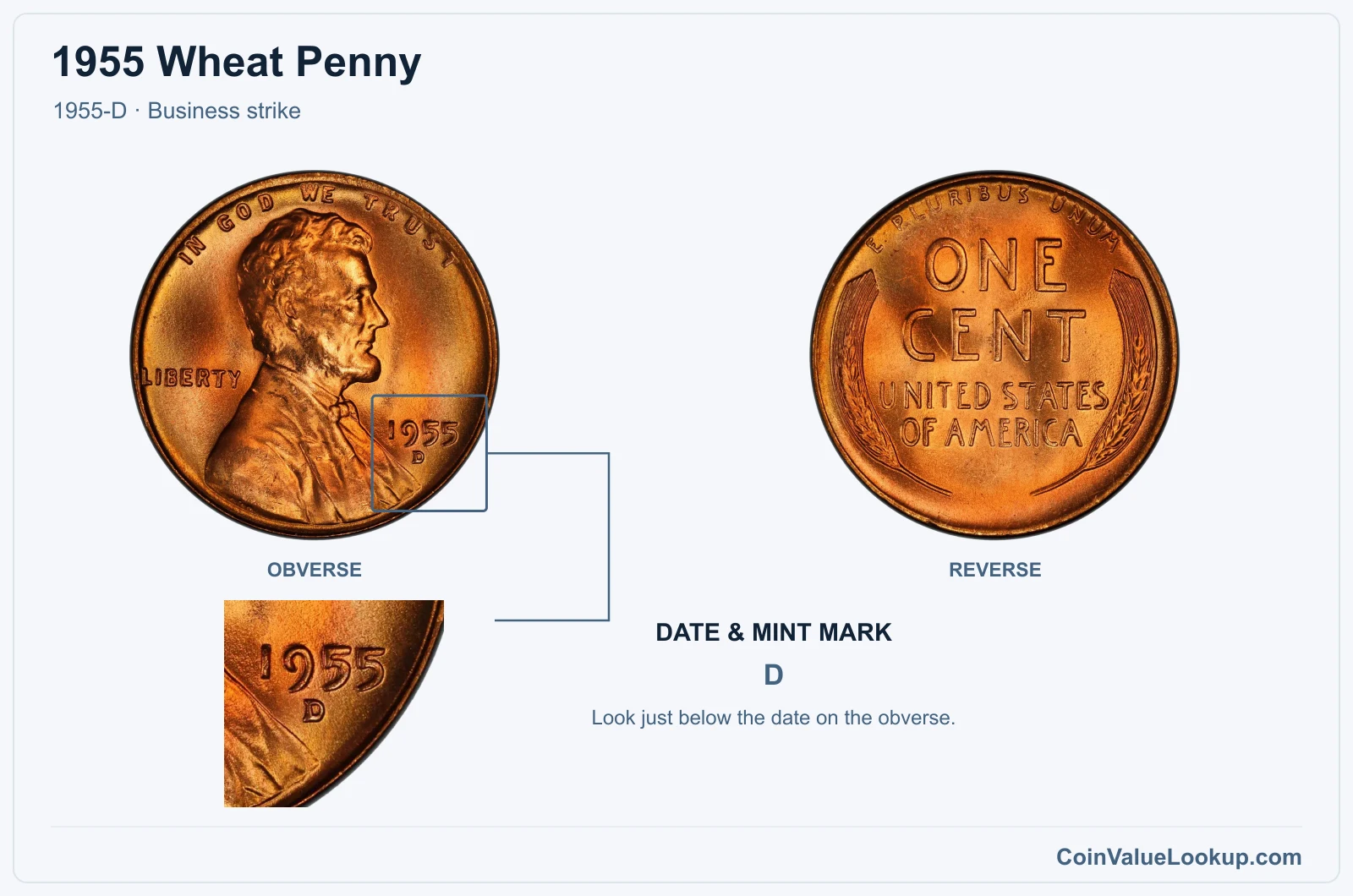
Look for a small "D" mintmark below the date. The 1955-D was struck at the Denver Mint using the same 95% copper composition and 3.11-gram weight as its Philadelphia counterpart.
Guide values sit at about $0.06 in Fine-12 and roughly $1.24 at MS63, per USA Coin Book. In practice, these are common in circulated grades.
Uncirculated examples with strong, original surfaces are where the modest premium lives.
| Range | Grade | Price | Auction Records | Appraisal |
|---|---|---|---|---|
| PO | PO 1 | — | Coin Identifier | |
| FR | FR 2 | — | Coin Identifier | |
| AG | AG 3 | — | Coin Identifier | |
| G | G 4 | — | Coin Identifier | |
| G 6 | — | Coin Identifier | ||
| VG | VG 8 | — | Coin Identifier | |
| VG 10 | — | Coin Identifier | ||
| F | F 12 | — | Coin Identifier | |
| F 15 | — | Coin Identifier | ||
| VF | VF 20 | — | Coin Identifier | |
| VF 25 | — | Coin Identifier | ||
| VF 30 | — | Coin Identifier | ||
| VF 35 | — | Coin Identifier | ||
| XF | XF 40 | — | Coin Identifier | |
| XF 45 | — | Coin Identifier | ||
| AU | AU 50 | — | Coin Identifier | |
| AU 53 | — | Coin Identifier | ||
| AU 55 | — | Coin Identifier | ||
| AU 58 | — | Coin Identifier | ||
| MS | MS 60 | — | Coin Identifier | |
| MS 61 | — | Coin Identifier | ||
| MS 62 | — | Coin Identifier | ||
| MS 63 | Coin Identifier | |||
| MS 64 | Coin Identifier | |||
| MS 65 | Coin Identifier | |||
| MS 66 | Coin Identifier | |||
| MS 67 | Coin Identifier | |||
| MS 68 | — | — | — | |
| MS 69 | — | — | — | |
| MS 70 | — | — | — |
1955 Wheat Penny — S
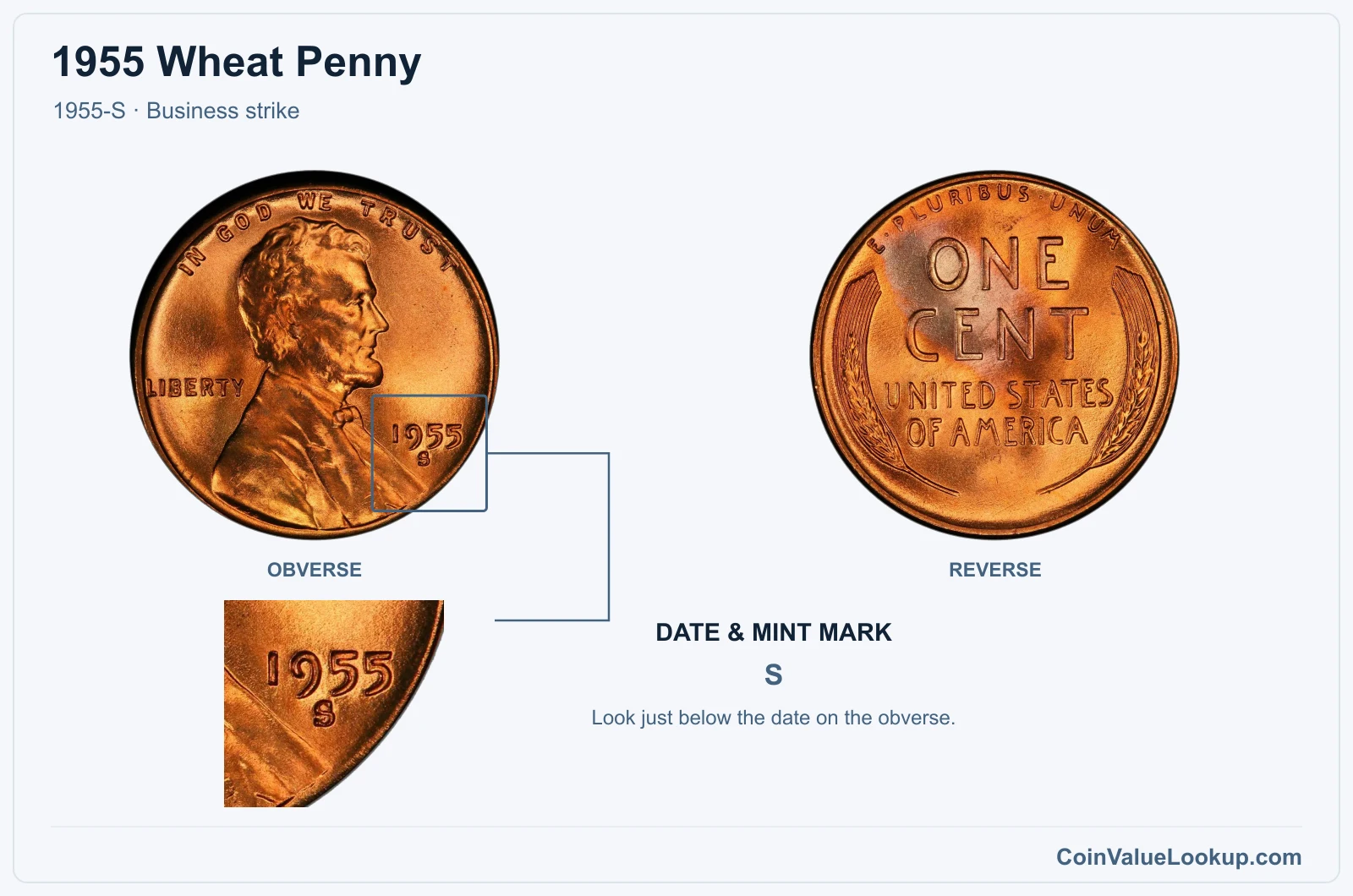
The 1955-S carries a small "S" mintmark below the date, identifying it as a San Francisco Mint product. Among the three regular business strikes this year, the S-mint commands slightly higher guide estimates: about $0.12 at Fine-12 and around $3.62 at MS63, based on USA Coin Book figures.
That edge over the Philadelphia and Denver issues makes it the one worth double-checking in a pile of Wheat pennies. Same copper-alloy composition, same 3.11-gram weight, same plain edge.
Condition and original surfaces still drive the real-world price.
| Range | Grade | Price | Auction Records | Appraisal |
|---|---|---|---|---|
| PO | PO 1 | — | Coin Identifier | |
| FR | FR 2 | — | Coin Identifier | |
| AG | AG 3 | — | Coin Identifier | |
| G | G 4 | — | Coin Identifier | |
| G 6 | — | Coin Identifier | ||
| VG | VG 8 | — | Coin Identifier | |
| VG 10 | — | Coin Identifier | ||
| F | F 12 | — | Coin Identifier | |
| F 15 | — | Coin Identifier | ||
| VF | VF 20 | — | Coin Identifier | |
| VF 25 | — | Coin Identifier | ||
| VF 30 | — | Coin Identifier | ||
| VF 35 | — | Coin Identifier | ||
| XF | XF 40 | — | Coin Identifier | |
| XF 45 | — | Coin Identifier | ||
| AU | AU 50 | — | Coin Identifier | |
| AU 53 | — | Coin Identifier | ||
| AU 55 | — | Coin Identifier | ||
| AU 58 | — | Coin Identifier | ||
| MS | MS 60 | — | Coin Identifier | |
| MS 61 | — | Coin Identifier | ||
| MS 62 | — | Coin Identifier | ||
| MS 63 | — | Coin Identifier | ||
| MS 64 | Coin Identifier | |||
| MS 65 | Coin Identifier | |||
| MS 66 | Coin Identifier | |||
| MS 67 | Coin Identifier | |||
| MS 68 | Coin Identifier | |||
| MS 69 | — | — | — | |
| MS 70 | — | — | — |
1955 Wheat Penny — PR
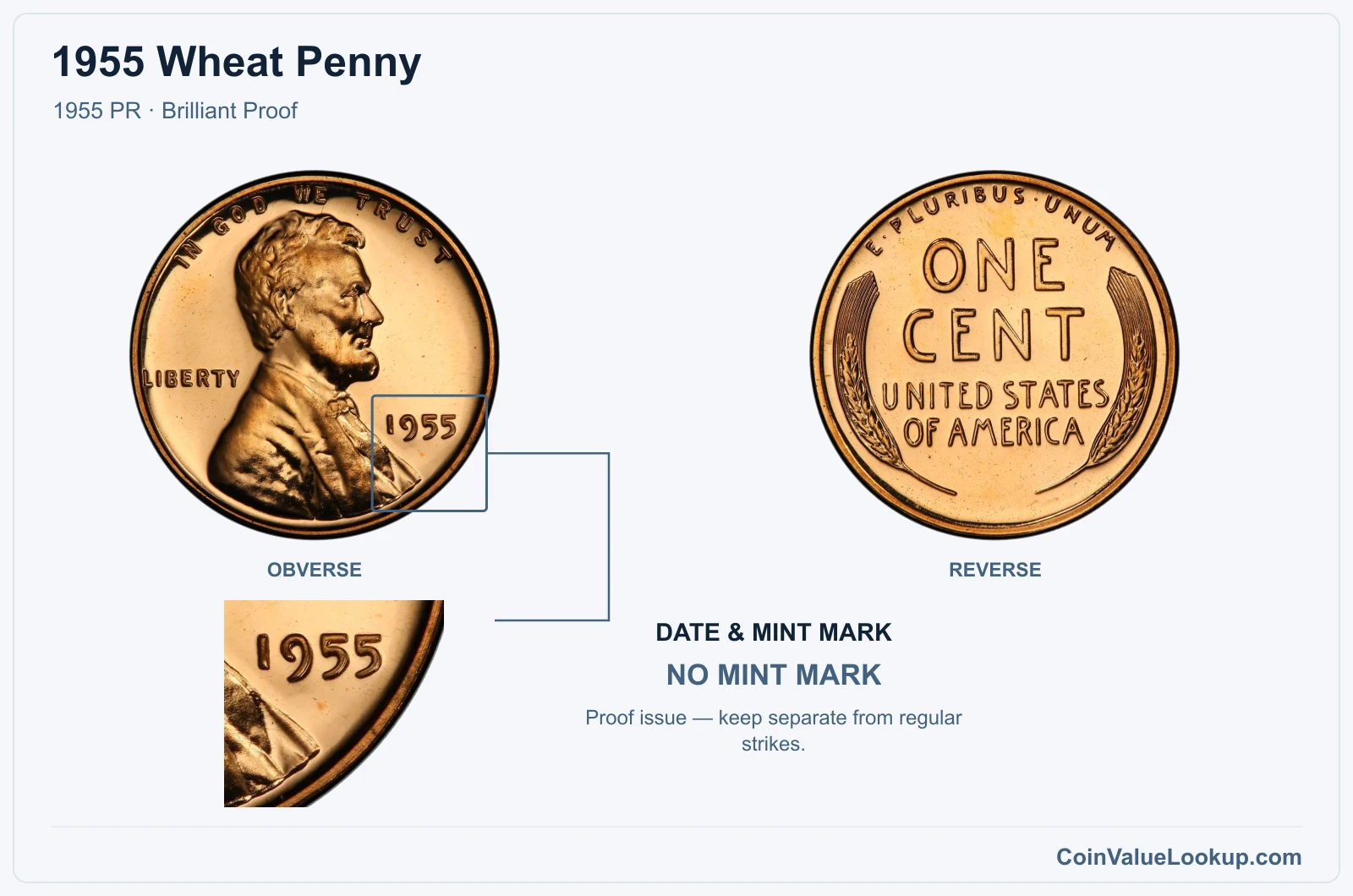
Philadelphia produced brilliant proof Lincoln cents for collectors in 1955. These were struck on polished planchets with polished dies, creating mirror-like fields that are unmistakable when the coin is original.
A circulated cent that someone polished at home is not a proof, no matter how shiny it looks.
USA Coin Book lists a guide estimate of about $22 at PR63. Cameo and deep cameo contrast designations describe the degree of frost on the devices against mirrored fields.
They are not errors or separate manufacturing methods. Actual value depends on the coin's surfaces, any toning or haze, and whether it has been certified.
| Range | Grade | Price | Auction Records | Appraisal |
|---|---|---|---|---|
| PR | PR 1 | — | Coin Identifier | |
| PR 2 | — | Coin Identifier | ||
| PR 3 | — | Coin Identifier | ||
| PR 4 | — | Coin Identifier | ||
| PR 6 | — | Coin Identifier | ||
| PR 8 | — | Coin Identifier | ||
| PR 10 | — | Coin Identifier | ||
| PR 12 | — | Coin Identifier | ||
| PR 15 | — | Coin Identifier | ||
| PR 20 | — | Coin Identifier | ||
| PR 25 | — | Coin Identifier | ||
| PR 30 | — | Coin Identifier | ||
| PR 35 | — | Coin Identifier | ||
| PR 40 | — | Coin Identifier | ||
| PR 45 | — | Coin Identifier | ||
| PR 50 | — | Coin Identifier | ||
| PR 53 | — | Coin Identifier | ||
| PR 55 | — | Coin Identifier | ||
| PR 58 | — | Coin Identifier | ||
| PR 60 | — | Coin Identifier | ||
| PR 61 | — | Coin Identifier | ||
| PR 62 | — | Coin Identifier | ||
| PR 63 | Coin Identifier | |||
| PR 64 | Coin Identifier | |||
| PR 65 | Coin Identifier | |||
| PR 66 | Coin Identifier | |||
| PR 67 | Coin Identifier | |||
| PR 68 | Coin Identifier | |||
| PR 69 | Coin Identifier | |||
| PR 70 | — | — | — |
1955 Wheat Penny Error List
1. 1955 Wheat Penny — Doubled Die Obverse
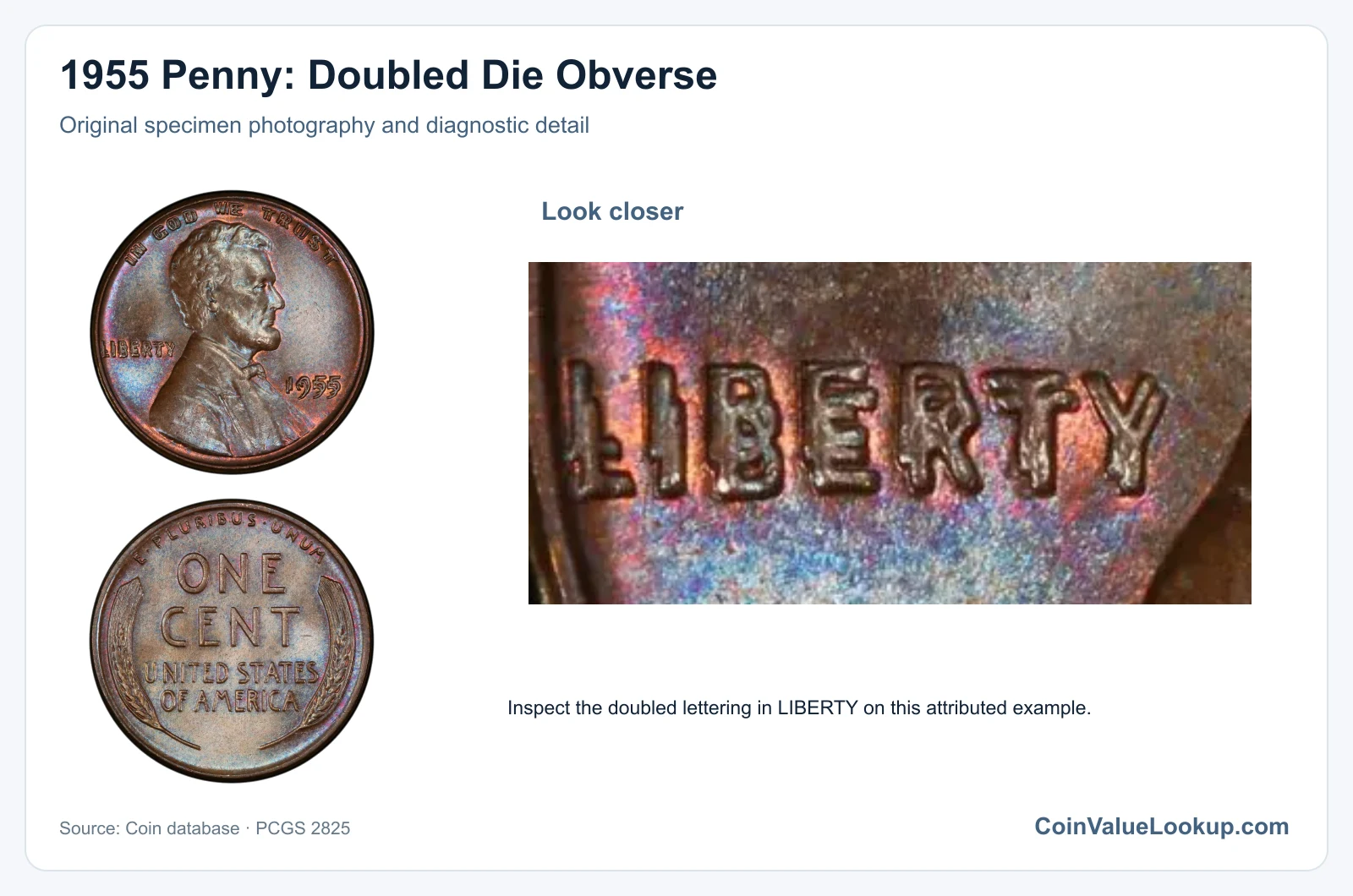
A Doubled-Die Obverse on a 1955 Wheat cent shows consistent separation or notching on obverse lettering and the date. Compare your coin's inscriptions, especially LIBERTY, IN GOD WE TRUST and the date numerals, against a normal 1955 cent under the same lighting.
Genuine hub doubling produces crisp, parallel outlines on multiple design elements simultaneously.
The common lookalike is machine doubling, which leaves a flat, shelf-like distortion rather than sharp separated images. Die-deterioration doubling can also mimic the effect to an untrained eye.
No specific price range is adopted for this category. The value of any individual example depends on authenticated identity, the severity of the doubling and the coin's overall condition.
Third-party certification is the standard way to confirm a genuine doubled die.
2. 1955 Wheat Penny — Repunched Mintmark
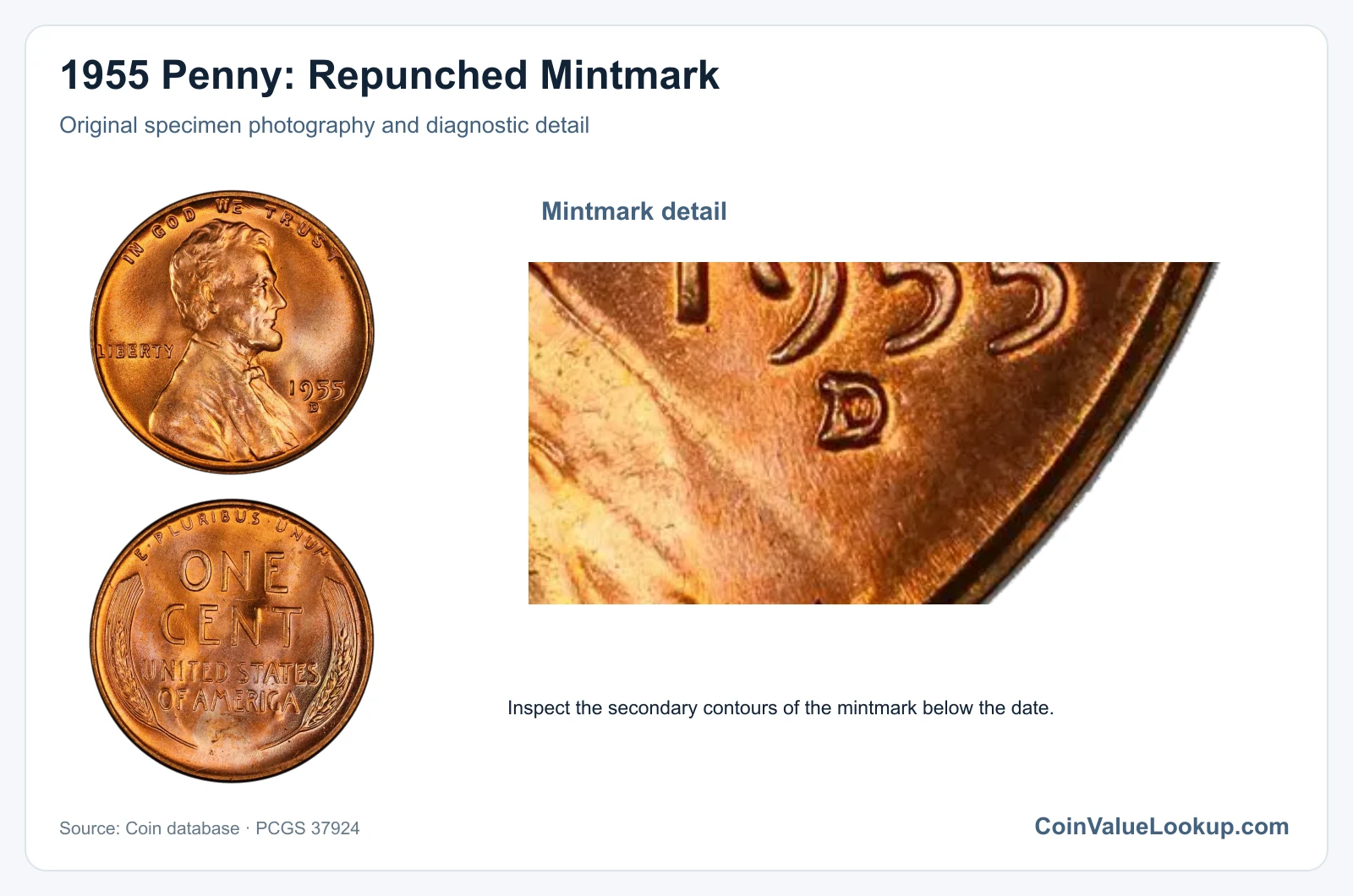
A repunched mintmark occurs when the mintmark punch was applied more than once in slightly different positions, leaving traces of an earlier impression. This category applies only to branch-mint 1955 cents, meaning the D or S varieties.
Philadelphia coins have no mintmark to repunch.
To check, examine the mintmark area under magnification and compare it side by side with a normal example at the same zoom. A genuine RPM shows remnants of a second, offset letter, sometimes as a partial outline or a notch on one side of the primary mark.
Die chips, corrosion around the letter or machine doubling can create similar-looking distortions. No specific price range is adopted here.
Individual value depends on authenticated identity, the clarity of the repunching and the coin's grade and surfaces.
3. 1955 Wheat Penny — BIE Die Break
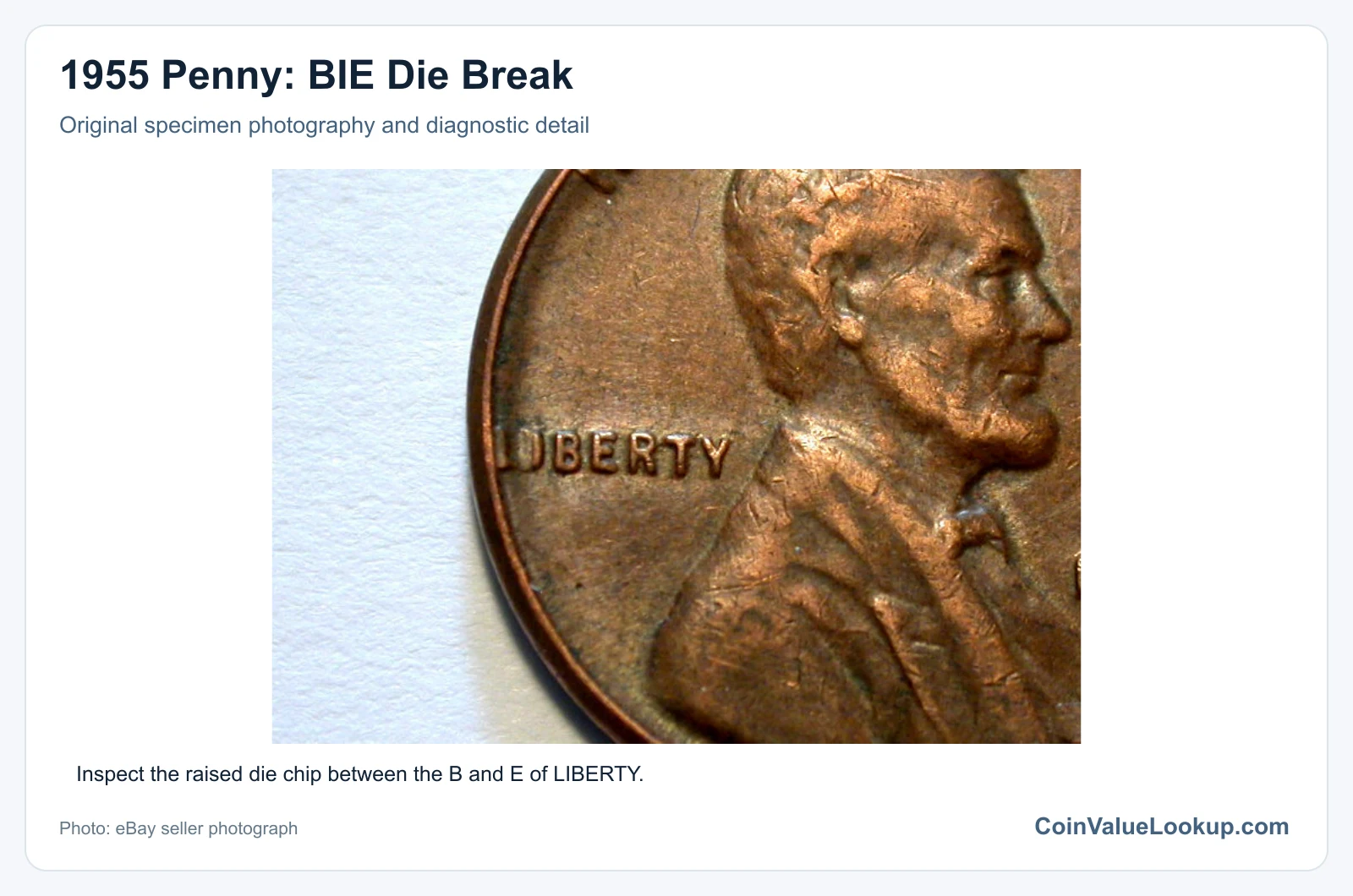
A BIE die break is a raised vertical line or blob that appears between the letters B and E in LIBERTY, caused by a crack in the die that filled with metal during striking. It looks like a small extra letter "I" standing between B and E.
Check your coin under good light and slight magnification.
Do not confuse this with dirt lodged between the letters, a scratch running vertically, or a bit of adhesive residue. A genuine die break is raised above the field and has the same metal texture as the surrounding surface.
These are collected as minor die varieties across many Wheat cent years. No specific price range is adopted for this error on the 1955 cent.
Value depends on the size and clarity of the break, the coin's overall condition and whether it has been authenticated.
4. 1955 Wheat Penny — Doubled Die Reverse
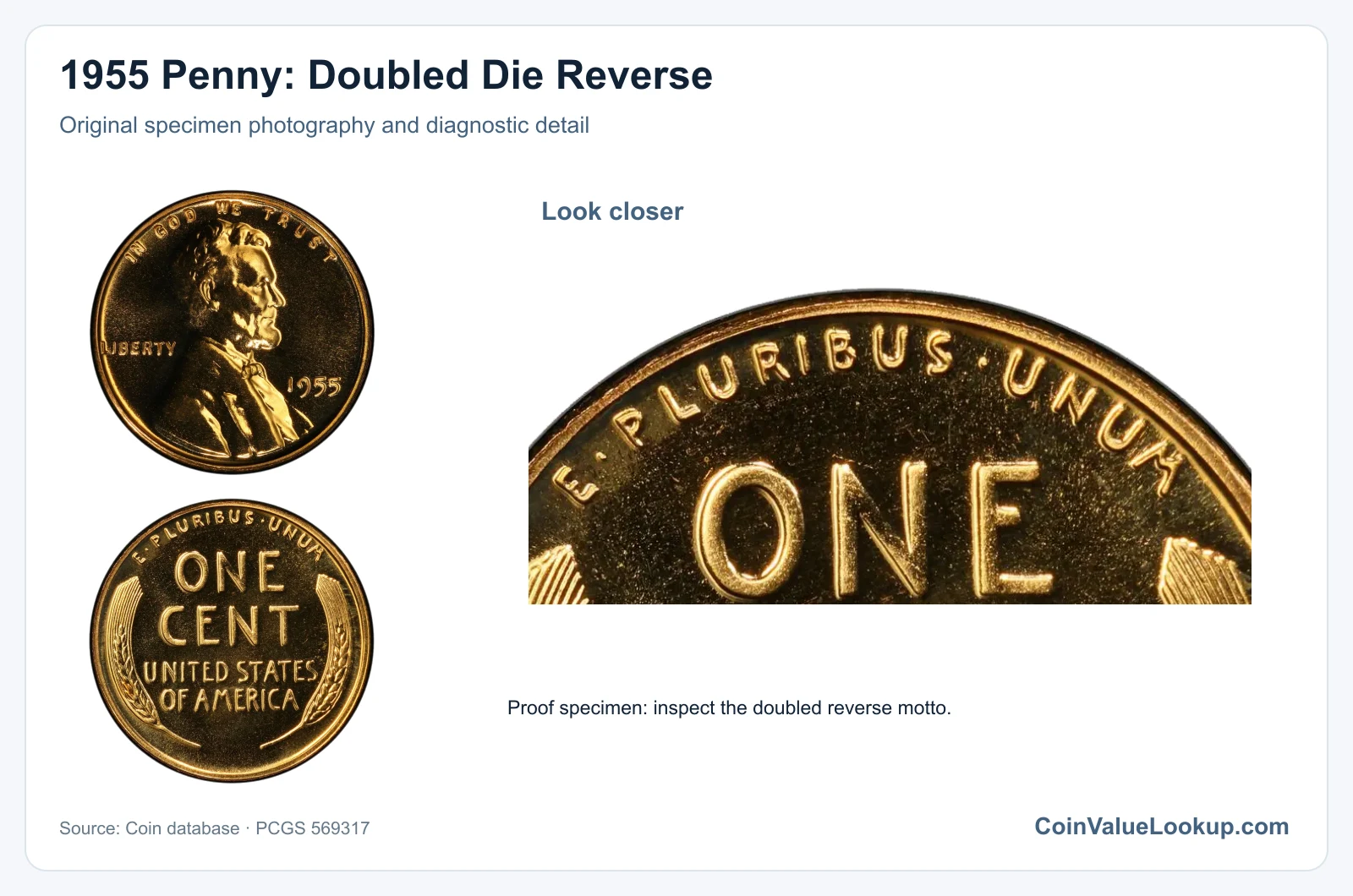
A Doubled-Die Reverse on the 1955 Wheat cent shows doubling on the reverse legends or design elements, such as ONE CENT, UNITED STATES OF AMERICA or the wheat stalks. Compare your coin's reverse closely with a normal example under matching magnification and lighting.
Genuine hub doubling produces consistent, directional separation across multiple letters or design features. Machine doubling, which is far more common, leaves flat, shelf-like distortion that lacks the crispness of a true doubled die.
Random nicks, scratches or reflections from a worn die can also mimic doubling at a glance. No specific price range is adopted for this category.
What any individual coin is worth depends on its authenticated identity, the strength and location of the doubling, and the coin's grade and surface quality.