1979 Washington Quarter Coin Value: How Much Is It Worth?
Most 1979 Washington quarters you will find in pocket change are worth face value — 25 cents. That is the practical starting point for ordinary circulated examples.
In higher uncirculated grades, guide estimates for Philadelphia and Denver business strikes reach around $7.29 at MS65. Proof versions struck at San Francisco, along with certain mint errors, occupy their own value territory and need individual identification and grading.
Fast Way to Identify Your 1979 Washington Quarter
Snap a clear photo of the front and back of your 1979 quarter and upload both images. Our identifier can give you a preliminary read on which version you have — Philadelphia, Denver, or one of the two San Francisco proof types.
It is not a substitute for professional authentication or exact grading, but it is a solid first step before you dig deeper.
1979 Washington Quarter Value
Upload both sides of your 1979 Washington Quarter.
Front Obverse
Upload photo
Back Reverse
Upload photo
Which 1979 Washington Quarter Versions Are Worth Money?
- Philadelphia and Denver business strikes in original, uncirculated condition (MS65 or better) carry guide values well above face — around $7.29 at MS65 per USA Coin Book.
- The 1979-S Type 2 Clear S proof is the scarcer of the two proof punch varieties and worth learning to identify; its PR65 guide estimate is $7.29.
- Authenticated mint errors such as a triple strike or wrong-planchet strike have sold individually for hundreds of dollars at major auction houses.
- Correctly distinguishing Type 1 Filled S from Type 2 Clear S proofs is the single most useful skill for this date — misidentification is common.
Step 1: Identify Your 1979 Washington Quarter Mint Mark and Version
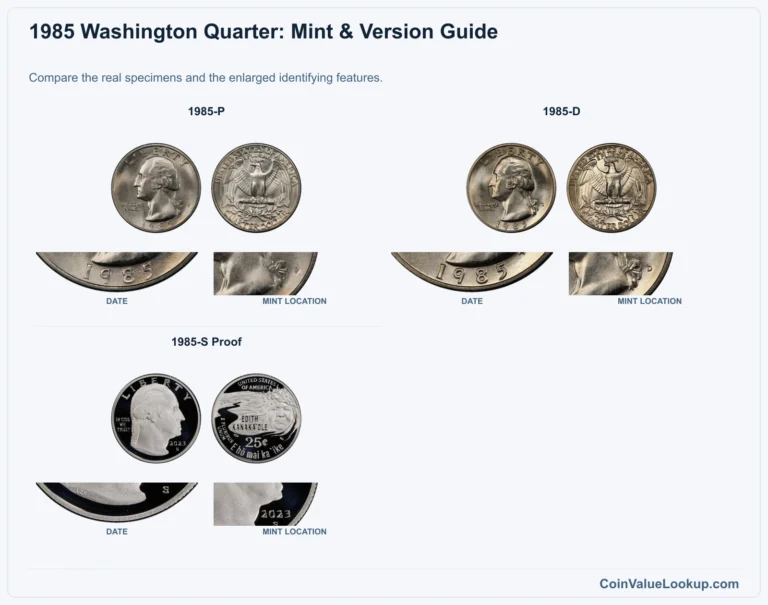
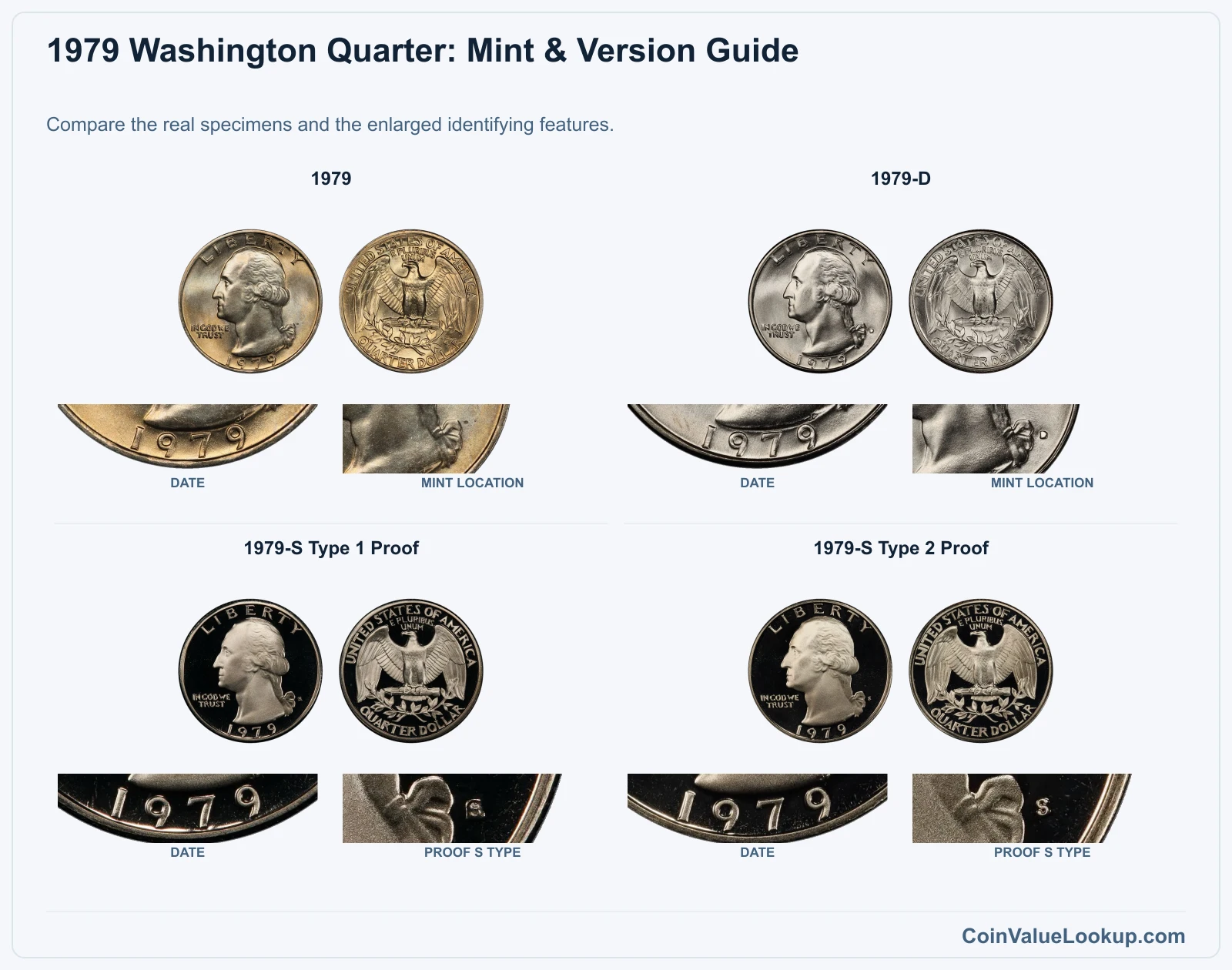
Look near the date on the obverse for the mintmark. Philadelphia coins carry no mintmark.
A small D means Denver. An S indicates a San Francisco proof.
All 1979 quarters are copper-nickel clad over a copper core, weighing about 5.67 grams and measuring 24.3 mm. An S mintmark does not mean silver — check the edge for the telltale copper stripe if you are curious about composition, but do not try to authenticate alloy by color alone.
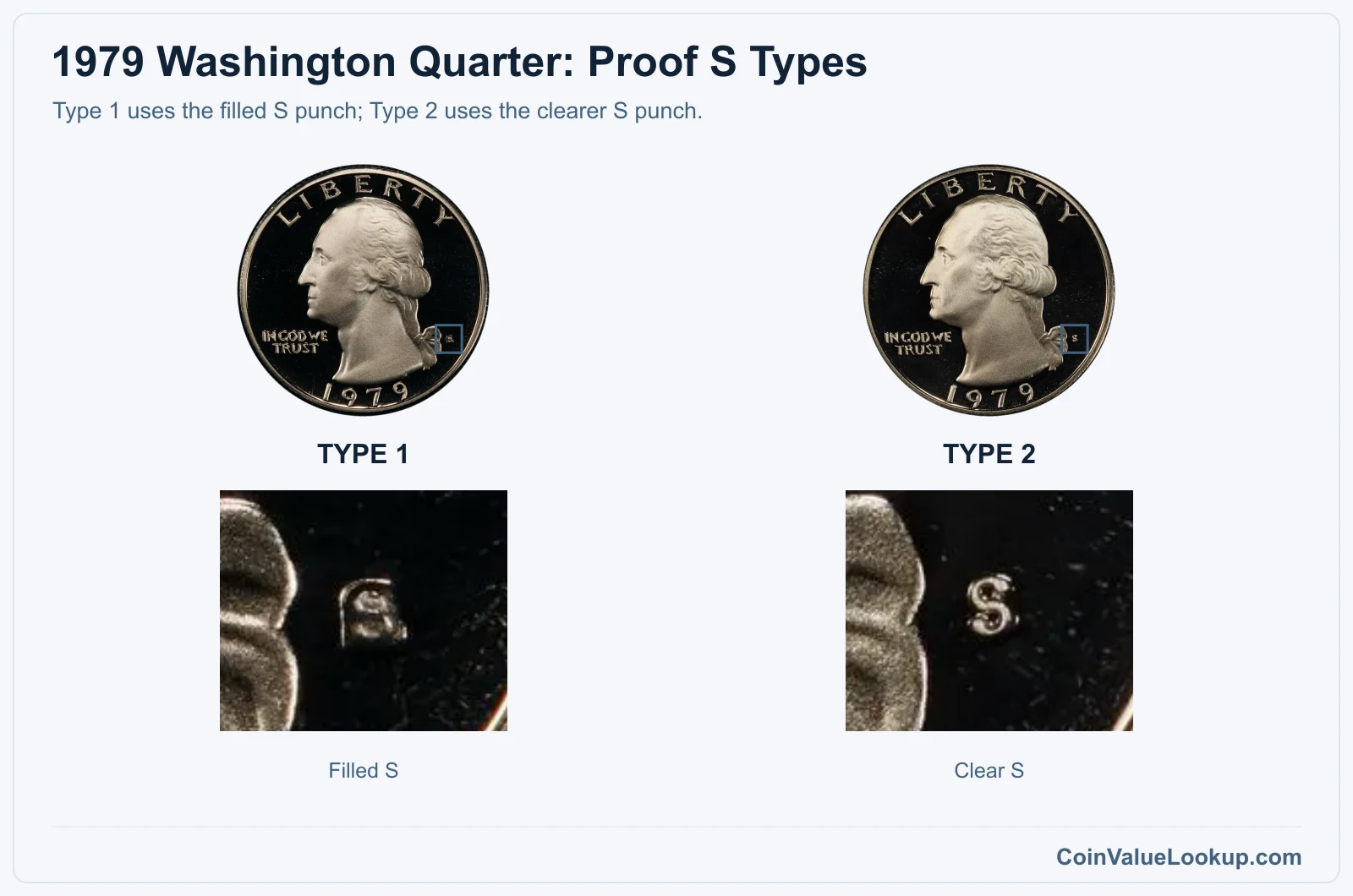
San Francisco proofs come in two punch varieties. Type 1 has a Filled S where the interior of the letter looks blobby and partly closed.
Type 2 has a Clear S with open, well-defined loops. This is a mintmark-punch difference, not a doubled die or missing-mintmark error.
Comparing the two side by side makes the distinction obvious.
Step 2: Check Your 1979 Washington Quarter Grade
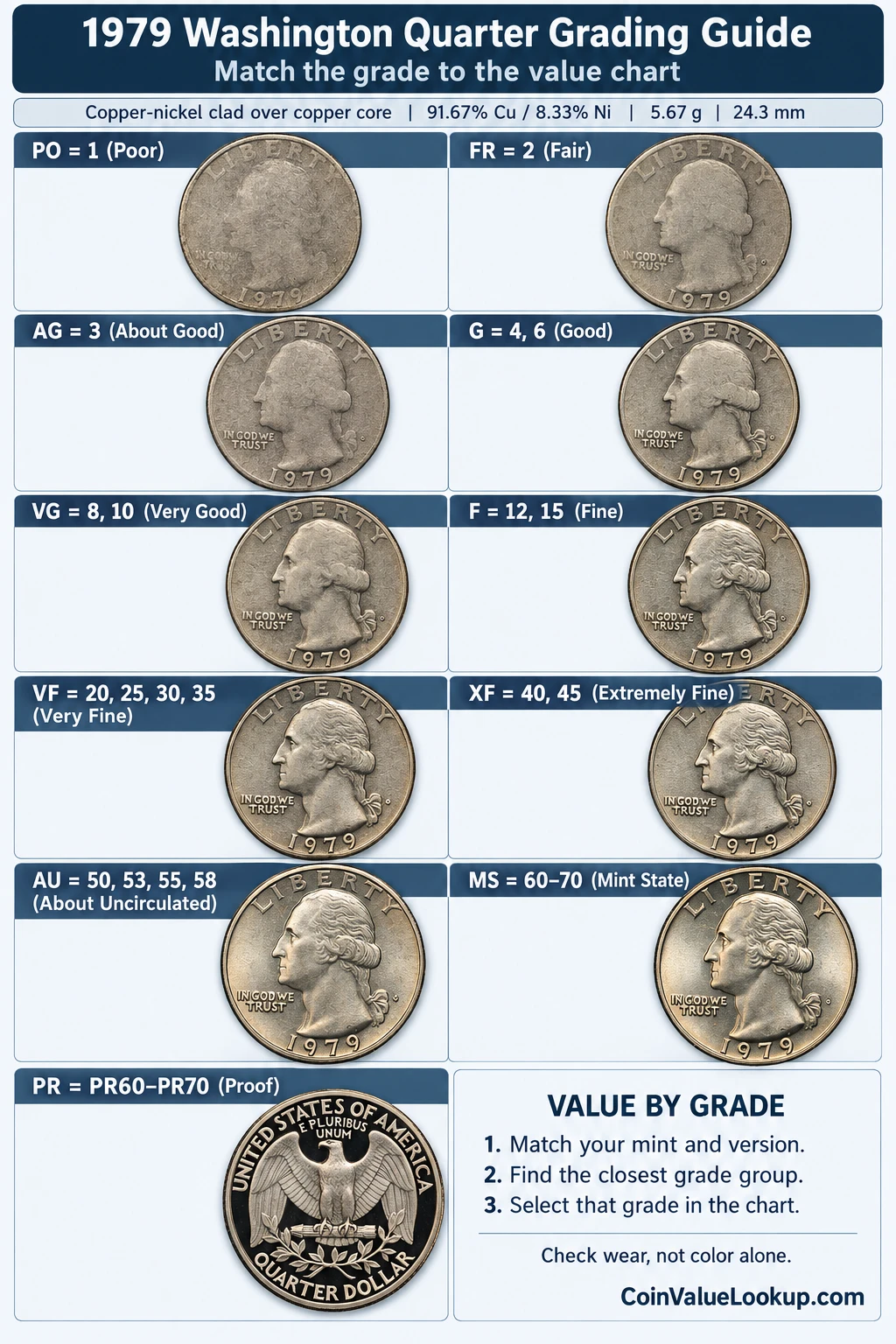
Focus on the hair detail just above Washington's ear, along with the cheek and jawline. These are the first spots to lose definition from circulation wear.
On the reverse, check the eagle's breast feathers for matching friction.
Separate a weak strike from actual wear. A weakly struck coin can look flat in those same areas but will still have undisturbed luster.
True wear breaks through the luster and leaves dull, smooth patches.
Inspect for contact marks — bag hits from storage — and any hairlines from cleaning. Both reduce the grade.
On proofs, a mirror finish with frosted devices (cameo contrast) is a desirable visual feature, but it describes the surface contrast, not the numerical grade itself. Use the comparison image to benchmark your coin's condition against known grade points.
Step 3: Check 1979 Washington Quarter Value by Mint and Version
1979 Washington Quarter
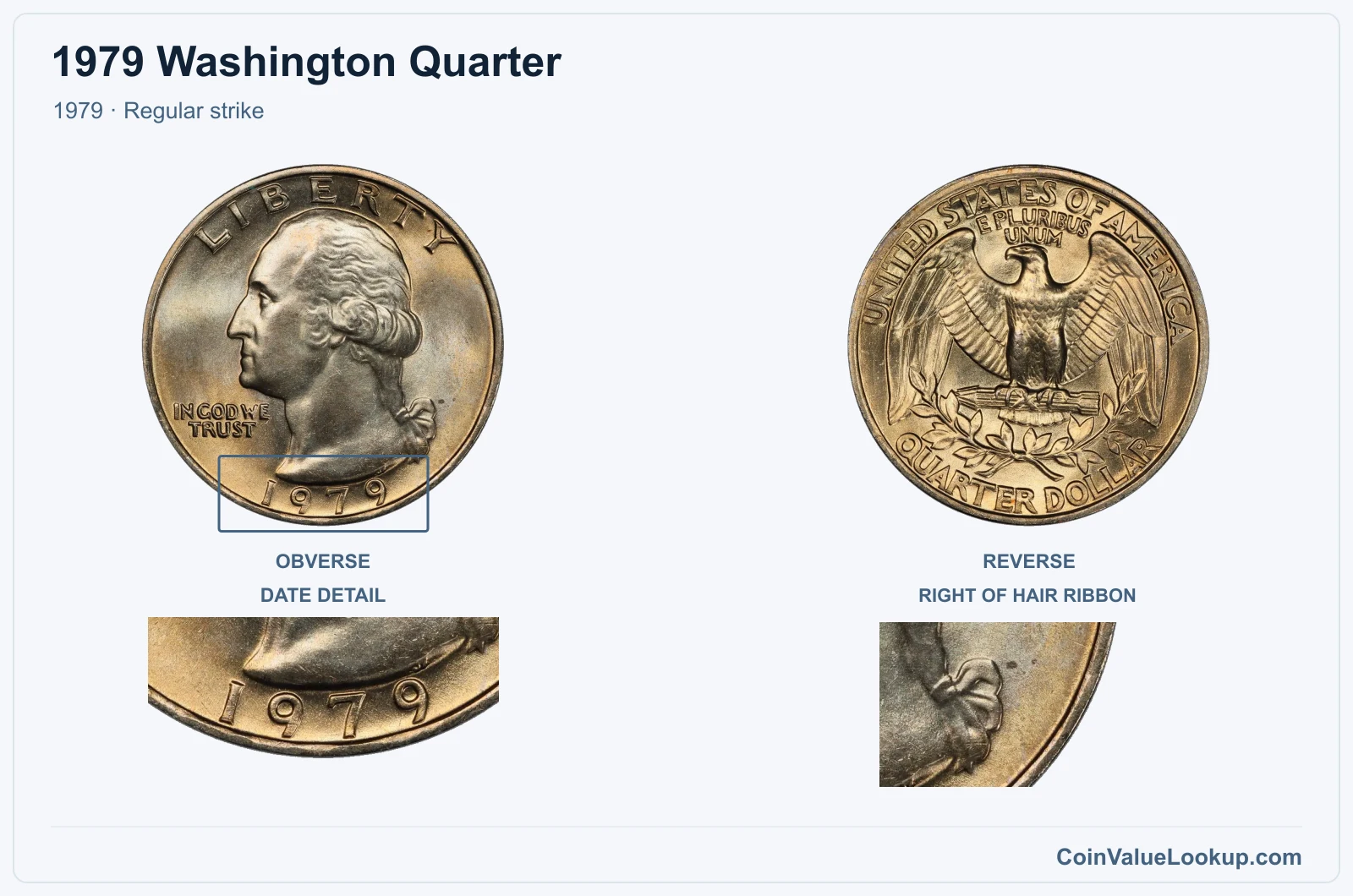
The 1979 Philadelphia quarter has no mintmark beside the date. It is a copper-nickel clad business strike with the standard Washington obverse and heraldic eagle reverse.
Millions were produced, so circulated examples are worth 25 cents.
In gem uncirculated condition, the USA Coin Book guide places MS65 specimens at about $7.29. Look for full, unbroken luster and minimal contact marks to justify that grade.
Any friction on the hair or cheek drops the coin back toward face value quickly.
| Range | Grade | Price | Auction Records | Appraisal |
|---|---|---|---|---|
| PO | PO 1 | — | Coin Identifier | |
| FR | FR 2 | — | Coin Identifier | |
| AG | AG 3 | — | Coin Identifier | |
| G | G 4 | — | Coin Identifier | |
| G 6 | — | Coin Identifier | ||
| VG | VG 8 | — | Coin Identifier | |
| VG 10 | — | Coin Identifier | ||
| F | F 12 | — | Coin Identifier | |
| F 15 | — | Coin Identifier | ||
| VF | VF 20 | — | Coin Identifier | |
| VF 25 | — | Coin Identifier | ||
| VF 30 | — | Coin Identifier | ||
| VF 35 | — | Coin Identifier | ||
| XF | XF 40 | — | Coin Identifier | |
| XF 45 | — | Coin Identifier | ||
| AU | AU 50 | — | Coin Identifier | |
| AU 53 | — | Coin Identifier | ||
| AU 55 | — | Coin Identifier | ||
| AU 58 | — | Coin Identifier | ||
| MS | MS 60 | — | Coin Identifier | |
| MS 61 | — | Coin Identifier | ||
| MS 62 | — | Coin Identifier | ||
| MS 63 | — | Coin Identifier | ||
| MS 64 | Coin Identifier | |||
| MS 65 | Coin Identifier | |||
| MS 66 | Coin Identifier | |||
| MS 67 | Coin Identifier | |||
| MS 68 | Coin Identifier | |||
| MS 69 | — | — | — | |
| MS 70 | — | — | — |
1979 Washington Quarter — D
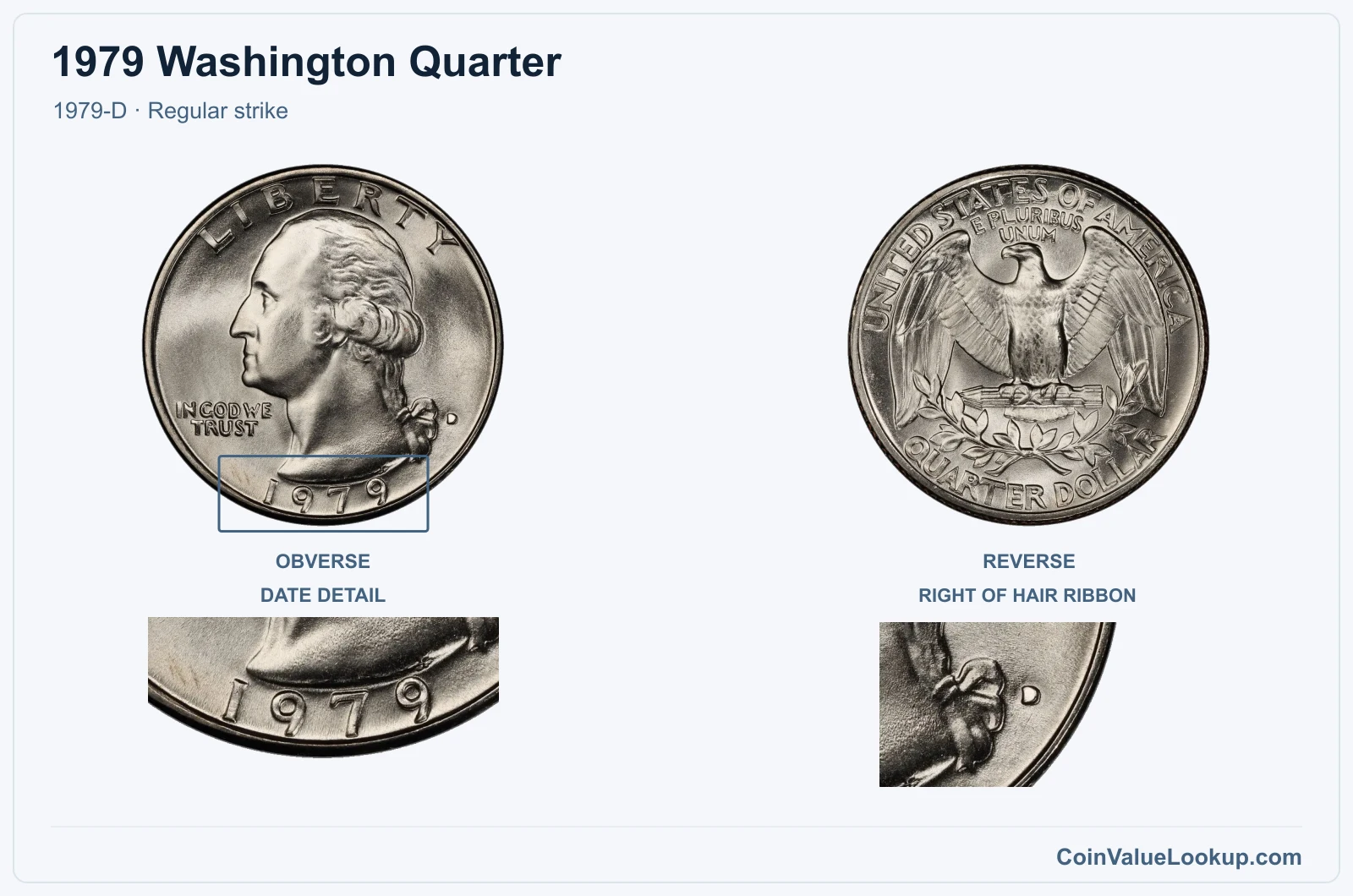
Denver's 1979-D quarter carries a small D mintmark near the date. Same copper-nickel clad composition, same design, same huge mintage ballpark as its Philadelphia sibling.
At MS65, the USA Coin Book guide also estimates about $7.29. Circulated pieces are spenders.
If yours has original luster with no bag marks or hairlines, it is worth a closer look under magnification to confirm the grade before setting it aside.
Coin Value Lookup is a handy place to look up guides for other dates and denominations if you are sorting a whole jar of quarters.
| Range | Grade | Price | Auction Records | Appraisal |
|---|---|---|---|---|
| PO | PO 1 | — | Coin Identifier | |
| FR | FR 2 | — | Coin Identifier | |
| AG | AG 3 | — | Coin Identifier | |
| G | G 4 | — | Coin Identifier | |
| G 6 | — | Coin Identifier | ||
| VG | VG 8 | — | Coin Identifier | |
| VG 10 | — | Coin Identifier | ||
| F | F 12 | — | Coin Identifier | |
| F 15 | — | Coin Identifier | ||
| VF | VF 20 | — | Coin Identifier | |
| VF 25 | — | Coin Identifier | ||
| VF 30 | — | Coin Identifier | ||
| VF 35 | — | Coin Identifier | ||
| XF | XF 40 | — | Coin Identifier | |
| XF 45 | — | Coin Identifier | ||
| AU | AU 50 | — | Coin Identifier | |
| AU 53 | — | Coin Identifier | ||
| AU 55 | — | Coin Identifier | ||
| AU 58 | — | Coin Identifier | ||
| MS | MS 60 | — | Coin Identifier | |
| MS 61 | — | Coin Identifier | ||
| MS 62 | — | Coin Identifier | ||
| MS 63 | — | Coin Identifier | ||
| MS 64 | — | Coin Identifier | ||
| MS 65 | — | Coin Identifier | ||
| MS 66 | Coin Identifier | |||
| MS 67 | Coin Identifier | |||
| MS 68 | — | Coin Identifier | ||
| MS 69 | — | — | — | |
| MS 70 | — | — | — |
1979 Washington Quarter — S Type 1 Proof
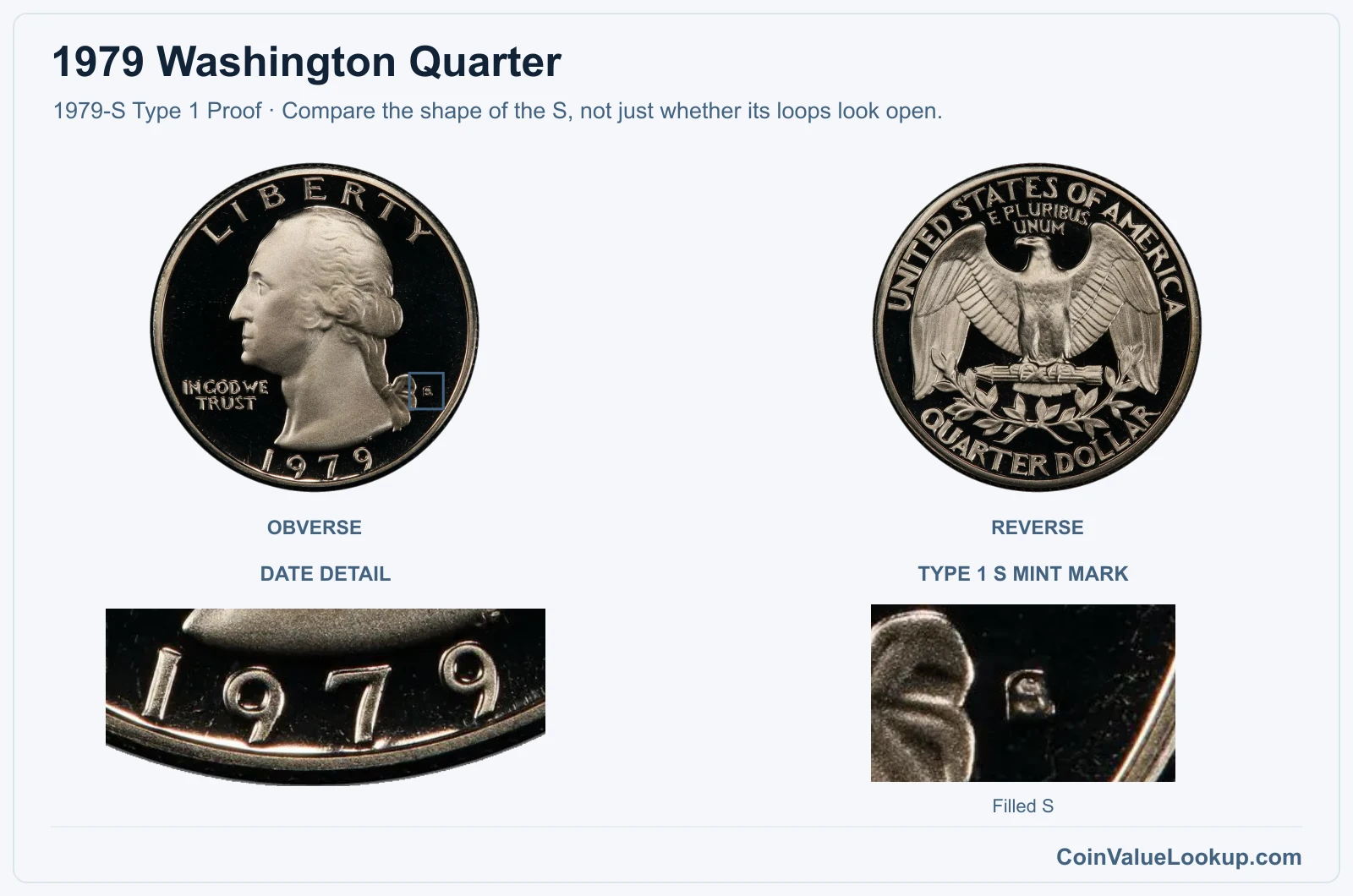
The 1979-S Type 1 proof was struck at San Francisco for collector sets. Its defining feature is the Filled S mintmark — under magnification the loops of the S look blobby, partially filled in, almost like a rubber stamp that picked up too much ink.
These are copper-nickel clad proofs, not silver. The USA Coin Book guide lists PR65 at about $6.25.
Cameo and deep-cameo contrast designations describe the degree of frost on the devices against the mirror fields; they are visual features within the proof category, not separate compositions or higher-tier grades. Type 1 is the more common of the two 1979 proof punches.
| Range | Grade | Price | Auction Records | Appraisal |
|---|---|---|---|---|
| PR | PR 1 | — | Coin Identifier | |
| PR 2 | — | Coin Identifier | ||
| PR 3 | — | Coin Identifier | ||
| PR 4 | — | Coin Identifier | ||
| PR 6 | — | Coin Identifier | ||
| PR 8 | — | Coin Identifier | ||
| PR 10 | — | Coin Identifier | ||
| PR 12 | — | Coin Identifier | ||
| PR 15 | — | Coin Identifier | ||
| PR 20 | — | Coin Identifier | ||
| PR 25 | — | Coin Identifier | ||
| PR 30 | — | Coin Identifier | ||
| PR 35 | — | Coin Identifier | ||
| PR 40 | — | Coin Identifier | ||
| PR 45 | — | Coin Identifier | ||
| PR 50 | — | Coin Identifier | ||
| PR 53 | — | Coin Identifier | ||
| PR 55 | — | Coin Identifier | ||
| PR 58 | — | Coin Identifier | ||
| PR 60 | — | Coin Identifier | ||
| PR 61 | — | Coin Identifier | ||
| PR 62 | — | Coin Identifier | ||
| PR 63 | — | Coin Identifier | ||
| PR 64 | — | Coin Identifier | ||
| PR 65 | — | Coin Identifier | ||
| PR 66 | — | Coin Identifier | ||
| PR 67 | Coin Identifier | |||
| PR 68 | Coin Identifier | |||
| PR 69 | Coin Identifier | |||
| PR 70 | Coin Identifier |
1979 Washington Quarter — S Type 2 Proof
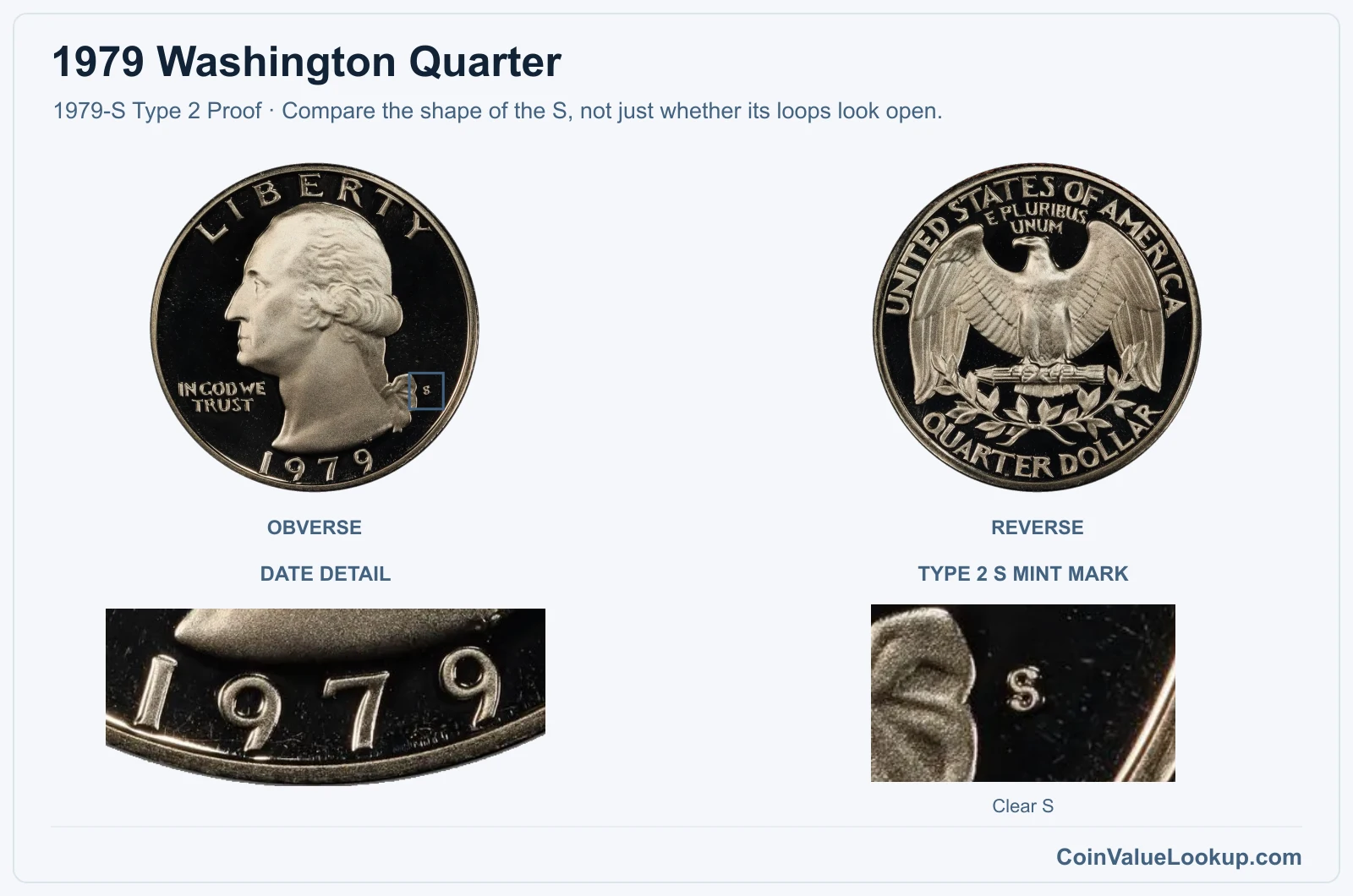
The 1979-S Type 2 proof uses a different mintmark punch with a clearly open, well-shaped S. Compare it directly against a Type 1 — the difference is in the internal loops of the letter, not the size or position of the mark overall.
This Clear S punch is the scarcer variety for 1979 proofs. Exact production figures are not established.
The USA Coin Book guide estimates PR65 at about $7.29. As with Type 1, cameo and deep-cameo are contrast descriptions within the proof finish, and the cited guide figure is a generic PR65 estimate, not a cameo-specific quotation.
Get magnification and good lighting before deciding which type you have.
| Range | Grade | Price | Auction Records | Appraisal |
|---|---|---|---|---|
| PR | PR 1 | — | Coin Identifier | |
| PR 2 | — | Coin Identifier | ||
| PR 3 | — | Coin Identifier | ||
| PR 4 | — | Coin Identifier | ||
| PR 6 | — | Coin Identifier | ||
| PR 8 | — | Coin Identifier | ||
| PR 10 | — | Coin Identifier | ||
| PR 12 | — | Coin Identifier | ||
| PR 15 | — | Coin Identifier | ||
| PR 20 | — | Coin Identifier | ||
| PR 25 | — | Coin Identifier | ||
| PR 30 | — | Coin Identifier | ||
| PR 35 | — | Coin Identifier | ||
| PR 40 | — | Coin Identifier | ||
| PR 45 | — | Coin Identifier | ||
| PR 50 | — | Coin Identifier | ||
| PR 53 | — | Coin Identifier | ||
| PR 55 | — | Coin Identifier | ||
| PR 58 | — | Coin Identifier | ||
| PR 60 | — | Coin Identifier | ||
| PR 61 | — | Coin Identifier | ||
| PR 62 | — | Coin Identifier | ||
| PR 63 | — | Coin Identifier | ||
| PR 64 | — | Coin Identifier | ||
| PR 65 | — | Coin Identifier | ||
| PR 66 | — | Coin Identifier | ||
| PR 67 | — | Coin Identifier | ||
| PR 68 | Coin Identifier | |||
| PR 69 | Coin Identifier | |||
| PR 70 | Coin Identifier |
1979 Washington Quarter Error List
1. 1979 Washington Quarter — Triple Strike with Off-Center Third Strike
A 1979 Philadelphia quarter struck three times is a dramatic and scarce error. The first and second strikes nearly overlap, producing small rim fins, while the third strike lands roughly 40 percent off-center to the northeast with a slight rotation.
You will see a repeated date and a clearly displaced portrait and lettering on both sides of the coin.
Do not confuse this with a doubled die, shelf-like machine doubling, or damage impressed after the coin left the mint. The key diagnostic is the broad, obviously displaced third strike — no post-mint force replicates that.
One example graded NGC MS66 sold for $747.50 at Heritage Auctions in June 2006. That result reflects that specific coin's combined error and grade, not a blanket price for every multi-struck 1979 quarter.
2. 1979 Washington Quarter — Struck on a Nickel Planchet
This error occurs when a 1979 Philadelphia quarter die pair strikes a five-cent nickel blank instead of the larger quarter planchet. The result is a quarter design squeezed onto a smaller, lighter disc — documented at about 5.0 grams.
Peripheral design elements are cut off because the blank is too small, but the struck surfaces themselves are genuine and fully detailed where present.
Watch out for quarters that have been cut down, hammered, plated, or chemically altered after minting. The difference is in the struck edge texture and the proportional design.
A Heritage Auctions example graded NGC MS64 brought $199.75 in June 2013. Condition and correct attribution matter — have a suspicious coin evaluated by a professional grading service before assuming it is a wrong-planchet strike.
3. 1979 Washington Quarter — Clipped Planchet
A clipped planchet error means a portion of the original metal blank was missing before the coin was struck. On a 1979 quarter you might see a curved, straight, or ragged absence along the rim.
The struck design will be weak or incomplete in the clipped zone, and you may notice corresponding weakness on the opposite side of the coin — a useful confirmation detail.
Do not confuse a clip with an edge that has been filed, cut, or corroded after minting. Genuine clips show metal flow consistent with the striking process, not tool marks or rough corrosion pits.
The value of a clipped 1979 quarter depends on the size and visibility of the clip, as well as the coin's overall condition. Each piece needs individual assessment.
4. 1979 Washington Quarter — Missing Clad Layer
A missing clad layer error means one of the outer nickel-alloy layers was absent from the planchet before striking. On a 1979 quarter with a missing obverse clad layer, the face of the coin may show the copper core exposed, giving it an unusual color compared to the normal silvery surface.
The edge will also look different — you should be able to see a thinner or absent layer on the affected side.
Compare measured weight against the normal 5.67 grams; a missing layer will reduce it noticeably. Be careful: toning, environmental corrosion, plating, and post-mint surface removal can all mimic the look of a missing clad layer.
Value depends on condition, which side is affected, and how clearly the error presents. Individual assessment is necessary.
5. 1979 Washington Quarter — Struck-Through Error
A struck-through error happens when foreign material sits between the die and the planchet during striking, leaving an impression or depression in the coin's surface. For 1979 quarters, a reported category involves a staple caught during the strike.
You would see a localized, sharply defined impression matching the shape of the object — distinct from a grease-filled die, which produces broad mushy weakness.
Do not mistake ordinary wear, scratches, or cleaning marks for a struck-through impression. The depression should have the same depth and sharpness as the surrounding design, pressed into the surface rather than scraped across it.
Value depends on how dramatic and identifiable the impression is, plus the coin's overall condition. Each example warrants individual evaluation.