1940 Mercury Dime Coin Value: How Much Is It Worth?
A 1940 Mercury Dime in well-worn condition books around $5.73 at the G4 grade level, while uncirculated examples can reach roughly $41 to $46 at MS65 depending on the mint, according to USA Coin Book estimates. Philadelphia proof strikes carry a separate premium.
Full Bands designation, specific error types, and individual coin condition all influence final value beyond these guide figures.
Fast Way to Identify Your 1940 Mercury Dime
Want a quick read on your 1940 dime? Upload clear photos of the front and back, and our identifier can offer a preliminary take on which mint version you have and its general condition.
This is not a certified authentication or precise grade assignment, but it gives you a solid starting point before deciding on next steps.
1940 Mercury Dime Value
Upload both sides of your 1940 Mercury Dime.
Front Obverse
Upload photo
Back Reverse
Upload photo
Which 1940 Mercury Dime Versions Are Worth Money?
- Philadelphia business strikes range from about $5.73 in G4 to $41 in MS65; proof examples in PR65 book around $229 per USA Coin Book.
- Denver and San Francisco business strikes share the same G4 floor but reach roughly $46 in MS65, slightly above Philadelphia.
- Full Bands designation can command premiums on any mint's business strike, though no separate FB price is provided here.
- Philadelphia proof dimes from 1940 have brilliant mirror fields and are a distinct collectible category apart from circulation strikes.
- Error categories such as repunched mintmarks, off-center strikes, and doubled dies on the 1940-S have been reported and may carry premiums depending on severity and condition.
Step 1: Identify Your 1940 Mercury Dime Mint Mark and Version
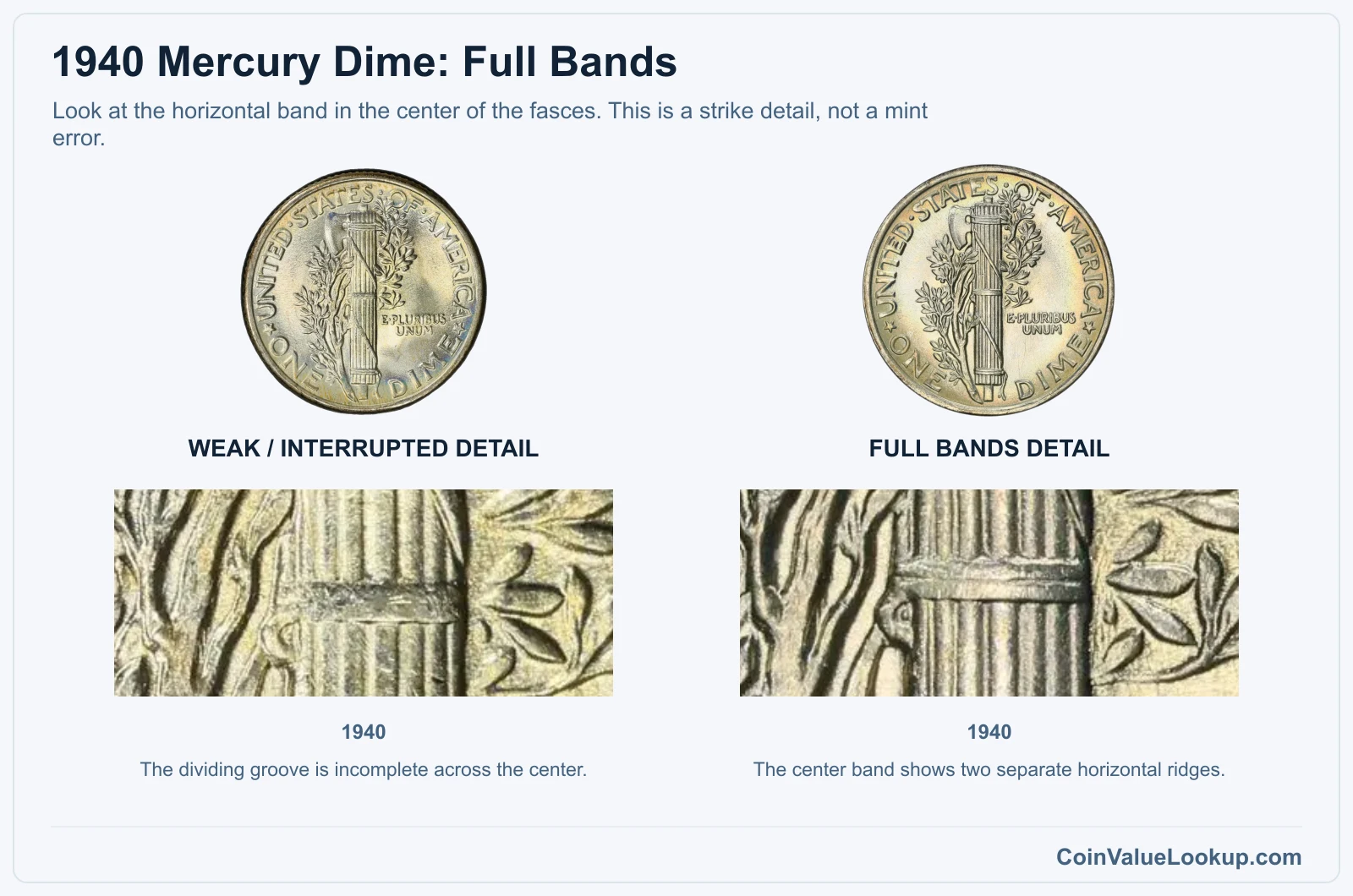
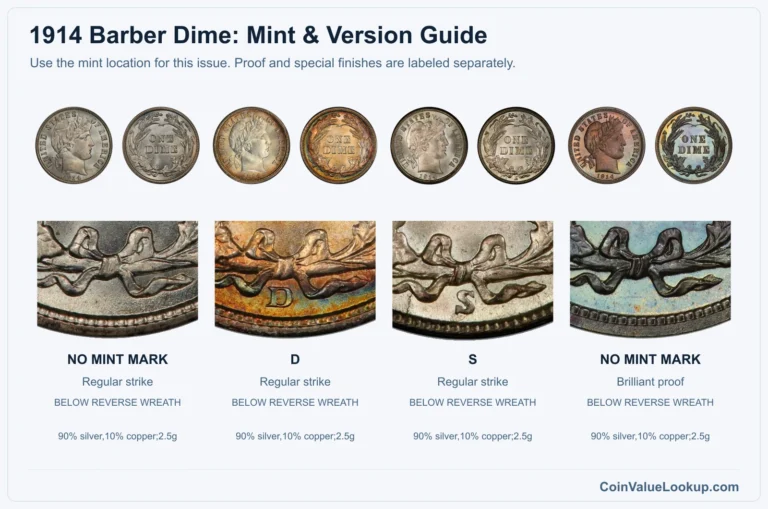
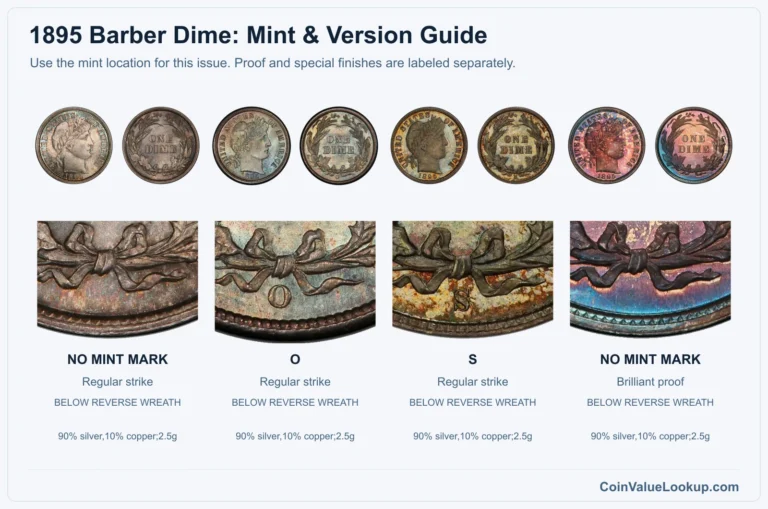
Three business-strike mints produced the 1940 Mercury Dime: Philadelphia, Denver, and San Francisco. Philadelphia coins carry no mintmark.
Denver pieces show a small "D" and San Francisco a small "S," both located on the reverse at the lower left, just beside the word ONE near the base of the fasces.
Do not confuse the "AW" monogram on the obverse with a mintmark. Those are designer Adolph Weinman's initials, and they appear on every 1940 dime regardless of mint.
Philadelphia also struck proof versions this year, identifiable by their mirror-like reflective fields and sharp rims.
All 1940 dimes are 90% silver and 10% copper, weighing about 2.5 grams with a 17.9 mm diameter and a reeded edge. There is no clad or base-metal version for this date.
Step 2: Check Your 1940 Mercury Dime Grade
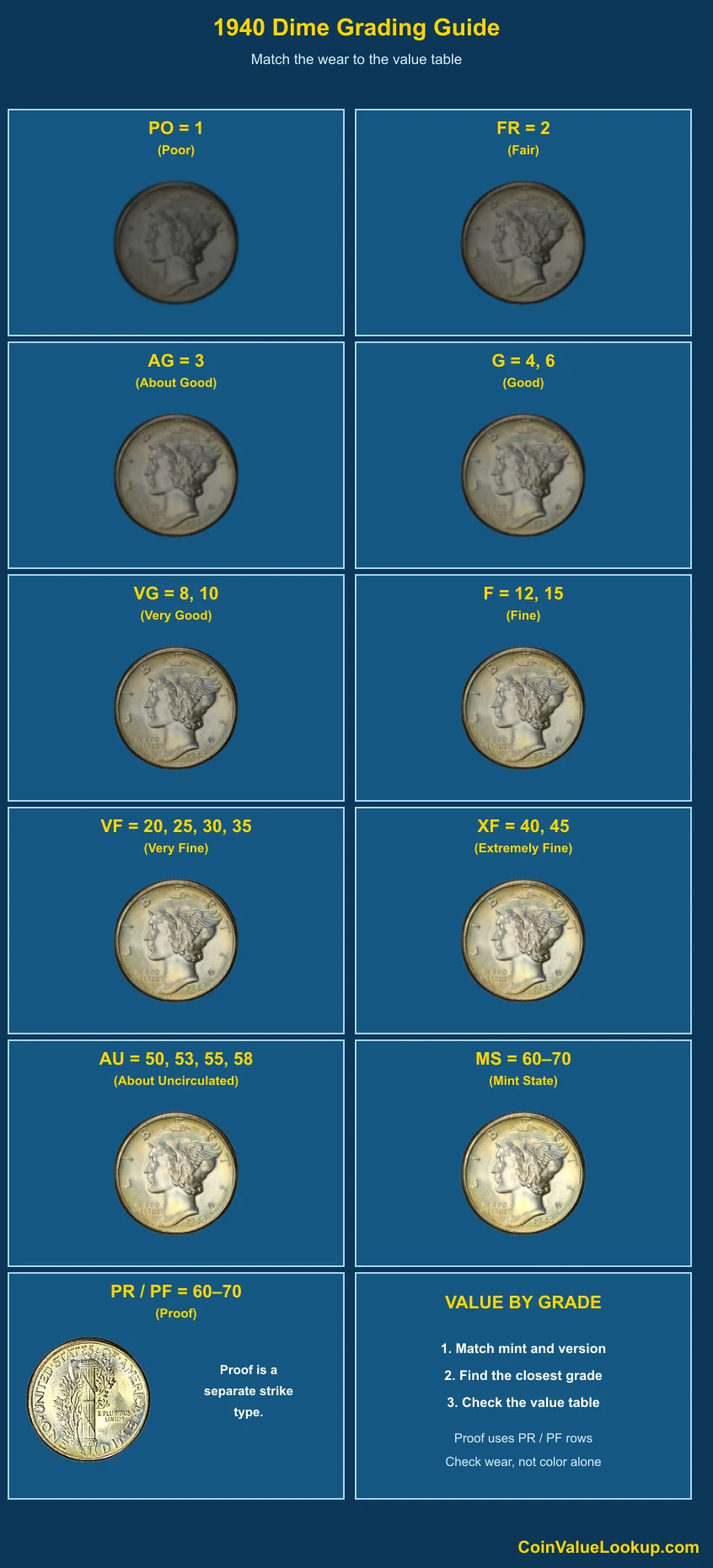
Start with Liberty's hair detail just above and in front of the ear. On a lightly worn coin, the highest points of the hair lose definition first, then the wing feathers on the cap flatten.
The reverse fasces bands are another checkpoint, but a weak strike can mimic wear, so do not automatically assume a soft band area means circulation damage.
Luster matters a lot. A coin with full original mint luster but a couple of contact marks still grades differently from one that has been cleaned or polished.
Cleaned coins often show unnatural brightness or hairline scratches visible under a light.
Use the comparison image to match your coin's wear pattern. Pay attention to peripheral legends and the date; if those are sharp but the bands are mushy, you may have a strike issue rather than a grade issue.
Full Bands is a separate designation applied by grading services like NGC, which checks that the central horizontal bands on the fasces are fully separated. Different services may apply slightly different criteria, so FB is a strike quality call, not a different grade tier.
Proof is a manufacturing method, not a grade above Mint State.
Step 3: Check 1940 Mercury Dime Value by Mint and Version
1940 Mercury Dime — No Mint Mark — Silver Circulation
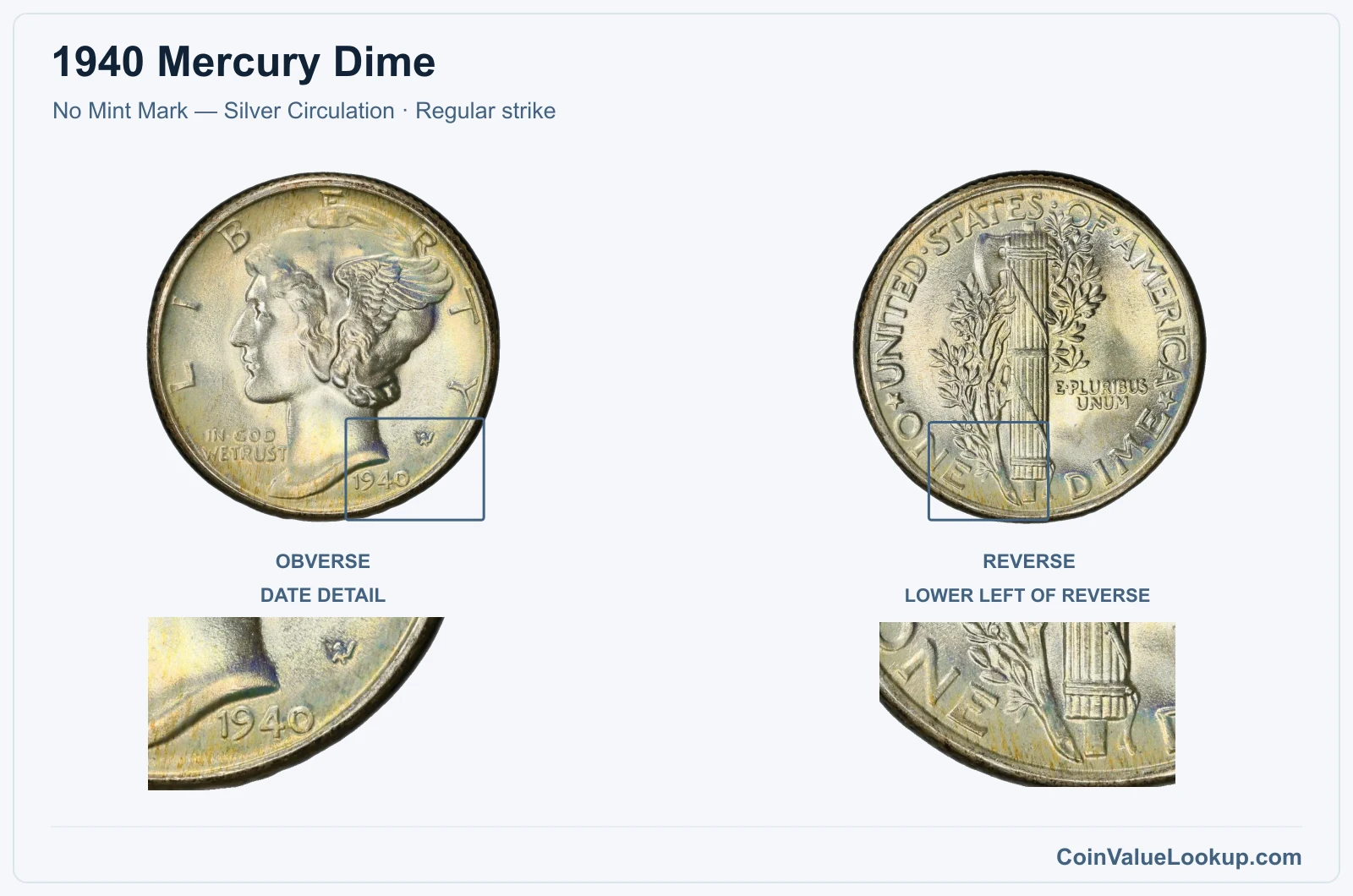
The 1940 Philadelphia dime has no mintmark. Look at the reverse near the base of the fasces and beside ONE — if the space is blank, you have the Philly issue.
USA Coin Book estimates place this coin at about $5.73 in G4 and around $41 in MS65. These are guide figures for regular strikes without the Full Bands designation.
FB examples may trade higher, but no separate FB price is provided here.
This is the most straightforward version to find. Silver content alone gives it a floor value tied to the metal market.
Range Grade
Price Auction Records Appraisal PO PO 1
—
Coin Identifier FR FR 2
—
Coin Identifier AG AG 3
—
Coin Identifier G G 4
—
Coin Identifier
G 6
—
Coin Identifier VG VG 8
—
Coin Identifier
VG 10
—
Coin Identifier F F 12
—
Coin Identifier
F 15
—
Coin Identifier VF VF 20
—
Coin Identifier
VF 25
—
Coin Identifier
VF 30
—
Coin Identifier
VF 35
—
Coin Identifier XF XF 40
—
Coin Identifier
XF 45
—
Coin Identifier AU AU 50
—
Coin Identifier
AU 53
—
Coin Identifier
AU 55
—
Coin Identifier
AU 58
Coin Identifier MS MS 60
—
Coin Identifier
MS 61
—
Coin Identifier
MS 62
Coin Identifier
MS 63
Coin Identifier
MS 64
Coin Identifier
MS 65
Coin Identifier
MS 66
Coin Identifier
MS 67
Coin Identifier
MS 68
Coin Identifier
MS 69
—
—
—
MS 70
—
—
—
1940 Mercury Dime — D — Silver Circulation
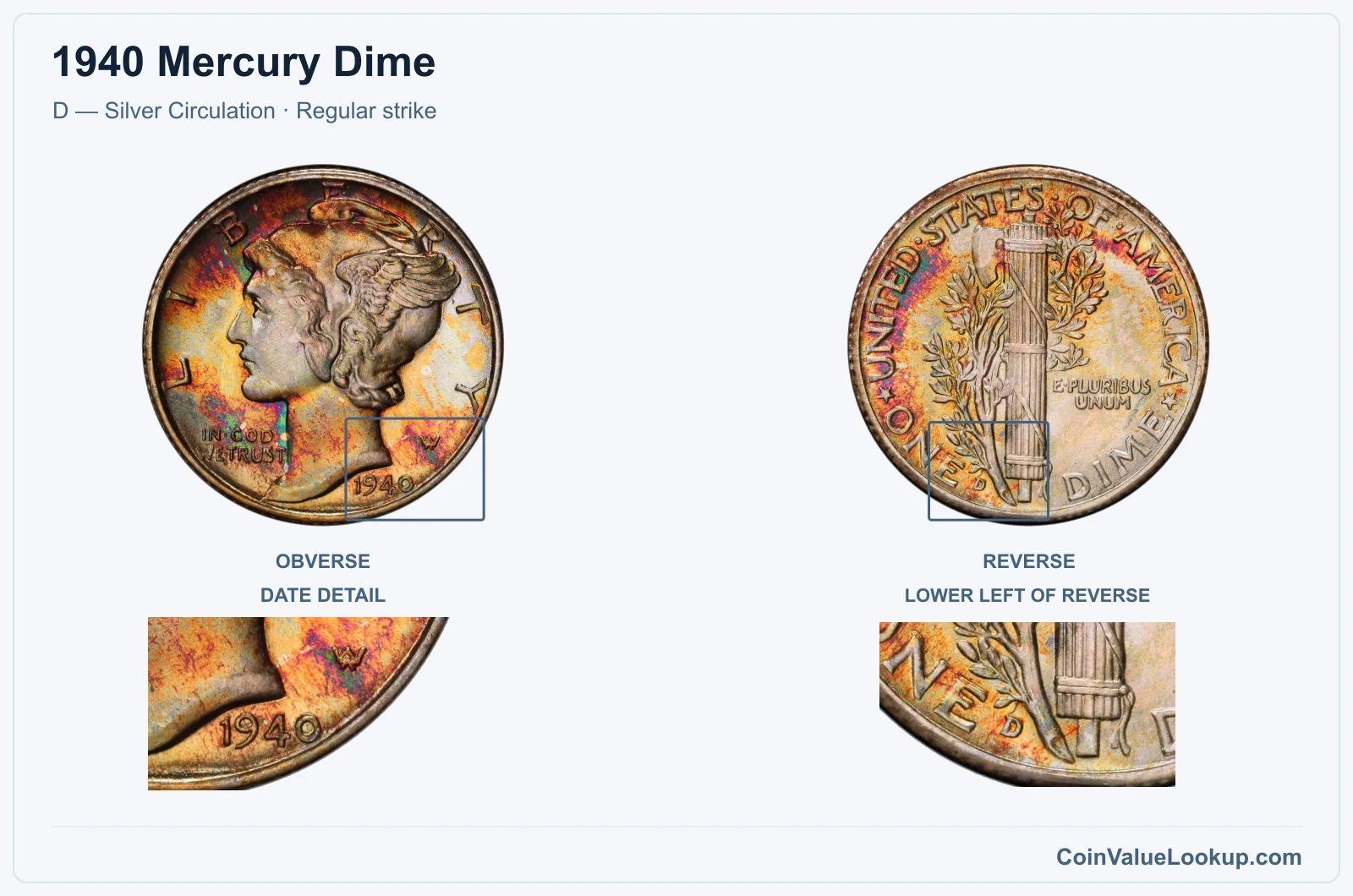
Denver strikes carry a small "D" mintmark on the lower-left reverse. It sits right next to ONE, and you will likely need a loupe or good magnification to read it clearly on worn examples.
Guide estimates from USA Coin Book put the 1940-D at about $5.73 in G4 and roughly $46 in MS65. That small premium over the Philadelphia issue at the MS65 level reflects typical supply and demand differences between mints.
As with all business strikes this year, Full Bands coins are a separate tier. The "D" mintmark is also the one to inspect carefully if you suspect a repunched mintmark error.
Range Grade
Price Auction Records Appraisal PO PO 1
—
Coin Identifier FR FR 2
—
Coin Identifier AG AG 3
—
Coin Identifier G G 4
—
Coin Identifier
G 6
—
Coin Identifier VG VG 8
—
Coin Identifier
VG 10
—
Coin Identifier F F 12
—
Coin Identifier
F 15
—
Coin Identifier VF VF 20
—
Coin Identifier
VF 25
—
Coin Identifier
VF 30
—
Coin Identifier
VF 35
—
Coin Identifier XF XF 40
—
Coin Identifier
XF 45
—
Coin Identifier AU AU 50
—
Coin Identifier
AU 53
—
Coin Identifier
AU 55
—
Coin Identifier
AU 58
—
Coin Identifier MS MS 60
—
Coin Identifier
MS 61
—
Coin Identifier
MS 62
—
Coin Identifier
MS 63
—
Coin Identifier
MS 64
—
Coin Identifier
MS 65
—
Coin Identifier
MS 66
—
Coin Identifier
MS 67
Coin Identifier
MS 68
—
—
—
MS 69
—
—
—
MS 70
—
—
—
1940 Mercury Dime — S — Silver Circulation
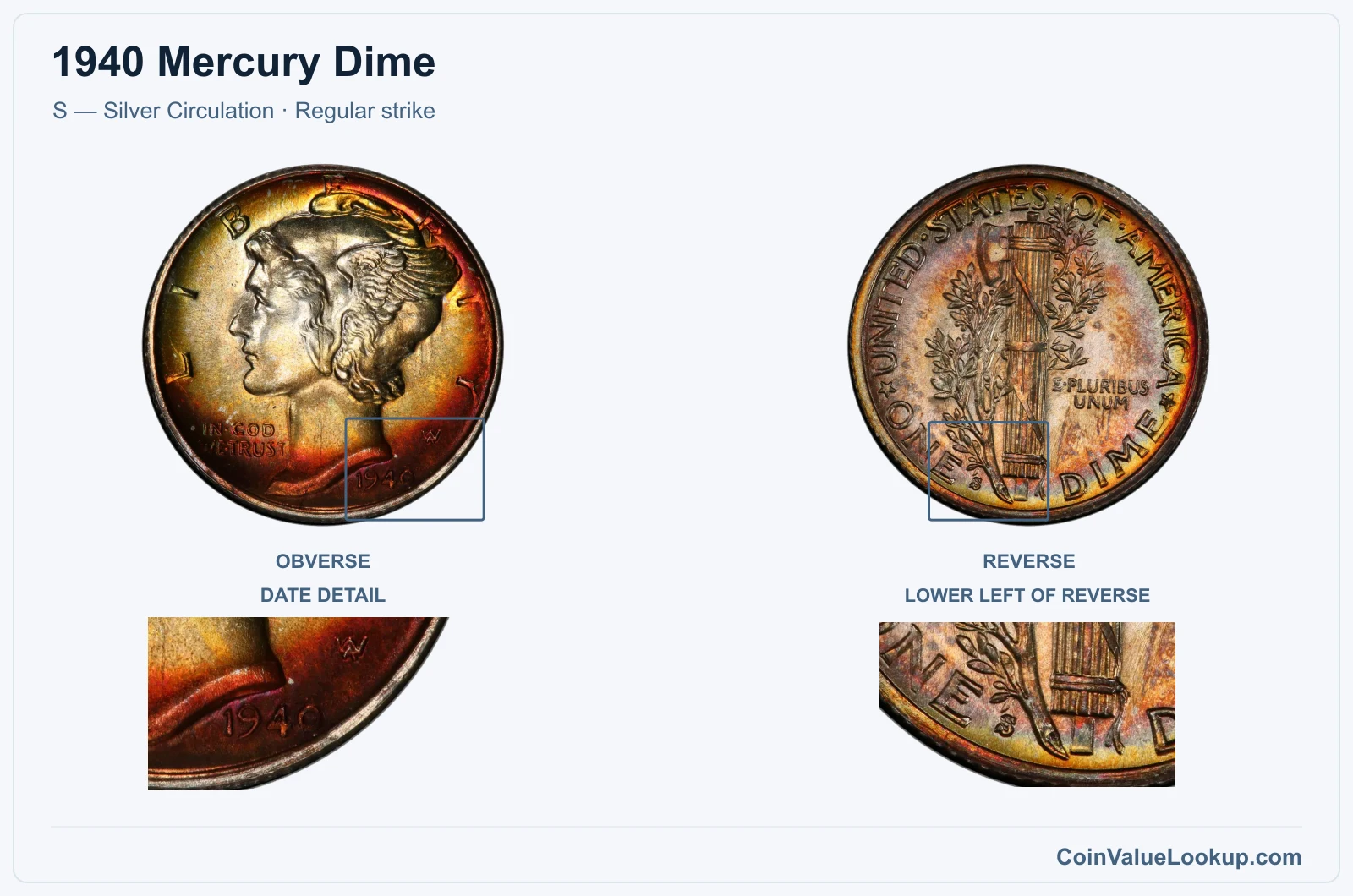
San Francisco's 1940 dime carries a small "S" mintmark in the same lower-left reverse position. The S can be faint on well-worn pieces, so tilt the coin under direct light.
USA Coin Book estimates match the Denver issue: about $5.73 in G4 and around $46 in MS65. This mint is also the one associated with reported doubled-die varieties for the year, so the 1940-S is worth a closer look under magnification.
Coin Value Lookup is a handy place to look up guides for Mercury Dimes and other series when you want to compare values across dates and mints.
Range Grade
Price Auction Records Appraisal PO PO 1
—
Coin Identifier FR FR 2
—
Coin Identifier AG AG 3
—
Coin Identifier G G 4
—
Coin Identifier
G 6
—
Coin Identifier VG VG 8
—
Coin Identifier
VG 10
—
Coin Identifier F F 12
—
Coin Identifier
F 15
—
Coin Identifier VF VF 20
—
Coin Identifier
VF 25
—
Coin Identifier
VF 30
—
Coin Identifier
VF 35
—
Coin Identifier XF XF 40
—
Coin Identifier
XF 45
—
Coin Identifier AU AU 50
—
Coin Identifier
AU 53
—
Coin Identifier
AU 55
Coin Identifier
AU 58
—
Coin Identifier MS MS 60
—
Coin Identifier
MS 61
—
Coin Identifier
MS 62
—
Coin Identifier
MS 63
—
Coin Identifier
MS 64
Coin Identifier
MS 65
Coin Identifier
MS 66
Coin Identifier
MS 67
Coin Identifier
MS 68
Coin Identifier
MS 69
—
—
—
MS 70
—
—
—
1940 Mercury Dime — No Mint Mark — Silver Proof
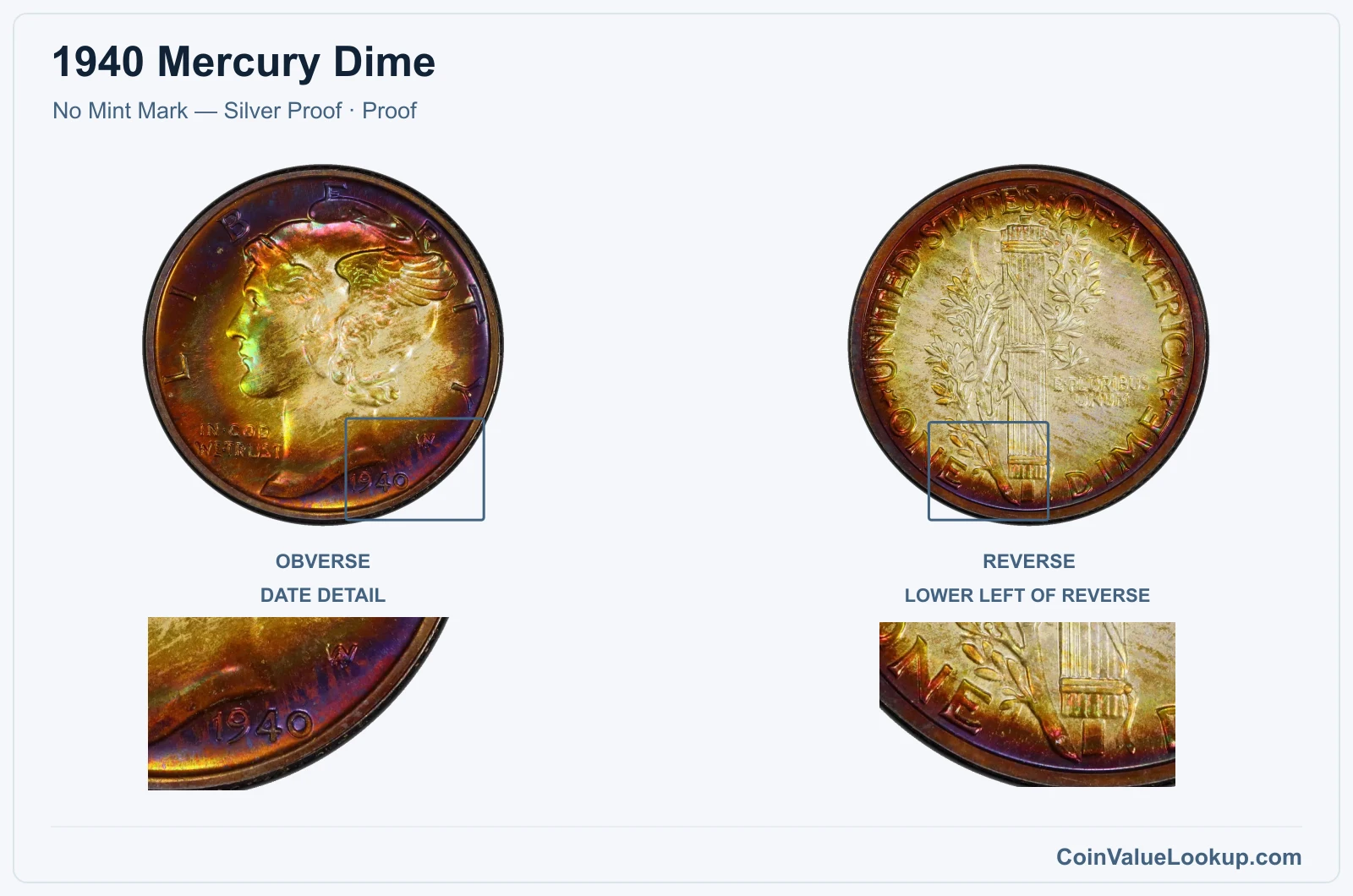
Philadelphia produced proof Mercury Dimes from 1936 through 1942, and the 1940 issue is part of that run. These coins were struck on specially prepared planchets with polished dies, giving them deeply reflective mirror fields and sharp, squared-off rims.
A PR65 example is estimated at about $229 by USA Coin Book. Proof is a manufacturing method, not a condition grade above Mint State, so a proof coin still gets graded for surface quality, contact marks, and haze.
There is no Full Bands filter applied to the proof price here, and cameo quality may appear as a grading-service designation rather than a different alloy or strike type.
Like the business strikes, this coin is 90% silver. It also carries no mintmark, since only Philadelphia produced proofs this year.
Range Grade
Price Auction Records Appraisal PR PR 1
—
Coin Identifier
PR 2
—
Coin Identifier
PR 3
—
Coin Identifier
PR 4
—
Coin Identifier
PR 6
—
Coin Identifier
PR 8
—
Coin Identifier
PR 10
—
Coin Identifier
PR 12
—
Coin Identifier
PR 15
—
Coin Identifier
PR 20
—
Coin Identifier
PR 25
—
Coin Identifier
PR 30
—
Coin Identifier
PR 35
—
Coin Identifier
PR 40
—
Coin Identifier
PR 45
—
Coin Identifier
PR 50
—
Coin Identifier
PR 53
—
Coin Identifier
PR 55
—
Coin Identifier
PR 58
—
Coin Identifier
PR 60
Coin Identifier
PR 61
Coin Identifier
PR 62
Coin Identifier
PR 63
Coin Identifier
PR 64
Coin Identifier
PR 65
Coin Identifier
PR 66
Coin Identifier
PR 67
Coin Identifier
PR 68
Coin Identifier
PR 69
Coin Identifier
PR 70
—
—
—
1940 Mercury Dime Error List
1. 1940 Mercury Dime — Repunched Mintmark
A repunched mintmark occurs when the mintmark punch was applied more than once in slightly different positions, leaving traces of the earlier impression. On the 1940 dime, you would look at the D or S mintmark area on the lower-left reverse for any secondary outline, notch, or displaced remnant beside or beneath the primary letter.
Use magnification and compare directly against a normal mintmark at the same scale. Machine doubling can produce shelf-like flatness around a letter that looks similar at a glance but lacks the distinct, separately raised second impression of a true repunched mark.
Corrosion or a small die chip near the mintmark can also mimic this error.
Value depends on how visible the repunching is, which specific variety it represents, and the coin's overall condition. No fixed price range is provided here.
2. 1940 Mercury Dime — Clipped Planchet
A clipped planchet means a piece of the blank was missing before the coin was struck. The result is a curved, straight, or irregular bite out of the coin's edge.
Look for a smooth, rounded missing area rather than a sharp cut, and check for a corresponding area of design weakness on the opposite side of the coin — metal flow during striking can cause that telltale soft spot.
Edge filing, deliberate cutting, or corrosion can all create notches that resemble clips. Genuine clips typically show undisturbed metal flow at the boundary and the Blakesley effect opposite the missing area.
Pricing depends on the clip's size, shape, and the coin's grade. No specific dollar figure is available from the supplied sources for this error on the 1940 dime.
3. 1940 Mercury Dime — Broadstrike
A broadstrike happens when the coin is struck without the retaining collar that normally confines the planchet. The result is a coin that spreads wider than normal, with design elements extending outward and the reeded edge either absent or distorted.
The full design is usually present, just larger than it should be.
This differs from an off-center strike, where part of the design is missing entirely. It also differs from a coin that was squashed flat after leaving the mint — post-mint damage lacks the uniform metal flow and die impression consistency of a genuine broadstrike.
Check the edge profile carefully. A legitimate broadstrike on a 1940 dime retains recognizable design detail across both faces.
Condition and degree of spread determine collector interest, but no specific price is available for this error here.
4. 1940 Mercury Dime — Off-Center Strike
An off-center strike means the planchet was not properly centered between the dies, leaving an unstruck crescent on one side and a shifted design on the other. The more dramatic the misalignment, the more visually striking the error — but collectors also want the date to remain visible, so a moderate off-center with a readable 1940 is typically more desirable than a severe one that obliterates key details.
Do not confuse an off-center strike with a clipped planchet. Clips remove metal from the blank before striking; off-center coins have a full-size blank that was simply misaligned.
Post-mint flattening or one-sided die misalignment can also create superficially similar appearances.
Value varies with the percentage off-center, date visibility, and overall condition. No specific price data is available here.
5. 1940 Mercury Dime — Die Crack / Die Chip
Die cracks appear as thin raised lines on the coin's surface, created when a crack in the steel die transfers as a ridge during striking. Die chips show up as small raised blobs where a piece of the die face broke away.
Both are common on heavily used dies.
A crack that connects to the rim and produces a larger raised area is sometimes called a cud. Interior cracks and chips are generally less dramatic but still collectible.
The key diagnostic is that these features are raised above the coin's surface, not incised.
Do not confuse die cracks with scratches, which are incuse, or with surface corrosion and debris. Under magnification, a genuine die crack has a consistent raised profile that matches the coin's strike.
Value depends on the crack's size, location, and visual impact, as well as overall coin condition. No price range is supplied for this error.
6. 1940 Mercury Dime — Doubled Dies — Obverse and Reverse
The 1940-S has been reported with doubled-die characteristics on both the obverse and reverse. This means the die itself carried a doubled image, so the resulting coins show raised, separated doubling on design elements across both faces — not just a mushy or shelf-like distortion from mechanical bounce during striking.
To check, compare lettering, the date, and design elements on your 1940-S against a normal example at matching magnification. True hub doubling produces distinct, separately raised contours.
Machine doubling, by contrast, tends to create flat, shelf-like displacement and does not carry the same collector premium.
Reflections, worn die contours, and even lighting angles can fool you at first glance. Careful side-by-side comparison under consistent light is the best approach.
Pricing depends on the strength and clarity of the doubling and the coin's grade, but no dollar figure is available from the sources provided.