1981 Lincoln Penny Coin Value: How Much Is It Worth?
Most 1981 Lincoln pennies you pull from a jar are worth face value. A USA Coin Book guide estimate places an uncirculated MS65 example at about $1.24, so we are not talking retirement money here.
That said, there are specific proof varieties and authenticated mint errors that push certain 1981 cents well above a penny. Knowing which version you have, and what condition it is in, makes all the difference.
Fast Way to Identify Your 1981 Lincoln Penny
The quickest way to start figuring out what you have is to upload clear photos of both the front and back of your coin. A preliminary identification from those images can help you sort out whether you are holding a business strike, a proof, or something unusual.
Good lighting and a steady hand go a long way.
1981 Penny Value
Upload both sides of your 1981 Lincoln Penny.
Front Obverse
Upload photo
Back Reverse
Upload photo
Which 1981 Lincoln Penny Versions Are Worth Money?
- The 1981-S Type 2 proof carries a guide estimate of about $19 at PR65, significantly more than the Type 1 proof at $3.62.
- Both S proof mintmark styles need magnification to distinguish; do not assume you have the common one without checking.
- Authenticated striking errors on 1981-D cents, such as wrong-planchet strikes or flipover double strikes, have sold for hundreds of dollars at auction.
Step 1: Identify Your 1981 Lincoln Penny Mint Mark and Version
The 1981 Lincoln cent carries the familiar Lincoln obverse and Memorial reverse on a plain-edge planchet. Normal composition is 95% copper and 5% zinc, with a nominal weight of 3.11 grams.
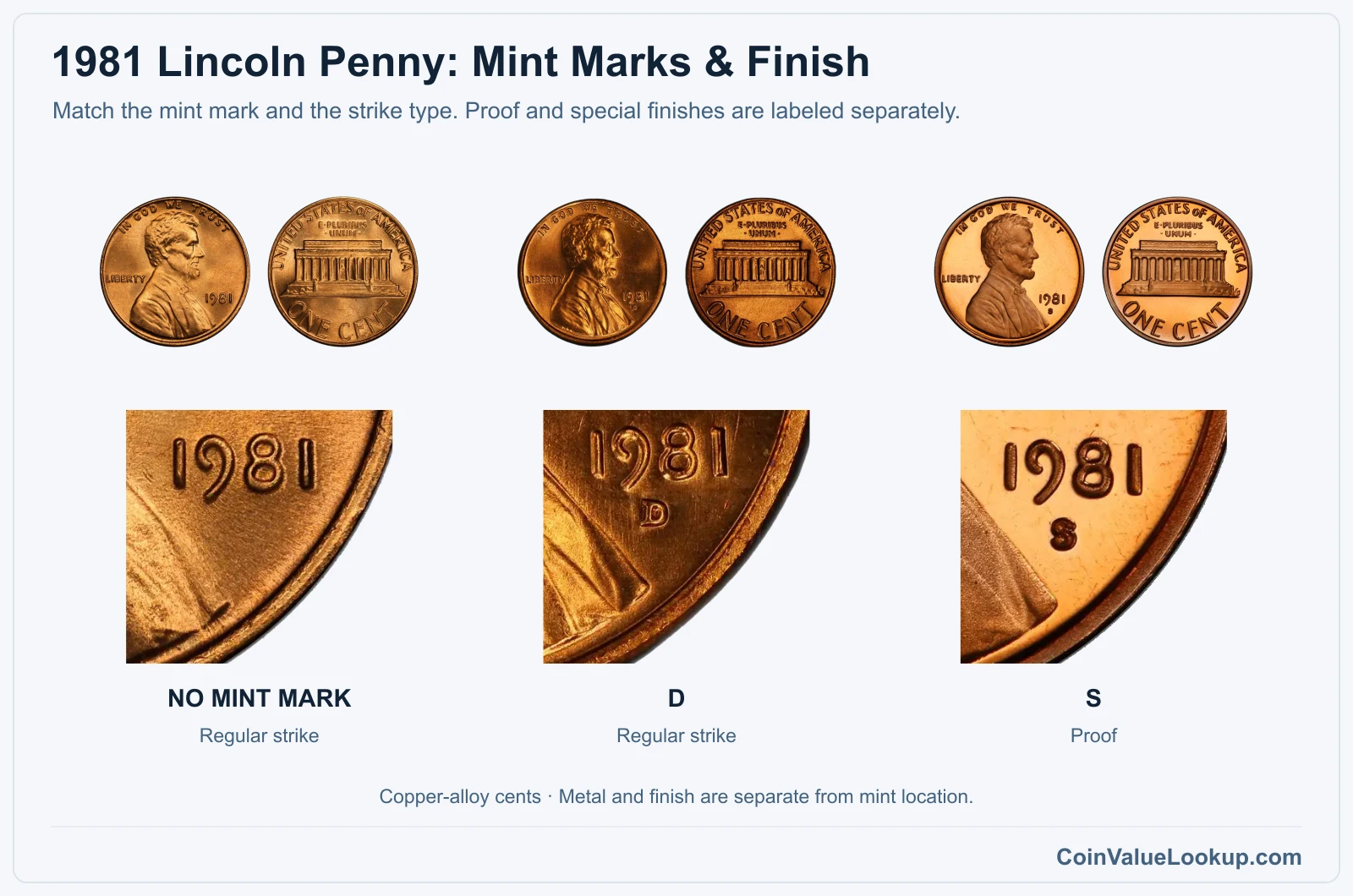
Check below the date for a mintmark. No mintmark or a D means you have a regular business strike.
An S mintmark means you have a proof, because San Francisco did not produce normal circulation cents this year.
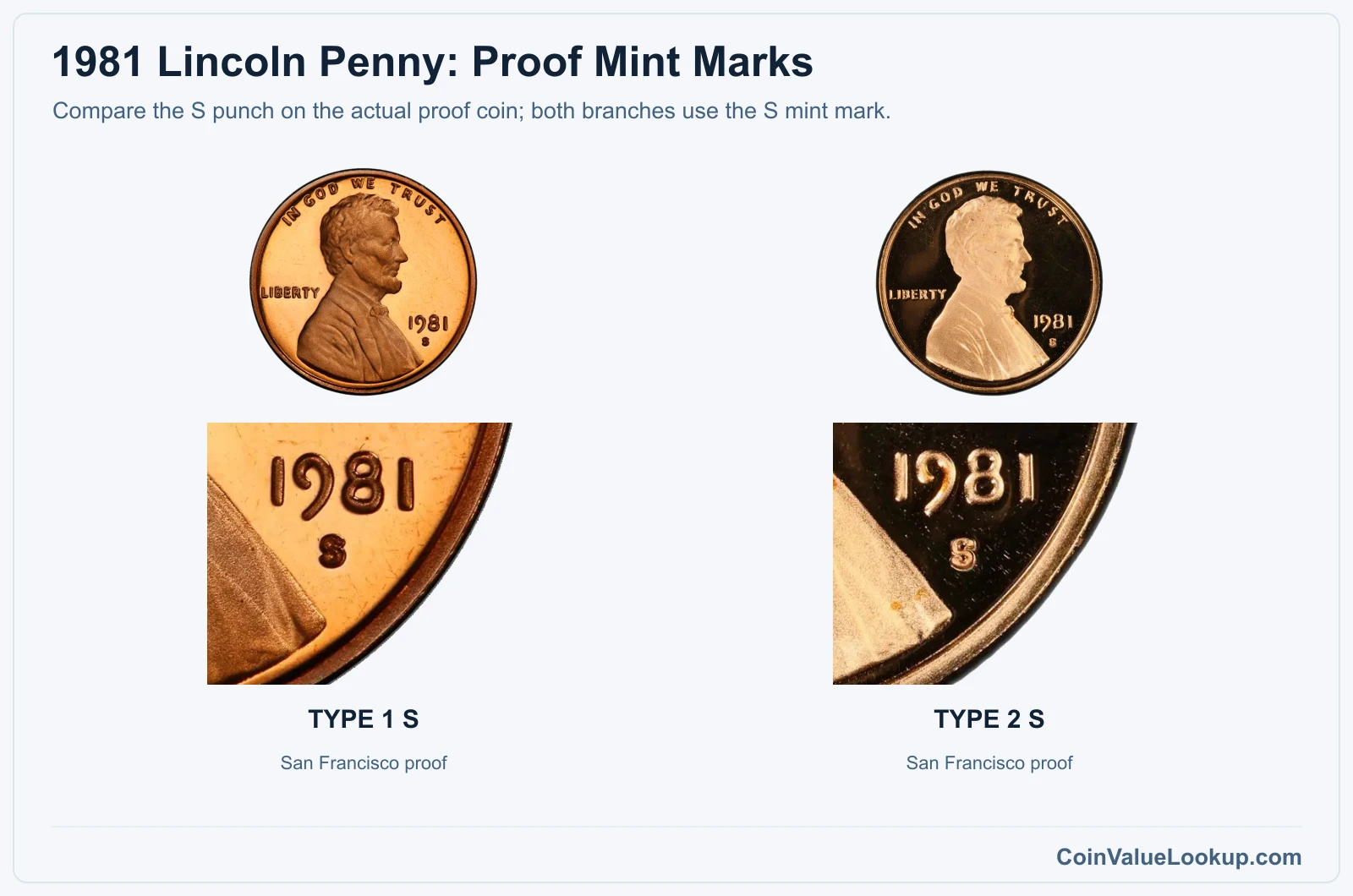
Here is where it gets a bit tricky. There are two S proof types for 1981, and both can look clear to the naked eye.
You cannot just use the old filled-versus-clear shortcut that works for the 1979 proofs. The 1981 Type 1 actually uses the same clear-S punch that was introduced as the 1979 Type 2.
The 1981 Type 2 has its own distinct punch with more pronounced, bulbous serifs on the S. Compare your mintmark at magnification against known examples of each style before deciding.
Copper-color designations like Brown, Red-Brown, and Red describe the surface color of the same alloy, not different metals. Similarly, Cameo and Deep Cameo labels on proofs describe contrast levels on the proof finish, not a separate material.
Step 2: Check Your 1981 Lincoln Penny Grade
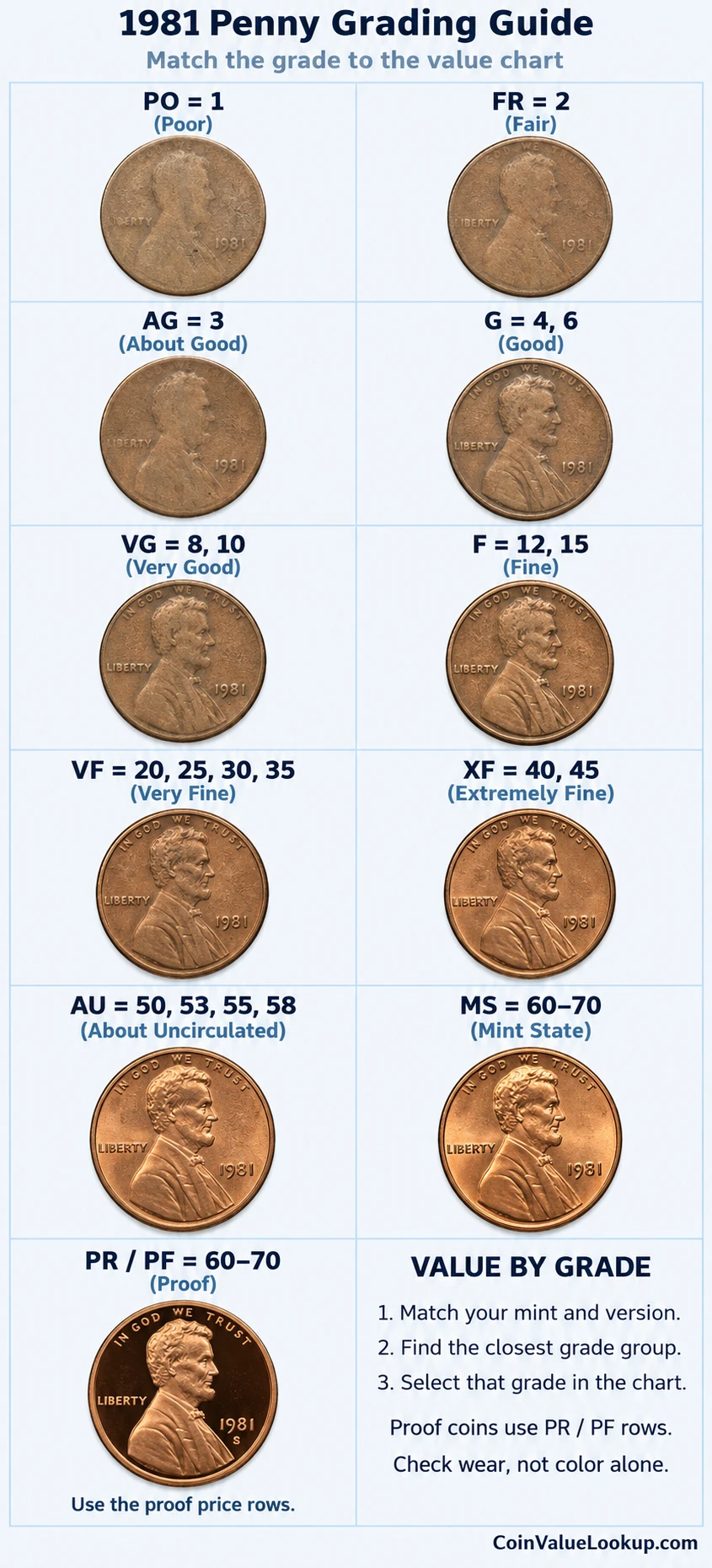
Start by looking at Lincoln's cheek, jawline, and the hair detail above his ear. These are the first spots to lose sharpness as a coin circulates.
On the reverse, check the roof and columns of the Memorial for flatness.
The line between About Uncirculated and Mint State comes down to luster. If the original mint sheen is broken on the highest points, you are looking at AU, no matter how shiny the rest of the coin appears.
Color alone does not decide grade.
For proofs, hairlines from handling and spots from improper storage are the main value killers. Never clean a copper coin or try to remove toning.
Use the comparison image to gauge where your coin falls relative to known grade benchmarks.
Step 3: Check 1981 Lincoln Penny Value by Mint and Version
1981 Lincoln Penny
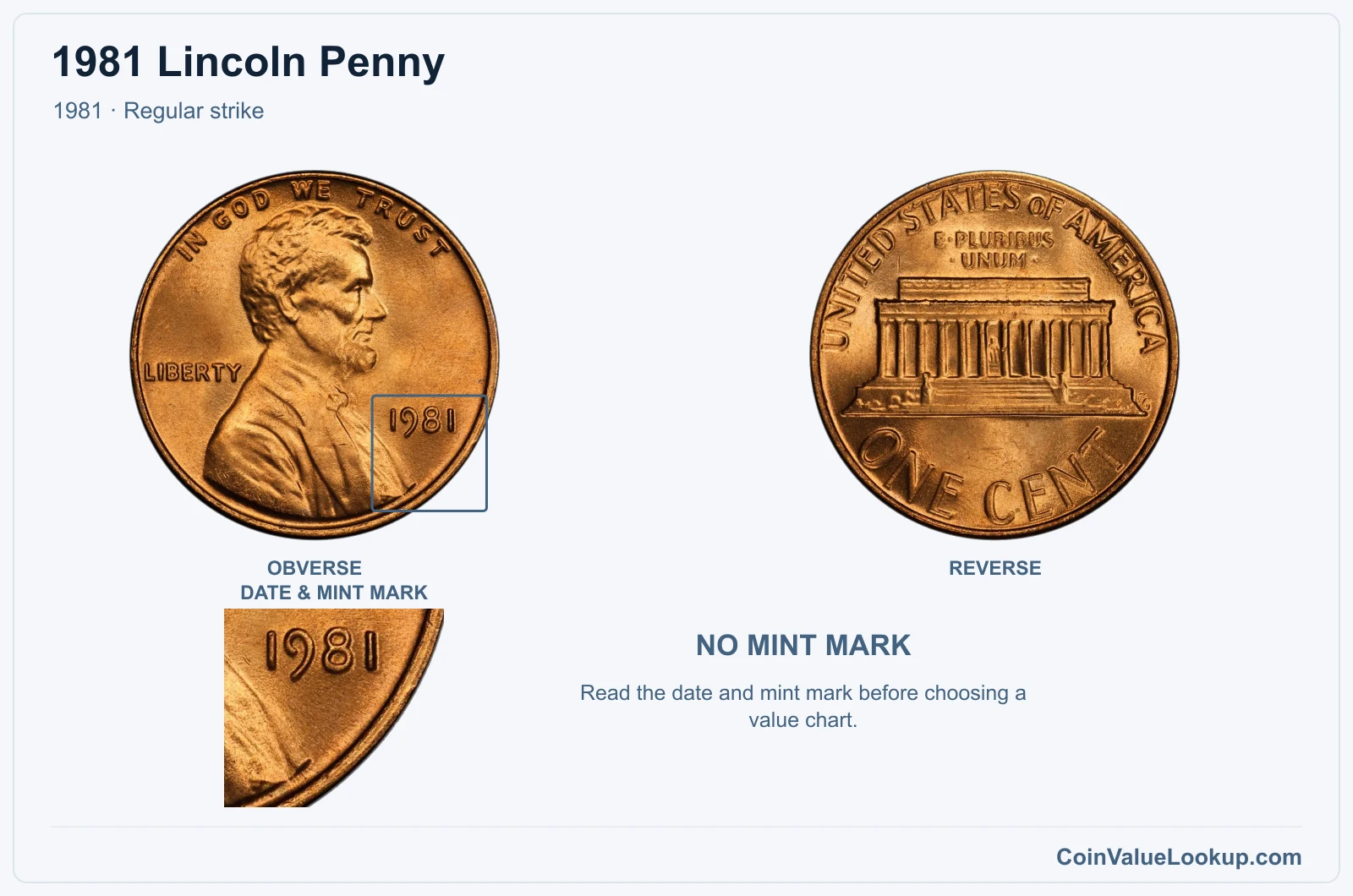
This is the Philadelphia-attributed branch with no mintmark below the date. It is a business strike on the standard 95% copper and 5% zinc planchet weighing about 3.11 grams.
A USA Coin Book guide estimate places the MS65 value at roughly $1.24. Billions were made, so the date alone is not scarce.
What matters is surface quality and copper color. A full Red designation at a high Mint State grade is where the modest premium lives.
Do not confuse proof-like reflectivity on a business strike with an actual proof finish.
| Range | Grade | Price | Auction Records | Appraisal |
|---|---|---|---|---|
| PO | PO 1 | — | Coin Identifier | |
| FR | FR 2 | — | Coin Identifier | |
| AG | AG 3 | — | Coin Identifier | |
| G | G 4 | — | Coin Identifier | |
| G 6 | — | Coin Identifier | ||
| VG | VG 8 | — | Coin Identifier | |
| VG 10 | — | Coin Identifier | ||
| F | F 12 | — | Coin Identifier | |
| F 15 | — | Coin Identifier | ||
| VF | VF 20 | — | Coin Identifier | |
| VF 25 | — | Coin Identifier | ||
| VF 30 | — | Coin Identifier | ||
| VF 35 | — | Coin Identifier | ||
| XF | XF 40 | — | Coin Identifier | |
| XF 45 | — | Coin Identifier | ||
| AU | AU 50 | — | Coin Identifier | |
| AU 53 | — | Coin Identifier | ||
| AU 55 | — | Coin Identifier | ||
| AU 58 | — | Coin Identifier | ||
| MS | MS 60 | — | Coin Identifier | |
| MS 61 | — | Coin Identifier | ||
| MS 62 | — | Coin Identifier | ||
| MS 63 | — | Coin Identifier | ||
| MS 64 | — | Coin Identifier | ||
| MS 65 | Coin Identifier | |||
| MS 66 | Coin Identifier | |||
| MS 67 | Coin Identifier | |||
| MS 68 | Coin Identifier | |||
| MS 69 | — | — | — | |
| MS 70 | — | — | — |
1981 Lincoln Penny — D
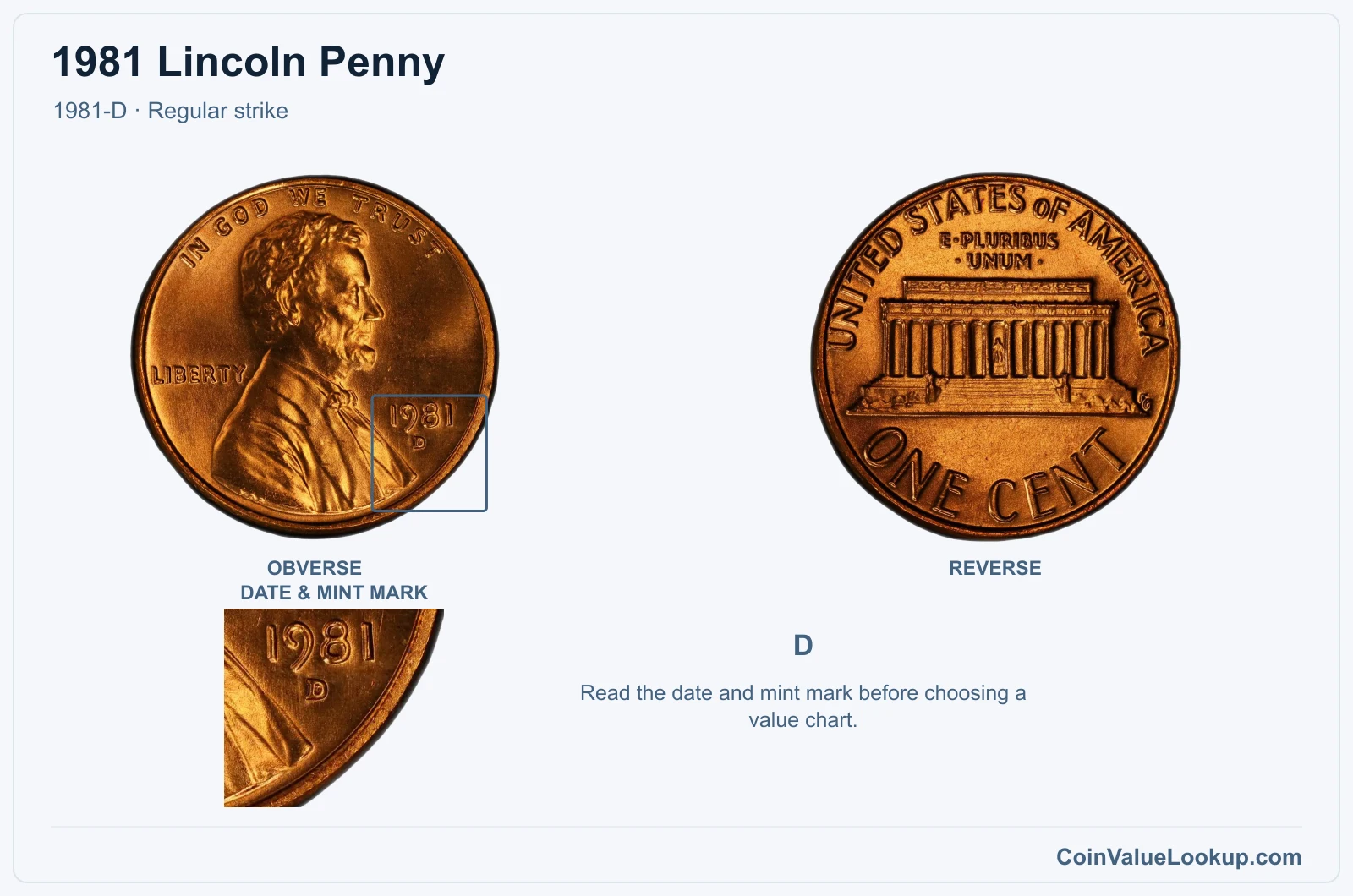
The Denver mint issue carries a small D below the date. Same alloy, same weight, same design.
A USA Coin Book guide estimate puts it at about $1.24 in MS65, identical to the no-mintmark branch. Finding one in pocket change is effortless.
Finding one with pristine original Red surfaces and no contact marks takes more effort. Grade, copper color, and clean surfaces are what separate a penny from a collectible coin here.
| Range | Grade | Price | Auction Records | Appraisal |
|---|---|---|---|---|
| PO | PO 1 | — | Coin Identifier | |
| FR | FR 2 | — | Coin Identifier | |
| AG | AG 3 | — | Coin Identifier | |
| G | G 4 | — | Coin Identifier | |
| G 6 | — | Coin Identifier | ||
| VG | VG 8 | — | Coin Identifier | |
| VG 10 | — | Coin Identifier | ||
| F | F 12 | — | Coin Identifier | |
| F 15 | — | Coin Identifier | ||
| VF | VF 20 | — | Coin Identifier | |
| VF 25 | — | Coin Identifier | ||
| VF 30 | — | Coin Identifier | ||
| VF 35 | — | Coin Identifier | ||
| XF | XF 40 | — | Coin Identifier | |
| XF 45 | — | Coin Identifier | ||
| AU | AU 50 | — | Coin Identifier | |
| AU 53 | — | Coin Identifier | ||
| AU 55 | — | Coin Identifier | ||
| AU 58 | — | Coin Identifier | ||
| MS | MS 60 | — | Coin Identifier | |
| MS 61 | — | Coin Identifier | ||
| MS 62 | — | Coin Identifier | ||
| MS 63 | — | Coin Identifier | ||
| MS 64 | Coin Identifier | |||
| MS 65 | Coin Identifier | |||
| MS 66 | Coin Identifier | |||
| MS 67 | Coin Identifier | |||
| MS 68 | — | — | — | |
| MS 69 | — | — | — | |
| MS 70 | — | — | — |
1981 Lincoln Penny — S Type 1 PR
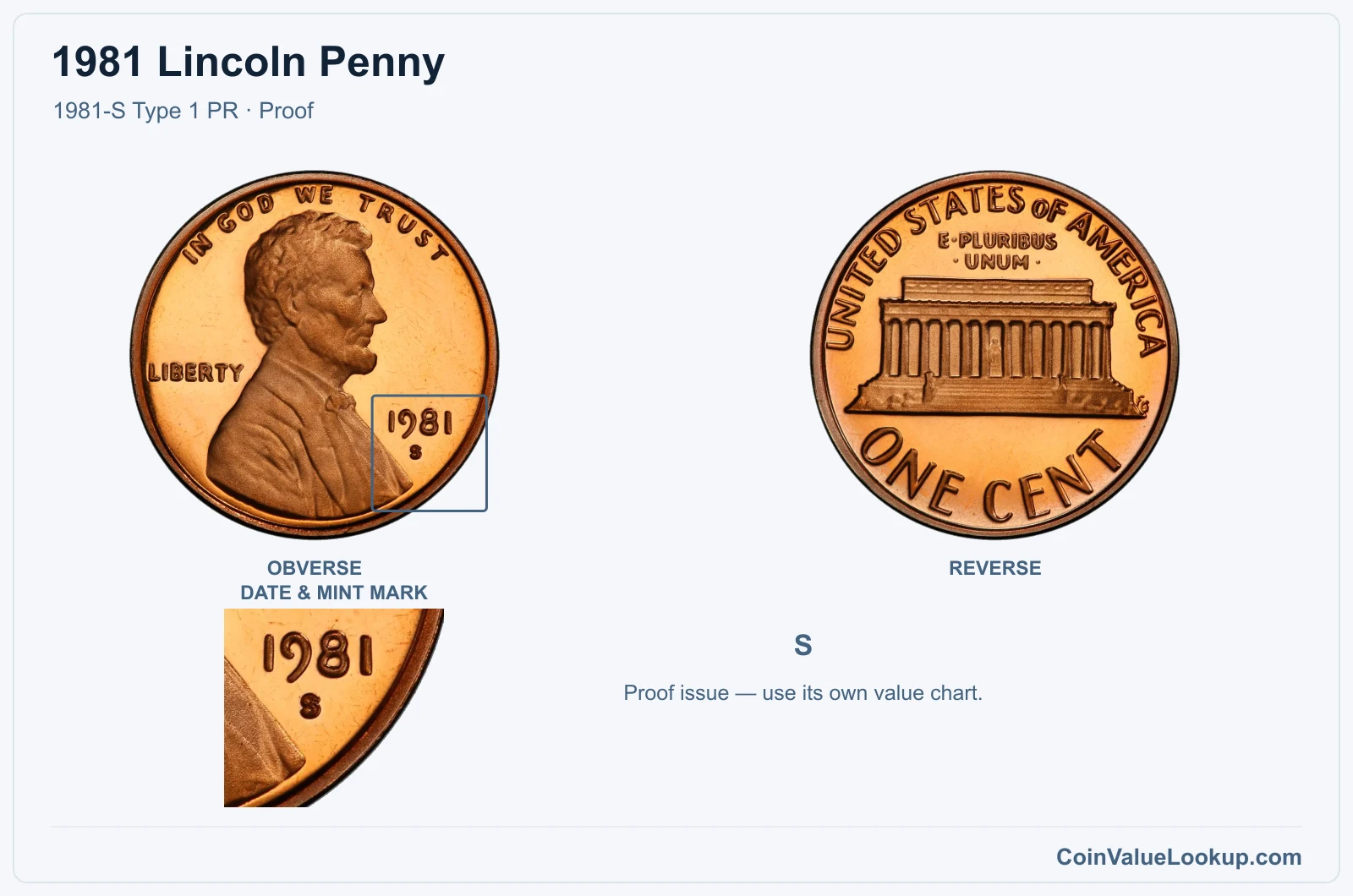
This is the San Francisco proof with the Type 1 S mintmark punch. This punch is actually the same clear-S that debuted as the 1979 Type 2, so do not confuse the numbering across years.
At PR65, the USA Coin Book guide estimate is around $3.62. To identify it, examine the S under magnification.
Type 1 has thinner, more traditional serifs compared to the bolder, bulbous serifs of Type 2. Both 1981 styles can appear clear, so shape is everything.
Proof finish means mirror fields and frosted devices struck with specially prepared dies. Hairlines and spots reduce the grade quickly on these reflective surfaces.
Coin Value Lookup is a good starting point if you want to compare your 1981-S proof against other Lincoln cent years and denominations. You can look up guides for specific coins without digging through stacks of catalogs.
| Range | Grade | Price | Auction Records | Appraisal |
|---|---|---|---|---|
| PR | PR 1 | — | Coin Identifier | |
| PR 2 | — | Coin Identifier | ||
| PR 3 | — | Coin Identifier | ||
| PR 4 | — | Coin Identifier | ||
| PR 6 | — | Coin Identifier | ||
| PR 8 | — | Coin Identifier | ||
| PR 10 | — | Coin Identifier | ||
| PR 12 | — | Coin Identifier | ||
| PR 15 | — | Coin Identifier | ||
| PR 20 | — | Coin Identifier | ||
| PR 25 | — | Coin Identifier | ||
| PR 30 | — | Coin Identifier | ||
| PR 35 | — | Coin Identifier | ||
| PR 40 | — | Coin Identifier | ||
| PR 45 | — | Coin Identifier | ||
| PR 50 | — | Coin Identifier | ||
| PR 53 | — | Coin Identifier | ||
| PR 55 | — | Coin Identifier | ||
| PR 58 | — | Coin Identifier | ||
| PR 60 | — | Coin Identifier | ||
| PR 61 | — | Coin Identifier | ||
| PR 62 | — | Coin Identifier | ||
| PR 63 | — | Coin Identifier | ||
| PR 64 | — | Coin Identifier | ||
| PR 65 | — | Coin Identifier | ||
| PR 66 | Coin Identifier | |||
| PR 67 | Coin Identifier | |||
| PR 68 | Coin Identifier | |||
| PR 69 | Coin Identifier | |||
| PR 70 | Coin Identifier |
1981 Lincoln Penny — S Type 2 PR
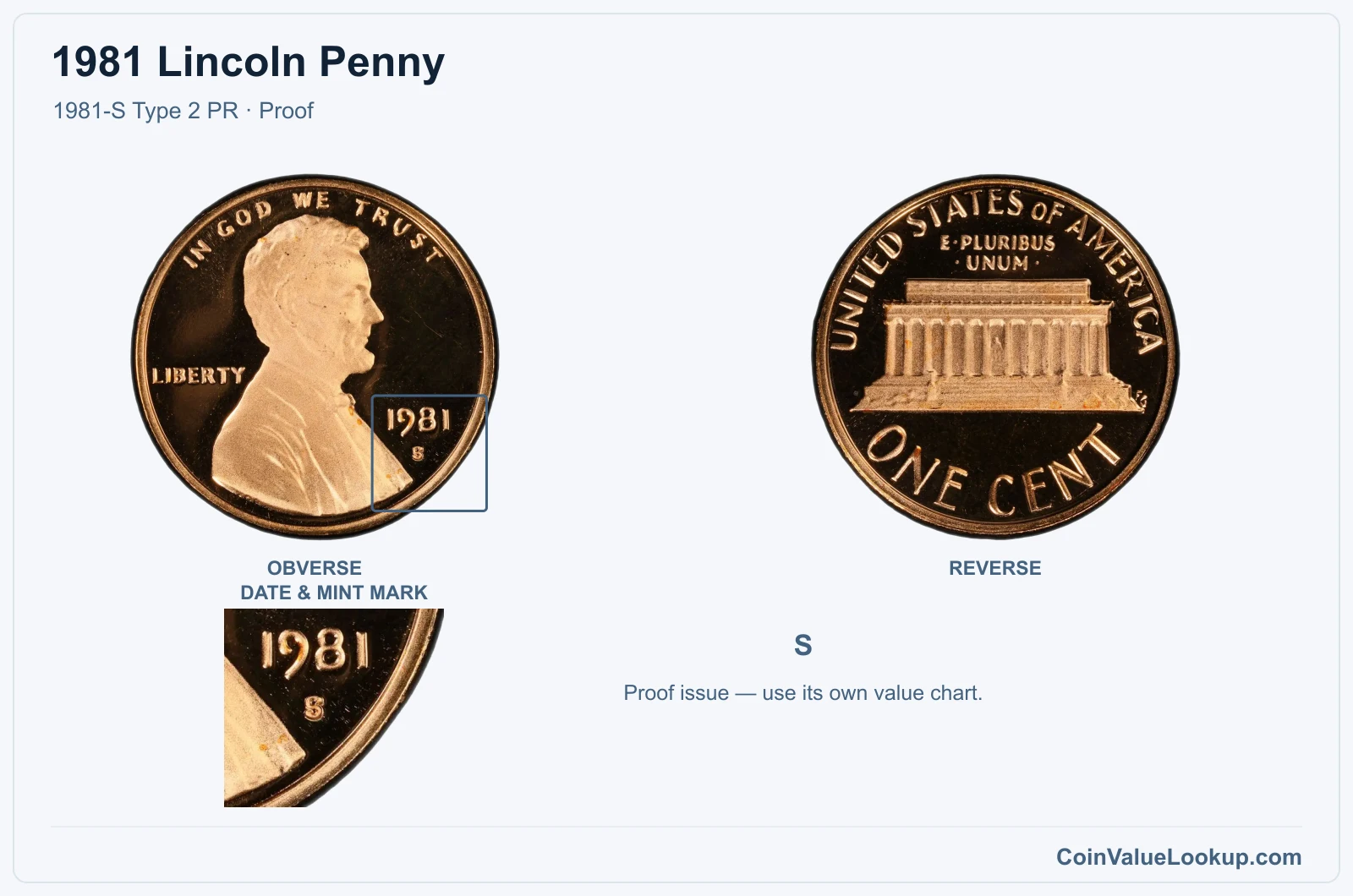
The 1981-S Type 2 proof is the one collectors pay attention to. Its S mintmark has distinctly bulbous, rounded serifs that differ from the thinner Type 1 punch.
A USA Coin Book guide estimate at PR65 is about $19, roughly five times the Type 1 figure. That price gap exists because the Type 2 punch was a new style introduced during the 1981 production run, and fewer sets contain it.
You need to compare your mintmark at equal magnification against confirmed examples of both styles. Do not rely on filled-versus-clear distinctions; both 1981 types look clear.
Shape of the serifs is the diagnostic. Proof-specific grading applies: check for hairlines, spots, and the degree of cameo contrast on the devices.
| Range | Grade | Price | Auction Records | Appraisal |
|---|---|---|---|---|
| PR | PR 1 | — | Coin Identifier | |
| PR 2 | — | Coin Identifier | ||
| PR 3 | — | Coin Identifier | ||
| PR 4 | — | Coin Identifier | ||
| PR 6 | — | Coin Identifier | ||
| PR 8 | — | Coin Identifier | ||
| PR 10 | — | Coin Identifier | ||
| PR 12 | — | Coin Identifier | ||
| PR 15 | — | Coin Identifier | ||
| PR 20 | — | Coin Identifier | ||
| PR 25 | — | Coin Identifier | ||
| PR 30 | — | Coin Identifier | ||
| PR 35 | — | Coin Identifier | ||
| PR 40 | — | Coin Identifier | ||
| PR 45 | — | Coin Identifier | ||
| PR 50 | — | Coin Identifier | ||
| PR 53 | — | Coin Identifier | ||
| PR 55 | — | Coin Identifier | ||
| PR 58 | — | Coin Identifier | ||
| PR 60 | Coin Identifier | |||
| PR 61 | — | Coin Identifier | ||
| PR 62 | — | Coin Identifier | ||
| PR 63 | — | Coin Identifier | ||
| PR 64 | — | Coin Identifier | ||
| PR 65 | Coin Identifier | |||
| PR 66 | Coin Identifier | |||
| PR 67 | Coin Identifier | |||
| PR 68 | Coin Identifier | |||
| PR 69 | Coin Identifier | |||
| PR 70 | — | Coin Identifier |
1981 Lincoln Penny Error List
1. 1981 Lincoln Penny — Struck on a Dime Blank before Rim Upsetting
A 1981-D cent struck on a Type 1 clad dime blank weighs only about 2.2 grams instead of the normal 3.11 grams. The coin will look undersized and the design may be incomplete at the edges because the dime blank is smaller than a cent planchet.
This blank was fed into the press before its rim was upset, meaning it had not yet gone through the rimming mill that gives blanks their raised edge. The Type 1 designation here refers to the blank stage, not the proof mintmark varieties.
A normal cent, or a plated cent that has lost coating, will still weigh around 3.11 grams, so the scale is your first check. One NGC MS64 example sold for $299 at auction in June 2004.
2. 1981 Lincoln Penny — Triple Curved Clip
A triple curved clip means the blank had three overlapping or separate curved sections missing before the dies ever struck it. You will see three distinct crescents of missing metal along the rim, each with a corresponding area where the design fades or is absent.
The strike may redistribute metal in unusual ways near the clipped zones. These clips happen during the blanking process when a strip is punched too close to a previous hole.
After minting, someone cutting a coin with shears leaves straight or irregular edges, not the smooth curves and Blakesley effects of a genuine clip. A PCGS MS63 Red-Brown 1981-D example sold for $156 at auction in May 2021.
3. 1981 Lincoln Penny — Flipover Double Strike
A flipover double strike is a dramatic error. The coin was struck once, then flipped over and struck again while off center.
The result is overlapping designs from opposite faces on the same side of the coin. You will see parts of Lincoln's portrait blending with Memorial details, or vice versa, in a way that no normal coin or doubled die can produce.
This is not subtle. Machine doubling creates flat shelf-like outlines near design elements.
A vise job or glued coins show seams and incorrect metal flow. This error shows genuine die impressions on both strikes with proper metal displacement.
An NGC MS65 Red 1981-D example brought $384 at auction in August 2020.
4. 1981 Lincoln Penny — Doubled Die Obverse
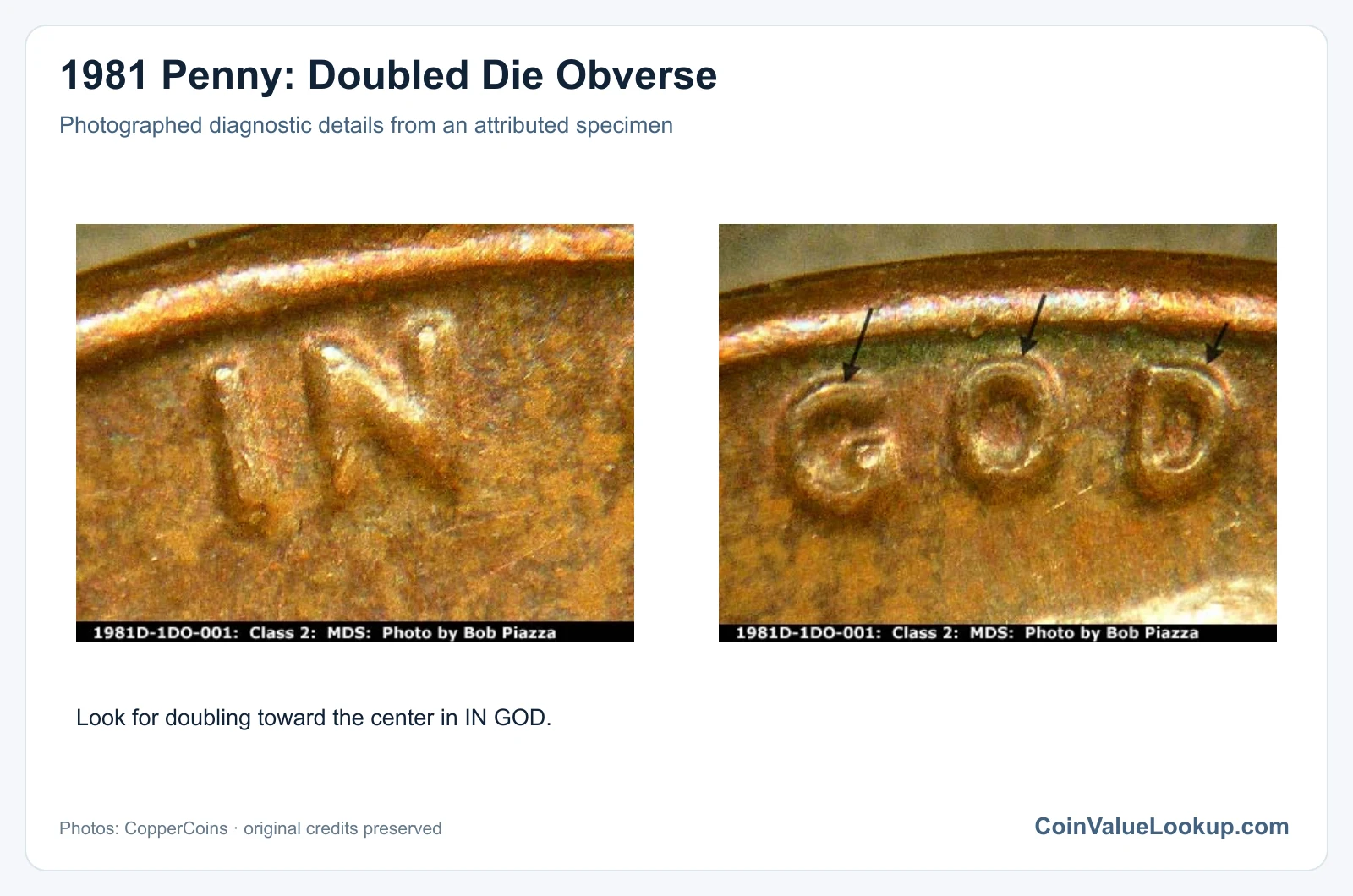
A doubled die obverse on a 1981 cent shows consistent doubling on obverse design elements such as lettering or date numerals. Under magnification, look for separation or notching that repeats in the same direction across multiple letters or features.
This consistency is the hallmark of a true doubled die versus machine doubling, which tends to produce flat, shelf-like distortions that vary across the coin. Reflections from proof surfaces or worn die contours can also mimic doubling to an untrained eye.
The value of a doubled die obverse depends on how visible the doubling is, the specific die involved, and the coin's overall condition. Individual assessment is needed.
5. 1981 Lincoln Penny — Doubled Die Reverse
A doubled die reverse on a 1981 cent affects the Memorial side. Compare the reverse legends and architectural details against a normal example under matching magnification and lighting.
True doubled dies show a repeatable offset in the same direction on multiple design elements. Machine doubling looks different.
It creates flat, mushy outlines that shift inconsistently, often appearing stronger on one side of a letter than the other. Random nicks, corrosion, or worn surfaces can also create false positives.
Value depends on the strength and visibility of the doubling and the coin's condition. Have the coin assessed individually rather than assuming a specific price.
6. 1981 Lincoln Penny — Off-Center Strike
An off-center strike happens when the blank is not properly seated between the dies. The design shifts to one side, and a crescent of unstruck blank metal appears on the opposite edge.
The percentage of off-center displacement and whether the date remains visible are the two biggest factors in collector interest. A coin with a readable date and a significant off-center percentage is more desirable than one where the date is lost in the missing area.
Do not confuse a clipped planchet or a misaligned die with a true off-center strike. Post-mint flattening or bending can also distort the apparent shape.
Value depends on the degree of displacement, date visibility, and condition.
7. 1981 Lincoln Penny — BIE Die Break
A BIE die break shows up as a small raised vertical line or blob between the letters B and E in LIBERTY on the obverse. It is caused by a crack or chip in the die that fills with metal during striking.
The result is a tiny raised bridge that looks like the letter I inserted between B and E. Under magnification, it should appear raised and consistent with the surrounding surface, not incused.
Dirt, scratches, or glued-on debris can mimic this at first glance, but those will sit on top of the surface or cut into it rather than being part of the struck design. Value varies with the size and clarity of the break and the coin's condition.
8. 1981 Lincoln Penny — Repunched Mintmark
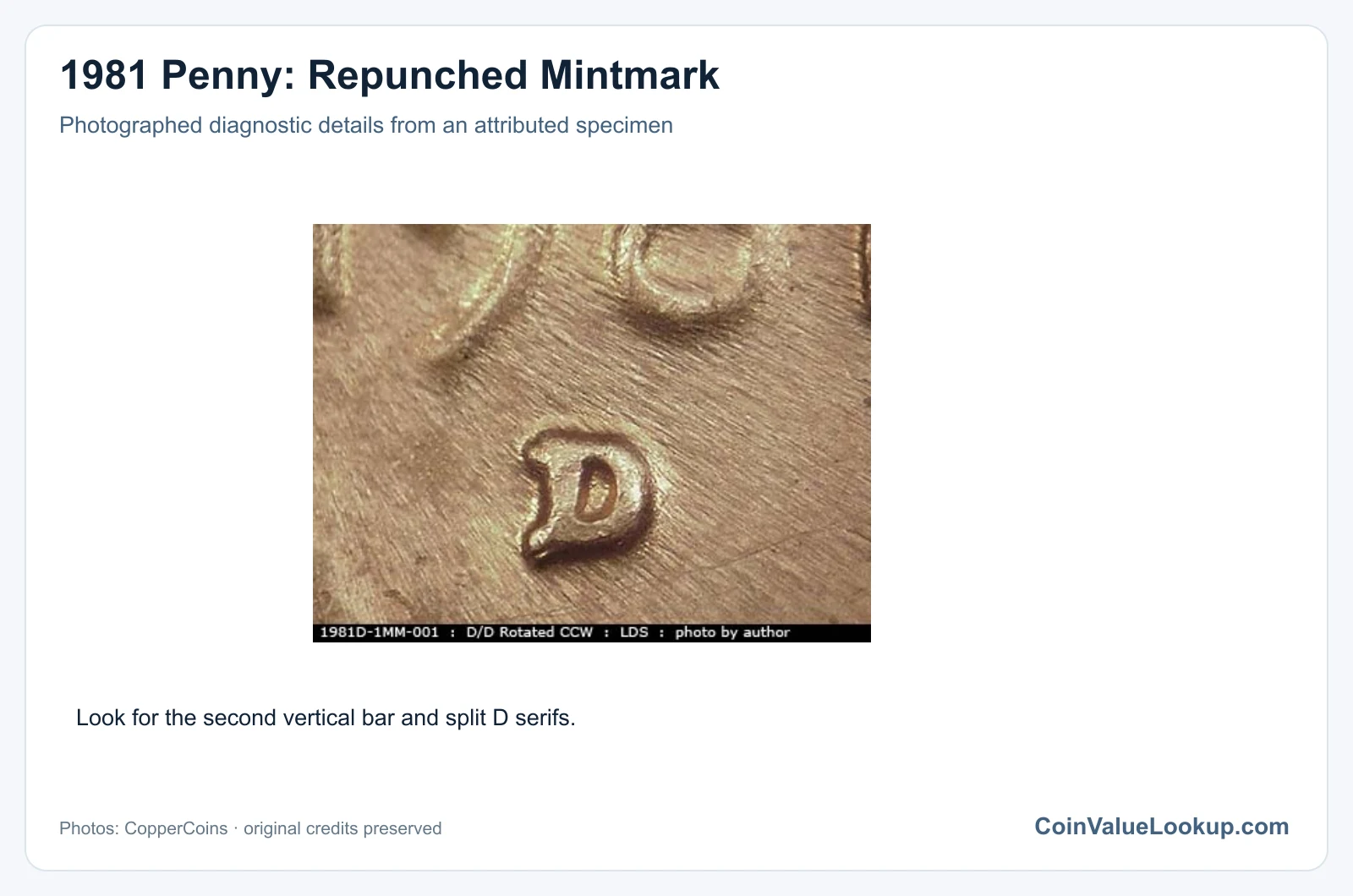
A repunched mintmark on a 1981 cent shows remnants of a second mintmark position near the primary one. Under magnification, you may see traces of an extra D or part of a D offset slightly from the final punch.
The key diagnostic is that the remnant follows the shape of the mintmark letter itself, not a random blob. Machine doubling around a mintmark looks flatter and more shelf-like.
Die chips or corrosion near the mintmark can also create bumps that resemble a second punch, but they lack the letter-shaped contour. Compare your mintmark to a confirmed normal example at the same magnification.
Value depends on how visible the repunching is and overall coin condition.
9. 1981 Lincoln Penny — Die Crack / Die Chip
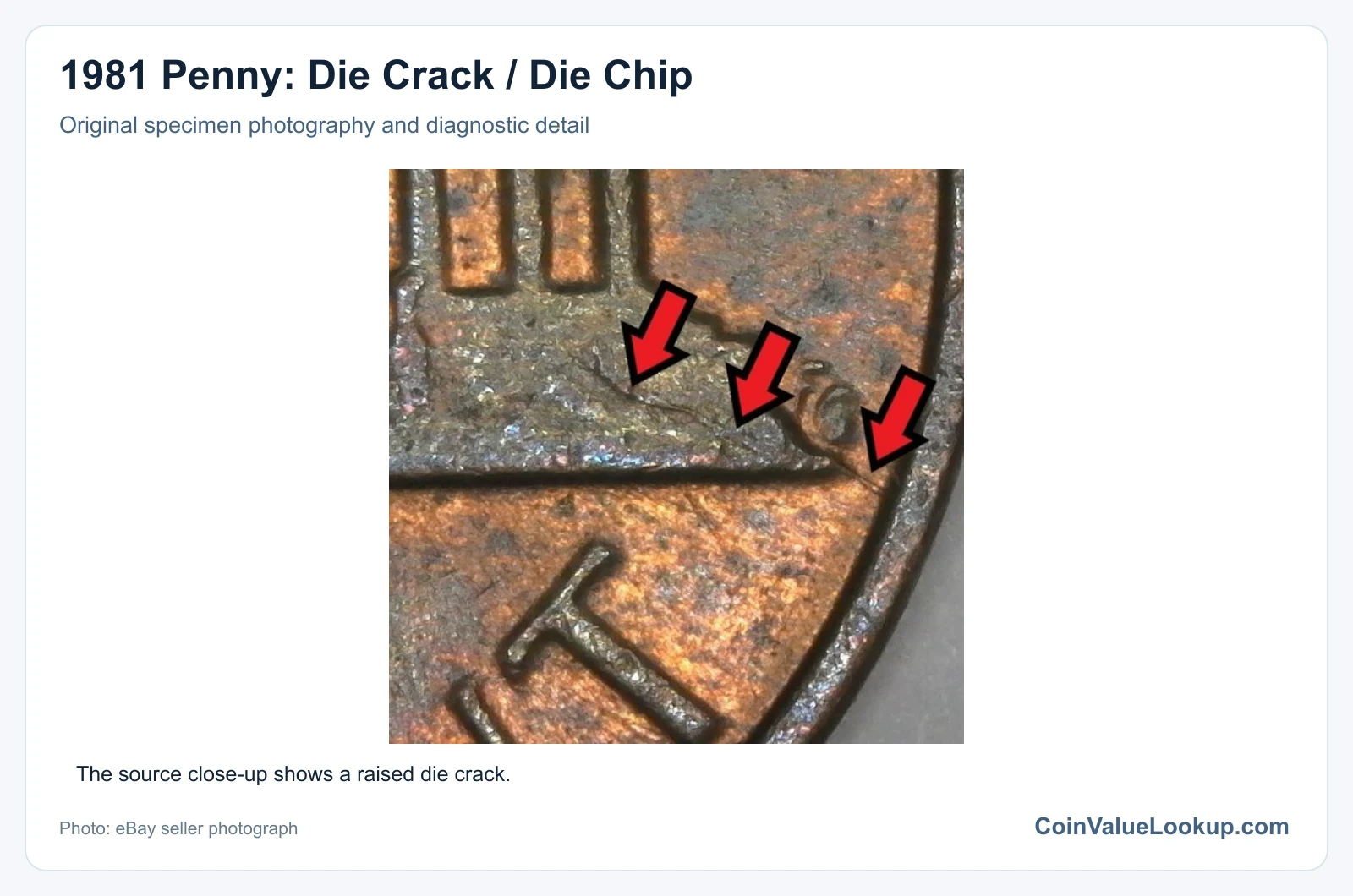
Die cracks appear as thin raised lines running across the coin's surface, while die chips show up as small raised lumps. Both are caused by damage to the steel die transferring to every coin it strikes.
A crack that extends from the rim inward is common; a larger break that removes a chunk of the die rim is called a cud. Incuse scratches cut into the surface, which is the opposite of what a die crack does.
Corrosion or foreign material stuck to a coin can also look raised but will not match the sharp, consistent profile of a genuine die crack. Value depends on the size, location, and visual impact of the crack or chip, along with the coin's overall grade.
10. 1981 Lincoln Penny — Fold-Over Strike
A fold-over strike produces a coin where part of the blank was bent or folded before or during striking, so the design wraps across the fold onto what would normally be blank metal. Both faces and the edge will show evidence of the fold, with design elements continuing across the bent area.
This is a scarce and visually dramatic error. A coin that was simply bent after leaving the mint will show a sharp crease interrupting the design rather than design elements flowing over the fold.
Check for die impressions on both sides of the folded section. Value depends on how much of the design is affected and the overall condition of the piece.