1884 Morgan Silver Dollar Coin Value: How Much Is It Worth?
The 1884 Morgan Silver Dollar is a classic piece struck across multiple mints, and values vary enormously depending on which facility made yours. Adopted guide estimates range from about $74.00 in well-worn grades to $240,700.00 for a specific mint and top grade — but that upper figure applies to one scarce branch in gem condition, not every coin in your junk-silver box.
Identifying your mint, finish and condition is the essential first step before assigning any value.
Fast Way to Identify Your 1884 Morgan Silver Dollar
The quickest way to start is to upload clear photos of both the front and back of your coin. Our identifier can offer a preliminary identification of your mint and design branch based on those images.
It does not authenticate errors or assign a certified grade, but it points you in the right direction before you dig deeper.
1884 Morgan Silver Dollar Value
Upload both sides of your 1884 Morgan Silver Dollar.
Front Obverse
Upload photo
Back Reverse
Upload photo
Which 1884 Morgan Silver Dollar Versions Are Worth Money?
- 1884-S in high Mint State grades commands extraordinary premiums; the guide estimate at MS65 is $240,700.00, reflecting genuine scarcity in gem condition.
- 1884-CC carries a consistent premium over other mints even in lower grades, with a G4 guide estimate of $169.00 versus $74.00 for Philadelphia.
- 1884 Proof (PR) coins are a distinct manufacturing finish and require authenticated attribution; their value depends on individual condition and confirmation of proof status.
- Prooflike (PL) and deep-mirror prooflike (DMPL) surfaces on eligible business strikes can add value — but only when properly attributed, not just because a coin looks shiny.
Step 1: Identify Your 1884 Morgan Silver Dollar Mint Mark and Version
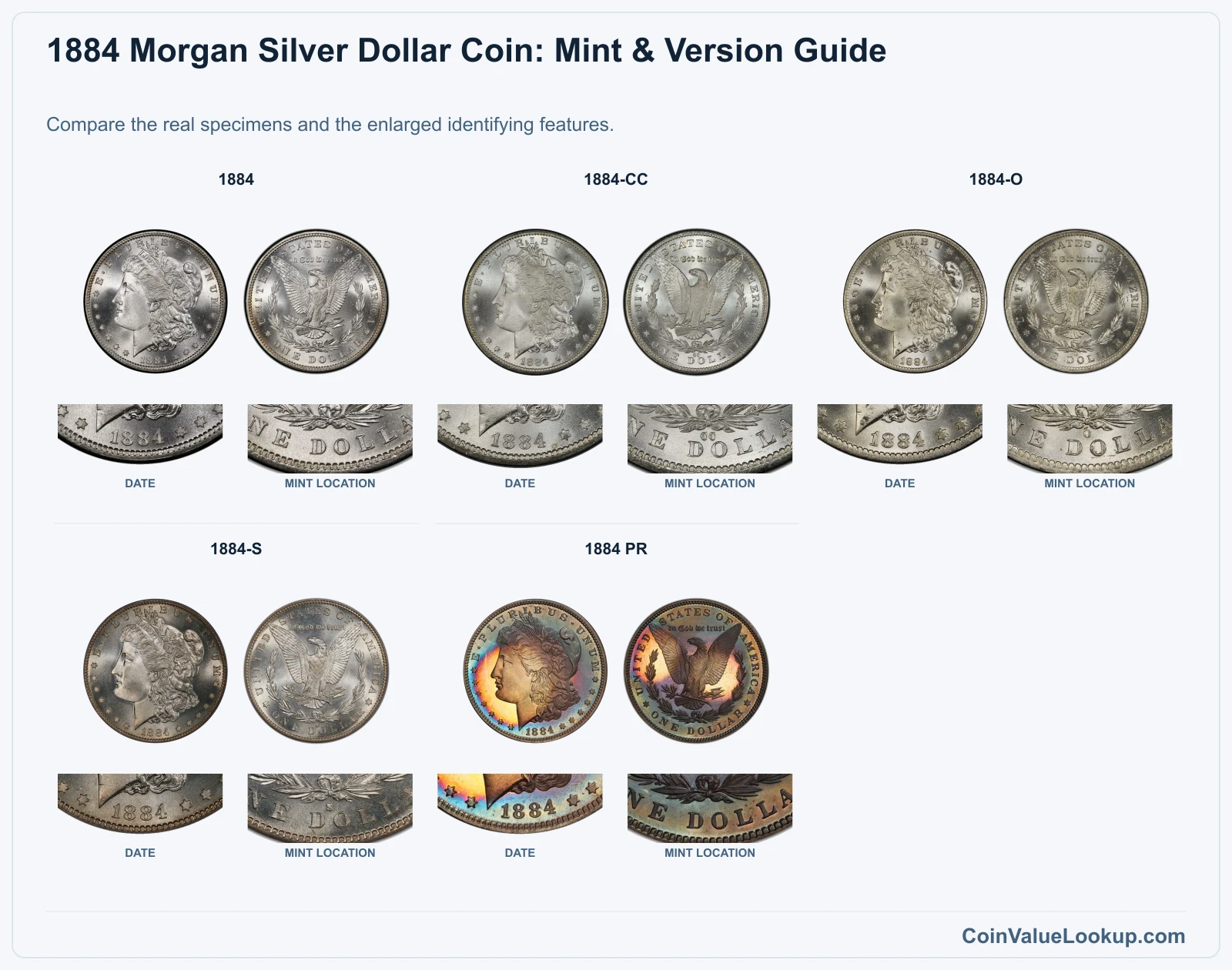
Flip the coin to the reverse and look below the bow that ties the wreath. That is where the mintmark lives.
No letter means Philadelphia. A "CC" means Carson City.
An "O" is New Orleans, and an "S" is San Francisco. Those four mints plus a separate proof issue from Philadelphia make up the five branches for 1884.
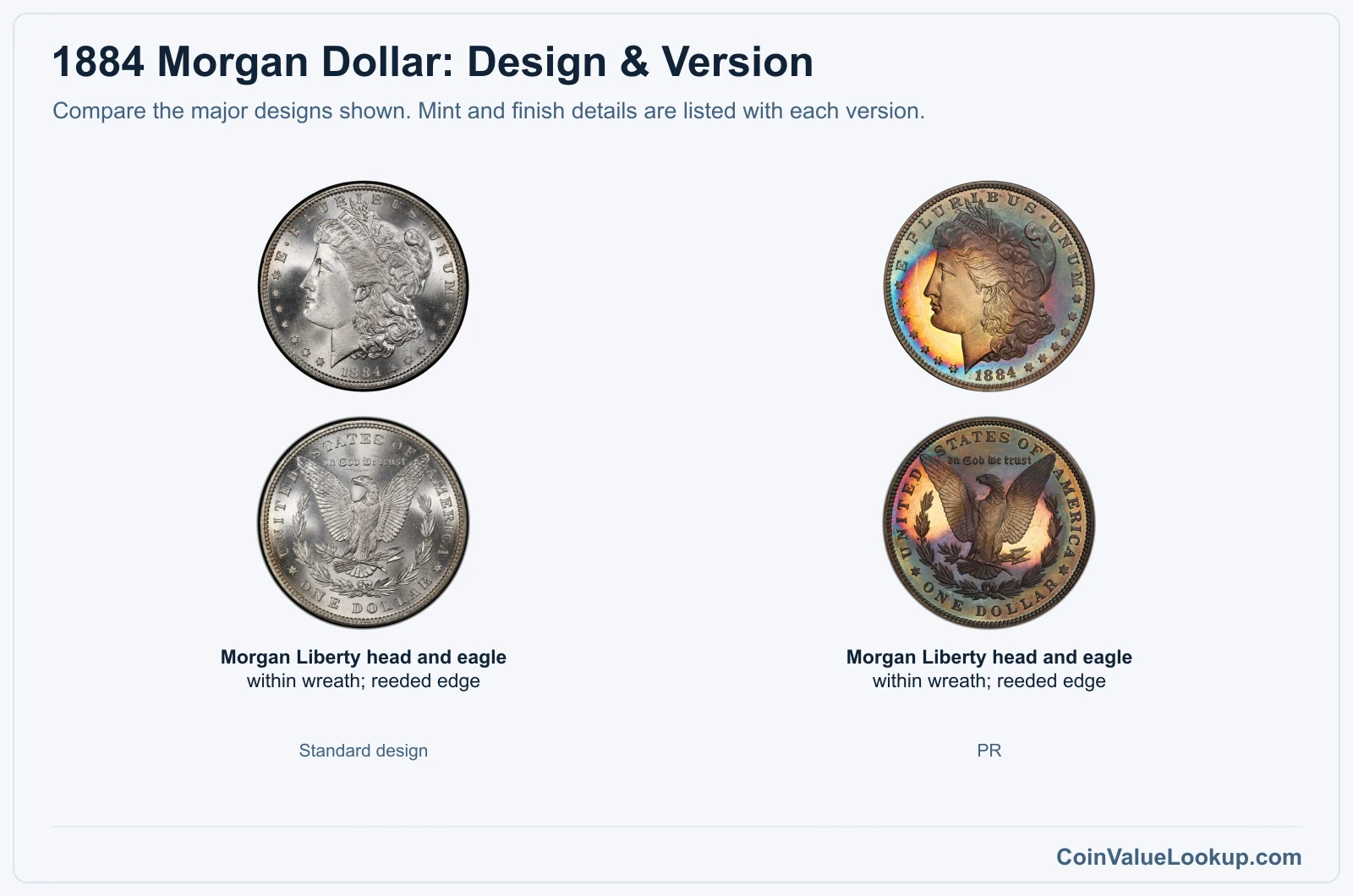
All genuine 1884 Morgan Dollars are struck in 90% silver and 10% copper, weighing 26.73 grams. The obverse shows the Morgan Liberty head, and the reverse features an eagle within a wreath.
The edge is reeded — vertical lines all around.
Be careful with shiny coins. A bright, reflective surface does not automatically mean you have a proof or a prooflike coin.
Proofs are a specific manufacturing finish made at Philadelphia; prooflike (PL) and deep-mirror prooflike (DMPL) are surface designations that apply only to eligible business strikes. Polished or cleaned coins may look mirror-like but have reduced collector value.
Step 2: Check Your 1884 Morgan Silver Dollar Grade
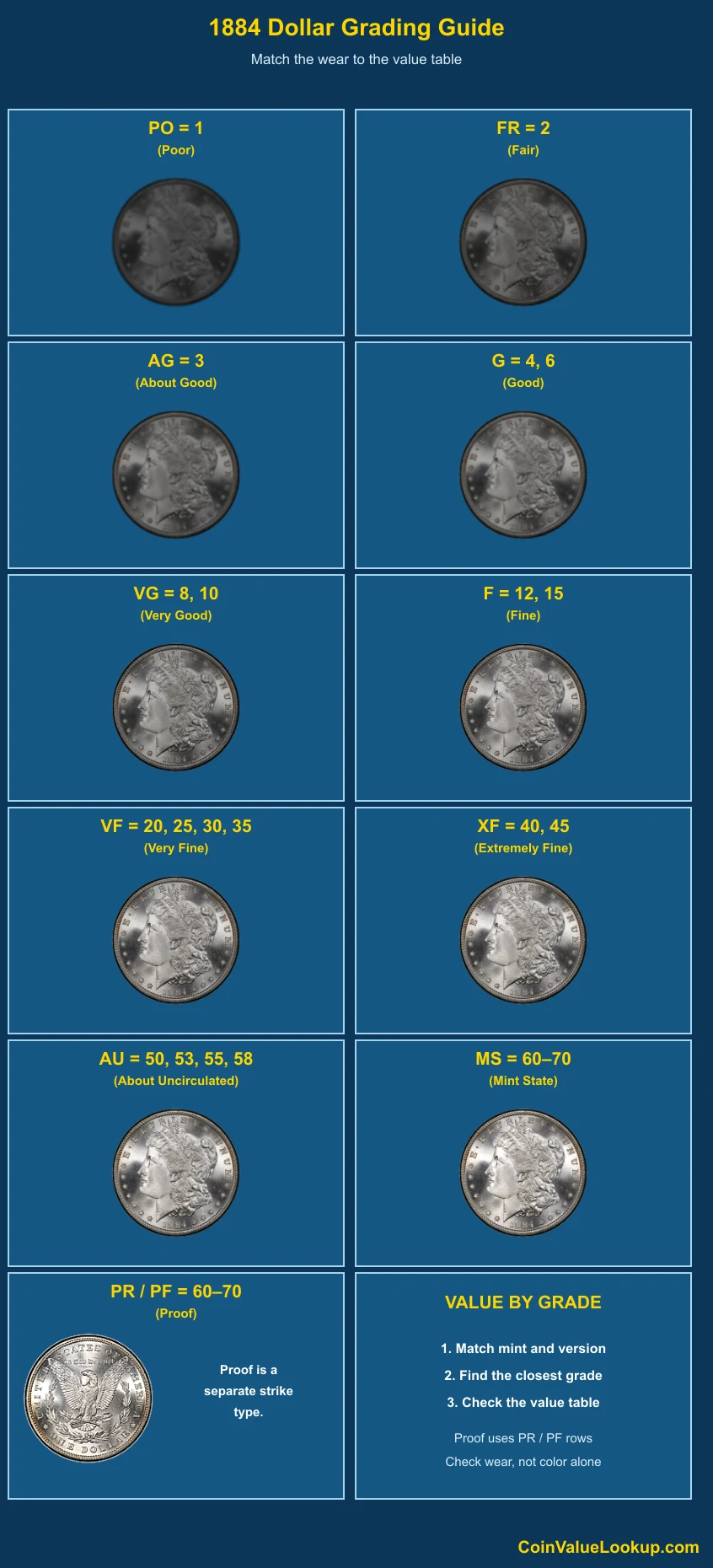
Start at Liberty's cheek and the hair above her ear. These are the highest relief points and the first to show wear.
On an uncirculated coin, full luster flows unbroken across both areas. Once you see flat spots or dullness there, you are looking at a circulated grade.
The cap and its details lose sharpness progressively as wear increases. On the reverse, check the eagle's breast feathers — they flatten early.
Bag marks are a quirk of Morgan Dollars. Heavy contact from storage in mint bags can leave nicks that reduce the Mint State quality without being circulation wear.
A coin might technically never have been spent yet still look rough. Use the comparison image to see side-by-side examples of circulated, About Uncirculated and Mint State grades — this helps train your eye for the differences.
Step 3: Check 1884 Morgan Silver Dollar Value by Mint and Version
1884 Morgan Silver Dollar
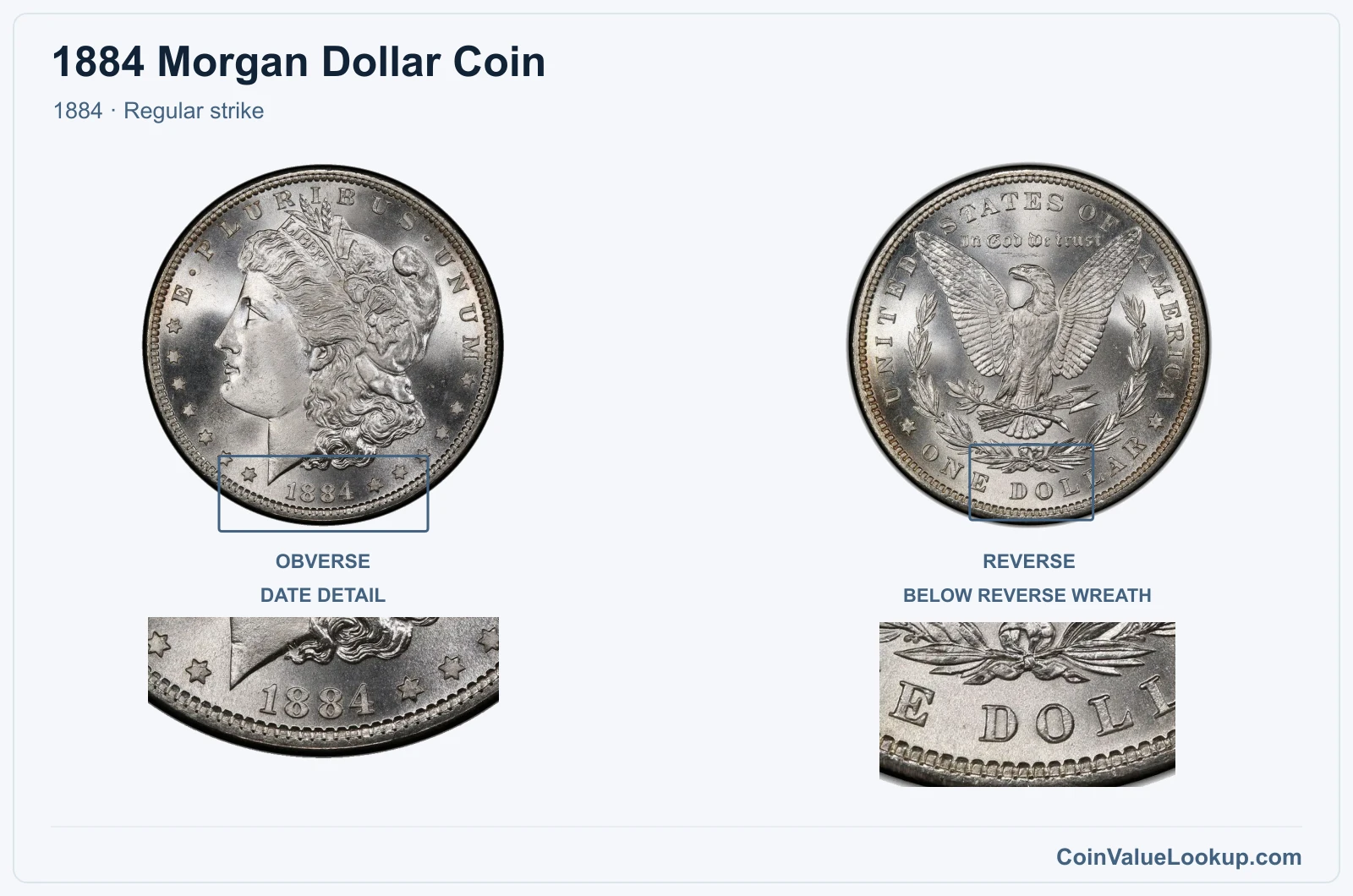
The 1884 Philadelphia issue carries no mintmark. In heavily circulated condition around G4, the USA Coin Book guide estimates about $74.00.
A gem MS65 example steps up to roughly $412.00. These are common enough that worn pieces trade near silver-bullion territory, but original, untouched surfaces still matter — cleaning or polishing reduces collector appeal even if the coin looks prettier to untrained eyes.
If you spot reflective fields on your Philadelphia coin, it may qualify for a PL or DMPL designation, which can affect pricing. Those are surface characteristics on business strikes, not proof manufacture.
Range Grade
Price Auction Records Appraisal PO PO 1
Coin Identifier FR FR 2
Coin Identifier AG AG 3
—
Coin Identifier G G 4
—
Coin Identifier
G 6
Coin Identifier VG VG 8
—
Coin Identifier
VG 10
—
Coin Identifier F F 12
—
Coin Identifier
F 15
—
Coin Identifier VF VF 20
—
Coin Identifier
VF 25
—
Coin Identifier
VF 30
Coin Identifier
VF 35
—
Coin Identifier XF XF 40
Coin Identifier
XF 45
Coin Identifier AU AU 50
—
Coin Identifier
AU 53
Coin Identifier
AU 55
Coin Identifier
AU 58
Coin Identifier MS MS 60
—
Coin Identifier
MS 61
Coin Identifier
MS 62
Coin Identifier
MS 63
Coin Identifier
MS 64
Coin Identifier
MS 65
Coin Identifier
MS 66
Coin Identifier
MS 67
Coin Identifier
MS 68
Coin Identifier
MS 69
—
—
—
MS 70
—
—
—
1884 Morgan Silver Dollar — CC
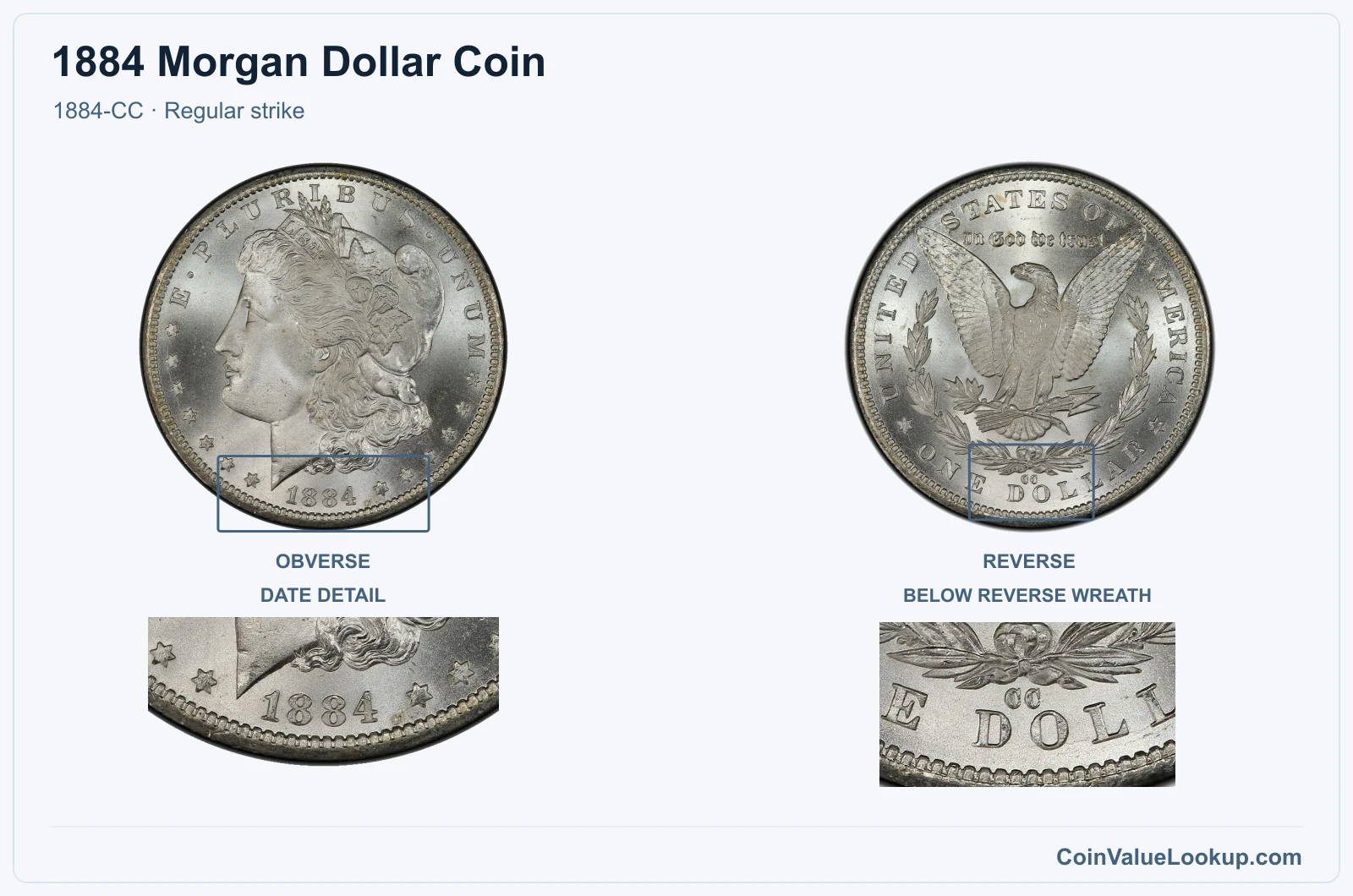
Look for the "CC" mintmark below the wreath bow. Carson City Morgans always carry a collector premium because the mint had a relatively short operational life.
Even a well-worn G4 example is estimated at $169.00 per the USA Coin Book guide, more than double the Philadelphia equivalent. At MS65, the guide suggests $758.00.
Coin Value Lookup is a useful starting point if you want to compare your 1884-CC against other Carson City dates. It can help you find relevant guides for Morgan Dollars across different years and mints.
Original surfaces matter here. A cleaned CC will not command the same respect, and polished examples can be mistaken for prooflike coins — which they are not unless properly designated.
Range Grade
Price Auction Records Appraisal PO PO 1
Coin Identifier FR FR 2
Coin Identifier AG AG 3
Coin Identifier G G 4
Coin Identifier
G 6
Coin Identifier VG VG 8
Coin Identifier
VG 10
Coin Identifier F F 12
Coin Identifier
F 15
Coin Identifier VF VF 20
Coin Identifier
VF 25
Coin Identifier
VF 30
Coin Identifier
VF 35
Coin Identifier XF XF 40
Coin Identifier
XF 45
Coin Identifier AU AU 50
Coin Identifier
AU 53
Coin Identifier
AU 55
Coin Identifier
AU 58
Coin Identifier MS MS 60
Coin Identifier
MS 61
Coin Identifier
MS 62
Coin Identifier
MS 63
Coin Identifier
MS 64
Coin Identifier
MS 65
Coin Identifier
MS 66
Coin Identifier
MS 67
Coin Identifier
MS 68
Coin Identifier
MS 69
—
—
—
MS 70
—
—
—
1884 Morgan Silver Dollar — O
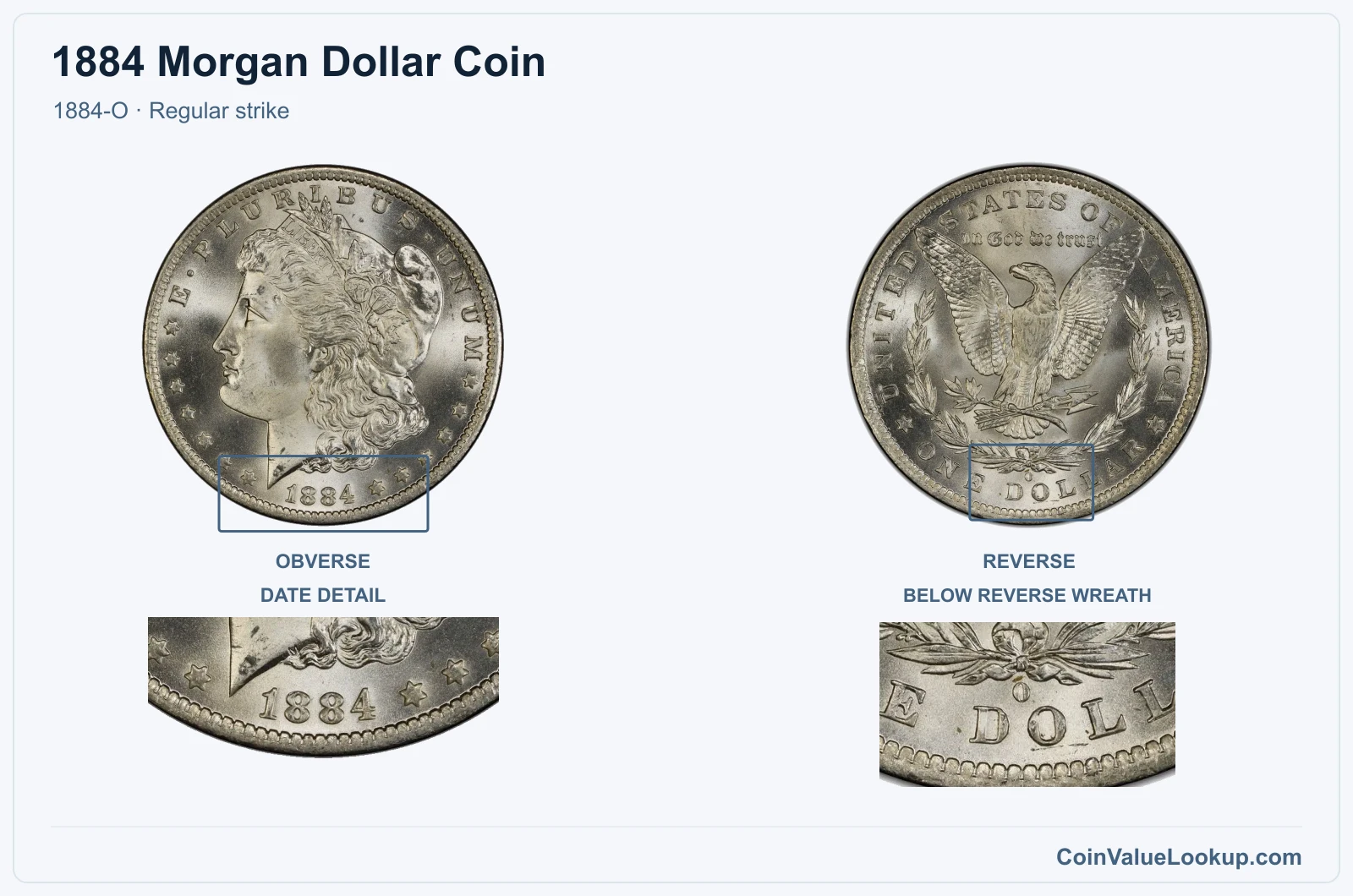
The New Orleans "O" mintmark sits in the same spot below the wreath. The 1884-O is a high-mintage issue, so circulated examples are plentiful.
Guide estimates from USA Coin Book put a G4 around $74.00, matching Philadelphia. An MS65 comes in at about $302.00.
Many 1884-O Morgans survived in Treasury bags and were released decades later, which is why you can find them in nice condition without paying a fortune. That said, a truly gem piece with minimal bag marks still takes patience to locate.
Range Grade
Price Auction Records Appraisal PO PO 1
Coin Identifier FR FR 2
Coin Identifier AG AG 3
Coin Identifier G G 4
—
Coin Identifier
G 6
—
Coin Identifier VG VG 8
—
Coin Identifier
VG 10
—
Coin Identifier F F 12
—
Coin Identifier
F 15
—
Coin Identifier VF VF 20
—
Coin Identifier
VF 25
—
Coin Identifier
VF 30
—
Coin Identifier
VF 35
—
Coin Identifier XF XF 40
—
Coin Identifier
XF 45
—
Coin Identifier AU AU 50
Coin Identifier
AU 53
Coin Identifier
AU 55
Coin Identifier
AU 58
Coin Identifier MS MS 60
Coin Identifier
MS 61
Coin Identifier
MS 62
Coin Identifier
MS 63
Coin Identifier
MS 64
Coin Identifier
MS 65
Coin Identifier
MS 66
Coin Identifier
MS 67
Coin Identifier
MS 68
—
Coin Identifier
MS 69
—
—
—
MS 70
—
—
—
1884 Morgan Silver Dollar — S
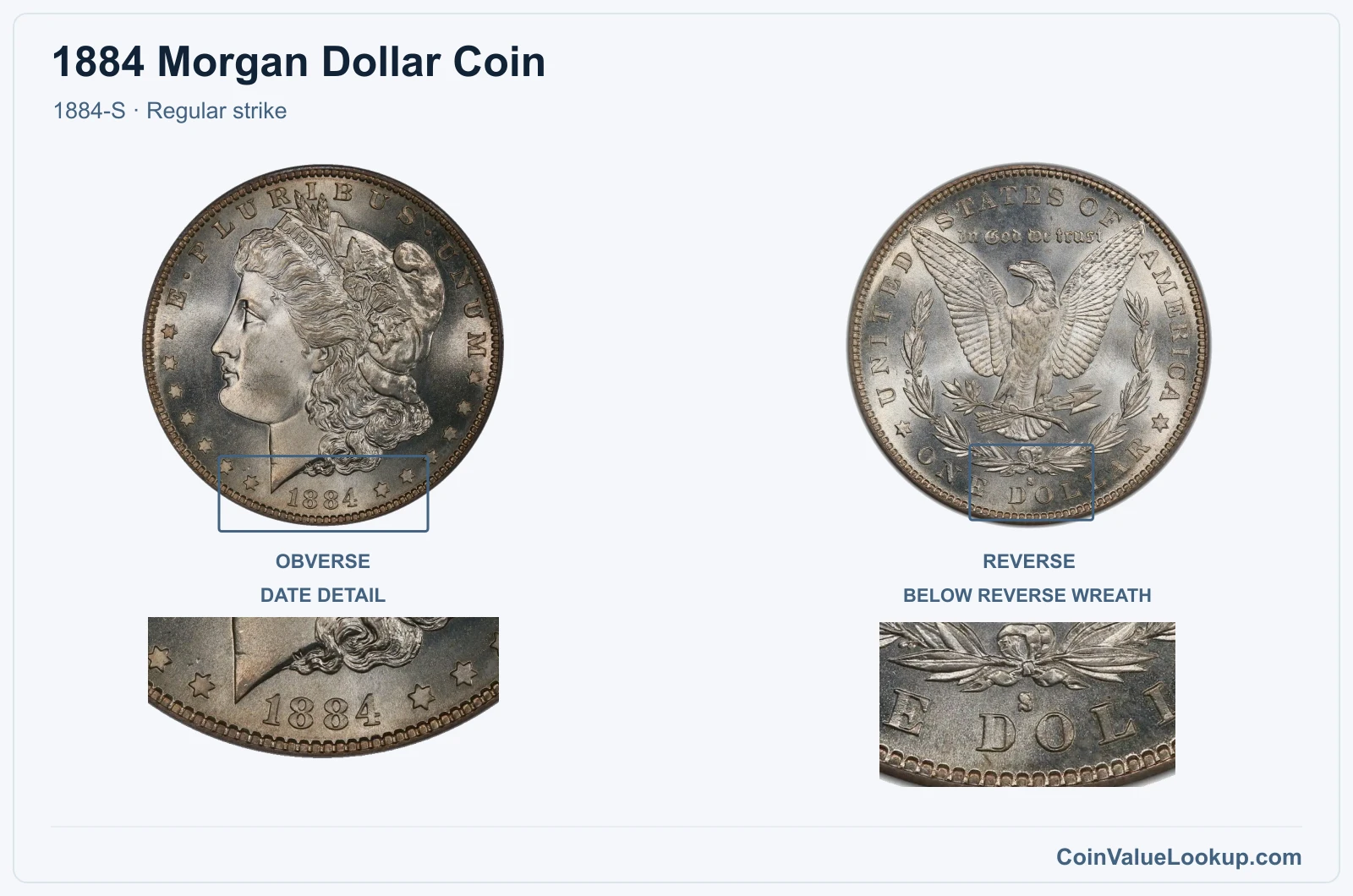
The 1884-S is the sleeper of this date. In low grades it is only modestly more expensive — around $86.00 at G4 per USA Coin Book.
But surviving examples in high Mint State are exceptionally scarce. The guide estimate at MS65 is a staggering $240,700.00.
That is not a typo.
San Francisco struck plenty of these, but most entered circulation and stayed there. Finding one that somehow escaped bag marks and wear is the challenge.
If you believe you have a high-grade 1884-S, professional grading from a major service is worth the cost — the difference between MS64 and MS65 in this series can be enormous. Do not rely on your own assessment for a coin this consequential.
Range Grade
Price Auction Records Appraisal PO PO 1
Coin Identifier FR FR 2
Coin Identifier AG AG 3
—
Coin Identifier G G 4
—
Coin Identifier
G 6
Coin Identifier VG VG 8
Coin Identifier
VG 10
Coin Identifier F F 12
Coin Identifier
F 15
Coin Identifier VF VF 20
Coin Identifier
VF 25
Coin Identifier
VF 30
Coin Identifier
VF 35
Coin Identifier XF XF 40
Coin Identifier
XF 45
Coin Identifier AU AU 50
Coin Identifier
AU 53
Coin Identifier
AU 55
Coin Identifier
AU 58
Coin Identifier MS MS 60
Coin Identifier
MS 61
Coin Identifier
MS 62
Coin Identifier
MS 63
Coin Identifier
MS 64
Coin Identifier
MS 65
Coin Identifier
MS 66
—
—
—
MS 67
Coin Identifier
MS 68
Coin Identifier
MS 69
—
—
—
MS 70
—
—
—
1884 Morgan Silver Dollar — PR
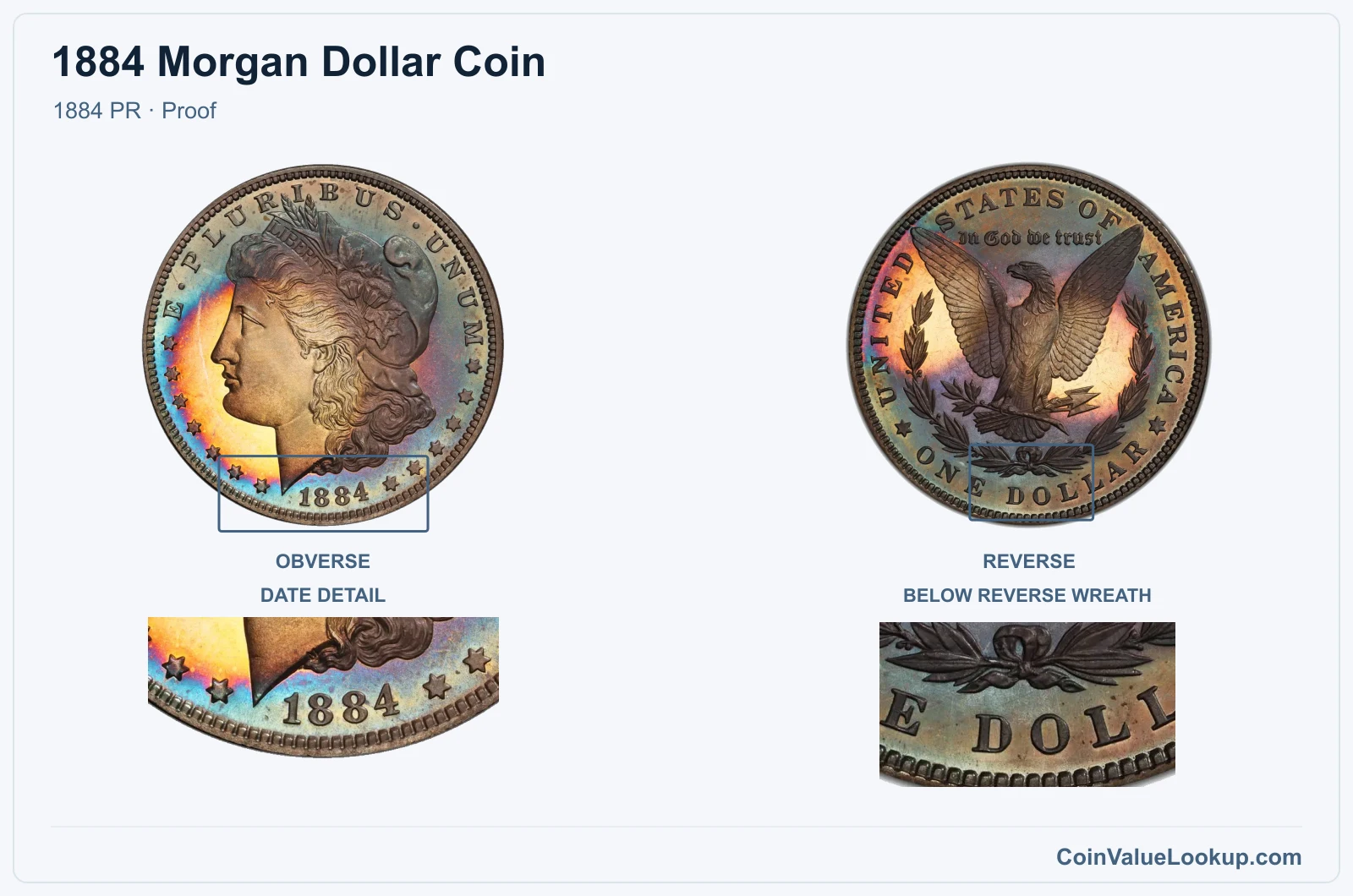
The 1884 Proof Morgan was struck at Philadelphia using specially prepared dies and polished planchets. These carry no mintmark, same as regular Philadelphia business strikes, so authentication is essential — you cannot call a coin proof just because it is shiny or well-preserved.
No specific numeric price range is adopted for proof examples here. Value depends on the authenticated grade, surface quality and whether cameo contrast is present.
Individual assessment by a recognized grading service is the practical path. If you think you have one, compare it against known proof characteristics: squared rims, mirrored fields and frosted devices are typical indicators, but none of those alone is conclusive without professional confirmation.
Range Grade
Price Auction Records Appraisal PR PR 1
—
Coin Identifier
PR 2
—
Coin Identifier
PR 3
—
Coin Identifier
PR 4
—
Coin Identifier
PR 6
—
Coin Identifier
PR 8
—
Coin Identifier
PR 10
—
Coin Identifier
PR 12
—
Coin Identifier
PR 15
—
Coin Identifier
PR 20
—
Coin Identifier
PR 25
—
Coin Identifier
PR 30
—
Coin Identifier
PR 35
—
Coin Identifier
PR 40
—
Coin Identifier
PR 45
—
Coin Identifier
PR 50
—
Coin Identifier
PR 53
—
Coin Identifier
PR 55
Coin Identifier
PR 58
—
Coin Identifier
PR 60
Coin Identifier
PR 61
Coin Identifier
PR 62
Coin Identifier
PR 63
Coin Identifier
PR 64
Coin Identifier
PR 65
Coin Identifier
PR 66
Coin Identifier
PR 67
Coin Identifier
PR 68
Coin Identifier
PR 69
—
—
—
PR 70
—
—
—
1884 Morgan Silver Dollar Error List
1. 1884 Morgan Silver Dollar — Die Gouge / Named Raised-Line Variety
The "1884 Large Dot" is a reported die gouge variety on the 1884 Morgan Dollar. A die gouge shows up as a raised blob or line of extra metal on the coin's surface, transferred from a damaged die.
Look for an unusual raised dot that does not match the normal design elements — it will appear in the same position on every coin struck from that die.
Compare your coin to a normal 1884 to see if the feature is genuinely raised and in the reported location. An incuse scratch, random damage or an unrelated die crack can mimic a gouge but will behave differently under magnification.
No specific price is adopted for this variety; value depends on the visibility of the feature, the coin's overall condition, and buyer interest in the specific error.
2. 1884 Morgan Silver Dollar — Clipped Planchet
A clipped planchet error occurs when part of the blank was missing before the coin was struck. On the 1884 Morgan Dollar, a reported example is described as a rim clipped planchet.
You will see a curved, straight or irregular section of the rim and adjacent design area simply absent — not filed off or corroded away after minting.
A genuine clip usually produces weakness in the design opposite the missing area, sometimes called the Blakesley effect. Compare the edge texture carefully: a real clip will have a different character than a cut, filed notch or corrosion damage.
Those post-mint alterations leave tool marks or rough pitting that a pre-strike clip does not.
No numerical price is adopted here. Value depends on the size, shape and visibility of the clip, as well as the coin's overall grade and confirmation of the error.
3. 1884 Morgan Silver Dollar — Repunched Mintmark
A repunched mintmark (RPM) on the 1884 Morgan Dollar has been reported for the New Orleans mint as an O/O variety. This means the "O" mintmark was punched into the die more than once, leaving remnants of an earlier impression visible alongside the final position.
Under magnification you can see doubling, a shadow or a notch that does not belong on a single clean punch.
Do not confuse this with machine doubling, which produces a flat shelf-like appearance, or with die chips and corrosion around the mintmark that can create misleading shapes. Compare your mintmark to a known normal example at the same magnification.
No specific price is adopted for this variety. The premium, if any, depends on the clarity of the repunching, the coin's grade and collector demand for the particular RPM.
4. 1884 Morgan Silver Dollar — Off-Center Strike
An off-center strike happens when the planchet is not properly seated between the dies. The result is a displaced design with an unstruck crescent of blank metal on one side.
On an 1884 Morgan Dollar, this is a dramatic and obvious error — you will not need magnification to spot it.
The value of an off-center Morgan depends heavily on how much of the design is displaced and whether the date remains fully visible. A coin with an identifiable date commands more interest than one struck so far off that you cannot tell what year it is.
Do not confuse an off-center strike with a clipped planchet, a one-sided die misalignment or post-mint flattening. Clips remove metal from the blank; off-center strikes shift the entire design.
No numerical price is adopted for this error. Condition, degree of displacement and date visibility all factor into individual assessment.