1824 Coronet Head Cent Coin Value: How Much Is It Worth?
The 1824 Coronet Head Cent is a copper large cent struck at Philadelphia, and guide estimates range from about $61 in G4 to $30,920 in MS63 depending on the exact variety. That spread is not the entire market picture — rare proofs, restrikes, and major errors sit outside those anchors and require individual assessment.
Identifying the correct variety is the critical first step before any valuation.
Fast Way to Identify Your 1824 Coronet Head Cent
The quickest way to start figuring out what your 1824 cent is worth is to upload clear photos of the front and back. Our identifier can give you a preliminary read on the variety and general condition.
Good lighting and a sharp shot of the date area are especially helpful, since the overdate variety hides its secret right there in the last digit.
1824 Coronet Head Cent Value
Upload both sides of your 1824 Coronet Head Cent.
Front Obverse
Upload photo
Back Reverse
Upload photo
Which 1824 Coronet Head Cent Versions Are Worth Money?
- The 1824/2 overdate, with remnants of a "2" beneath the "4," carries guide values from $100 in G4 up to $30,920 in MS63 — substantially higher than the normal date at every grade level.
- The normal date 1824 is listed from $61 in G4 to $6,828 in MS63, making mint-state examples far more valuable than typical circulated survivors.
- Proof 1824 cents exist but have no adopted numeric price range; each one requires individual expert attribution of surfaces, rims, and die characteristics.
Step 1: Identify Your 1824 Coronet Head Cent Mint Mark and Version
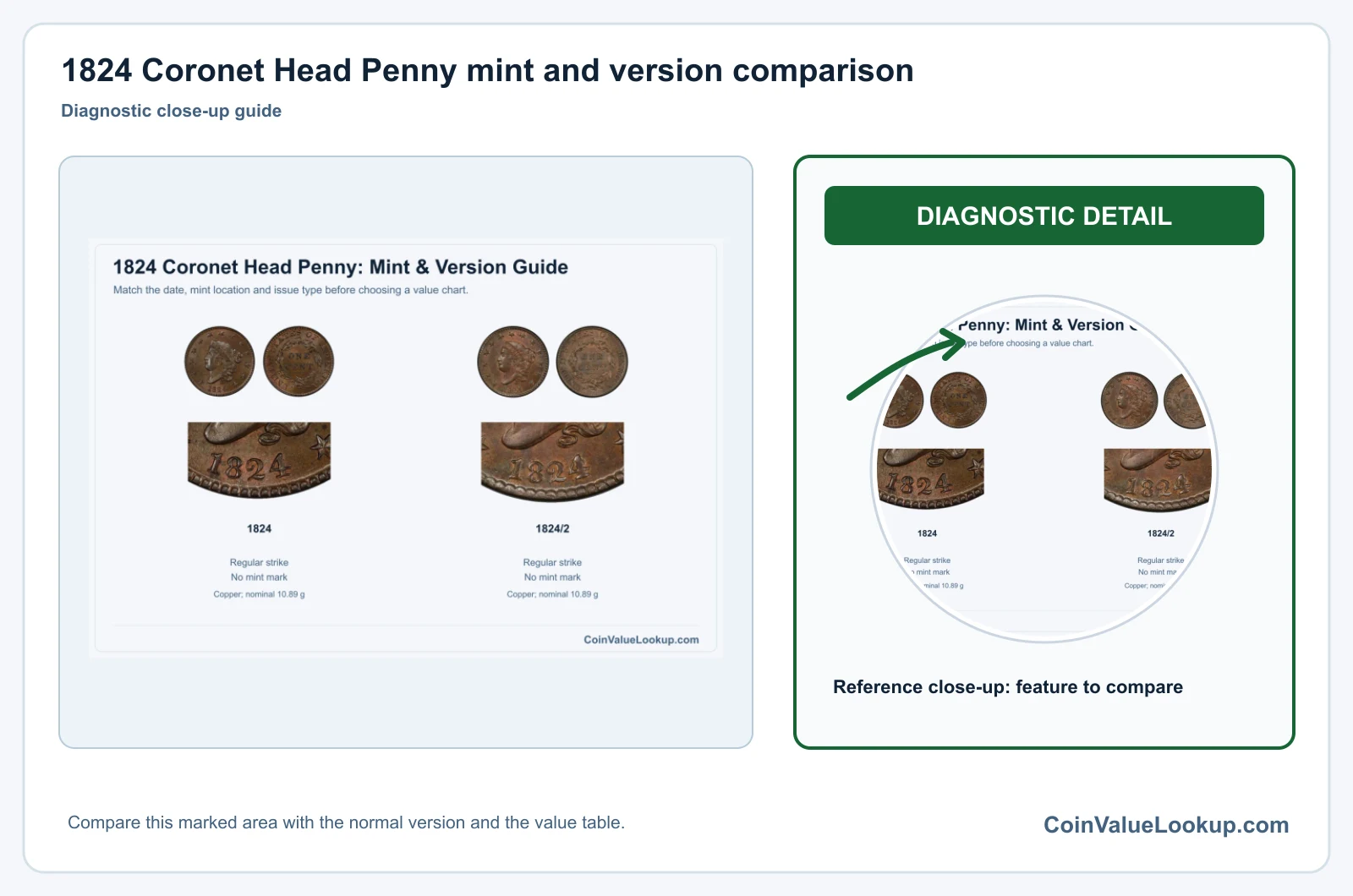
Every 1824 Coronet Head Cent was struck at Philadelphia, so there is no mintmark to hunt for. The two main business-strike varieties are the Normal Date 1824 and the 1824/2 overdate, where remnants of an underlying "2" are visible beneath the final "4" in the date.
To tell them apart, examine the base and curves of the last digit under magnification. On the overdate, traces of the earlier "2" — particularly its curved lower stroke — peek out from behind the "4." A normal 1824 has a clean, unambiguous "4" with no secondary digit.
Beyond the date, confirm the design: Liberty faces left wearing a coronet inscribed LIBERTY on the obverse, with thirteen stars around the border. The reverse shows ONE CENT within a wreath.
Check the edge for consistent original copper surface and the expected weight near 10.89 grams, though wear, corrosion, and period production tolerances mean weight alone cannot prove authenticity. Inspect both faces for cleaning, tooling, or added material that would change the coin's category.
Step 2: Check Your 1824 Coronet Head Cent Grade
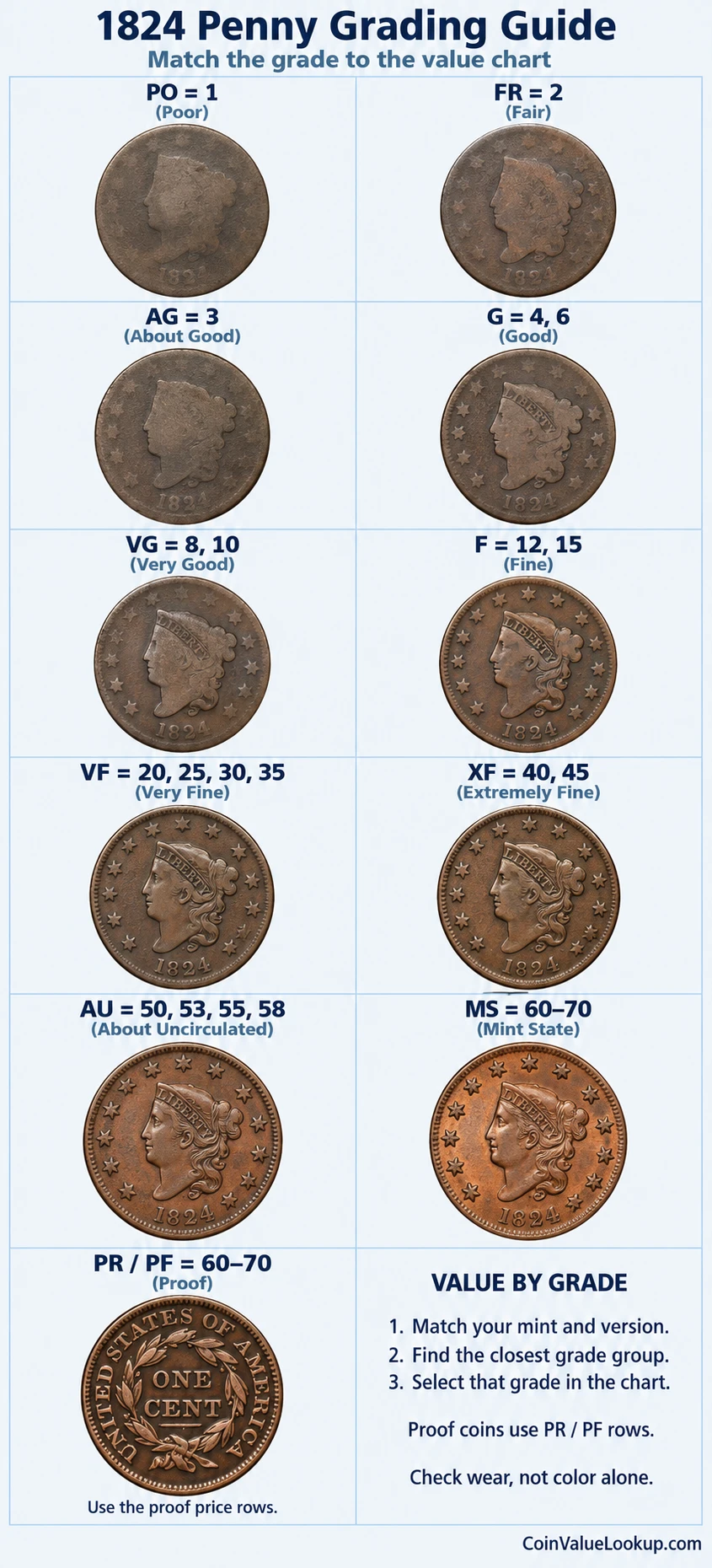
Start with the portrait. On a well-worn coin (around Good-4), Liberty's outline and the date should still be readable, but most hair detail and the coronet lettering will be flat.
As grade improves, look for individual hair strands above the ear and behind the coronet — these wear first.
The cheek is another telltale. A coin with visible cheek contour and some hair separation is heading into Fine territory.
Full, sharp hair curls with minimal friction on the high points suggest About Uncirculated or better.
On the reverse, leaf veins in the wreath are the barometer. Worn flat means lower grade; crisp veins with full stem detail push it higher.
Compare your coin side-by-side with the reference image of a like-type example.
Don't confuse a weak strike with honest wear. A weakly struck coin can look worn even if it never circulated.
Likewise, corrosion and porosity eat into detail and can drop the market value well below what the apparent grade might suggest. Color designations like BN, RB, and RD describe how much original red copper color remains — they are not separate alloys or automatic grade boosts.
And a proof is a method of manufacture, not a grade sitting above Mint State.
Step 3: Check 1824 Coronet Head Cent Value by Mint and Version
1824 Coronet Head Cent
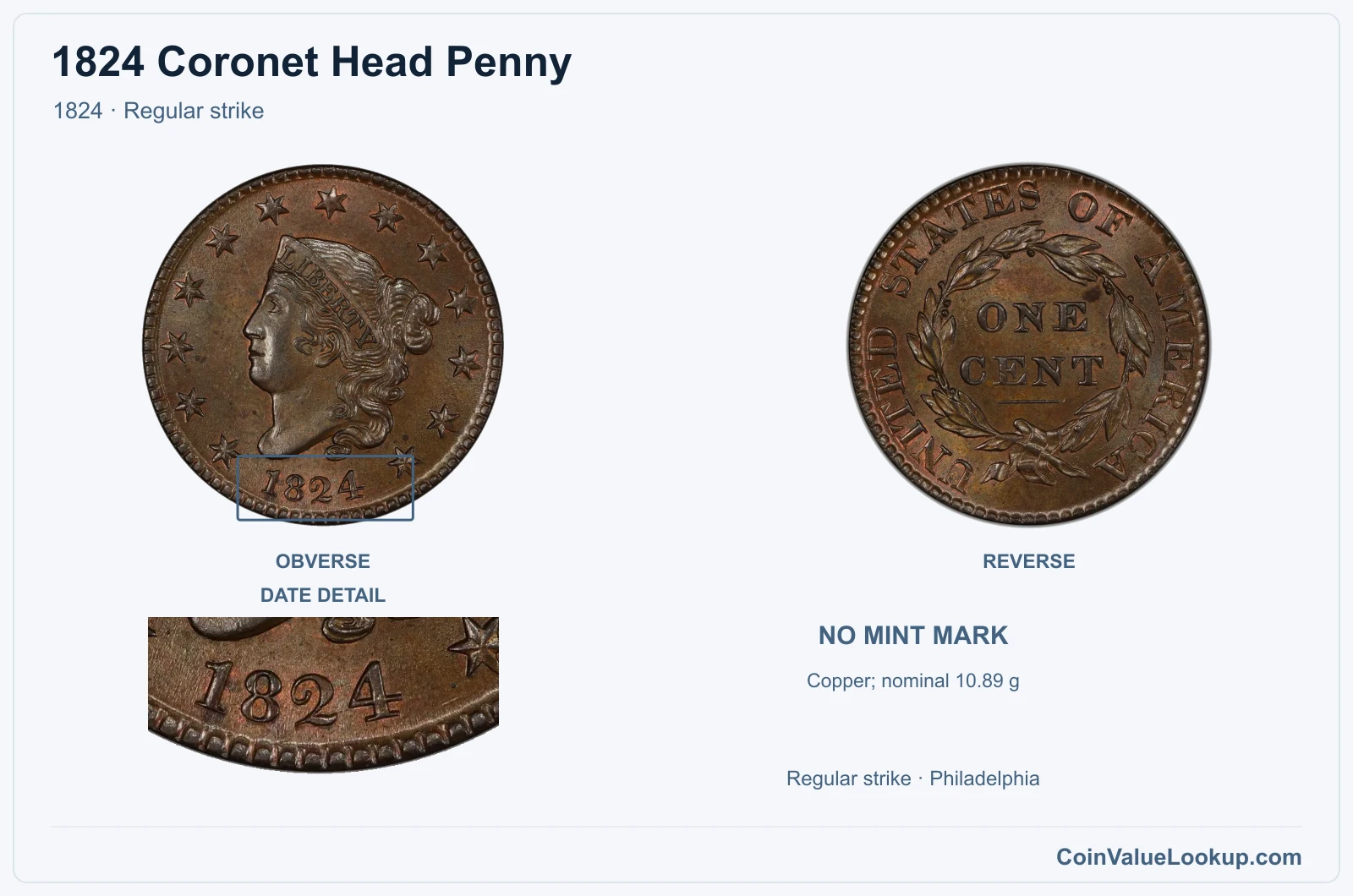
The ordinary 1824 Coronet Head Cent was struck in copper at Philadelphia with no mintmark. Its date shows a clean "4" with no underlying digit.
USA Coin Book guide estimates place this variety at about $61 in G4 and roughly $6,828 in MS63, with intermediate grades filling in between.
Most surviving examples are circulated, often heavily so. A well-defined portrait with sharp hair curls and full wreath detail commands a significant premium over a worn example.
Surface quality matters a lot on early copper — original color and the absence of cleaning or corrosion can make a real difference in desirability.
| Range | Grade | Price | Auction Records | Appraisal |
|---|---|---|---|---|
| PO | PO 1 | — | Coin Identifier | |
| FR | FR 2 | — | Coin Identifier | |
| AG | AG 3 | Coin Identifier | ||
| G | G 4 | — | Coin Identifier | |
| G 6 | Coin Identifier | |||
| VG | VG 8 | Coin Identifier | ||
| VG 10 | Coin Identifier | |||
| F | F 12 | Coin Identifier | ||
| F 15 | Coin Identifier | |||
| VF | VF 20 | Coin Identifier | ||
| VF 25 | Coin Identifier | |||
| VF 30 | Coin Identifier | |||
| VF 35 | Coin Identifier | |||
| XF | XF 40 | Coin Identifier | ||
| XF 45 | Coin Identifier | |||
| AU | AU 50 | Coin Identifier | ||
| AU 53 | Coin Identifier | |||
| AU 55 | Coin Identifier | |||
| AU 58 | Coin Identifier | |||
| MS | MS 60 | Coin Identifier | ||
| MS 61 | Coin Identifier | |||
| MS 62 | Coin Identifier | |||
| MS 63 | Coin Identifier | |||
| MS 64 | Coin Identifier | |||
| MS 65 | Coin Identifier | |||
| MS 66 | — | — | — | |
| MS 67 | — | — | — | |
| MS 68 | — | — | — | |
| MS 69 | — | — | — | |
| MS 70 | — | — | — |
1824 Coronet Head Cent — /2
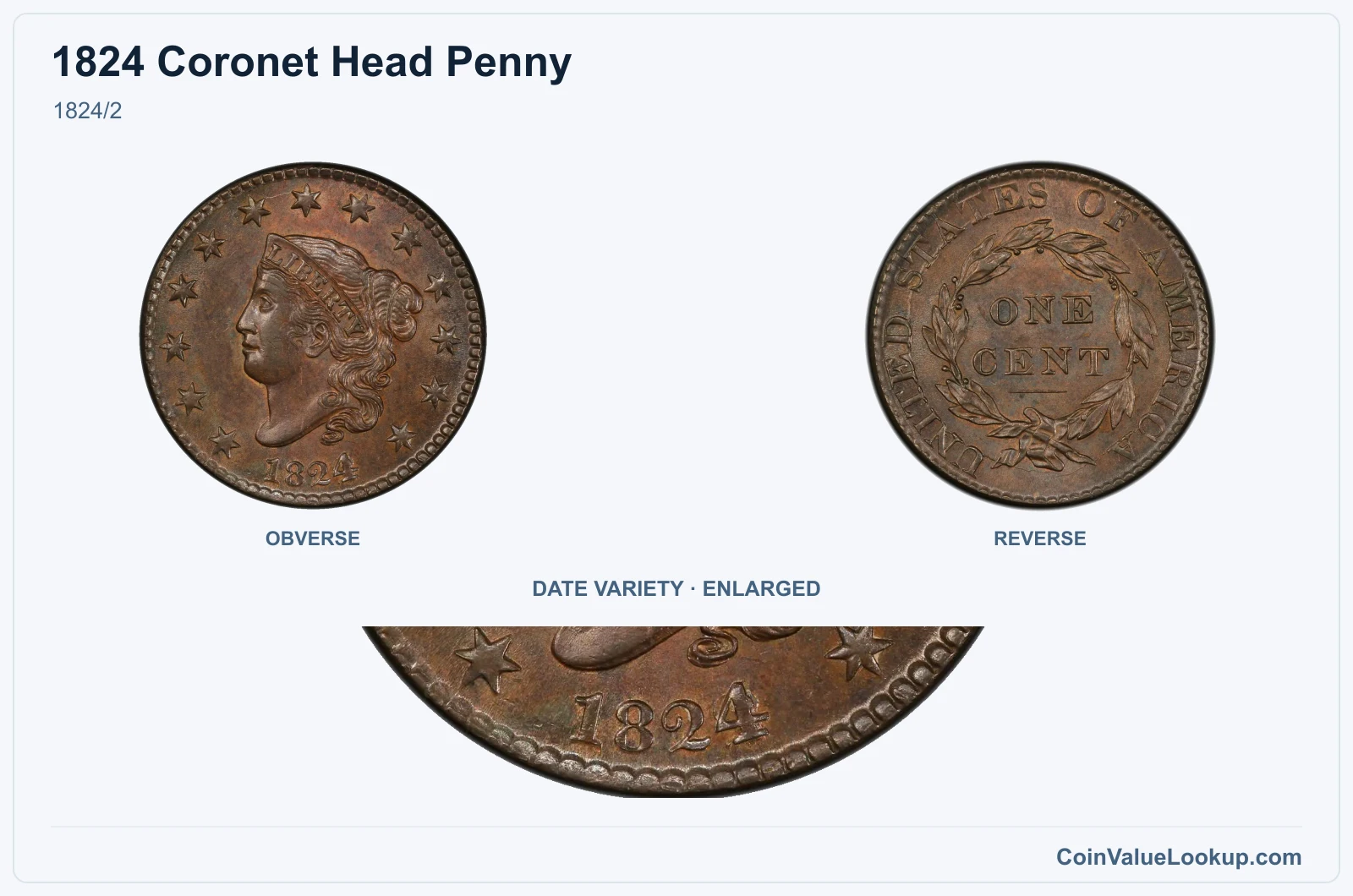
The 1824/2 is the overdate variety, and it is the one that gets collectors excited for a good mechanical reason: the Mint reused an earlier-dated die by punching a "4" over the original "2." Remnants of the "2" — especially its curved lower portion — survive beneath the final digit. Under magnification, the ghost of that earlier numeral is the diagnostic.
USA Coin Book guide estimates run from about $100 in G4 to approximately $30,920 in MS63. That is a dramatic jump over the normal date at every grade, which reflects genuine scarcity in higher conditions.
Even a low-grade example with a clearly visible underdigit holds a meaningful premium. Confirm the overdate attribution carefully, because a damaged or corroded date can mimic the appearance of a secondary digit.
Coin Value Lookup is a good starting point if you want to compare this variety against other Coronet Head dates and denominations in one place.
| Range | Grade | Price | Auction Records | Appraisal |
|---|---|---|---|---|
| PO | PO 1 | — | Coin Identifier | |
| FR | FR 2 | — | Coin Identifier | |
| AG | AG 3 | — | Coin Identifier | |
| G | G 4 | — | Coin Identifier | |
| G 6 | Coin Identifier | |||
| VG | VG 8 | Coin Identifier | ||
| VG 10 | Coin Identifier | |||
| F | F 12 | Coin Identifier | ||
| F 15 | Coin Identifier | |||
| VF | VF 20 | Coin Identifier | ||
| VF 25 | Coin Identifier | |||
| VF 30 | Coin Identifier | |||
| VF 35 | Coin Identifier | |||
| XF | XF 40 | Coin Identifier | ||
| XF 45 | Coin Identifier | |||
| AU | AU 50 | Coin Identifier | ||
| AU 53 | Coin Identifier | |||
| AU 55 | Coin Identifier | |||
| AU 58 | Coin Identifier | |||
| MS | MS 60 | — | Coin Identifier | |
| MS 61 | Coin Identifier | |||
| MS 62 | Coin Identifier | |||
| MS 63 | Coin Identifier | |||
| MS 64 | — | Coin Identifier | ||
| MS 65 | — | — | — | |
| MS 66 | — | — | — | |
| MS 67 | — | — | — | |
| MS 68 | — | — | — | |
| MS 69 | — | — | — | |
| MS 70 | — | — | — |
1824 Coronet Head Cent — Proof
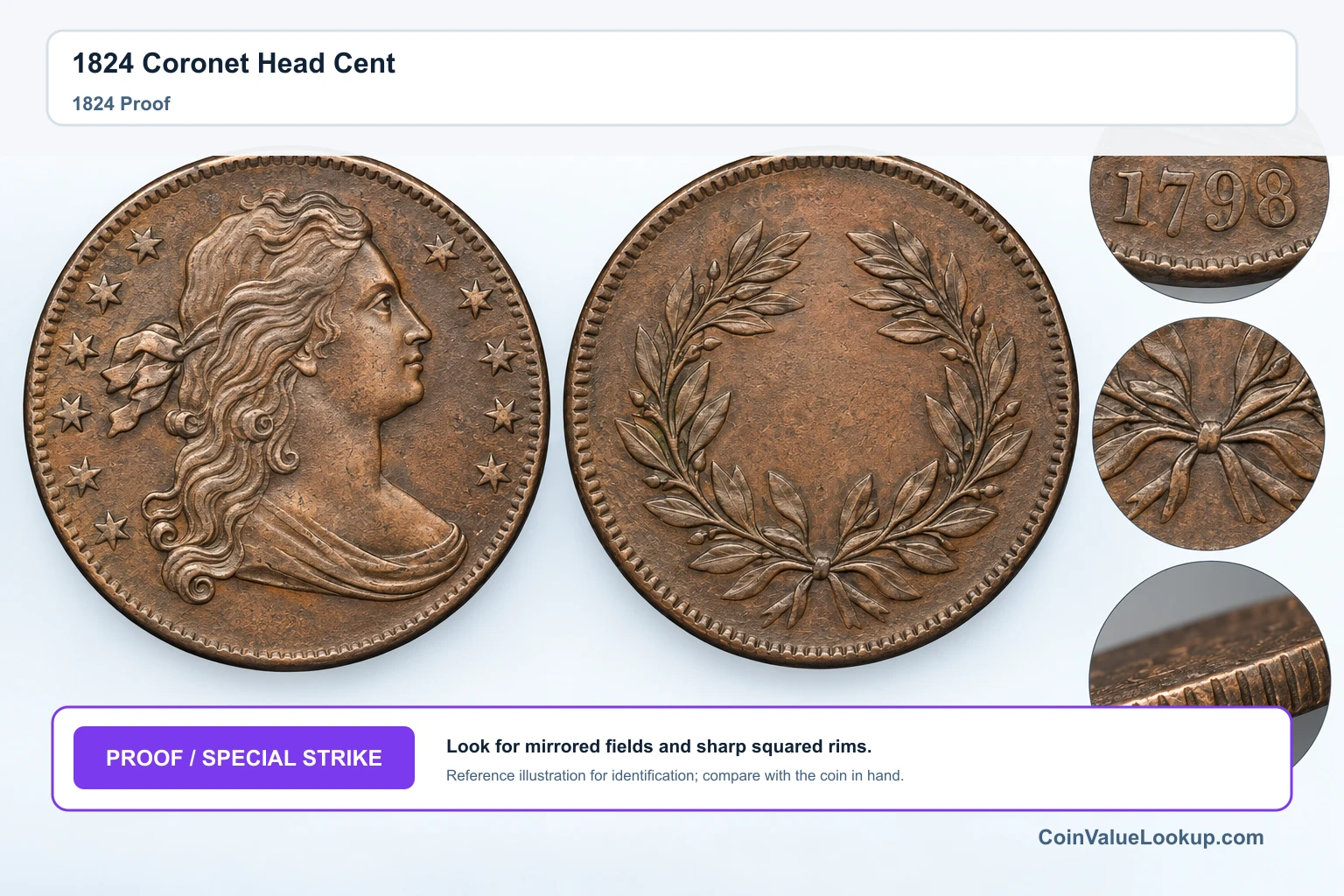
Proof 1824 Coronet Head Cents are known, but they are extreme rarities. A proof is a manufacturing method — specially prepared dies, polished planchets, deliberate striking — not simply a pretty coin.
Polishing a business strike does not create a proof, no matter how shiny it gets.
No numeric price range has been adopted for the 1824 Proof because each example must be assessed individually. Attribution requires examination of the surfaces, rims, die characteristics, and edge quality by an experienced specialist or a major grading service.
If you believe you have one, professional authentication is the necessary next step. Catalog listings confirm the variety exists, but a listing alone does not equal a recent market transaction.
| Range | Grade | Price | Auction Records | Appraisal |
|---|---|---|---|---|
| PR | PR 1 | — | Coin Identifier | |
| PR 2 | — | Coin Identifier | ||
| PR 3 | — | Coin Identifier | ||
| PR 4 | — | Coin Identifier | ||
| PR 6 | — | Coin Identifier | ||
| PR 8 | — | Coin Identifier | ||
| PR 10 | — | Coin Identifier | ||
| PR 12 | — | Coin Identifier | ||
| PR 15 | — | Coin Identifier | ||
| PR 20 | — | Coin Identifier | ||
| PR 25 | — | Coin Identifier | ||
| PR 30 | — | Coin Identifier | ||
| PR 35 | — | Coin Identifier | ||
| PR 40 | — | Coin Identifier | ||
| PR 45 | — | Coin Identifier | ||
| PR 50 | — | Coin Identifier | ||
| PR 53 | — | Coin Identifier | ||
| PR 55 | — | Coin Identifier | ||
| PR 58 | — | Coin Identifier | ||
| PR 60 | — | Coin Identifier | ||
| PR 61 | — | Coin Identifier | ||
| PR 62 | — | Coin Identifier | ||
| PR 63 | — | Coin Identifier | ||
| PR 64 | — | Coin Identifier | ||
| PR 65 | — | — | — | |
| PR 66 | — | — | — | |
| PR 67 | — | — | — | |
| PR 68 | — | — | — | |
| PR 69 | — | — | — | |
| PR 70 | — | — | — |
1824 Coronet Head Cent Error List
1. 1824 Coronet Head Cent — Off-Center Strike
An off-center strike happens when the planchet is not seated properly in the coining chamber, so the dies impress the design away from center. The result is a displaced image with an unstruck crescent of blank metal along one side.
On an 1824 Coronet Head Cent, the key question is whether the date remains fully visible — that is what separates a collectible off-center error from a curiosity.
Look-alikes include clipped planchets, one-sided die misalignment, and coins that were flattened or bent after leaving the Mint. Post-mint damage tends to show stress marks, uneven metal, or tool impressions that a genuine off-center strike does not.
No numeric price has been adopted for this error on the 1824 cent; value depends on the degree of off-center shift, date visibility, authenticated identity, and overall condition.
2. 1824 Coronet Head Cent — Clipped Planchet
A clipped planchet error occurs when the blank was incompletely punched from the copper strip before striking. You will see a missing curved, straight, or ragged section along the edge.
The area opposite the clip often shows weakness in the design because metal could not flow fully during the strike — that opposite weakness is a useful confirmation.
Do not confuse a clip with an edge that was filed, cut, or corroded after the coin left the Mint. Genuine clips have smooth, consistent metal flow at the boundary, while post-mint damage typically leaves tool marks, sharp angles, or rough pitting.
No numeric price range is adopted for clipped 1824 cents. Each piece needs individual assessment based on the clip's size, location, authenticated variety, and surface condition.
3. 1824 Coronet Head Cent — Lamination / Split Planchet
A lamination or split planchet error shows peeling metal, a retained flap, or an internal separation within the copper. These result from impurities or gas pockets in the planchet that cause layers to separate during or after striking.
When photographing a suspected lamination, capture the edge and the affected face together so the separation is clearly visible.
The main look-alikes are scraping, heavy corrosion, and deliberately cut or shaved coins. Genuine laminations follow the contour of the metal's internal structure, whereas post-mint scrapes tend to leave directional scratches, and corrosion produces a different surface texture entirely.
No specific price range has been adopted for lamination errors on the 1824 cent. Value depends on the size and visibility of the flaw, the coin's authenticated identity, and overall condition.
4. 1824 Coronet Head Cent — Die Crack
Die cracks appear as raised lines running across the coin's fields or through the design elements. They form when a working die develops a fracture, and metal fills the crack during striking.
On an 1824 cent, look for thin raised ridges that cross lettering, stars, or Liberty's portrait — they will feel slightly raised when you run a fingernail across them.
Don't mistake incuse scratches, corrosion lines, or tool marks for die cracks. A scratch is recessed into the surface, while a die crack is raised above it.
That distinction is the quickest diagnostic test. No numeric price range is adopted for die cracks on the 1824 Coronet Head Cent; value depends on the crack's prominence, location, and the coin's authenticated condition.
5. 1824 Coronet Head Cent — Die Break / Cud
A cud is a specific type of die break where a piece of the die breaks away at the rim, leaving a raised, featureless blob of metal on the finished coin. It connects to the rim — that is what distinguishes a cud from an interior die chip or a simple die crack.
On an 1824 cent, show where the cud's boundary meets the normal design and how it displaces the expected detail.
Rim dents, corrosion buildup, and interior die chips can all mimic a cud at first glance. A rim dent will depress or distort the metal inward, while a cud is raised and uniform.
No adopted numeric price exists for cuds on the 1824 cent. Each example is evaluated individually based on the size and location of the break, authenticated identity, and surface preservation.
6. 1824 Coronet Head Cent — Overdate
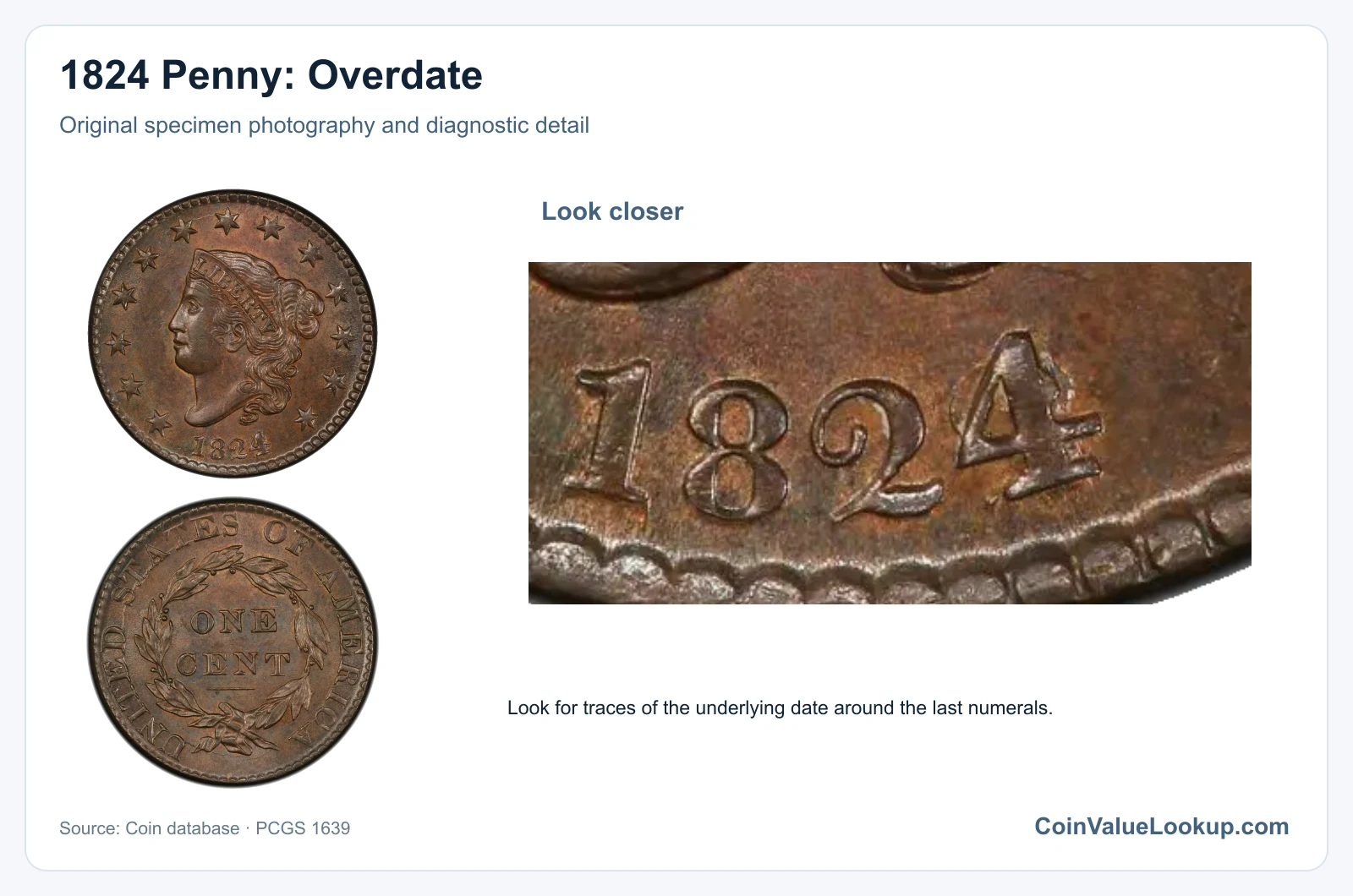
The overdate on 1824 cents is the well-known 1824/2, where the Mint punched a "4" over an earlier "2" on the same die. Surviving contours of the underlying "2" are visible beneath the final digit, especially its curved lower stroke.
This is a die variety, not a striking error in the traditional sense, but it falls under the overdate category.
Be careful not to confuse a damaged date or ordinary machine doubling with a true overdate. Machine doubling produces a flat, shelf-like secondary image, while an overdate shows the distinct shape of a different numeral.
Physical damage from contact marks can also distort digits in misleading ways. Compare your coin's date carefully against known examples of the 1824/2.
No separate error-category price has been adopted beyond the variety-specific guide values already listed for the 1824/2 branch above.