1827 Coronet Head Cent Coin Value: How Much Is It Worth?
An 1827 Coronet Head Cent in well-worn condition (G4) carries a guide value around $38, while a mint-state example graded MS63 can reach roughly $3,248 according to USA Coin Book estimates. That is just the business-strike range.
Proof versions, major die errors, and exceptional surface quality all fall outside those anchors and need individual evaluation. Identifying your exact variety is the first step to understanding what you have.
Fast Way to Identify Your 1827 Coronet Head Cent
Snap a clear photo of both the front and back of your 1827 cent and upload them here. That gives us a starting point for preliminary identification, helping sort out the design type, surface condition, and whether anything unusual is going on.
This is not a substitute for professional authentication, but it can point you in the right direction quickly.
1827 Coronet Head Cent Value
Upload both sides of your 1827 Coronet Head Cent.
Front Obverse
Upload photo
Back Reverse
Upload photo
Which 1827 Coronet Head Cent Versions Are Worth Money?
- Business strikes range from about $38 in G4 to roughly $3,248 in MS63 per USA Coin Book, so higher-grade survivors are worth careful examination.
- Proof 1827 Coronet Head Cents are a separate category requiring expert attribution of die characteristics, surfaces, and rims; no standard business-strike price applies.
- Die cracks, cuds, clipped planchets, and off-center strikes are reported for this date and can add collector interest beyond the base value.
- Original, problem-free surfaces on early copper cents carry a strong premium over cleaned or corroded examples at every grade level.
Step 1: Identify Your 1827 Coronet Head Cent Mint Mark and Version
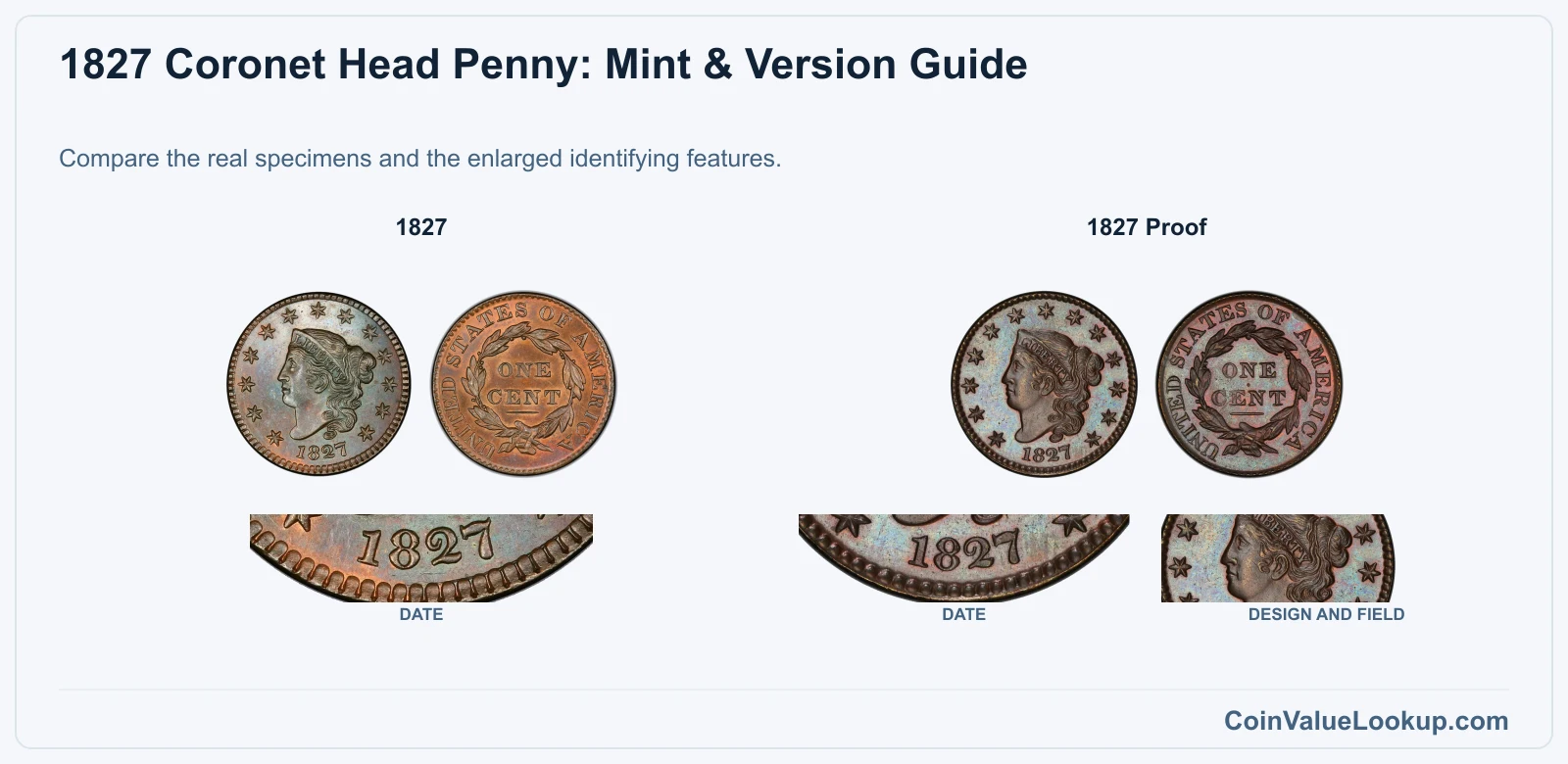
The 1827 Coronet Head Cent shows Liberty facing left wearing a coronet inscribed LIBERTY, with thirteen stars around the rim and the date below. Flip it over and you will see ONE CENT inside a wreath.
All of these were struck at Philadelphia, so there is no mintmark to hunt for.
Do not assume any branch-mint versions exist for this date. If someone offers you an 1827 cent with a mintmark, that is a red flag.
To separate a business strike from a proof, look at the surfaces and rims. Proofs were made with specially prepared dies and show mirror-like fields and sharp, squared rims.
A shiny coin that was polished or whizzed is not a proof, no matter how reflective it looks.
Weight can help support identification since the copper planchet should be close to 10.89 grams. But wear, corrosion, and normal production tolerances mean weight alone does not prove or disprove authenticity.
Check the date-punch shape, the legend spelling, and the wreath details carefully against known references for this year.
Step 2: Check Your 1827 Coronet Head Cent Grade
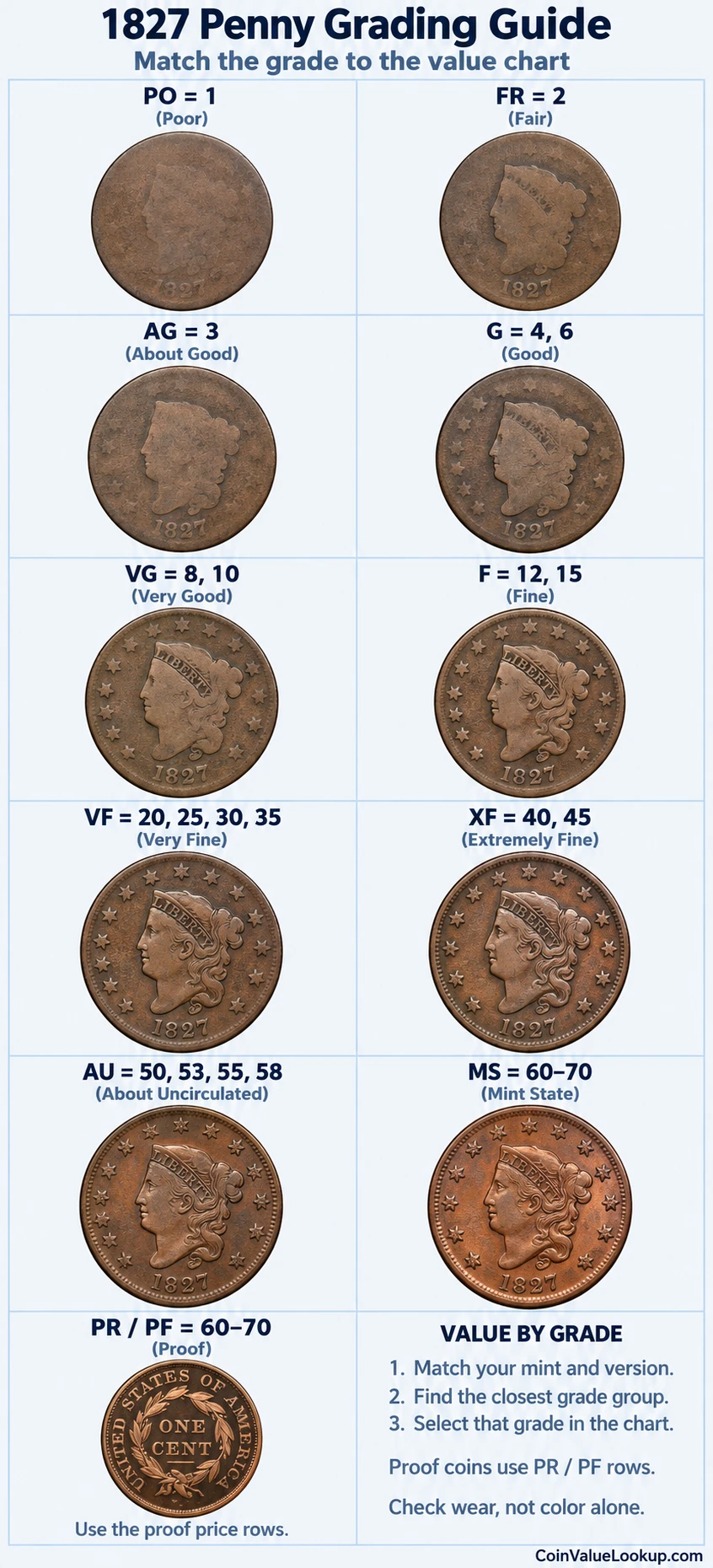
Start with Liberty's hair above the ear and across the forehead. On a well-circulated coin those strands merge into flat areas first, while the cheek loses its roundness.
The wreath on the reverse tells a parallel story: individual leaf veins vanish early, and the stems blur together as the grade drops.
Do not confuse a weak strike with heavy wear. Some 1827 cents left the press with soft details in specific areas, which is a manufacturing trait, not damage from pocket change.
Corrosion and porosity also eat away sharpness, and coins with those problems typically trade below the guide value for a given grade.
Copper cents are described by color: BN (brown), RB (red-brown), and RD (red). These are surface-color designations, not different metals.
Most survivors this old are solidly brown. If yours has significant original red remaining, that is unusual and worth noting.
Compare your coin side-by-side with the reference image for this type. Focus on the same checkpoints: hair detail, cheek contour, star points, and leaf definition.
Surface problems like scratches, cleaning, or environmental damage can lower market value well below the guide figure for a particular grade.
Step 3: Check 1827 Coronet Head Cent Value by Mint and Version
1827 Coronet Head Cent
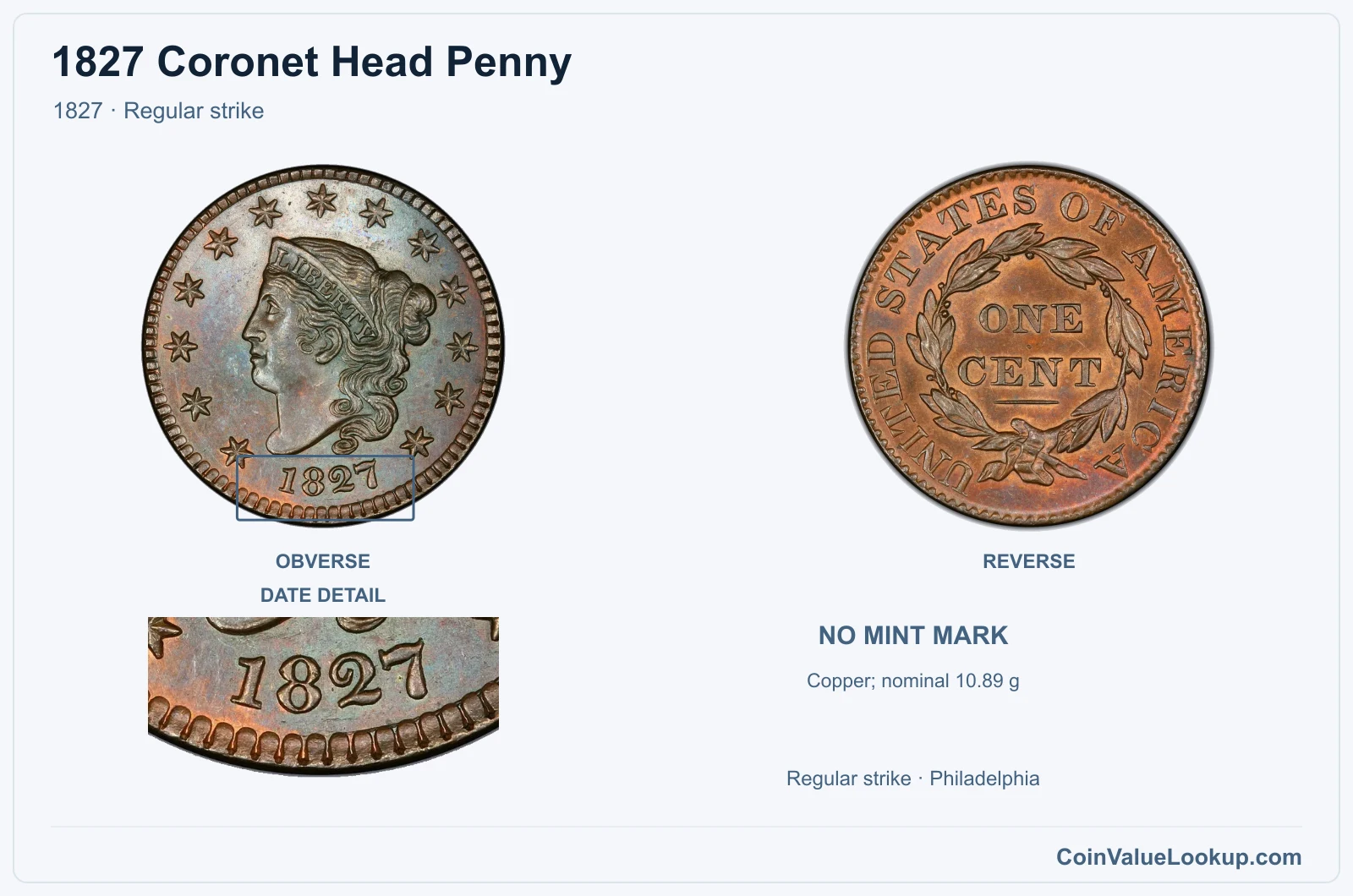
The standard 1827 Coronet Head Cent is a copper business strike from Philadelphia, weighing nominally 10.89 grams. Guide estimates from USA Coin Book place it at about $38 in G4 and around $3,248 in MS63.
That is a wide spread, which tells you condition matters enormously on this date.
Look for the classic Coronet Head portrait with all thirteen stars visible and a complete date. On the reverse, the denomination should read clearly within the wreath.
Original brown surfaces without signs of cleaning or tooling will command stronger prices than brightened or damaged examples.
Coin Value Lookup is a useful starting point if you want to compare this cent against other early copper dates or check values across the Coronet Head series.
| Range | Grade | Price | Auction Records | Appraisal |
|---|---|---|---|---|
| PO | PO 1 | — | Coin Identifier | |
| FR | FR 2 | — | Coin Identifier | |
| AG | AG 3 | — | Coin Identifier | |
| G | G 4 | Coin Identifier | ||
| G 6 | Coin Identifier | |||
| VG | VG 8 | Coin Identifier | ||
| VG 10 | Coin Identifier | |||
| F | F 12 | Coin Identifier | ||
| F 15 | Coin Identifier | |||
| VF | VF 20 | Coin Identifier | ||
| VF 25 | Coin Identifier | |||
| VF 30 | Coin Identifier | |||
| VF 35 | Coin Identifier | |||
| XF | XF 40 | Coin Identifier | ||
| XF 45 | Coin Identifier | |||
| AU | AU 50 | Coin Identifier | ||
| AU 53 | Coin Identifier | |||
| AU 55 | Coin Identifier | |||
| AU 58 | Coin Identifier | |||
| MS | MS 60 | Coin Identifier | ||
| MS 61 | Coin Identifier | |||
| MS 62 | Coin Identifier | |||
| MS 63 | Coin Identifier | |||
| MS 64 | Coin Identifier | |||
| MS 65 | Coin Identifier | |||
| MS 66 | Coin Identifier | |||
| MS 67 | — | — | — | |
| MS 68 | — | — | — | |
| MS 69 | — | — | — | |
| MS 70 | — | — | — |
1827 Coronet Head Cent — Proof
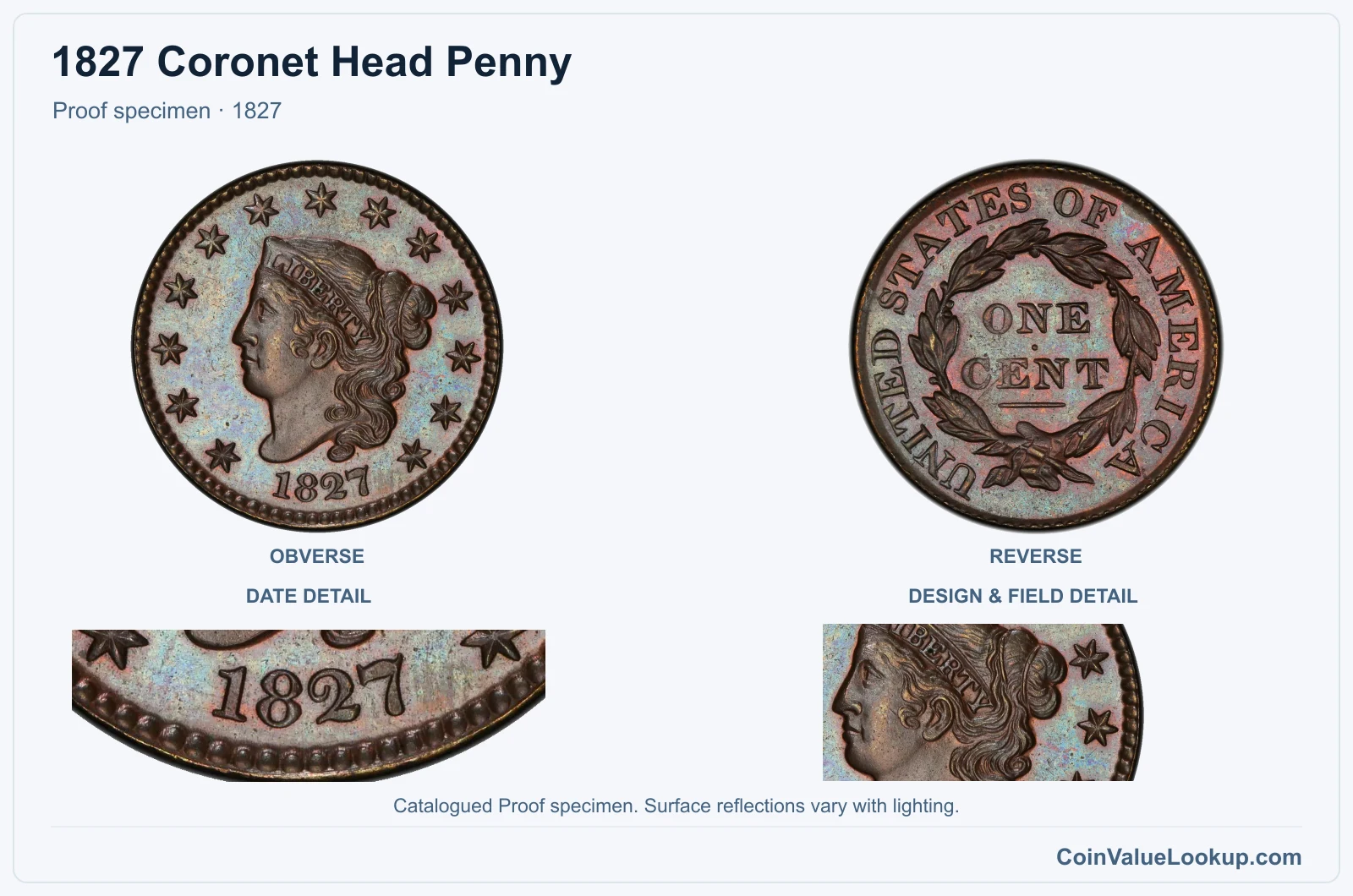
A proof 1827 Coronet Head Cent is a genuinely rare coin. These were produced using specially prepared dies that left mirror-like fields and crisp, sharp details impossible to replicate through polishing or conservation.
The rims tend to be square and well-defined, and die lines in the fields may be visible under magnification.
Here is the hard truth: polishing a business strike does not turn it into a proof. Attribution requires careful examination of the die characteristics, surface quality, and rim profile by someone experienced with early copper proofs.
No standard business-strike price transfers to this category.
Because no supported numeric range is available here, any 1827 proof cent should be evaluated individually based on its authenticated identity, surface preservation, and overall condition. Third-party certification from a major grading service is effectively a prerequisite for this kind of coin to trade at its full potential.
| Range | Grade | Price | Auction Records | Appraisal |
|---|---|---|---|---|
| PR | PR 1 | — | Coin Identifier | |
| PR 2 | — | Coin Identifier | ||
| PR 3 | — | Coin Identifier | ||
| PR 4 | — | Coin Identifier | ||
| PR 6 | — | Coin Identifier | ||
| PR 8 | — | Coin Identifier | ||
| PR 10 | — | Coin Identifier | ||
| PR 12 | — | Coin Identifier | ||
| PR 15 | — | Coin Identifier | ||
| PR 20 | — | Coin Identifier | ||
| PR 25 | — | Coin Identifier | ||
| PR 30 | — | Coin Identifier | ||
| PR 35 | — | Coin Identifier | ||
| PR 40 | — | Coin Identifier | ||
| PR 45 | — | Coin Identifier | ||
| PR 50 | — | Coin Identifier | ||
| PR 53 | — | Coin Identifier | ||
| PR 55 | — | Coin Identifier | ||
| PR 58 | — | Coin Identifier | ||
| PR 60 | — | Coin Identifier | ||
| PR 61 | — | Coin Identifier | ||
| PR 62 | — | Coin Identifier | ||
| PR 63 | — | Coin Identifier | ||
| PR 64 | Coin Identifier | |||
| PR 65 | — | — | — | |
| PR 66 | — | — | — | |
| PR 67 | — | — | — | |
| PR 68 | — | — | — | |
| PR 69 | — | — | — | |
| PR 70 | — | — | — |
1827 Coronet Head Cent Error List
1. 1827 Coronet Head Cent — Die Crack
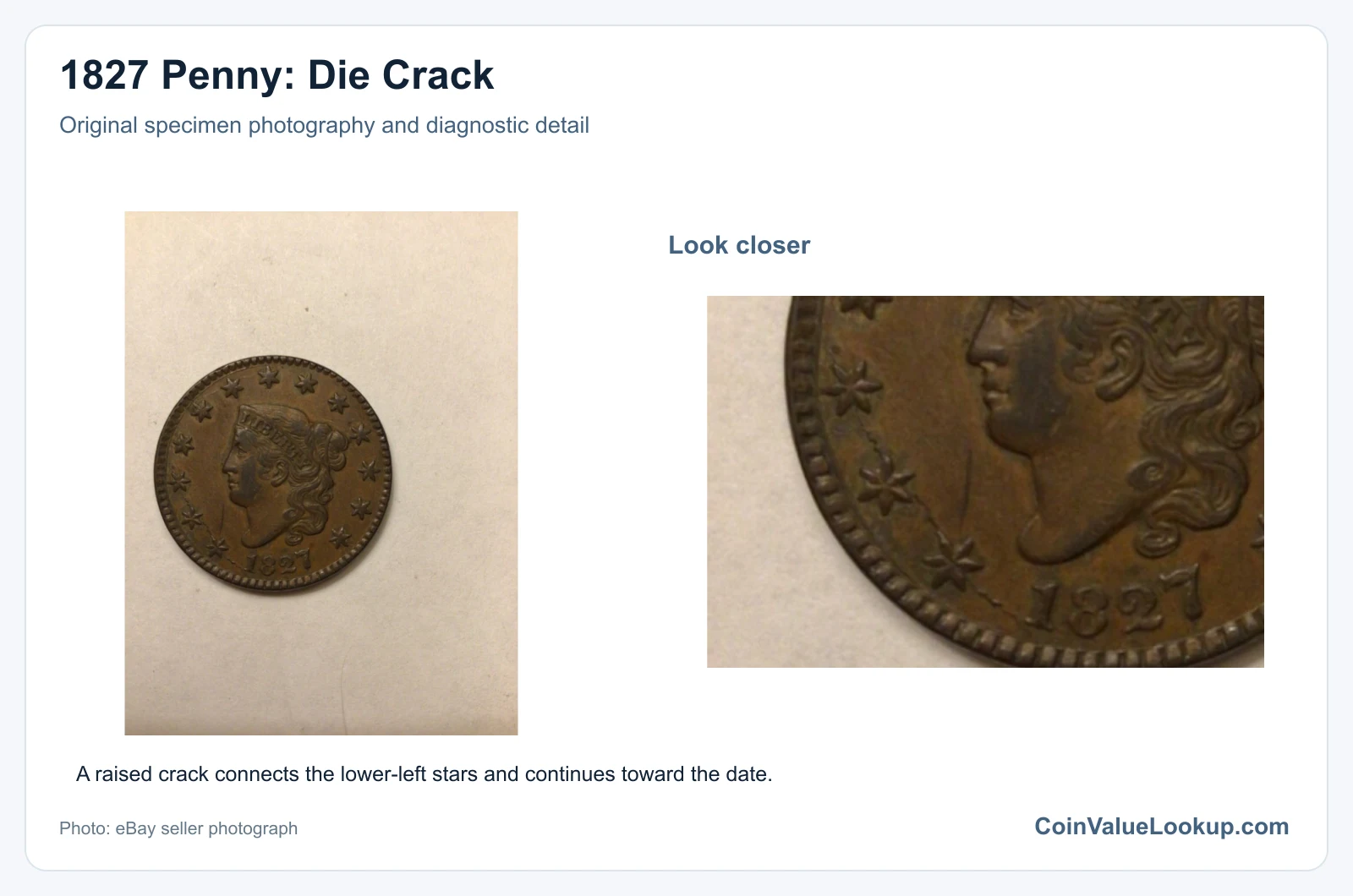
Die cracks appear as thin, raised lines running across the coin's surface. They form when a working die develops fractures from repeated striking pressure.
On an 1827 cent, look for these lines crossing open fields or cutting through letters and devices. They are raised above the surface because metal flows into the crack during striking.
The key distinction from a scratch is direction: a die crack is raised, while a scratch is incised into the surface. Corrosion lines and tool marks also sit below the surface or have irregular texture.
If you see a fine raised line that follows a path across the coin, photograph the full coin and a closeup of the affected area. Value depends on the crack's size, location, and the coin's overall grade, and requires individual assessment.
2. 1827 Coronet Head Cent — Die Break / Cud
A cud is a specific type of die break where a chunk of the die has broken away at the rim, leaving a raised, featureless blob of metal on the finished coin. It connects to the rim, which is the defining characteristic.
Interior die breaks that do not reach the rim are simply called die breaks and are less dramatic.
On an 1827 cent, inspect the entire rim on both sides. A cud displaces part of the design and has a smooth, rounded boundary where the die fragment separated.
Do not confuse it with a rim dent, which pushes metal inward rather than raising it, or with corrosion buildup along the edge.
No standard premium is established for this date. Each example needs individual evaluation based on the cud's size, position, and the coin's condition.
3. 1827 Coronet Head Cent — Clipped Planchet
A clipped planchet means the blank was cut improperly before striking, leaving a missing portion along the edge. The clip can be curved, straight, or ragged depending on how the error occurred.
On an 1827 cent, examine the entire edge for an area where metal is absent and the rim does not complete its circle.
A genuine clip often shows a corresponding area of design weakness on the opposite side of the coin, called the Blakesley effect. The edge at the clip will have a different texture than a filed or cut edge, which tends to show tool marks or sharp angles.
Do not confuse a clip with post-mint damage like someone filing a notch or corrosion eating away the edge. Value depends on the clip's size and the coin's overall preservation, and each piece should be assessed individually.
4. 1827 Coronet Head Cent — Off-Center Strike
An off-center strike happens when the planchet is not properly seated between the dies, so part of the design is missing and a blank crescent of unstruck metal appears on one side. The percentage off-center and whether the date remains visible are the two factors collectors care about most.
For an 1827 Coronet Head Cent, a visible date is critical. Without it, the coin cannot be attributed to this specific year, which limits its appeal considerably.
Look for the displaced design and confirm the blank crescent has a smooth, unstruck surface rather than showing signs of post-mint flattening or deliberate alteration.
A clipped planchet is a different error and will not show the same design displacement pattern. One-sided die misalignment can mimic a mild off-center strike but typically still shows a complete rim.
No standard price range is adopted for this error on the 1827 date, so individual evaluation is necessary.