1804 Draped Bust Cent Coin Value: How Much Is It Worth?
The 1804 Draped Bust Cent sits in a price window that depends entirely on which version you actually have. USA Coin Book guide estimates place the original Philadelphia issue from roughly $4,245 in Good-4 condition up to around $604,205 at the Mint State-60 level.
A later private restrike, however, carries far lower figures. Identifying the correct branch before pricing is essential.
Fast Way to Identify Your 1804 Draped Bust Cent
Not sure which 1804 cent you have? Upload clear photos of the front and back of your coin, and our identifier can give you a preliminary read on the variety and general condition.
That first step saves time before you dig into detailed comparisons or seek professional authentication.
1804 Draped Bust Cent Value
Upload both sides of your 1804 Draped Bust Cent.
Front Obverse
Upload photo
Back Reverse
Upload photo
Which 1804 Draped Bust Cent Versions Are Worth Money?
- Original 1804 cents carry guide estimates from $4,245 in G-4 to $604,205 in MS-60, per USA Coin Book, making them among the pricier Draped Bust dates.
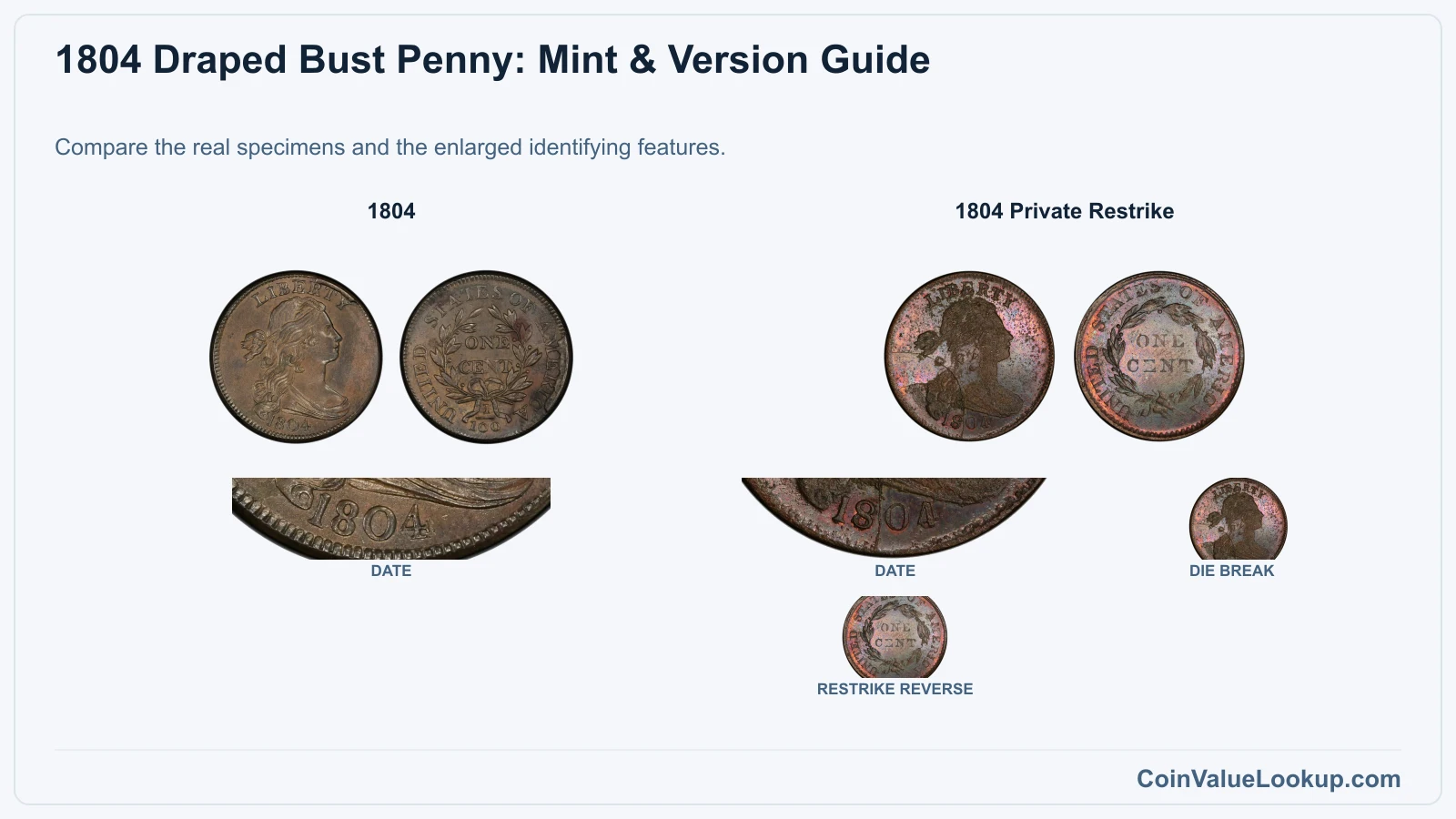
- The 1804 Private Restrike, struck around 1860, is a separate collectible with much lower guide values ranging from about $103 in G-4 to $1,877 in EF-40.
- Clipped planchet errors on this date are a reported category and can add collector interest beyond the base coin value.
- Die break or cud errors are also reported for 1804 cents, where a raised lump of metal connected to the rim signals a broken die.
Step 1: Identify Your 1804 Draped Bust Cent Mint Mark and Version
All genuine 1804 cents were struck at Philadelphia with no mintmark. Do not assume a branch-mint version exists for this date.
The critical distinction is between original Mint-produced cents and the private restrikes made around 1860. These are two completely different collectibles with very different values, so lumping them together will mislead you.
Examine both sides carefully. Date-punch shape, the style of the legend lettering, and wreath details can reveal which category your coin falls into.
Edge inspection helps too.
Weight can serve as supporting evidence since the nominal spec is about 10.89 grams in copper, but wear, corrosion, and original production tolerances mean weight alone will not prove authenticity. A coin that weighs close to spec could still be a restrike or even a counterfeit, so treat weight as one data point among several.
Step 2: Check Your 1804 Draped Bust Cent Grade

Focus on the portrait first. Hair detail above the ear and along the forehead, the smoothness of the cheek, and the sharpness of the bust drapery tell you a lot about how much this coin circulated.
On the reverse, check individual leaf detail in the wreath and the crispness of the denomination lettering.
Use the comparison image to match your coin against known grade benchmarks for the Draped Bust type. A coin in Good-4 will show a clear outline and date but most fine detail is worn flat.
By contrast, an EF-40 retains sharp hair strands and full leaf veins.
Do not confuse wear from circulation with a weak original strike or surface porosity. Old copper is prone to corrosion, and a porous or cleaned surface can tank market appeal even if the design detail looks decent.
These problems are not the same as honest wear.
Color designations like BN, RB, and RD describe the remaining original red on a copper coin. They are color attributes, not separate alloy types.
And "Proof" refers to a manufacturing method, not a grade above Mint State.
Step 3: Check 1804 Draped Bust Cent Value by Mint and Version
1804 Draped Bust Cent
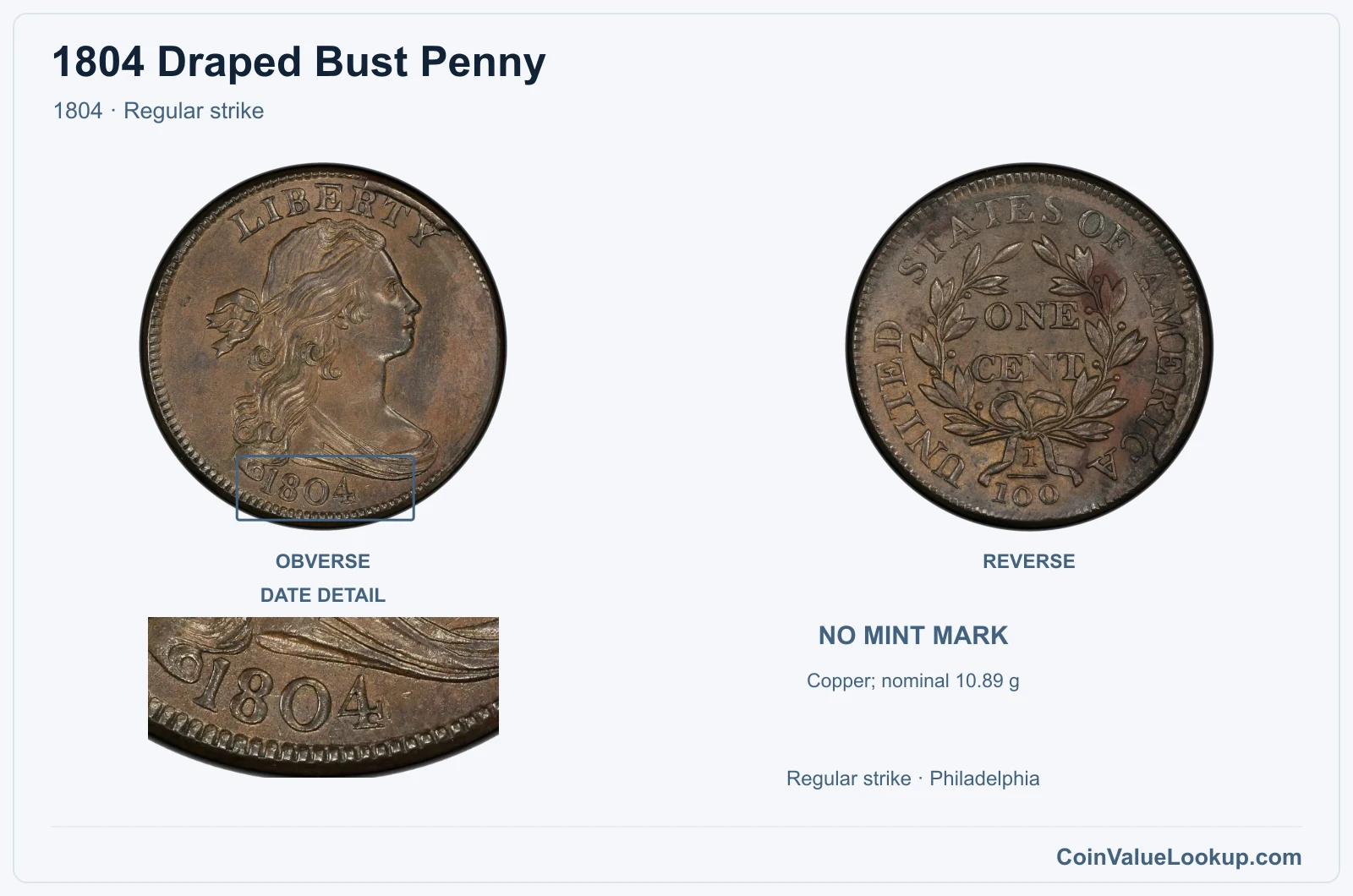
This is the coin you probably picture when someone says "1804 cent." Struck at Philadelphia in copper on planchets weighing nominally 10.89 grams, it carries the classic Draped Bust obverse with a wreath and denomination reverse. No mintmark appears.
USA Coin Book guide estimates run from approximately $4,245 in Good-4 to around $604,205 at the MS-60 level. That is an enormous spread, and most survivors sit in the lower circulated grades.
Surface quality matters a great deal on early copper, so a problem-free example commands a premium over one with corrosion, tooling, or cleaning.
Remember that restrike copies exist. Confirming your coin is an original Mint issue is the first step before applying these values.
| Range | Grade | Price | Auction Records | Appraisal |
|---|---|---|---|---|
| PO | PO 1 | — | Coin Identifier | |
| FR | FR 2 | Coin Identifier | ||
| AG | AG 3 | Coin Identifier | ||
| G | G 4 | Coin Identifier | ||
| G 6 | Coin Identifier | |||
| VG | VG 8 | Coin Identifier | ||
| VG 10 | Coin Identifier | |||
| F | F 12 | Coin Identifier | ||
| F 15 | Coin Identifier | |||
| VF | VF 20 | Coin Identifier | ||
| VF 25 | Coin Identifier | |||
| VF 30 | Coin Identifier | |||
| VF 35 | Coin Identifier | |||
| XF | XF 40 | Coin Identifier | ||
| XF 45 | Coin Identifier | |||
| AU | AU 50 | Coin Identifier | ||
| AU 53 | — | Coin Identifier | ||
| AU 55 | Coin Identifier | |||
| AU 58 | — | Coin Identifier | ||
| MS | MS 60 | — | Coin Identifier | |
| MS 61 | — | Coin Identifier | ||
| MS 62 | — | Coin Identifier | ||
| MS 63 | — | Coin Identifier | ||
| MS 64 | — | — | — | |
| MS 65 | — | — | — | |
| MS 66 | — | — | — | |
| MS 67 | — | — | — | |
| MS 68 | — | — | — | |
| MS 69 | — | — | — | |
| MS 70 | — | — | — |
1804 Draped Bust Cent — Private Restrike
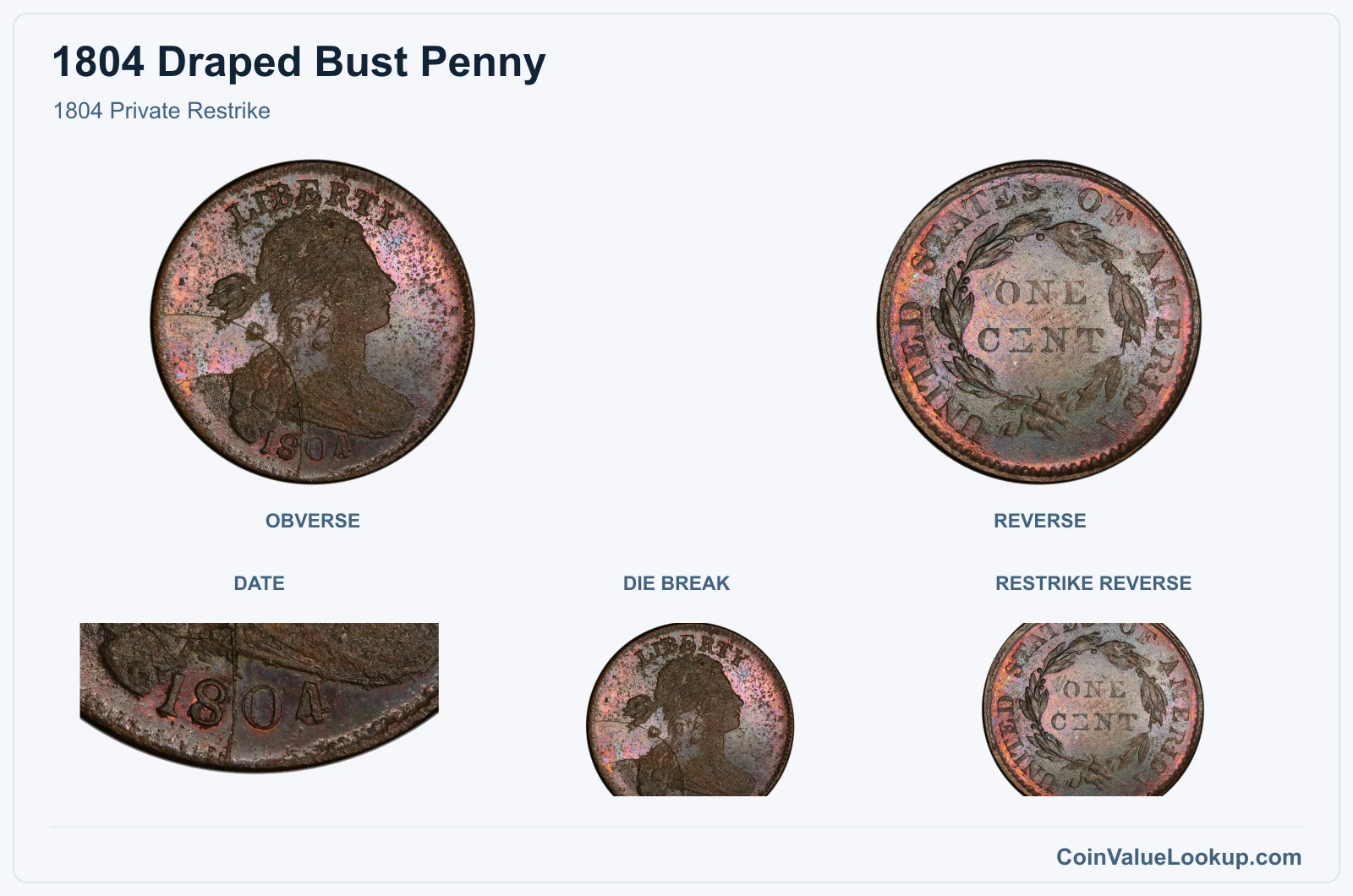
This is not an original 1804 Mint product. The private restrike was produced around 1860 as a collector novelty, using dies from the original period.
It shares the Draped Bust design and nominal 10.89-gram copper composition, but it belongs in its own category entirely.
USA Coin Book lists guide estimates of roughly $103 in Good-4 and about $1,877 in EF-40 for this piece. Those numbers reflect its status as a later collector production, not a coin that actually circulated in the early 1800s.
Coin Value Lookup is a handy starting point if you want to compare guide values across other Draped Bust dates or different series altogether. It can help you quickly pull up the right reference before committing to a purchase or sale.
| Range | Grade | Price | Auction Records | Appraisal |
|---|---|---|---|---|
| PO | PO 1 | — | Coin Identifier | |
| FR | FR 2 | — | Coin Identifier | |
| AG | AG 3 | — | Coin Identifier | |
| G | G 4 | — | Coin Identifier | |
| G 6 | — | Coin Identifier | ||
| VG | VG 8 | — | Coin Identifier | |
| VG 10 | — | Coin Identifier | ||
| F | F 12 | — | Coin Identifier | |
| F 15 | — | Coin Identifier | ||
| VF | VF 20 | — | Coin Identifier | |
| VF 25 | — | Coin Identifier | ||
| VF 30 | — | Coin Identifier | ||
| VF 35 | — | Coin Identifier | ||
| XF | XF 40 | — | Coin Identifier | |
| XF 45 | — | Coin Identifier | ||
| AU | AU 50 | Coin Identifier | ||
| AU 53 | — | Coin Identifier | ||
| AU 55 | Coin Identifier | |||
| AU 58 | Coin Identifier | |||
| MS | MS 60 | — | Coin Identifier | |
| MS 61 | Coin Identifier | |||
| MS 62 | Coin Identifier | |||
| MS 63 | Coin Identifier | |||
| MS 64 | Coin Identifier | |||
| MS 65 | Coin Identifier | |||
| MS 66 | Coin Identifier | |||
| MS 67 | — | — | — | |
| MS 68 | — | — | — | |
| MS 69 | — | — | — | |
| MS 70 | — | — | — |
1804 Draped Bust Cent Error List
1. 1804 Draped Bust Cent — Clipped Planchet
A clipped planchet means a portion of the original copper blank was missing before the coin was struck. You will see a curved, straight, or irregular section of the edge that is absent, and the design near that area may show weakness because the metal could not flow fully into the die.
Look at the opposite side of the coin from the clip. A genuine clip often produces a slight area of weakness there, sometimes called the Blakesley effect.
This helps separate a real pre-strike clip from a post-strike filed edge, corrosion loss, or deliberate cut.
No specific price range is adopted for clipped 1804 cents. Value depends on the authenticated identity of the coin, the size and type of the clip, and overall condition.
Professional authentication is the safest route for a coin of this age and value.
2. 1804 Draped Bust Cent — Die Break / Cud
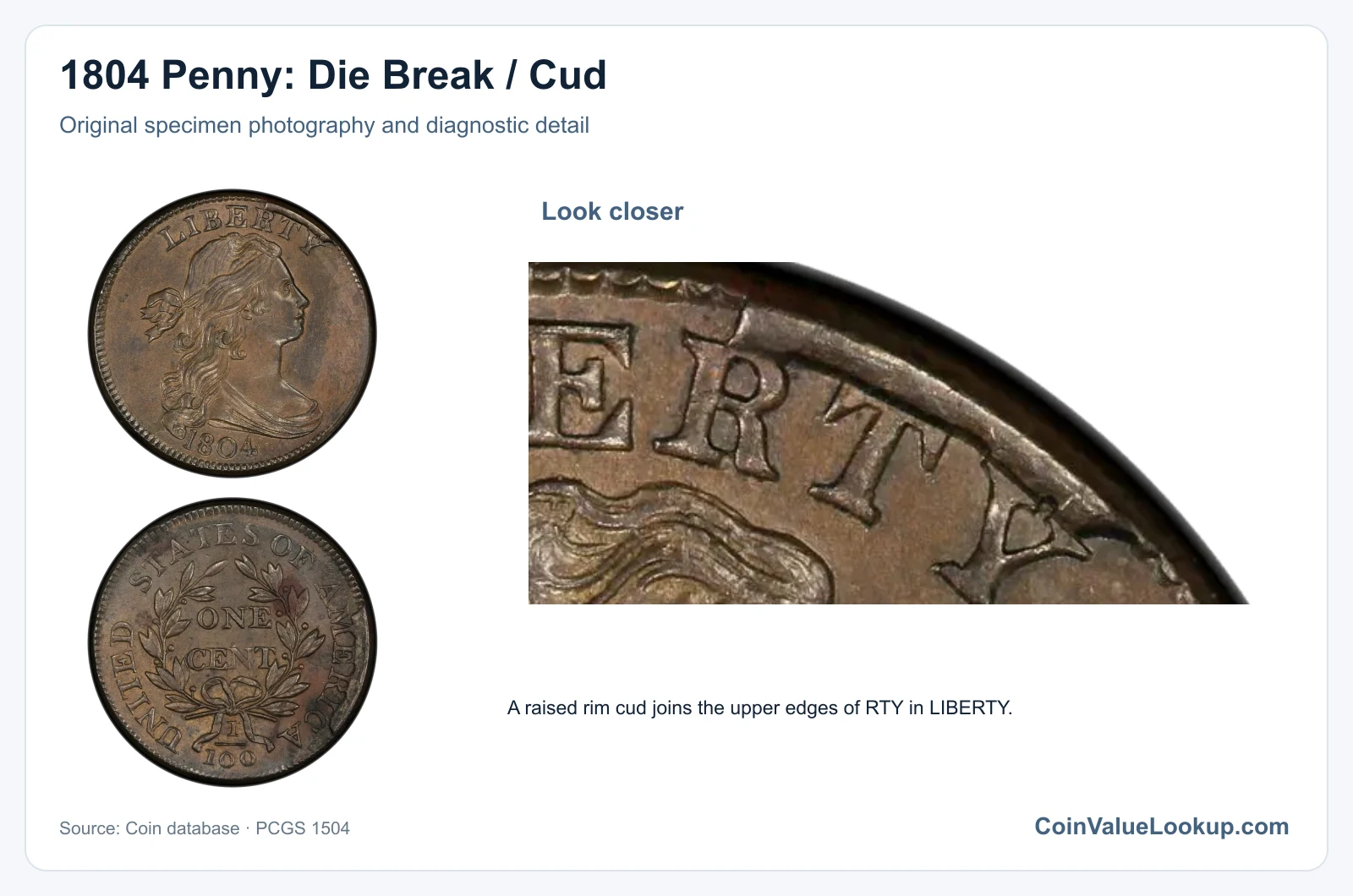
A die break leaves a raised, irregular blob of metal on the coin where a chunk of the die itself cracked away. When that raised area connects to the rim, collectors call it a cud.
You can usually see the boundary where normal design detail stops and the featureless raised mass begins.
Do not confuse this with a rim dent, which is recessed, or with interior die chips that appear as small raised dots away from the rim. Corrosion bumps also mimic cuds at first glance, but they lack the sharp boundary and the displaced design element that a genuine die break shows.
No adopted numeric price range exists for die-break examples of the 1804 cent. The premium depends on the size and location of the cud, the coin's authenticated variety, and its overall grade.
Larger cuds that obliterate recognizable design elements tend to draw more collector attention.