1795 Flowing Hair Large Cent Coin Value: How Much Is It Worth?
The 1795 Flowing Hair Large Cent is one of the earliest copper coins struck by the United States Mint. Guide estimates for the two main business-strike varieties range from about $498 in Good-4 to $7,329 in Extremely Fine-40, depending on which edge type you have.
Rare branches such as the Reeded Edge and Jefferson Head varieties carry dramatically different values, so identifying your exact coin matters a great deal before assuming any price applies.
Fast Way to Identify Your 1795 Flowing Hair Large Cent
The fastest way to start figuring out what you have is to upload clear photos of both the front and back of your coin. Our identifier can offer a preliminary identification based on those images, helping you narrow down the variety and edge type.
Keep in mind this is not a substitute for professional authentication or grading, but it gives you a solid starting point.
1795 Flowing Hair Large Cent Value
Upload both sides of your 1795 Flowing Hair Large Cent.
Front Obverse
Upload photo
Back Reverse
Upload photo
Which 1795 Flowing Hair Large Cent Versions Are Worth Money?
- Lettered Edge cents (heavier copper standard) carry guide estimates from roughly $666 in G-4 to $7,329 in EF-40, making higher-grade survivors particularly desirable.
- Plain Edge cents (lighter standard) guide from about $498 in G-4 to $4,940 in EF-40, a bit more accessible in lower grades.
- The Reeded Edge variety is exceptionally rare, with a single reported guide anchor near $312,881 in G-4; professional attribution is mandatory.
- Jefferson Head varieties, both Plain Edge and Lettered Edge, are unusual related productions with guide estimates reaching six figures in higher grades.
- Mint errors such as clips, off-center strikes and brockages on any 1795 Large Cent require individual expert assessment.
Step 1: Identify Your 1795 Flowing Hair Large Cent Mint Mark and Version
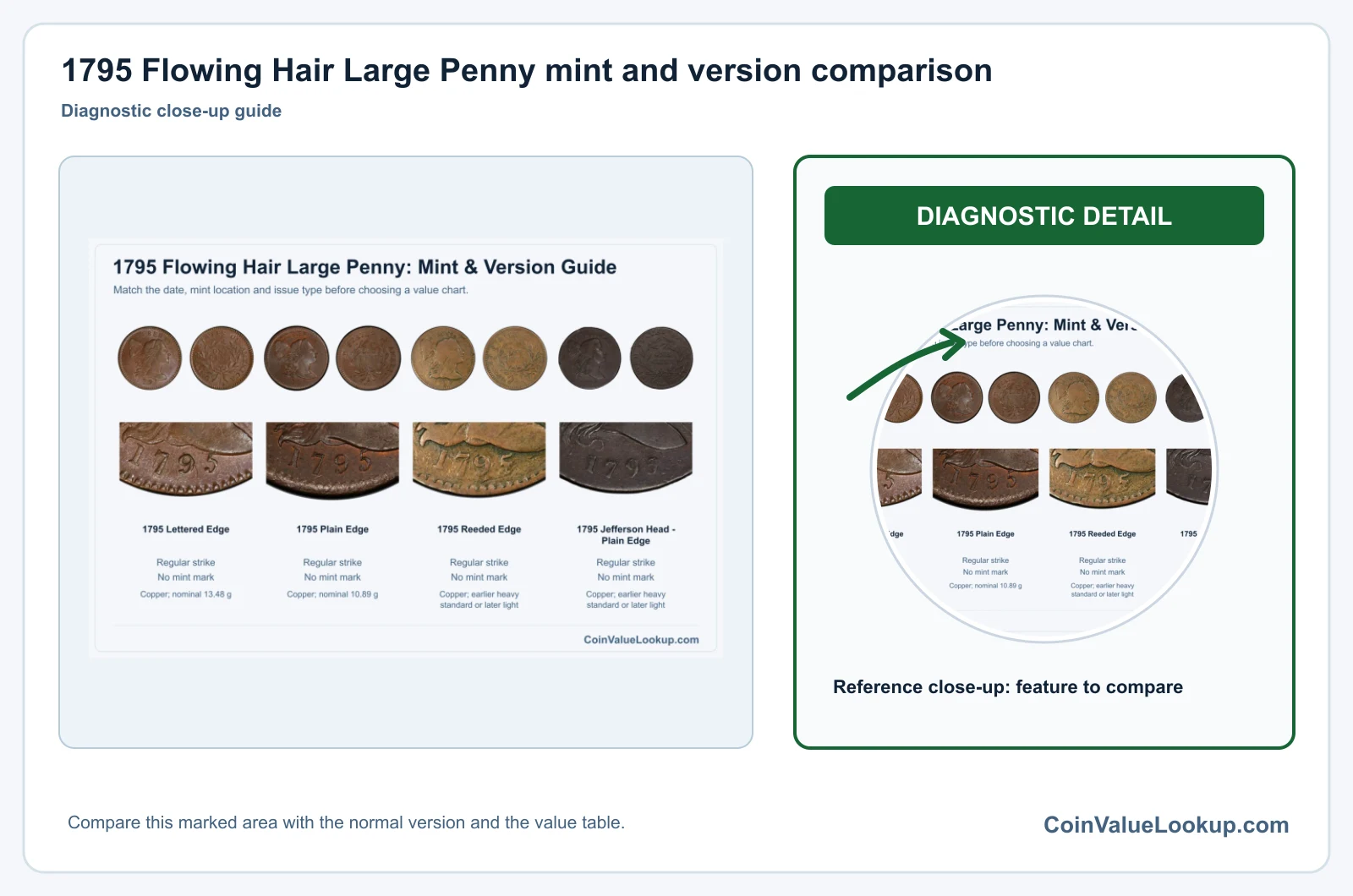
All 1795 Flowing Hair Large Cents were produced at the Philadelphia Mint, so there is no mintmark to look for. The critical distinction is the edge of the coin.
Lettered Edge cents carry the inscription "ONE HUNDRED FOR A DOLLAR" around the rim and were struck on heavier copper planchets with a nominal weight of about 13.48 grams. Plain Edge cents have a smooth, unlettered edge and use a lighter 10.89-gram planchet that reflects the reduced copper standard adopted partway through the year.
A third edge variety, the Reeded Edge, is genuinely rare. You will feel or see fine vertical lines around the rim, similar to a modern dime.
If you think you have one, professional attribution is essential.
The Jefferson Head varieties show a noticeably different portrait from the standard Liberty Cap design. These are unusual related productions of disputed origin, not routine federal issues.
They exist with both plain and lettered edges. Compare your coin's portrait carefully to known reference images at equal scale before jumping to conclusions.
Weight can support your identification but should not be the sole basis. Wear, corrosion and original production tolerances mean a heavily worn Lettered Edge cent might weigh less than expected.
Step 2: Check Your 1795 Flowing Hair Large Cent Grade
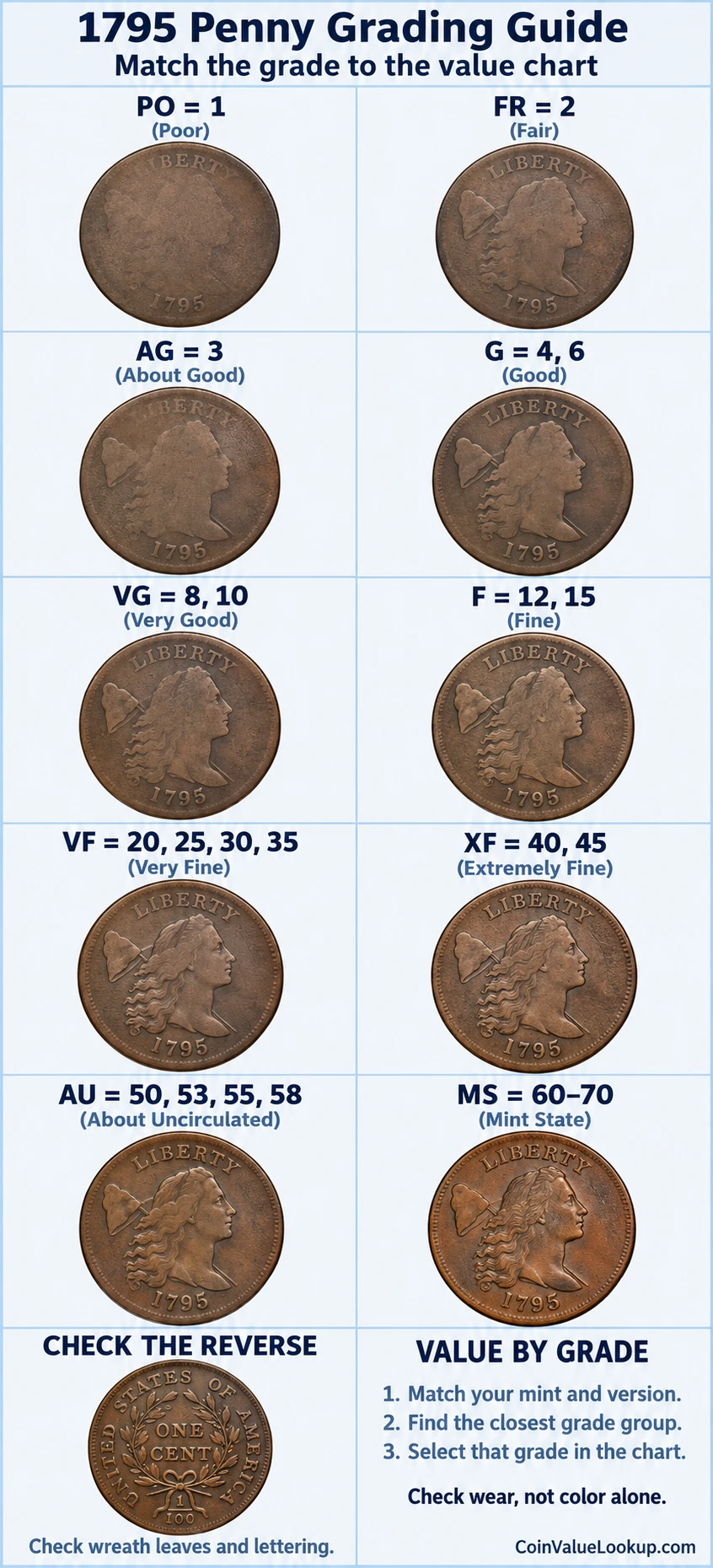
Start with the portrait. On a well-struck example in higher grades, individual hair strands above Liberty's forehead and behind her ear should be distinct.
As the coin wears into Very Fine territory, those strands merge into flat bands, and the cheek loses its rounded contour.
The wreath on the reverse tells a similar story. Leaf veins disappear first, then the leaves flatten into the surrounding field.
By Good-4, the wreath outline and legend are readable but most interior detail is gone.
Use the comparison image to match your coin's remaining detail against known grade benchmarks for this type. Pay attention to whether lost detail comes from actual circulation wear or from a weak original strike, which is common on early copper.
Surface problems matter enormously on these coins. Porosity, corrosion, cleaning and environmental damage can significantly reduce what a collector will pay, even if the underlying sharpness looks decent.
A coin with sharp detail but heavy cleaning may sell for less than a naturally worn but problem-free piece at a lower grade. Color designations like BN, RB and RD describe surface color on copper, not different alloys or separate grades.
Step 3: Check 1795 Flowing Hair Large Cent Value by Mint and Version
1795 Flowing Hair Large Cent — Lettered Edge
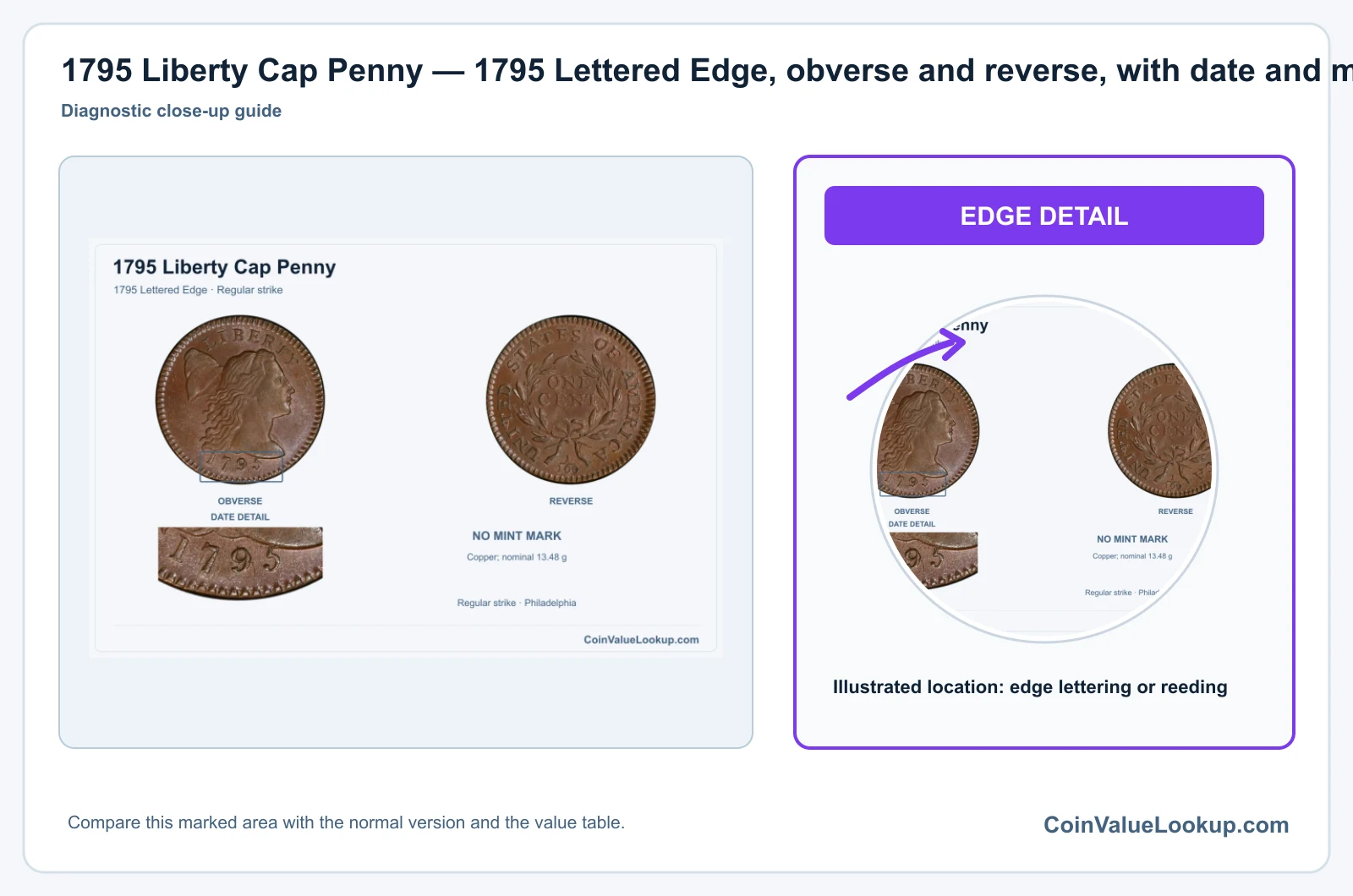
The 1795 Lettered Edge cent was struck on the heavier copper planchet standard, nominally 13.48 grams. Check the edge for the inscription "ONE HUNDRED FOR A DOLLAR" running around the rim.
This is a business-strike issue from the Philadelphia Mint.
Guide estimates from USA Coin Book place this variety at roughly $666 in Good-4 and $7,329 in Extremely Fine-40. That is a wide spread, and it reflects how much surviving condition matters on a coin that is well over two centuries old.
Problem-free examples with strong detail command strong premiums.
| Range | Grade | Price | Auction Records | Appraisal |
|---|---|---|---|---|
| PO | PO 1 | Coin Identifier | ||
| FR | FR 2 | Coin Identifier | ||
| AG | AG 3 | Coin Identifier | ||
| G | G 4 | Coin Identifier | ||
| G 6 | Coin Identifier | |||
| VG | VG 8 | Coin Identifier | ||
| VG 10 | Coin Identifier | |||
| F | F 12 | Coin Identifier | ||
| F 15 | Coin Identifier | |||
| VF | VF 20 | — | Coin Identifier | |
| VF 25 | Coin Identifier | |||
| VF 30 | Coin Identifier | |||
| VF 35 | Coin Identifier | |||
| XF | XF 40 | Coin Identifier | ||
| XF 45 | Coin Identifier | |||
| AU | AU 50 | Coin Identifier | ||
| AU 53 | Coin Identifier | |||
| AU 55 | Coin Identifier | |||
| AU 58 | Coin Identifier | |||
| MS | MS 60 | — | Coin Identifier | |
| MS 61 | — | Coin Identifier | ||
| MS 62 | Coin Identifier | |||
| MS 63 | Coin Identifier | |||
| MS 64 | Coin Identifier | |||
| MS 65 | Coin Identifier | |||
| MS 66 | — | — | — | |
| MS 67 | — | — | — | |
| MS 68 | — | — | — | |
| MS 69 | — | — | — | |
| MS 70 | — | — | — |
1795 Flowing Hair Large Cent — Plain Edge
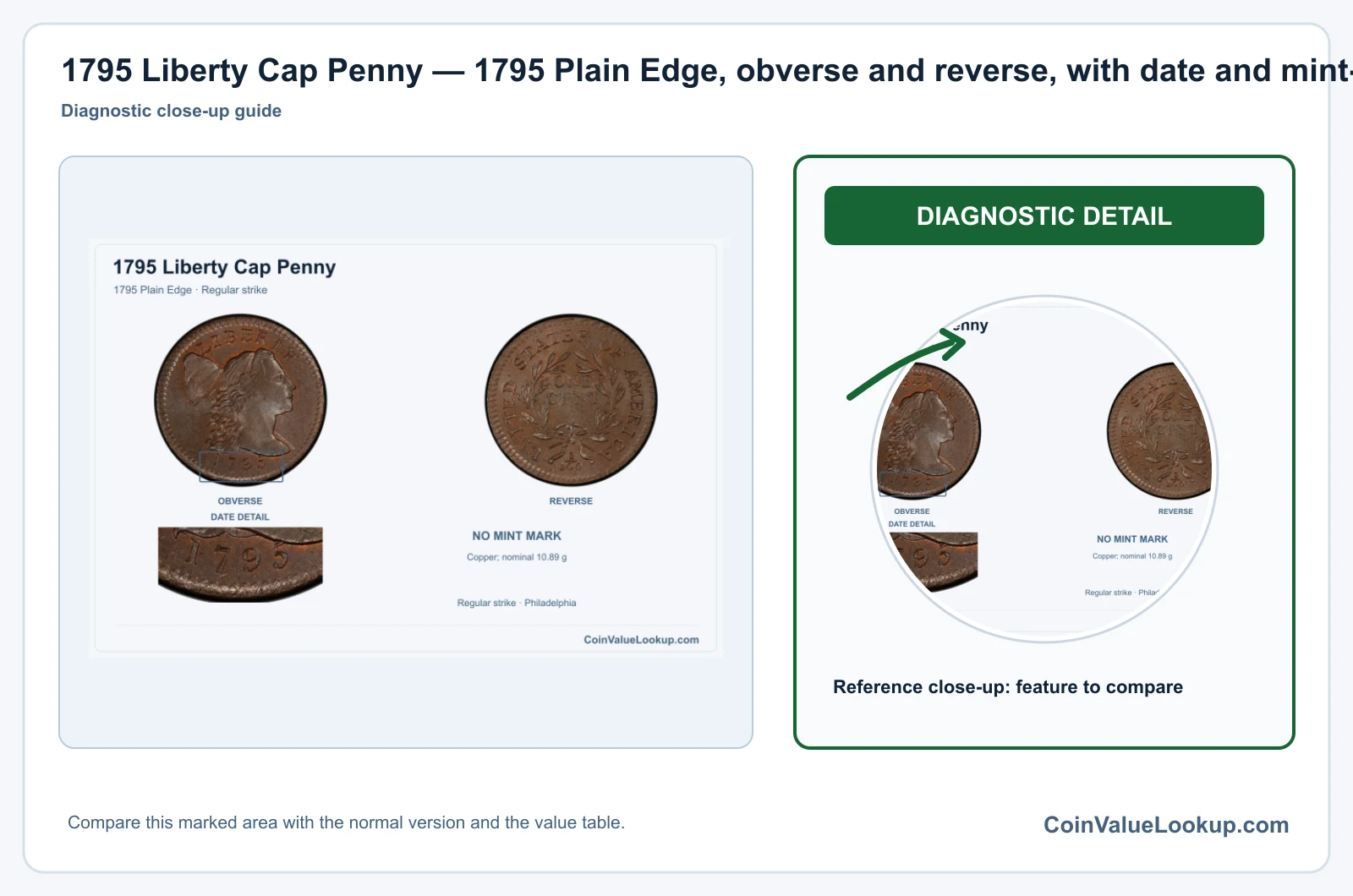
The 1795 Plain Edge cent uses the lighter copper standard at a nominal 10.89 grams. The edge is smooth with no lettering or reeding.
This reflects the Mint's mid-year switch to a reduced planchet weight.
Guide estimates run about $498 in Good-4 to $4,940 in Extremely Fine-40 per USA Coin Book. Slightly more affordable than the Lettered Edge variety in lower grades, but still a serious early American copper coin.
If you can visit Coin Value Lookup, you can look up additional denominations and years for comparison as you explore early U.S. coinage.
| Range | Grade | Price | Auction Records | Appraisal |
|---|---|---|---|---|
| PO | PO 1 | Coin Identifier | ||
| FR | FR 2 | Coin Identifier | ||
| AG | AG 3 | Coin Identifier | ||
| G | G 4 | Coin Identifier | ||
| G 6 | Coin Identifier | |||
| VG | VG 8 | Coin Identifier | ||
| VG 10 | Coin Identifier | |||
| F | F 12 | Coin Identifier | ||
| F 15 | Coin Identifier | |||
| VF | VF 20 | Coin Identifier | ||
| VF 25 | Coin Identifier | |||
| VF 30 | Coin Identifier | |||
| VF 35 | Coin Identifier | |||
| XF | XF 40 | Coin Identifier | ||
| XF 45 | Coin Identifier | |||
| AU | AU 50 | Coin Identifier | ||
| AU 53 | Coin Identifier | |||
| AU 55 | Coin Identifier | |||
| AU 58 | Coin Identifier | |||
| MS | MS 60 | — | Coin Identifier | |
| MS 61 | Coin Identifier | |||
| MS 62 | Coin Identifier | |||
| MS 63 | Coin Identifier | |||
| MS 64 | Coin Identifier | |||
| MS 65 | — | Coin Identifier | ||
| MS 66 | — | Coin Identifier | ||
| MS 67 | — | — | — | |
| MS 68 | — | — | — | |
| MS 69 | — | — | — | |
| MS 70 | — | — | — |
1795 Flowing Hair Large Cent — Reeded Edge
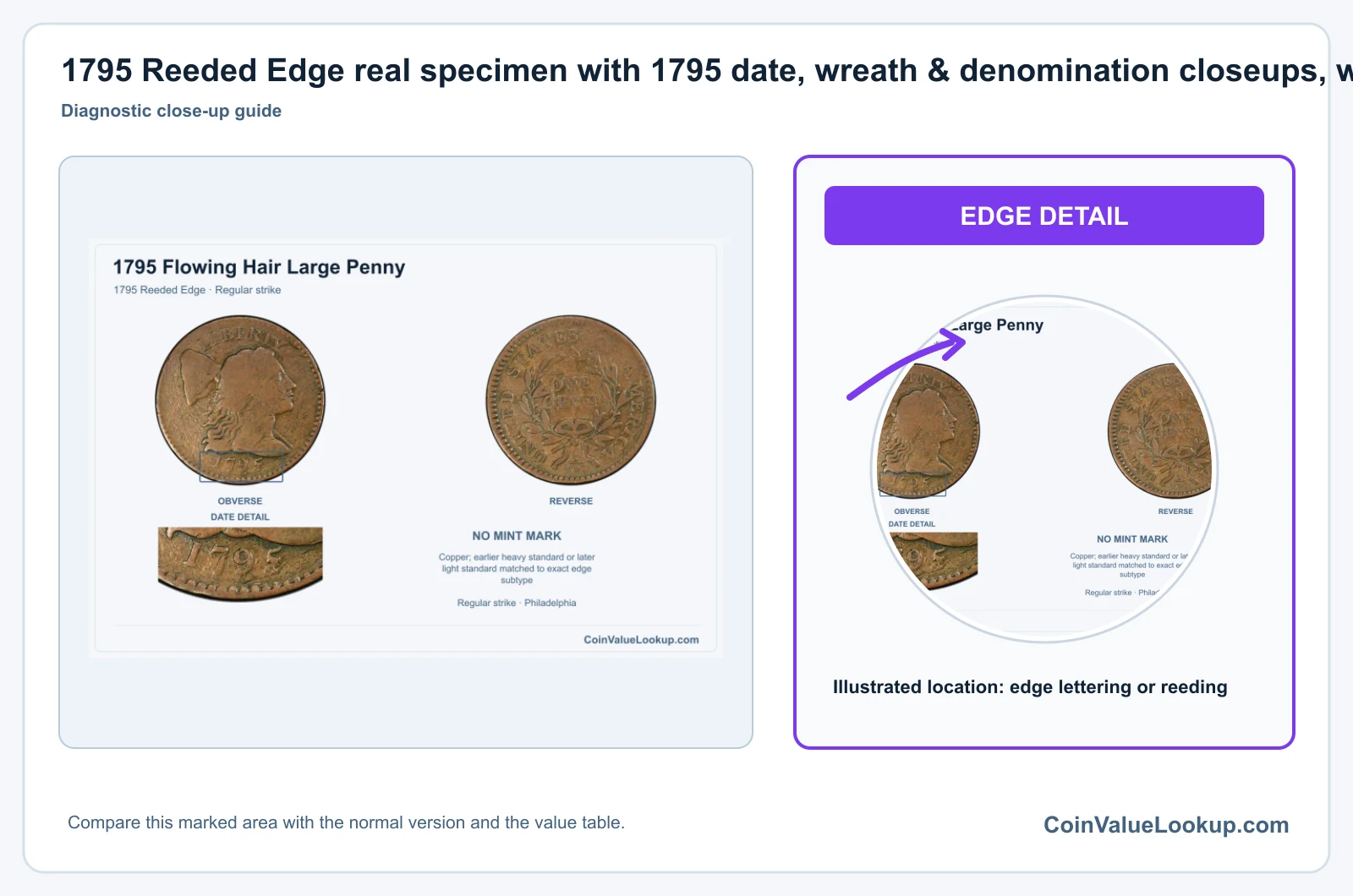
The Reeded Edge variety of the 1795 Large Cent is genuinely rare. Instead of lettering or a plain rim, the edge shows fine vertical lines similar to modern silver-colored coins.
A guide estimate of approximately $312,881 in Good-4 gives you a sense of the scarcity involved.
Do not assume you have this variety based on edge marks alone. Damaged edges, rim filing and post-mint alterations can mimic reeding.
If you suspect a Reeded Edge cent, have it examined and attributed by a professional grading service before making any value assumptions. Comparison against the ordinary Lettered and Plain Edge branches at equal magnification is the first step.
Range Grade
Price Auction Records Appraisal PO PO 1
—
Coin Identifier FR FR 2
—
Coin Identifier AG AG 3
—
Coin Identifier G G 4
Coin Identifier
G 6
—
Coin Identifier VG VG 8
—
Coin Identifier
VG 10
—
Coin Identifier F F 12
—
—
—
F 15
—
—
— VF VF 20
—
—
—
VF 25
—
—
—
VF 30
—
—
—
VF 35
—
—
— XF XF 40
—
—
—
XF 45
—
—
— AU AU 50
—
—
—
AU 53
—
—
—
AU 55
—
—
—
AU 58
—
—
— MS MS 60
—
—
—
MS 61
—
—
—
MS 62
—
—
—
MS 63
—
—
—
MS 64
—
—
—
MS 65
—
—
—
MS 66
—
—
—
MS 67
—
—
—
MS 68
—
—
—
MS 69
—
—
—
MS 70
—
—
—
1795 Flowing Hair Large Cent — Jefferson Head – Plain Edge
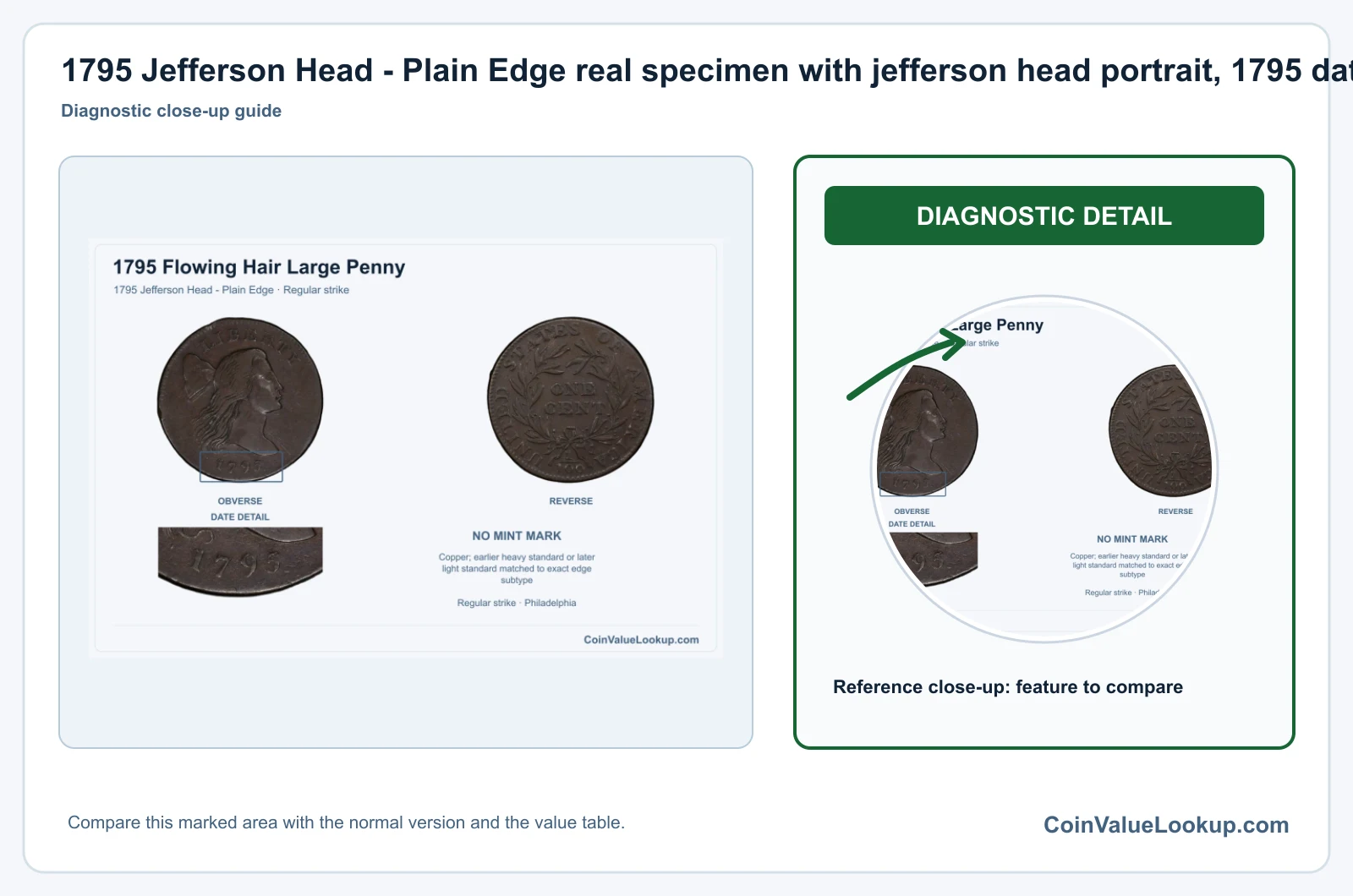
The Jefferson Head Plain Edge cent features a distinctly different portrait from the standard Liberty Cap design. The face is more angular and the hair treatment differs noticeably.
This is classified as an unusual related production of disputed origin rather than a routine Philadelphia Mint issue.
Guide estimates from USA Coin Book place this variety at about $30,915 in Good-4 and roughly $187,749 in Extremely Fine-40. Those figures reflect extreme rarity.
Any coin suspected of being a Jefferson Head requires careful comparison to authenticated reference examples and professional attribution. The plain edge and lighter-standard planchet weight can help distinguish it from lettered-edge counterparts.
Range Grade
Price Auction Records Appraisal PO PO 1
—
Coin Identifier FR FR 2
—
Coin Identifier AG AG 3
—
Coin Identifier G G 4
Coin Identifier
G 6
—
Coin Identifier VG VG 8
Coin Identifier
VG 10
—
Coin Identifier F F 12
—
Coin Identifier
F 15
Coin Identifier VF VF 20
Coin Identifier
VF 25
Coin Identifier
VF 30
—
Coin Identifier
VF 35
—
Coin Identifier XF XF 40
—
Coin Identifier
XF 45
—
—
— AU AU 50
—
—
—
AU 53
—
—
—
AU 55
—
—
—
AU 58
—
—
— MS MS 60
—
—
—
MS 61
—
—
—
MS 62
—
—
—
MS 63
—
—
—
MS 64
—
—
—
MS 65
—
—
—
MS 66
—
—
—
MS 67
—
—
—
MS 68
—
—
—
MS 69
—
—
—
MS 70
—
—
—
1795 Flowing Hair Large Cent — Jefferson Head – Lettered Edge
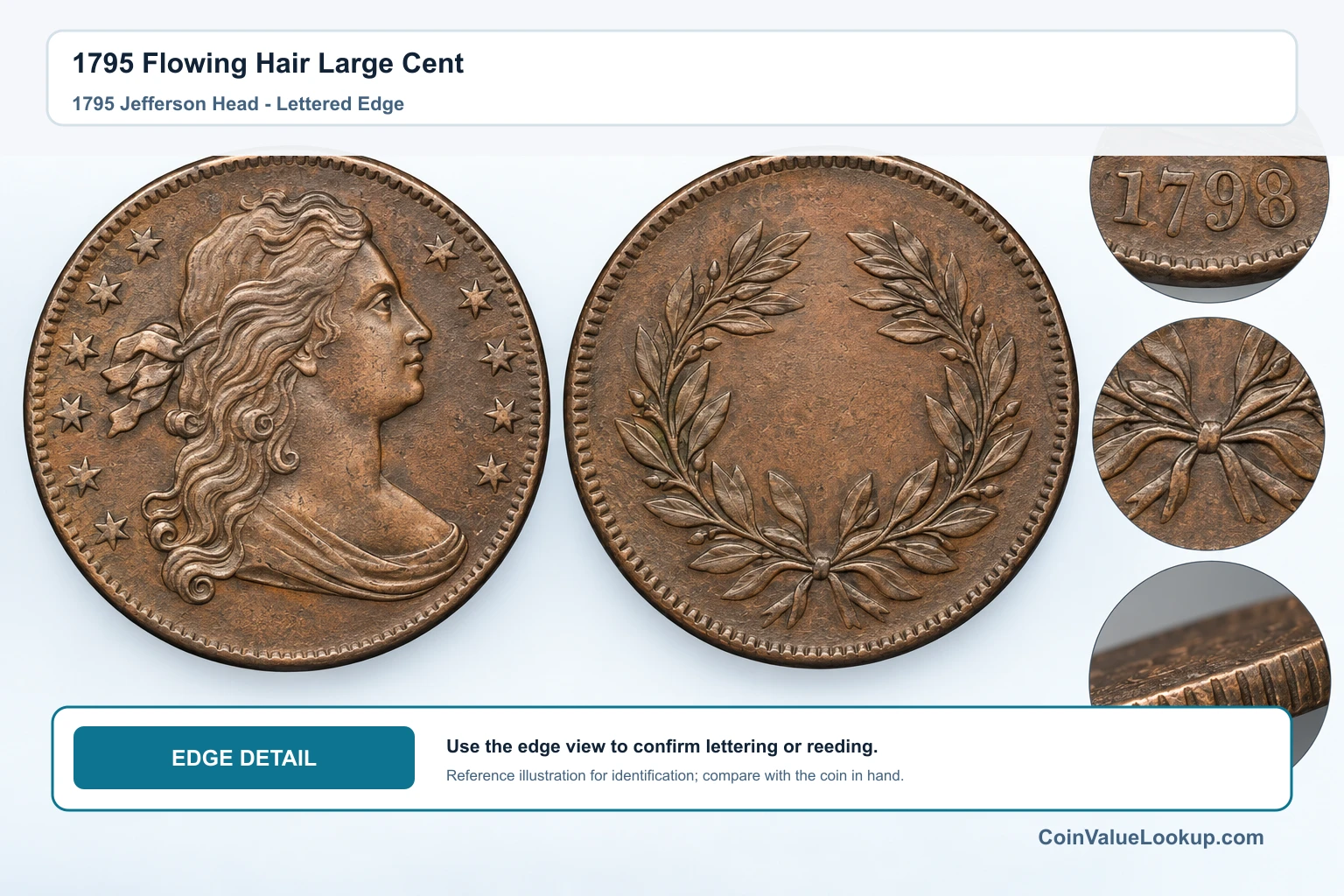
This variety pairs the distinctive Jefferson Head portrait with a lettered edge reading "ONE HUNDRED FOR A DOLLAR." Like its plain-edge sibling, this is considered an unusual related production of disputed origin.
Guide estimates are reported at approximately $66,341 in Very Good-8 and around $240,548 in Very Fine-20 per USA Coin Book. No Good-4 anchor is listed for this branch, so do not assume values simply scale down from there.
Attribution is critical; the portrait differences between the standard Liberty Cap and the Jefferson Head can be subtle to untrained eyes. Side-by-side comparison at equal scale, combined with professional review, is the only responsible path to confirming this variety.
Range Grade
Price Auction Records Appraisal PO PO 1
—
Coin Identifier FR FR 2
—
Coin Identifier AG AG 3
—
Coin Identifier G G 4
—
Coin Identifier
G 6
—
Coin Identifier VG VG 8
—
Coin Identifier
VG 10
—
Coin Identifier F F 12
—
Coin Identifier
F 15
—
Coin Identifier VF VF 20
—
Coin Identifier
VF 25
—
Coin Identifier
VF 30
—
Coin Identifier
VF 35
—
—
— XF XF 40
—
—
—
XF 45
—
—
— AU AU 50
—
—
—
AU 53
—
—
—
AU 55
—
—
—
AU 58
—
—
— MS MS 60
—
—
—
MS 61
—
—
—
MS 62
—
—
—
MS 63
—
—
—
MS 64
—
—
—
MS 65
—
—
—
MS 66
—
—
—
MS 67
—
—
—
MS 68
—
—
—
MS 69
—
—
—
MS 70
—
—
—
1795 Flowing Hair Large Cent Error List
1. 1795 Flowing Hair Large Cent — Clipped Planchet
A clipped planchet error on a 1795 Flowing Hair Large Cent means a portion of the original copper blank was missing before the coin was struck. Look for a curved, straight or irregular section of the rim that appears to be absent, with the design fading into the missing area rather than being cut through.
The area directly opposite the clip often shows slight design weakness, which helps confirm the clip happened before striking. Compare this to post-mint damage: a filed edge, deliberate notch or corrosion pit will typically cut through the design sharply or show tool marks.
No supported price range is available for this error on the 1795 cent. Value depends heavily on the authenticated identity, specific variety, condition and severity of the clip, so individual professional assessment is the way to go.
2. 1795 Flowing Hair Large Cent — Off-Center Strike
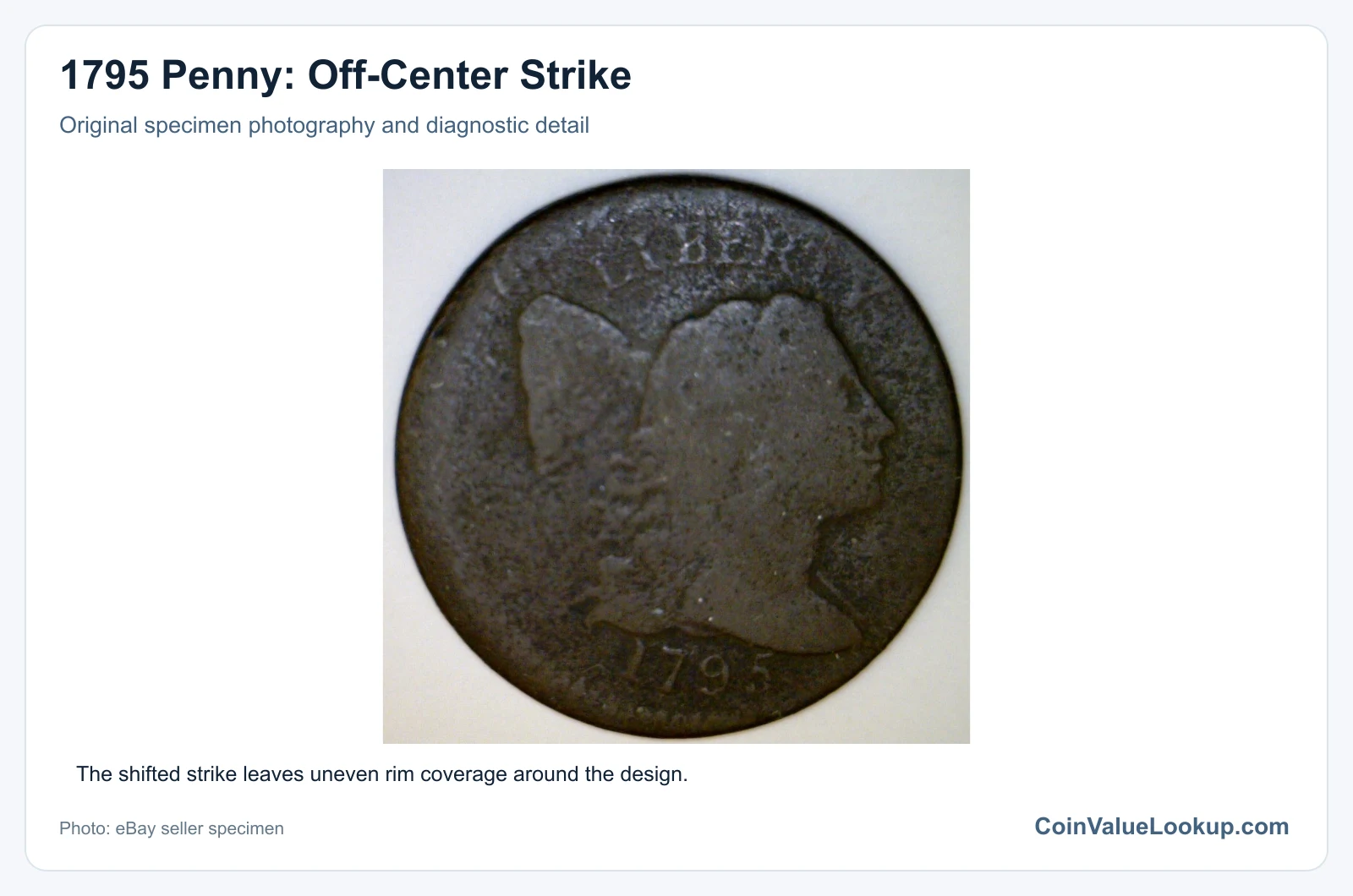
An off-center strike occurs when the planchet is not properly centered between the dies. On a 1795 Large Cent this produces a displaced design with an unstruck crescent of blank copper on one side.
The date needs to remain visible for the coin to be attributed to this year.
Do not confuse an off-center strike with a clipped planchet or a die misalignment that affects only one side. Post-mint flattening from a vise or similar tool can also push the design off-center in appearance, but the blank will still be round and the distortion uneven.
No supported price range is adopted for off-center 1795 Large Cents. Each example must be evaluated individually based on its authenticated identity, the percentage of off-center displacement, whether the date is legible, and overall condition.
3. 1795 Flowing Hair Large Cent — Brockage
A brockage happens when a previously struck coin sticks to a die and impresses its design into the next blank fed into the press. The result is one normal side and one side showing an incuse, mirror-image version of the design from the stuck coin.
On a 1795 Large Cent, look for a sunken reversed impression on one face while the opposite face appears normal. The incuse image should be a true mirror, not just a shadow or faint outline.
A die clash leaves faint ghosted elements from the opposing die but does not produce a full incuse mirror image. Coins pressed together after minting can also look similar but lack the even depth and centering of a genuine brockage.
No numeric price range is supported for this error. Value requires individual assessment based on authenticated identity, clarity of the brockage and overall coin condition.