1882 Indian Head Penny Coin Value: How Much Is It Worth?
The 1882 Indian Head penny is a solid Philadelphia-only bronze cent that turns up regularly in old collections. A guide estimate from USA Coin Book places the regular business strike at about $6.25 in G4 (a well-worn but readable coin) up to around $112 in MS63 (a coin with original mint luster and only light contact marks).
Proofs, mint errors, and coins with exceptional original color require separate evaluation beyond those anchors.
Fast Way to Identify Your 1882 Indian Head Penny
Want a quick read on your 1882 Indian Head cent? Upload clear photos of both the front and back, and our identifier can provide a preliminary identification of your coin's version and approximate condition.
Sharp, well-lit images help distinguish proof surfaces from business strikes and reveal any error features worth investigating further.
1882 Indian Head Penny Value
Upload both sides of your 1882 Indian Head Penny.
Front Obverse
Upload photo
Back Reverse
Upload photo
Which 1882 Indian Head Penny Versions Are Worth Money?
- The 1882 business strike in MS63 condition carries a guide estimate around $112, making original uncirculated examples the clear target for this date.
- An 1882 proof in PR63 carries a USA Coin Book guide estimate near $313, reflecting its limited original mintage as a collector-only issue.
- Coins retaining significant original red copper color at uncirculated grades tend to bring stronger prices than fully brown examples at the same technical grade.
- Reported error varieties such as repunched dates and die breaks exist for this date and can add value depending on severity and authenticated identity.
Step 1: Identify Your 1882 Indian Head Penny Mint Mark and Version
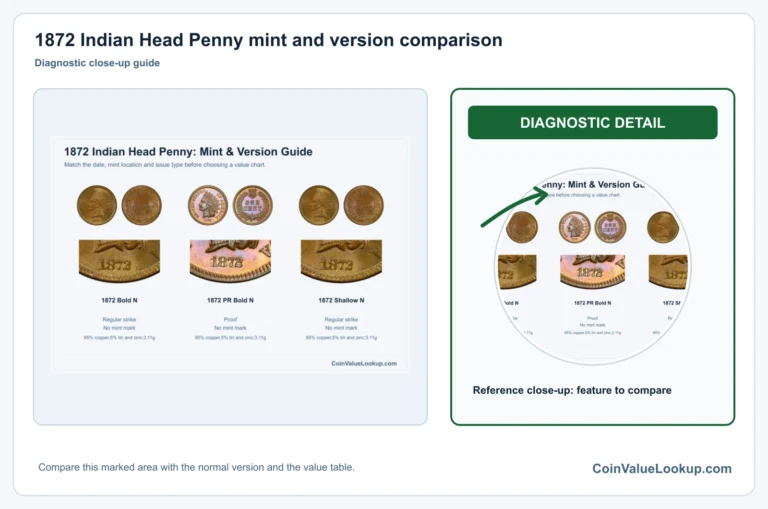
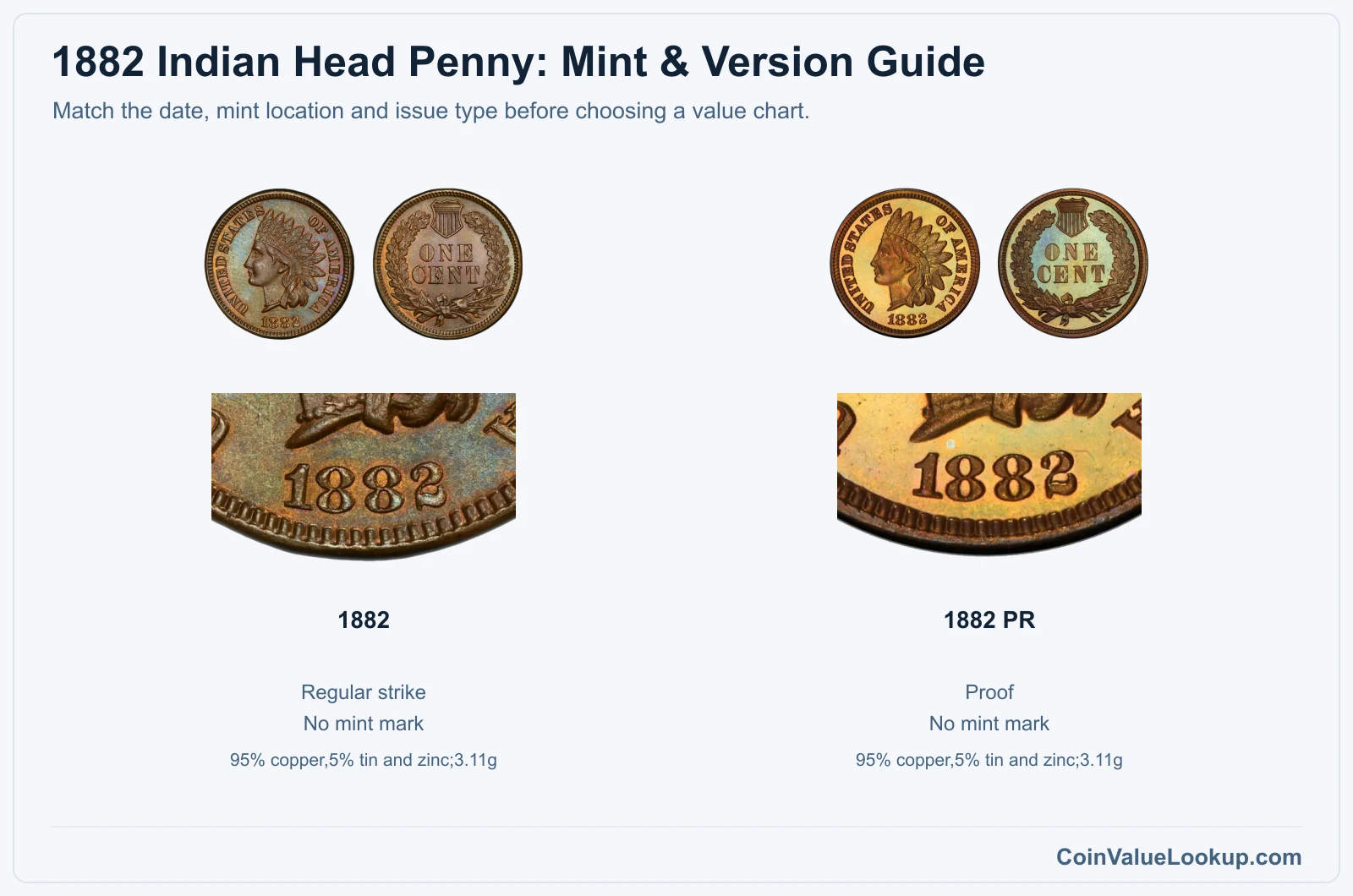
Every regular 1882 Indian Head cent was struck at the Philadelphia Mint. There is no mintmark to look for.
The small "L" on the ribbon behind the neck is the engraver's initial, not a mint designation, so don't mistake it for one.
The obverse shows an allegorical Liberty wearing a feathered headdress with the word LIBERTY inscribed on the headband. The reverse features an oak wreath surrounding the denomination, topped by a small shield.
Make sure you're not confusing this with a copper-nickel Indian cent from 1859–1864 or an entirely different series like the Lincoln wheat cent.
The two main branches for this date are the standard business strike and the proof. Proofs were manufactured with specially prepared dies on polished planchets, producing mirrored fields and sharp rims.
A business strike that someone has polished at home is not a proof, no matter how shiny it looks. Proof identification requires examining the rim geometry, field reflectivity and overall sharpness of strike together, not just one trait in isolation.
Coin Value Lookup is a handy starting point if you're sorting through a batch of old cents and need guides for different dates and denominations.
Step 2: Check Your 1882 Indian Head Penny Grade
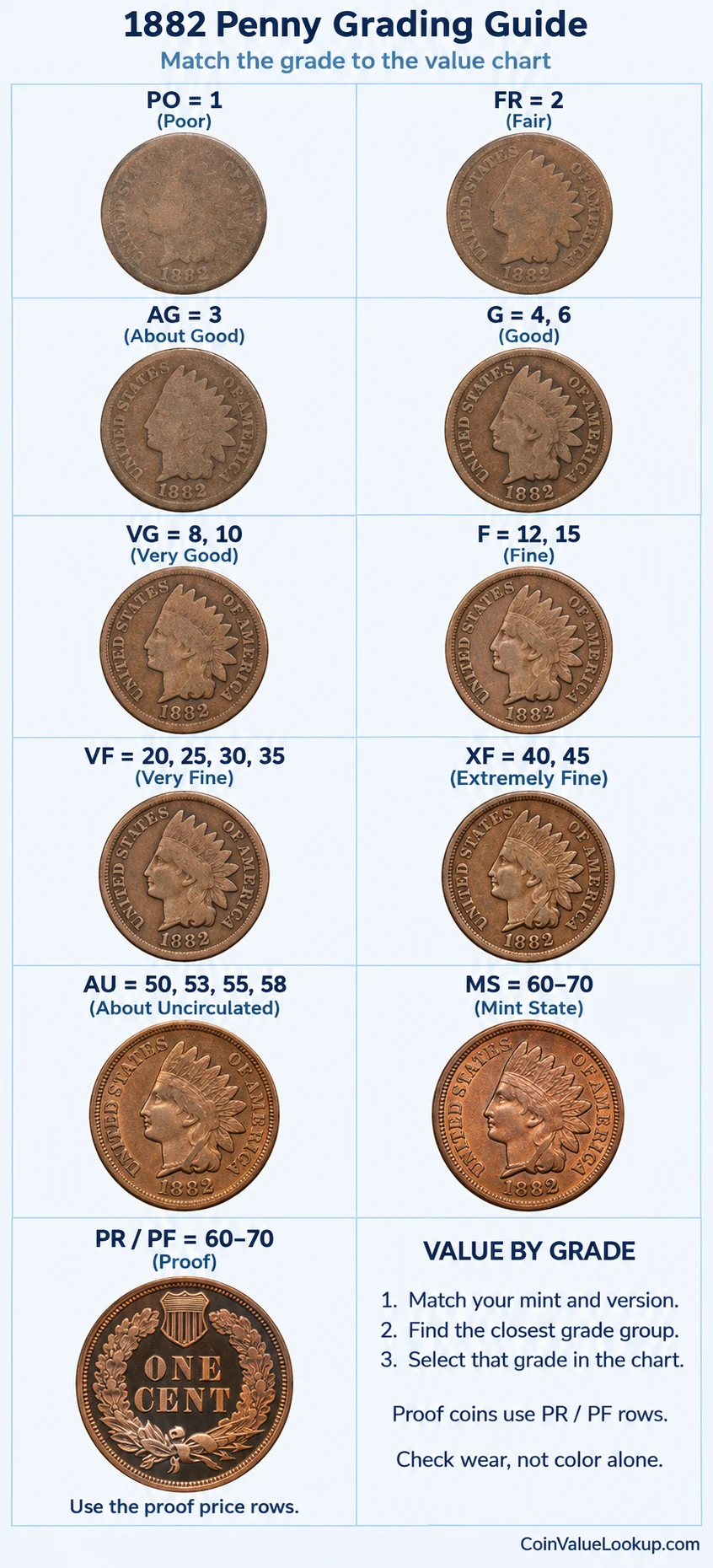
Start with the headband. On a well-circulated coin, the letters in LIBERTY wear down progressively; a G4 coin may show only partial lettering while the rest of the design is flat but visible.
Move to the feather tips above the ear and the hair curls below the headband; these are high points that lose detail first.
On the reverse, check the leaf tips and the shield detail at the top of the wreath. A coin grading around VF will still show most leaf veins and a readable shield.
Don't rely on a single letter of LIBERTY to assign a grade. Some 1882 cents were softly struck, meaning the feathers or hair detail may look worn even on a coin that never circulated.
Judge strike quality, remaining luster, and surface marks independently.
Bronze color designations like BN (brown), RB (red-brown), and RD (red) describe how much original copper color remains. They are not separate materials.
A coin with full original red surfaces at the same technical grade will typically bring a premium over a fully brown example, but these guide prices do not specify a color tier, so treat them as general anchors. Cleaned, corroded, or damaged coins trade below guide levels regardless of their apparent wear.
Step 3: Check 1882 Indian Head Penny Value by Mint and Version
1882 Indian Head Penny
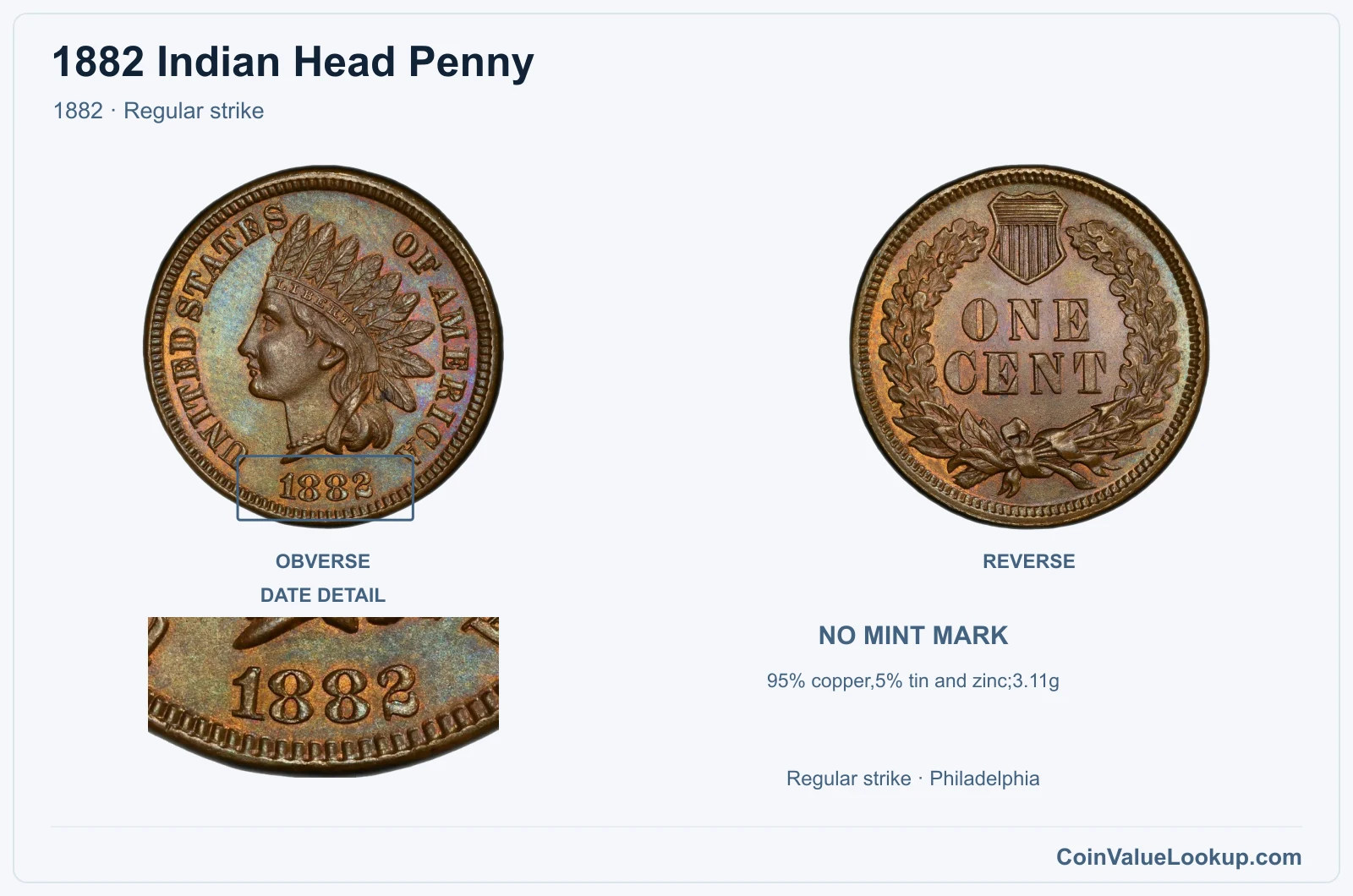
The standard 1882 Indian Head cent is a Philadelphia business strike on a bronze planchet weighing about 3.11 grams, composed of 95% copper with 5% tin and zinc. USA Coin Book lists a guide estimate of roughly $6.25 in G4 and around $112 in MS63.
Millions were struck, so finding one in a cigar box or junk bin is not unusual. The challenge is condition.
Most survivors are brown and well-worn. An example with sharp LIBERTY, full feather detail, and original luster stands apart from the typical survivor.
Compare your coin's surfaces to graded reference images before assuming a grade, and be honest about cleaning or environmental damage.
| Range | Grade | Price | Auction Records | Appraisal |
|---|---|---|---|---|
| PO | PO 1 | — | Coin Identifier | |
| FR | FR 2 | — | Coin Identifier | |
| AG | AG 3 | — | Coin Identifier | |
| G | G 4 | — | Coin Identifier | |
| G 6 | — | Coin Identifier | ||
| VG | VG 8 | — | Coin Identifier | |
| VG 10 | — | Coin Identifier | ||
| F | F 12 | — | Coin Identifier | |
| F 15 | — | Coin Identifier | ||
| VF | VF 20 | — | Coin Identifier | |
| VF 25 | — | Coin Identifier | ||
| VF 30 | — | Coin Identifier | ||
| VF 35 | — | Coin Identifier | ||
| XF | XF 40 | — | Coin Identifier | |
| XF 45 | Coin Identifier | |||
| AU | AU 50 | Coin Identifier | ||
| AU 53 | Coin Identifier | |||
| AU 55 | — | Coin Identifier | ||
| AU 58 | Coin Identifier | |||
| MS | MS 60 | — | Coin Identifier | |
| MS 61 | Coin Identifier | |||
| MS 62 | Coin Identifier | |||
| MS 63 | Coin Identifier | |||
| MS 64 | Coin Identifier | |||
| MS 65 | Coin Identifier | |||
| MS 66 | Coin Identifier | |||
| MS 67 | — | — | — | |
| MS 68 | — | — | — | |
| MS 69 | — | — | — | |
| MS 70 | — | — | — |
1882 Indian Head Penny — PR
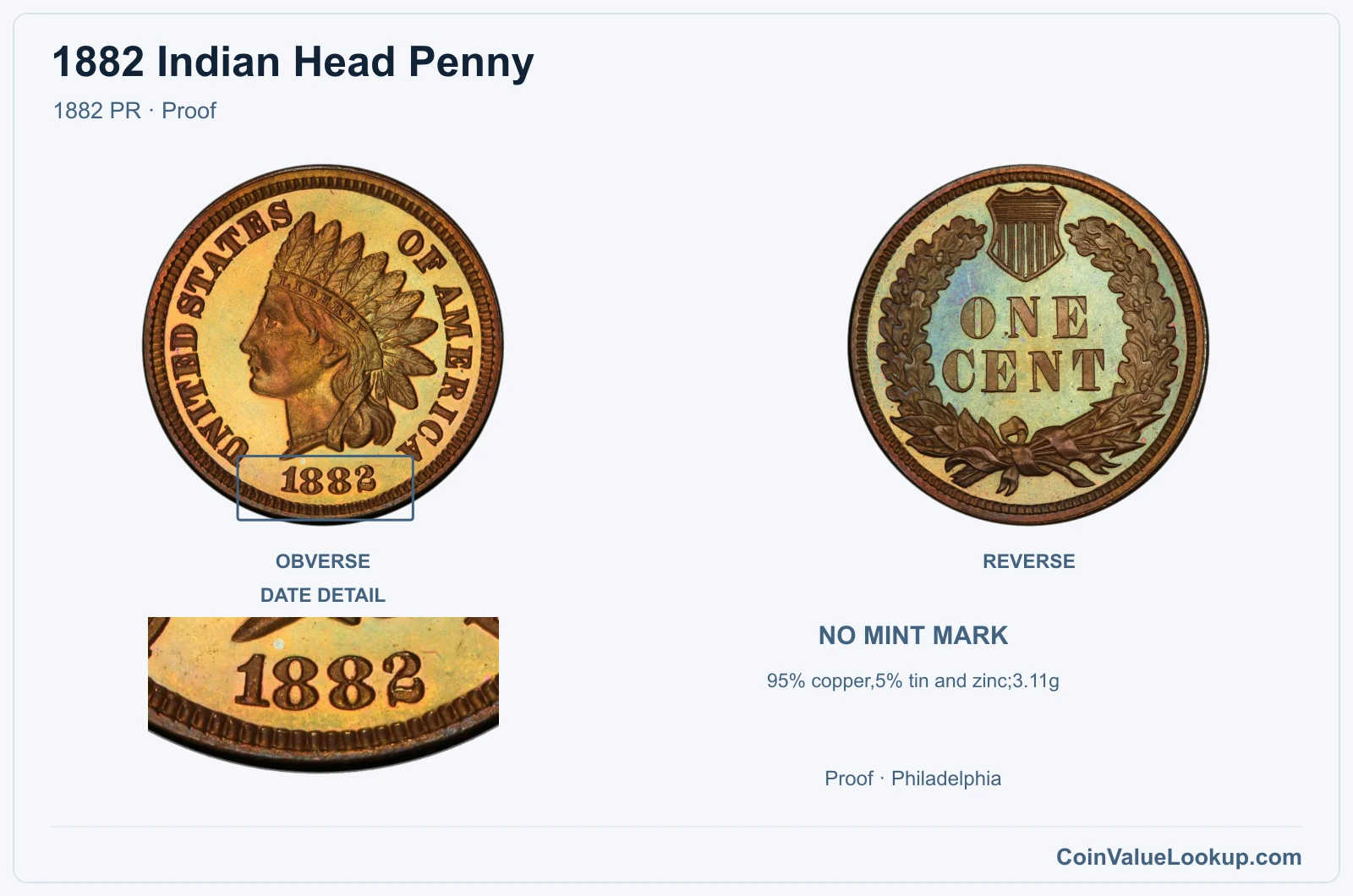
The 1882 proof Indian Head cent was struck at Philadelphia on the same bronze composition as the business strike but using polished dies and specially prepared planchets. USA Coin Book places a PR63 example at roughly $313.
Genuine proofs display deeply mirrored fields, squared-off rims, and exceptional sharpness in the headdress feathers and wreath leaves. These were sold directly to collectors, so most surviving examples avoided heavy circulation.
Still, many have been mishandled over 140-plus years, picking up hairlines or haze.
Do not call a polished business strike a proof. A real proof's mirror field is a product of die preparation, not a buffing wheel.
Examine the rim profile and overall strike character together before drawing conclusions.
| Range | Grade | Price | Auction Records | Appraisal |
|---|---|---|---|---|
| PR | PR 1 | — | Coin Identifier | |
| PR 2 | — | Coin Identifier | ||
| PR 3 | — | Coin Identifier | ||
| PR 4 | — | Coin Identifier | ||
| PR 6 | — | Coin Identifier | ||
| PR 8 | — | Coin Identifier | ||
| PR 10 | — | Coin Identifier | ||
| PR 12 | — | Coin Identifier | ||
| PR 15 | — | Coin Identifier | ||
| PR 20 | — | Coin Identifier | ||
| PR 25 | — | Coin Identifier | ||
| PR 30 | — | Coin Identifier | ||
| PR 35 | — | Coin Identifier | ||
| PR 40 | — | Coin Identifier | ||
| PR 45 | — | Coin Identifier | ||
| PR 50 | — | Coin Identifier | ||
| PR 53 | — | Coin Identifier | ||
| PR 55 | — | Coin Identifier | ||
| PR 58 | — | Coin Identifier | ||
| PR 60 | — | Coin Identifier | ||
| PR 61 | — | Coin Identifier | ||
| PR 62 | Coin Identifier | |||
| PR 63 | Coin Identifier | |||
| PR 64 | Coin Identifier | |||
| PR 65 | Coin Identifier | |||
| PR 66 | Coin Identifier | |||
| PR 67 | Coin Identifier | |||
| PR 68 | — | — | — | |
| PR 69 | — | — | — | |
| PR 70 | — | — | — |
1882 Indian Head Penny Error List
1. 1882 Indian Head Penny — Die Break / Cud
A die break, sometimes called a cud when it connects to the rim, shows up as a raised, featureless blob on the coin's surface. It happens when a chunk of the die face breaks away, leaving nothing to press into the planchet at that spot.
On an 1882 Indian cent, look for a smooth raised area that interrupts the normal design or lettering and merges into the rim edge.
Don't confuse this with a rim dent or corrosion lump. A cud has a distinct boundary where normal design stops and the flat raised area begins.
Interior die chips are smaller and don't reach the rim. Pricing depends on the size, location, and severity of the break, as well as the coin's overall condition, so individual assessment by a professional service is the practical route.
2. 1882 Indian Head Penny — Misplaced Date
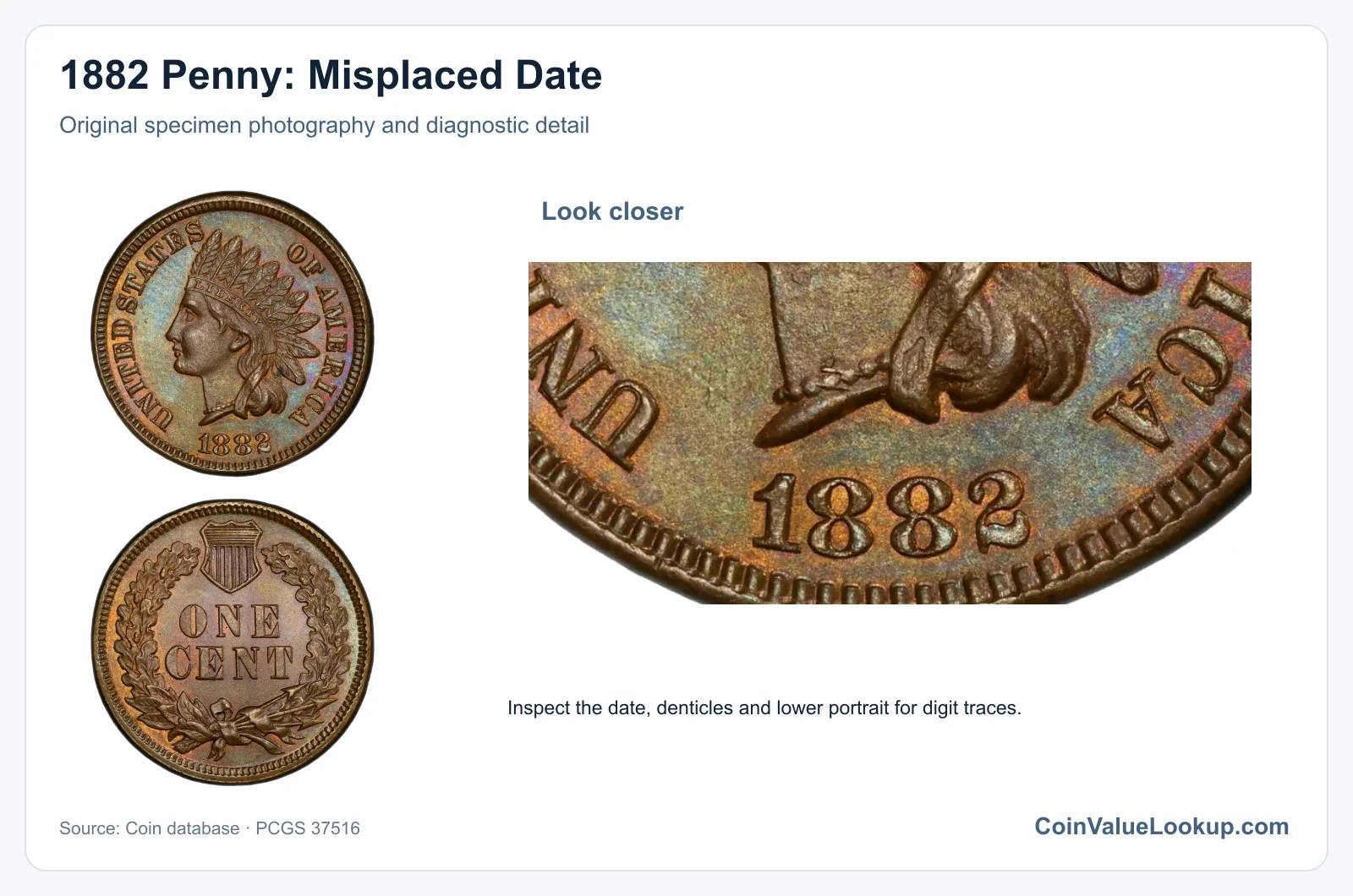
A misplaced date occurs when the date punch was first impressed in the wrong location, leaving ghost-like remnants of one or more digits in an area away from the final date position. On the 1882 Indian cent, look near the denticles or close to the portrait's neck for faint partial numerals that echo the shapes of 1, 8, or 2.
These traces are subtle. You'll usually need magnification to separate them from random die chips or scratches.
A genuine misplaced digit will match the style and proportions of the other date numerals. Random bumps and surface hits will not.
No specific pricing is established in the supplied data, so value depends on the coin's authenticated identity, condition, and the clarity of the misplacement.
3. 1882 Indian Head Penny — Repunched Date
A repunched date shows traces of an earlier punch position next to the final date numerals. On the 1882 cent, you might see a shadow or doubled outline near one or more digits of the date, shifted slightly north, south, east or west of the final position.
This is different from machine doubling, which produces flat, shelf-like doubling across the whole design. A repunched date is confined to the date area and results from the die being punched more than once during its manufacture.
Damage from a hit or scratch won't follow the exact contour of a numeral.
No adopted price range exists in the available data, so the value of a repunched date example depends on the specific variety, its visual strength, and the coin's overall grade as confirmed by professional authentication.
4. 1882 Indian Head Penny — Die Crack
A die crack appears as a thin raised line running across the coin's surface, crossing fields or design elements. It forms when the steel die develops a fracture from repeated use, and that crack transfers as a raised ridge onto every coin struck afterward.
On the 1882 Indian cent, look for a fine raised line that may run from the rim across a letter, through the portrait, or across the wreath. The key diagnostic is that the line is raised, not incised.
A scratch dug into the coin's surface is incuse and is post-strike damage, not a die crack. Corrosion lines and displaced-metal scrapes also sit below or level with the surface rather than above it.
Value depends on length, prominence, and the coin's condition. No specific price range is adopted for this category, so professional evaluation of the individual coin is recommended.