1921 Wheat Penny Coin Value: How Much Is It Worth?
A 1921 Wheat Penny in circulated condition starts around $0.61 at the Good-4 grade level, while uncirculated examples can reach up to $313 at MS63 depending on the mint. Those figures cover the two ordinary business-strike branches — Philadelphia and San Francisco — and do not include major varieties, errors or coins with exceptional color.
Original surfaces, honest wear and the absence of cleaning all matter when pinning down what yours is actually worth.
Fast Way to Identify Your 1921 Wheat Penny
Want a quick read on your 1921 cent? Upload clear photos of both the front and back of your coin using the identifier on this page.
That gives you a preliminary identification of the mint, design type and general condition so you know which branch to research further. Good lighting and a steady shot help the most.
1921 Wheat Penny Value
Upload both sides of your 1921 Wheat Penny.
Front Obverse
Upload photo
Back Reverse
Upload photo
Which 1921 Wheat Penny Versions Are Worth Money?
- The 1921-S (San Francisco) carries the larger premium — around $2.50 in Good-4 and up to $313 in MS63 according to guide estimates, making mint verification essential.
- The 1921 Philadelphia is the more common branch, valued around $0.61 in Good-4 and about $100 in MS63, so condition is the main driver.
- Strong original surfaces without cleaning or corrosion significantly affect desirability across both mints.
- Identifiable mint errors such as off-center strikes, broadstrikes or die cracks can add collector interest beyond ordinary values, assessed individually by severity and authentication.
Step 1: Identify Your 1921 Wheat Penny Mint Mark and Version
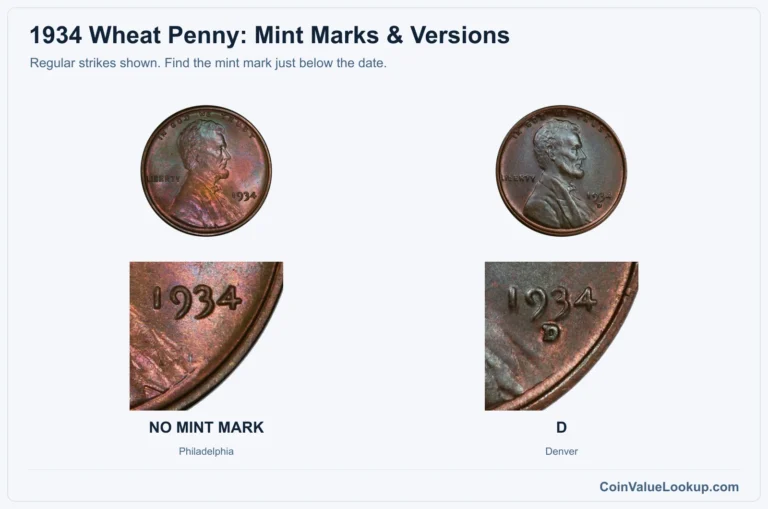
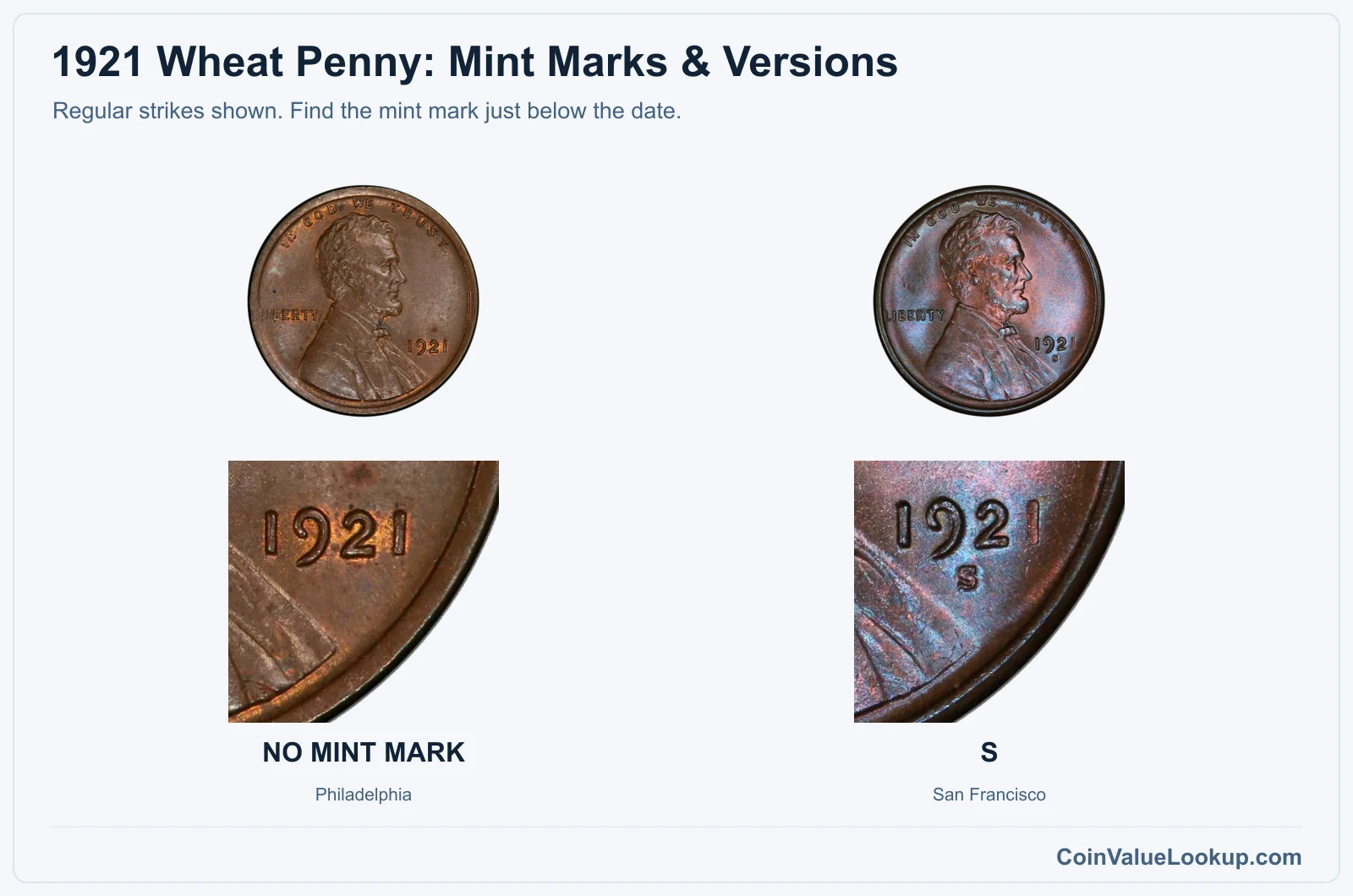
Only two mints produced Lincoln cents in 1921: Philadelphia and San Francisco. There was no Denver issue this year, so if you see a D mintmark, you are looking at a different date.
Flip the coin over and check below the date on the obverse. A small "S" means San Francisco.
No letter at all means Philadelphia.
The reverse carries the familiar two wheat ears framing ONE CENT and UNITED STATES OF AMERICA. The coin is a standard copper-alloy cent — 95% copper with 5% tin and zinc — weighing about 3.11 grams with a plain edge.
If your coin is noticeably lighter, magnetic or silver-colored, it is likely a different year or a novelty piece.
San Francisco cents generally carry a higher collector premium than their Philadelphia counterparts in equivalent condition. Confirming the mintmark is the single most important step before you price anything.
Step 2: Check Your 1921 Wheat Penny Grade
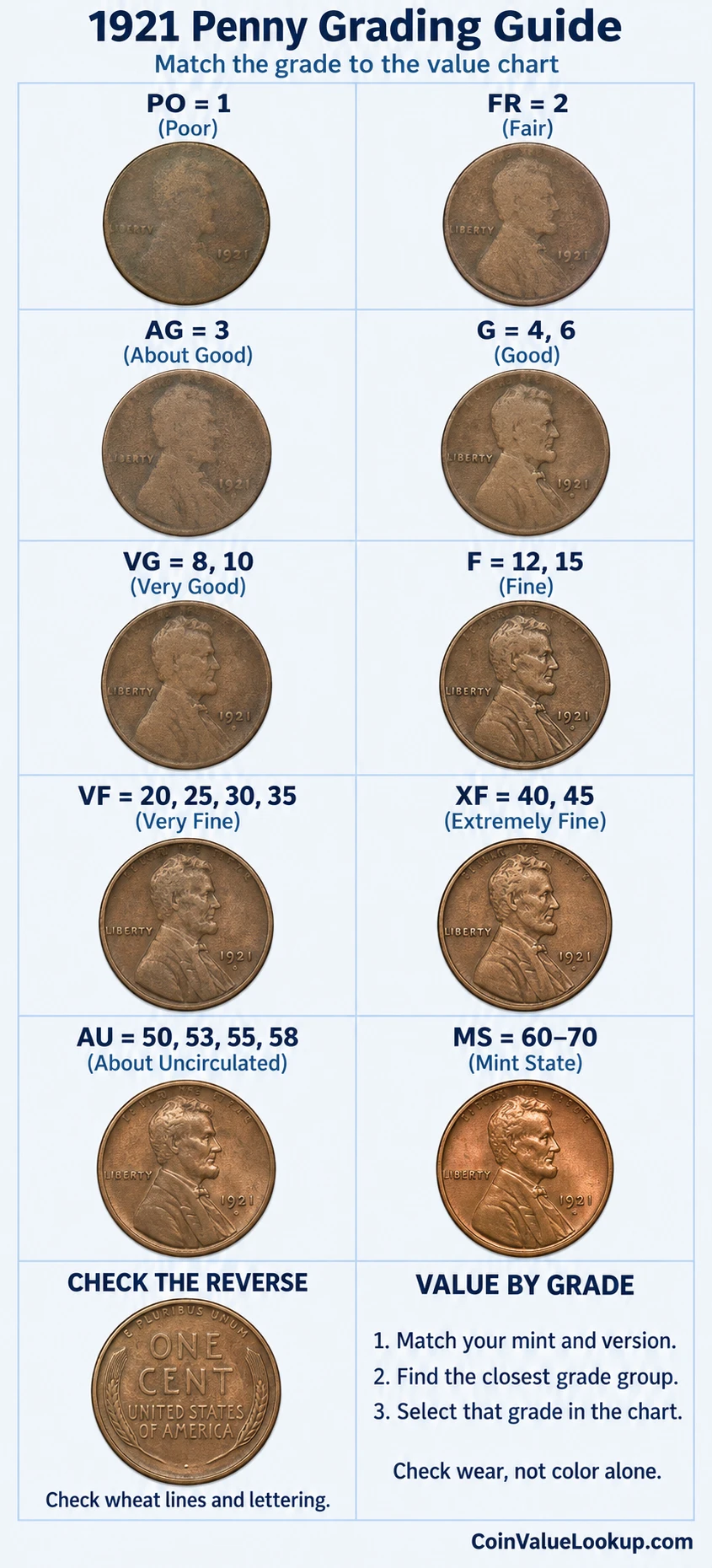
Start with Lincoln's cheek and jawline on the obverse. In higher grades those areas show full, rounded detail with original luster still visible in the fields.
As a coin wears, the cheekbone flattens first, then the jaw softens and fine hair strands above the ear merge together.
On the reverse, check the individual wheat grains and the parallel lines between the stalks. A well-preserved coin shows crisp separation there.
Once those lines blur into each other you are looking at moderate to heavy wear.
Use the comparison image on this page to match your coin's wear pattern against known grade examples. A weak strike from the original die can mimic wear, so look for luster in the protected areas — if it is still there, the softness is probably strike-related, not circulation damage.
Color, spots, corrosion and signs of cleaning are separate value factors. A brown coin is not automatically lower grade than a red one; color describes the surface, while grade describes the wear.
Cleaned coins lose their natural tone and often show tiny hairline scratches under magnification, which significantly reduces collector appeal.
Step 3: Check 1921 Wheat Penny Value by Mint and Version
1921 Wheat Penny
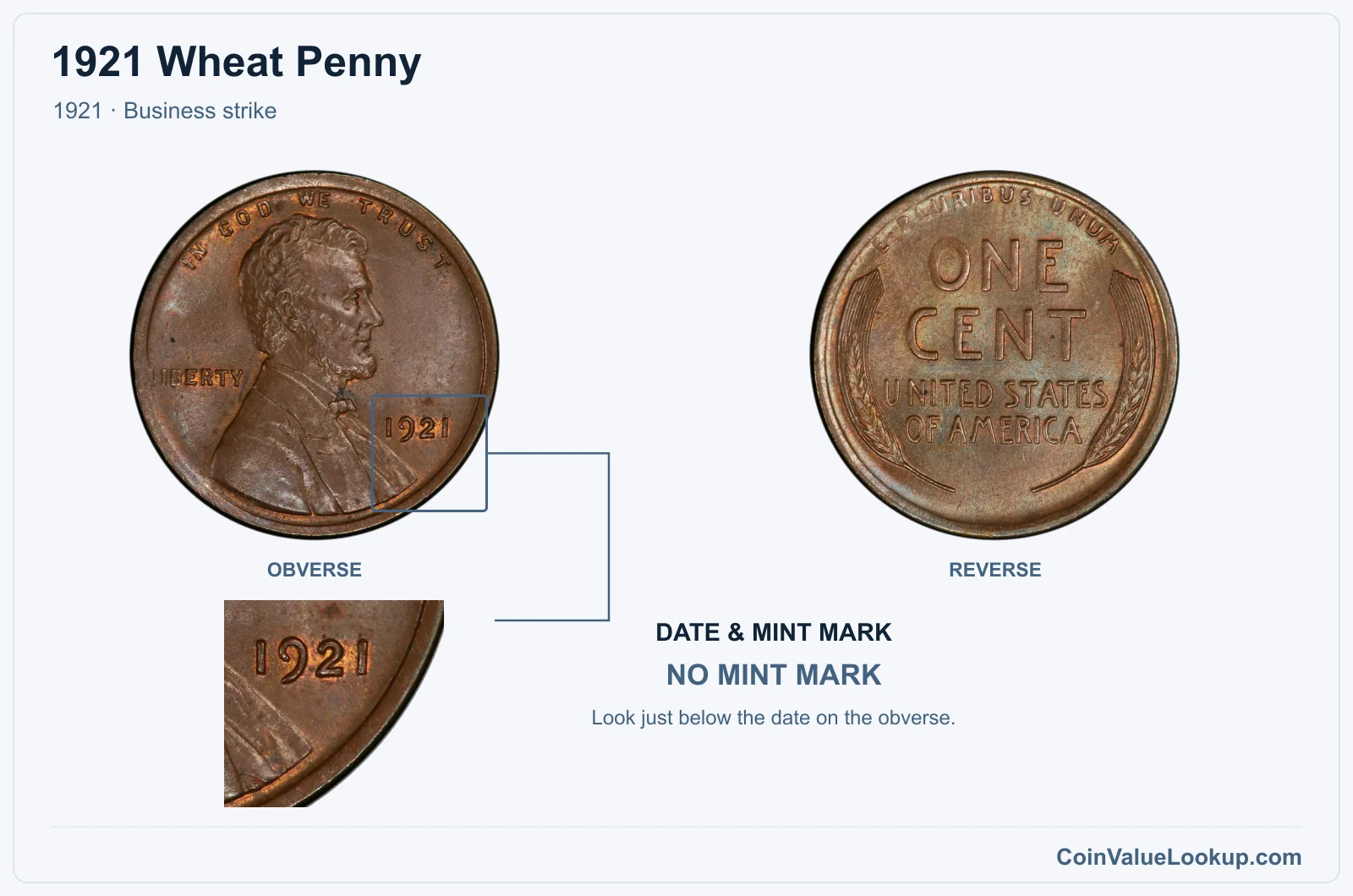
The 1921 Philadelphia cent has no mintmark — just a blank space below the date. It was struck on standard 95% copper planchets weighing about 3.11 grams with a plain edge.
Guide estimates place this coin at roughly $0.61 in Good-4 and around $100 in MS63. Most survivors are well-circulated, so finding one with sharp hair detail and full wheat-stalk lines takes some patience.
Color is not specified by the guide figures, so treat those numbers as a starting point rather than a quote for a certified red example.
Coin Value Lookup is a good place to look up other dates in the Wheat cent series if you are building a collection or just checking what turned up in a jar of old change.
| Range | Grade | Price | Auction Records | Appraisal |
|---|---|---|---|---|
| PO | PO 1 | — | Coin Identifier | |
| FR | FR 2 | — | Coin Identifier | |
| AG | AG 3 | — | Coin Identifier | |
| G | G 4 | — | Coin Identifier | |
| G 6 | — | Coin Identifier | ||
| VG | VG 8 | — | Coin Identifier | |
| VG 10 | — | Coin Identifier | ||
| F | F 12 | — | Coin Identifier | |
| F 15 | — | Coin Identifier | ||
| VF | VF 20 | — | Coin Identifier | |
| VF 25 | — | Coin Identifier | ||
| VF 30 | — | Coin Identifier | ||
| VF 35 | — | Coin Identifier | ||
| XF | XF 40 | — | Coin Identifier | |
| XF 45 | — | Coin Identifier | ||
| AU | AU 50 | — | Coin Identifier | |
| AU 53 | — | Coin Identifier | ||
| AU 55 | Coin Identifier | |||
| AU 58 | Coin Identifier | |||
| MS | MS 60 | — | Coin Identifier | |
| MS 61 | — | Coin Identifier | ||
| MS 62 | Coin Identifier | |||
| MS 63 | Coin Identifier | |||
| MS 64 | Coin Identifier | |||
| MS 65 | Coin Identifier | |||
| MS 66 | — | — | — | |
| MS 67 | — | — | — | |
| MS 68 | — | — | — | |
| MS 69 | — | — | — | |
| MS 70 | — | — | — |
1921 Wheat Penny — S
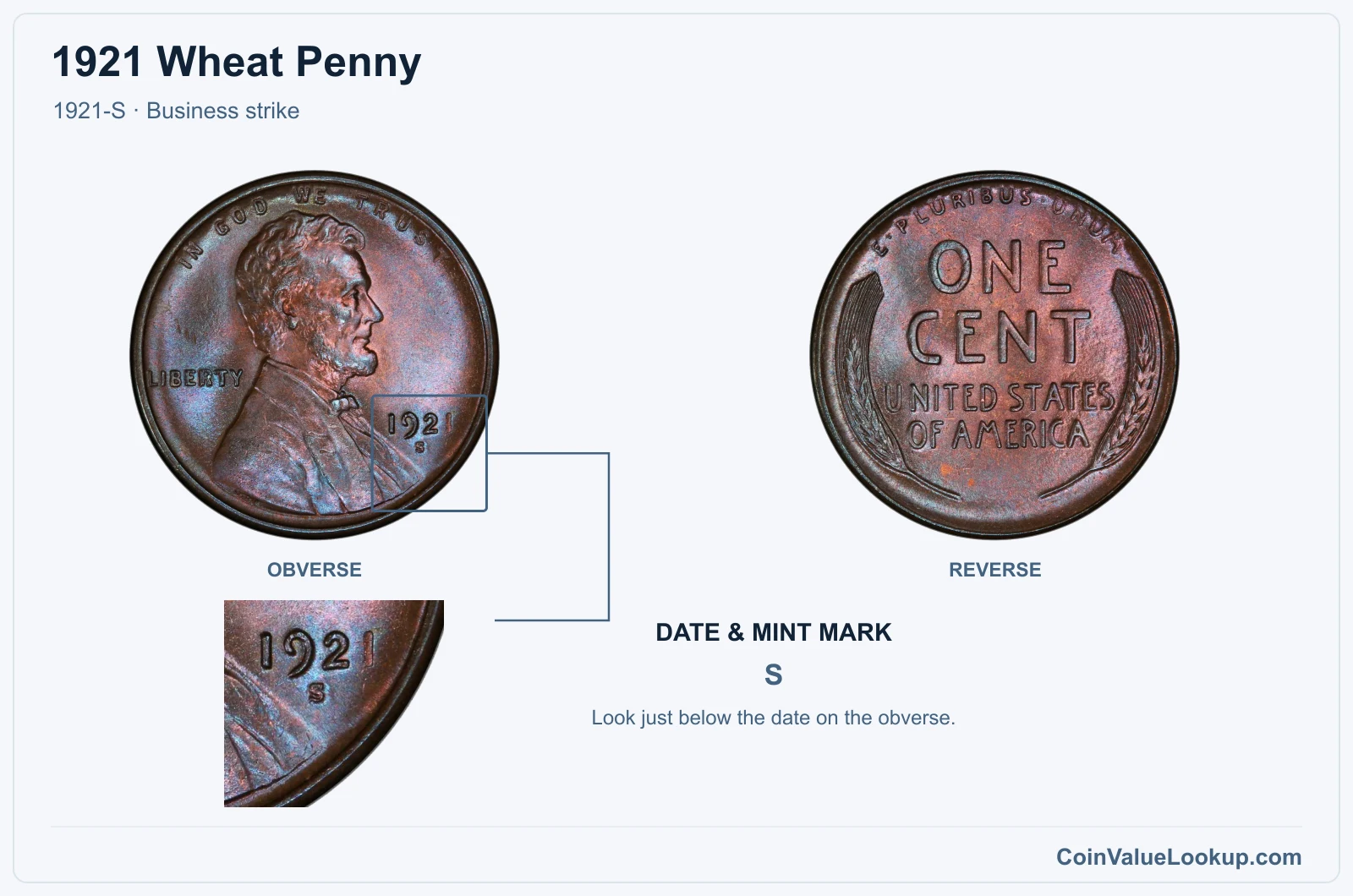
Look for the small "S" mintmark sitting below the date to confirm a San Francisco strike. Same copper alloy, same 3.11-gram weight, same plain edge — but the collector market treats this one differently.
Guide estimates put the 1921-S at about $2.50 in Good-4 condition and approximately $313 in MS63, a substantial jump over its Philadelphia sibling. That premium reflects both lower survival rates in high grades and steady demand from set builders who need this date.
Because the guide does not specify coin color, those anchors should not be read as certified Red prices. A coin graded MS63 Brown or MS63 Red-Brown will sit at different points in the market.
Original, problem-free surfaces matter more here than chasing a particular color label.
| Range | Grade | Price | Auction Records | Appraisal |
|---|---|---|---|---|
| PO | PO 1 | — | Coin Identifier | |
| FR | FR 2 | — | Coin Identifier | |
| AG | AG 3 | — | Coin Identifier | |
| G | G 4 | — | Coin Identifier | |
| G 6 | — | Coin Identifier | ||
| VG | VG 8 | Coin Identifier | ||
| VG 10 | — | Coin Identifier | ||
| F | F 12 | — | Coin Identifier | |
| F 15 | — | Coin Identifier | ||
| VF | VF 20 | — | Coin Identifier | |
| VF 25 | Coin Identifier | |||
| VF 30 | Coin Identifier | |||
| VF 35 | Coin Identifier | |||
| XF | XF 40 | Coin Identifier | ||
| XF 45 | Coin Identifier | |||
| AU | AU 50 | Coin Identifier | ||
| AU 53 | Coin Identifier | |||
| AU 55 | Coin Identifier | |||
| AU 58 | Coin Identifier | |||
| MS | MS 60 | — | Coin Identifier | |
| MS 61 | Coin Identifier | |||
| MS 62 | Coin Identifier | |||
| MS 63 | Coin Identifier | |||
| MS 64 | Coin Identifier | |||
| MS 65 | Coin Identifier | |||
| MS 66 | — | — | — | |
| MS 67 | — | — | — | |
| MS 68 | — | — | — | |
| MS 69 | — | — | — | |
| MS 70 | — | — | — |
1921 Wheat Penny Error List
1. 1921 Wheat Penny — Off-Center Strike
An off-center strike happens when the planchet is not seated properly in the collar before the dies come together. The result is a displaced design with an unstruck crescent of blank metal along one edge.
To identify this on a 1921 Wheat cent, look for the design shifted noticeably to one side with a corresponding area of flat, featureless metal opposite it. The date should still be visible for the coin to hold strong collector interest — a dateless off-center piece is much harder to attribute.
Do not confuse this with a clipped planchet, which removes metal before striking, or with a coin that was flattened or bent after it left the mint. Post-mint damage lacks the clean unstruck crescent and the smooth metal flow you see on a genuine off-center error.
Value depends on the percentage of displacement, date visibility and overall condition, each assessed individually by an authenticated example.
2. 1921 Wheat Penny — Broadstrike
A broadstrike occurs when the coin is struck without the retaining collar that normally constrains the planchet and forms the rim. The metal spreads outward freely, producing a coin that is wider than normal with a weak or absent rim.
On a 1921 cent, look for a design that reaches nearly to the edge without the usual raised border. The full design is generally present — just expanded — unlike an off-center strike where part of the design is missing entirely.
Watch out for coins that were simply flattened by machinery or a hammer after leaving the mint. Post-mint flattening typically shows uneven spreading and surface distortion that a genuine broadstrike does not.
Authenticated identity, the degree of spread and the coin's condition all factor into how a broadstrike is assessed, so individual evaluation matters.
3. 1921 Wheat Penny — Clipped Planchet
A clipped planchet error means a portion of the blank was missing before the coin was struck. The clip can be curved, straight or irregular depending on what went wrong during blank production.
On a 1921 Wheat cent, look for an area where metal is absent along the edge, sometimes with a corresponding area of design weakness on the opposite side. That opposite weakness — called the Blakesley effect — is a strong diagnostic for a genuine pre-strike clip rather than post-mint damage.
Filed notches, deliberate edge cuts and corrosion eating away the rim can all mimic a clip. Compare the edge texture carefully: a genuine clip shows smooth, natural metal flow at the boundary, while damage after minting usually leaves tool marks or rough, uneven surfaces.
Pricing varies with size and location, assessed on an individual basis with authentication.
4. 1921 Wheat Penny — Die Crack / Die Chip
Die cracks appear as raised lines on the coin's surface, caused by fractures in the steel die transferring their shape in relief during striking. A small raised blob, by contrast, indicates a die chip — a tiny piece of the die face that broke away, leaving a filled void.
On a 1921 cent, inspect both sides for thin raised lines running across the design or connecting to the rim. A crack that reaches the rim and produces a significant raised area is sometimes called a cud, which is a more dramatic version of the same failure.
Do not confuse these with incuse scratches, which are pressed into the surface rather than raised above it. Corrosion pits and foreign material stuck to the coin can also mimic small die chips under casual inspection.
Magnification helps. Value depends on the size, location and visual impact of the break, evaluated individually with proper authentication.
5. 1921 Wheat Penny — BIE Die Break
The so-called BIE error is a specific type of die break found on Lincoln cents, where a raised vertical line or blob appears between the letters B and E in LIBERTY. It looks like a small capital I wedged between those two letters.
To check your 1921 cent, examine LIBERTY on the obverse under magnification. A genuine BIE will be raised metal — the same height as the surrounding letters — because it formed from a crack or chip in the die face.
Dirt lodged between the letters, a thin scratch or a bit of adhesive residue can look similar at first glance. The key distinction is that a real BIE is raised and shows consistent metal texture with the rest of the coin.
It should also be repeatable across multiple coins struck by the same die, though you may only have one example in hand. Individual evaluation by condition and visual strength determines collector interest.
6. 1921 Wheat Penny — Lamination / Split Planchet
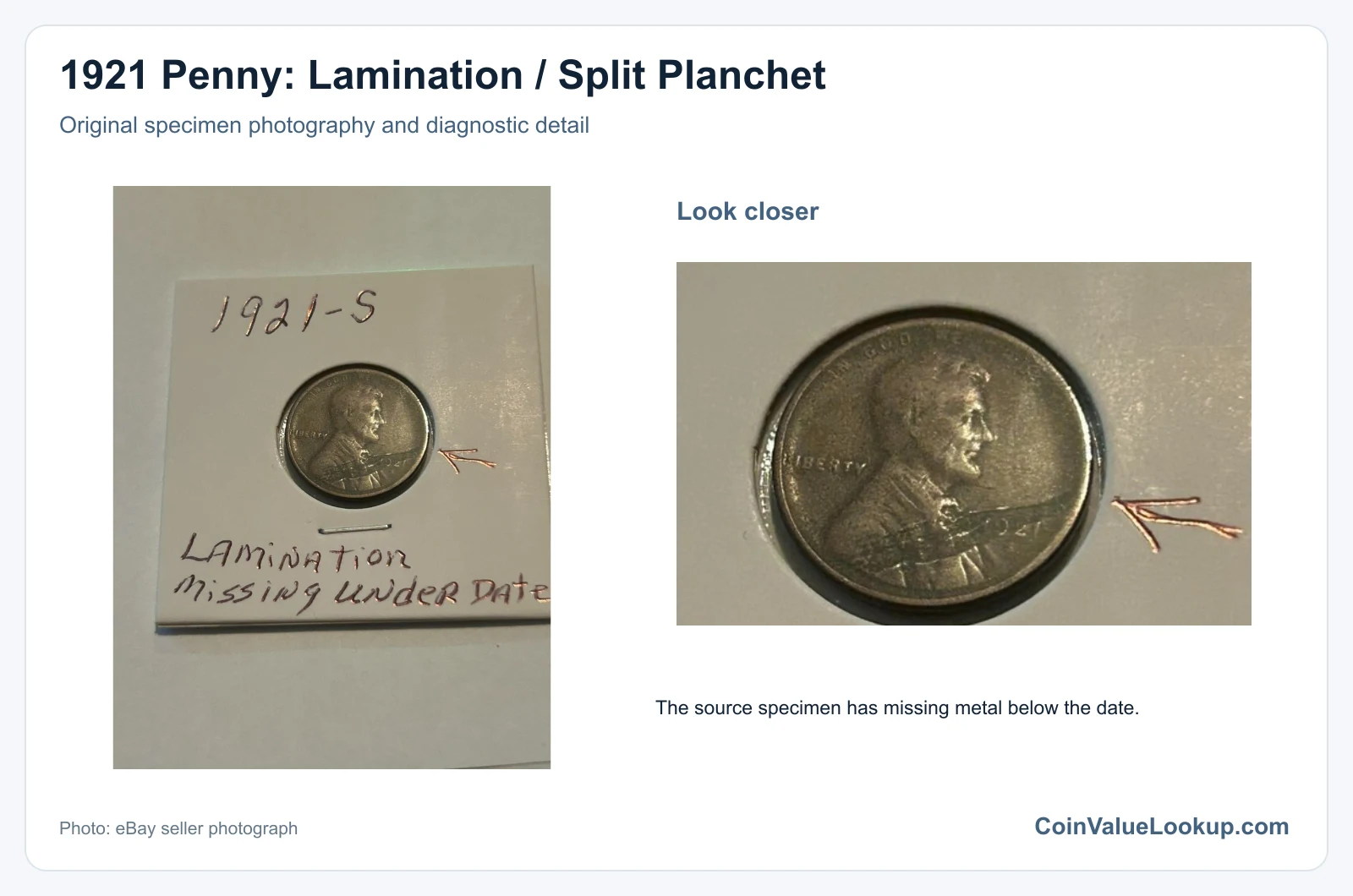
Lamination errors occur when the metal alloy separates into layers, creating a peeling flap, a missing surface patch or a visible split within the planchet. On a copper-alloy cent like the 1921, impurities or trapped gas during alloy preparation can cause this separation.
Look for a thin layer of metal lifting away from the coin's surface, sometimes still attached at one edge. Photographing the affected area alongside the coin's edge helps show the depth and nature of the split.
Scraping damage, heavy corrosion and deliberately shaved coins can all look similar. A genuine lamination follows the metal's internal structure and usually has smooth, naturally separated edges rather than the rough tool marks left by post-mint tampering.
Retained flaps that are still attached tend to generate more collector interest than missing-layer patches. Each piece is assessed individually based on the extent of separation, visual impact and authenticated condition.
7. 1921 Wheat Penny — Double / Multiple Strike
A double or multiple strike happens when the coin receives two or more impressions from the dies, with the planchet shifting or rotating between impacts. The result is two distinct, displaced sets of design elements visible on the same coin.
On a 1921 Wheat cent, look for a clearly separate second impression of the portrait or lettering — not just thickened letters, but an entirely shifted duplicate image. The relationship between the two strikes (how far apart, what angle of rotation) defines the visual character of each piece.
This is different from a doubled die, which involves a problem with the die itself and produces consistent doubling on every coin struck by that die. It also differs from post-mint impressions where someone pressed another coin into the surface.
Genuine multiple strikes show proper relief and metal flow consistent with mint production. Value is assessed individually based on the number of strikes, displacement and overall condition, confirmed through authentication.