1895 Barber Dime Coin Value: How Much Is It Worth?
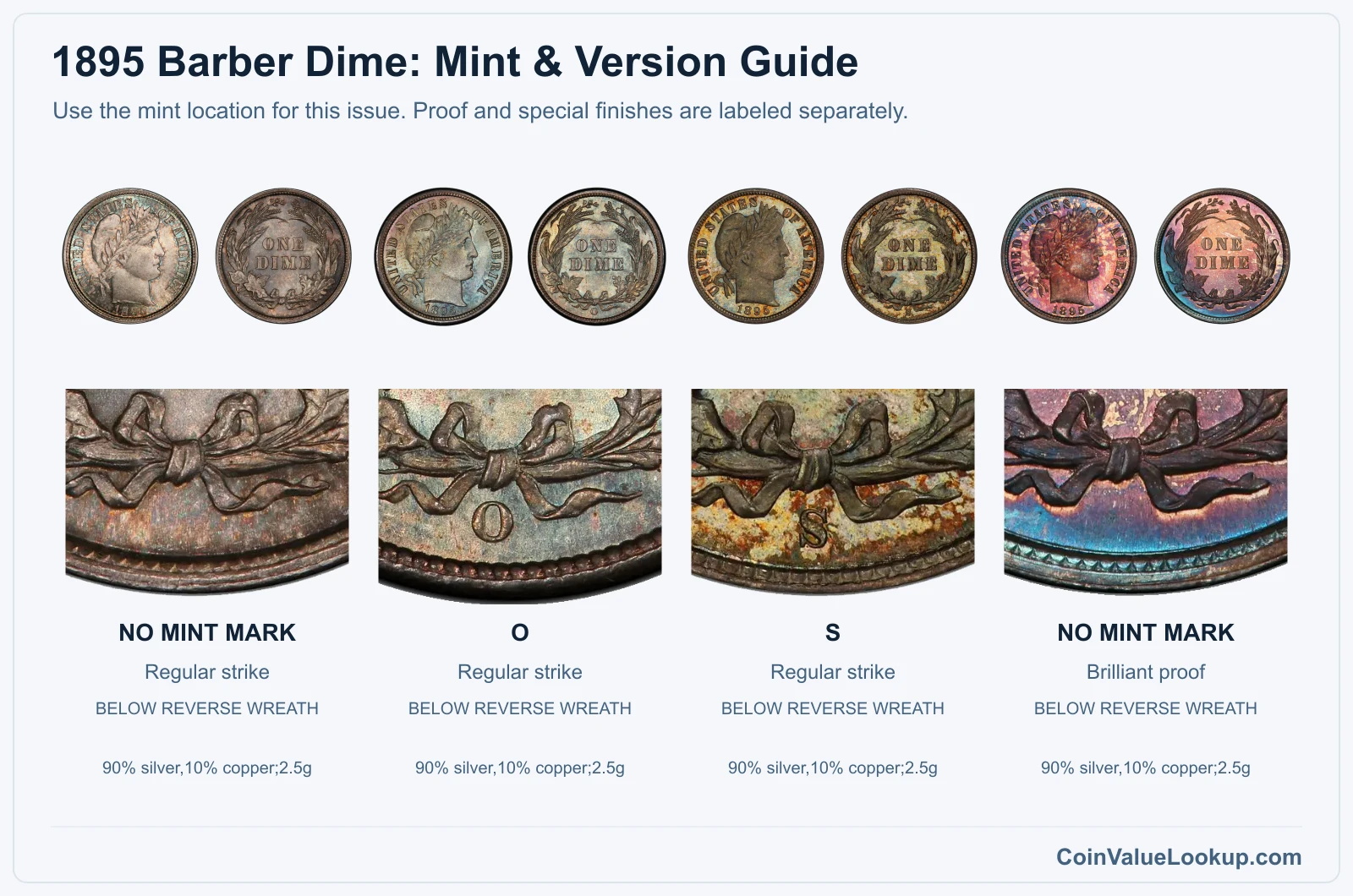
A genuine 1895 Barber Dime can range from about $60 at G4 for the San Francisco mint up to around $15,254 at MS63 for the scarce New Orleans issue, based on USA Coin Book guide estimates. Three mints produced business strikes that year, and Philadelphia also struck a small number of brilliant proofs.
The 1895-O stands out as the key date among ordinary circulation pieces, so confirming a real mintmark matters before celebrating.
Fast Way to Identify Your 1895 Barber Dime
The quickest way to start figuring out what you have is to upload clear photos of both sides of your coin. A front shot captures the date and Liberty's portrait, while the back reveals the mintmark position below the wreath bow.
Share those images for a preliminary identification of your coin's mint and general type.
1895 Barber Dime Value
Upload both sides of your 1895 Barber Dime.
Front Obverse
Upload photo
Back Reverse
Upload photo
Which 1895 Barber Dime Versions Are Worth Money?
- The 1895-O is the key ordinary circulation issue for this date, with guide values from about $588 at G4 to $15,254 at MS63 — but altered mintmarks and counterfeits circulate, so authentication matters.
- Philadelphia strikes without a mintmark are scarcer than many later Barber dates, with guide estimates around $126 at G4 to $1,191 at MS63.
- San Francisco pieces carry the lowest entry point at about $60 in G4, though uncirculated examples climb to around $1,348 at MS63.
- A die cap error has been reported on the 1895-O; condition and visibility of the error affect value, so individual assessment is essential.
- Brilliant proofs from Philadelphia are collected separately, with a PR63 guide estimate near $616.
Step 1: Identify Your 1895 Barber Dime Mint Mark and Version
Every 1895 Barber Dime shows Liberty facing right on the obverse, wearing a cap and headband inscribed LIBERTY. The reverse displays ONE DIME inside a cereal wreath tied with a bow at the bottom.
If your coin shows a winged Liberty head, you have a Mercury Dime, not a Barber.
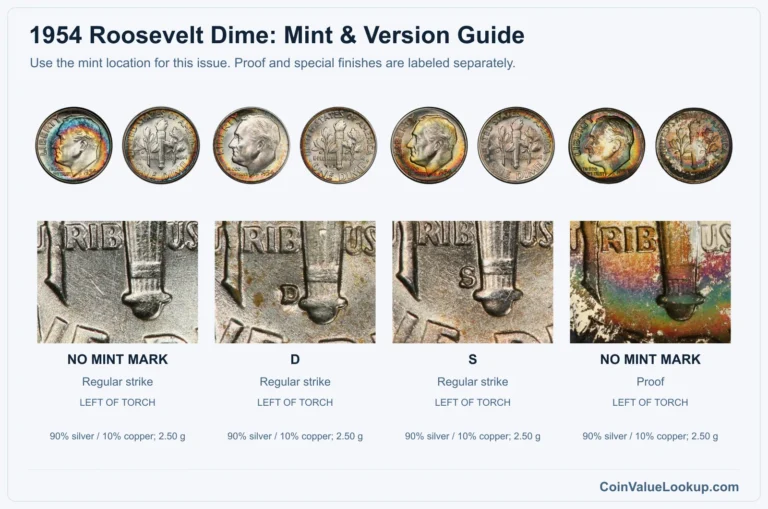
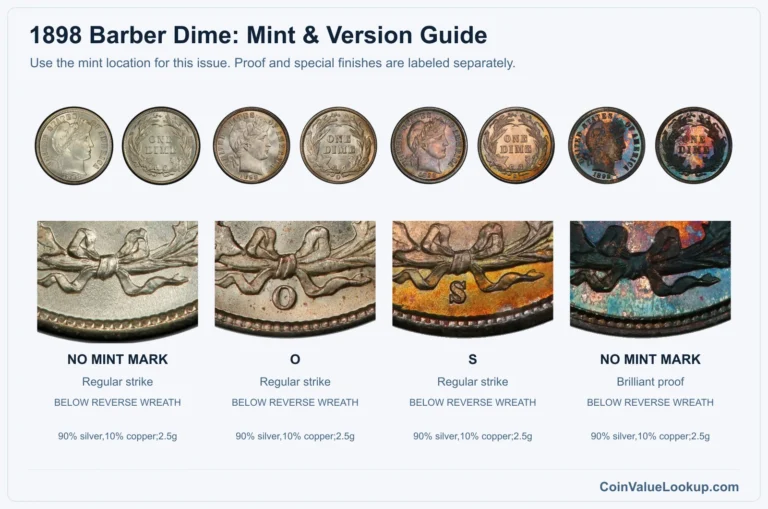
Three mints struck this date for circulation. Philadelphia coins carry no mintmark.
New Orleans pieces show an "O" below the wreath bow on the reverse. San Francisco coins display an "S" in the same spot.
A small magnifier helps, since the mintmark can be faint or partially filled on well-worn examples.
The 1895-O is a genuinely scarce coin, which unfortunately means altered mintmarks and outright counterfeits exist. Look for tooling marks around the mintmark area, an "O" that sits at an odd angle, or surface texture that differs near the letter compared to the surrounding field.
If anything looks off, professional authentication is worth pursuing before assuming you struck gold — or rather, silver.
All normal examples are 90% silver and 10% copper, weighing 2.5 grams with a diameter of 17.9 mm and a reeded edge.
Step 2: Check Your 1895 Barber Dime Grade
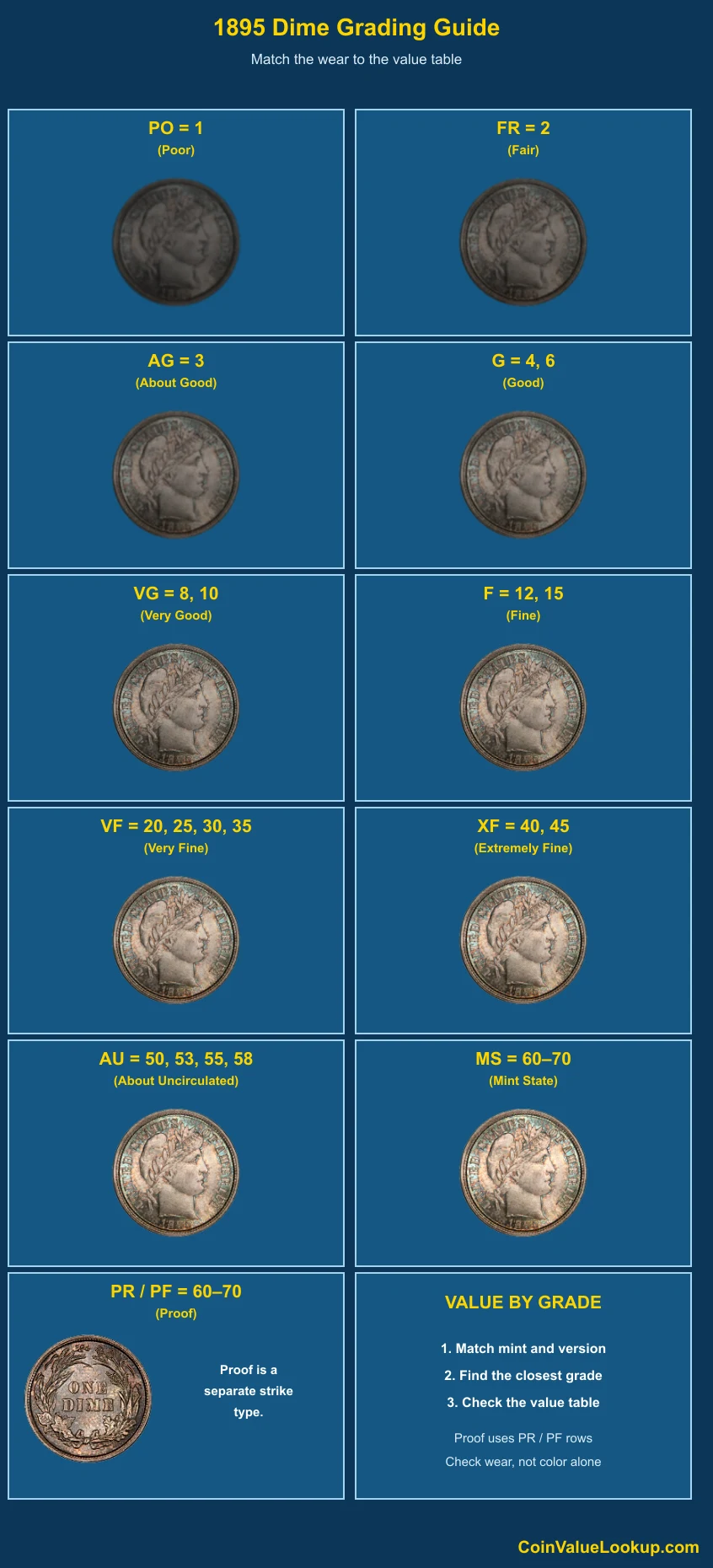
When grading a Barber Dime, examine several areas together rather than relying on a single detail. The LIBERTY inscription on the headband is a classic checkpoint — on a G4 coin most letters are gone, while a VF piece should show a readable but softened word.
But do not stop there.
Check Liberty's cheek for smoothness versus defined contour, look at the hair detail above the ear and at the temple, and flip the coin to assess the wreath leaves and bow. Rim sharpness matters too; heavy rim wear usually accompanies an honestly circulated lower grade.
New Orleans coins can appear weaker in certain areas even without much actual wear. This is a strike characteristic from the original press, not damage.
Compare your coin carefully to the reference image rather than downgrading it solely because the headband looks mushy.
Mint State means unbroken original luster across the entire surface. Hairlines from old cleaning, dull patches, or visible scratches disqualify a coin from that designation regardless of how sharp the details look.
Proof is a special manufacturing method — mirror fields and razor-sharp rims — not simply one step above Mint State.
Step 3: Check 1895 Barber Dime Value by Mint and Version
1895 Barber Dime — No Mint Mark — Silver Circulation
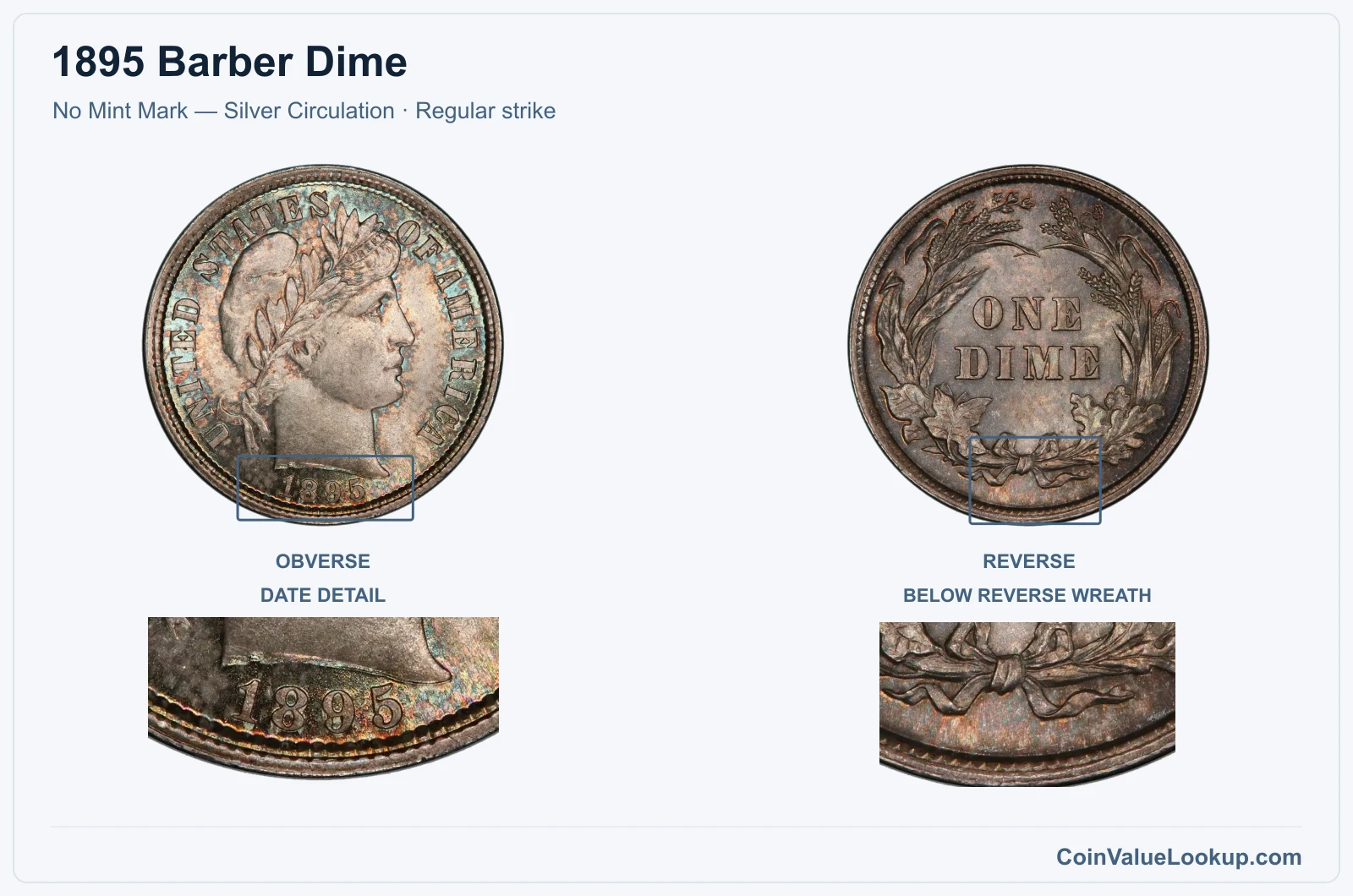
The Philadelphia issue carries no mintmark. Look at the space below the wreath bow on the reverse — if it is clean, you have a P-mint coin.
This date is scarcer than many later Philadelphia Barber Dimes, making it a better find than the typical junk-silver pickup.
USA Coin Book guide estimates place the 1895 Philadelphia at about $126 in G4 and around $1,191 in MS63. These are retail guide snapshots, not guaranteed sale prices.
Actual value depends on the specific coin's surfaces, strike quality, and whether it has been cleaned or damaged.
Coin Value Lookup is a handy place to look up guides for other dates in the Barber Dime series, so you can compare where your coin sits in the broader lineup.
Range Grade
Price Auction Records Appraisal PO PO 1
—
Coin Identifier FR FR 2
—
Coin Identifier AG AG 3
Coin Identifier G G 4
Coin Identifier
G 6
Coin Identifier VG VG 8
Coin Identifier
VG 10
Coin Identifier F F 12
Coin Identifier
F 15
Coin Identifier VF VF 20
Coin Identifier
VF 25
Coin Identifier
VF 30
Coin Identifier
VF 35
Coin Identifier XF XF 40
Coin Identifier
XF 45
Coin Identifier AU AU 50
Coin Identifier
AU 53
Coin Identifier
AU 55
Coin Identifier
AU 58
Coin Identifier MS MS 60
—
Coin Identifier
MS 61
Coin Identifier
MS 62
Coin Identifier
MS 63
Coin Identifier
MS 64
Coin Identifier
MS 65
Coin Identifier
MS 66
Coin Identifier
MS 67
Coin Identifier
MS 68
Coin Identifier
MS 69
—
—
—
MS 70
—
—
—
1895 Barber Dime — O — Silver Circulation
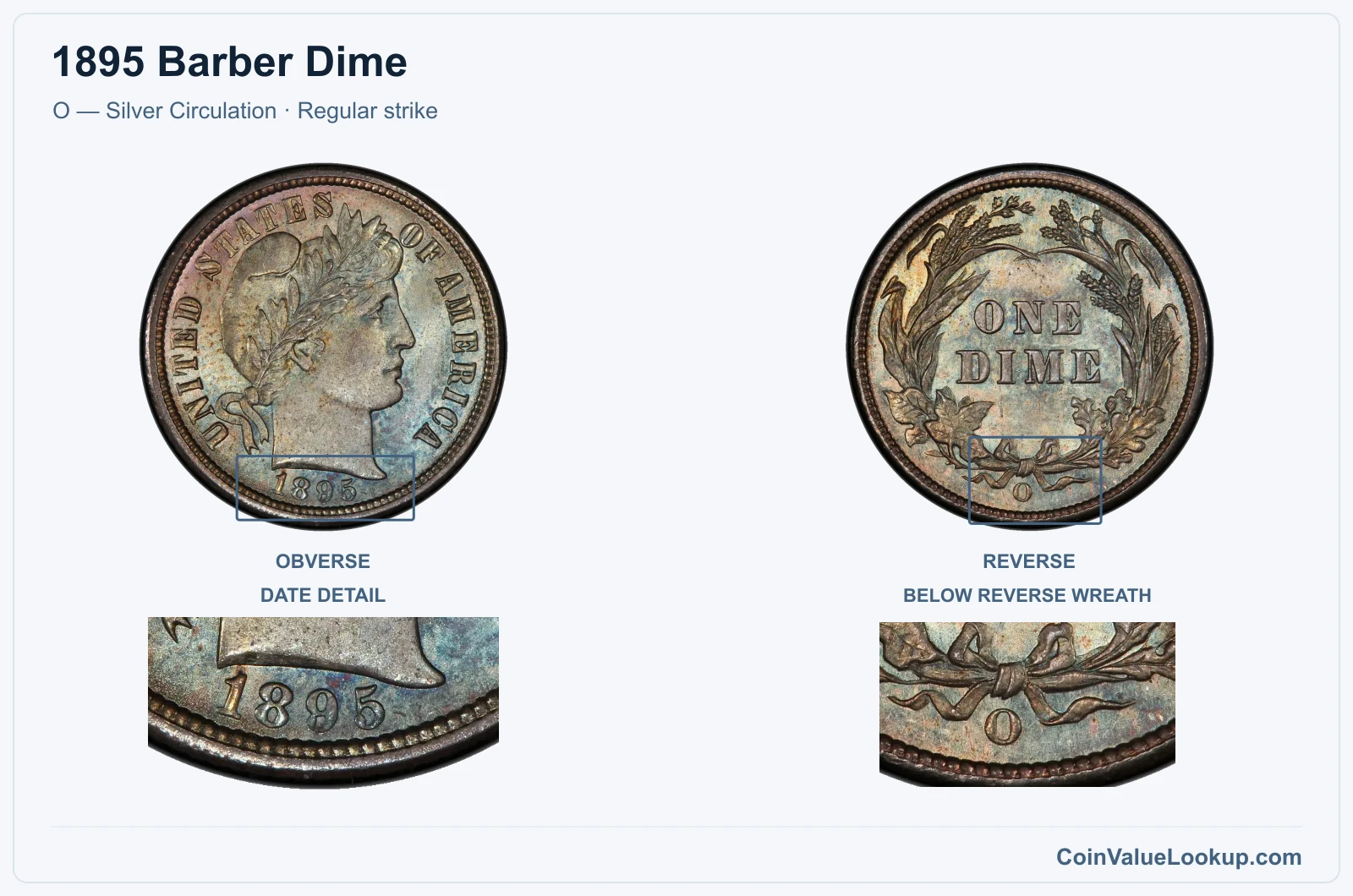
This is the one everyone wants. The 1895-O carries guide estimates of roughly $588 at G4 and a striking $15,254 at MS63 per USA Coin Book.
Even well-worn examples command real money.
Confirm that "O" mintmark is genuine before getting excited. Counterfeiters have added, re-cut, or transplanted mintmarks onto common Philadelphia coins to simulate this rarity.
Examine the mintmark's edges under magnification. A real "O" should show consistent metal flow and the same surface texture as the surrounding field.
Any signs of tooling, unusual luster breaks, or a letter that looks pasted on are red flags.
New Orleans Barber Dimes are often softly struck, so a slightly mushy headband does not automatically mean heavy wear. Compare the overall coin — cheek, hair, wreath — rather than fixating on one detail.
For a coin this valuable, third-party certification from a major grading service is a wise investment.
Range Grade
Price Auction Records Appraisal PO PO 1
Coin Identifier FR FR 2
Coin Identifier AG AG 3
Coin Identifier G G 4
Coin Identifier
G 6
Coin Identifier VG VG 8
Coin Identifier
VG 10
Coin Identifier F F 12
Coin Identifier
F 15
Coin Identifier VF VF 20
Coin Identifier
VF 25
Coin Identifier
VF 30
Coin Identifier
VF 35
Coin Identifier XF XF 40
Coin Identifier
XF 45
Coin Identifier AU AU 50
Coin Identifier
AU 53
Coin Identifier
AU 55
Coin Identifier
AU 58
Coin Identifier MS MS 60
Coin Identifier
MS 61
—
Coin Identifier
MS 62
Coin Identifier
MS 63
Coin Identifier
MS 64
Coin Identifier
MS 65
Coin Identifier
MS 66
Coin Identifier
MS 67
Coin Identifier
MS 68
—
—
—
MS 69
—
—
—
MS 70
—
—
—
1895 Barber Dime — S — Silver Circulation
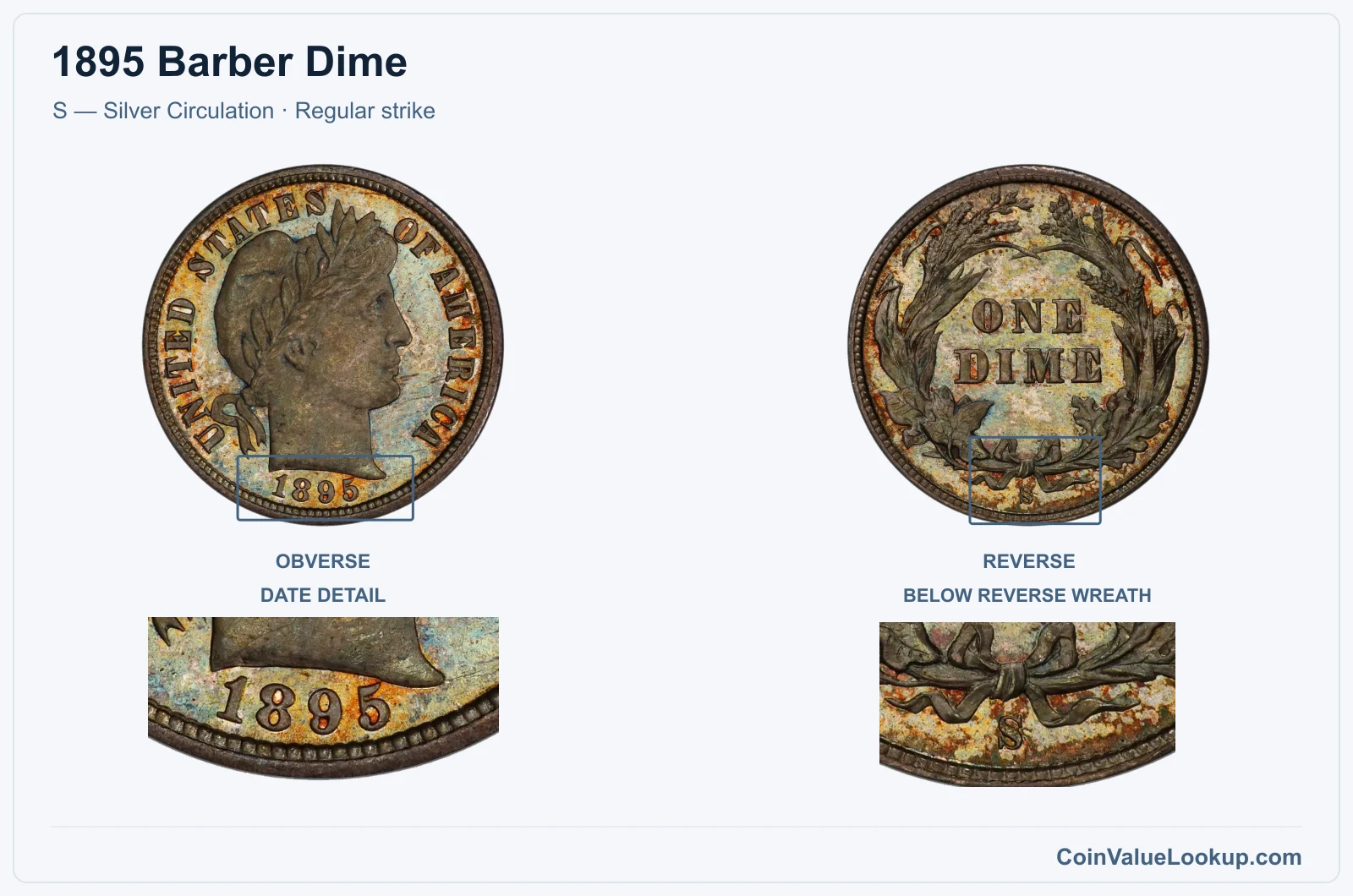
The San Francisco mint used an "S" mintmark below the wreath bow. This is the most affordable 1895 Barber Dime for collectors on a budget, with a USA Coin Book guide estimate near $60 at G4.
That said, uncirculated examples are not cheap. The MS63 guide figure is approximately $1,348, reflecting how few survived without wear or cleaning.
Full original luster and problem-free surfaces push the value up considerably compared to a cleaned or lightly circulated piece.
As with all Barber Dimes, check for hairlines under good lighting. Old cleanings that looked fine decades ago often reveal themselves as a network of tiny parallel scratches when you tilt the coin under a single light source.
Range Grade
Price Auction Records Appraisal PO PO 1
—
Coin Identifier FR FR 2
—
Coin Identifier AG AG 3
—
Coin Identifier G G 4
Coin Identifier
G 6
Coin Identifier VG VG 8
Coin Identifier
VG 10
Coin Identifier F F 12
Coin Identifier
F 15
Coin Identifier VF VF 20
Coin Identifier
VF 25
Coin Identifier
VF 30
Coin Identifier
VF 35
Coin Identifier XF XF 40
Coin Identifier
XF 45
Coin Identifier AU AU 50
Coin Identifier
AU 53
Coin Identifier
AU 55
Coin Identifier
AU 58
Coin Identifier MS MS 60
—
Coin Identifier
MS 61
Coin Identifier
MS 62
Coin Identifier
MS 63
Coin Identifier
MS 64
Coin Identifier
MS 65
Coin Identifier
MS 66
Coin Identifier
MS 67
—
—
—
MS 68
—
—
—
MS 69
—
—
—
MS 70
—
—
—
1895 Barber Dime — No Mint Mark — Brilliant Silver Proof
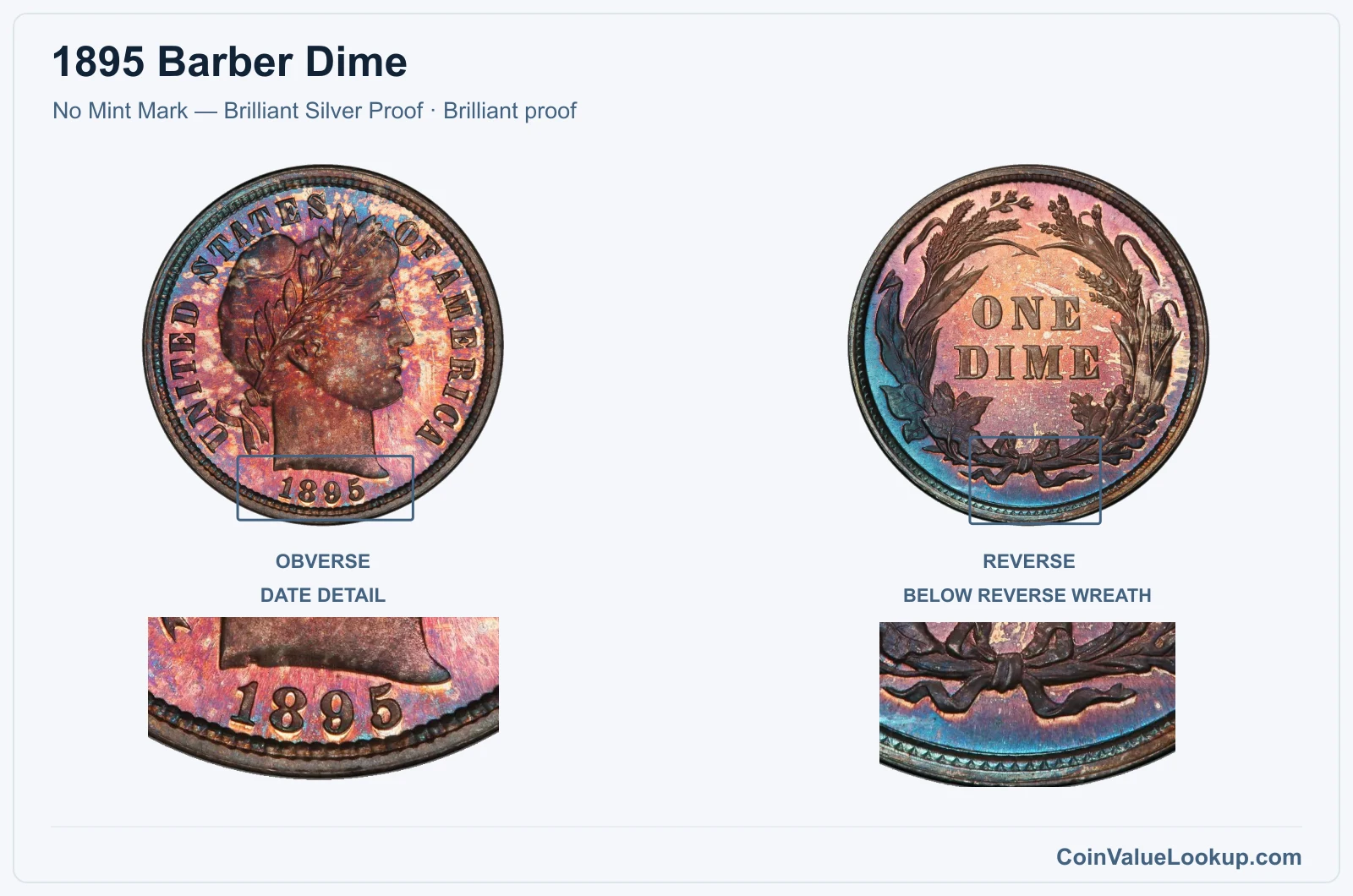
Philadelphia produced brilliant proof Barber Dimes each year from 1892 through 1915, and the 1895 is part of that run. These coins show deeply mirrored fields and exceptionally sharp rim and device detail — a result of specially prepared dies and planchets, not simply careful handling.
The USA Coin Book guide estimate for a PR63 example is about $616. Cameo and Deep Cameo designations refer to the contrast between frosted devices and mirror fields.
Do not assume an ordinary PR63 price applies to a coin graded with a cameo or Deep Cameo label, as those typically carry different premiums.
Proof coins have no mintmark, just like Philadelphia business strikes. The difference is in the surfaces: a proof shows mirror-like reflectivity in the flat fields, while a business strike displays cartwheel luster.
If you are unsure, compare both sides under a directional light.
Range Grade
Price Auction Records Appraisal PR PR 1
—
Coin Identifier
PR 2
—
Coin Identifier
PR 3
—
Coin Identifier
PR 4
—
Coin Identifier
PR 6
—
Coin Identifier
PR 8
—
Coin Identifier
PR 10
—
Coin Identifier
PR 12
—
Coin Identifier
PR 15
—
Coin Identifier
PR 20
—
Coin Identifier
PR 25
—
Coin Identifier
PR 30
—
Coin Identifier
PR 35
—
Coin Identifier
PR 40
—
Coin Identifier
PR 45
—
Coin Identifier
PR 50
—
Coin Identifier
PR 53
—
Coin Identifier
PR 55
—
Coin Identifier
PR 58
—
Coin Identifier
PR 60
Coin Identifier
PR 61
Coin Identifier
PR 62
Coin Identifier
PR 63
Coin Identifier
PR 64
Coin Identifier
PR 65
Coin Identifier
PR 66
Coin Identifier
PR 67
Coin Identifier
PR 68
Coin Identifier
PR 69
—
—
—
PR 70
—
—
—
1895 Barber Dime Error List
1. 1895 Barber Dime — Die Cap / Capped-Die Strike
A die cap occurs when a struck coin sticks to one of the dies and is carried upward, becoming a cap over the die face. Subsequent strikes press into this adhered coin, gradually cupping it into a bottle-cap shape.
The result is a dramatic, unmistakable error piece.
A PCGS-graded MS64 obverse die cap on an 1895-O has been documented. Both sides of a die cap look abnormal: one side shows a spread, mirrored incuse impression, while the other is typically cupped with distorted design elements.
Coins struck through an existing cap also exist and look different — they receive a weakened, ghostly impression from the capped die.
Do not confuse a die cap with a coin that has been bent in a vise, stepped on, or damaged post-mint. Genuine caps show progressive metal flow consistent with repeated striking, not sharp creases or random dents.
A normal weak strike is also not a cap error. No specific price was adopted for this error because condition, the degree of cupping, and the error's visual impact all affect value individually.
Professional evaluation is the sensible route here.