1821 Capped Bust Dime Coin Value: How Much Is It Worth?
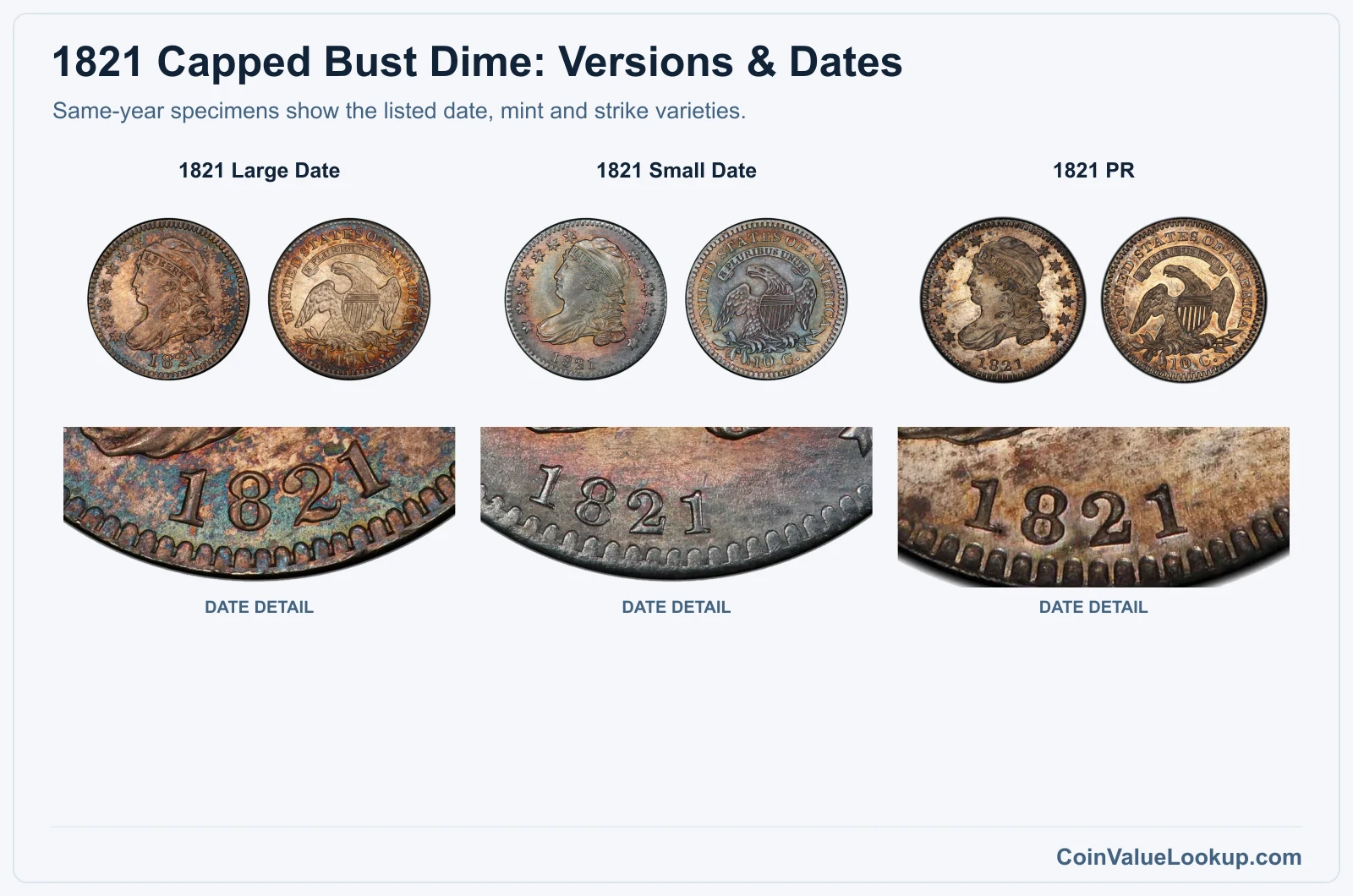
The 1821 Capped Bust Dime is one of the earlier collectible silver dimes struck at the Philadelphia Mint. These coins were made from a silver-copper alloy of approximately 89.24% silver, giving them a distinctive look and heft that modern dimes simply lack.
Guide estimates for identified branches range from about $107.00 in well-worn Good condition to $4,945.00 at the MS63 level, depending on the specific date variety and grade. Those anchors are not guaranteed offers — your coin's actual surfaces, wear and variety determine where it falls.
Fast Way to Identify Your 1821 Capped Bust Dime
Want a quick read on what you have? Upload clear photos of both the front and back of your 1821 Capped Bust Dime, and our identifier can give you a preliminary identification of the version and approximate condition.
Good lighting and a steady shot help — try to capture the full coin without glare or shadow across the date and lettering.
1821 Capped Bust Dime Value
Upload both sides of your 1821 Capped Bust Dime.
Front Obverse
Upload photo
Back Reverse
Upload photo
Which 1821 Capped Bust Dime Versions Are Worth Money?
- 1821 Large Date — the more commonly encountered business-strike variety, with guide estimates from $107.00 (G4) to $4,674.00 (MS63).
- 1821 Small Date — a distinct date variety with slightly higher guide estimates in top grades, reaching $4,945.00 at MS63.
- 1821 Proof — extremely scarce early proof manufacture requiring professional attribution; no standard guide price is adopted.
- Die crack examples on the Large Date obverse have appeared in the marketplace and can add collector interest depending on visibility and condition.
Step 1: Identify Your 1821 Capped Bust Dime Mint Mark and Version
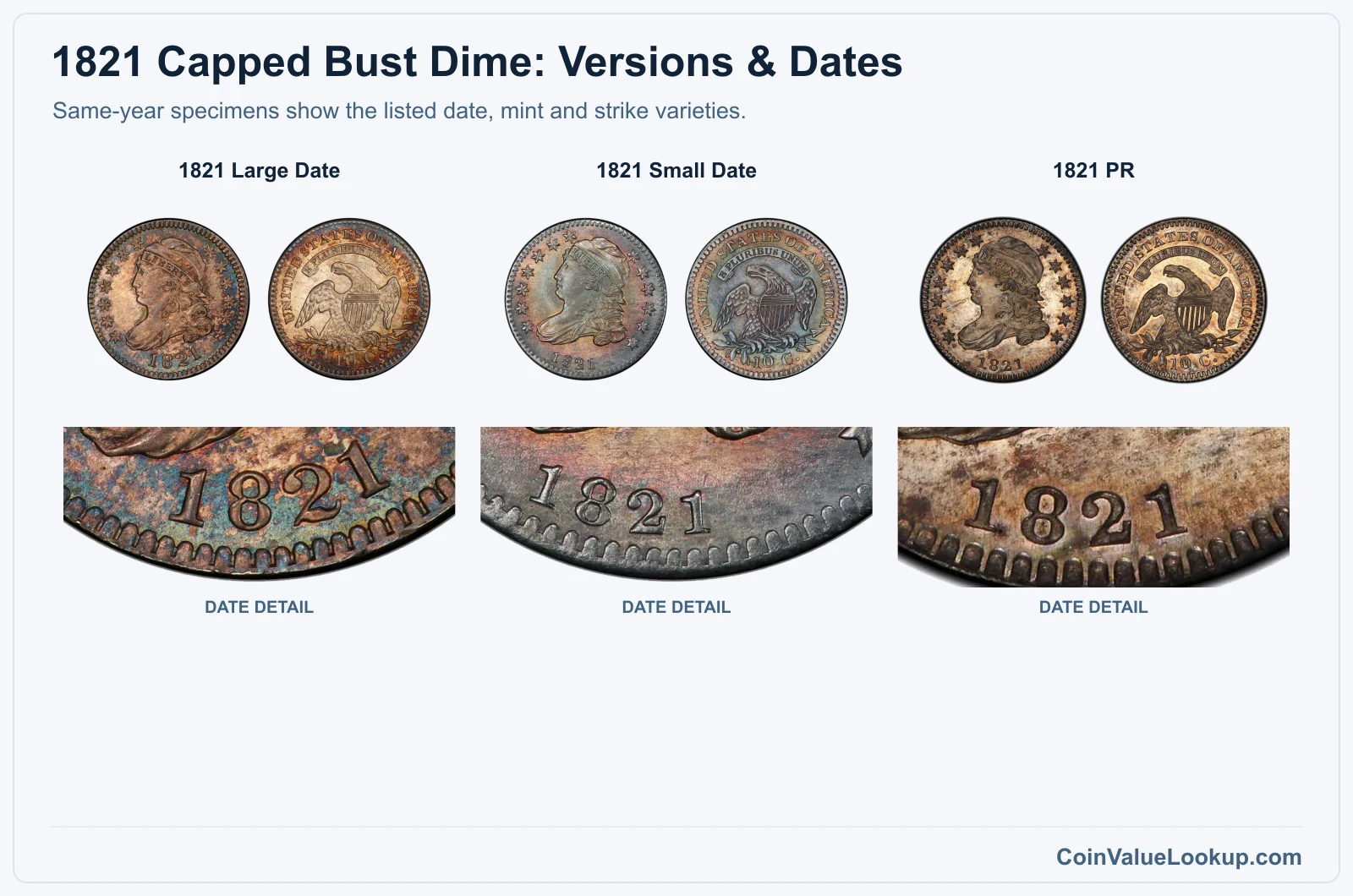
Every 1821 dime was struck in Philadelphia. There is no mintmark to look for.
Do not confuse this coin with a half dime, which is a smaller denomination entirely.
The design features a Capped Bust on the obverse with large dentils around the rim and a heraldic eagle on the reverse. This is the wider-format Capped Bust style used during this era.
The key split you need to identify is the date variety: Large Date versus Small Date. Compare the size and shape of the numerals in "1821" against a correctly labeled reference image of each variety.
Magnification alone will not settle it — you need a side-by-side comparison showing the actual proportions of the digits relative to the bust and stars. Zooming in on a single coin without a reference is a common mistake.
A third branch exists: the 1821 Proof. These are extremely scarce early proof manufactures.
A coin that simply looks shiny, reflective, or strongly struck is not automatically a proof — confirmed proof status requires professional attribution.
Step 2: Check Your 1821 Capped Bust Dime Grade
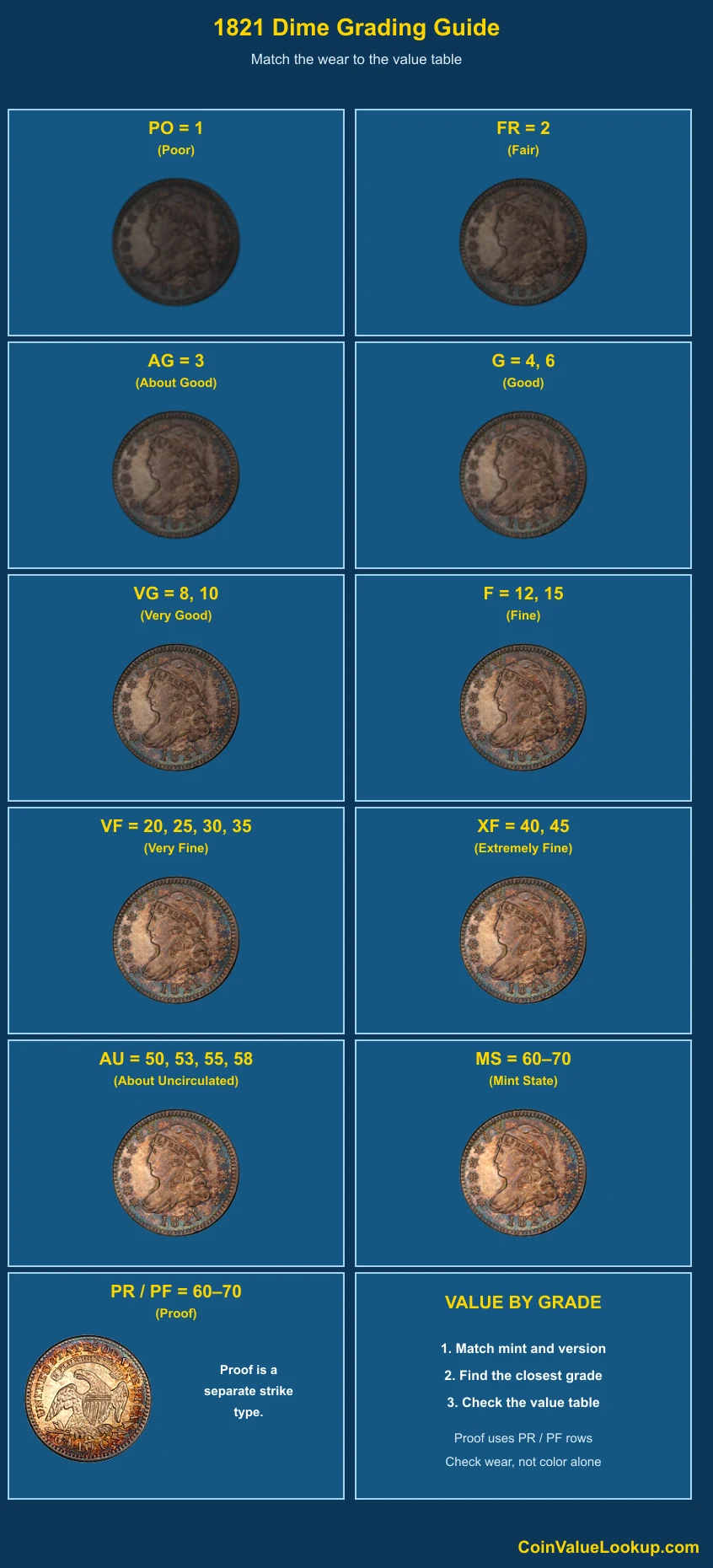
Start by examining Liberty's hair curls above the forehead and ear, the cheek, and the drapery and cap on the obverse. On the reverse, check the eagle's breast feathers and wing tips.
These are the first areas to show friction.
Use the comparison image to match your coin's wear against known grade examples of the same type. Early dimes were struck on hand-operated presses, so even uncirculated pieces can show uneven or slightly weak details in spots.
That is a strike characteristic, not wear.
Luster matters. A coin with full original luster across the fields and only light contact marks is a different animal from one that has been cleaned to look bright.
If the surfaces feel slick or show hairlines under a light, the coin has likely been cleaned, and that reduces its comparability to guide estimates.
Do not clean or polish the coin. Collectors and graders prefer original, naturally toned surfaces over a bright, artificially stripped coin every time.
Step 3: Check 1821 Capped Bust Dime Value by Mint and Version
1821 Capped Bust Dime — Large Date
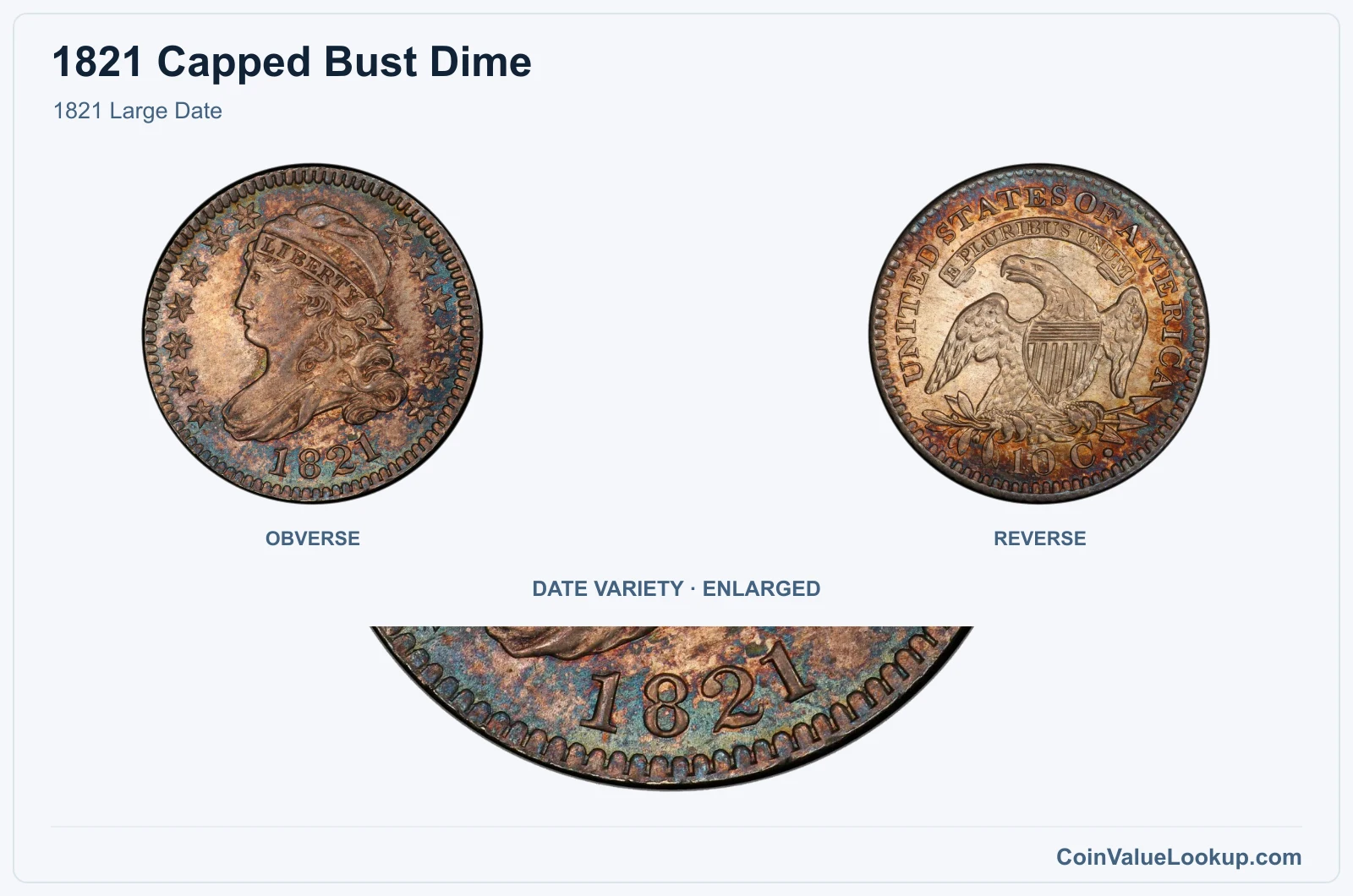
The 1821 Large Date is the variety most collectors encounter first. Its numerals in the date are noticeably taller and wider compared to the Small Date counterpart.
You need a correctly labeled reference image to confirm which you have — simply zooming in on your coin is not enough.
All examples were struck in Philadelphia with no mintmark, from a silver-copper alloy of about 89.24% silver. Guide estimates place this variety at roughly $107.00 in G4 and $4,674.00 in MS63, per USA Coin Book.
Original surfaces and honest wear matter far more than brightness when comparing your coin to those figures.
Range Grade
Price Auction Records Appraisal PO PO 1
—
Coin Identifier FR FR 2
—
Coin Identifier AG AG 3
Coin Identifier G G 4
Coin Identifier
G 6
Coin Identifier VG VG 8
—
Coin Identifier
VG 10
Coin Identifier F F 12
Coin Identifier
F 15
Coin Identifier VF VF 20
Coin Identifier
VF 25
Coin Identifier
VF 30
Coin Identifier
VF 35
Coin Identifier XF XF 40
Coin Identifier
XF 45
Coin Identifier AU AU 50
Coin Identifier
AU 53
Coin Identifier
AU 55
Coin Identifier
AU 58
Coin Identifier MS MS 60
—
Coin Identifier
MS 61
Coin Identifier
MS 62
Coin Identifier
MS 63
Coin Identifier
MS 64
Coin Identifier
MS 65
Coin Identifier
MS 66
Coin Identifier
MS 67
—
Coin Identifier
MS 68
—
—
—
MS 69
—
—
—
MS 70
—
—
—
1821 Capped Bust Dime — Small Date
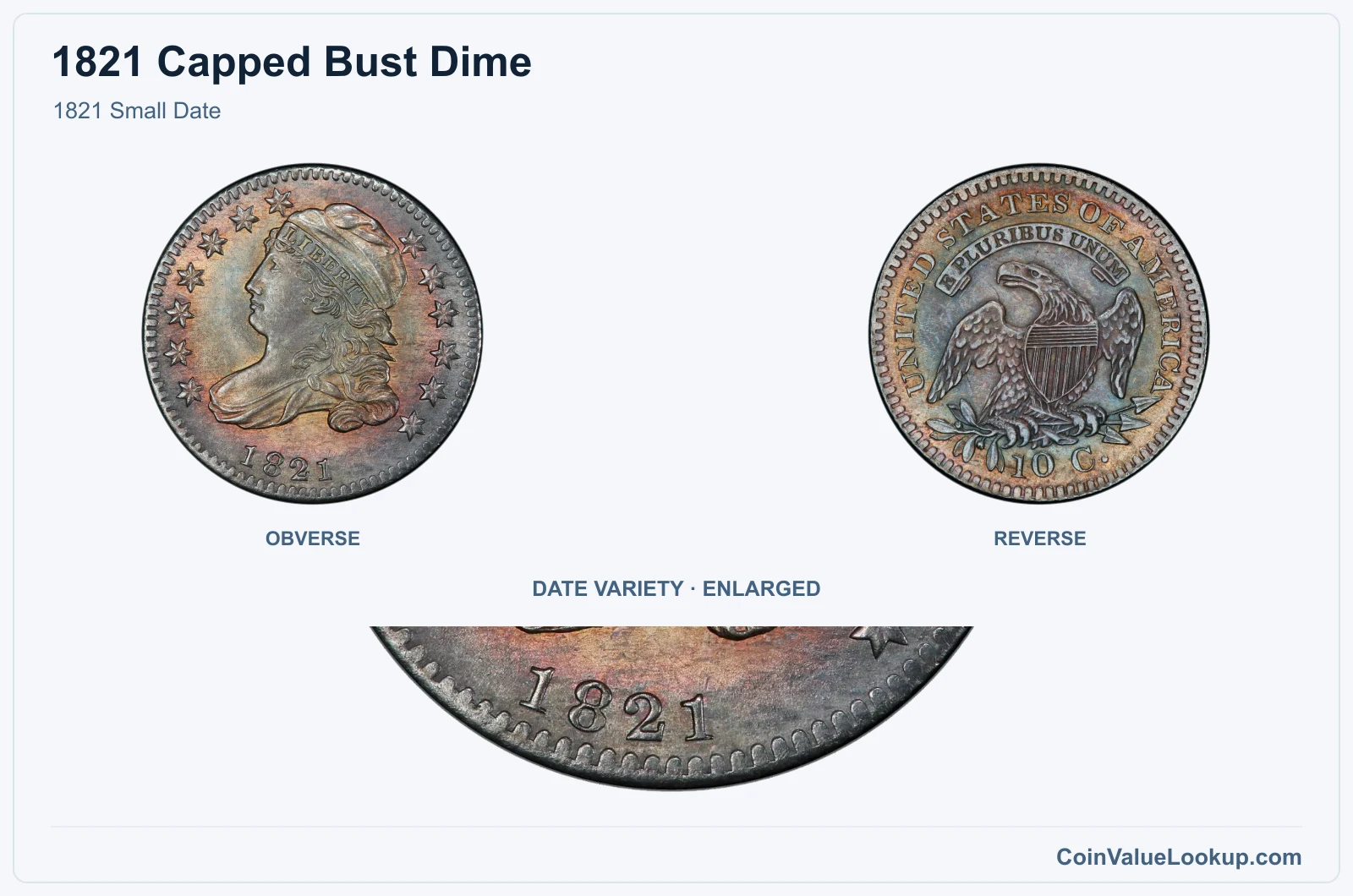
The 1821 Small Date variety features noticeably smaller, more compact numerals in the date. Side by side with a Large Date example, the difference is clear, but in isolation it can be tricky.
Always compare against a labeled reference rather than relying on your gut feeling about digit size.
This version was also struck at Philadelphia with no mintmark, in the same silver-copper alloy. Guide estimates from USA Coin Book run about $107.00 in G4 and $4,945.00 in MS63 — slightly above the Large Date at the top grade level.
As always, those figures assume original, problem-free surfaces. Cleaning, scratches, or corrosion will reduce how closely your coin compares to those benchmarks.
Coin Value Lookup is a good starting point if you want to look up value guides for other early dimes or related series. It can help you zero in on the right denomination and year before diving into variety details.
Range Grade
Price Auction Records Appraisal PO PO 1
—
Coin Identifier FR FR 2
—
Coin Identifier AG AG 3
—
Coin Identifier G G 4
Coin Identifier
G 6
—
Coin Identifier VG VG 8
Coin Identifier
VG 10
Coin Identifier F F 12
Coin Identifier
F 15
Coin Identifier VF VF 20
Coin Identifier
VF 25
Coin Identifier
VF 30
Coin Identifier
VF 35
Coin Identifier XF XF 40
Coin Identifier
XF 45
Coin Identifier AU AU 50
Coin Identifier
AU 53
Coin Identifier
AU 55
Coin Identifier
AU 58
Coin Identifier MS MS 60
Coin Identifier
MS 61
Coin Identifier
MS 62
Coin Identifier
MS 63
Coin Identifier
MS 64
Coin Identifier
MS 65
Coin Identifier
MS 66
Coin Identifier
MS 67
—
—
—
MS 68
—
—
—
MS 69
—
—
—
MS 70
—
—
—
1821 Capped Bust Dime — PR
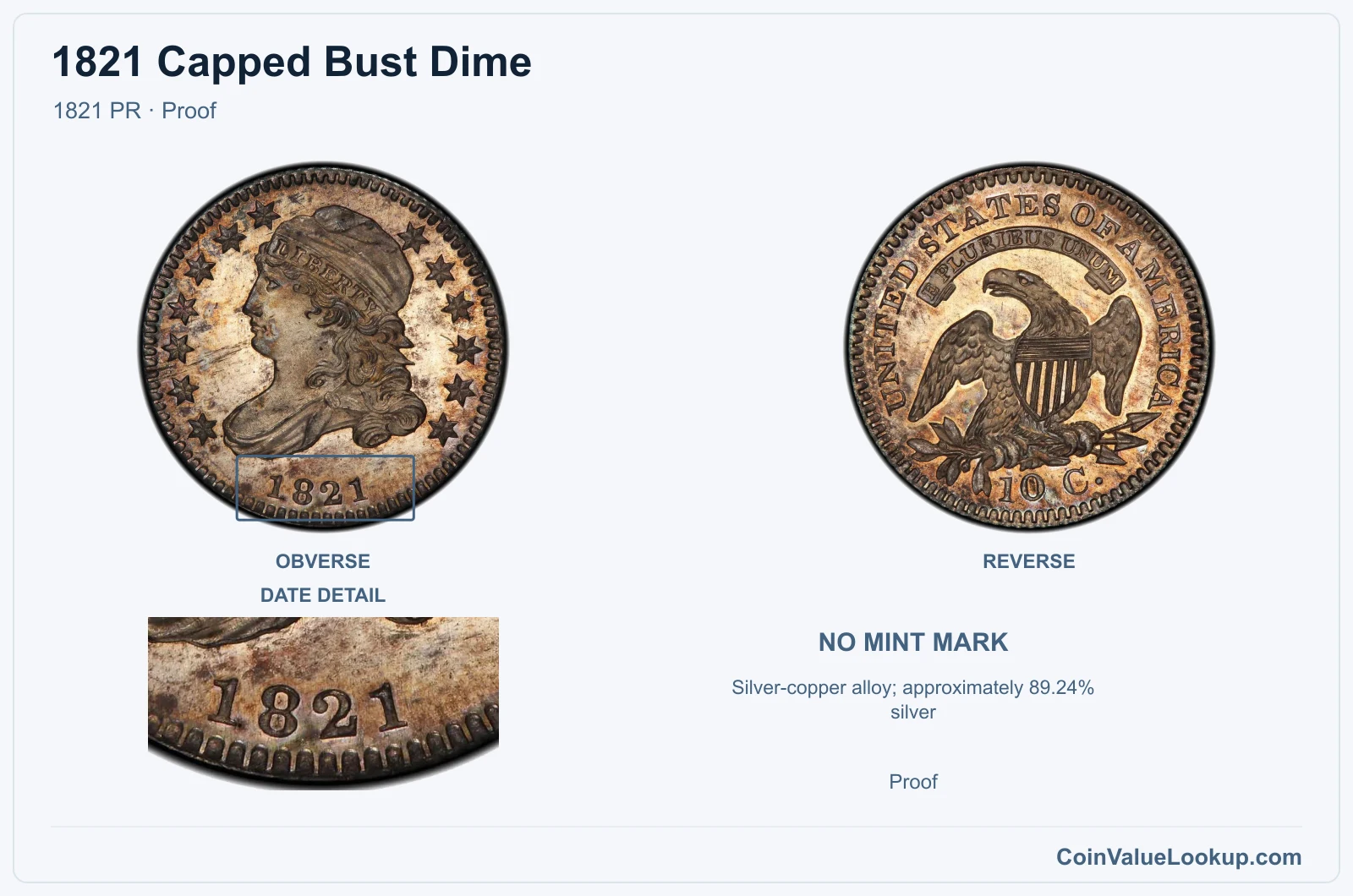
The 1821 Proof Capped Bust Dime is an extremely scarce coin from the earliest era of deliberate proof production at the Philadelphia Mint. These were struck with specially prepared dies and polished planchets, resulting in deeply mirrored fields and sharp detail that business strikes simply do not achieve.
Here is the critical point: a circulation-strike coin that happens to look reflective, strongly struck, or well-preserved is not a proof. Confirmed proof status requires professional attribution by a recognized grading service.
No standard numeric guide price is adopted for this branch, so value depends entirely on the individual coin's authenticated identity and condition. If you suspect you have one, professional evaluation is the only reliable next step.
Range Grade
Price Auction Records Appraisal PR PR 1
—
Coin Identifier
PR 2
—
Coin Identifier
PR 3
—
Coin Identifier
PR 4
—
Coin Identifier
PR 6
—
Coin Identifier
PR 8
—
Coin Identifier
PR 10
—
Coin Identifier
PR 12
—
Coin Identifier
PR 15
—
Coin Identifier
PR 20
—
Coin Identifier
PR 25
—
Coin Identifier
PR 30
—
Coin Identifier
PR 35
—
Coin Identifier
PR 40
—
Coin Identifier
PR 45
—
Coin Identifier
PR 50
—
Coin Identifier
PR 53
—
Coin Identifier
PR 55
—
Coin Identifier
PR 58
—
Coin Identifier
PR 60
—
Coin Identifier
PR 61
—
Coin Identifier
PR 62
—
Coin Identifier
PR 63
—
Coin Identifier
PR 64
—
Coin Identifier
PR 65
Coin Identifier
PR 66
Coin Identifier
PR 67
—
—
—
PR 68
—
—
—
PR 69
—
—
—
PR 70
—
—
—
1821 Capped Bust Dime Error List
1. 1821 Capped Bust Dime — Die Crack / Die Chip
Die cracks on the 1821 Capped Bust Dime have been reported specifically on the Large Date variety, with a crack running through the lower-left stars on the obverse. These appear as thin, raised lines on the coin's surface — the result of a fracture in the steel die transferring its outline onto every coin struck afterward.
To spot one, look for a continuous raised line connecting or passing through stars near the date on the obverse. A die chip, by contrast, shows up as a small raised blob rather than a line, and a rim-connected break (called a cud) produces a raised, featureless lump at the edge.
Do not confuse die cracks with incuse scratches, corrosion pitting, or foreign material stuck to the surface. Scratches are recessed into the metal, while die cracks stand above it.
No specific price range is adopted for this feature. The value depends on the crack's visibility, the coin's overall condition, and collector demand for the particular die state.