1822 Capped Bust Dime Coin Value: How Much Is It Worth?
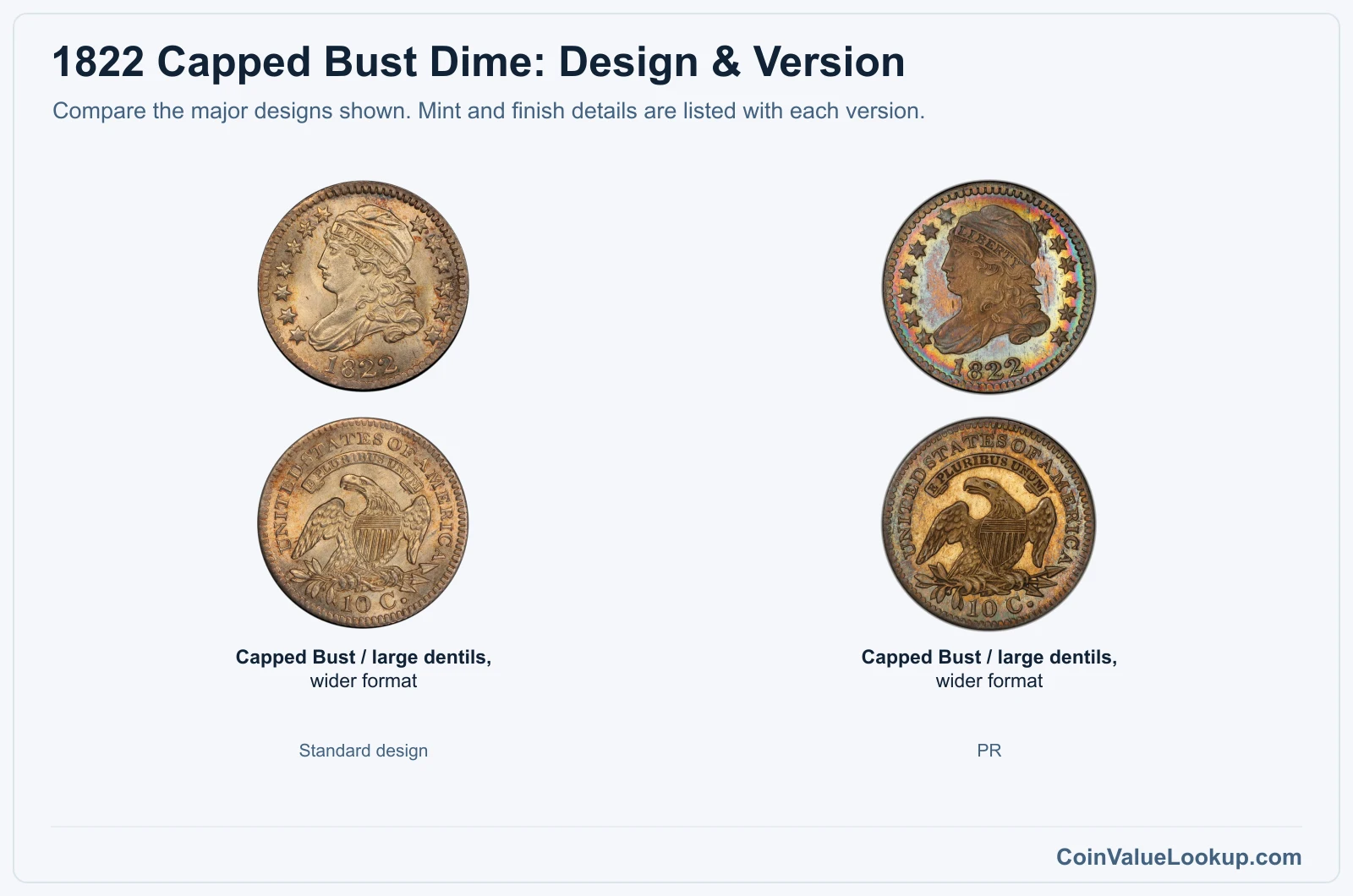
The 1822 Capped Bust Dime is one of the earlier silver dimes struck at the Philadelphia Mint, and surviving examples draw serious attention from collectors of early American coinage. Guide estimates for identified branches range from roughly $3,088 in well-worn condition up to around $42,833 at higher grades, depending on the exact version, wear and originality of surfaces.
Those figures are guide anchors for specific grades and versions, not guaranteed offers for every coin.
Fast Way to Identify Your 1822 Capped Bust Dime
If you have an 1822 dime and want a quick starting point, snap clear photos of the front and back and upload them here. Our identifier can give you a preliminary read on the design, date and general condition.
It is not a substitute for professional authentication or precise grading, but it helps you figure out what you are working with before diving deeper.
1822 Capped Bust Dime Value
Upload both sides of your 1822 Capped Bust Dime.
Front Obverse
Upload photo
Back Reverse
Upload photo
Which 1822 Capped Bust Dime Versions Are Worth Money?
- The 1822 business strike in G4 condition carries a guide estimate around $3,088, climbing to roughly $42,833 at MS63, so even heavily worn survivors hold meaningful value.
- The 1822 PR (proof) is extremely scarce early proof coinage; no standard guide price is adopted, and each example requires individual expert assessment based on authenticated identity and condition.
- Confirm which branch you hold, business strike or proof, before comparing to any price reference, since the two categories are valued on completely different scales.
- Original, uncleaned surfaces add desirability across all grades; a bright, scrubbed coin will not match guide estimates for problem-free examples.
Step 1: Identify Your 1822 Capped Bust Dime Mint Mark and Version
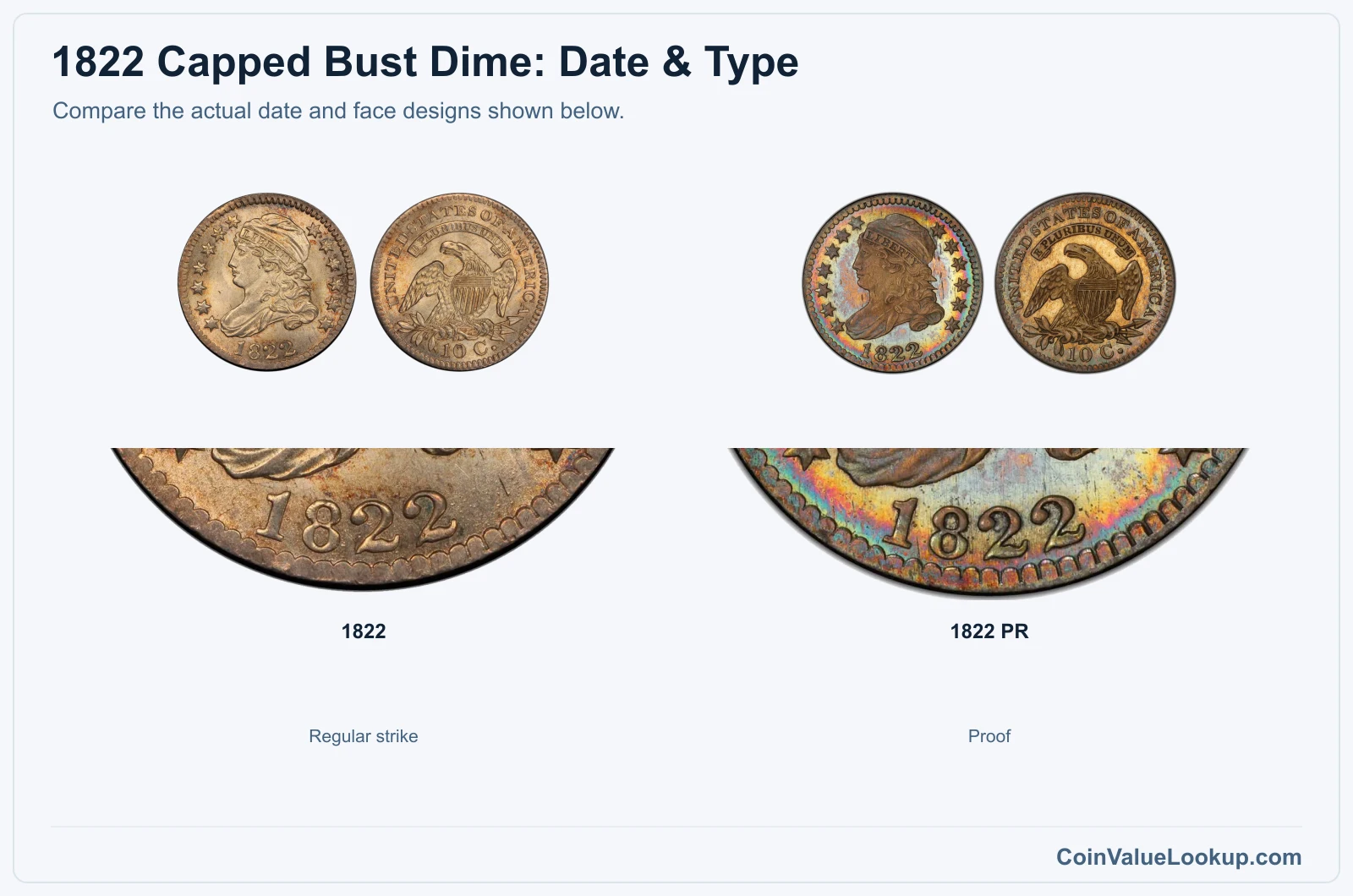
Every 1822 Capped Bust Dime was struck at the Philadelphia Mint, so there is no mintmark to hunt for. The coin is a silver-copper alloy, roughly 89.24% silver, and uses the wider-format Capped Bust design with large dentils around the rim.
Two branches exist for this date: the regular business strike (1822) and an extremely scarce proof version (1822 PR). Do not confuse this coin with a Capped Bust half dime, which is a smaller denomination entirely.
On the obverse, Liberty faces left wearing a cloth cap with "LIBERTY" inscribed on the headband. The reverse shows a heraldic eagle with a shield on its breast.
The wide border dentils and overall diameter distinguish the large-type Capped Bust design from earlier and later dime formats.
If your coin looks unusually reflective or sharply struck, that alone does not make it a proof. Proof status requires attribution by a recognized grading service.
Start by confirming the date, design type and whether the coin has been cleaned or damaged before comparing to any price guide.
Step 2: Check Your 1822 Capped Bust Dime Grade
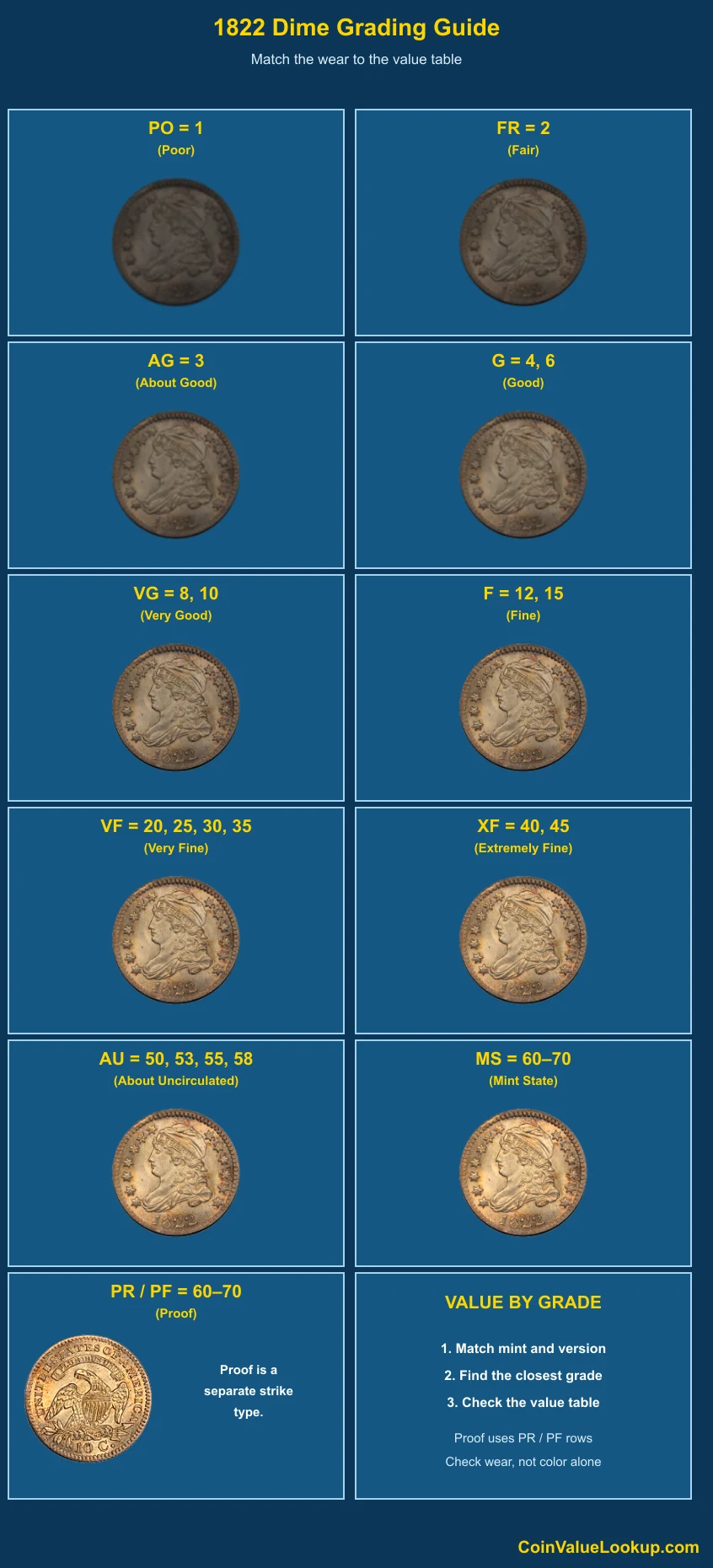
Focus on the highest points of the design first. On the obverse, check Liberty's hair curls above the forehead, the cheek and the drapery near the shoulder and cap.
These areas lose detail earliest as the coin circulates.
On the reverse, the eagle's breast feathers and wing tips show wear quickly. Compare your coin to the reference image to see how these zones should look at various grades.
Early 1820s dimes were struck on hand-operated presses, so even uncirculated examples can show uneven strike strength or soft spots. A flat area on an otherwise lustrous coin might be strike weakness rather than wear.
Look at overall luster and contact marks alongside high-point detail to judge the real grade.
Do not clean, polish or dip the coin. Original surfaces, even if toned or slightly dingy, are strongly preferred by collectors and directly affect value.
Step 3: Check 1822 Capped Bust Dime Value by Mint and Version
1822 Capped Bust Dime
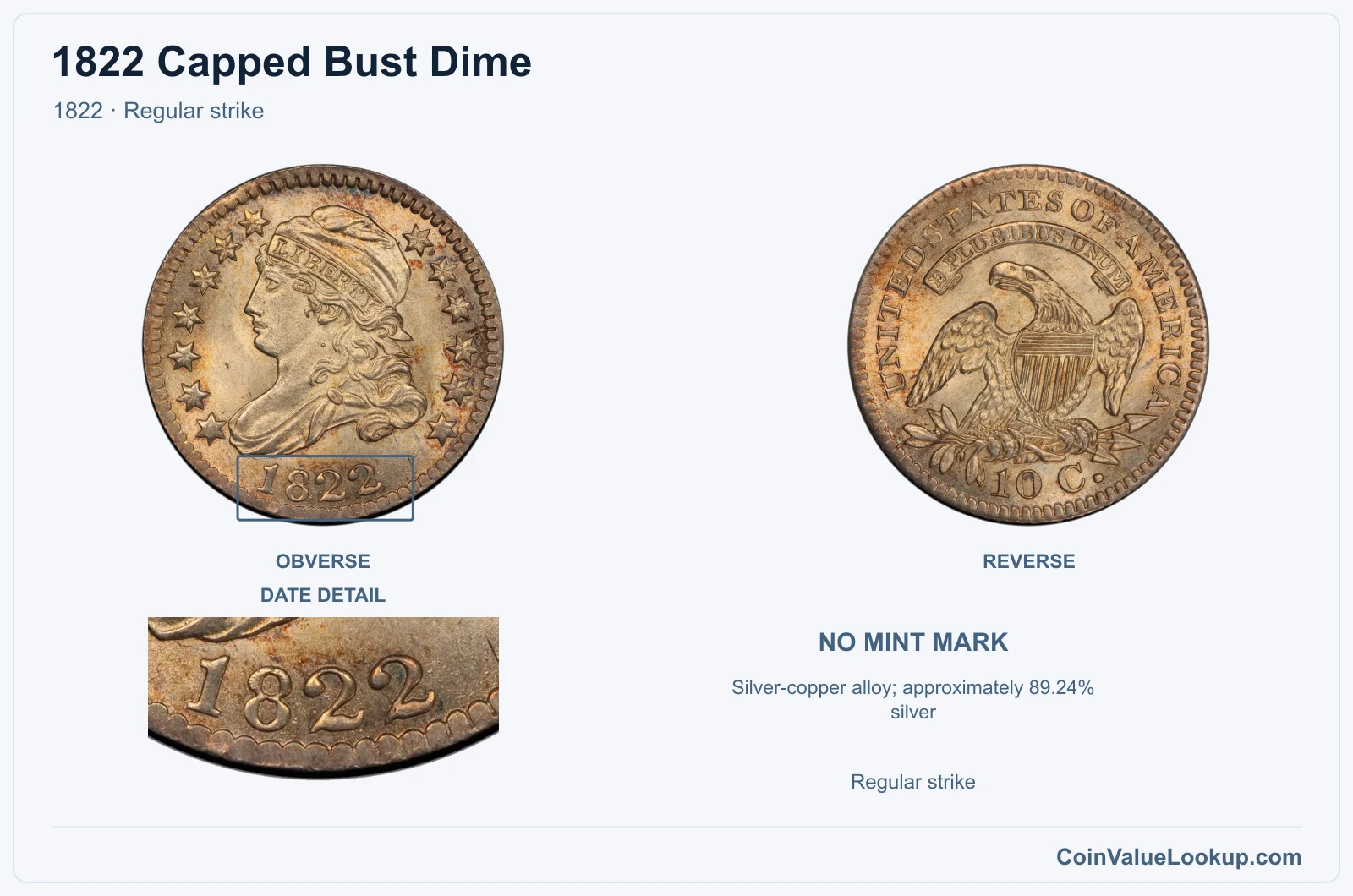
The regular 1822 Capped Bust Dime is a Philadelphia business strike in silver-copper alloy, about 89.24% silver. There is no mintmark.
Identify it by the date, the wide Capped Bust obverse with large dentils and the heraldic eagle reverse.
Guide estimates place this coin at approximately $3,088 in G4 and around $42,833 in MS63, per USA Coin Book. These are grade-specific reference points, not blanket offers.
Original surfaces and actual wear matter far more than how shiny the coin looks. Cleaning, scratches or corrosion will pull real-world value below those benchmarks.
Coin Value Lookup is a useful starting point if you want to look up guides for other early dime dates and denominations alongside this one.
Range Grade
Price Auction Records Appraisal PO PO 1
—
Coin Identifier FR FR 2
Coin Identifier AG AG 3
Coin Identifier G G 4
Coin Identifier
G 6
Coin Identifier VG VG 8
Coin Identifier
VG 10
Coin Identifier F F 12
Coin Identifier
F 15
Coin Identifier VF VF 20
Coin Identifier
VF 25
Coin Identifier
VF 30
—
Coin Identifier
VF 35
Coin Identifier XF XF 40
—
Coin Identifier
XF 45
Coin Identifier AU AU 50
Coin Identifier
AU 53
—
Coin Identifier
AU 55
Coin Identifier
AU 58
Coin Identifier MS MS 60
—
Coin Identifier
MS 61
—
Coin Identifier
MS 62
Coin Identifier
MS 63
Coin Identifier
MS 64
Coin Identifier
MS 65
—
Coin Identifier
MS 66
Coin Identifier
MS 67
—
—
—
MS 68
—
—
—
MS 69
—
—
—
MS 70
—
—
—
1822 Capped Bust Dime — PR
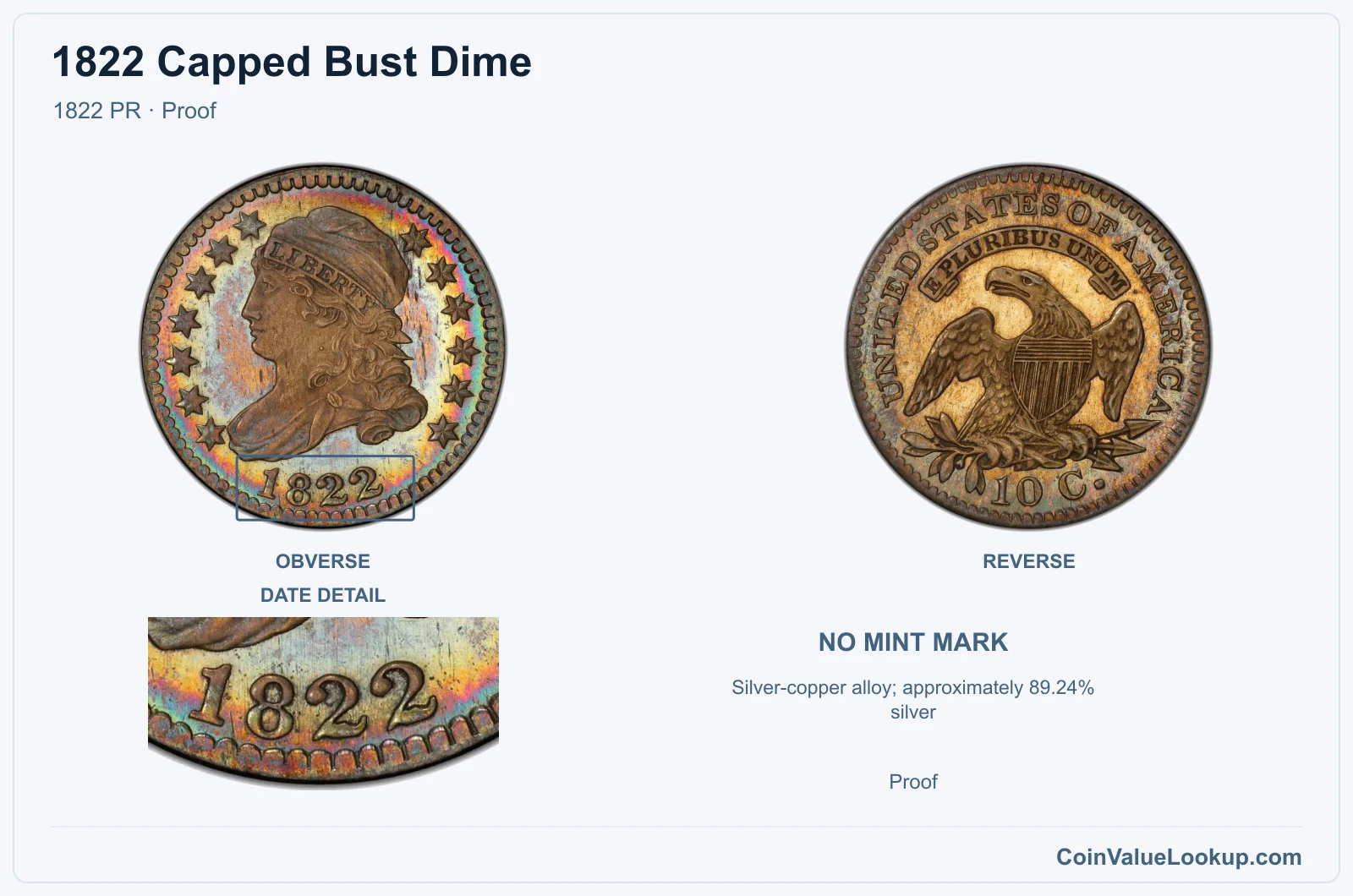
The 1822 PR is an early proof striking of the Capped Bust Dime. Proof coins from this era were made in tiny numbers, often as presentation pieces or for collectors with connections to the Mint.
They were produced on polished planchets with carefully prepared dies, giving them mirrored fields and sharp design details that business strikes rarely match.
A circulation strike that happens to look reflective or well-struck is not automatically a proof. Authentication and attribution by a recognized third-party grading service are essential before treating any 1822 dime as a proof.
No standard guide price has been adopted for this version, so value depends entirely on the individual coin's authenticated identity, condition and provenance. If you suspect you have one, professional evaluation is the right next step.
Range Grade
Price Auction Records Appraisal PR PR 1
—
Coin Identifier
PR 2
—
Coin Identifier
PR 3
—
Coin Identifier
PR 4
—
Coin Identifier
PR 6
—
Coin Identifier
PR 8
—
Coin Identifier
PR 10
—
Coin Identifier
PR 12
—
Coin Identifier
PR 15
—
Coin Identifier
PR 20
—
Coin Identifier
PR 25
—
Coin Identifier
PR 30
—
Coin Identifier
PR 35
—
Coin Identifier
PR 40
—
Coin Identifier
PR 45
—
Coin Identifier
PR 50
—
Coin Identifier
PR 53
—
Coin Identifier
PR 55
—
Coin Identifier
PR 58
—
Coin Identifier
PR 60
—
Coin Identifier
PR 61
—
Coin Identifier
PR 62
—
Coin Identifier
PR 63
—
Coin Identifier
PR 64
—
—
—
PR 65
—
—
—
PR 66
—
—
—
PR 67
—
—
—
PR 68
—
—
—
PR 69
—
—
—
PR 70
—
—
—