1829 Capped Bust Dime Coin Value: How Much Is It Worth?
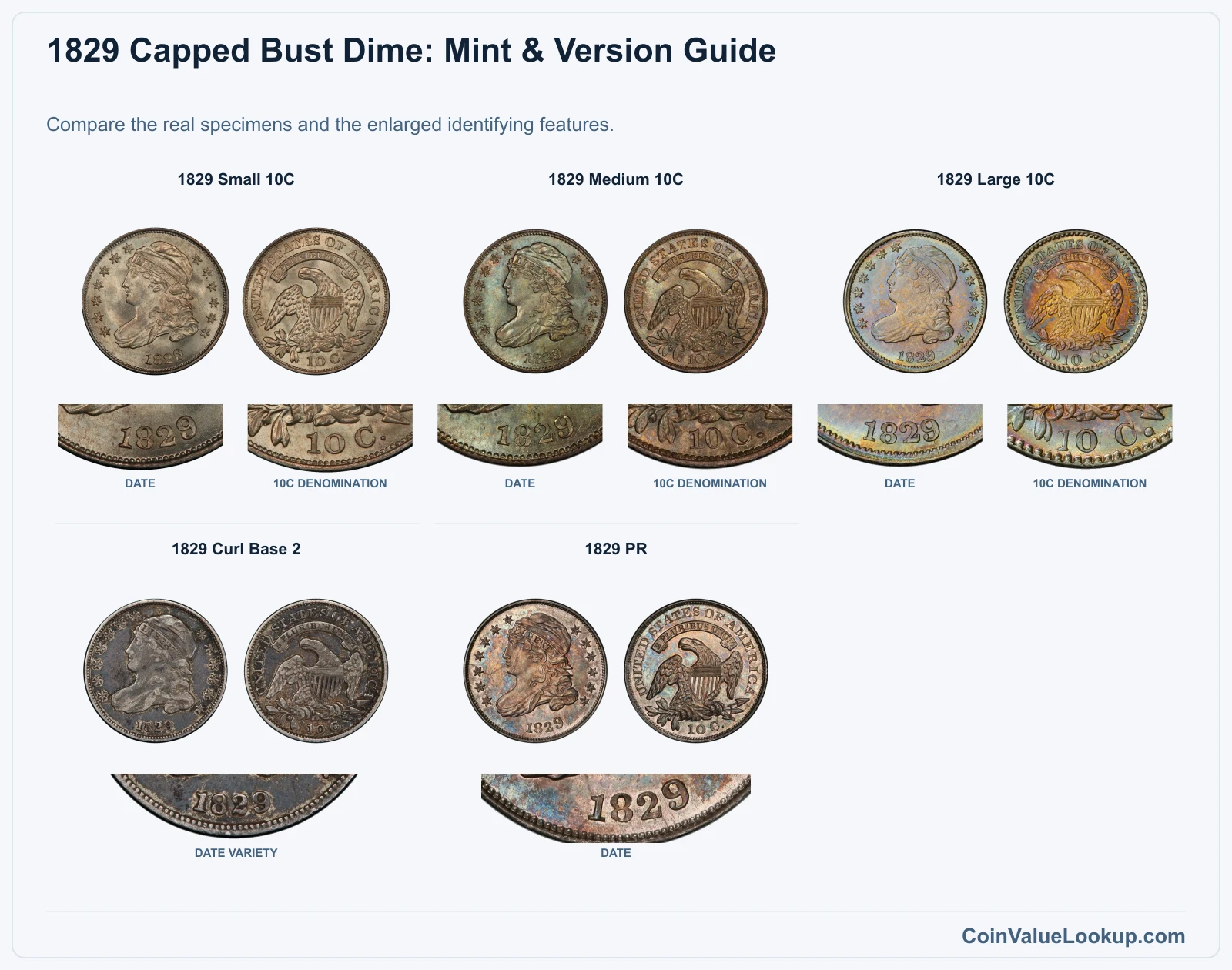
The 1829 Capped Bust Dime is an early American silver collectible struck at the Philadelphia Mint. Guide estimates for the main business-strike branches range from about $60.00 in well-worn Good-4 condition up to $4,945.00 in choice Mint State 63, depending on the exact variety.
One rare date-punch variety and a proof issue carry their own separate value considerations. Your coin's worth depends on its specific variety, honest wear and original surfaces, so those guide anchors are not guaranteed offers.
Fast Way to Identify Your 1829 Capped Bust Dime
Want a quick read on what you have? Upload clear photos of the front and back of your 1829 dime, and our identifier can give you a preliminary take on the variety and approximate condition.
That first step helps you figure out which branch you are dealing with before diving into detailed comparisons.
1829 Capped Bust Dime Value
Upload both sides of your 1829 Capped Bust Dime.
Front Obverse
Upload photo
Back Reverse
Upload photo
Which 1829 Capped Bust Dime Versions Are Worth Money?
- The 1829 Curl Base 2 carries a guide estimate of $6,261.00 even in low-grade G4, making it the standout rarity among the business-strike branches.
- The 1829 Large 10C reaches an estimated $4,945.00 in MS63, the highest Mint State guide figure among the three denomination-size varieties.
- The 1829 Small 10C and 1829 Medium 10C share a G4 estimate of $60.00 and an MS63 estimate of $2,501.00, so condition is the main value driver for these two.
- The 1829 Proof is extremely scarce early proof manufacture; no standard guide range is adopted, and each coin requires individual assessment by an authenticated example.
Step 1: Identify Your 1829 Capped Bust Dime Mint Mark and Version
Every 1829 Capped Bust Dime was struck at the Philadelphia Mint, so there is no mintmark to hunt for. The coin is a silver-copper alloy, roughly 89.24% silver, in the closed-collar, small-dentils format of the later Capped Bust design.
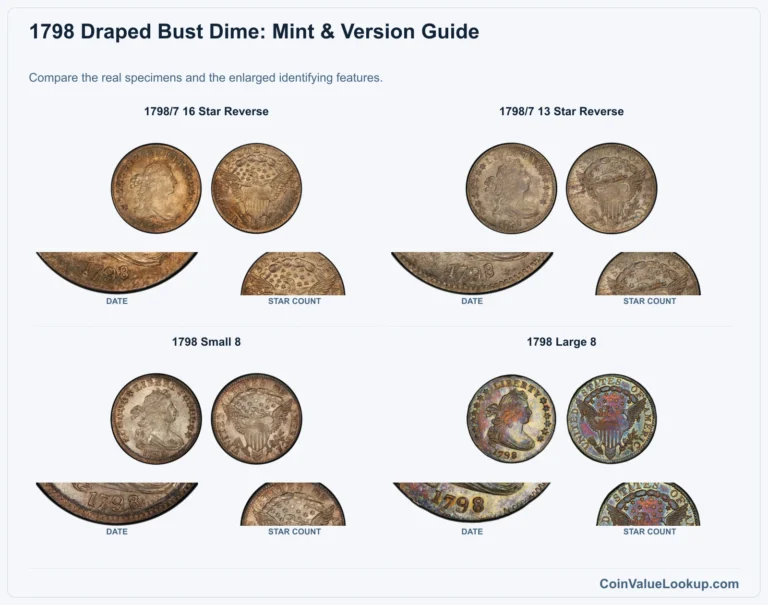
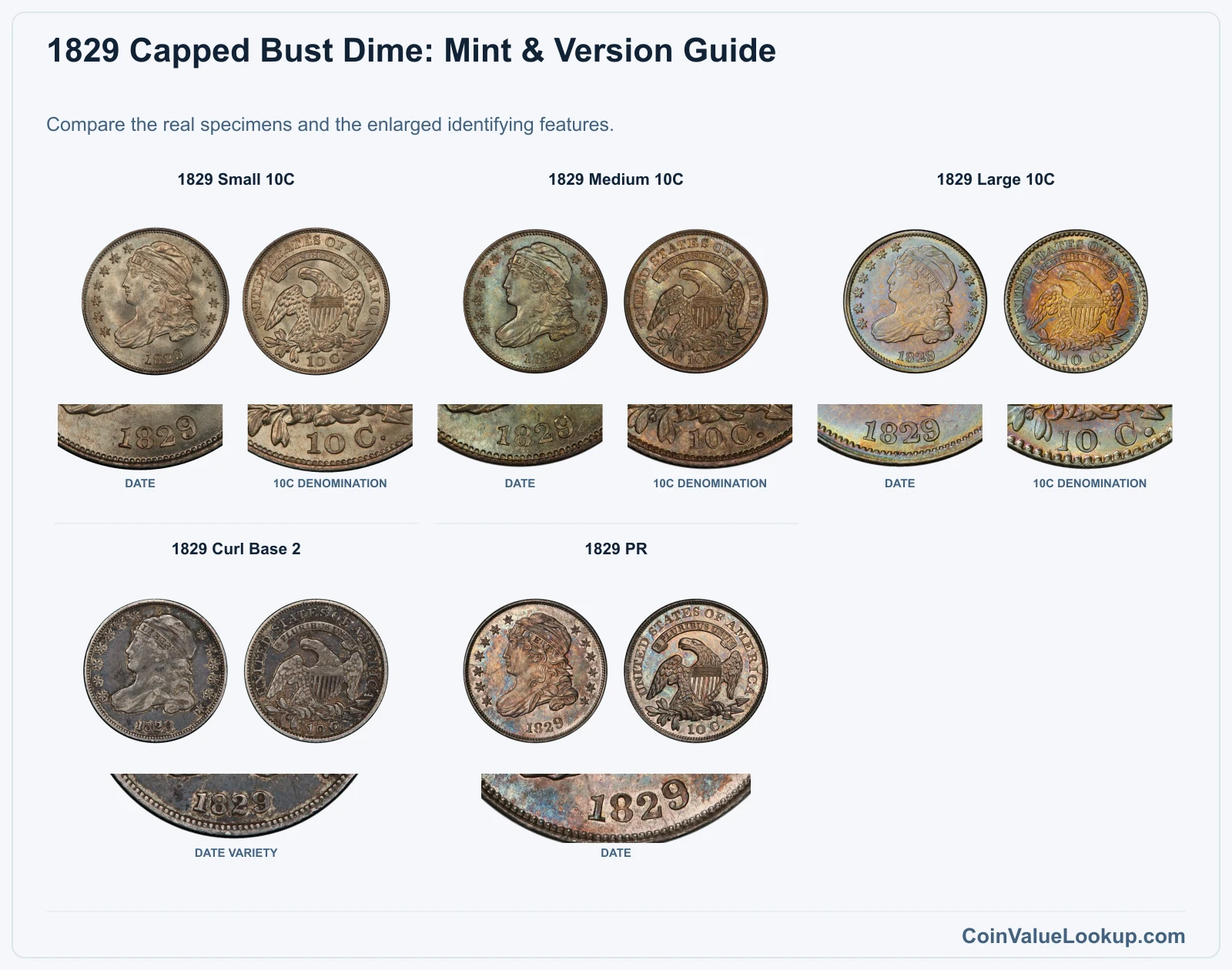
Five branches exist for this date: Small 10C, Medium 10C, Large 10C, Curl Base 2, and Proof (PR). The first three are distinguished by the physical size of the "10 C." denomination stamped beneath the eagle on the reverse.
You need a correctly labeled reference image at the same scale as your coin; zooming in on your photo alone will not settle it because magnification can make any version look "large."
The Curl Base 2 variety is identified by looking at the numeral 2 in the date. On most 1829 dimes the base of the 2 is flat or squared off.
On the Curl Base 2, the foot of the digit curls inward. Damage or wear can sometimes mimic this shape, so confirmation against a known example is important.
One more thing: a half dime is a completely different, smaller denomination. Do not use one as a comparison piece for your dime.
Step 2: Check Your 1829 Capped Bust Dime Grade
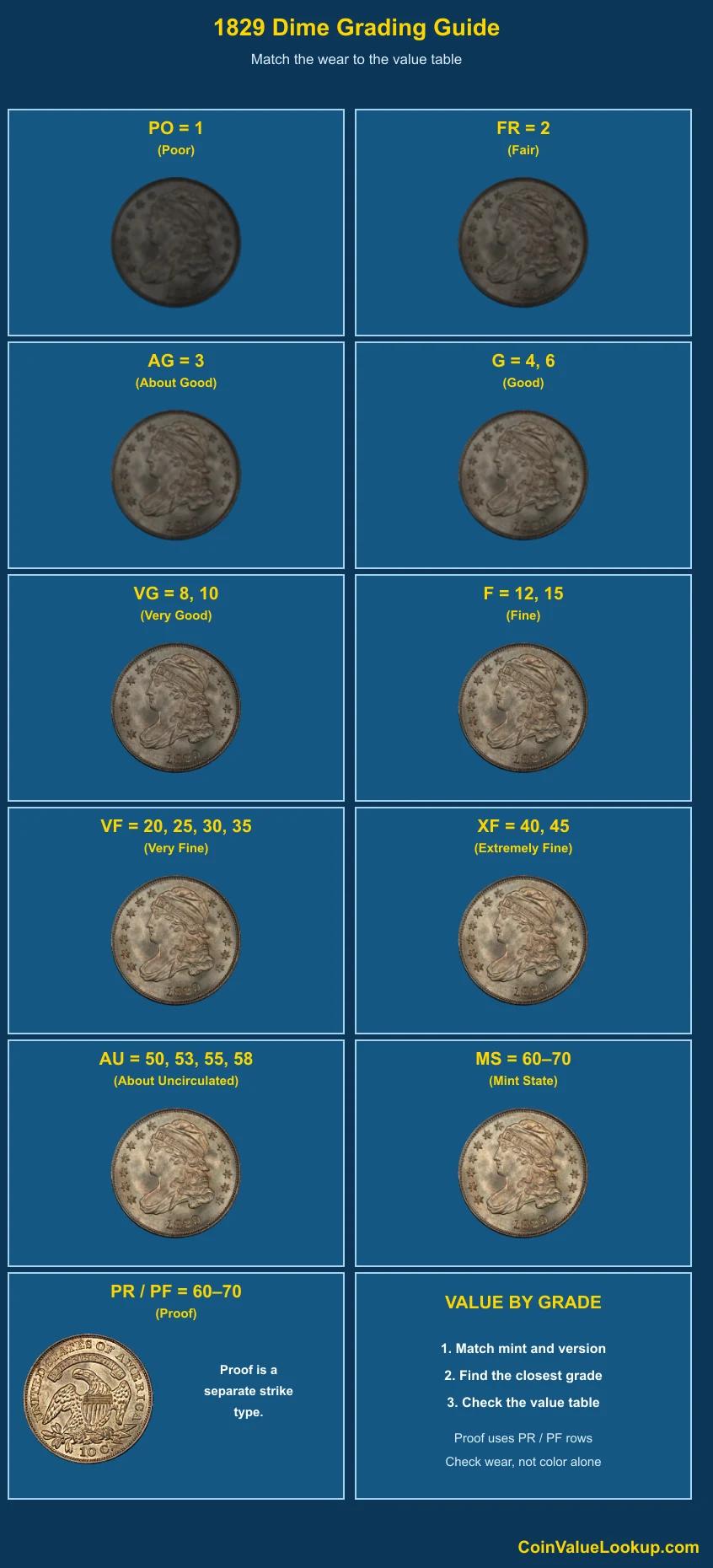
Start with Liberty's portrait on the obverse. The highest points that wear first are the hair curls above her forehead, the cheek, and the clasp area of the cap and drapery.
On the reverse, check the eagle's breast feathers and the tips of the wings.
Use the comparison image to match your coin against known grade benchmarks for this same type. Early 1829 dimes were struck on hand-operated presses, and uneven or slightly soft details can appear even on coins that never circulated.
So a weak spot does not automatically mean wear; look at the surrounding luster and contact marks for context.
Never clean or polish the coin to make it "look better." Cleaning destroys the original toned surfaces that experienced buyers and grading services expect, and it will reduce what the coin is worth.
Step 3: Check 1829 Capped Bust Dime Value by Mint and Version
1829 Capped Bust Dime — Small 10C
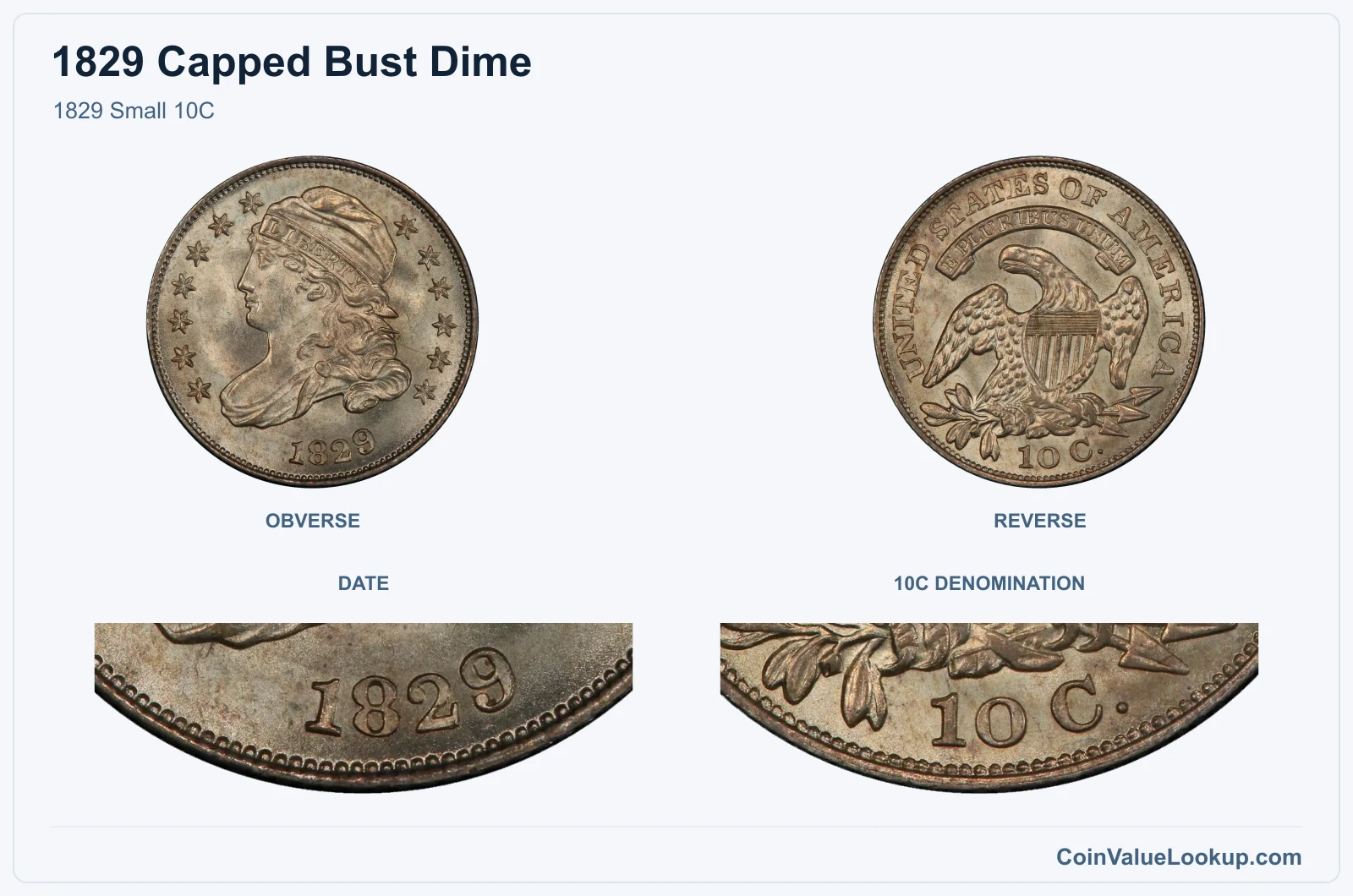
The 1829 Small 10C is a Philadelphia business strike on a silver-copper alloy planchet. To identify it, compare the size of the "10 C." denomination beneath the eagle against a correctly labeled reference image at the same scale.
A smaller-than-average denomination punch defines this branch. Do not rely on magnification alone.
Guide estimates place this variety at about $60.00 in G4 and $2,501.00 in MS63. Those are reference anchors, not guaranteed sale prices.
Coins with original, untampered surfaces at any grade will compare more favorably than cleaned or damaged examples at the same technical wear level.
Range Grade
Price Auction Records Appraisal PO PO 1
—
Coin Identifier FR FR 2
—
Coin Identifier AG AG 3
—
Coin Identifier G G 4
Coin Identifier
G 6
Coin Identifier VG VG 8
Coin Identifier
VG 10
Coin Identifier F F 12
Coin Identifier
F 15
Coin Identifier VF VF 20
Coin Identifier
VF 25
Coin Identifier
VF 30
Coin Identifier
VF 35
Coin Identifier XF XF 40
Coin Identifier
XF 45
Coin Identifier AU AU 50
Coin Identifier
AU 53
Coin Identifier
AU 55
Coin Identifier
AU 58
Coin Identifier MS MS 60
Coin Identifier
MS 61
Coin Identifier
MS 62
Coin Identifier
MS 63
Coin Identifier
MS 64
Coin Identifier
MS 65
Coin Identifier
MS 66
Coin Identifier
MS 67
Coin Identifier
MS 68
—
—
—
MS 69
—
—
—
MS 70
—
—
—
1829 Capped Bust Dime — Medium 10C
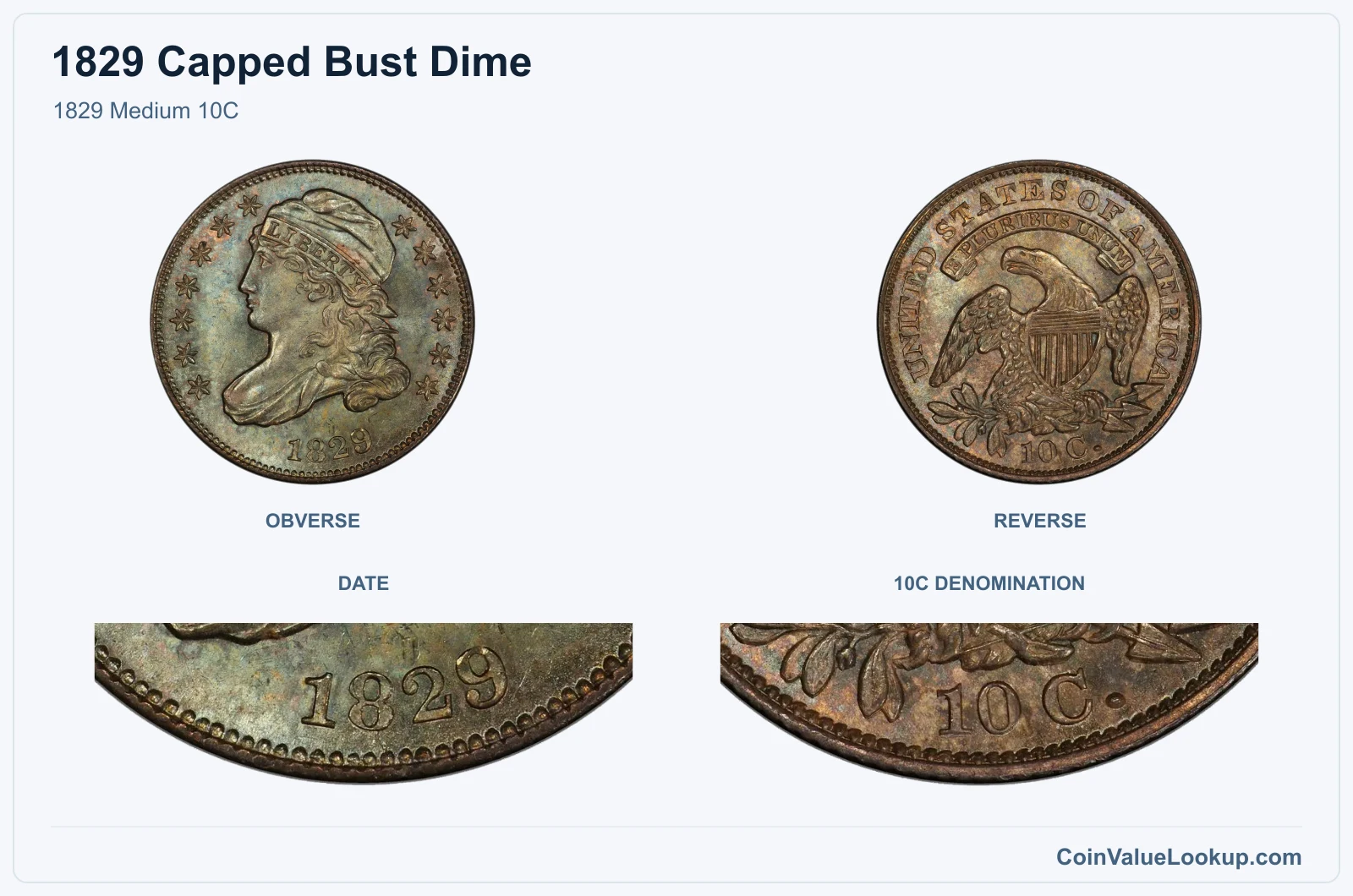
The 1829 Medium 10C is the middle sibling of the three denomination-size varieties. Same mint, same silver-copper alloy, same Capped Bust design.
The difference is in the size of the "10 C." text on the reverse, which falls between the Small and Large versions.
You need a side-by-side comparison with labeled examples to pin this one down. Guide estimates run $60.00 in G4 up to $2,501.00 in MS63.
Original surfaces matter here; a dull, honest coin will generally be more desirable than one that has been scrubbed shiny.
Coin Value Lookup is a good starting point if you are trying to look up other dates or denominations in this series alongside your 1829 dime.
Range Grade
Price Auction Records Appraisal PO PO 1
—
Coin Identifier FR FR 2
—
Coin Identifier AG AG 3
—
Coin Identifier G G 4
—
Coin Identifier
G 6
—
Coin Identifier VG VG 8
—
Coin Identifier
VG 10
—
Coin Identifier F F 12
Coin Identifier
F 15
—
Coin Identifier VF VF 20
—
Coin Identifier
VF 25
Coin Identifier
VF 30
—
Coin Identifier
VF 35
—
Coin Identifier XF XF 40
Coin Identifier
XF 45
Coin Identifier AU AU 50
Coin Identifier
AU 53
—
Coin Identifier
AU 55
Coin Identifier
AU 58
Coin Identifier MS MS 60
Coin Identifier
MS 61
—
Coin Identifier
MS 62
Coin Identifier
MS 63
Coin Identifier
MS 64
Coin Identifier
MS 65
Coin Identifier
MS 66
Coin Identifier
MS 67
—
Coin Identifier
MS 68
—
—
—
MS 69
—
—
—
MS 70
—
—
—
1829 Capped Bust Dime — Large 10C
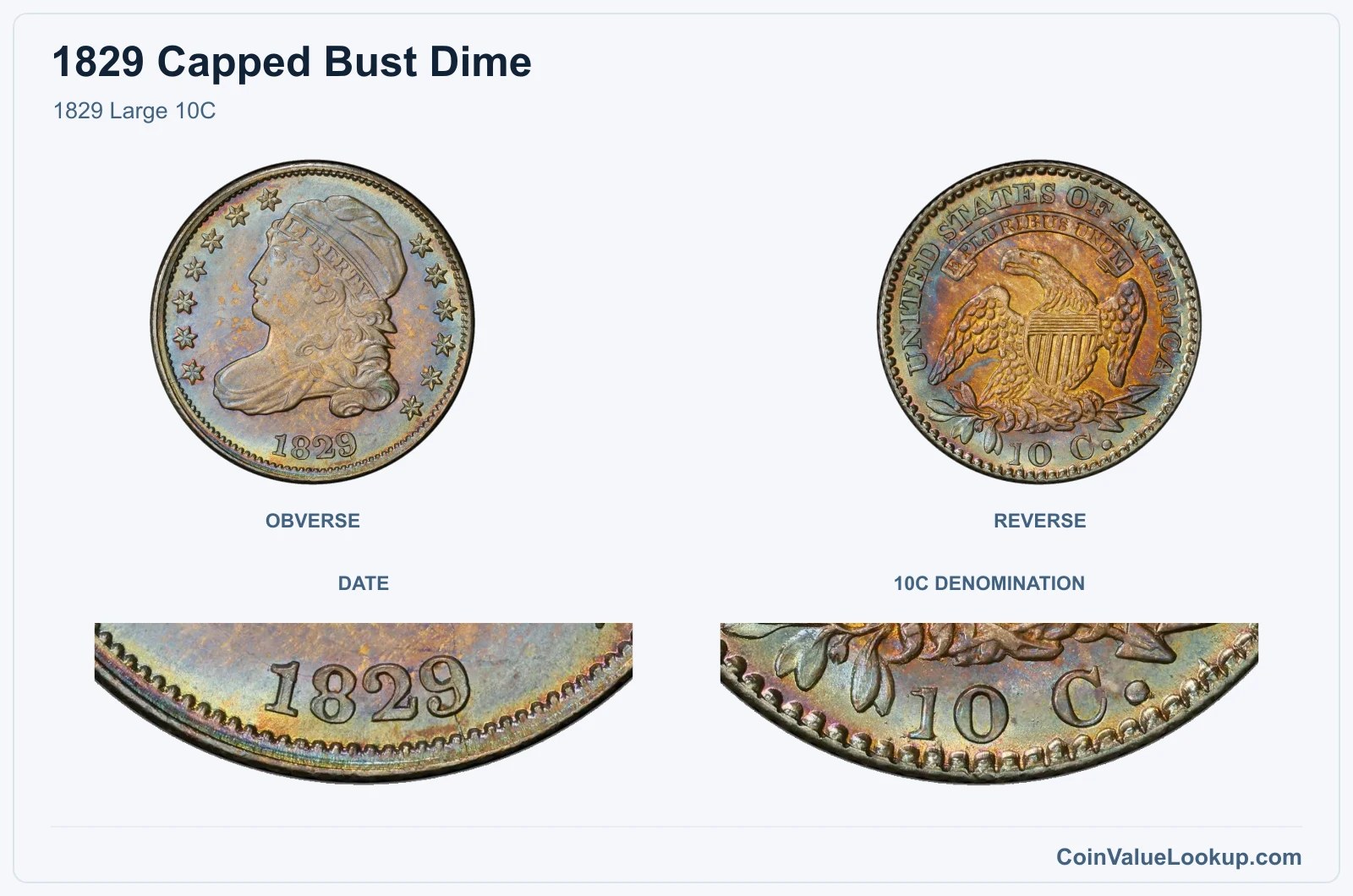
The 1829 Large 10C features the biggest version of the "10 C." denomination punch beneath the eagle. Again, confirm this by comparing against a properly labeled reference image at the same scale rather than just enlarging your own photo.
Guide estimates for this variety are $60.00 in G4 and $4,945.00 in MS63, the highest Mint State anchor among the three size variants. That gap between low-grade and high-grade tells you everything: condition is doing the heavy lifting here.
A well-preserved example with full original luster and minimal contact marks is in a different league from a worn survivor. Brightness alone does not equal high grade.
Range Grade
Price Auction Records Appraisal PO PO 1
—
Coin Identifier FR FR 2
—
Coin Identifier AG AG 3
—
Coin Identifier G G 4
—
Coin Identifier
G 6
—
Coin Identifier VG VG 8
Coin Identifier
VG 10
—
Coin Identifier F F 12
Coin Identifier
F 15
—
Coin Identifier VF VF 20
—
Coin Identifier
VF 25
Coin Identifier
VF 30
—
Coin Identifier
VF 35
Coin Identifier XF XF 40
Coin Identifier
XF 45
Coin Identifier AU AU 50
—
Coin Identifier
AU 53
—
Coin Identifier
AU 55
Coin Identifier
AU 58
Coin Identifier MS MS 60
—
Coin Identifier
MS 61
—
Coin Identifier
MS 62
Coin Identifier
MS 63
Coin Identifier
MS 64
Coin Identifier
MS 65
Coin Identifier
MS 66
Coin Identifier
MS 67
Coin Identifier
MS 68
—
—
—
MS 69
—
—
—
MS 70
—
—
—
1829 Capped Bust Dime — Curl Base 2
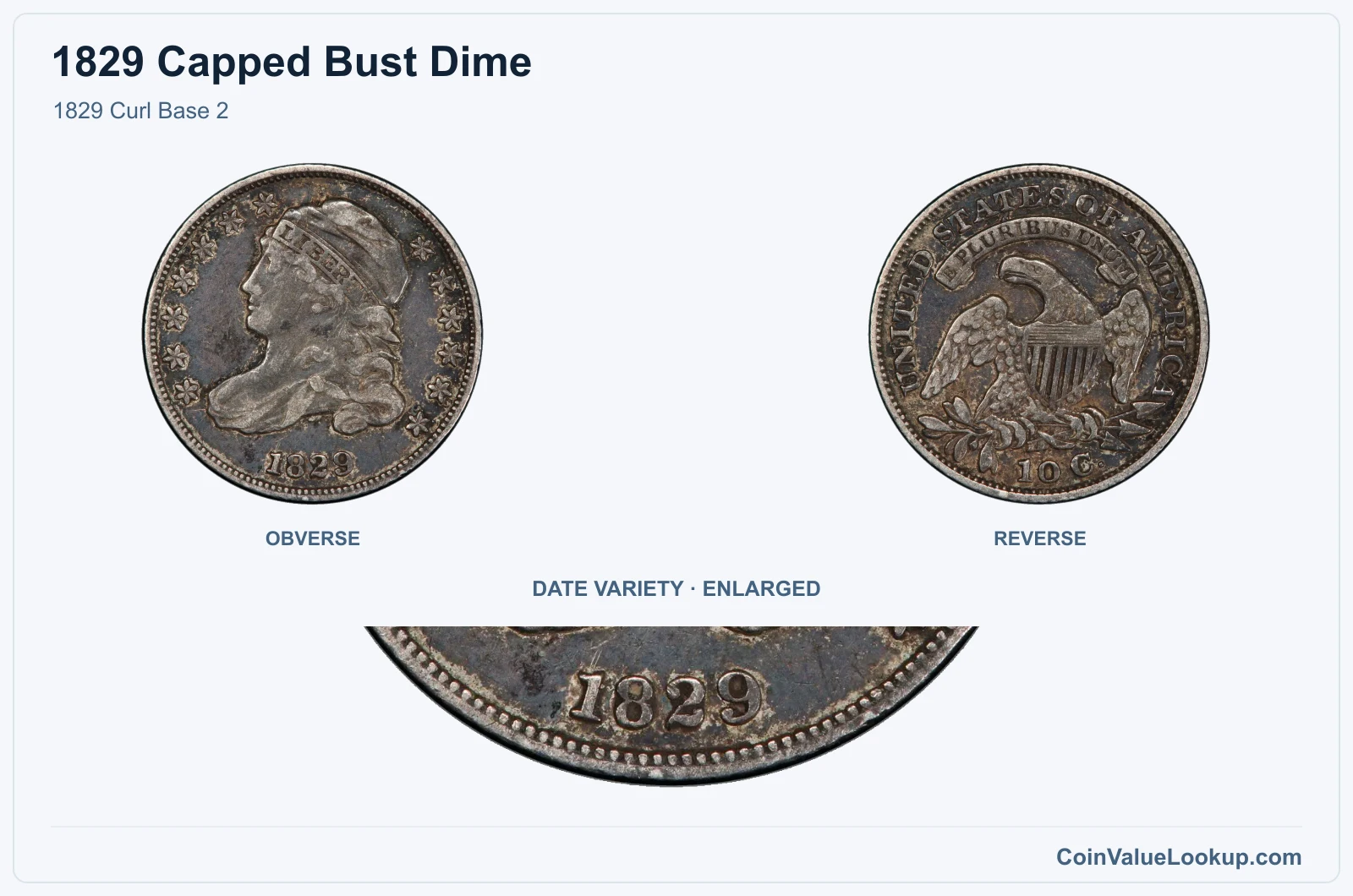
The 1829 Curl Base 2 is the key variety for this date. Look at the numeral 2 in the date on the obverse.
On most 1829 dimes the base of the 2 is flat or squared. On this variety, the foot of the 2 curls distinctly inward.
Damage, corrosion or heavy wear can sometimes create a false curl, so you really need to compare against a confirmed example before claiming this one.
The guide estimate for a G4 specimen is $6,261.00, which dwarfs the other business-strike branches at the same grade. No higher-grade guide figure is adopted here, reflecting how few survive in better condition.
Because of the premium, authentication by a recognized grading service is a practical step before buying or selling one of these.
Range Grade
Price Auction Records Appraisal PO PO 1
—
Coin Identifier FR FR 2
—
Coin Identifier AG AG 3
—
Coin Identifier G G 4
Coin Identifier
G 6
Coin Identifier VG VG 8
Coin Identifier
VG 10
Coin Identifier F F 12
Coin Identifier
F 15
—
Coin Identifier VF VF 20
Coin Identifier
VF 25
—
Coin Identifier
VF 30
Coin Identifier
VF 35
Coin Identifier XF XF 40
—
—
—
XF 45
—
—
— AU AU 50
—
—
—
AU 53
—
—
—
AU 55
—
—
—
AU 58
—
—
— MS MS 60
—
—
—
MS 61
—
—
—
MS 62
—
—
—
MS 63
—
—
—
MS 64
—
—
—
MS 65
—
—
—
MS 66
—
—
—
MS 67
—
—
—
MS 68
—
—
—
MS 69
—
—
—
MS 70
—
—
—
1829 Capped Bust Dime — PR
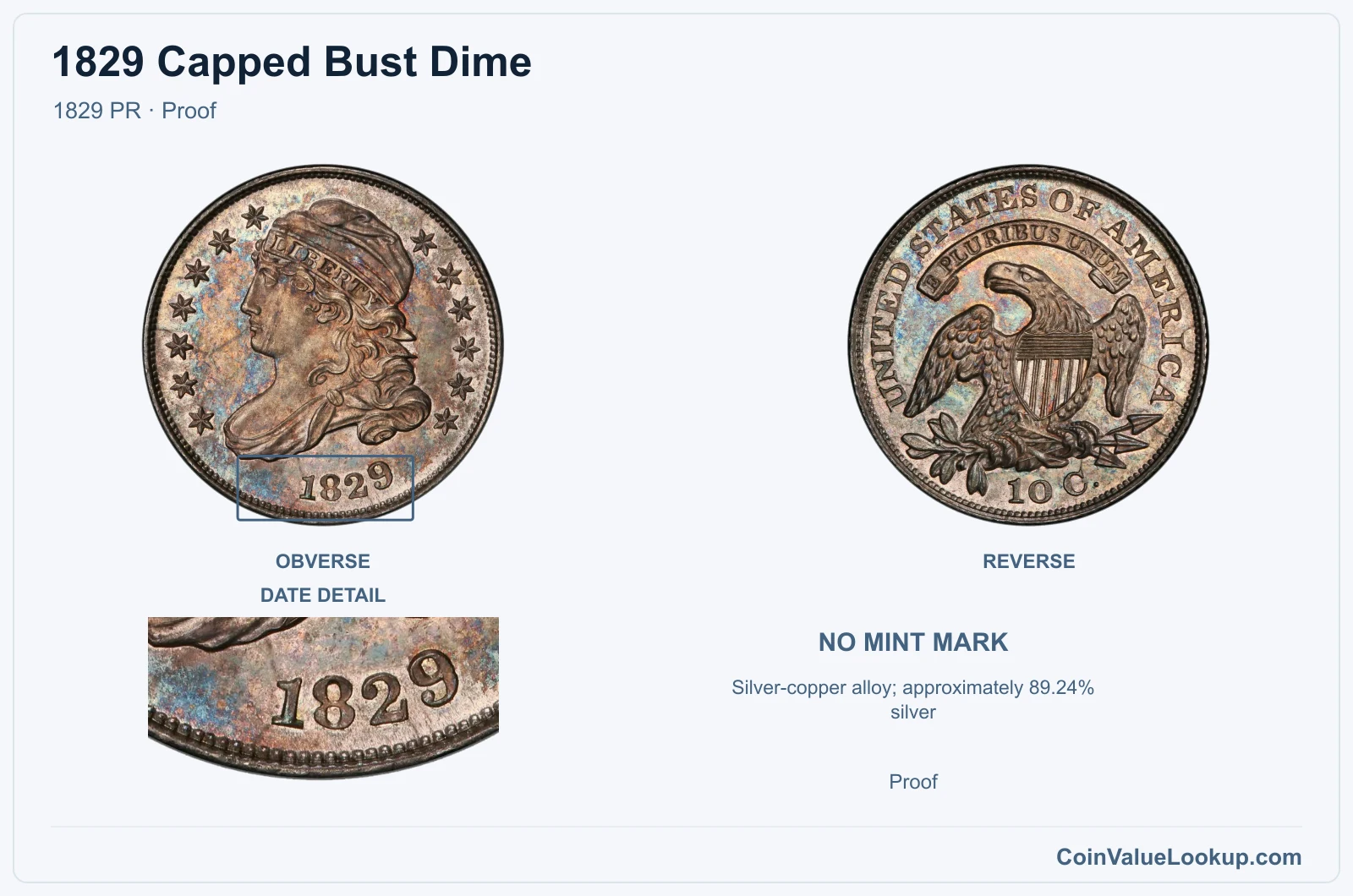
The 1829 PR is an extremely scarce early proof striking. These were made in tiny quantities on polished planchets with specially prepared dies, well before proof production became routine at the Mint.
A reflective surface or a particularly strong strike on a circulation coin does not make it a proof. Genuine early proofs show specific die-finish characteristics that require attribution against a known, authenticated specimen.
No standard numeric guide range is adopted for this issue, so each coin requires individual assessment based on its authenticated identity and condition. If you think you have one, professional authentication is essentially mandatory.
Range Grade
Price Auction Records Appraisal PR PR 1
—
Coin Identifier
PR 2
—
Coin Identifier
PR 3
—
Coin Identifier
PR 4
—
Coin Identifier
PR 6
—
Coin Identifier
PR 8
—
Coin Identifier
PR 10
—
Coin Identifier
PR 12
—
Coin Identifier
PR 15
—
Coin Identifier
PR 20
—
Coin Identifier
PR 25
—
Coin Identifier
PR 30
—
Coin Identifier
PR 35
—
Coin Identifier
PR 40
—
Coin Identifier
PR 45
—
Coin Identifier
PR 50
—
Coin Identifier
PR 53
—
Coin Identifier
PR 55
—
Coin Identifier
PR 58
—
Coin Identifier
PR 60
—
Coin Identifier
PR 61
—
Coin Identifier
PR 62
—
Coin Identifier
PR 63
Coin Identifier
PR 64
Coin Identifier
PR 65
Coin Identifier
PR 66
Coin Identifier
PR 67
—
—
—
PR 68
—
—
—
PR 69
—
—
—
PR 70
—
—
—