1847 Liberty Seated Dime Coin Value: How Much Is It Worth?
The 1847 Liberty Seated Dime is a Philadelphia-only issue struck in 90% silver. Guide estimates for normal business strikes range from about $29 in G4 (a heavily worn but readable coin) up to around $4,946 in MS63 (a choice uncirculated example).
Proofs exist but are genuinely rare early pieces, not routine collector products. Better preserved examples are scarce, so condition drives value sharply.
Fast Way to Identify Your 1847 Liberty Seated Dime
Want a quick read on your 1847 dime? Upload clear photos of the front and back, and our identifier can offer a preliminary take on what you have — mint, design branch, and approximate condition.
It cannot authenticate or certify your coin, but it is a solid starting point before you chase down a professional opinion.
1847 Liberty Seated Dime Value
Upload both sides of your 1847 Liberty Seated Dime.
Front Obverse
Upload photo
Back Reverse
Upload photo
Which 1847 Liberty Seated Dime Versions Are Worth Money?
- Philadelphia business strikes in MS63 or better are scarce and carry guide values near $4,946, making well-preserved survivors the main prize for this date.
- Proof 1847 dimes are rare early issues, not standard annual collector coins; a PR65 example carries a guide estimate around $45,000.
- Die crack varieties — especially a raised crack across the reverse bow knot — may attract specialist interest, though no standard premium is established.
Step 1: Identify Your 1847 Liberty Seated Dime Mint Mark and Version
First, confirm you are looking at a seated Liberty obverse paired with a ONE DIME reverse inside a wreath. Half dimes are smaller and say HALF DIME — easy mistake if you are new to the series.
The 1847 belongs to the Stars Obverse, With Drapery subtype, meaning thirteen stars ring the seated figure and a fold of drapery falls from her elbow. Check both features before consulting any value chart.
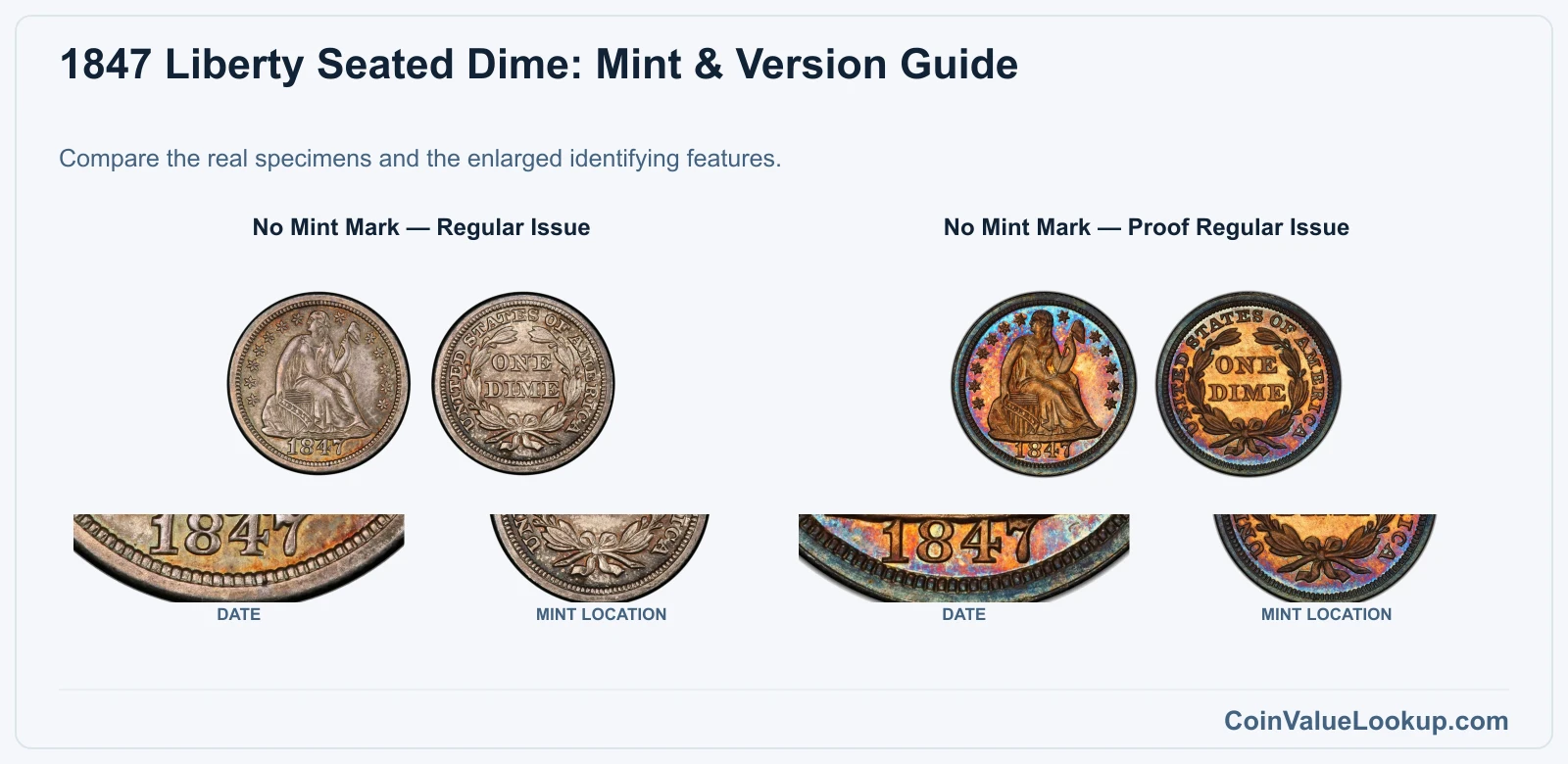
Flip the coin over. Philadelphia strikes carry no mintmark below the wreath.
If you see a letter there, you have a different mint and a different listing.
Specifications: 90% silver and 10% copper, 17.9 mm diameter, reeded edge, nominal weight of 2.67 grams. A coin that feels too light or has a smooth edge deserves a closer look.
One quirk of the 1847 date: the numerals can touch or slightly overlap the base beneath Liberty. This is a normal die-positioning trait, not an automatic error.
Do not assume every high or overlapping date commands a premium.
Step 2: Check Your 1847 Liberty Seated Dime Grade
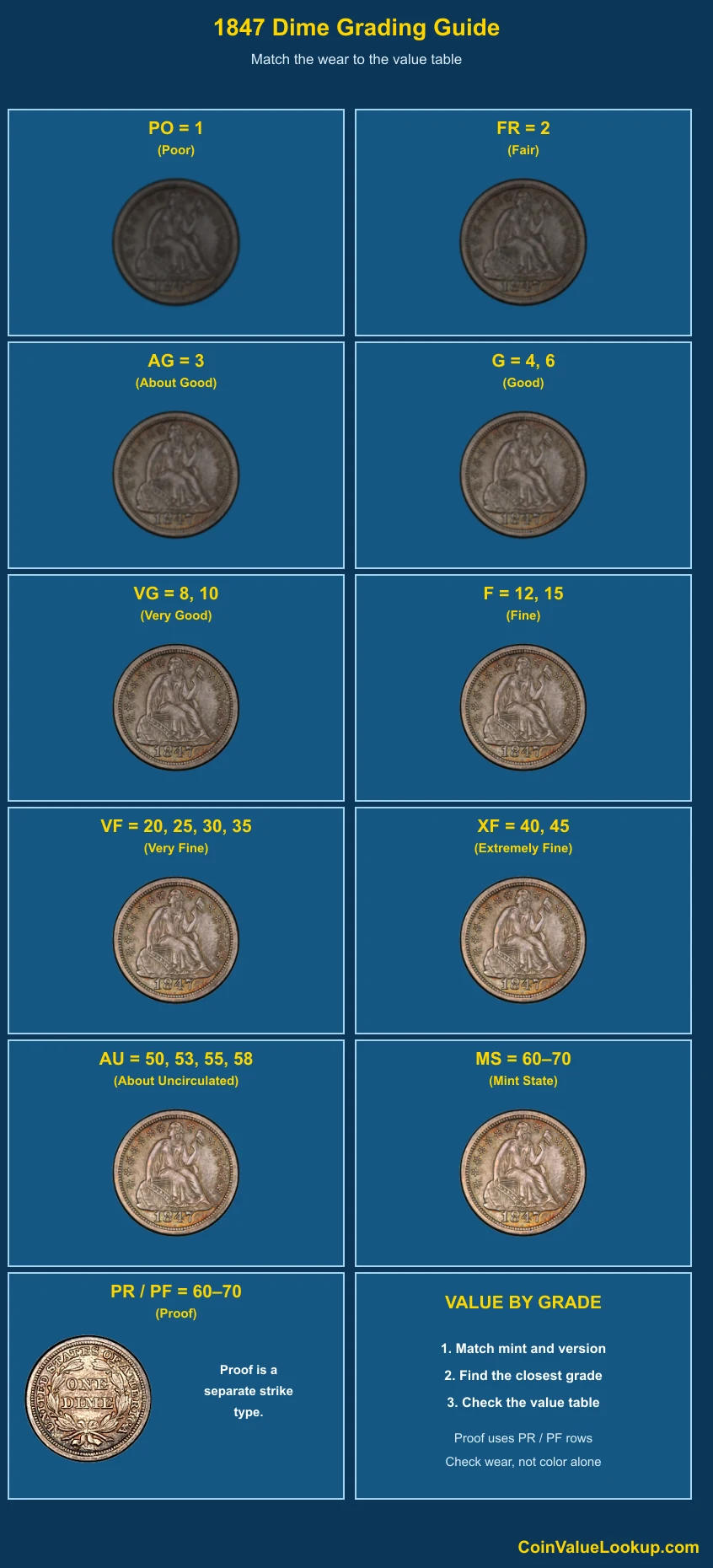
Start by examining the shield on Liberty's lap and the folds of her gown. On a well-worn coin (around Good-4), the outline of the seated figure is visible but almost all interior detail is flat.
As grade climbs, look for the separation of her head from the cap, individual toes on her feet, and distinct horizontal shield lines.
Wreath detail on the reverse wears in tandem. A coin with sharp leaf veins and a crisp bow knot is telling you it saw very little circulation.
Original strike weakness can mimic wear, especially on the head and feet. Compare your coin against the grading image for this subtype to separate soft strikes from genuine friction.
Remaining luster is your ally here — circulated coins lose their original mint sheen, while a weakly struck uncirculated piece still glows under angled light.
Polished coins are not Proofs. A genuine Proof has deeply mirrored fields from specially prepared dies, not a buffed surface from a hobbyist's polish cloth.
Keep Proof and Mint State in separate mental categories when you evaluate.
Step 3: Check 1847 Liberty Seated Dime Value by Mint and Version
1847 Liberty Seated Dime — No Mint Mark — Regular Issue
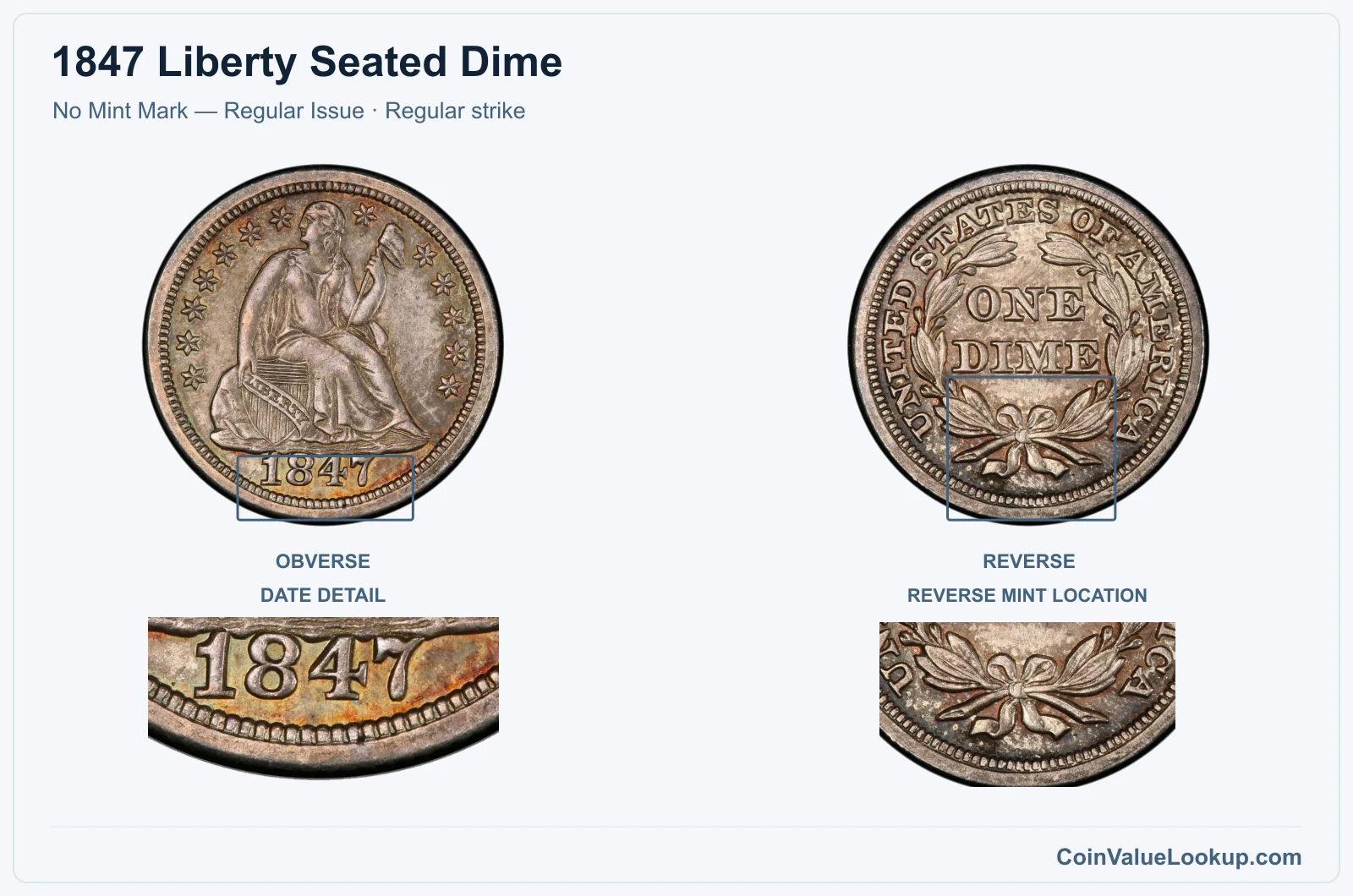
The 1847 regular-issue dime was struck only at Philadelphia, so there is no mintmark on the reverse. It uses the Stars Obverse with Drapery design and the small-wreath reverse with the legend ONE DIME.
Composition is 90% silver and 10% copper at a nominal 2.67 grams.
USA Coin Book guide estimates place this coin at roughly $29 in G4 and around $4,946 in MS63. The gap tells you everything: most survivors are well worn, and finding one with full luster is not easy.
The date position can vary — numerals may touch or overlap the base of the seated figure, which is factory-normal, not a separate variety.
Coin Value Lookup is a handy starting point if you want to compare this date against other years in the Liberty Seated Dime series or check values for related denominations.
Range Grade
Price Auction Records Appraisal PO PO 1
—
Coin Identifier FR FR 2
—
Coin Identifier AG AG 3
—
Coin Identifier G G 4
—
Coin Identifier
G 6
—
Coin Identifier VG VG 8
Coin Identifier
VG 10
—
Coin Identifier F F 12
—
Coin Identifier
F 15
—
Coin Identifier VF VF 20
—
Coin Identifier
VF 25
Coin Identifier
VF 30
Coin Identifier
VF 35
Coin Identifier XF XF 40
Coin Identifier
XF 45
Coin Identifier AU AU 50
Coin Identifier
AU 53
Coin Identifier
AU 55
Coin Identifier
AU 58
Coin Identifier MS MS 60
Coin Identifier
MS 61
Coin Identifier
MS 62
Coin Identifier
MS 63
Coin Identifier
MS 64
Coin Identifier
MS 65
Coin Identifier
MS 66
—
Coin Identifier
MS 67
—
—
—
MS 68
—
—
—
MS 69
—
—
—
MS 70
—
—
—
1847 Liberty Seated Dime — No Mint Mark — Proof Regular Issue
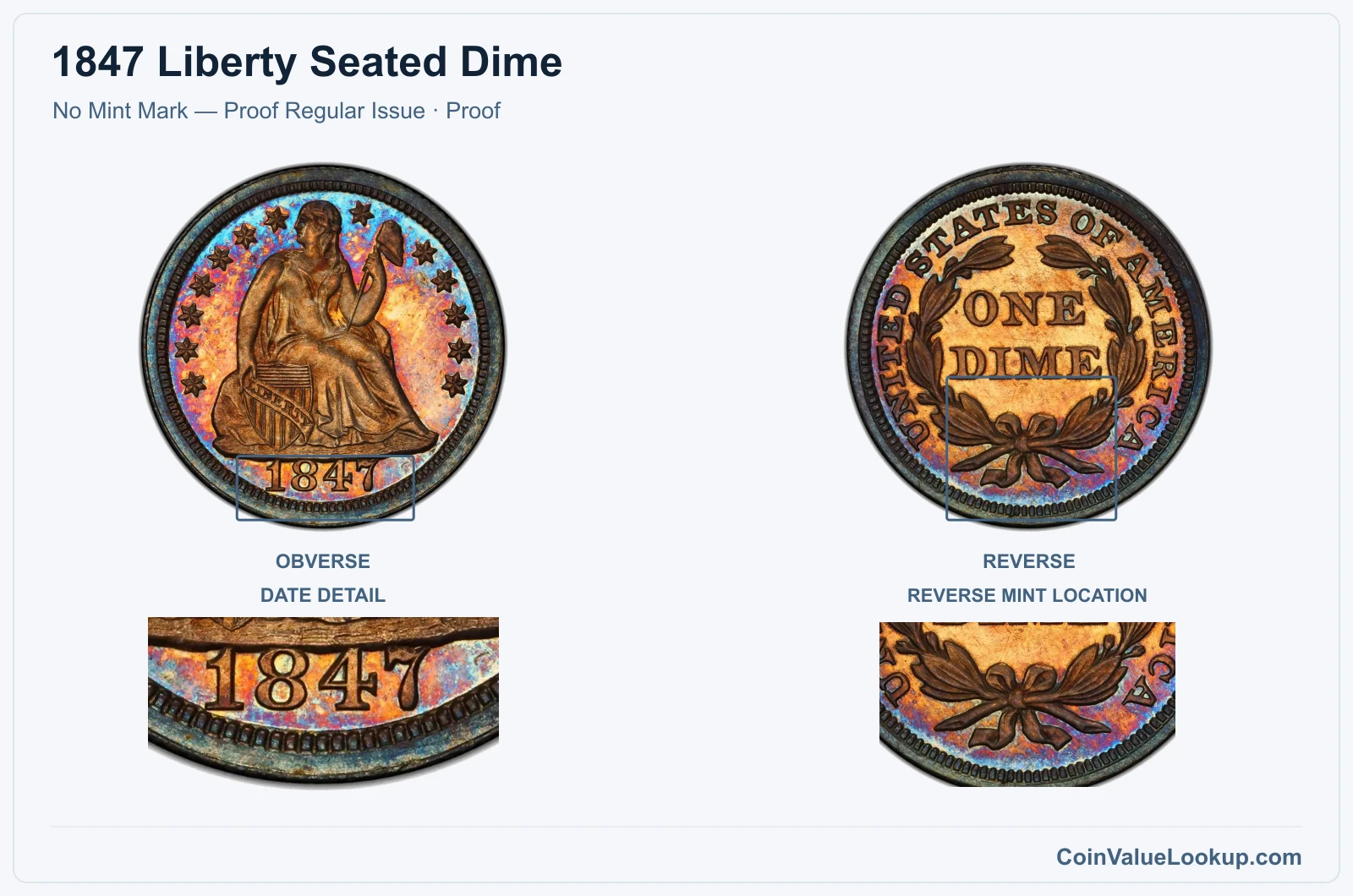
Proof 1847 Liberty Seated Dimes are genuinely rare. These are not the mass-produced annual proof sets collectors know from the twentieth century.
Early Proof dimes were struck in tiny numbers for presentation or VIP distribution, making each survivor a significant piece.
A PCGS guide estimate puts a PR65 example at around $45,000. That figure reflects extreme scarcity, not just eye appeal.
Identifying a real Proof means confirming deeply mirrored fields produced by polished dies, squared-off rims, and typically sharper design elements than any business strike. Hairlines from old cleaning or mishandling are common on early Proofs and affect grade substantially.
Do not confuse a polished circulation coin for a Proof. A buffed surface looks shiny at first glance but lacks the liquid-mirror depth of genuine Proof fields.
Attribution by a major grading service is the safest path for a coin in this price range.
Range Grade
Price Auction Records Appraisal PR PR 1
—
Coin Identifier
PR 2
—
Coin Identifier
PR 3
—
Coin Identifier
PR 4
—
Coin Identifier
PR 6
—
Coin Identifier
PR 8
—
Coin Identifier
PR 10
—
Coin Identifier
PR 12
—
Coin Identifier
PR 15
—
Coin Identifier
PR 20
—
Coin Identifier
PR 25
—
Coin Identifier
PR 30
—
Coin Identifier
PR 35
—
Coin Identifier
PR 40
—
Coin Identifier
PR 45
—
Coin Identifier
PR 50
—
Coin Identifier
PR 53
—
Coin Identifier
PR 55
—
Coin Identifier
PR 58
—
Coin Identifier
PR 60
—
Coin Identifier
PR 61
—
Coin Identifier
PR 62
—
Coin Identifier
PR 63
—
Coin Identifier
PR 64
—
Coin Identifier
PR 65
—
Coin Identifier
PR 66
Coin Identifier
PR 67
—
—
—
PR 68
—
—
—
PR 69
—
—
—
PR 70
—
—
—
1847 Liberty Seated Dime Error List
1. 1847 Liberty Seated Dime — Die Crack / Die Chip
Die cracks on the 1847 dime have been documented in specialist references for this date. The diagnostic to look for is a raised, hair-thin line crossing the bow knot on the reverse wreath.
Keep the full wreath in view so you can trace the crack's path and confirm it is not just a random scratch.
The key distinction: a genuine die crack is raised above the field because metal filled the crack in the die during striking. Incuse scratches, surface corrosion, or stuck-on debris sit into or on top of the surface instead.
Tilting the coin under a light source usually reveals which direction the feature projects.
No standard numerical premium has been established for this variety. Value depends on the crack's visibility, the coin's overall condition, and how much a specialist collector wants that particular die state.
Have the coin evaluated individually rather than assuming any crack automatically commands a bonus.