1874 Liberty Seated Dime Coin Value: How Much Is It Worth?
The 1874 Liberty Seated Dime spans a wide value range depending on mint and condition. USA Coin Book guide estimates place a Philadelphia example around $26 at G4, while the Carson City issue can reach approximately $313,014 at MS63.
Every regular 1874 dime carries arrows flanking the date, reflecting the 2.50-gram weight standard adopted in 1873. The Carson City mint mark makes this year especially notable among Seated Dime collectors.
Fast Way to Identify Your 1874 Liberty Seated Dime
Want a quick read on what you have? Upload clear photos of both the front and back of your 1874 dime.
This lets us give you a preliminary identification of the mint, version, and general condition. Good lighting and a steady shot help, especially for picking up the small mintmark on the reverse.
1874 Liberty Seated Dime Value
Upload both sides of your 1874 Liberty Seated Dime.
Front Obverse
Upload photo
Back Reverse
Upload photo
Which 1874 Liberty Seated Dime Versions Are Worth Money?
- The 1874-CC (Carson City) dime is the major key date, with guide values from about $10,609 at G4 to roughly $313,014 at MS63 per USA Coin Book.
- The 1874 Philadelphia Proof with arrows carries a guide estimate near $1,067 at PR63, appealing to type-set and Proof collectors.
- The 1874-S (San Francisco) dime lists around $47 at G4 and about $2,501 at MS63, making higher-grade examples worth a close look.
- Die varieties such as the repunched date or repunched left arrow on the 1874-S may carry additional collector interest beyond standard guide values.
Step 1: Identify Your 1874 Liberty Seated Dime Mint Mark and Version
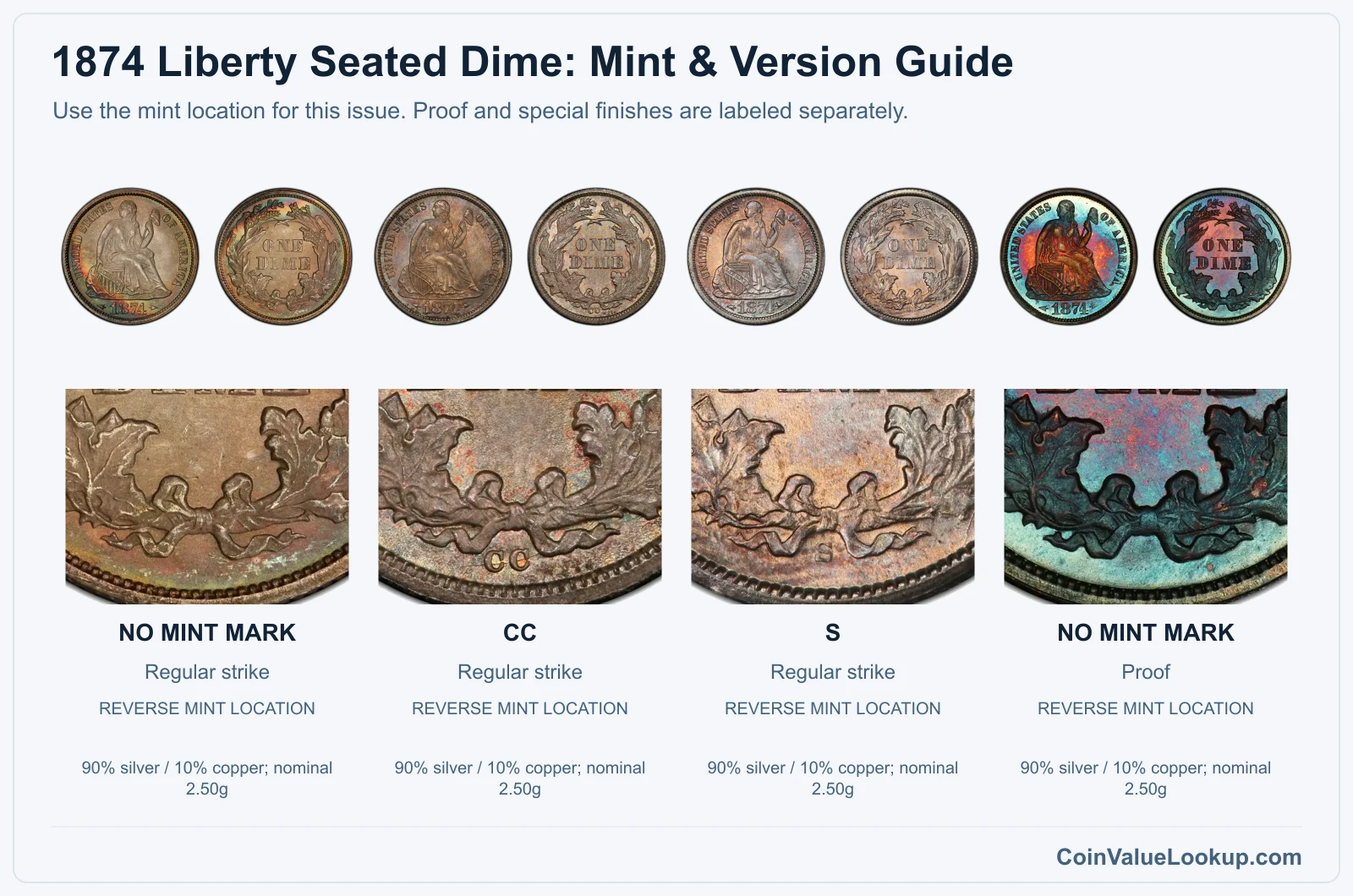
Start with the basics: you should see a seated Liberty figure on the front and the words ONE DIME inside a wreath on the back. The date 1874 will appear at the bottom of the obverse, flanked by small arrows on each side.
Those arrows are standard for every regular-issue 1874 dime, so do not worry if you see them.
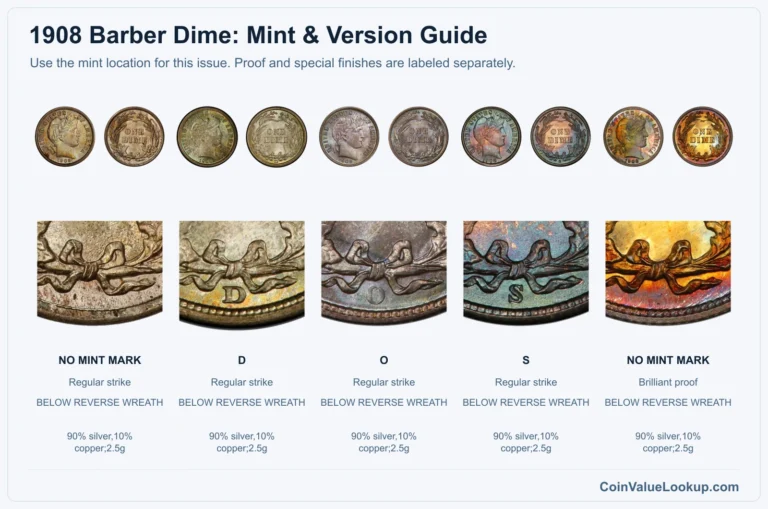
Next, flip the coin over and look below the wreath near the bottom rim. Philadelphia coins have no mintmark at all.
A tiny "CC" means Carson City, and an "S" means San Francisco.
All three mints struck these in 90% silver and 10% copper, at a nominal weight of 2.50 grams. The coin measures 17.9mm across with a reeded edge.
If your coin is noticeably larger or lighter, you may have a half dime or a damaged piece instead.
The Carson City version is the key date here and far scarcer than the other two. Small differences in how the San Francisco arrows were punched represent die varieties, not a separate design type.
Original surfaces and the correct mintmark are what steer you to the right price chart.
Step 2: Check Your 1874 Liberty Seated Dime Grade
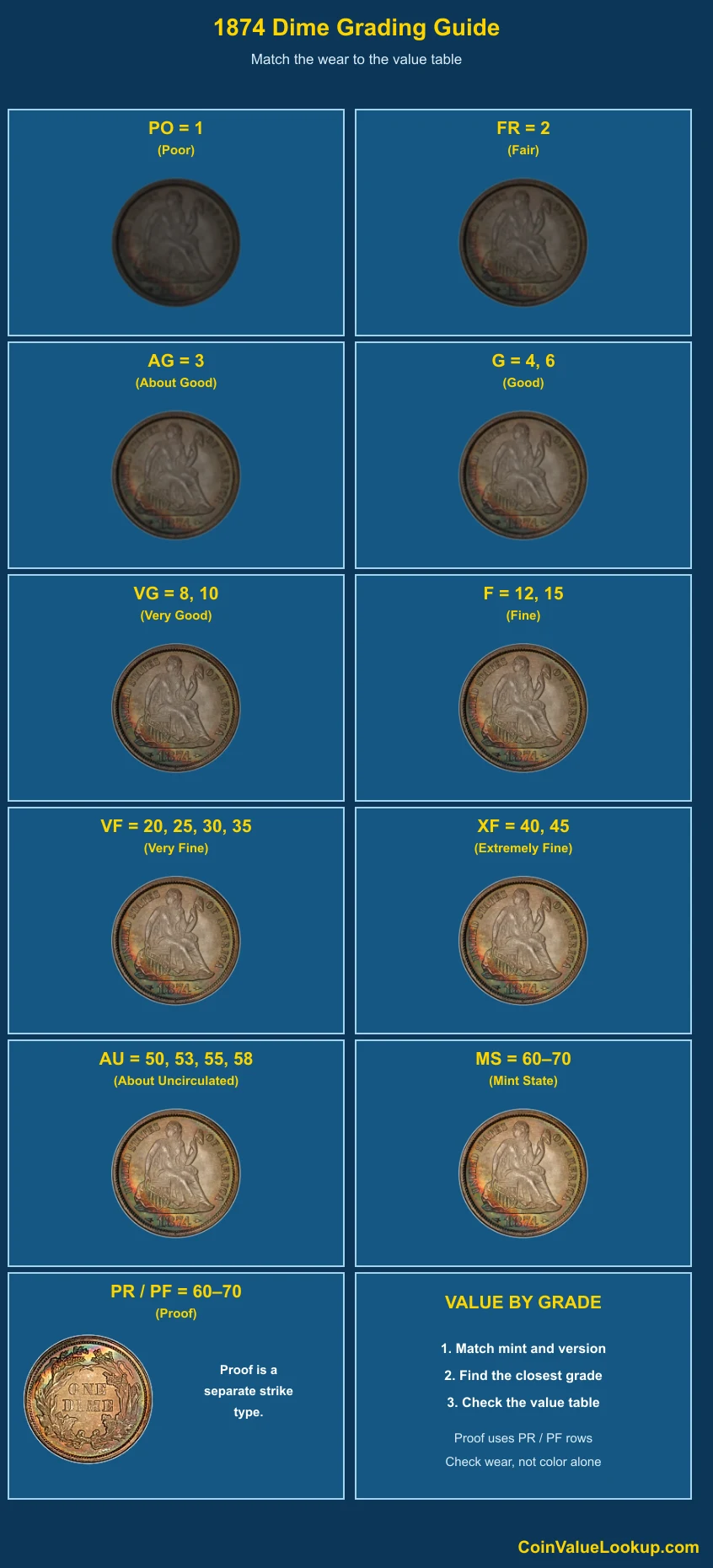
Check Liberty's head first. On a well-worn coin, her cap and hair detail will merge into a flat silhouette.
Move to the breast, knee, and shield on her lap; these are the highest points and show friction earliest. On the reverse, inspect the tops of the wreath leaves.
A coin grading around Good (G4) will have a visible date and outline of Liberty but almost no interior detail. By Mint State (MS63), you should see full design sharpness and original luster across both sides, though minor contact marks are expected.
Do not confuse a weak strike or tired dies with actual wear. Some Seated Dimes left the press with soft detail in spots, especially around the head and stars.
Compare your coin to the reference image and judge whether the softness follows the high points of design (wear) or appears random and unrelated to relief (strike).
Also keep Proof coins separate from business strikes. A polished coin is not a Proof.
Genuine Proofs were deliberately prepared with mirror fields and sharp rims. If your coin just looks shiny from cleaning, that is a different situation entirely.
Step 3: Check 1874 Liberty Seated Dime Value by Mint and Version
1874 Liberty Seated Dime — No Mint Mark — With Arrows
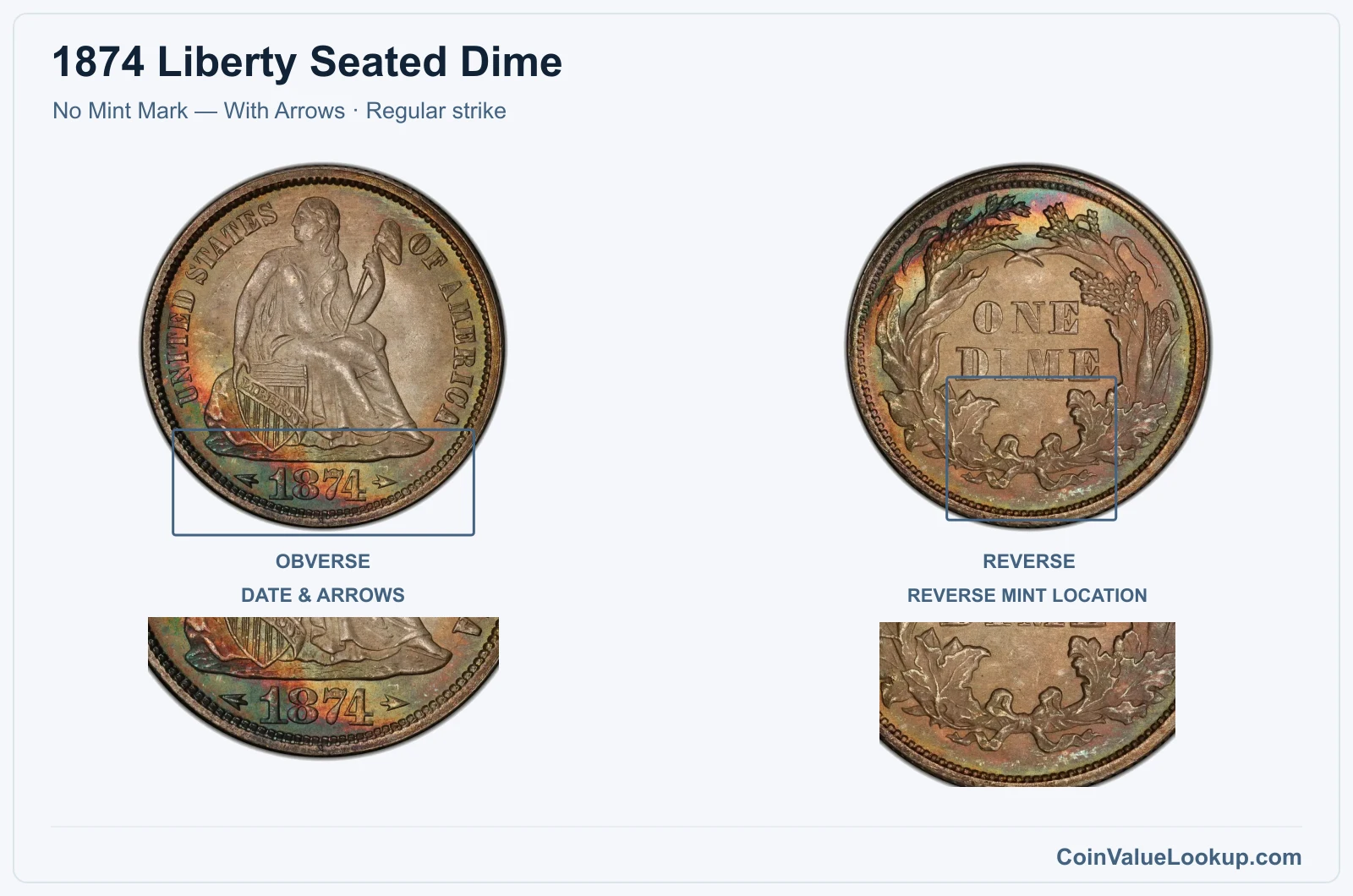
The Philadelphia 1874 dime has no mintmark. Look at the reverse below the wreath: if the space is empty, you have the Philly issue.
Arrows flank the date on both sides, standard for the year.
USA Coin Book guide estimates place this coin around $26 at G4 and approximately $1,247 at MS63. It is the most available of the three mints for 1874, so circulated examples turn up regularly.
Higher-grade pieces with full luster and clean surfaces are a different story and command a clear premium.
The design features the Legend Obverse paired with the agricultural wreath reverse. Confirm the 1874 date is clear and the arrows are present before looking up values.
Range Grade
Price Auction Records Appraisal PO PO 1
Coin Identifier FR FR 2
—
Coin Identifier AG AG 3
—
Coin Identifier G G 4
—
Coin Identifier
G 6
—
Coin Identifier VG VG 8
—
Coin Identifier
VG 10
—
Coin Identifier F F 12
—
Coin Identifier
F 15
—
Coin Identifier VF VF 20
Coin Identifier
VF 25
Coin Identifier
VF 30
Coin Identifier
VF 35
Coin Identifier XF XF 40
Coin Identifier
XF 45
Coin Identifier AU AU 50
Coin Identifier
AU 53
Coin Identifier
AU 55
Coin Identifier
AU 58
Coin Identifier MS MS 60
Coin Identifier
MS 61
Coin Identifier
MS 62
Coin Identifier
MS 63
Coin Identifier
MS 64
Coin Identifier
MS 65
Coin Identifier
MS 66
Coin Identifier
MS 67
Coin Identifier
MS 68
Coin Identifier
MS 69
—
—
—
MS 70
—
—
—
1874 Liberty Seated Dime — CC — With Arrows
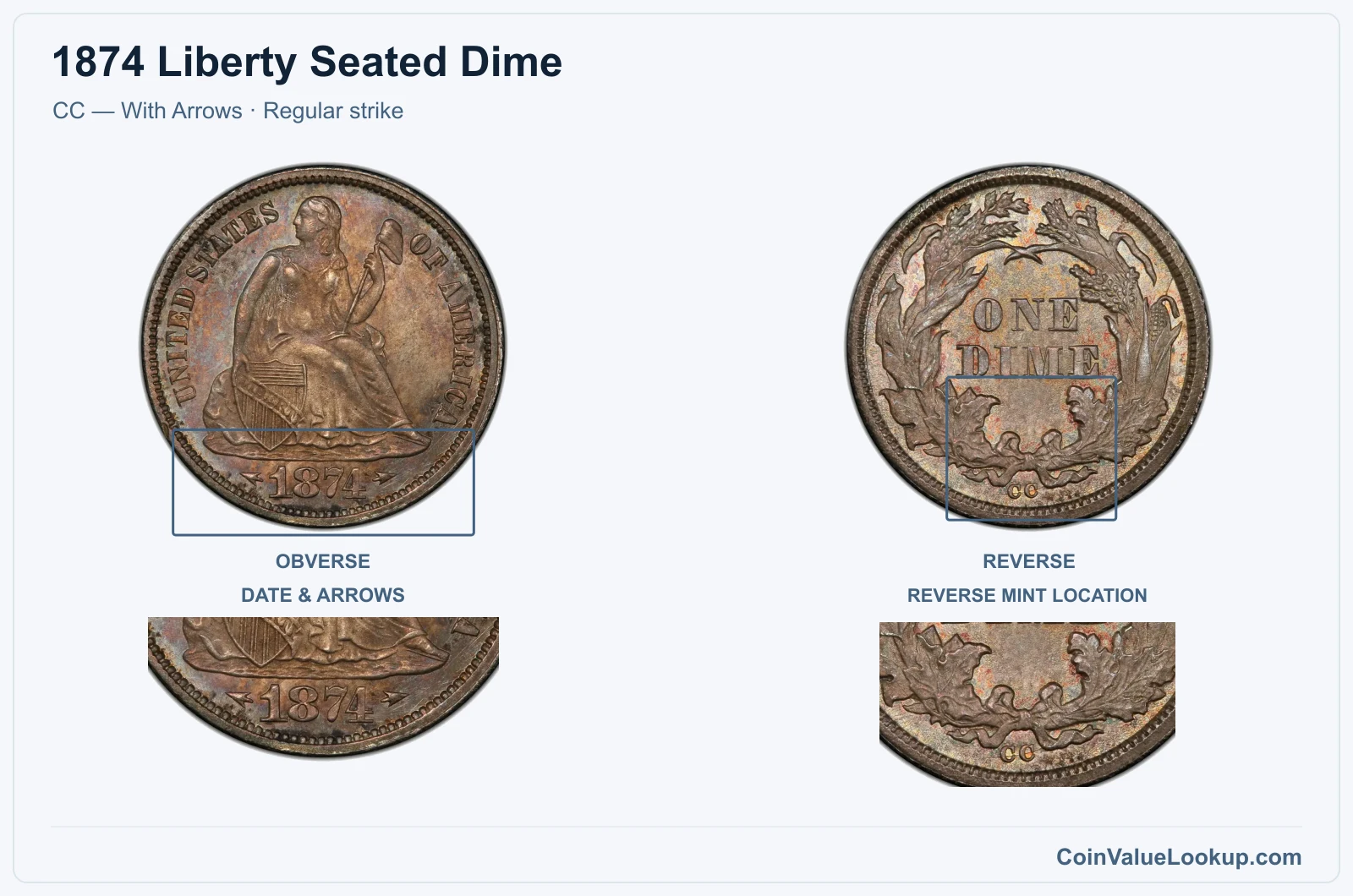
This is the one collectors lose sleep over. The 1874-CC dime, struck at Carson City, is a genuine key date in the entire Seated Dime series.
The CC mintmark sits on the reverse beneath the wreath.
USA Coin Book guide estimates run from roughly $10,609 at G4 all the way to about $313,014 at MS63. Even heavily worn examples carry serious value.
Survival rates are tiny, so any authentic specimen gets attention.
Make sure the CC is original to the coin and not tooled or added. Check the style and depth of the mintmark against known examples.
A genuine 1874-CC will show consistent wear across both the mintmark and surrounding design. If you think you have one, professional authentication is strongly recommended before any transaction.
Range Grade
Price Auction Records Appraisal PO PO 1
—
Coin Identifier FR FR 2
Coin Identifier AG AG 3
Coin Identifier G G 4
Coin Identifier
G 6
Coin Identifier VG VG 8
Coin Identifier
VG 10
Coin Identifier F F 12
Coin Identifier
F 15
Coin Identifier VF VF 20
Coin Identifier
VF 25
Coin Identifier
VF 30
—
Coin Identifier
VF 35
Coin Identifier XF XF 40
Coin Identifier
XF 45
Coin Identifier AU AU 50
Coin Identifier
AU 53
Coin Identifier
AU 55
Coin Identifier
AU 58
—
Coin Identifier MS MS 60
—
Coin Identifier
MS 61
—
Coin Identifier
MS 62
Coin Identifier
MS 63
Coin Identifier
MS 64
—
—
—
MS 65
—
—
—
MS 66
—
—
—
MS 67
—
—
—
MS 68
—
—
—
MS 69
—
—
—
MS 70
—
—
—
1874 Liberty Seated Dime — S — With Arrows
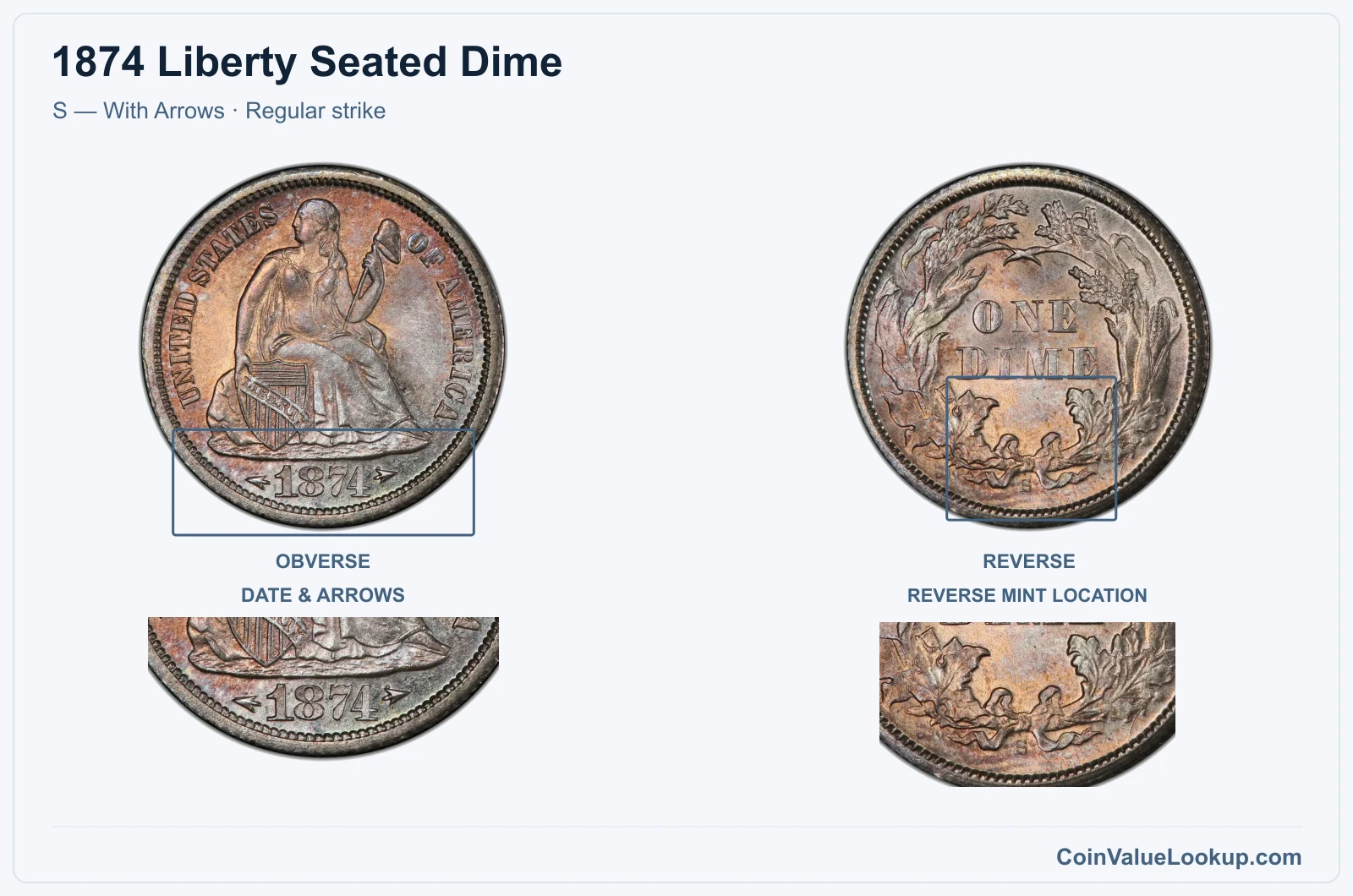
The San Francisco issue carries a small "S" mintmark on the reverse below the wreath. Like its siblings, it features arrows beside the date and weighs the 2.50-gram standard.
USA Coin Book guide estimates place the 1874-S at roughly $47 in G4 and around $2,501 at MS63. It sits between the common Philadelphia and the rare Carson City in both availability and price.
Some 1874-S dimes show minor differences in how the arrows were punched into the die. These are die varieties, not a sign that something is wrong.
Collectors of Seated Dime varieties track them closely, so examine the left arrow area if you want to dig deeper.
Coin Value Lookup is a handy starting point if you want to compare this dime against other dates and mints in the series.
Range Grade
Price Auction Records Appraisal PO PO 1
—
Coin Identifier FR FR 2
—
Coin Identifier AG AG 3
—
Coin Identifier G G 4
—
Coin Identifier
G 6
—
Coin Identifier VG VG 8
—
Coin Identifier
VG 10
—
Coin Identifier F F 12
—
Coin Identifier
F 15
—
Coin Identifier VF VF 20
Coin Identifier
VF 25
—
Coin Identifier
VF 30
Coin Identifier
VF 35
Coin Identifier XF XF 40
Coin Identifier
XF 45
Coin Identifier AU AU 50
Coin Identifier
AU 53
Coin Identifier
AU 55
Coin Identifier
AU 58
Coin Identifier MS MS 60
—
Coin Identifier
MS 61
—
Coin Identifier
MS 62
Coin Identifier
MS 63
Coin Identifier
MS 64
Coin Identifier
MS 65
Coin Identifier
MS 66
Coin Identifier
MS 67
Coin Identifier
MS 68
—
—
—
MS 69
—
—
—
MS 70
—
—
—
1874 Liberty Seated Dime — No Mint Mark — Proof With Arrows
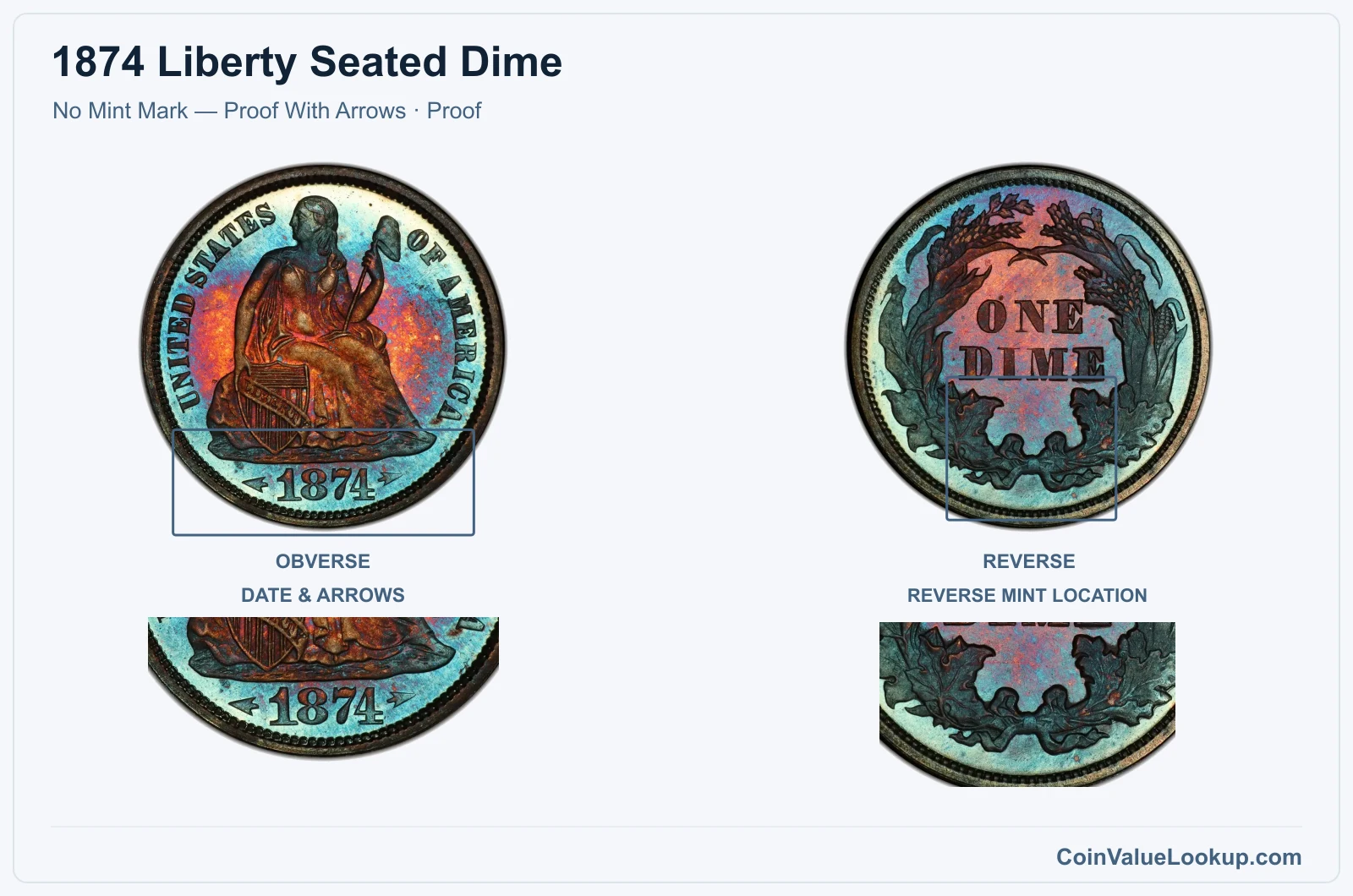
Philadelphia also struck Proof 1874 dimes for collectors. These were made with specially prepared dies and planchets, producing mirror-like fields and sharply defined design elements.
USA Coin Book lists a guide estimate of about $1,067 at PR63. Hairlines from mishandling are the most common detractor in this grade range, so tilt the coin under a light and look for fine lines across the flat mirror fields.
A Proof is a method of manufacture, not a grade above Mint State. Brilliance alone does not make a coin a Proof.
Genuine examples show squared-off rims and a distinctive reflective surface that differs from a business strike's cartwheel luster. Cleaned or polished business strikes sometimes fool newer collectors, so compare carefully against known Proof specimens before drawing conclusions.
Ordinary-issue reference: Ordinary-issue reference only: The table below shows prices for the 1874 Liberty Seated Dime (proof). It does not represent the value of the specific No Mint Mark — Proof With Arrows variety or its variety premium. Year, mint, metal and strike type are matched; the specific variety is not priced by this table.
Range Grade
Price Auction Records Appraisal PR PR 1
—
Coin Identifier
PR 2
—
Coin Identifier
PR 3
—
Coin Identifier
PR 4
—
Coin Identifier
PR 6
—
Coin Identifier
PR 8
—
Coin Identifier
PR 10
—
Coin Identifier
PR 12
—
Coin Identifier
PR 15
—
Coin Identifier
PR 20
—
Coin Identifier
PR 25
—
Coin Identifier
PR 30
—
Coin Identifier
PR 35
—
Coin Identifier
PR 40
—
Coin Identifier
PR 45
—
Coin Identifier
PR 50
—
Coin Identifier
PR 53
—
Coin Identifier
PR 55
—
Coin Identifier
PR 58
Coin Identifier
PR 60
Coin Identifier
PR 61
Coin Identifier
PR 62
Coin Identifier
PR 63
Coin Identifier
PR 64
Coin Identifier
PR 65
Coin Identifier
PR 66
Coin Identifier
PR 67
Coin Identifier
PR 68
—
—
—
PR 69
—
—
—
PR 70
—
—
—
1874 Liberty Seated Dime Error List
1. 1874 Liberty Seated Dime — Repunched Date
A repunched date occurs when the date numerals were punched into the working die more than once with slight misalignment between strikes. On an 1874 dime, look for ghost outlines or extra serifs beside the final position of one or more digits.
The remnants of the first punch usually appear as faint secondary lines offset from the primary numerals.
This is a die-level variety, distinct from doubled die errors that affect the entire design. It is also not the same as machine doubling, which produces flat, shelf-like distortion rather than a crisp secondary image.
Damage to the date area from contact or corrosion can mimic a repunched date. Check that the extra impressions match the style and font of the original numerals.
No specific price range is adopted for this variety; value depends on the visibility of the repunching, the overall condition of the coin, and collector demand for the particular die pairing.
2. 1874 Liberty Seated Dime — Repunched Left Arrow
This variety has been reported on the 1874-S dime specifically. The left arrow beside the date shows overlapping punch contours where the arrow was impressed into the die at slightly different positions.
The arrows flanking the date are an intentional design feature, but displaced secondary outlines within the arrow shape itself indicate a repunched element.
Compare the left arrow on your coin to a normal 1874-S arrow. A repunched arrow will show doubling or extra contour lines within the arrowhead or shaft that do not appear on standard examples.
Do not confuse this with general damage or machine doubling. Damage tends to be irregular and lacks the precise duplication of a deliberate punch, while machine doubling creates flat, shelf-like distortion.
No adopted price range exists for this variety; its premium depends on how clearly the repunching shows, the coin's grade, and collector interest in the specific die.
3. 1874 Liberty Seated Dime — Die Break / Cud
A cud is a specific type of die break where a piece of the die has broken away at the rim. The result on the struck coin is a raised, featureless blob of metal connected to the rim, replacing part of the normal design.
Interior die breaks that do not touch the rim produce raised lumps but are not technically cuds.
On an 1874 Seated Dime, check the entire rim area on both sides. A cud will show a smooth, slightly rounded raised area where the design detail simply stops.
Do not mistake a rim dent, corrosion buildup, or a small interior die chip for a cud. Rim dents are incuse rather than raised, and corrosion has a rough, pitted texture.
No numerical price range is adopted for this category; the premium depends on the size and location of the break, the overall condition of the coin, and how visually dramatic the cud appears.
4. 1874 Liberty Seated Dime — Clashed Dies
Clashed dies happen when the obverse and reverse dies strike each other without a planchet between them. The impact transfers faint traces of each die's design onto the opposing die.
Subsequent coins struck from those dies carry ghost impressions of the wrong design on one or both sides.
On an 1874 Seated Dime, look in the open fields for faint outlines that correspond to features on the opposite side. For example, wreath outlines might appear in the obverse field around Liberty, or traces of the seated figure might show in the reverse field.
These marks should line up with the expected opposing design elements, not appear randomly. Random raised lines, scratches, or a brockage error are different phenomena entirely.
No specific price range is adopted for clashed die specimens from this year; value depends on how visible the clash marks are, the coin's condition, and the interest level among Seated Dime variety collectors.