1890 Liberty Seated Dime Coin Value: How Much Is It Worth?
The 1890 Liberty Seated Dime spans a wide value range depending on mint, version and condition. USA Coin Book guide estimates place the Philadelphia regular issue from about $22 in G4 to around $316 in MS63, while Proof examples carry a guide value near $725 in PR63.
San Francisco pieces come in Small S and Medium S mintmark varieties, each requiring individual assessment. Original surfaces, correct identification and authenticated condition drive what any single coin is actually worth.
Fast Way to Identify Your 1890 Liberty Seated Dime
The quickest way to start figuring out what you have is to upload clear photos of both the front and back of your coin. Our identifier can offer a preliminary read on the mint, version and general condition from those images.
It is not a substitute for professional authentication, but it gives you a solid starting point before diving deeper.
1890 Liberty Seated Dime Value
Upload both sides of your 1890 Liberty Seated Dime.
Front Obverse
Upload photo
Back Reverse
Upload photo
Which 1890 Liberty Seated Dime Versions Are Worth Money?
- The San Francisco Small S variety is scarcer than the Medium S; confirming which mintmark size you have can affect desirability and value.
- Philadelphia Proof dimes in PR63 carry a USA Coin Book guide value of about $725, well above typical business strikes.
- Die errors such as doubled dies, repunched dates and die breaks have been reported for 1890 and can add a premium depending on visibility and condition.
- Higher-grade uncirculated examples of any version are uncommon for this date and command stronger prices than worn survivors.
Step 1: Identify Your 1890 Liberty Seated Dime Mint Mark and Version
First, confirm you are looking at the Legend Obverse design with a seated Liberty on the front and ONE DIME inside an agricultural wreath on the back. The date 1890 should be clearly visible below the seated figure.
All regular 1890 dimes are struck in 90% silver with 10% copper, weigh about 2.50 grams and measure 17.9mm with a reeded edge.
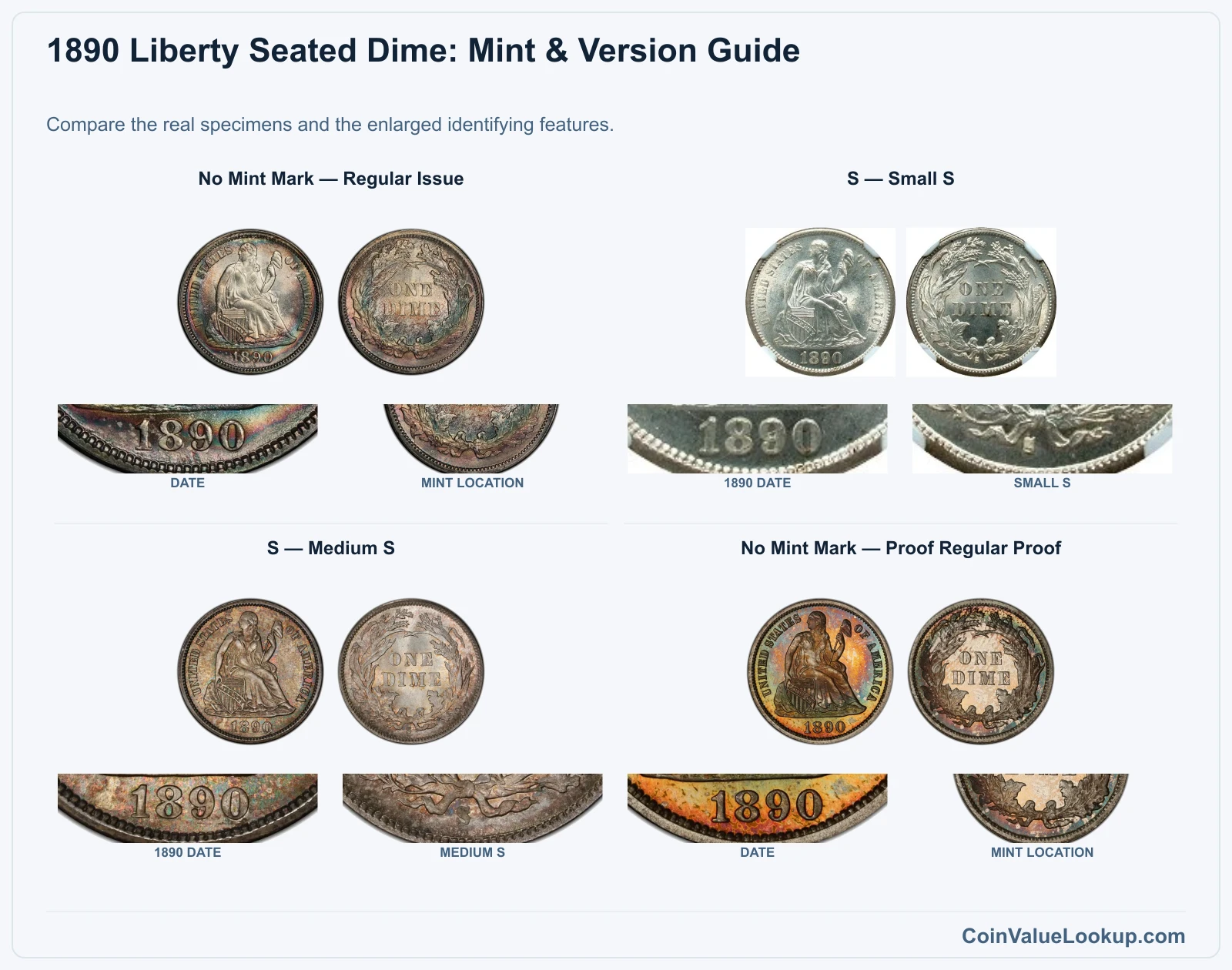
Flip the coin over and check just below the wreath bow for a mintmark. Philadelphia coins carry no mintmark at all.
A small "S" means San Francisco, but that S comes in two sizes for 1890: a Small S and a Medium S.
The Small S is noticeably more compact than the Medium S. Comparing your mintmark against reference images at matching magnification is the only reliable way to tell them apart.
The Small S is the scarcer of the two, so getting this right matters.
Proof issues were struck only at Philadelphia and also lack a mintmark. They are identified by mirror-like fields and deliberate die preparation, not simply by being shiny.
A polished circulated coin is not a Proof.
Step 2: Check Your 1890 Liberty Seated Dime Grade
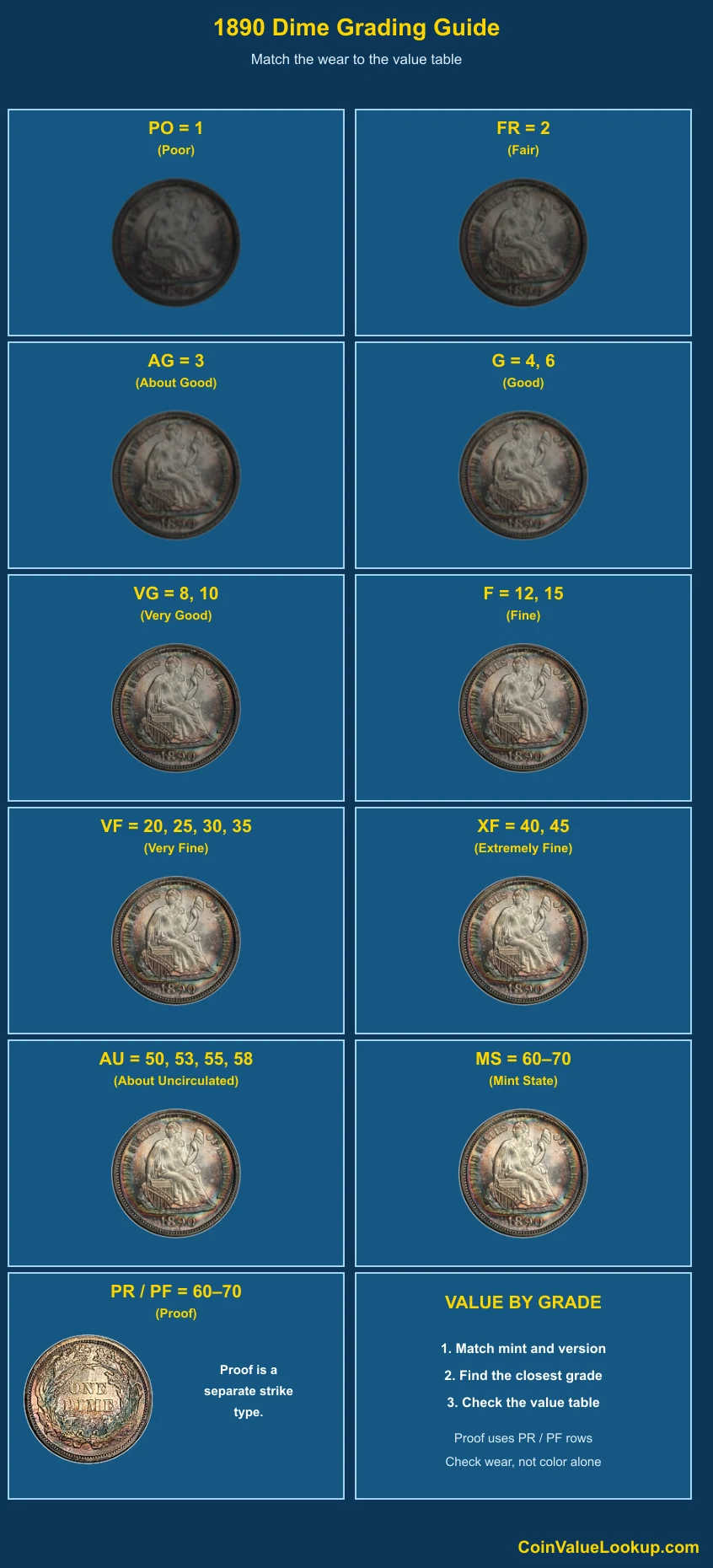
Start with the obverse. On a well-worn coin, Liberty's head, the breast and knee areas, and the shield details will be the first to go flat.
Compare your coin's remaining detail in these spots against the reference image.
On the reverse, the highest wreath leaves lose sharpness earliest. A coin grading around G4 will show a full outline of Liberty but most interior detail will be smoothed away.
Luster matters as much as sharpness. An original mint-state coin shows unbroken cartwheel luster across both faces when tilted under a single light source.
Do not confuse a weak strike with wear. Some 1890 dimes left the press with soft detail on the head or wreath because the dies were worn or improperly spaced.
The difference is that a weakly struck coin still shows luster in the flat areas, while a circulated coin does not.
Keep Proof coins in a separate mental category. Proof is a method of manufacture featuring specially prepared dies and polished planchets, not a grade above Mint State.
Hairlines from cleaning are common on old Proofs and reduce the grade significantly.
Step 3: Check 1890 Liberty Seated Dime Value by Mint and Version
1890 Liberty Seated Dime — No Mint Mark — Regular Issue
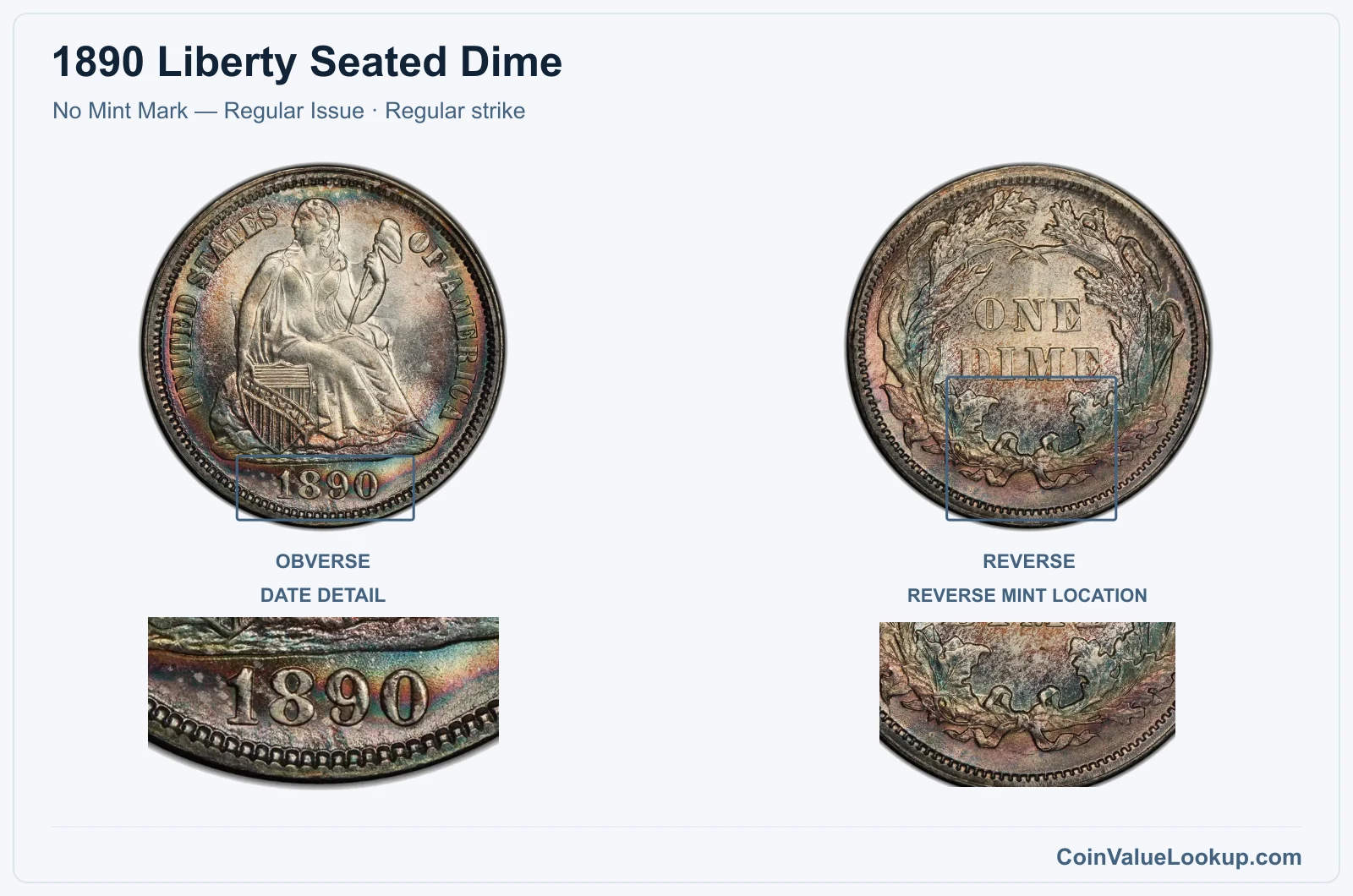
The Philadelphia regular issue has no mintmark anywhere on the coin. It features the Legend Obverse with stars and UNITED STATES OF AMERICA around the seated Liberty, paired with the agricultural wreath reverse reading ONE DIME.
USA Coin Book guide estimates place this version at about $22 in G4 and around $316 in MS63. Most survivors turn up well circulated, so a piece with strong detail and original luster stands out.
Check both faces for cleaning or tooling, which reduce collector appeal regardless of remaining sharpness.
Range Grade
Price Auction Records Appraisal PO PO 1
—
Coin Identifier FR FR 2
Coin Identifier AG AG 3
—
Coin Identifier G G 4
—
Coin Identifier
G 6
—
Coin Identifier VG VG 8
—
Coin Identifier
VG 10
—
Coin Identifier F F 12
—
Coin Identifier
F 15
—
Coin Identifier VF VF 20
—
Coin Identifier
VF 25
—
Coin Identifier
VF 30
—
Coin Identifier
VF 35
Coin Identifier XF XF 40
—
Coin Identifier
XF 45
Coin Identifier AU AU 50
Coin Identifier
AU 53
Coin Identifier
AU 55
Coin Identifier
AU 58
Coin Identifier MS MS 60
Coin Identifier
MS 61
Coin Identifier
MS 62
Coin Identifier
MS 63
Coin Identifier
MS 64
Coin Identifier
MS 65
Coin Identifier
MS 66
Coin Identifier
MS 67
Coin Identifier
MS 68
—
—
—
MS 69
—
—
—
MS 70
—
—
—
1890 Liberty Seated Dime — S — Small S
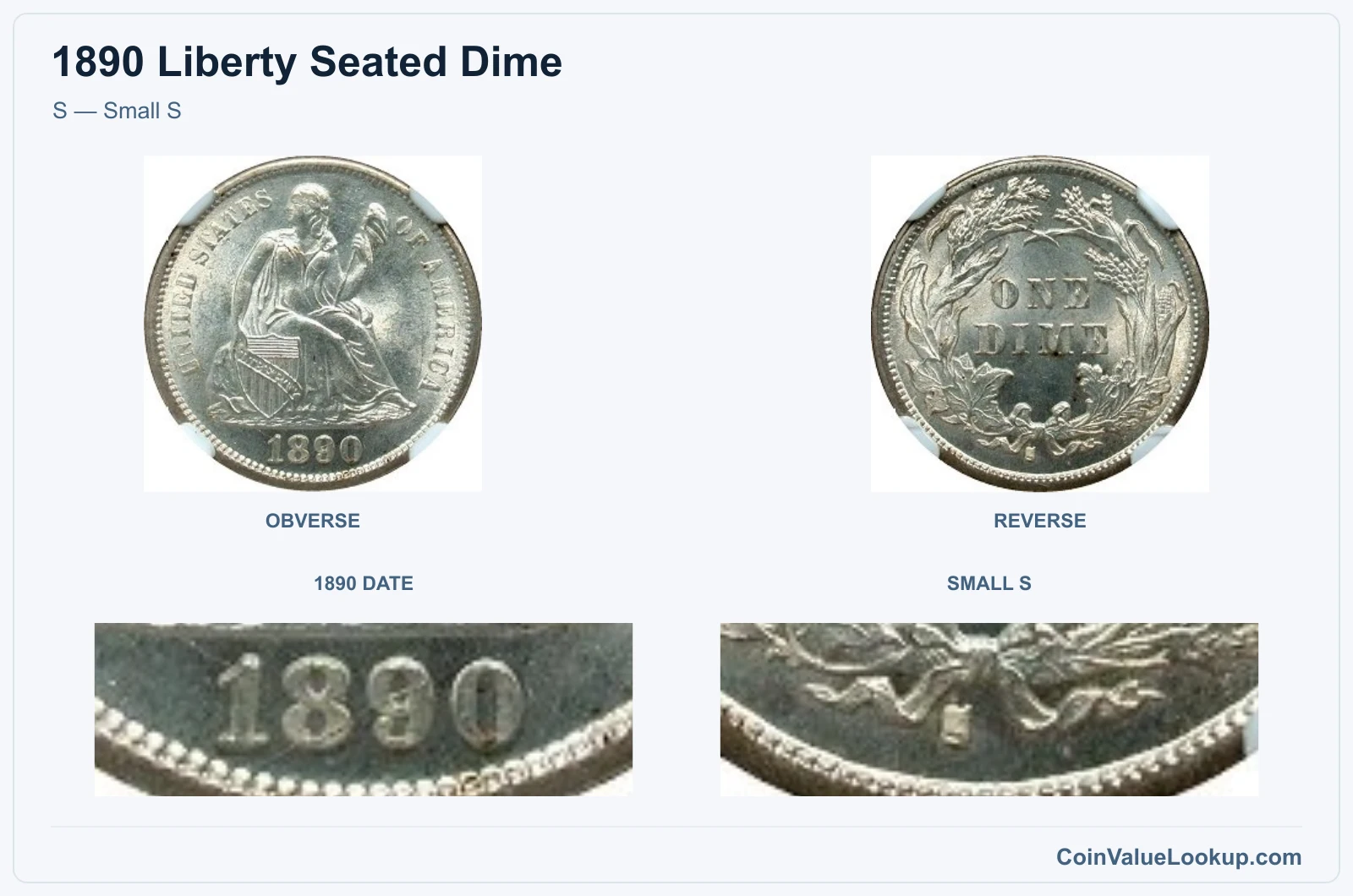
The Small S variety from San Francisco displays a noticeably compact "S" mintmark below the wreath on the reverse. Side-by-side comparison with the Medium S at equal magnification is the most reliable way to confirm it.
This is the scarcer of the two San Francisco mintmark styles for 1890. No separately adopted guide price is available for the Small S specifically; the overall San Francisco issue anchors from USA Coin Book (about $26 in G4 to $864 in MS63) cover both mintmark sizes together without splitting them.
Individual value depends on authenticated identity, condition and any die features present, so professional evaluation is worthwhile if you believe you have the Small S.
Coin Value Lookup is a good place to start when you want to look up guides for other dates and mints in the Liberty Seated Dime series.
Range Grade
Price Auction Records Appraisal PO PO 1
—
Coin Identifier FR FR 2
—
Coin Identifier AG AG 3
—
Coin Identifier G G 4
—
Coin Identifier
G 6
—
Coin Identifier VG VG 8
—
Coin Identifier
VG 10
—
Coin Identifier F F 12
—
Coin Identifier
F 15
—
Coin Identifier VF VF 20
—
Coin Identifier
VF 25
—
Coin Identifier
VF 30
—
Coin Identifier
VF 35
—
Coin Identifier XF XF 40
—
Coin Identifier
XF 45
—
Coin Identifier AU AU 50
—
—
—
AU 53
—
—
—
AU 55
—
—
—
AU 58
—
—
— MS MS 60
—
—
—
MS 61
—
—
—
MS 62
—
—
—
MS 63
—
—
—
MS 64
—
—
—
MS 65
—
—
—
MS 66
—
—
—
MS 67
—
—
—
MS 68
—
—
—
MS 69
—
—
—
MS 70
—
—
—
1890 Liberty Seated Dime — S — Medium S
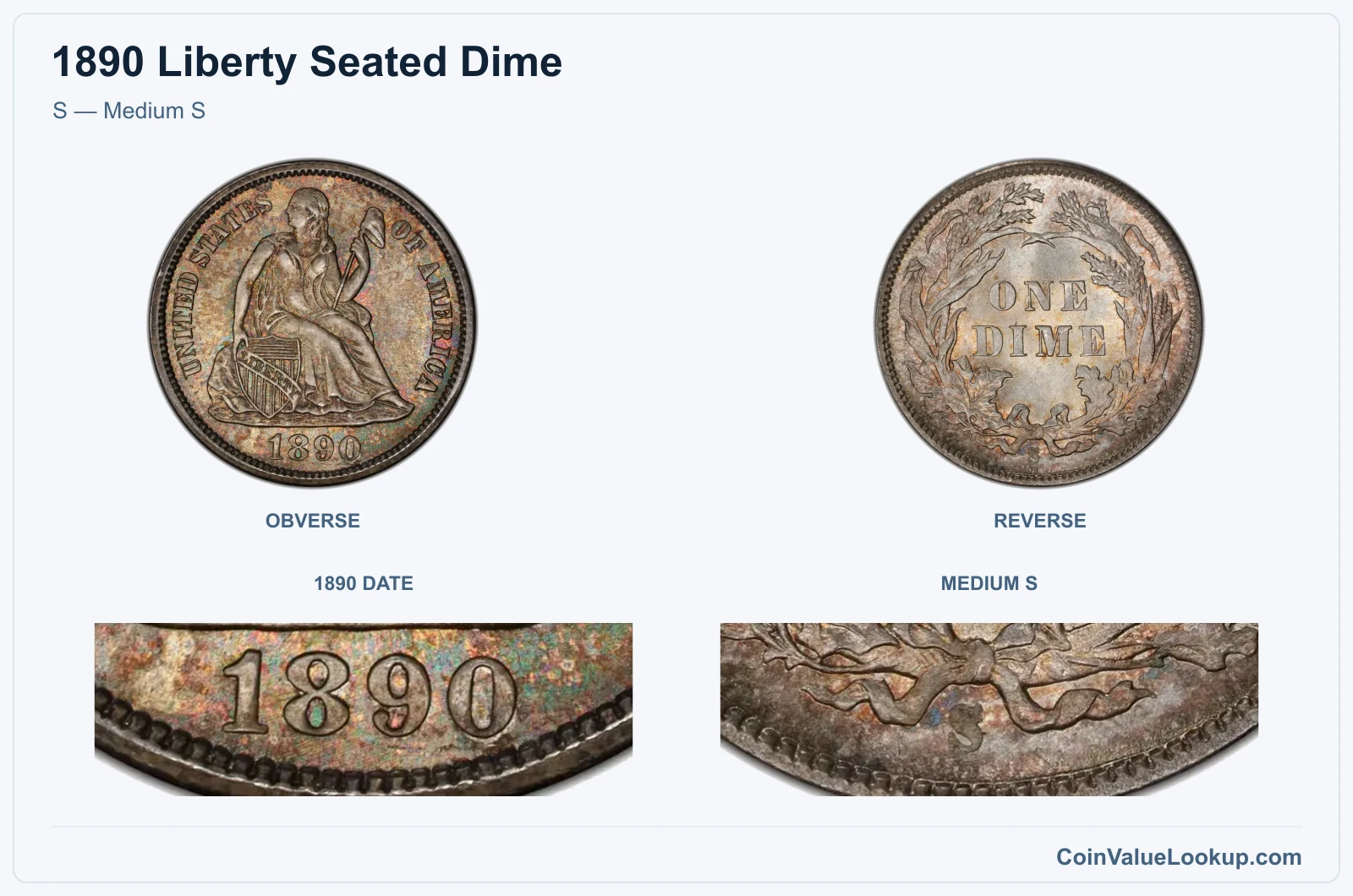
The Medium S shows a larger, more open "S" mintmark compared to the Small S. On a genuine Medium S the letter has wider curves and a taller profile, sitting in the same position below the wreath bow.
Because the published guide anchors for San Francisco 1890 dimes (roughly $26 at G4 to $864 at MS63 per USA Coin Book) are not split by mintmark size, there is no separately adopted price for the Medium S. It is the more common of the two S varieties.
Value still depends on authenticated identity, overall condition and whether any die errors are present, so careful examination pays off.
Ordinary-issue reference: Ordinary-issue reference only: The table below shows prices for the 1890-S Liberty Seated Dime (regular strike). It does not represent the value of the specific S — Medium S variety or its variety premium. Year, mint, metal and strike type are matched; the specific variety is not priced by this table.
Range Grade
Price Auction Records Appraisal PO PO 1
—
Coin Identifier FR FR 2
—
Coin Identifier AG AG 3
—
Coin Identifier G G 4
—
Coin Identifier
G 6
—
Coin Identifier VG VG 8
—
Coin Identifier
VG 10
—
Coin Identifier F F 12
—
Coin Identifier
F 15
—
Coin Identifier VF VF 20
Coin Identifier
VF 25
—
Coin Identifier
VF 30
—
Coin Identifier
VF 35
—
Coin Identifier XF XF 40
—
Coin Identifier
XF 45
Coin Identifier AU AU 50
—
Coin Identifier
AU 53
Coin Identifier
AU 55
Coin Identifier
AU 58
Coin Identifier MS MS 60
—
Coin Identifier
MS 61
Coin Identifier
MS 62
Coin Identifier
MS 63
Coin Identifier
MS 64
Coin Identifier
MS 65
Coin Identifier
MS 66
Coin Identifier
MS 67
—
—
—
MS 68
—
—
—
MS 69
—
—
—
MS 70
—
—
—
1890 Liberty Seated Dime — No Mint Mark — Proof Regular Proof
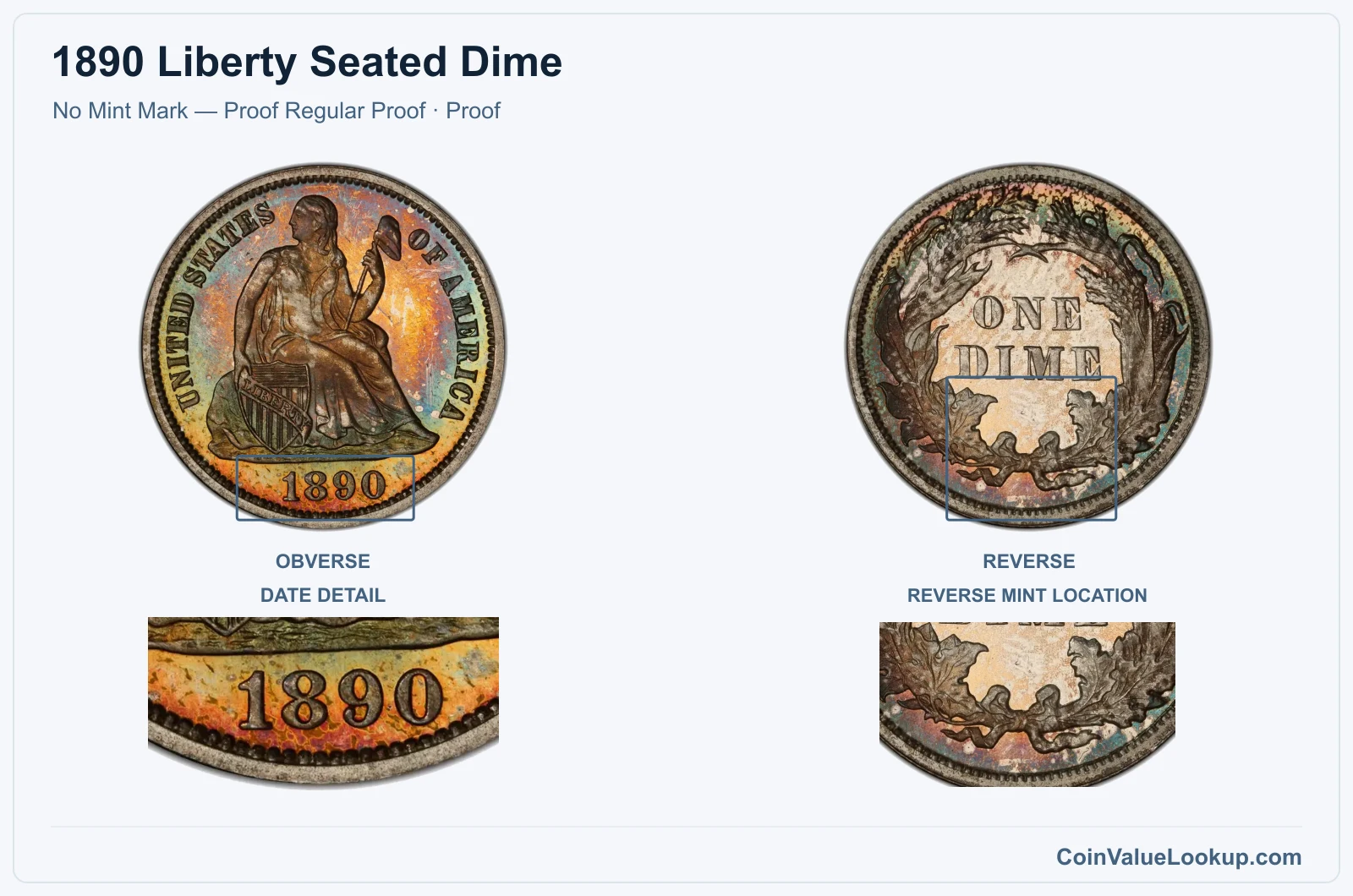
Philadelphia Proof dimes of 1890 were struck from specially prepared dies onto polished planchets, producing deep mirror fields. The USA Coin Book guide places a PR63 example at about $725.
Genuine Proofs show squared, well-defined rims and razor-sharp design edges that business strikes rarely match. Look for the characteristic reflective fields when tilting the coin under a point light source.
Hairlines from old cleanings are common on 19th-century Proofs and will lower the grade.
A polished circulation strike can look shiny, but it will not have the same die-preparation characteristics. If you suspect you have a Proof, third-party authentication is the safest route to confirm it.
Range Grade
Price Auction Records Appraisal PR PR 1
—
Coin Identifier
PR 2
—
Coin Identifier
PR 3
—
Coin Identifier
PR 4
—
Coin Identifier
PR 6
—
Coin Identifier
PR 8
—
Coin Identifier
PR 10
—
Coin Identifier
PR 12
—
Coin Identifier
PR 15
—
Coin Identifier
PR 20
—
Coin Identifier
PR 25
—
Coin Identifier
PR 30
—
Coin Identifier
PR 35
—
Coin Identifier
PR 40
—
Coin Identifier
PR 45
—
Coin Identifier
PR 50
—
Coin Identifier
PR 53
—
Coin Identifier
PR 55
—
Coin Identifier
PR 58
—
Coin Identifier
PR 60
—
Coin Identifier
PR 61
Coin Identifier
PR 62
Coin Identifier
PR 63
Coin Identifier
PR 64
Coin Identifier
PR 65
Coin Identifier
PR 66
Coin Identifier
PR 67
Coin Identifier
PR 68
Coin Identifier
PR 69
—
—
—
PR 70
—
—
—
1890 Liberty Seated Dime Error List
1. 1890 Liberty Seated Dime — Repunched Date
A repunched date on an 1890 dime shows remnants of an earlier date-punch position next to or underneath the final numerals. You might see a ghostly shadow of one or more digits slightly offset from where they ended up.
This is a die variety, not post-strike damage. The key diagnostic is consistency: the extra impression should be in the same relative position on every surviving example from that die pair.
Tilt the coin under magnification and look for doubling confined to the date digits alone.
Do not confuse this with a damaged date caused by a hit or scratch, which tends to look irregular and one-of-a-kind. Machine doubling leaves a flat shelf rather than a distinct second impression.
Value depends on the visibility of the repunching and the coin's overall condition.
2. 1890 Liberty Seated Dime — Misplaced Date
A misplaced date means recognizable fragments of a date digit appear outside the intended date position, often in the gown or scroll area of the seated Liberty. The die was punched once in the wrong spot before being corrected.
To spot this, inspect the drapery and base area under magnification. Look for raised contours that match the shape of a numeral.
A stray "8" or "9" partially embedded in Liberty's gown is a classic example.
Scratches and random die polish lines can mimic numeral shapes, so compare any suspected fragment against the known date digits for a consistent match. Value depends on how clearly visible the misplaced digit is and the coin's condition.
No specific price range is adopted for this variety.
3. 1890 Liberty Seated Dime — Repunched Mintmark
A repunched mintmark on an 1890 dime shows traces of a second, slightly offset mintmark punch beneath or beside the final "S." This applies to San Francisco issues, since Philadelphia coins carry no mintmark.
Under magnification, look for a secondary outline or notch along the curves of the S. The remnant should be consistent and in a fixed position relative to the final letter, not random or one-sided.
Machine doubling around a mintmark leaves a flat, shelf-like displacement rather than a rounded second impression. Die chips and corrosion can also distort the letter's outline.
Compare your coin's mintmark to a known normal example at the same magnification. Value depends on the clarity of the repunching and overall condition; no adopted price range is available for this variety.
4. 1890 Liberty Seated Dime — Die Crack / Die Chip
Die cracks appear as thin raised lines running across the coin's surface, caused by a fracture in the steel die. Die chips are small raised blobs where a tiny piece of the die surface broke away, leaving a void that fills with metal during striking.
These have been reported on 1890 Philadelphia dimes.
A crack that connects to the rim is on its way to becoming a cud, so note its position and length. Interior chips are typically small and round.
Do not confuse die cracks with incuse scratches, which are pressed into the surface rather than raised above it. Corrosion pitting and surface grime can also mimic a chip.
Run a fingernail or toothpick across the feature: a die crack or chip will be raised. Value depends on prominence, location and the coin's grade.
5. 1890 Liberty Seated Dime — Clashed Dies
Clashed dies occur when the obverse and reverse dies strike each other without a planchet between them, transferring ghost impressions of the opposite design onto each die. On the struck coin you will see faint traces of the wreath on Liberty's side, or outlines of the seated figure among the reverse lettering.
These transferred features should align with where the opposing design would naturally sit during a normal strike. That alignment is the key diagnostic.
Random scratches and raised lines will not match the opposite die's layout.
Clashed dies have been reported on 1890 Philadelphia dimes. The strength of the clash impression and the coin's condition together determine collector interest.
No specific price range is adopted for this variety.
6. 1890 Liberty Seated Dime — Die Break / Cud
A cud is a raised, featureless blob that connects to the rim, caused by a piece of the die breaking away entirely. The missing die fragment means metal flows into that void during striking, creating a lump where design detail should be.
On an 1890 Philadelphia dime, inspect the rim carefully all the way around. A cud will interrupt the normal rim and adjacent design with a smooth, rounded mass.
Do not confuse a rim dent or contact mark with a cud. Dents are incuse, pressed into the metal, while a cud is raised.
An interior die chip that does not touch the rim is a different category. Larger cuds that obscure significant design elements tend to draw more collector attention.
Value depends on size, location and the coin's overall grade.
7. 1890 Liberty Seated Dime — Doubled Die Reverse
A doubled die reverse on the 1890 Philadelphia dime has been described with doubling visible on the left maple leaf area, sometimes accompanied by die cracks. Look for separated or notched contours on the leaf compared to a normal example under matching light and magnification.
True hub doubling shows consistent, rounded separation of design elements. Machine doubling, by contrast, produces a flat, shelf-like displacement that lacks the same depth and definition.
Compare the wreath leaves and lettering on your coin against a known normal reverse. If you see the same split or notching on multiple design elements in a consistent direction, that supports a doubled die.
Reflections and worn die contours can fool you, so use directional lighting. No adopted price range is available; value depends on visibility and condition.
8. 1890 Liberty Seated Dime — Double / Multiple Strike
A double or multiple strike means the coin was hit by the dies more than once, with the second impression displaced or rotated from the first. The result is two overlapping but offset versions of the design on the same planchet.
Look for a clearly separate second impression of Liberty or the wreath, shifted to one side or rotated. The displacement should be visible across the entire design, not just on individual letters.
This is different from a doubled die, which affects every coin struck from that die. A double strike is a planchet-handling error unique to one coin.
Post-mint damage such as vice marks or counter-stamps can also create extra impressions, but those will lack the sharp, die-struck quality of a genuine second strike. No adopted price range exists; value depends on severity and condition.
9. 1890 Liberty Seated Dime — Off-Center Strike
An off-center strike happens when the planchet is not properly seated between the dies, resulting in a displaced design and an unstruck crescent of blank metal along one edge. The more off-center the strike, the more dramatic the blank area.
For collector appeal, the date needs to remain visible. An off-center 1890 dime with a clear "1890" is far more desirable than one where the date has shifted off the planchet entirely.
Do not confuse a clipped planchet or post-mint flattening with an off-center strike. A clip has a curved missing section but the design is still centered, while post-mint damage lacks the sharp die-struck edge of a genuine misalignment.
No adopted price range is available; value depends on the percentage off-center and whether the date is readable.
10. 1890 Liberty Seated Dime — Lamination / Split Planchet
A lamination or split planchet occurs when layers of the silver alloy separate, creating a peeling flap, a missing layer or a visible crack running parallel to the surface. This happens due to impurities or gas trapped in the metal during the planchet preparation process.
On an 1890 dime, look for a raised flap of metal, a sunken area where a layer has peeled away, or a thin crack along the edge. Photographing the edge alongside the affected face helps document the separation.
Scratches, corrosion and deliberately altered coins can look similar. A genuine lamination follows the metal's internal structure and usually has a smooth, layered appearance at the boundary.
No adopted price range exists; the size, location and condition of the coin all affect desirability.
11. 1890 Liberty Seated Dime — Doubled Die Obverse
A doubled die obverse has been reported on 1890-S dimes, sometimes found alongside a repunched S mintmark. Look for consistent separation or notching on obverse letters, stars or design elements compared to a normal coin under the same lighting.
True hub doubling produces rounded, well-defined secondary contours that repeat across multiple design features in the same direction. Machine doubling, by contrast, shows a flat, shelf-like shift that is typically narrower and less distinct.
Worn die contours and reflections under certain lighting angles can create an illusion of doubling, so use directional light and compare carefully to a known normal obverse. No adopted price range is available for this variety; value depends on the strength of the doubling and the coin's overall condition.