1977 Roosevelt Dime Coin Value: How Much Is It Worth?
Most 1977 Roosevelt dimes are worth face value — a dime is a dime. In uncirculated condition at MS 65, guide estimates from USA Coin Book place both the Philadelphia and Denver issues around $2.79, while a normal San Francisco proof at PR 65 sits at about $3.08.
The real upside comes from authenticated mint errors and strong-strike designations, which can push values well beyond pocket change.
Fast Way to Identify Your 1977 Roosevelt Dime
Snap a clear photo of the front and back of your 1977 dime and upload both images to our identification tool. It can help with preliminary identification of your coin's mint version and general condition.
This is not a substitute for professional authentication, but it gives you a solid starting point before you dig deeper.
1977 Roosevelt Dime Value
Upload both sides of your 1977 Roosevelt Dime.
Front Obverse
Upload photo
Back Reverse
Upload photo
Which 1977 Roosevelt Dime Versions Are Worth Money?
- Uncirculated Philadelphia or Denver coins with Full Bands torch detail can carry a premium over standard MS 65 guide values — confirm with matched grade and designation evidence.
- San Francisco proofs with deep cameo contrast and clean fields stand apart from normal proof pricing at PR 65.
- A 1977-D obverse die cap sold for $1,725 at auction in April 2006, graded NGC MS 69 — authentication is essential.
- Off-center strikes, missing clad layers, and clipped planchets each require professional verification to separate genuine mint errors from post-mint damage.
Step 1: Identify Your 1977 Roosevelt Dime Mint Mark and Version
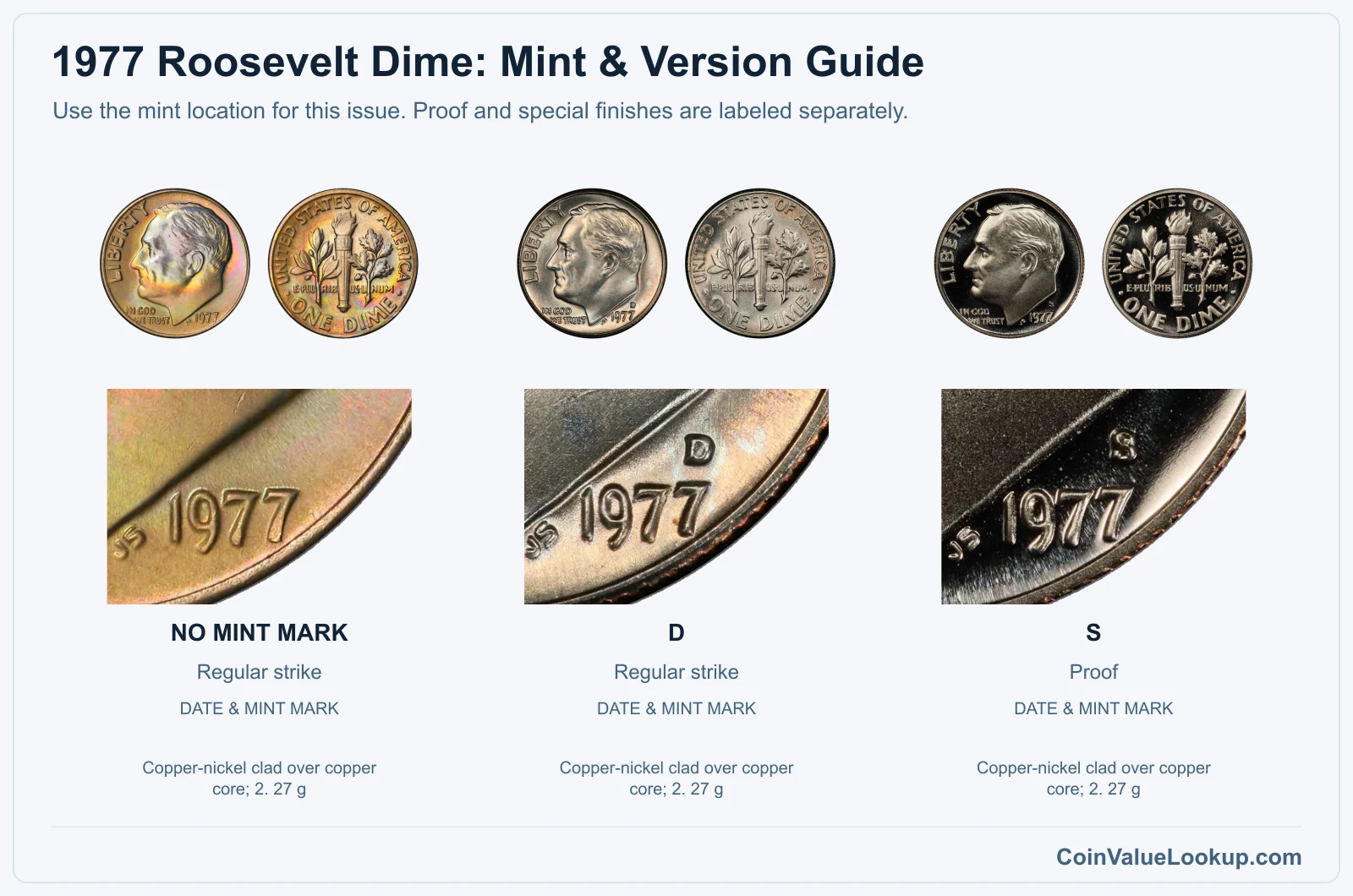
Every 1977 dime carries the Roosevelt portrait on the obverse and a torch flanked by branches on the reverse. The date appears on the obverse near the bottom rim.
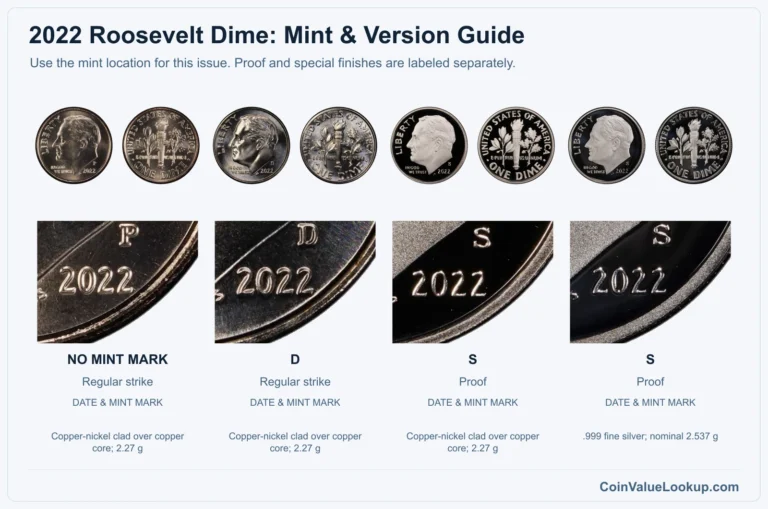
For mintmarks, look just above the date. Philadelphia coins have no mintmark at all.
Denver coins show a small "D." San Francisco coins carry an "S," and those were struck exclusively as proofs — you will not find a business-strike S for this year.
All 1977 dimes are copper-nickel clad over a copper core, weighing about 2.27 grams and measuring roughly 17.9 mm across. There is no silver version for this date.
If your coin looks silvery on the edge with no visible copper stripe, it is still the standard clad composition — that is normal.
No normal "No S" proof variety is recognized for the 1977 date, so do not confuse a Philadelphia business strike (which also lacks a mintmark) with a missing-mintmark proof.
Step 2: Check Your 1977 Roosevelt Dime Grade
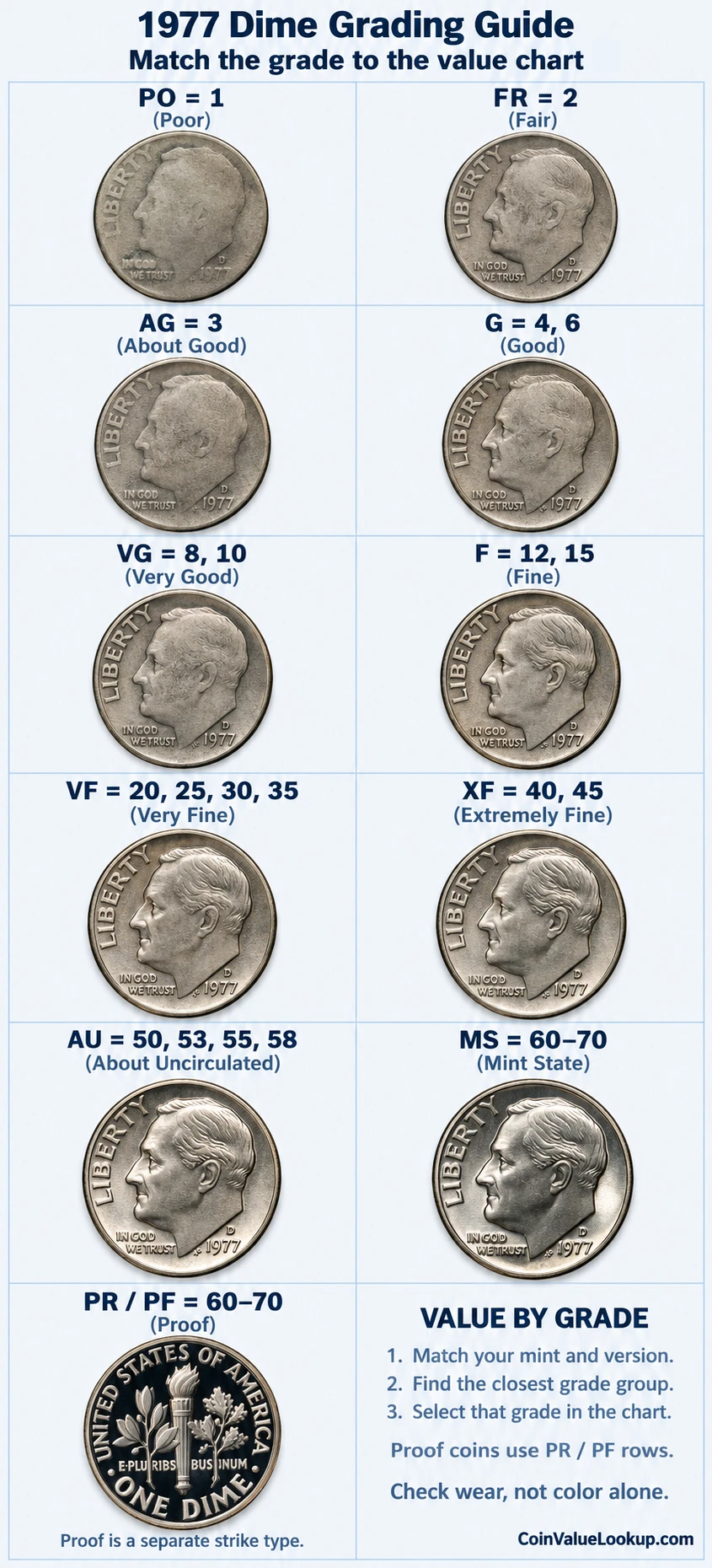
Start with Roosevelt's cheekbone and jawline — these are the highest points on the obverse and the first to show friction. Then check the hair detail directly above the ear; a fully uncirculated coin retains complete separation in those strands.
On the reverse, examine the horizontal bands on the torch. Both pairs of bands should be distinct on a well-struck example.
Full Bands is a strike designation, not a grade, so a coin can be MS 65 without it.
Luster matters more than shine. A coin that has been cleaned may look bright but will show fine hairlines under magnification.
Scratches, corrosion, and environmental damage all reduce the grade regardless of how sharp the design looks.
Remember that "proof" describes how the coin was made — mirror fields, frosted devices — not a grade above Mint State. Proof coins are graded on their own PR scale, so assess proof surfaces for haze, hairlines, and contact marks separately from business strikes.
Use the comparison image nearby to calibrate your eye for each wear level.
Step 3: Check 1977 Roosevelt Dime Value by Mint and Version
1977 Roosevelt Dime — No Mintmark Business Strike
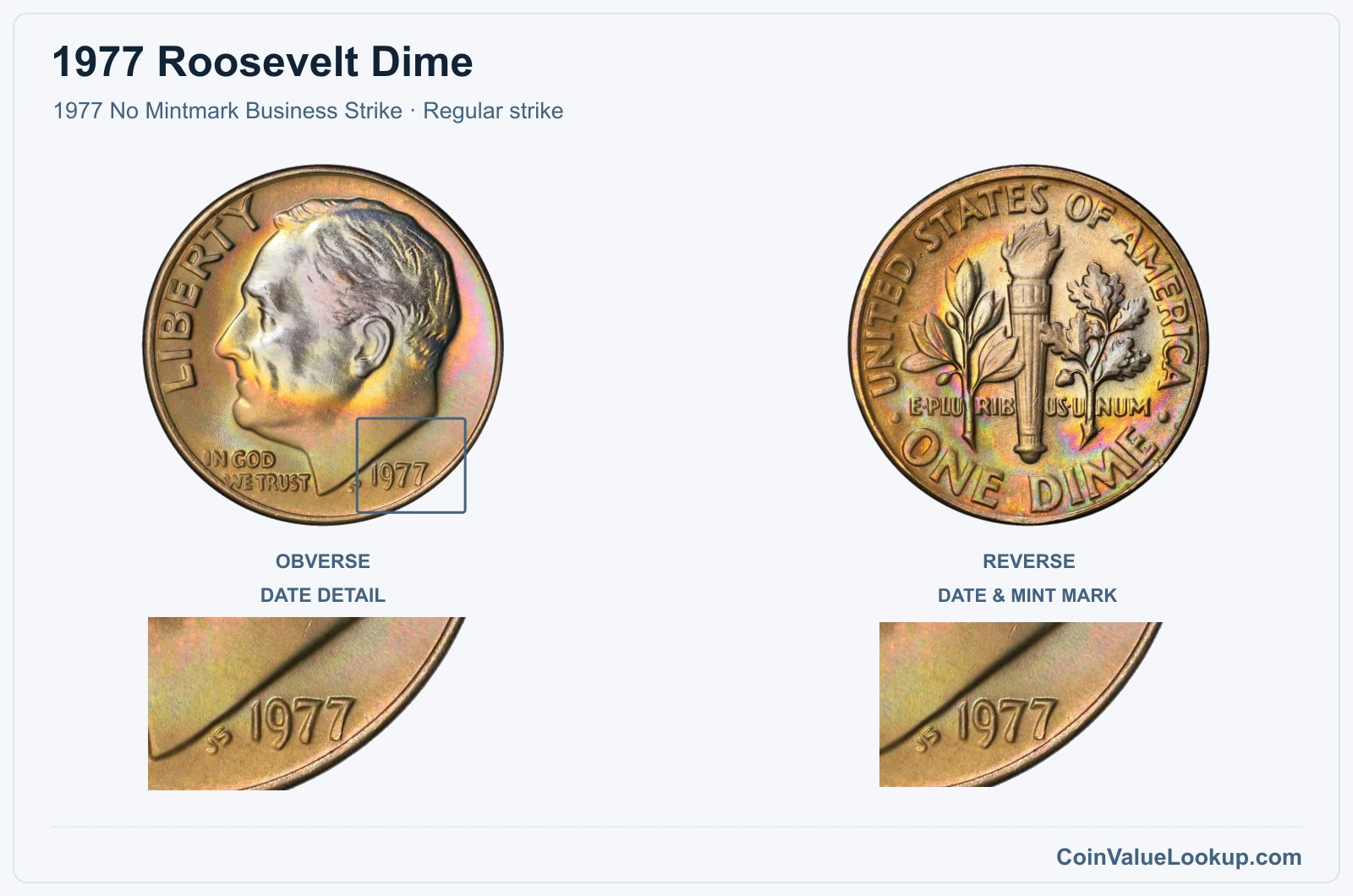
The 1977 Philadelphia dime has no mintmark on the obverse. It is a copper-nickel clad coin weighing about 2.27 grams.
Circulated examples are worth face value.
At MS 65, a USA Coin Book guide estimate is $2.79. Coins with Full Bands — meaning both horizontal band pairs on the torch are fully separated — may command more, but that designation needs to be confirmed by a grading service.
Do not confuse this business strike with a proof just because it lacks a mintmark; proofs were only struck at San Francisco.
Range Grade
Price Auction Records Appraisal PO PO 1
—
Coin Identifier FR FR 2
—
Coin Identifier AG AG 3
—
Coin Identifier G G 4
—
Coin Identifier
G 6
—
Coin Identifier VG VG 8
—
Coin Identifier
VG 10
—
Coin Identifier F F 12
—
Coin Identifier
F 15
—
Coin Identifier VF VF 20
—
Coin Identifier
VF 25
—
Coin Identifier
VF 30
—
Coin Identifier
VF 35
—
Coin Identifier XF XF 40
—
Coin Identifier
XF 45
—
Coin Identifier AU AU 50
—
Coin Identifier
AU 53
—
Coin Identifier
AU 55
—
Coin Identifier
AU 58
—
Coin Identifier MS MS 60
—
Coin Identifier
MS 61
—
Coin Identifier
MS 62
—
Coin Identifier
MS 63
—
Coin Identifier
MS 64
—
Coin Identifier
MS 65
Coin Identifier
MS 66
Coin Identifier
MS 67
Coin Identifier
MS 68
—
—
—
MS 69
—
—
—
MS 70
—
—
—
1977 Roosevelt Dime — D Business Strike
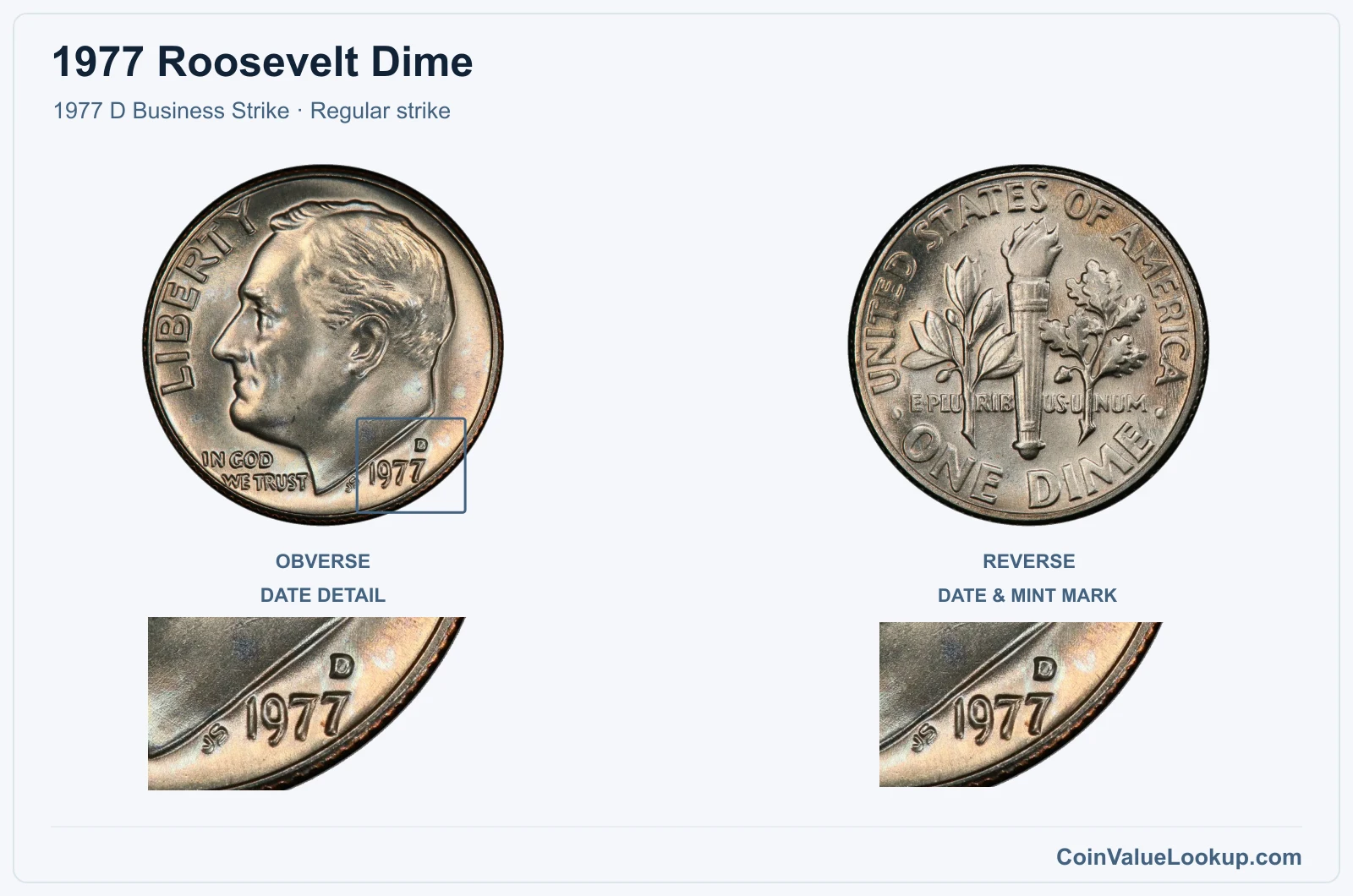
Denver's 1977 dime is identified by the small "D" mintmark above the date. Same clad composition, same 2.27-gram weight as Philadelphia.
The USA Coin Book guide places an MS 65 example at $2.79. As with the Philadelphia issue, Full Bands designation can add value when authenticated.
In worn grades these are strictly face-value coins. Check the mintmark carefully — a weak "D" can sometimes be misread as absent, leading people to misidentify the mint of origin.
Coin Value Lookup is a handy place to look up guides for Roosevelt dimes and other series when you are sorting through a batch of coins.
Range Grade
Price Auction Records Appraisal PO PO 1
—
Coin Identifier FR FR 2
—
Coin Identifier AG AG 3
—
Coin Identifier G G 4
—
Coin Identifier
G 6
—
Coin Identifier VG VG 8
—
Coin Identifier
VG 10
—
Coin Identifier F F 12
—
Coin Identifier
F 15
—
Coin Identifier VF VF 20
—
Coin Identifier
VF 25
—
Coin Identifier
VF 30
—
Coin Identifier
VF 35
—
Coin Identifier XF XF 40
—
Coin Identifier
XF 45
—
Coin Identifier AU AU 50
—
Coin Identifier
AU 53
—
Coin Identifier
AU 55
—
Coin Identifier
AU 58
—
Coin Identifier MS MS 60
—
Coin Identifier
MS 61
—
Coin Identifier
MS 62
—
Coin Identifier
MS 63
—
Coin Identifier
MS 64
Coin Identifier
MS 65
—
Coin Identifier
MS 66
Coin Identifier
MS 67
Coin Identifier
MS 68
—
Coin Identifier
MS 69
—
—
—
MS 70
—
—
—
1977 Roosevelt Dime — S Proof
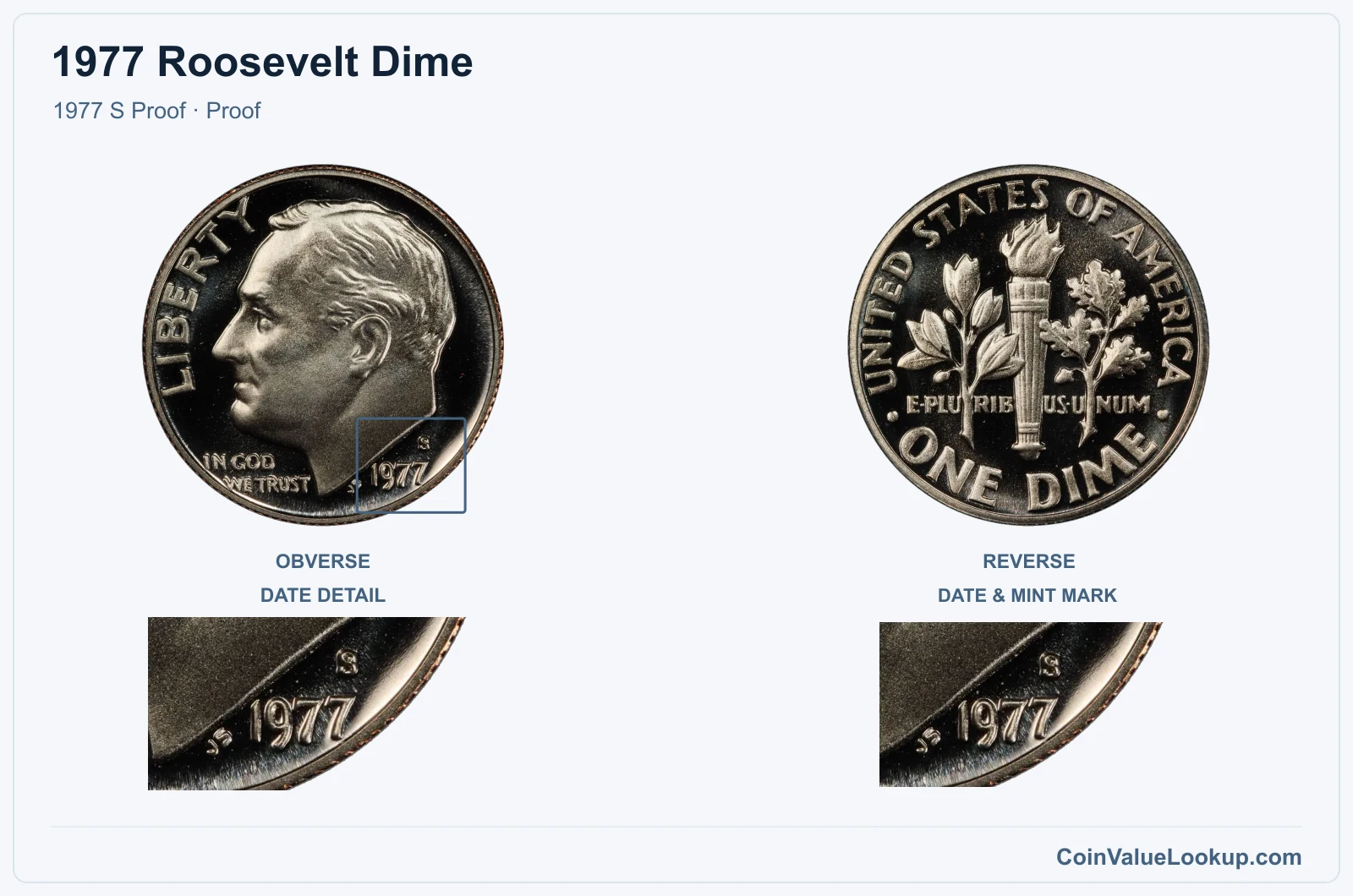
The 1977-S proof was struck at San Francisco and carries the "S" mintmark. These were sold in official proof sets, not released into circulation, so finding one in pocket change would be unusual.
At PR 65, the USA Coin Book guide estimate is $3.08. Proof coins should display mirror-like fields and sharp frosted devices.
Coins with strong cameo contrast — a visible difference between frosty design elements and deeply reflective fields — may be worth more, but that premium requires a cameo or deep cameo designation from a recognized grading service. Haze, fingerprints, or hairlines on the mirror surface will lower the proof grade.
Range Grade
Price Auction Records Appraisal PR PR 1
—
Coin Identifier
PR 2
—
Coin Identifier
PR 3
—
Coin Identifier
PR 4
—
Coin Identifier
PR 6
—
Coin Identifier
PR 8
—
Coin Identifier
PR 10
—
Coin Identifier
PR 12
—
Coin Identifier
PR 15
—
Coin Identifier
PR 20
—
Coin Identifier
PR 25
—
Coin Identifier
PR 30
—
Coin Identifier
PR 35
—
Coin Identifier
PR 40
—
Coin Identifier
PR 45
—
Coin Identifier
PR 50
—
Coin Identifier
PR 53
—
Coin Identifier
PR 55
—
Coin Identifier
PR 58
—
Coin Identifier
PR 60
Coin Identifier
PR 61
—
Coin Identifier
PR 62
—
Coin Identifier
PR 63
—
Coin Identifier
PR 64
—
Coin Identifier
PR 65
—
Coin Identifier
PR 66
—
Coin Identifier
PR 67
—
Coin Identifier
PR 68
Coin Identifier
PR 69
Coin Identifier
PR 70
Coin Identifier
1977 Roosevelt Dime Error List
1. 1977 Roosevelt Dime — Obverse Die Cap
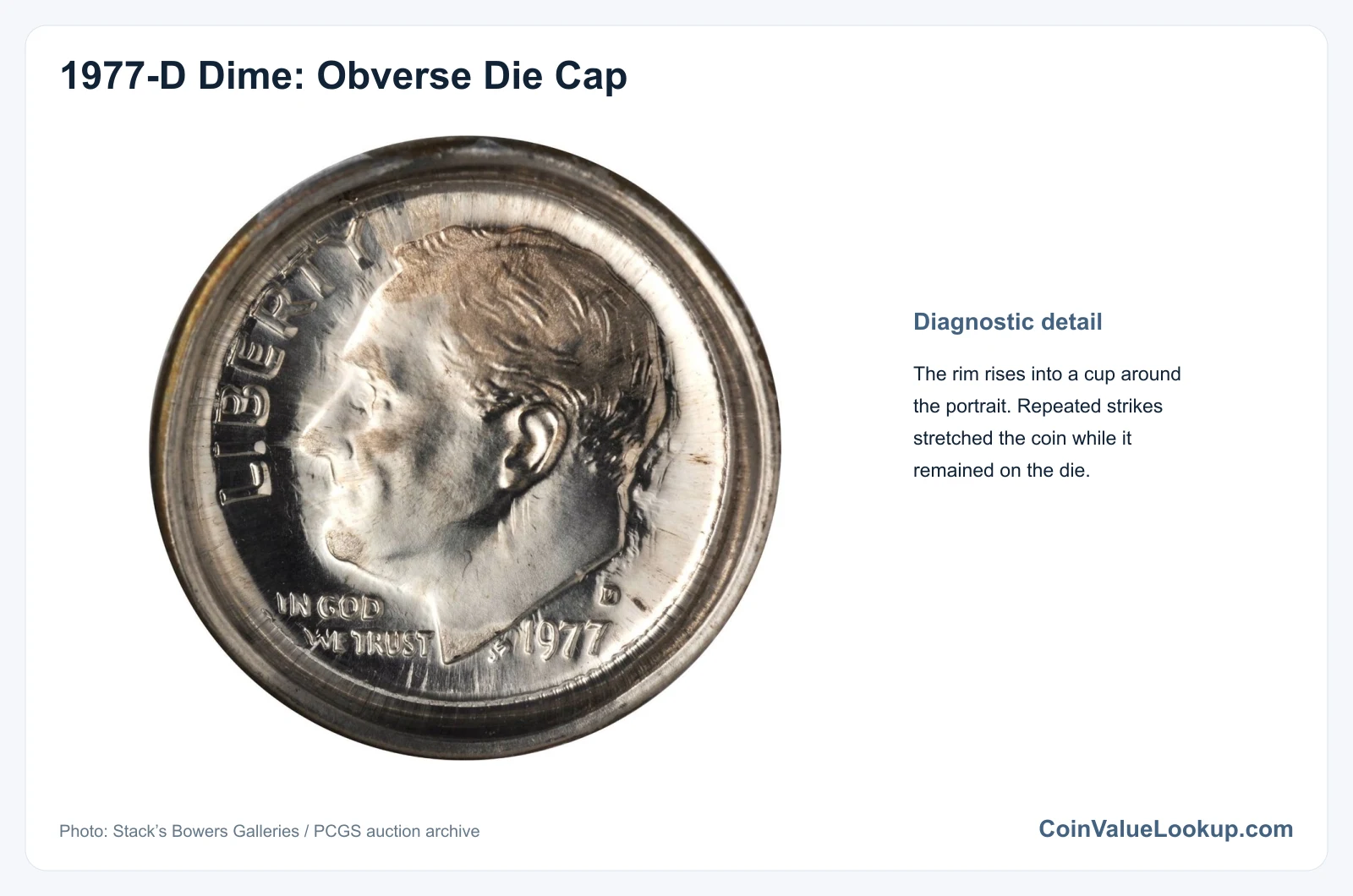
An obverse die cap forms when a struck coin sticks to the upper die and keeps striking incoming blanks. Over successive strikes the stuck coin cups upward around the die, creating a distinctive bowl shape.
The reverse becomes progressively more distorted from repeated contact with fresh planchets.
The documented example is a 1977-D business strike graded NGC MS 69 that sold for $1,725 at Heritage Auctions in April 2006. That price reflects one specific coin at an exceptionally high grade — your results will depend on condition, the degree of cupping, and whether the date and "D" mintmark remain readable.
Do not confuse a die cap with a dime that has been spooned, bent, or otherwise damaged after it left the mint. A genuine cap shows metal flow and progressive distortion consistent with repeated die contact, not simple mechanical bending.
2. 1977 Roosevelt Dime — Off-Center Strike
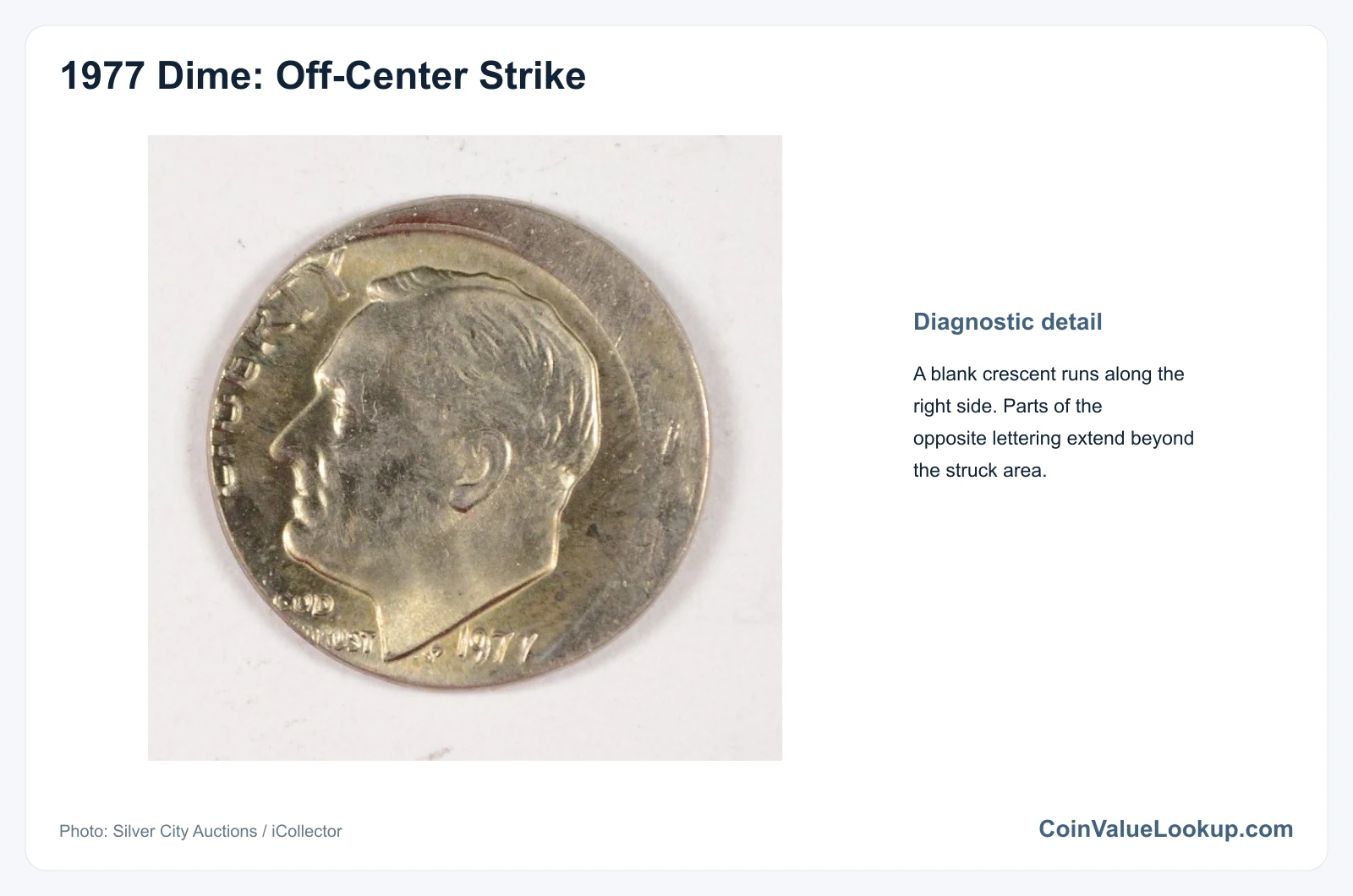
An off-center strike happens when the blank feeds into the press misaligned, so part of the design is missing entirely. The documented 1977 no-mintmark example shows about 15 percent displacement toward the one o'clock position, with an unstruck crescent visible on both faces.
It was graded ANACS MS 63.
No numerical price range is adopted here because value depends heavily on the percentage of off-center shift, whether the date is fully visible, and overall condition. Each coin needs individual assessment by an authenticated identity.
Watch out for one-sided die misalignment, which can look similar but behaves differently — the design may be weak on one side rather than truly missing. There is no universal percentage-to-price formula, so get a professional opinion before assuming a premium.
3. 1977 Roosevelt Dime — Missing Obverse Clad Layer
A missing obverse clad layer means the outer copper-nickel skin on the front of the coin was absent before striking. The result is an exposed copper surface on the obverse, giving it a distinctly reddish-brown appearance, while the reverse retains its normal silvery tone.
The edge should show an irregular boundary where the clad layer ends.
The documented example is a 1977-D graded NGC MS 64, weighing approximately 1.9 grams — noticeably lighter than the standard 2.27 grams. No specific sale price is adopted, so value depends on the coin's condition and how clearly the error presents itself.
Be careful not to mistake natural toning, post-mint abrasion, or chemical stripping for a genuine missing layer. A real missing clad error will show consistent copper exposure and a measurably reduced weight; damaged coins typically will not.
4. 1977 Roosevelt Dime — Clipped Planchet
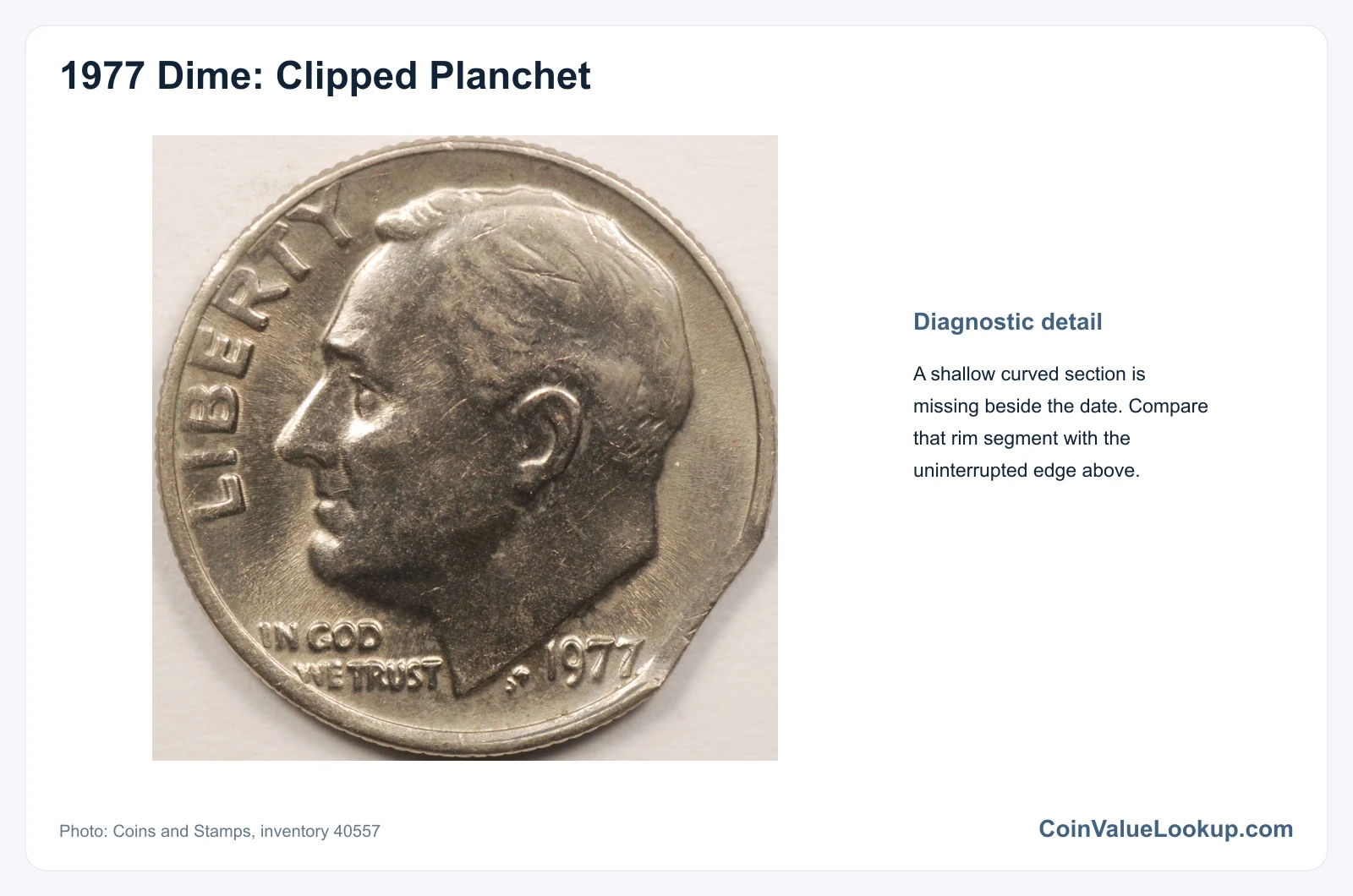
A clipped planchet occurs when the coin blank is punched from strip metal that overlaps a previously punched hole, leaving a curved, straight, or ragged missing section. On a 1977 dime, look for an incomplete rim and a corresponding area of weakness on the opposite side of the coin — this "Blakesley effect" is a good authenticity indicator.
No numerical price range is adopted for this variety. Value depends on the size and shape of the clip, the coin's overall condition, and how visually dramatic the missing portion is.
The main lookalike is post-mint damage: filed edges, deliberate cuts, or corrosion eating away the rim. A genuine clip will show undisturbed metal flow at the missing area and will not have tool marks or rough filing lines.
If in doubt, professional authentication is the safest route.