1984 Roosevelt Dime Coin Value: How Much Is It Worth?
Most 1984 Roosevelt dimes pulled from circulation are worth face value — ten cents. In uncirculated condition around MS 65, guide estimates sit at $2.50 for the Philadelphia strike and $2.79 for the Denver strike.
A standard S proof at PR 65 comes in around $3.08. The real upside lives in genuine mint errors and well-preserved examples with crisp torch detail, so it pays to look closely before tossing one back in the jar.
Fast Way to Identify Your 1984 Roosevelt Dime
Want a quick read on your 1984 dime? Snap a clear photo of the front (obverse) and back (reverse) and upload both.
That gives you a preliminary identification of your coin's mint mark, general condition, and whether it might carry an error worth investigating further. It is not a substitute for professional grading or authentication, but it is a solid first step.
1984 Roosevelt Dime Value
Upload both sides of your 1984 Roosevelt Dime.
Front Obverse
Upload photo
Back Reverse
Upload photo
Which 1984 Roosevelt Dime Versions Are Worth Money?
- Well-preserved Philadelphia or Denver business strikes with fully separated torch bands can bring a modest premium over ordinary uncirculated examples.
- San Francisco S proofs with strong contrast between frosted devices and mirrored fields are the collectible proof branch for this year.
- A confirmed Tilted Partial Collar on a 1984-P can carry a premium, but the edge diagnostic must match — not just random rim dings.
- Off-Center Strikes on 1984-D dimes are scarce; a dramatic shift with the date still visible is the key combination collectors want.
- Obverse Strike-Through errors on 1984-D dimes show as-made missing detail from a foreign object between die and planchet.
Step 1: Identify Your 1984 Roosevelt Dime Mint Mark and Version
Start by confirming the date reads 1984 and the obverse shows Franklin Roosevelt's portrait facing left. Flip it over — you should see a torch flanked by olive and oak branches.
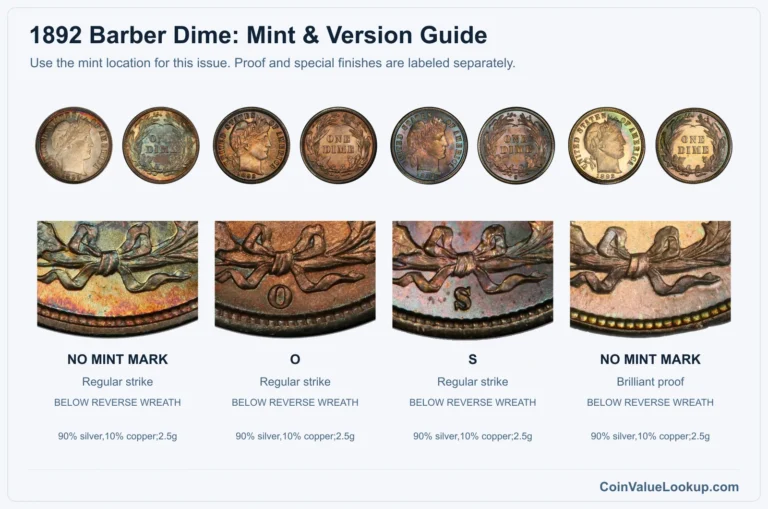
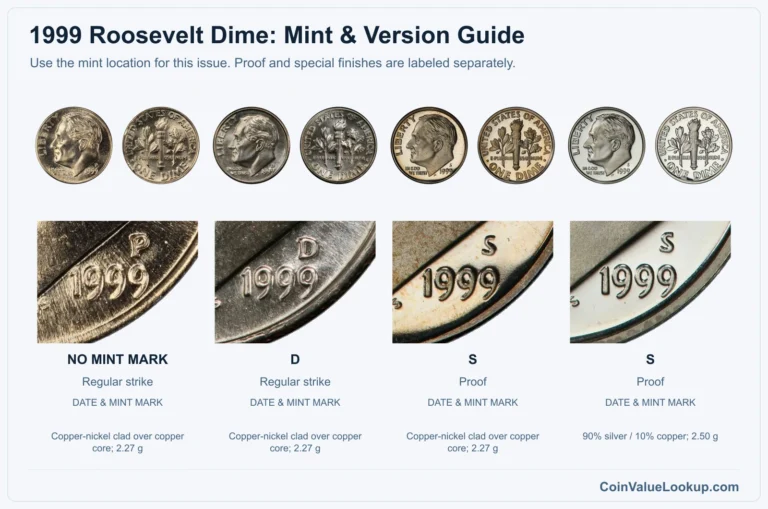
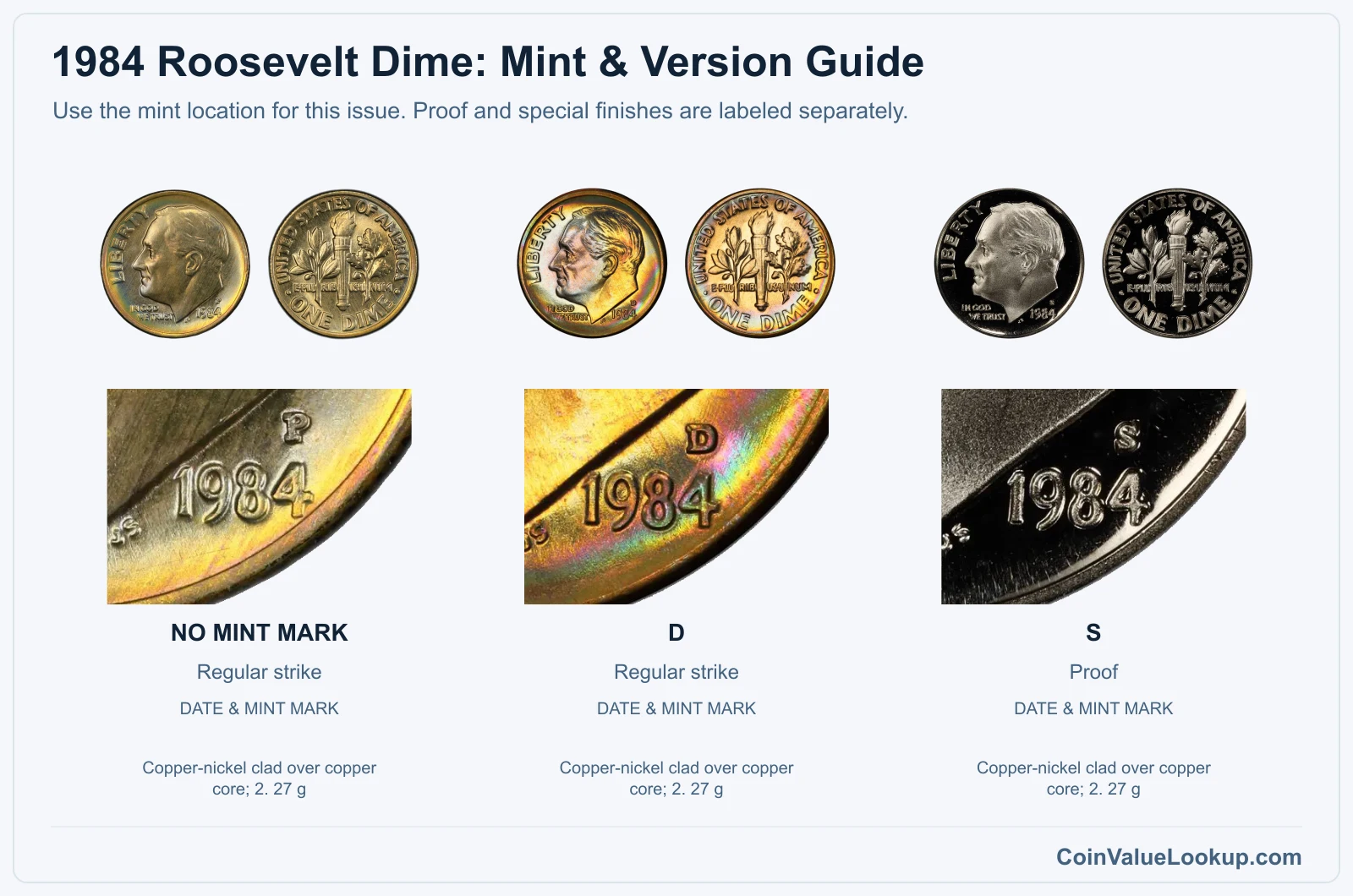
Now find the mint mark on the obverse, near the base of the date. A "P" means Philadelphia, a "D" means Denver, and an "S" indicates a San Francisco proof.
There is no regular silver version for 1984; all are copper-nickel clad over a copper core, weighing about 2.27 grams and measuring roughly 17.9 mm in diameter.
If the coin looks silver-toned on one side but coppery on the other, or if the edge color looks off, that could signal a missing clad layer — an error worth examining. A normal 1984 dime will show the characteristic copper-nickel sandwich visible at the edge.
Step 2: Check Your 1984 Roosevelt Dime Grade
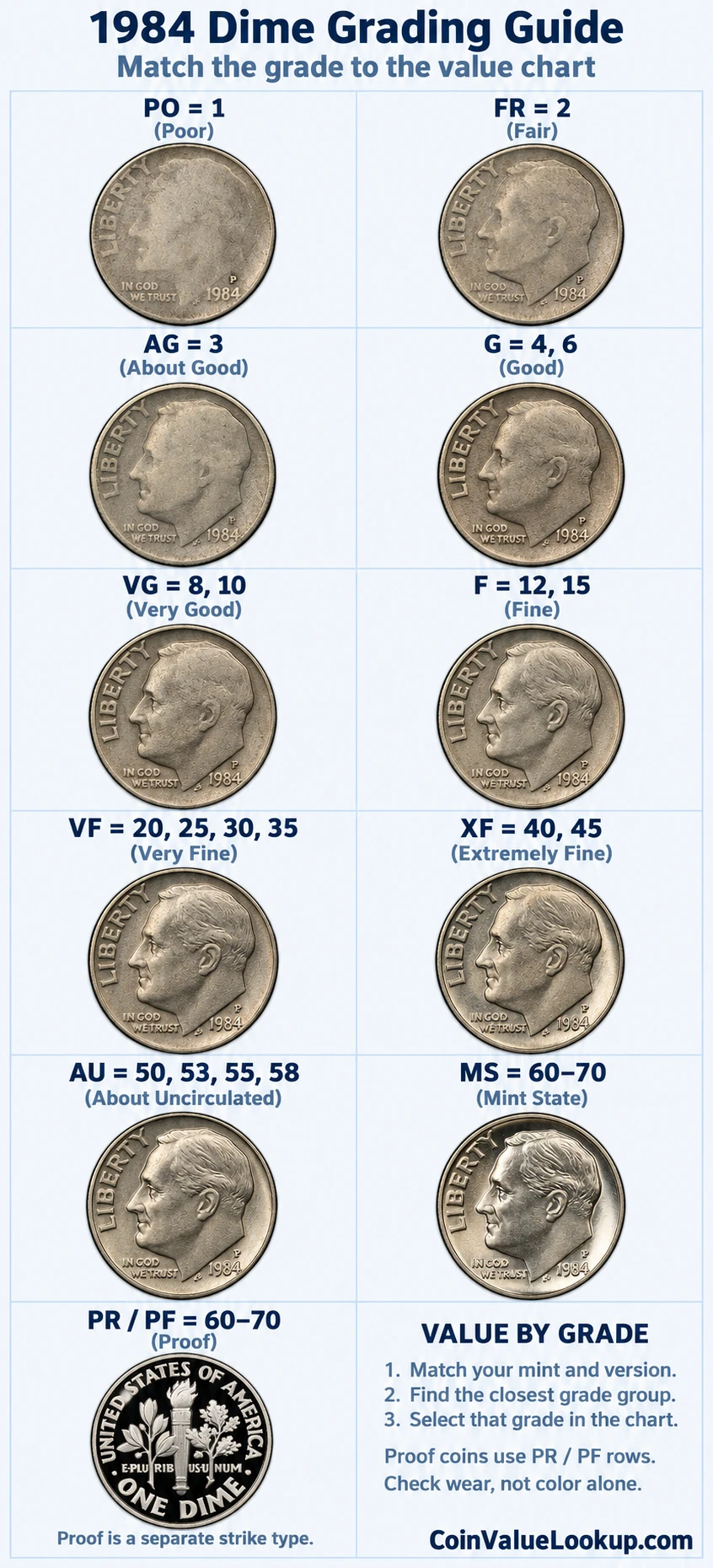
Focus on a few key wear points. On the obverse, check Roosevelt's cheekbone, jawline, and the hair detail just above his ear — these are the first areas to lose definition as a coin circulates.
On the reverse, inspect the torch lines and the leaf details on the branches. When both horizontal bands on the torch are fully separated, graders may designate the coin "Full Bands," which is a strike quality designation, not an error.
Original mint luster matters. A coin can look bright but still grade poorly if it has been cleaned or scratched.
Compare your coin to the grading image: a coin with full cartwheel luster and no contact marks across the cheek or fields is a strong candidate for a higher grade. Proof coins are judged on their reflective fields and frosted devices, not on the same wear scale as business strikes.
Step 3: Check 1984 Roosevelt Dime Value by Mint and Version
1984 Roosevelt Dime — P Business Strike
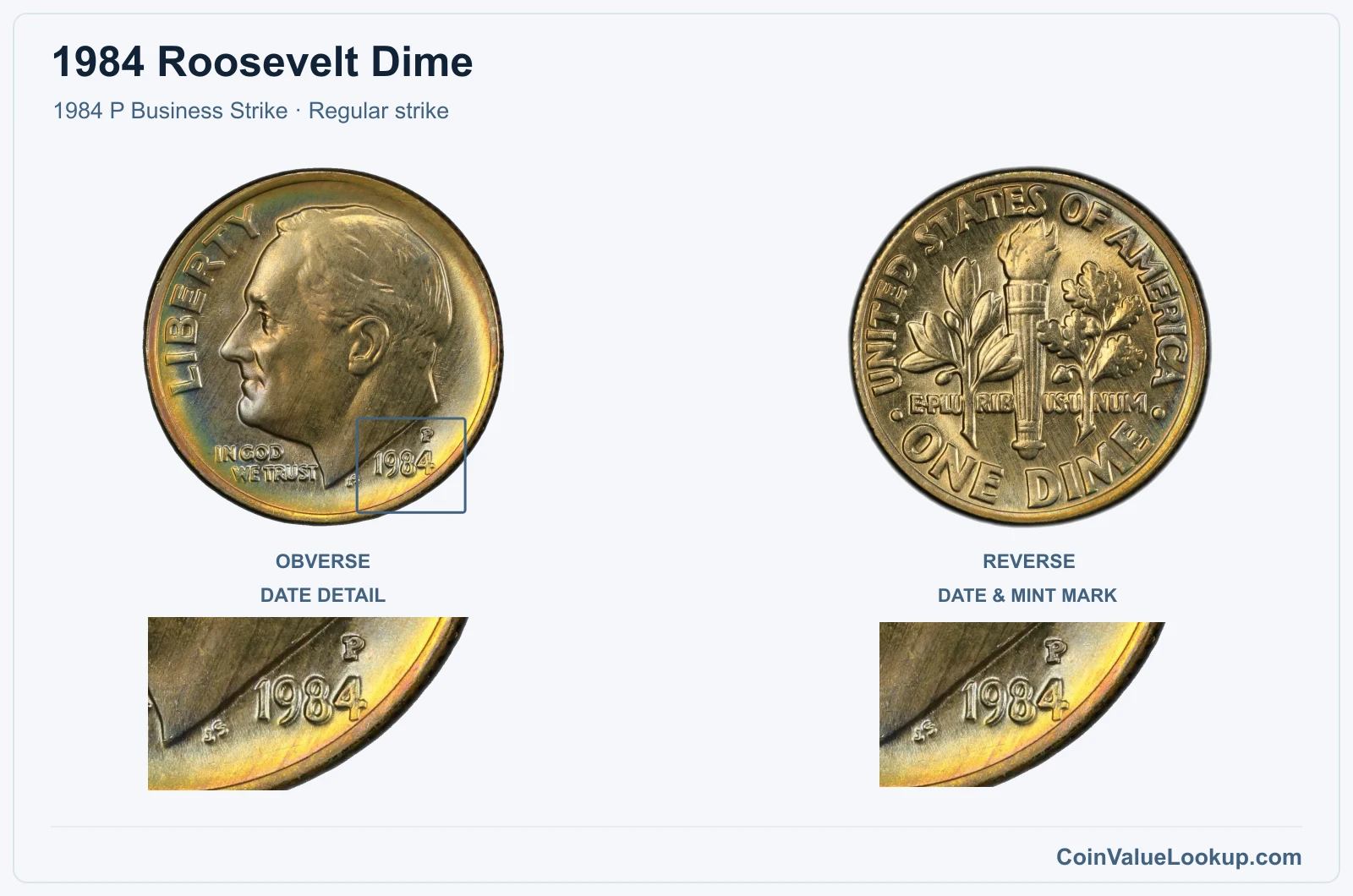
The 1984 P Roosevelt dime was struck at the Philadelphia Mint and carries a small "P" mint mark on the obverse near the date. It is copper-nickel clad over a copper core, weighing 2.27 grams.
In circulated grades, expect face value.
At MS 65, the USA Coin Book guide estimate is $2.50. That is not a sale price — it is a reference point.
Coins with sharp, fully separated torch bands and clean fields are the ones that attract attention at this grade level. Most 1984-P dimes you find in pocket change will show noticeable wear on the cheek and hair.
Range Grade
Price Auction Records Appraisal PO PO 1
—
Coin Identifier FR FR 2
—
Coin Identifier AG AG 3
—
Coin Identifier G G 4
—
Coin Identifier
G 6
—
Coin Identifier VG VG 8
—
Coin Identifier
VG 10
—
Coin Identifier F F 12
—
Coin Identifier
F 15
—
Coin Identifier VF VF 20
—
Coin Identifier
VF 25
—
Coin Identifier
VF 30
—
Coin Identifier
VF 35
—
Coin Identifier XF XF 40
—
Coin Identifier
XF 45
—
Coin Identifier AU AU 50
—
Coin Identifier
AU 53
—
Coin Identifier
AU 55
—
Coin Identifier
AU 58
—
Coin Identifier MS MS 60
—
Coin Identifier
MS 61
—
Coin Identifier
MS 62
—
Coin Identifier
MS 63
—
Coin Identifier
MS 64
Coin Identifier
MS 65
Coin Identifier
MS 66
Coin Identifier
MS 67
Coin Identifier
MS 68
Coin Identifier
MS 69
—
—
—
MS 70
—
—
—
1984 Roosevelt Dime — D Business Strike
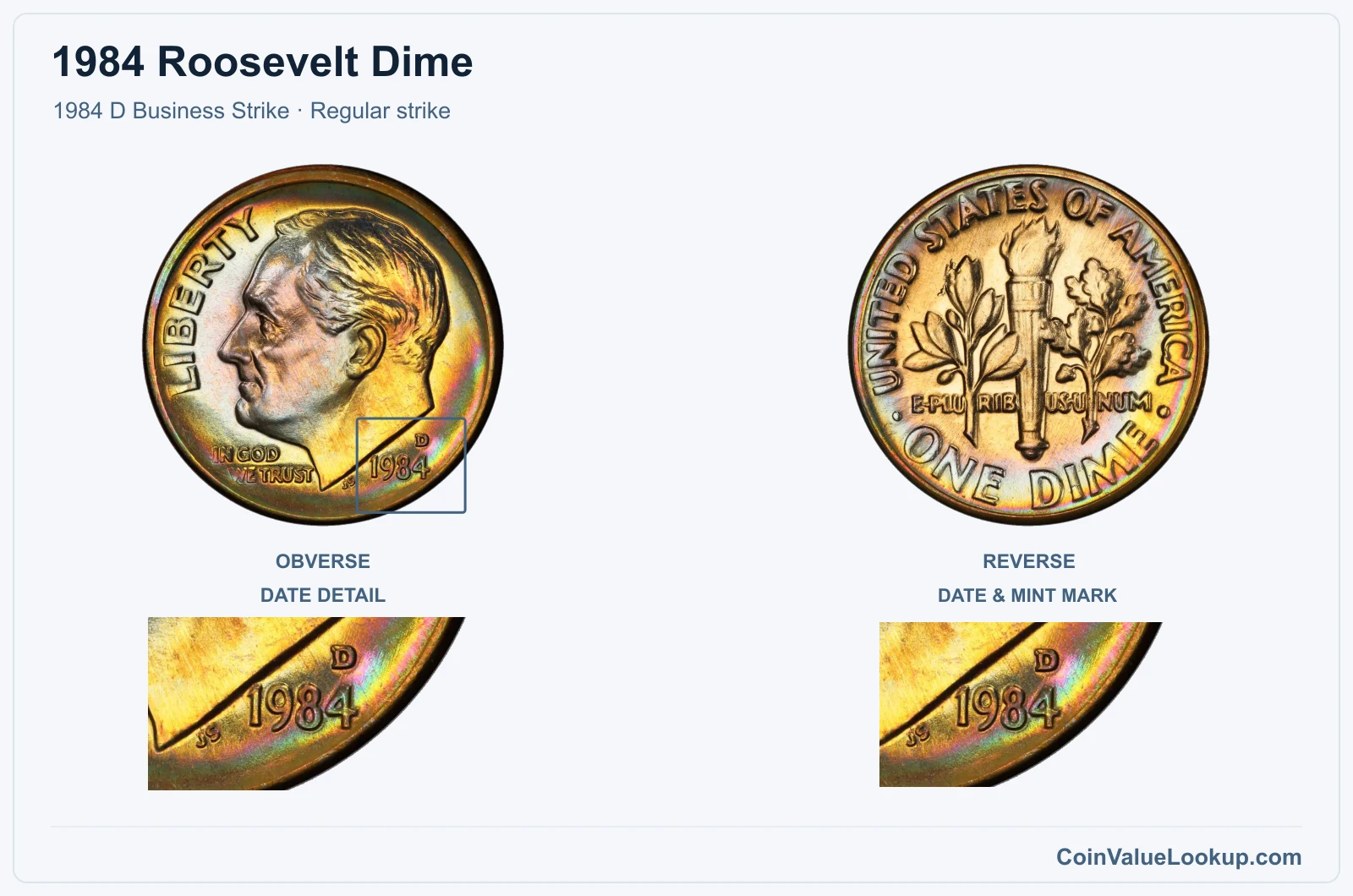
Denver's 1984 D dime also uses the standard copper-nickel clad composition and the same 2.27-gram weight. Look for the "D" mint mark beside the date on the obverse.
The MS 65 guide estimate from USA Coin Book is $2.79, slightly above the Philadelphia issue. Circulated examples are common and worth ten cents.
The premium only kicks in for well-preserved, lustrous pieces. If your 1984-D still has sharp torch bands and no distracting bag marks across Roosevelt's cheek, it is in better shape than most survivors.
Coin Value Lookup is a handy place to check guide values for other Roosevelt dime dates and mint marks if you are working through a collection.
Range Grade
Price Auction Records Appraisal PO PO 1
—
Coin Identifier FR FR 2
—
Coin Identifier AG AG 3
—
Coin Identifier G G 4
—
Coin Identifier
G 6
—
Coin Identifier VG VG 8
—
Coin Identifier
VG 10
—
Coin Identifier F F 12
—
Coin Identifier
F 15
—
Coin Identifier VF VF 20
—
Coin Identifier
VF 25
—
Coin Identifier
VF 30
—
Coin Identifier
VF 35
—
Coin Identifier XF XF 40
—
Coin Identifier
XF 45
—
Coin Identifier AU AU 50
—
Coin Identifier
AU 53
—
Coin Identifier
AU 55
—
Coin Identifier
AU 58
—
Coin Identifier MS MS 60
—
Coin Identifier
MS 61
—
Coin Identifier
MS 62
—
Coin Identifier
MS 63
—
Coin Identifier
MS 64
Coin Identifier
MS 65
Coin Identifier
MS 66
Coin Identifier
MS 67
Coin Identifier
MS 68
—
—
—
MS 69
—
—
—
MS 70
—
—
—
1984 Roosevelt Dime — S Proof
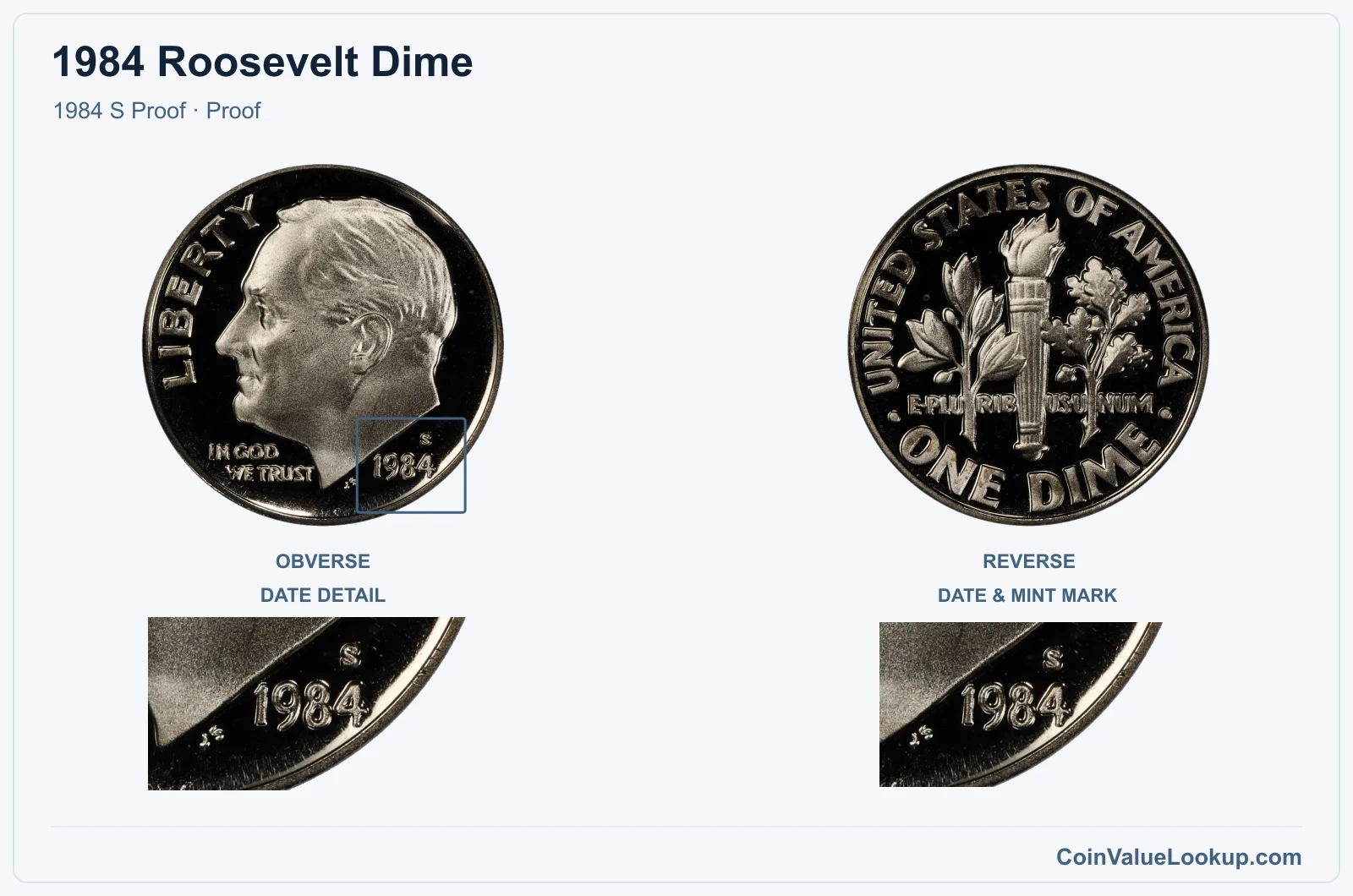
The 1984 S proof was produced at San Francisco exclusively for collector sets. It carries the "S" mint mark and is struck on the same copper-nickel clad planchet — no silver version exists for this date.
At PR 65, the USA Coin Book guide estimate is $3.08. Proof manufacture means the coin was struck with polished dies on a specially prepared planchet, producing mirror-like fields.
It is a finish, not a grade above Mint State. Coins with strong contrast between frosted raised devices and deeply reflective fields are more desirable within the proof category.
Check for hairlines or haze, which lower the grade quickly on proof surfaces.
Range Grade
Price Auction Records Appraisal PR PR 1
—
Coin Identifier
PR 2
—
Coin Identifier
PR 3
—
Coin Identifier
PR 4
—
Coin Identifier
PR 6
—
Coin Identifier
PR 8
—
Coin Identifier
PR 10
—
Coin Identifier
PR 12
—
Coin Identifier
PR 15
—
Coin Identifier
PR 20
—
Coin Identifier
PR 25
—
Coin Identifier
PR 30
—
Coin Identifier
PR 35
—
Coin Identifier
PR 40
—
Coin Identifier
PR 45
—
Coin Identifier
PR 50
—
Coin Identifier
PR 53
—
Coin Identifier
PR 55
—
Coin Identifier
PR 58
—
Coin Identifier
PR 60
—
Coin Identifier
PR 61
—
Coin Identifier
PR 62
—
Coin Identifier
PR 63
—
Coin Identifier
PR 64
—
Coin Identifier
PR 65
—
Coin Identifier
PR 66
—
Coin Identifier
PR 67
Coin Identifier
PR 68
Coin Identifier
PR 69
Coin Identifier
PR 70
Coin Identifier
1984 Roosevelt Dime Error List
1. 1984 Roosevelt Dime — Tilted Partial Collar
A Tilted Partial Collar error on the 1984-P business strike occurs when the retaining collar is not fully seated during striking. The result is a band around part of the edge that shows normal reeding, while the opposite side is smooth and slightly expanded.
The diagnostic to look for: a visible transition zone where reeded edge meets flat, smooth rim, running at an angle across the coin's edge. This is not the same as post-mint rim damage from coin-rolling machines or being dropped on concrete.
Genuine partial collars show the tilt as struck, with undisturbed surfaces in the affected area.
A confirmed example appeared in a Heritage Auctions lot graded ANACS MS 63. No individual price was adopted from that listing, so value depends on authenticated identity, the severity of the collar tilt, and overall condition.
2. 1984 Roosevelt Dime — Off-Center Strike
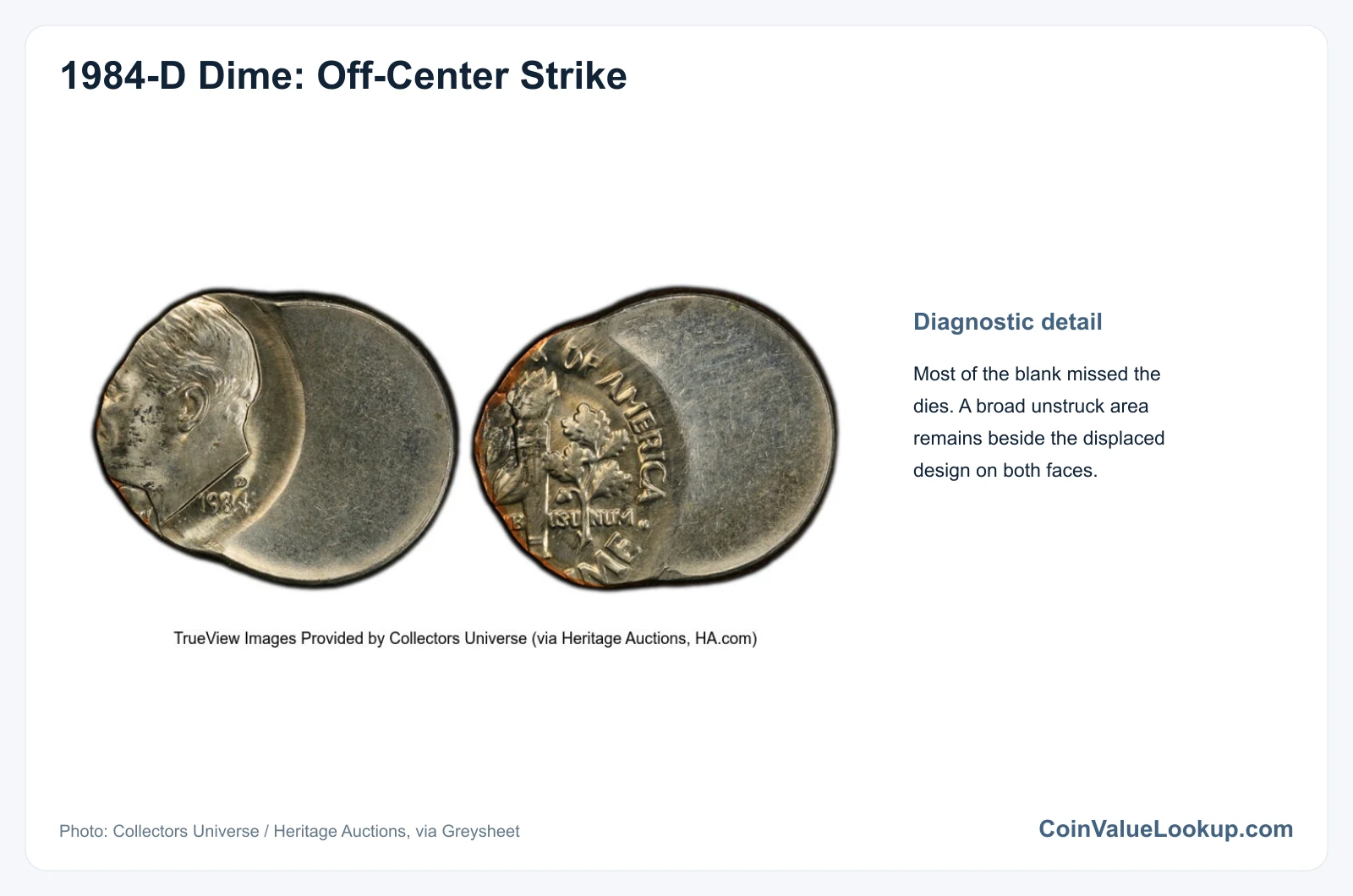
Off-center strikes happen when the planchet is not properly centered between the dies. A documented 1984-D example shows a dramatic 65% shift toward the 9 o'clock position, leaving a blank crescent on one side while still retaining enough design to confirm the date and mint mark.
That retained identity is critical. A big shift with no readable date is far less collectible.
The diagnostic here is the crescent-shaped blank area and the corresponding design compression on the opposite side.
Do not confuse this with a cut coin or a one-sided misalignment. Genuine off-center strikes affect both sides uniformly because the entire planchet was shifted relative to both dies.
A Heritage Auctions lot included a 1984-D off-center graded ANACS MS 63, but no individual price was separated from that multi-coin lot. Value depends on the degree of shift, date visibility, and authenticated condition.
3. 1984 Roosevelt Dime — Obverse Strike-Through
An obverse strike-through on the 1984-D occurs when a foreign object sits between the obverse die and the planchet at the moment of striking. The result is a recessed or missing area of detail on Roosevelt's portrait or surrounding fields that was created during manufacture, not from later damage.
The key diagnostic: the affected area looks pressed in or absent, with smooth, as-made surfaces in the depression rather than the rough, scratched texture you would see from post-mint scraping or gouging. The specific material that caused the obstruction is not identified for this example.
A Heritage Auctions lot included an NGC-certified 1984-D obverse strike-through. No individual sale price was separated from that listing, so value hinges on the size and location of the strike-through, the coin's overall grade, and authenticated identity.
4. 1984 Roosevelt Dime — Missing Clad Layer
A missing clad layer error means one of the outer copper-nickel layers was absent from the planchet before striking. The exposed side shows the copper core, giving the coin a distinctly different color on one face compared to the other.
Check the edge profile: a normal 1984 dime shows a visible copper-nickel sandwich. A missing clad layer coin will appear thinner on the affected side, and the weight will be noticeably below the standard 2.27 grams.
This is different from toning, environmental corrosion, or someone chemically stripping the surface after minting. Genuine examples have smooth, as-struck surfaces on the copper side.
Value depends on condition, which face is affected, and how clearly the error is visible. No specific price range is adopted for this category.
5. 1984 Roosevelt Dime — Broadstrike
A broadstrike occurs when the coin is struck without the retaining collar in place. Without the collar to contain metal flow, the planchet spreads outward, producing a coin that is wider than normal with no reeded edge.
The full design is still present — that is what separates a broadstrike from an off-center strike, where part of the design is missing. The edge will be smooth and slightly irregular rather than sharply reeded.
Do not confuse this with a coin that has been flattened after minting, which typically shows distorted lettering and uneven surfaces. A genuine broadstrike has normal strike quality across the entire design despite the wider diameter.
Value depends on condition, how dramatically the coin spread, and authenticated identity. No specific price range is adopted for this error.
6. 1984 Roosevelt Dime — Doubled Die Obverse
A Doubled Die Obverse on a 1984 dime would show consistent doubling on obverse design elements — letters, the date, or portions of Roosevelt's portrait. The doubling comes from a misalignment during die manufacture, so it repeats identically on every coin struck by that die.
To check, compare the obverse lettering and date against a known normal 1984 dime under good lighting and magnification. Look for separation or notching on letter edges that appears uniform and directional, not random.
Machine doubling is the common lookalike. It produces flat, shelf-like distortion rather than the raised, sharply defined secondary image of a true doubled die.
Worn die contours can also mimic doubling under certain light angles. Value depends on the strength of the doubling, which elements are affected, and the coin's condition.
No specific price range is adopted.
7. 1984 Roosevelt Dime — Clashed Dies
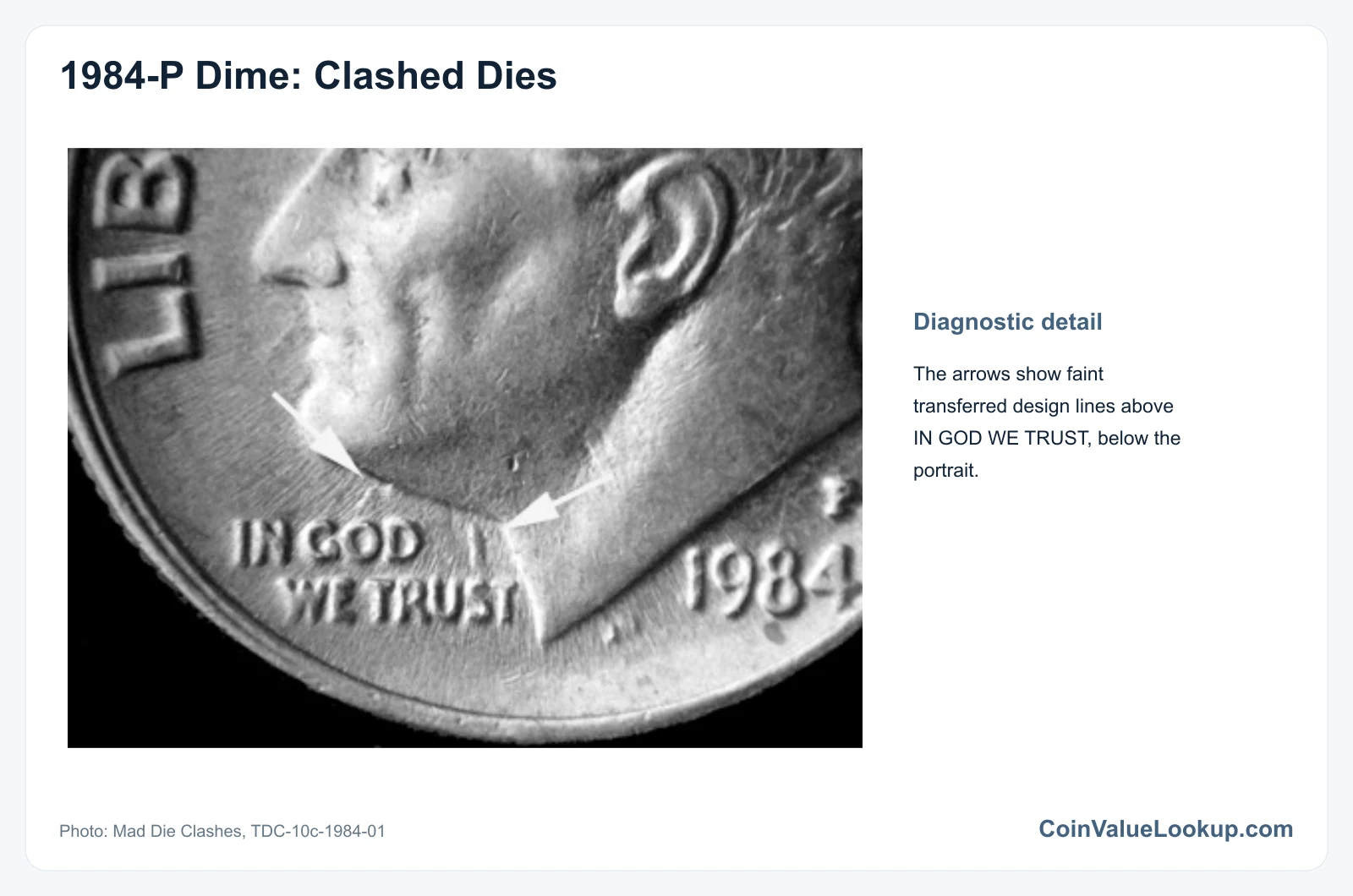
Die clash marks appear when the obverse and reverse dies strike each other without a planchet between them. The impact transfers faint impressions of one die's design onto the other.
On subsequent coins, you may see ghost-like traces of the reverse torch or branches in the obverse field, or Roosevelt's profile faintly visible on the reverse.
These clash marks align with the expected position of the opposing design — that is the key diagnostic. Random scratches, raised lines from debris, or brockage impressions will not line up the same way.
Compare suspect areas to a normal 1984 dime under matching light and magnification. Genuine clash marks are shallow, consistent, and positioned where the opposite die's high points would contact.
Value depends on how visible the transferred design is and the coin's overall condition. No specific price range is adopted for this error.