1988 Roosevelt Dime Coin Value: How Much Is It Worth?
A circulated 1988 Roosevelt dime is worth face value — ten cents. In uncirculated condition at MS 65, guide estimates from USA Coin Book place both the Philadelphia and Denver issues at about $2.79.
The 1988 S proof starts around $4.96 at PR 65. Real premiums come from well-preserved strikes, proof contrast, or genuine mint errors, so it pays to look closely before spending the coin.
Fast Way to Identify Your 1988 Roosevelt Dime
The quickest way to start is to upload clear photos of both sides of your 1988 dime. A front and back image lets our identifier give you a preliminary read on the mint mark, general condition, and whether anything unusual stands out.
It is not a substitute for professional grading or authentication, but it points you in the right direction.
1988 Roosevelt Dime Value
Upload both sides of your 1988 Roosevelt Dime.
Front Obverse
Upload photo
Back Reverse
Upload photo
Which 1988 Roosevelt Dime Versions Are Worth Money?
- Well-preserved 1988 P or D business strikes with clear, fully separated torch bands can command more than typical uncirculated examples.
- 1988 S proofs with strong contrast are the proof option for this year; value depends on grade and surface quality within the proof designation.
- A confirmed off-center strike on a 1988-P dime sold for $39 at auction in August 2021 — condition and degree of shift drive pricing.
- A double strike with a 95% off-center second impression on a 1988-P dime brought $30 in March 2022 — dramatic errors like this are scarce for the date.
Step 1: Identify Your 1988 Roosevelt Dime Mint Mark and Version
Start by confirming the date reads 1988 and the design shows Franklin Roosevelt's portrait on the obverse with a torch flanked by olive and oak branches on the reverse. The coin is copper-nickel clad, weighs about 2.27 grams, and measures roughly 17.9 mm across.
There is no silver in this issue.
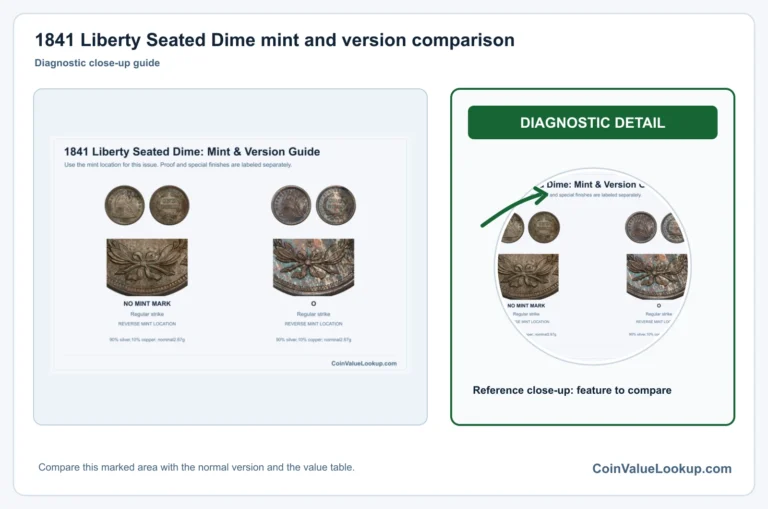
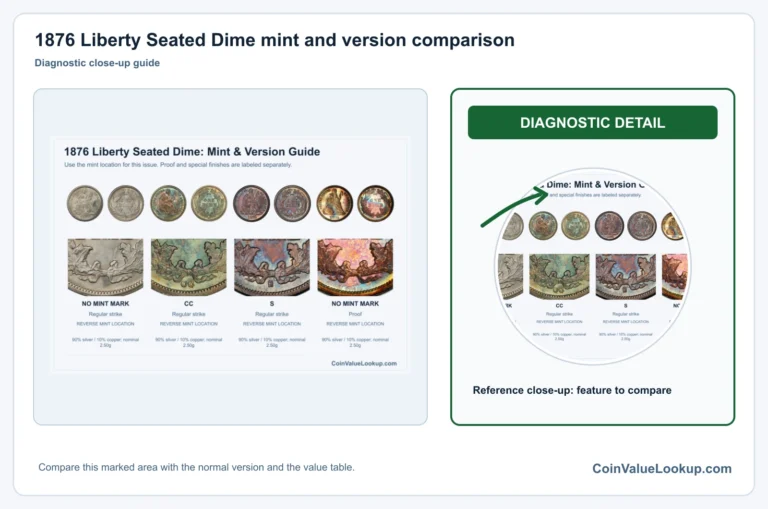
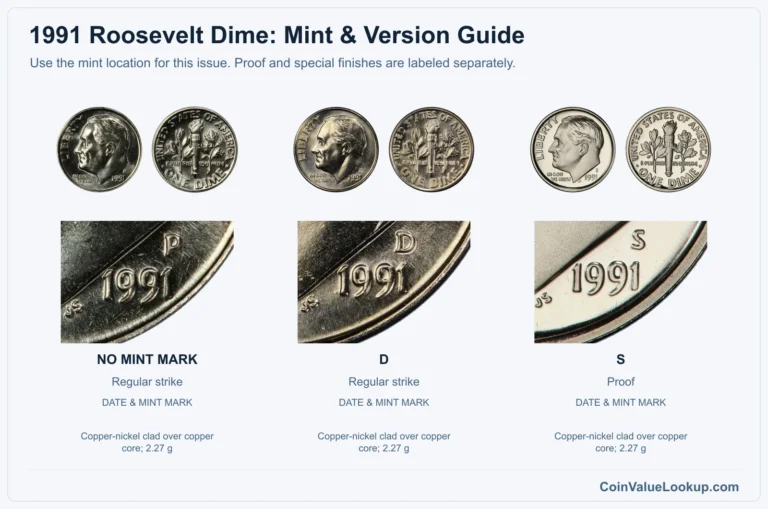
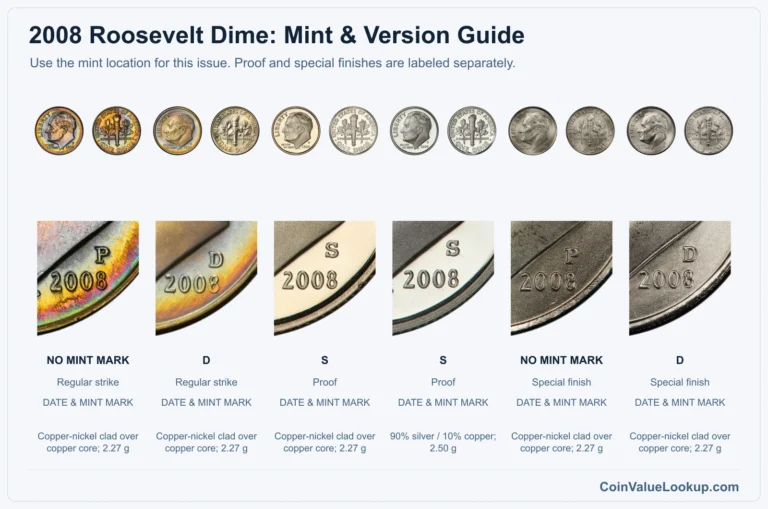
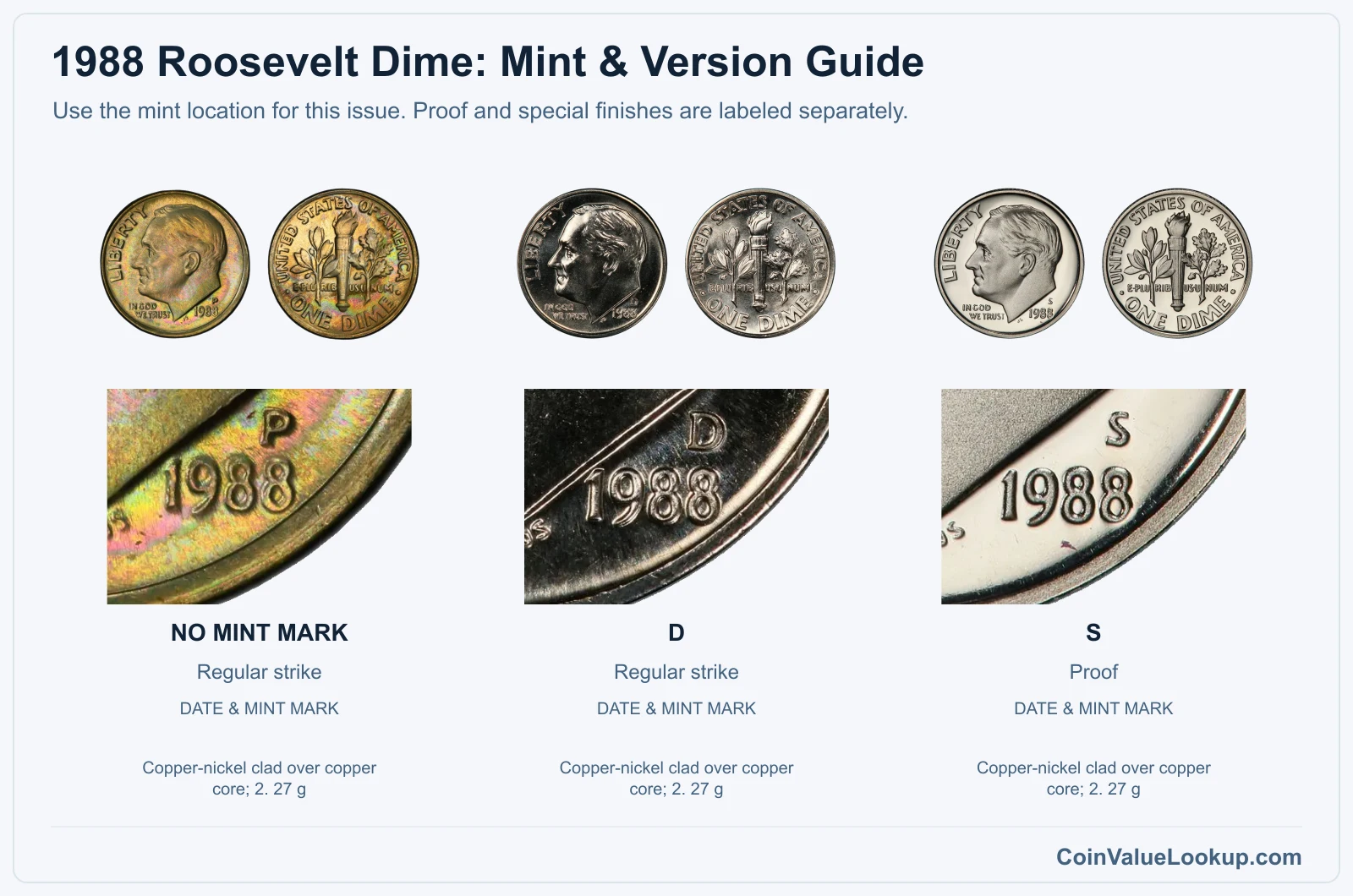
Next, find the mint mark. It sits on the obverse near the date.
A "P" means Philadelphia, a "D" means Denver, and an "S" indicates a San Francisco proof. Business strikes carry P or D; proofs carry S.
Do not confuse strike errors with post-mint damage. A coin that was scratched, bent, or cleaned after leaving the mint is not a mint error.
Genuine errors happen during the striking process and leave specific, repeatable diagnostics.
Step 2: Check Your 1988 Roosevelt Dime Grade
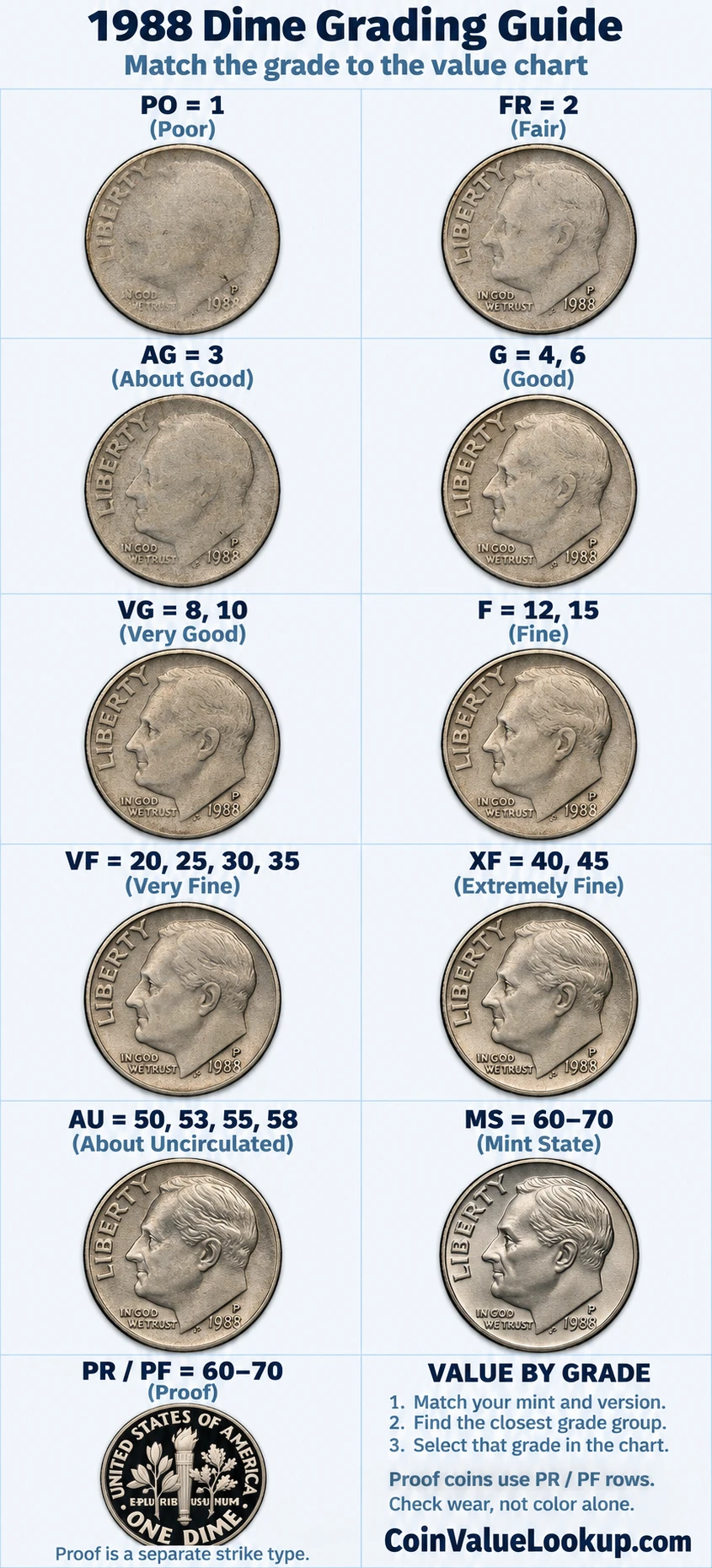
Check the high points first. On the obverse, Roosevelt's cheekbone, jawline, and the hair detail above his ear show wear earliest.
On the reverse, look at the torch bands and the leaf tips.
Original mint luster matters a lot. A coin can look shiny but still be damaged — cleaning removes the natural surface texture and lowers the grade.
The comparison image above shows progressive wear stages so you can match your coin visually.
Full Bands is a strike designation, not an error. It means both horizontal torch-band pairs are fully separated.
Proof manufacture and cameo contrast describe the finish, not a higher grade tier above Mint State.
Step 3: Check 1988 Roosevelt Dime Value by Mint and Version
1988 Roosevelt Dime — P Business Strike
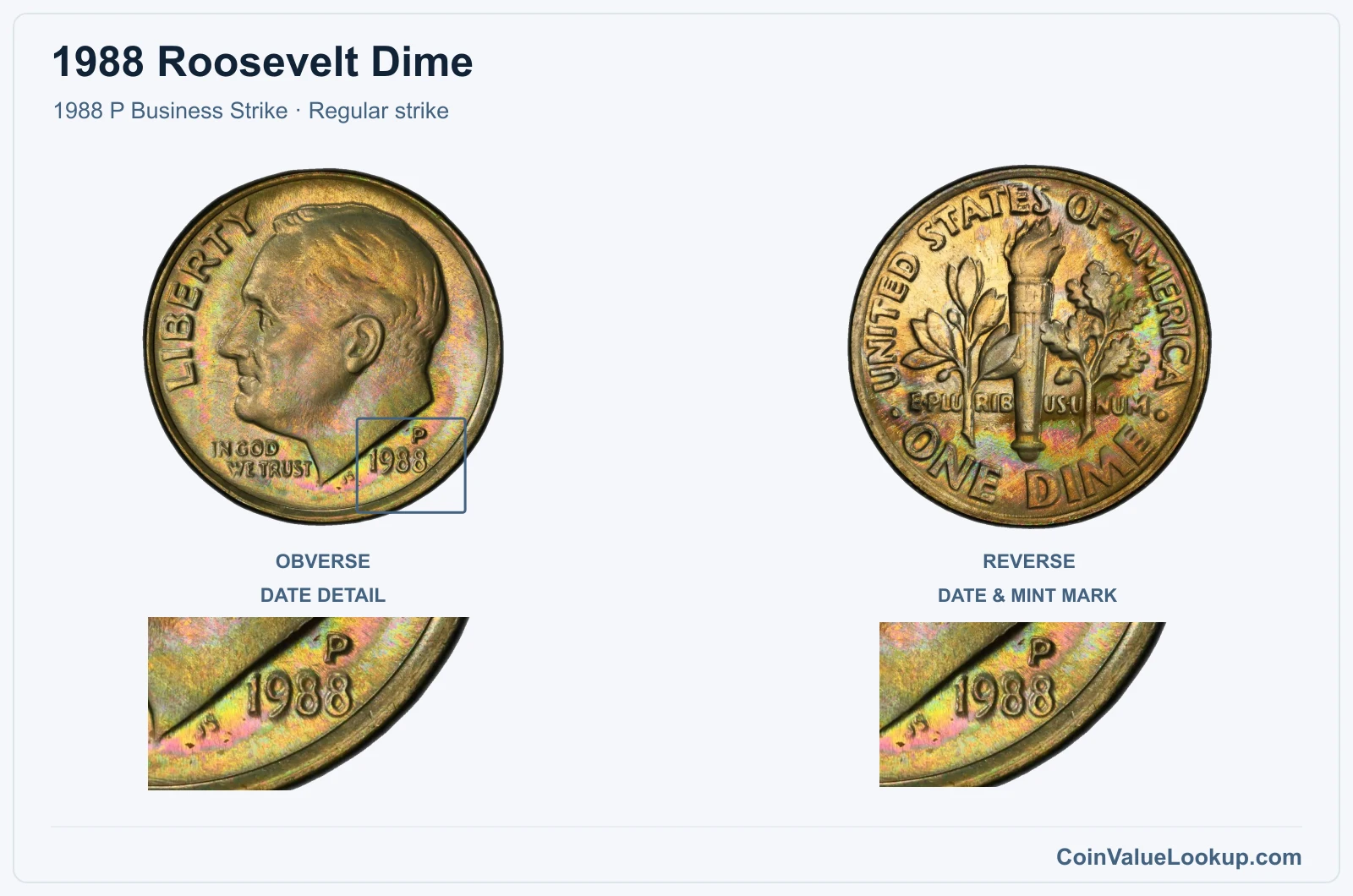
The 1988 P dime was struck at Philadelphia and carries a small "P" mint mark on the obverse. It is copper-nickel clad over a copper core, weighing 2.27 grams.
Most circulated examples are worth ten cents.
At MS 65, the USA Coin Book guide estimate is $2.79. Coins with full separation of both horizontal torch bands — the Full Bands designation — can bring more interest from collectors focused on strike quality.
Look for sharp detail across the hair and torch to gauge whether your coin might grade well.
Range Grade
Price Auction Records Appraisal PO PO 1
—
Coin Identifier FR FR 2
—
Coin Identifier AG AG 3
—
Coin Identifier G G 4
—
Coin Identifier
G 6
—
Coin Identifier VG VG 8
—
Coin Identifier
VG 10
—
Coin Identifier F F 12
—
Coin Identifier
F 15
—
Coin Identifier VF VF 20
—
Coin Identifier
VF 25
—
Coin Identifier
VF 30
—
Coin Identifier
VF 35
—
Coin Identifier XF XF 40
—
Coin Identifier
XF 45
—
Coin Identifier AU AU 50
—
Coin Identifier
AU 53
—
Coin Identifier
AU 55
—
Coin Identifier
AU 58
—
Coin Identifier MS MS 60
—
Coin Identifier
MS 61
—
Coin Identifier
MS 62
—
Coin Identifier
MS 63
Coin Identifier
MS 64
Coin Identifier
MS 65
Coin Identifier
MS 66
Coin Identifier
MS 67
Coin Identifier
MS 68
Coin Identifier
MS 69
—
—
—
MS 70
—
—
—
1988 Roosevelt Dime — D Business Strike
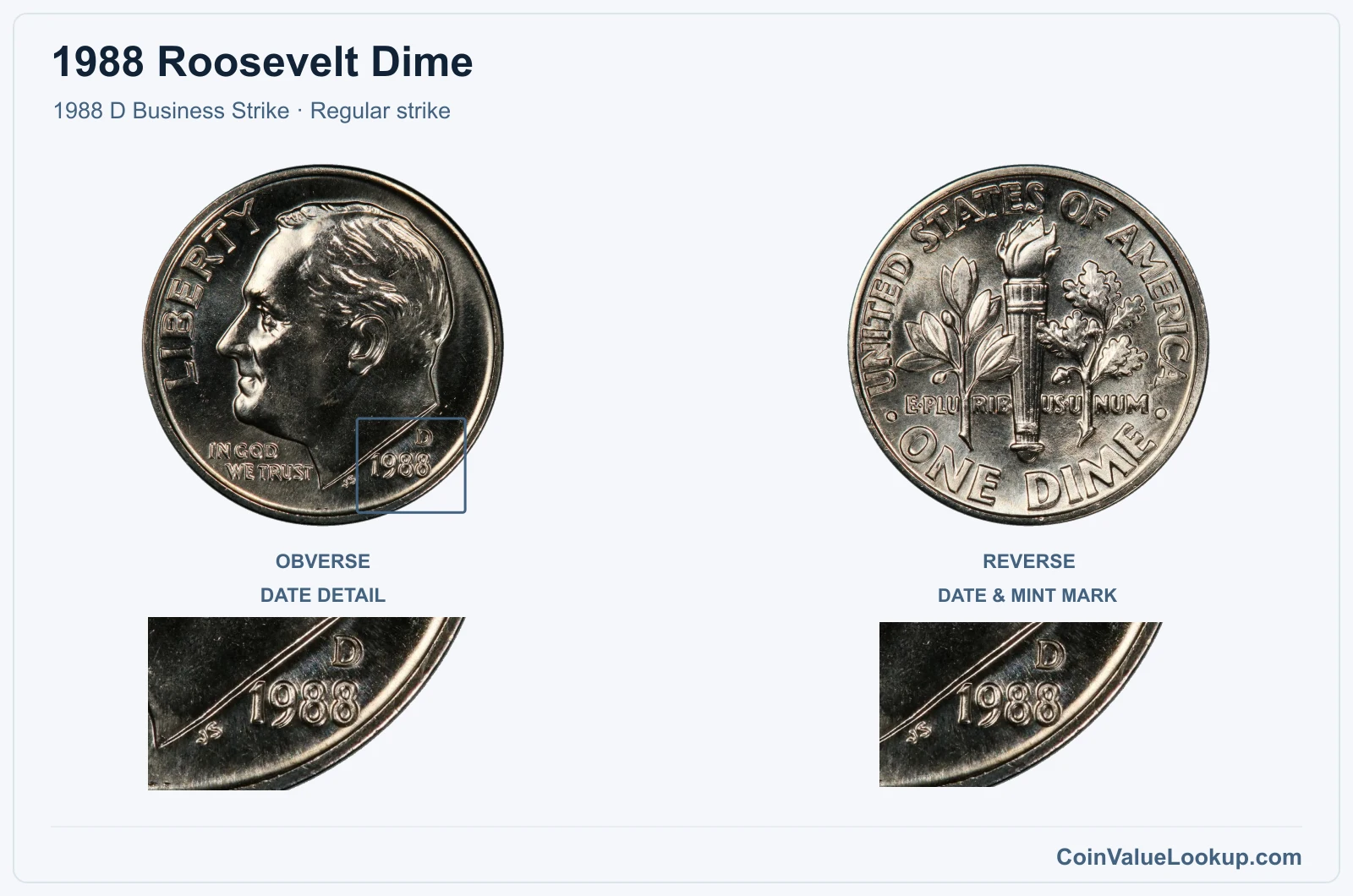
Denver's 1988 D dime is the same composition and weight as the Philadelphia issue, distinguished by the "D" mint mark near the date. Circulated pieces trade at face value.
The USA Coin Book guide lists $2.79 at MS 65, identical to the P mint. As with Philadelphia strikes, a coin showing full separation of both torch-band pairs earns the Full Bands designation and tends to draw more collector attention.
Check for bag marks and contact lines on the cheek, since those are the first things that pull a grade down.
Coin Value Lookup is a handy starting point if you want to look up guide values for other Roosevelt dime dates or denominations while you are sorting through a batch.
Range Grade
Price Auction Records Appraisal PO PO 1
—
Coin Identifier FR FR 2
—
Coin Identifier AG AG 3
—
Coin Identifier G G 4
—
Coin Identifier
G 6
—
Coin Identifier VG VG 8
—
Coin Identifier
VG 10
—
Coin Identifier F F 12
—
Coin Identifier
F 15
—
Coin Identifier VF VF 20
—
Coin Identifier
VF 25
—
Coin Identifier
VF 30
—
Coin Identifier
VF 35
—
Coin Identifier XF XF 40
—
Coin Identifier
XF 45
—
Coin Identifier AU AU 50
—
Coin Identifier
AU 53
—
Coin Identifier
AU 55
—
Coin Identifier
AU 58
—
Coin Identifier MS MS 60
—
Coin Identifier
MS 61
—
Coin Identifier
MS 62
—
Coin Identifier
MS 63
Coin Identifier
MS 64
—
Coin Identifier
MS 65
Coin Identifier
MS 66
Coin Identifier
MS 67
Coin Identifier
MS 68
—
Coin Identifier
MS 69
—
—
—
MS 70
—
—
—
1988 Roosevelt Dime — S Proof
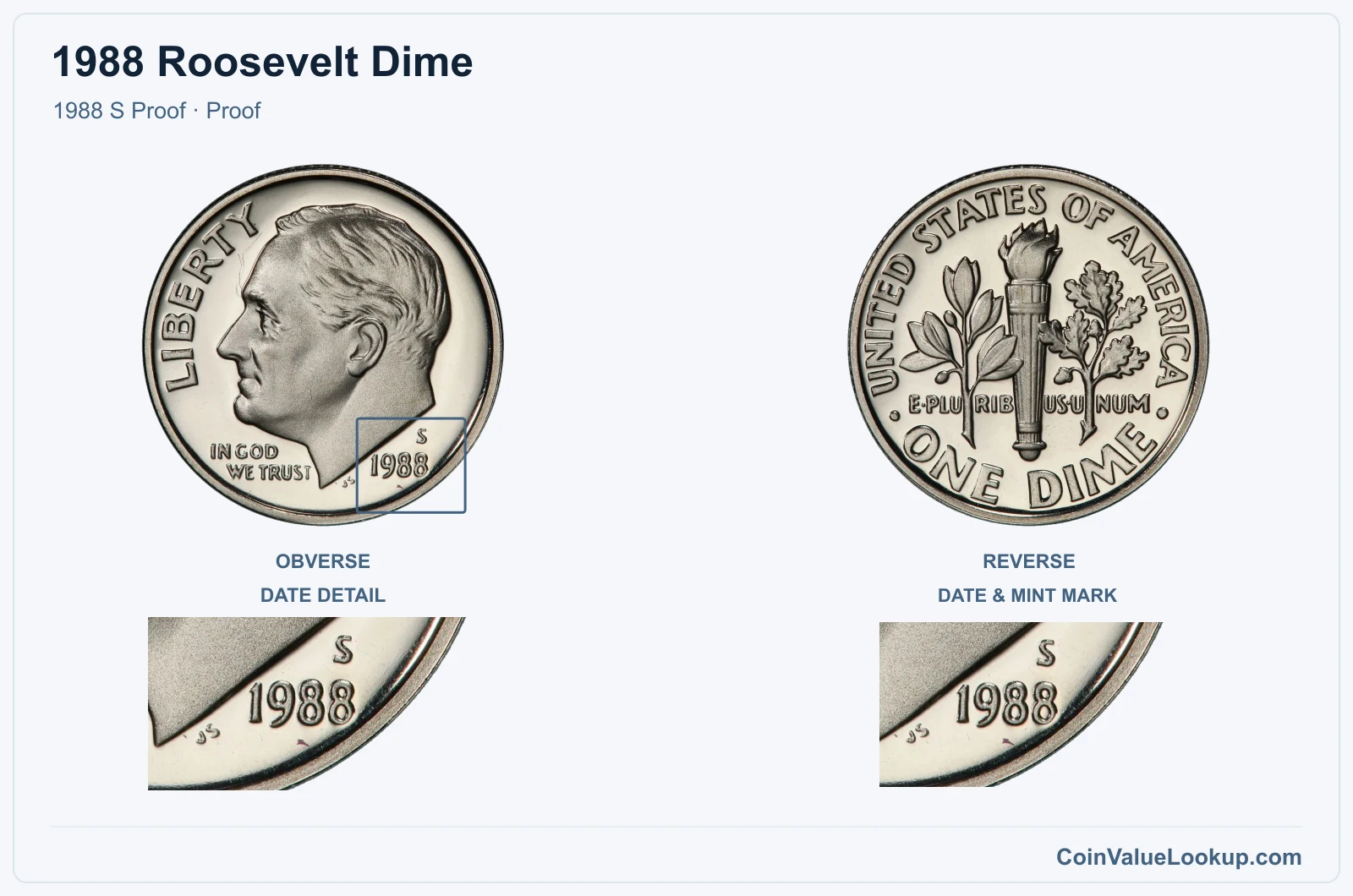
The 1988 S proof was struck at San Francisco with polished dies and specially prepared planchets, giving it mirror fields and frosted devices. The "S" mint mark appears on the obverse near the date.
At PR 65 the USA Coin Book guide places this coin at $4.96. Higher proof grades and strong cameo contrast can push value upward, though the degree depends on the individual coin's surfaces.
Hairlines from improper handling are the most common detractor on proofs. Hold yours by the edges and inspect under good lighting to assess contrast and surface quality.
Range Grade
Price Auction Records Appraisal PR PR 1
—
Coin Identifier
PR 2
—
Coin Identifier
PR 3
—
Coin Identifier
PR 4
—
Coin Identifier
PR 6
—
Coin Identifier
PR 8
—
Coin Identifier
PR 10
—
Coin Identifier
PR 12
—
Coin Identifier
PR 15
—
Coin Identifier
PR 20
—
Coin Identifier
PR 25
—
Coin Identifier
PR 30
—
Coin Identifier
PR 35
—
Coin Identifier
PR 40
—
Coin Identifier
PR 45
—
Coin Identifier
PR 50
—
Coin Identifier
PR 53
—
Coin Identifier
PR 55
—
Coin Identifier
PR 58
—
Coin Identifier
PR 60
—
Coin Identifier
PR 61
—
Coin Identifier
PR 62
—
Coin Identifier
PR 63
—
Coin Identifier
PR 64
—
Coin Identifier
PR 65
—
Coin Identifier
PR 66
—
Coin Identifier
PR 67
—
Coin Identifier
PR 68
Coin Identifier
PR 69
Coin Identifier
PR 70
Coin Identifier
1988 Roosevelt Dime Error List
1. 1988 Roosevelt Dime — Off-Center Strike
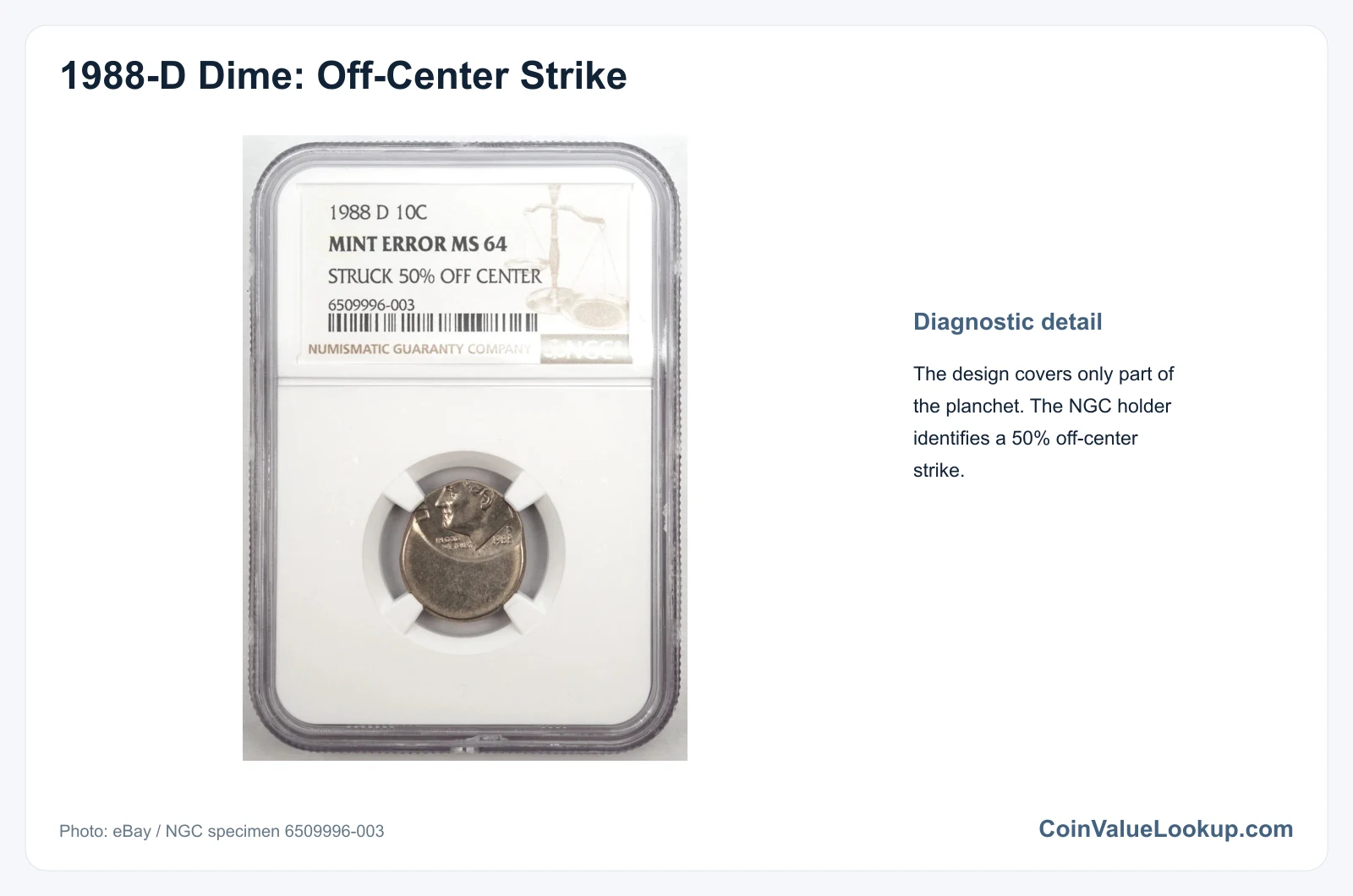
An off-center strike happens when the planchet is not seated properly in the collar before the dies come together, leaving part of the design missing and an unstruck crescent on both sides. On a confirmed 1988-P example, the shift measured about 10 percent toward roughly the 1:30 position, with the full date still readable.
One ANACS-certified MS 62 specimen sold for $39 at Heritage Auctions in August 2021. That gives you a single data point, not a market range — the percentage of off-center shift, whether the date is visible, and overall condition all influence what a particular coin brings.
Watch out for lookalikes. A misaligned die can shift the design on one side only, and rim wear can mimic a slight off-center appearance.
A genuine off-center strike shows matching displacement on both obverse and reverse.
2. 1988 Roosevelt Dime — Double Strike with Off-Center Second Strike
A double strike with an off-center second impression is one of the more visually dramatic errors you can find on a Roosevelt dime. On a confirmed 1988-P specimen, the first strike left a readable design and date, then a second strike landed roughly 95 percent off center, creating a mostly blank uniface impression overlapping the original coin.
An ANACS AU 55 example sold for $30 at Heritage Auctions in March 2022. Again, that is a single recorded sale, not a price guarantee.
Do not confuse this with a doubled die, which shows doubling within a single impression caused by a hub error. Random post-mint damage — a coin jammed in a machine, for example — also lacks the precise struck characteristics of a genuine second impression from the press.
3. 1988 Roosevelt Dime — Broadstrike
A broadstrike occurs when the retaining collar fails to confine the planchet during striking. The result is a coin that spreads outward, appearing wider than normal with a weakened or absent rim, while the full design is still present and centered.
Broadstrikes have been reported on 1988 dimes. Value depends on the degree of spread, overall condition, and how clearly the error is visible.
No specific price data is available here, so individual assessment is necessary.
The key lookalike is a coin that was flattened or squeezed after it left the mint. Post-mint damage lacks the even metal flow and consistent edge profile of a genuine broadstrike.
Also distinguish a broadstrike from an off-center strike — a broadstrike keeps the design centered, while an off-center coin shifts the entire image.
4. 1988 Roosevelt Dime — Brockage
A brockage error happens when a previously struck coin sticks to a die and impresses its design into the next blank. The result is one normal side and one side showing an incuse, mirror-image version of the opposing design.
Brockages have been reported for 1988 dimes. Because they are relatively scarce across all modern denominations, collectors pay attention when one surfaces.
Value depends on the clarity of the mirror-image transfer, the condition of the normal side, and certification status. No specific price data is available for this date and error combination.
Do not confuse a brockage with a die clash, which leaves faint opposite-design traces on a normally struck coin. Post-mint pressing of two coins together can also fake a brockage, but the relief and detail will be inconsistent with a genuine strike-transferred impression.
5. 1988 Roosevelt Dime — Clipped Planchet
A clipped planchet error means the coin blank was incompletely punched from the metal strip before striking. The missing portion can be curved, straight, or irregular, depending on where the punch overlapped a previously cut area or the edge of the strip.
Clipped planchet errors have been reported on 1988 dimes. A genuine clip often shows a characteristic weakness in the design directly opposite the missing area, called the Blakesley effect.
The edge at the clip will have a natural, as-punched texture rather than a sharp cut or filed surface.
Watch for fakes. A coin with a filed notch, deliberate cut, or corrosion-eaten edge is not a clip.
If the missing area has tool marks or the opposite side shows no design weakness, be skeptical. Value varies with clip size, shape, and coin condition.
6. 1988 Roosevelt Dime — Struck-Through Error
A struck-through error occurs when foreign material — grease, a fragment of metal, cloth fibers, or other debris — gets between the die and the planchet during striking. The result is a localized depression or area of incomplete design where the obstruction blocked the die's impression.
Filled-die errors, where grease fills part of the die cavity and prevents full transfer of detail, are the most common subtype. They have been reported on 1988 dimes.
The affected area looks mushy or flat, distinct from the sharp loss of a worn coin.
Do not mistake ordinary wear, cleaning, or weak strike for a struck-through error. Wear affects the highest points first in a predictable pattern.
A struck-through impression is localized and does not follow the wear sequence. Value depends on the size, visibility, and nature of the obstruction impression.
7. 1988 Roosevelt Dime — Clashed Dies
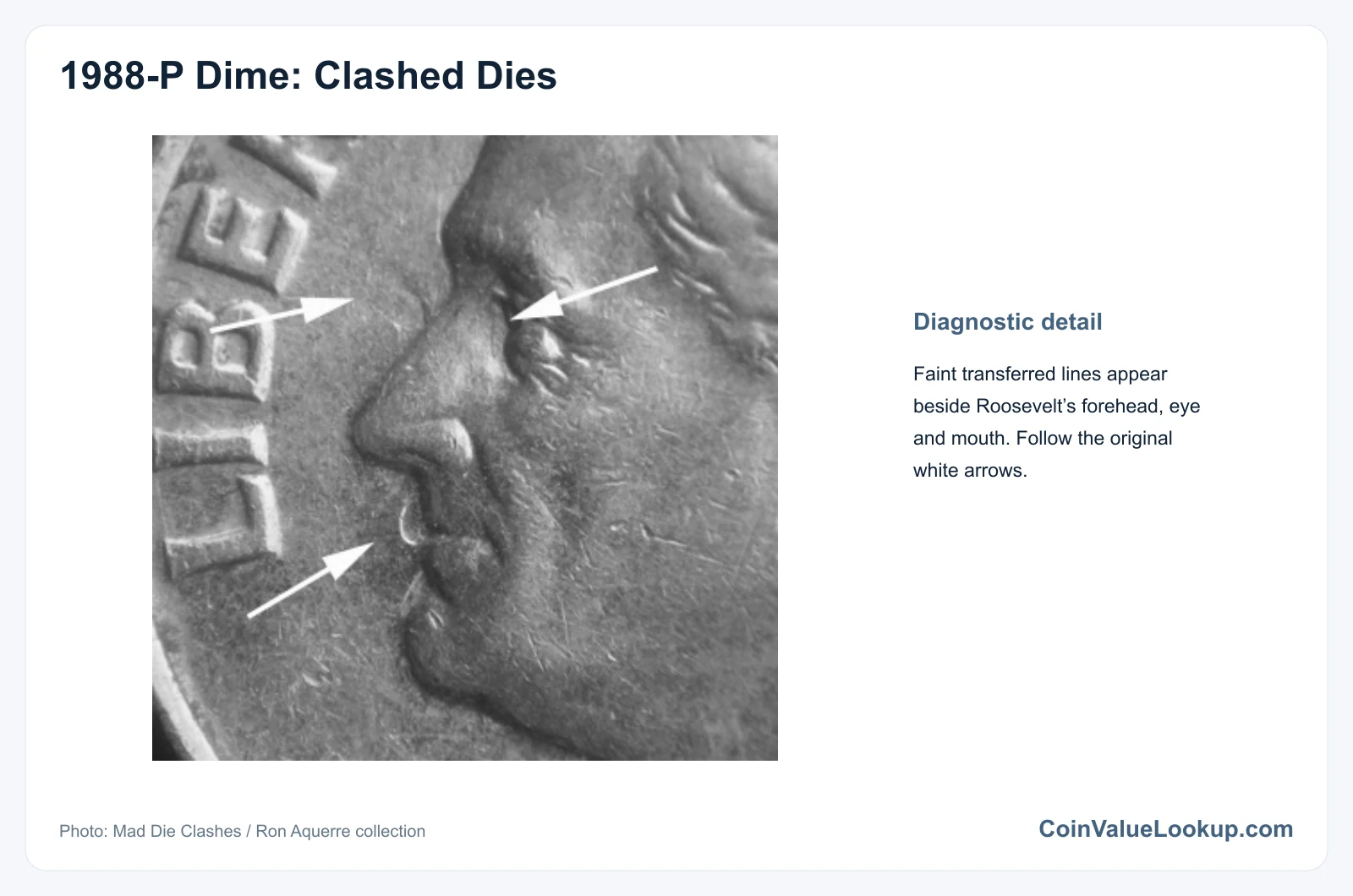
Clashed dies result from the obverse and reverse dies striking each other without a planchet between them. The impact transfers faint traces of each die's design onto the opposing die, which then appear as ghost images on subsequently struck coins.
Die clashes have been reported on 1988 dimes. On the obverse you might see faint torch or branch outlines in the field; on the reverse, traces of Roosevelt's profile may appear.
The transferred elements align with where the opposing design would be during a normal strike.
Do not confuse clash marks with random scratches, raised lines from die polish, or brockage impressions. Clash marks follow the geometry of the opposite die and appear in predictable locations.
Value depends on the strength and visibility of the clash, along with the coin's overall condition.