1996 Roosevelt Dime Coin Value: How Much Is It Worth?
Most 1996 Roosevelt dimes pulled from pocket change are worth face value — ten cents flat. In higher uncirculated grades the picture improves modestly: a USA Coin Book guide lists the P or D business strike at about $2.50 in MS65.
The 1996-S clad proof guides around $3.62 in PR65, while the 1996-S silver proof reaches roughly $13 in PR65. The real action sits with the 1996-W Mint Set issue and a surprisingly deep roster of authenticated mint errors, some of which have sold for hundreds or even thousands of dollars at auction.
Fast Way to Identify Your 1996 Roosevelt Dime
Snap a clear photo of your dime's front and back under good lighting. Upload both images to our identification tool for a preliminary look at the mint, finish and version.
This is not a substitute for professional authentication or grading, but it can point you toward what you are holding and what to research next.
1996 Roosevelt Dime Value
Upload both sides of your 1996 Roosevelt Dime.
Front Obverse
Upload photo
Back Reverse
Upload photo
Which 1996 Roosevelt Dime Versions Are Worth Money?
- 1996-W Mint Set dime — the first West Point dime, guides around $25 in MS65, far above a standard P or D.
- 1996-S silver proof — confirm the heavier weight and uniform silver edge; PR65 guides near $13 versus $3.62 for the clad proof.
- Double denomination (Lincoln cent over Roosevelt dime) — a 1996-P example sold for $1,880 in MS64 at auction in August 2015.
- Split obverse die on a 1996-P — one certified MS63 brought $192 at auction in April 2020.
- Broadstrike with obverse brockage on 1996-P — certified examples in MS66 and MS67 have appeared at Heritage Auctions.
- Off-center, missing clad layer, double clip and other authenticated errors each carry individual value based on severity and condition.
Step 1: Identify Your 1996 Roosevelt Dime Mint Mark and Version
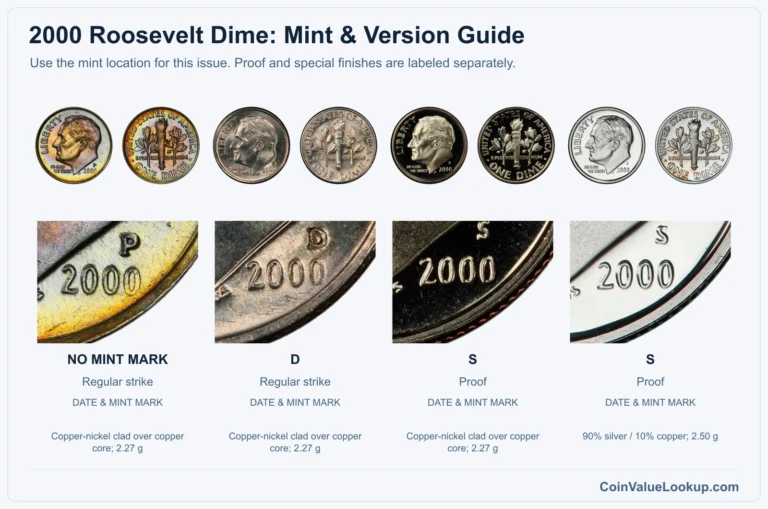
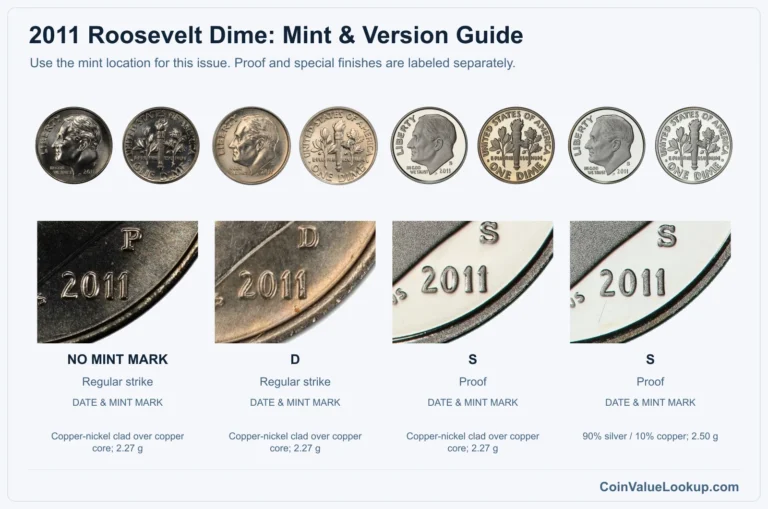
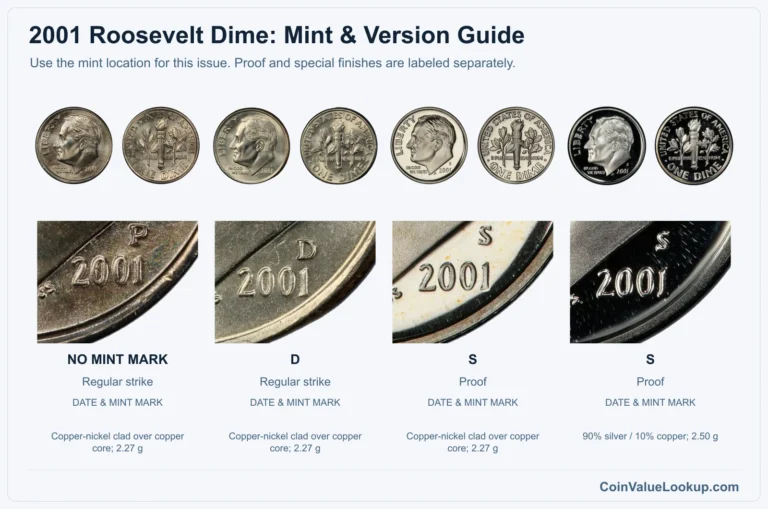
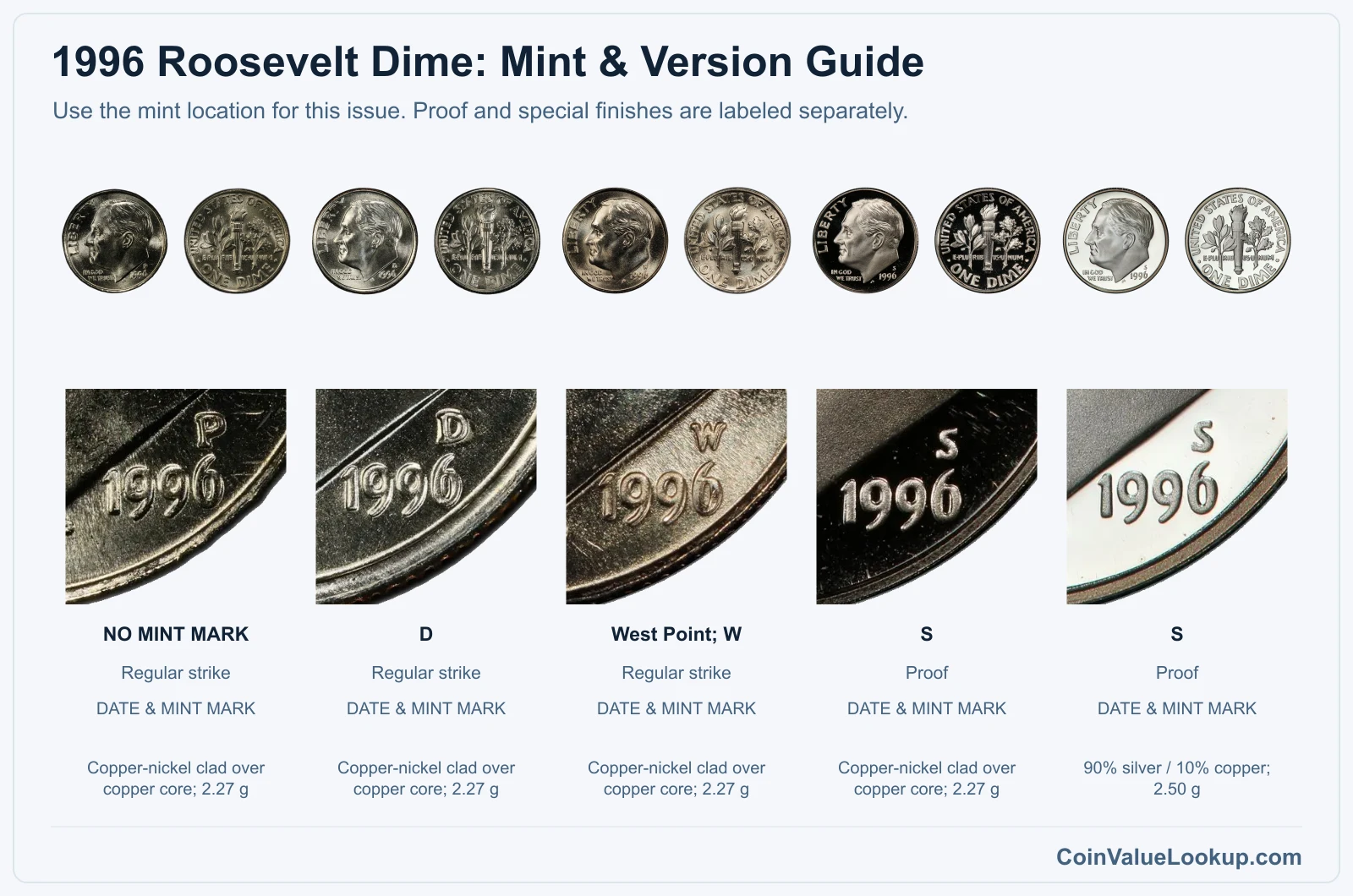
Start with the basics: confirm a 1996 date, Roosevelt's portrait on the obverse and a torch flanked by branches on the reverse. The mintmark sits on the obverse near the date — look for P, D, S or the scarcer W.
All standard clad issues weigh 2.27 grams and measure about 17.9 mm across. The silver proof is heavier at 2.50 grams because it is 90% silver and 10% copper.
Separating the S clad proof from the S silver proof trips people up because both carry an S mintmark and the same design. The mintmark alone tells you nothing about the metal.
Check the edge: a clad coin shows a copper-colored stripe, while a silver proof edge is uniform silver-gray. Weight helps too.
Original government packaging is the best shortcut, but an ambiguous piece really needs professional authentication.
The W mintmark means West Point. That coin is a clad business strike included in the 1996 Uncirculated Mint Set for the Roosevelt dime's 50th anniversary — the first W dime ever produced.
It is not a proof and the W is not an error.
Step 2: Check Your 1996 Roosevelt Dime Grade
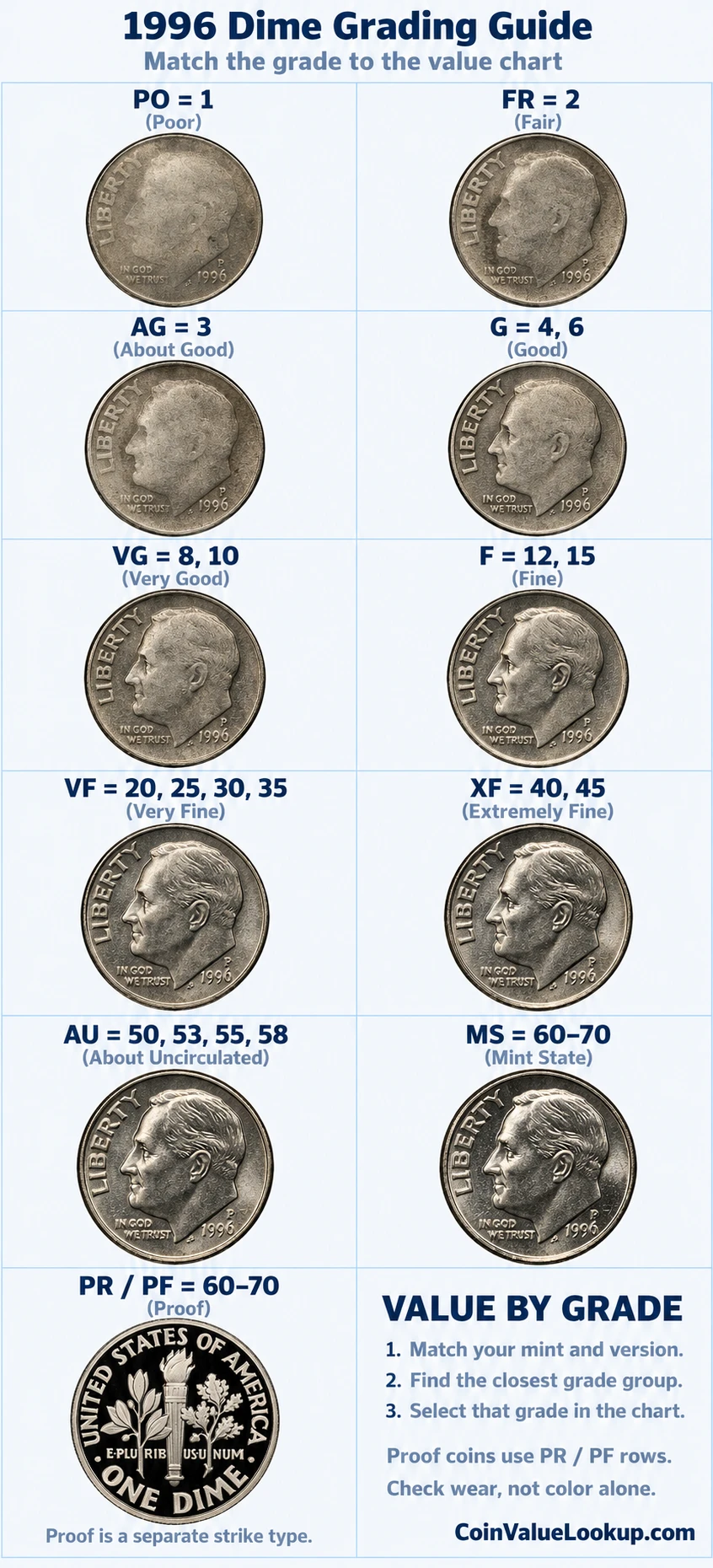
Focus on Roosevelt's cheek, jawline and the hair detail above his ear. These high points lose luster and show contact first.
On the reverse, inspect the torch bands and leaf detail.
A weak strike can mimic wear, so compare your coin's luster pattern against the reference image. An original uncirculated coin shows unbroken cartwheel luster across the fields even if the strike left soft spots.
A worn coin loses that luster on the high points progressively.
Cleaning, scratches and corrosion hurt a coin's desirability regardless of remaining detail. Proof coins are judged on mirror-field quality and the sharpness of contrast between frosted devices and reflective fields.
Full Bands is a strike designation, not a grade — it means both horizontal torch-band pairs separate cleanly.
Coin Value Lookup is a handy starting point if you want to look up guides for other dates and denominations in the Roosevelt series. Bookmark it and compare your finds as you go.
Step 3: Check 1996 Roosevelt Dime Value by Mint and Version
1996 Roosevelt Dime — P Business Strike
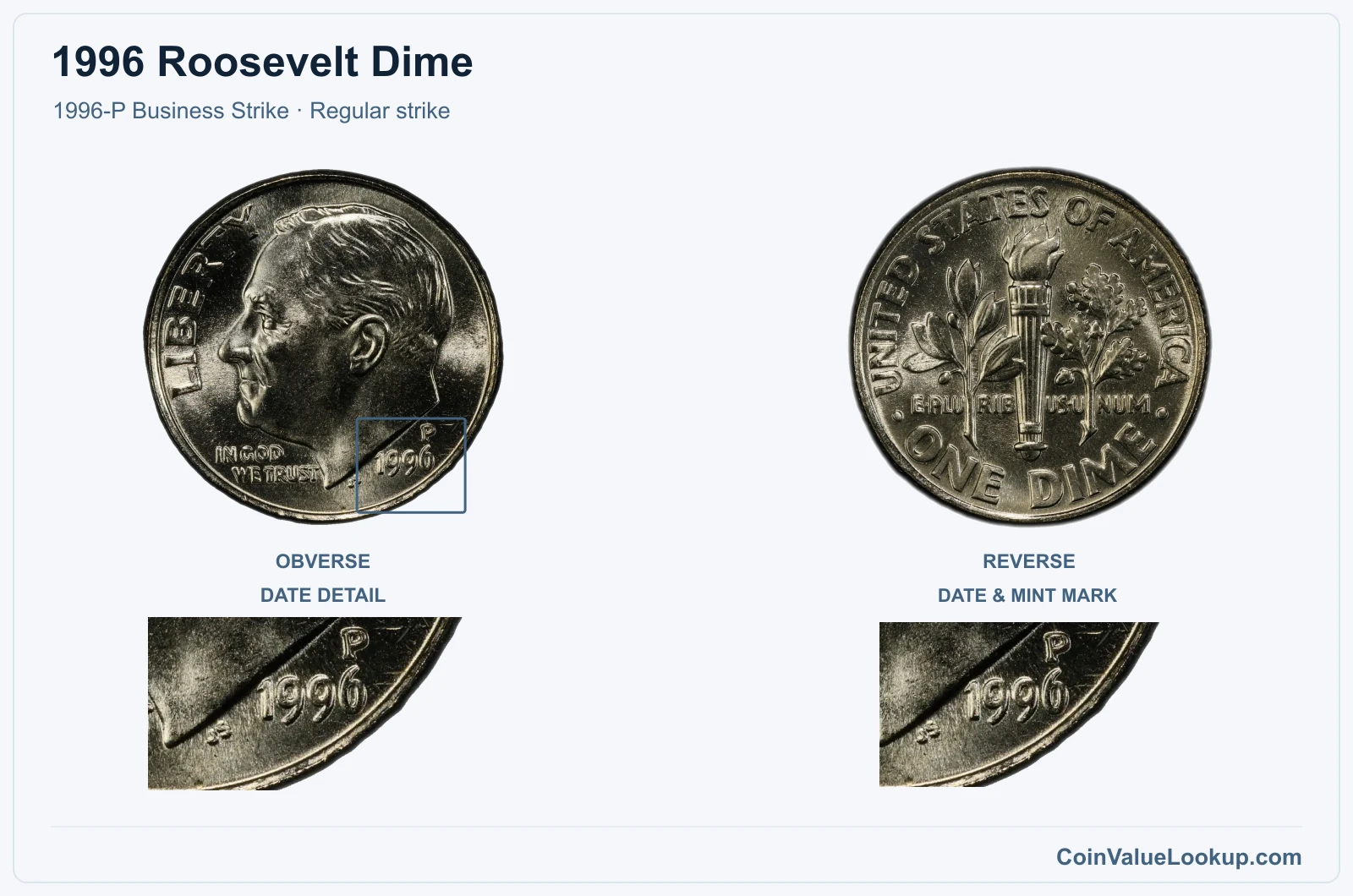
The 1996-P is a copper-nickel clad business strike weighing 2.27 grams, produced at Philadelphia. Look for the small P mintmark on the obverse to the right of the date.
In circulated condition these trade at face value. The USA Coin Book guide places an MS65 example at about $2.50.
This is the workhorse issue of the year with massive mintage, so gem examples are available without much effort. Where it gets interesting is Full Bands designation — if both horizontal torch-band pairs separate cleanly, the coin commands a premium over a soft strike at the same grade.
Range Grade
Price Auction Records Appraisal PO PO 1
—
Coin Identifier FR FR 2
—
Coin Identifier AG AG 3
—
Coin Identifier G G 4
—
Coin Identifier
G 6
—
Coin Identifier VG VG 8
—
Coin Identifier
VG 10
—
Coin Identifier F F 12
—
Coin Identifier
F 15
—
Coin Identifier VF VF 20
—
Coin Identifier
VF 25
—
Coin Identifier
VF 30
—
Coin Identifier
VF 35
—
Coin Identifier XF XF 40
—
Coin Identifier
XF 45
—
Coin Identifier AU AU 50
—
Coin Identifier
AU 53
—
Coin Identifier
AU 55
—
Coin Identifier
AU 58
—
Coin Identifier MS MS 60
—
Coin Identifier
MS 61
—
Coin Identifier
MS 62
—
Coin Identifier
MS 63
—
Coin Identifier
MS 64
Coin Identifier
MS 65
Coin Identifier
MS 66
Coin Identifier
MS 67
Coin Identifier
MS 68
Coin Identifier
MS 69
—
—
—
MS 70
—
—
—
1996 Roosevelt Dime — D Business Strike
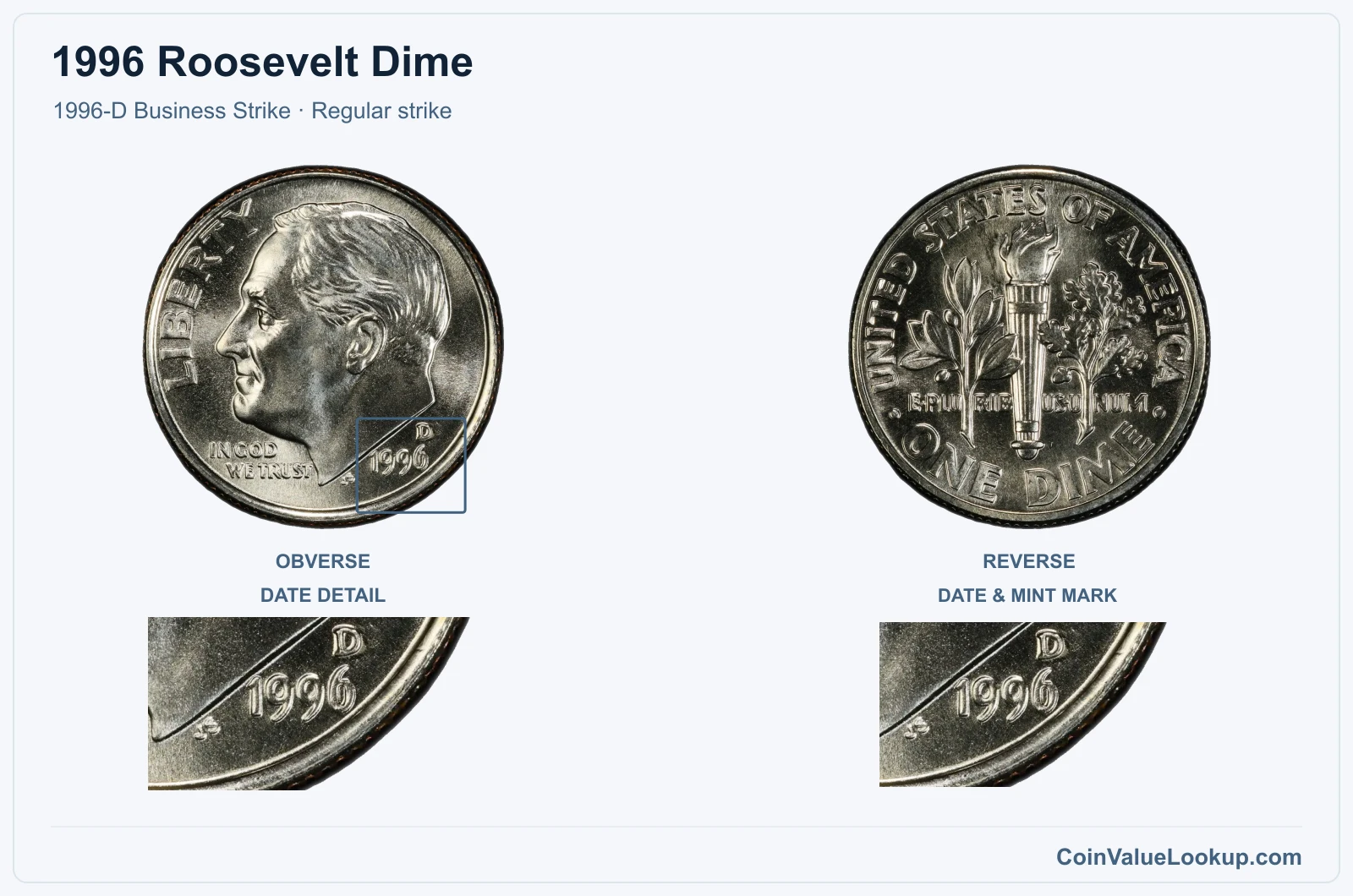
Denver's 1996-D business strike shares the same copper-nickel clad composition and 2.27-gram weight as the Philadelphia issue. Find the D mintmark near the date on the obverse.
Circulated pieces are worth ten cents. The guide estimate for MS65 is about $2.50, identical to the P.
Like the Philadelphia coin, a sharply struck example showing Full Bands separation on the torch is more desirable than a mushy one at the same certified grade. Most 1996-D dimes in pocket change show honest wear and are only collectible at face value.
Range Grade
Price Auction Records Appraisal PO PO 1
—
Coin Identifier FR FR 2
—
Coin Identifier AG AG 3
—
Coin Identifier G G 4
—
Coin Identifier
G 6
—
Coin Identifier VG VG 8
—
Coin Identifier
VG 10
—
Coin Identifier F F 12
—
Coin Identifier
F 15
—
Coin Identifier VF VF 20
—
Coin Identifier
VF 25
—
Coin Identifier
VF 30
—
Coin Identifier
VF 35
—
Coin Identifier XF XF 40
—
Coin Identifier
XF 45
—
Coin Identifier AU AU 50
—
Coin Identifier
AU 53
—
Coin Identifier
AU 55
—
Coin Identifier
AU 58
—
Coin Identifier MS MS 60
—
Coin Identifier
MS 61
—
Coin Identifier
MS 62
—
Coin Identifier
MS 63
—
Coin Identifier
MS 64
Coin Identifier
MS 65
Coin Identifier
MS 66
—
Coin Identifier
MS 67
Coin Identifier
MS 68
Coin Identifier
MS 69
—
Coin Identifier
MS 70
—
—
—
1996 Roosevelt Dime — W Mint Set Business Strike
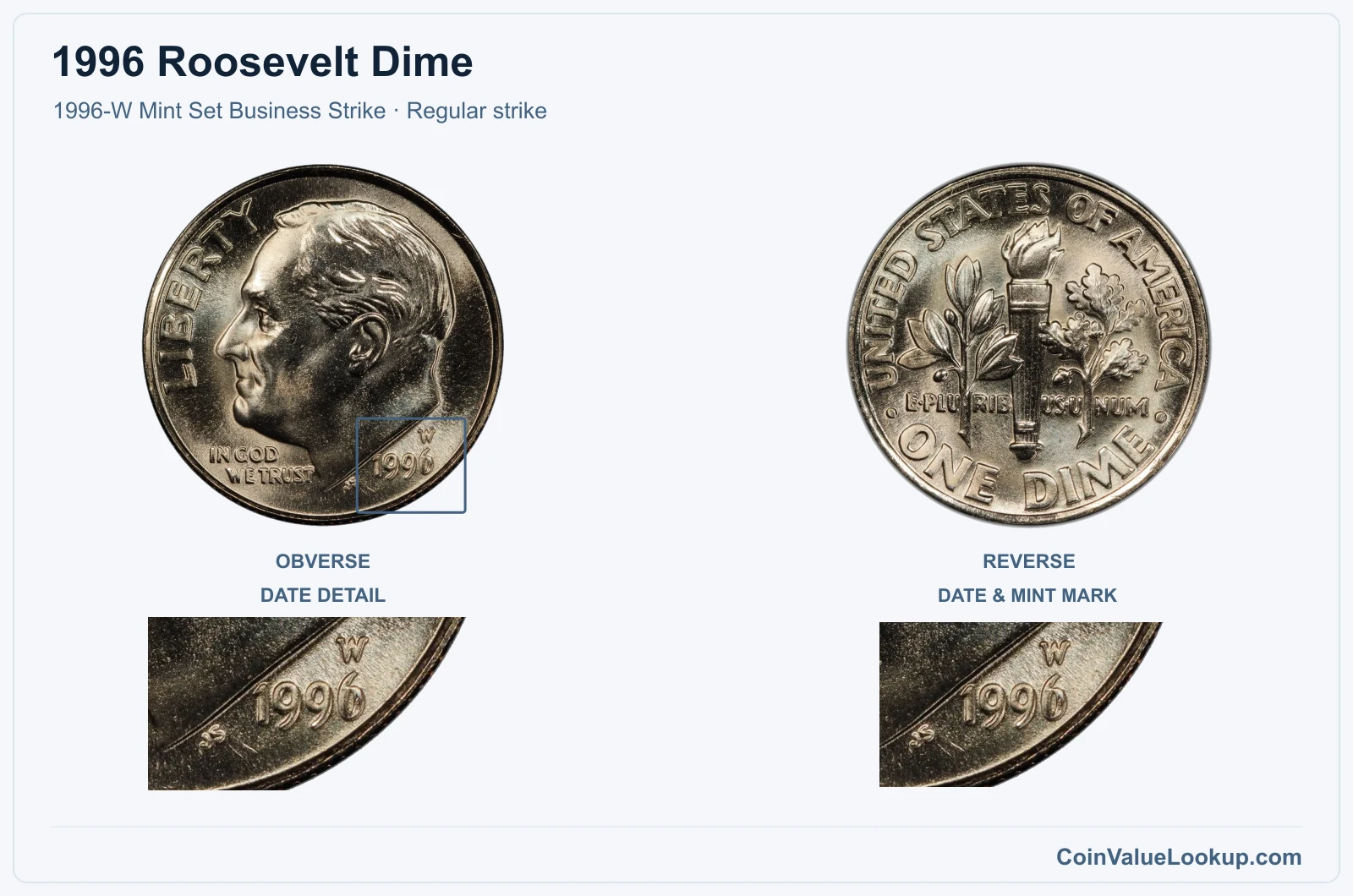
This is the headline coin of 1996. The West Point Mint struck a special clad dime — the first ever to carry a W mintmark — exclusively for the 1996 Uncirculated Mint Set, celebrating the Roosevelt dime's 50th anniversary.
It is not a proof; it is a standard business strike on the same 2.27-gram copper-nickel clad planchet as the P and D.
The W mintmark appears in the same position near the date. USA Coin Book guides the MS65 at roughly $25, a significant step above the regular issues.
Because these were only distributed inside Mint Sets, they did not enter general circulation. Condition still matters — look for clean fields, strong luster and, ideally, Full Bands on the torch.
Range Grade
Price Auction Records Appraisal PO PO 1
—
Coin Identifier FR FR 2
—
Coin Identifier AG AG 3
—
Coin Identifier G G 4
—
Coin Identifier
G 6
—
Coin Identifier VG VG 8
—
Coin Identifier
VG 10
—
Coin Identifier F F 12
—
Coin Identifier
F 15
—
Coin Identifier VF VF 20
—
Coin Identifier
VF 25
—
Coin Identifier
VF 30
—
Coin Identifier
VF 35
—
Coin Identifier XF XF 40
—
Coin Identifier
XF 45
—
Coin Identifier AU AU 50
—
Coin Identifier
AU 53
—
Coin Identifier
AU 55
—
Coin Identifier
AU 58
—
Coin Identifier MS MS 60
—
Coin Identifier
MS 61
—
Coin Identifier
MS 62
—
Coin Identifier
MS 63
—
Coin Identifier
MS 64
Coin Identifier
MS 65
Coin Identifier
MS 66
Coin Identifier
MS 67
Coin Identifier
MS 68
Coin Identifier
MS 69
—
Coin Identifier
MS 70
—
—
—
1996 Roosevelt Dime — S Clad Proof
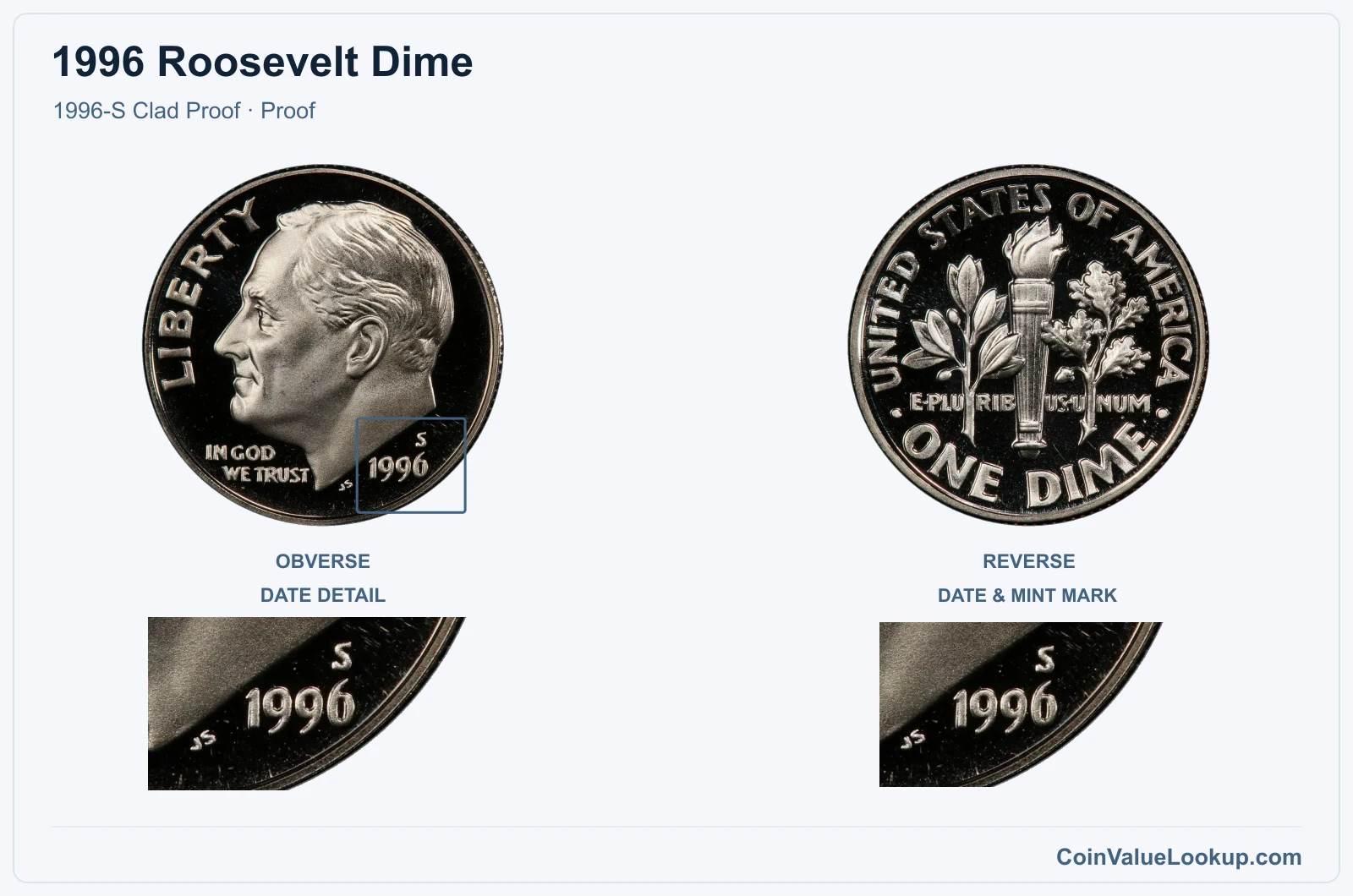
San Francisco produced a clad proof version of the 1996 dime for the standard proof set. It weighs 2.27 grams, the same as a business strike, and carries an S mintmark.
Mirror-like fields and frosted raised devices are hallmarks of the proof finish.
The USA Coin Book guide lists PR65 at about $3.62. Remember, the S mintmark alone does not confirm silver — you must check the edge color or weight to separate this clad proof from its silver counterpart.
Original government proof-set packaging is the easiest confirmation.
Range Grade
Price Auction Records Appraisal PR PR 1
—
Coin Identifier
PR 2
—
Coin Identifier
PR 3
—
Coin Identifier
PR 4
—
Coin Identifier
PR 6
—
Coin Identifier
PR 8
—
Coin Identifier
PR 10
—
Coin Identifier
PR 12
—
Coin Identifier
PR 15
—
Coin Identifier
PR 20
—
Coin Identifier
PR 25
—
Coin Identifier
PR 30
—
Coin Identifier
PR 35
—
Coin Identifier
PR 40
—
Coin Identifier
PR 45
—
Coin Identifier
PR 50
—
Coin Identifier
PR 53
—
Coin Identifier
PR 55
—
Coin Identifier
PR 58
—
Coin Identifier
PR 60
—
Coin Identifier
PR 61
—
Coin Identifier
PR 62
—
Coin Identifier
PR 63
—
Coin Identifier
PR 64
—
Coin Identifier
PR 65
—
Coin Identifier
PR 66
—
Coin Identifier
PR 67
—
Coin Identifier
PR 68
Coin Identifier
PR 69
Coin Identifier
PR 70
Coin Identifier
1996 Roosevelt Dime — S Silver Proof
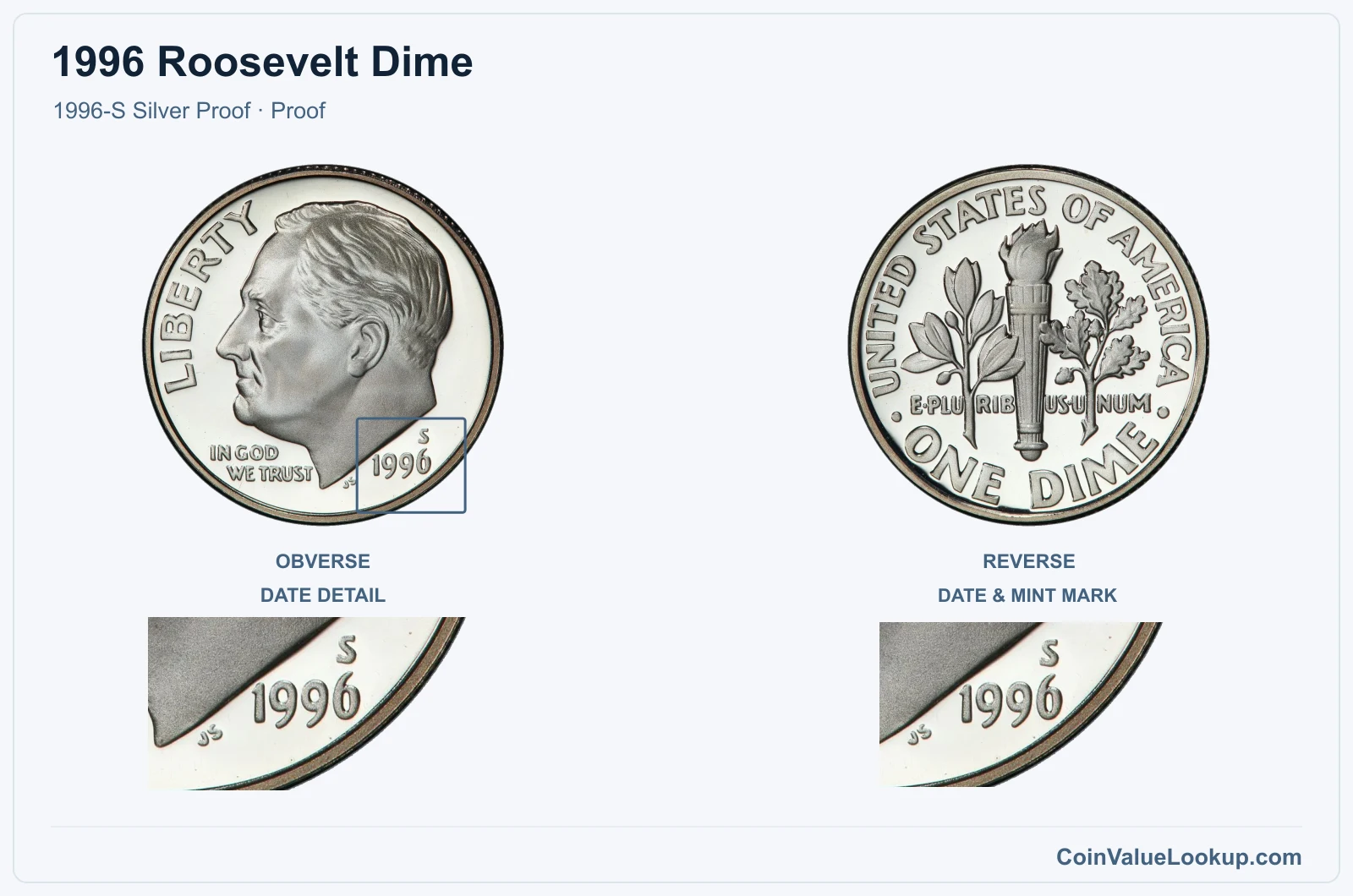
The 1996-S silver proof is struck on a 90% silver, 10% copper planchet weighing 2.50 grams — noticeably heavier than the 2.27-gram clad version. It also carries an S mintmark and looks nearly identical to the clad proof at first glance.
Edge inspection is your friend: the silver proof shows a uniform silver-gray edge with no copper stripe. The USA Coin Book guide places PR65 at about $13, well above the clad proof, partly because silver content provides a price floor that fluctuates with the metal market.
When in doubt about composition, professional authentication settles the question.
Range Grade
Price Auction Records Appraisal PR PR 1
—
Coin Identifier
PR 2
—
Coin Identifier
PR 3
—
Coin Identifier
PR 4
—
Coin Identifier
PR 6
—
Coin Identifier
PR 8
—
Coin Identifier
PR 10
—
Coin Identifier
PR 12
—
Coin Identifier
PR 15
—
Coin Identifier
PR 20
—
Coin Identifier
PR 25
—
Coin Identifier
PR 30
—
Coin Identifier
PR 35
—
Coin Identifier
PR 40
—
Coin Identifier
PR 45
—
Coin Identifier
PR 50
—
Coin Identifier
PR 53
—
Coin Identifier
PR 55
—
Coin Identifier
PR 58
—
Coin Identifier
PR 60
—
Coin Identifier
PR 61
—
Coin Identifier
PR 62
—
Coin Identifier
PR 63
—
Coin Identifier
PR 64
—
Coin Identifier
PR 65
—
Coin Identifier
PR 66
—
Coin Identifier
PR 67
—
Coin Identifier
PR 68
Coin Identifier
PR 69
Coin Identifier
PR 70
Coin Identifier
1996 Roosevelt Dime Error List
1. 1996 Roosevelt Dime — Split Obverse Die
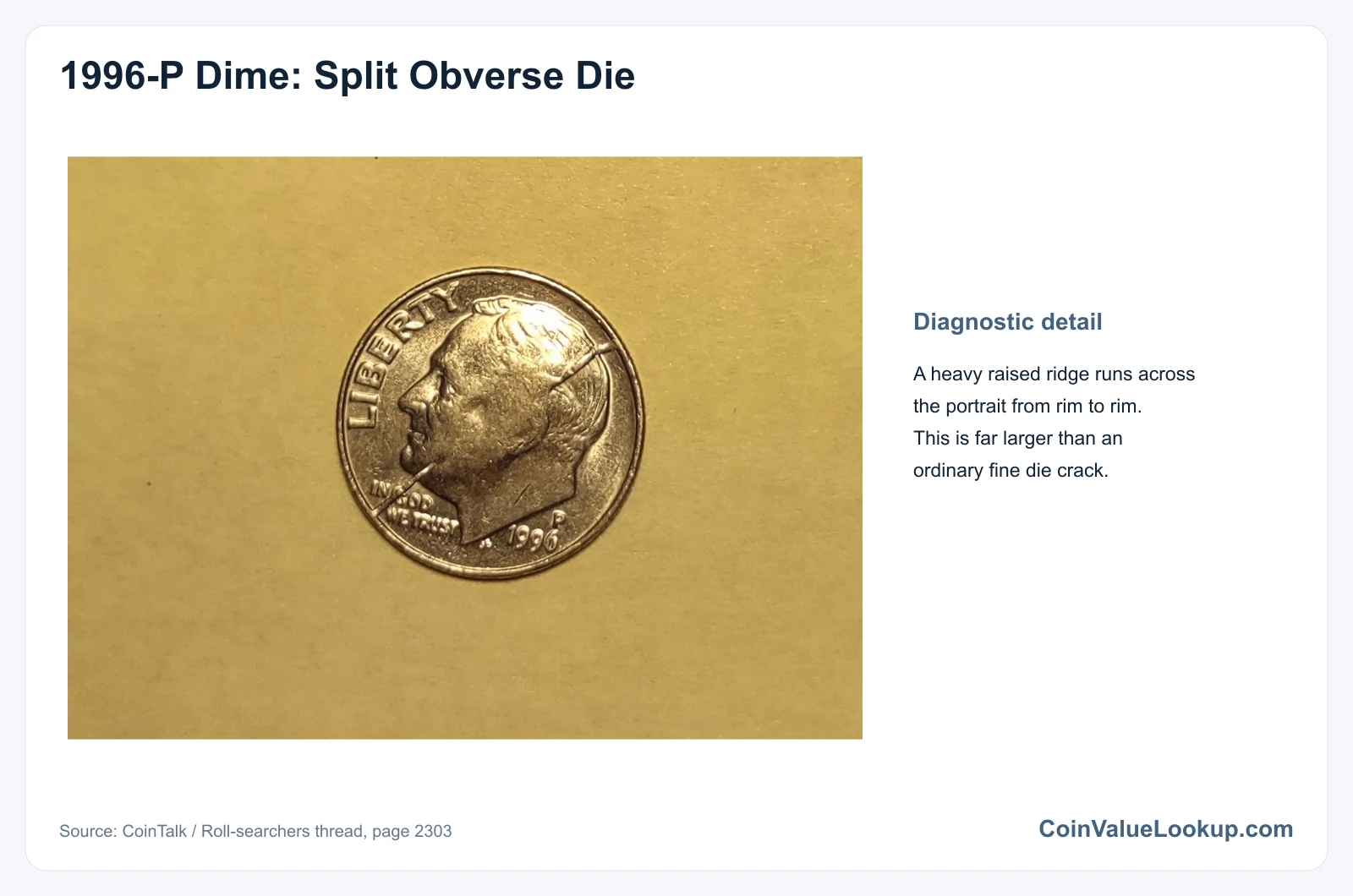
A split obverse die error occurs when a severe fracture runs through the die itself, transferring raised displaced metal and interrupted detail onto the struck coin. On the documented 1996-P specimen, the fracture is visible across the obverse and produces a distinctive ridge of displaced metal that follows the crack path.
Distinguish this from a scratch, a bent coin, or a physical split in the planchet — those are post-mint damage. A genuine die split shows struck, raised metal that was part of the striking process.
One certified PCGS MS63 example sold for $192 at Heritage Auctions in April 2020.
2. 1996 Roosevelt Dime — Broadstrike with Obverse Brockage
This compound error combines two problems in one coin. A broadstrike means the dime was struck outside the retaining collar, so the coin spread wider than normal diameter.
The obverse brockage adds an incuse, mirror-image impression of another coin's obverse design pressed into the surface.
Authenticated 1996-P examples graded NGC MS66 and MS67 have appeared at Heritage Auctions. Telling the real thing from a fake requires checking for continuous metal flow at the expanded rim and verifying that the brockage impression is die-struck, not tooled.
A centered broadstrike alone, a die clash or a vise-job imitation can fool you. Value depends on the individual coin's authenticated identity, condition and severity of the error.
3. 1996 Roosevelt Dime — Off-Center Strike
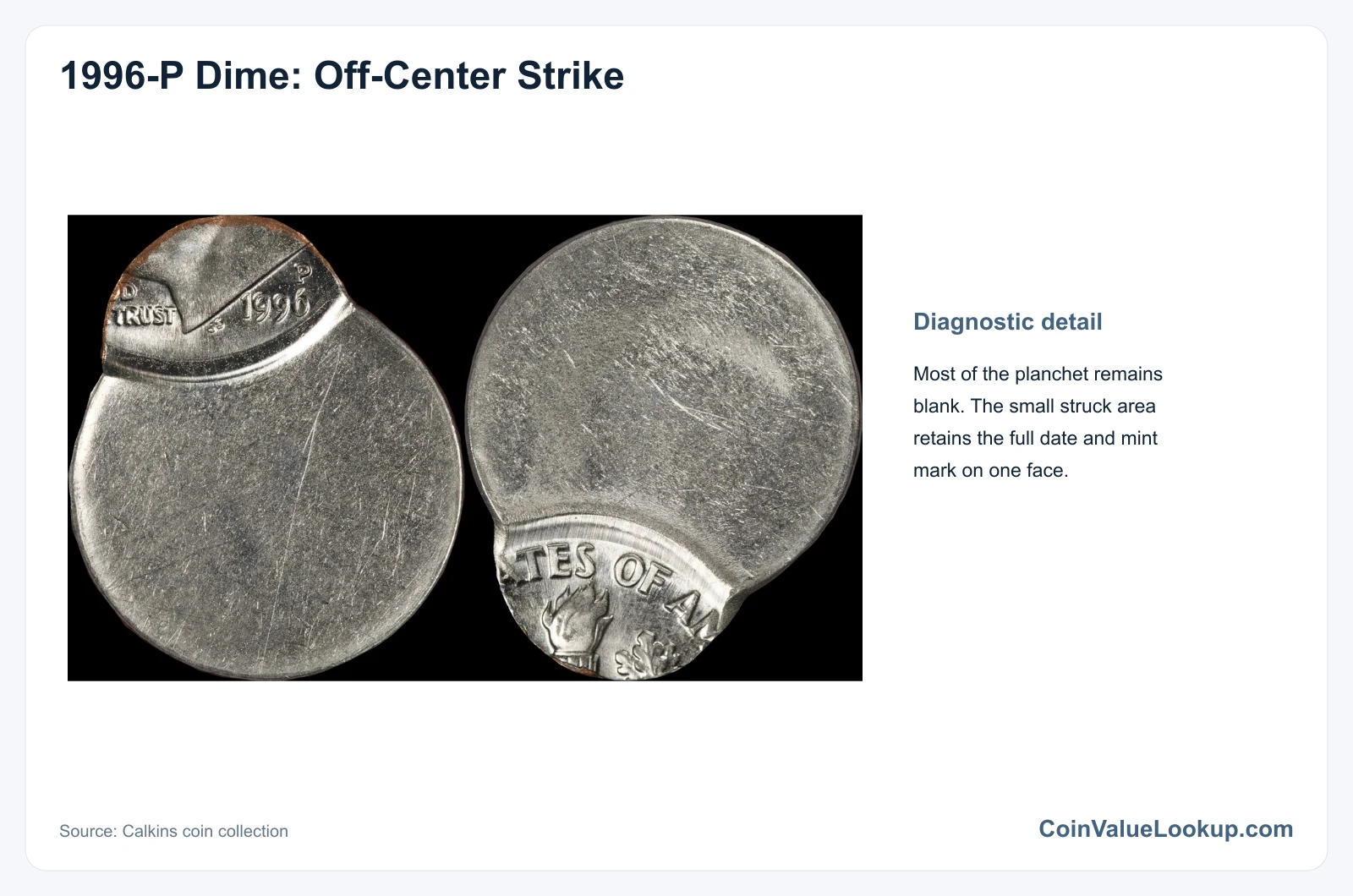
An off-center strike happens when the planchet is not seated properly between the dies. The documented 1996-P example shows a roughly 55% shift toward 12 o'clock, leaving a blank crescent of unstruck metal on one side while the date and P mintmark survive on the struck portion.
Retaining the date and mintmark matters — without them, you cannot confirm the year or mint. Look for a smooth, unstruck crescent and proper die-struck detail on the remaining design.
A one-sided die misalignment or post-mint cutting can mimic this error. No specific price is adopted for this variety; value depends on authentication, percentage of offset and overall condition.
4. 1996 Roosevelt Dime — Double Denomination (Lincoln Cent over Roosevelt Dime)
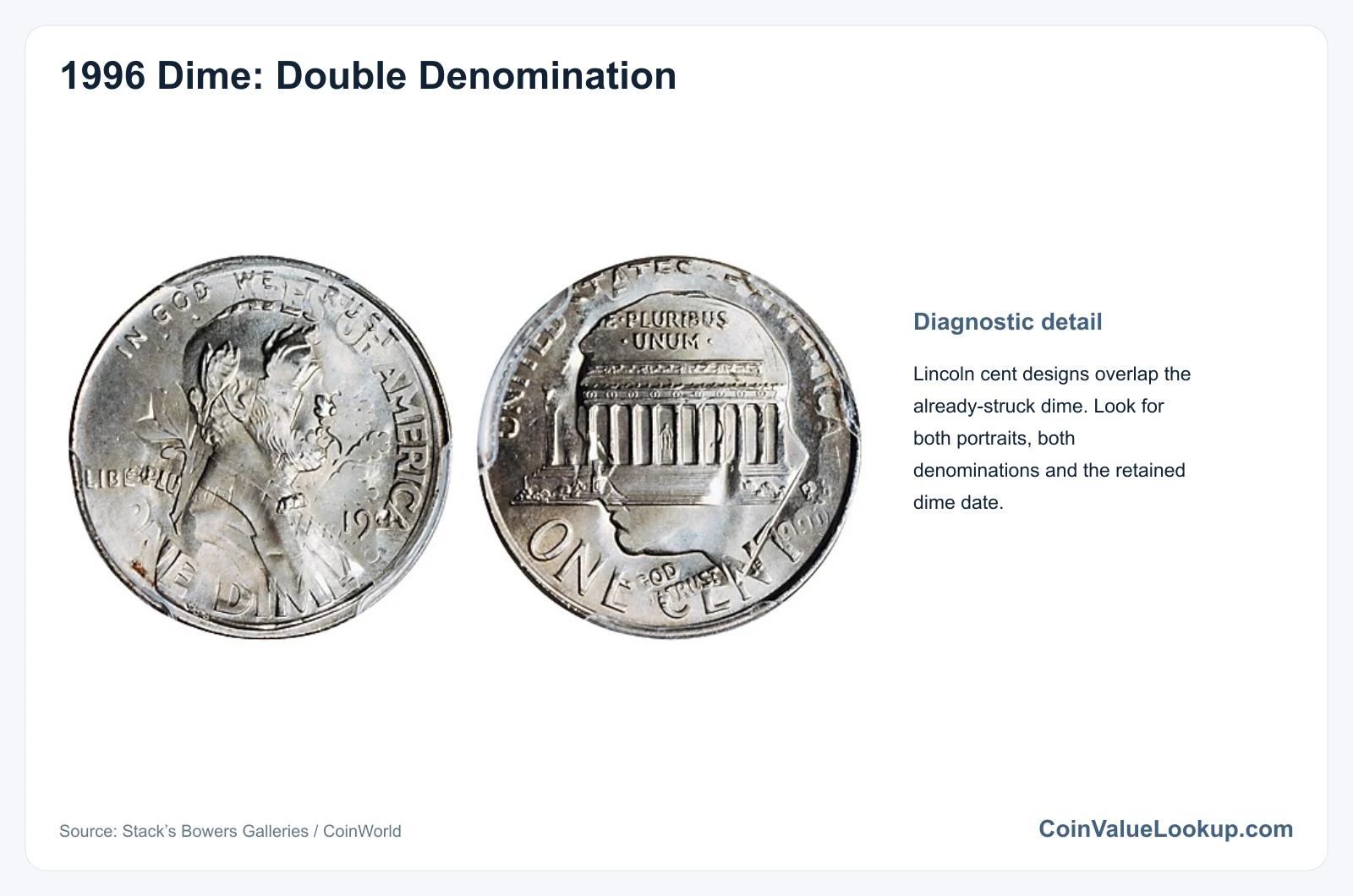
This is the heavy hitter. A double denomination occurs when a planchet already struck as one denomination gets fed through the press a second time with dies for a different denomination.
The documented piece is a 1995-P Roosevelt dime undertype overstruck by 1996-P Lincoln cent dies, so both Roosevelt and Lincoln designs coexist on the same coin with visible die-struck overlap.
Both dates can remain readable. To spot a fake, look for continuous metal flow where the two designs intersect — glued novelty pieces and scratched imitations lack that.
A certified MS64 example sold for $1,880 at auction in August 2015. That is a single recorded result, not a guaranteed market price, but it shows how seriously collectors take confirmed double denominations.
5. 1996 Roosevelt Dime — Missing Clad Layer
When the nickel cladding fails to bond to one or both faces of the copper core, you get a missing clad layer error. The affected side shows a bright copper surface instead of the usual silver-gray nickel finish.
This error has been documented on both 1996-P and 1996-D business strikes. Weigh the coin — a missing layer makes it lighter than the standard 2.27 grams.
A normal-weight coin that simply looks copper-colored is almost certainly environmental damage from acids or soil. Polishing and chemical stripping also mimic the look.
Value for authenticated specimens depends on condition and whether one or both layers are missing.
6. 1996 Roosevelt Dime — Double-Clipped Planchet
A double-clipped planchet has two smooth crescent-shaped sections missing from the blank before striking. These clips occur when the blanking punch overlaps a previously punched area of the metal strip.
On a genuine 1996-P double clip, look for two smooth curved indentations and weakened opposite rims — called Blakesley effects — where metal flow could not fully fill the die cavity opposite each clip. The clips must be smooth and show struck detail around their edges, not rough or jagged like plier marks or filing.
A certified PCGS AU58 example has been documented. Value depends on individual assessment of authentication, clip size and overall preservation.
7. 1996 Roosevelt Dime — Struck Through Cloth or Fibers
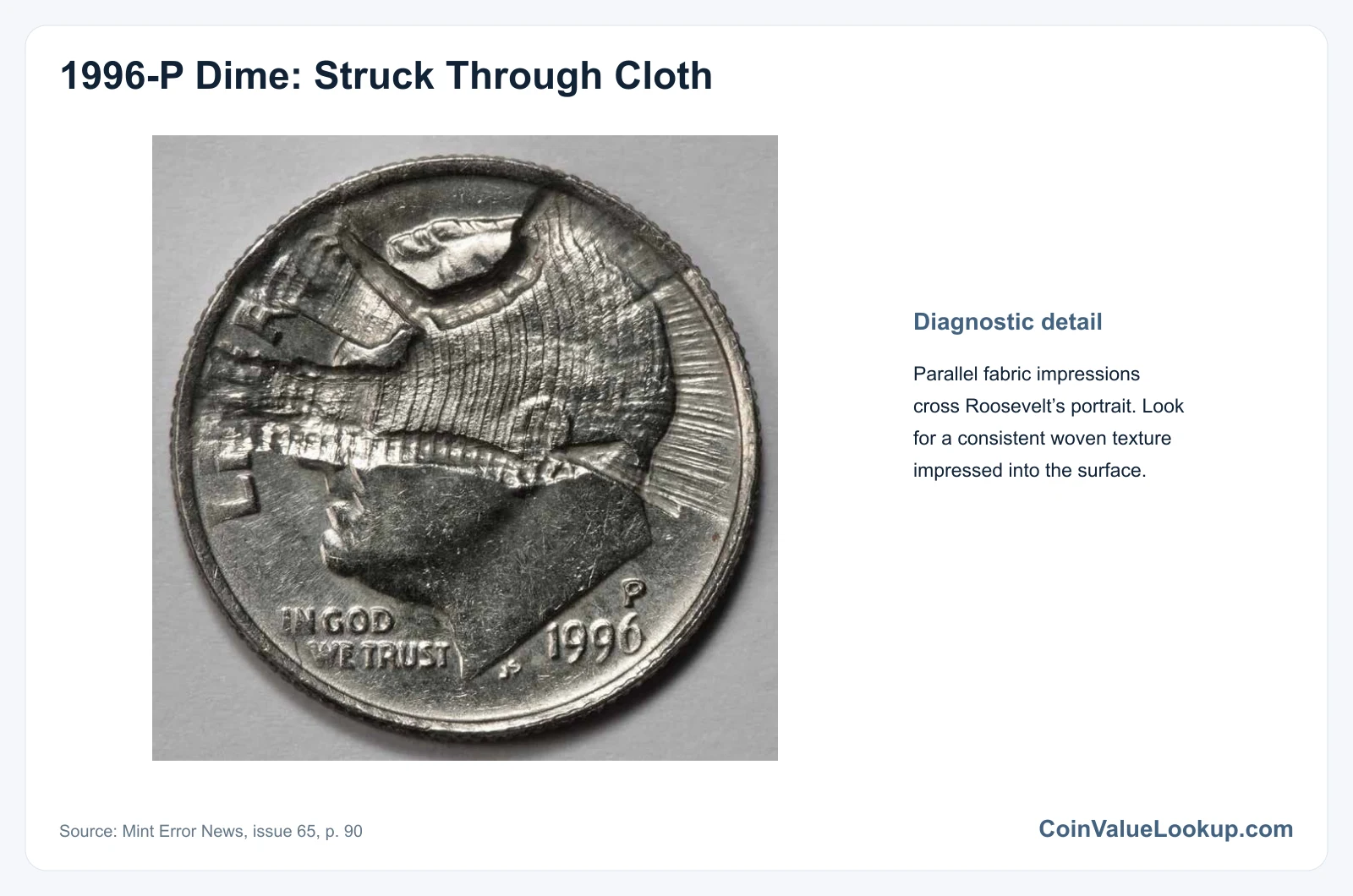
When cloth or loose fibers get trapped between the die and the planchet during striking, they leave a shallow, irregular area of missing or textured detail. The result looks like a ghostly fabric impression pressed into the coin's surface.
The documented example is a 1996-P Roosevelt dime. Examine the affected area under raking light — genuine struck-through cloth shows a consistent weave pattern or fiber impressions across the die-struck surface.
Abrasion, corrosion, a grease-filled die and even photographic artifacts can look similar to the untrained eye. Value requires individual assessment based on authenticated identity, the clarity of the cloth impression and overall condition.
8. 1996 Roosevelt Dime — Double Strike, Second Strike 95% Off Center
A double strike with the second impression about 95% off center is a dramatic error. The coin receives its first normal strike, then shifts almost entirely out of alignment before the dies come down again, leaving a second partial impression overlapping at the edge.
The documented 1996-P specimen shows both impressions with continuous metal flow connecting them — that flow is the key authentication feature. Machine doubling, a simple broadstrike, or even a rotated photograph can fool you if you are not careful.
A certified PCGS MS61 example has been recorded. Pricing depends on individual assessment of authenticity, the visual drama of the displacement and surface condition.
9. 1996 Roosevelt Dime — Reversed Partial Collar
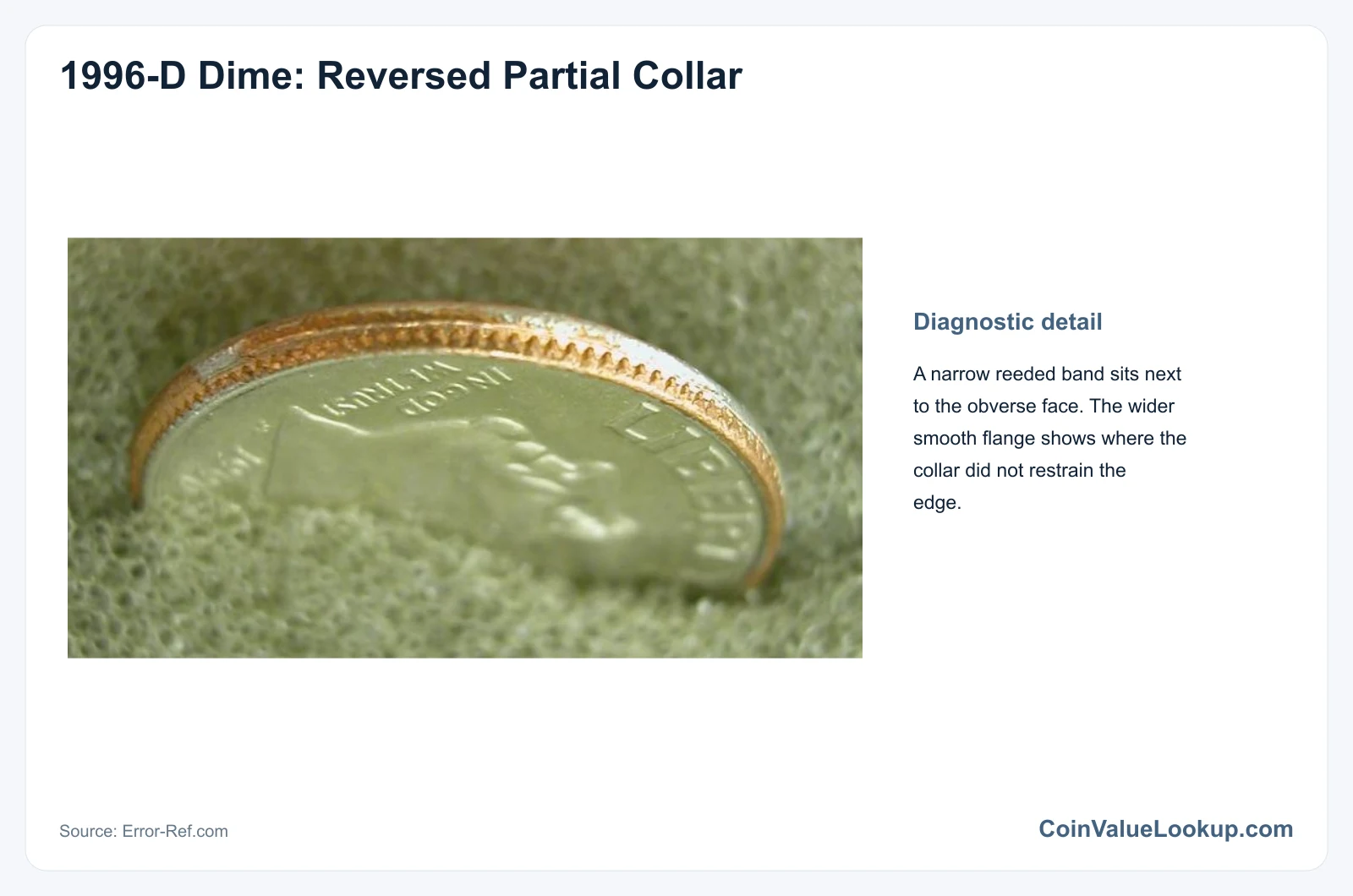
A reversed partial collar error on a 1996-D dime means the coin was partly inside the collar during striking, so one face retains normal diameter and reeding while the opposite face shows a wider flange or beveled edge where the metal escaped.
Inspect the edge carefully — you should see a continuous transition from normal reeded edge to the expanded, unreeded section. This is different from a full broadstrike, where the entire coin exceeds normal diameter, and from post-mint rim damage.
An angled photograph can make a normal coin look irregular, so examine the actual edge in hand. Value is determined individually based on authenticated identity, the degree of collar displacement and condition.
10. 1996 Roosevelt Dime — Indent and Broadstrike
An indent-and-broadstrike error happens when a foreign blank or planchet intrudes between the die and the target planchet during striking. The intruder presses a depressed, unstruck area into the coin while the absence of a collar lets the coin spread beyond normal diameter.
The documented 1996-P example shows approximately a 20% indent alongside the broadstrike expansion. Look for a smooth, concave depression with no design detail inside it, combined with an expanded rim and full date with P mintmark.
A post-mint dent, vise flattening or a broadstrike without the characteristic depression are common lookalikes. A certified MS66 specimen has been documented by Stack's Bowers.
Value depends on individual assessment of authentication, indent size and surface quality.