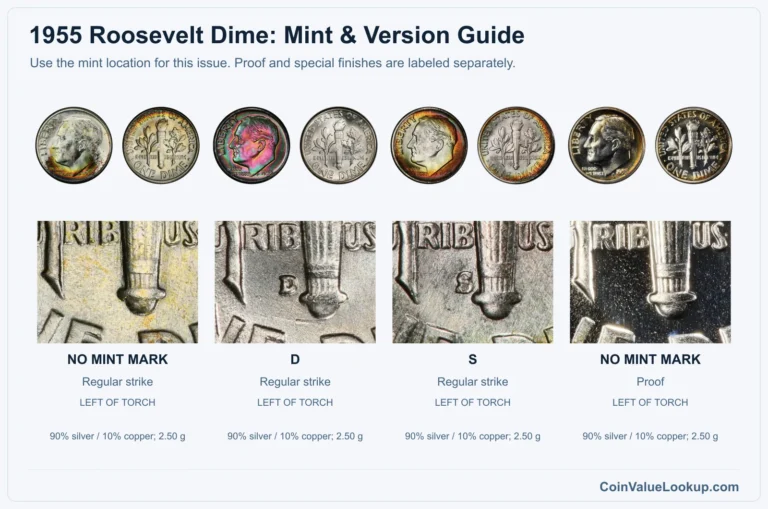
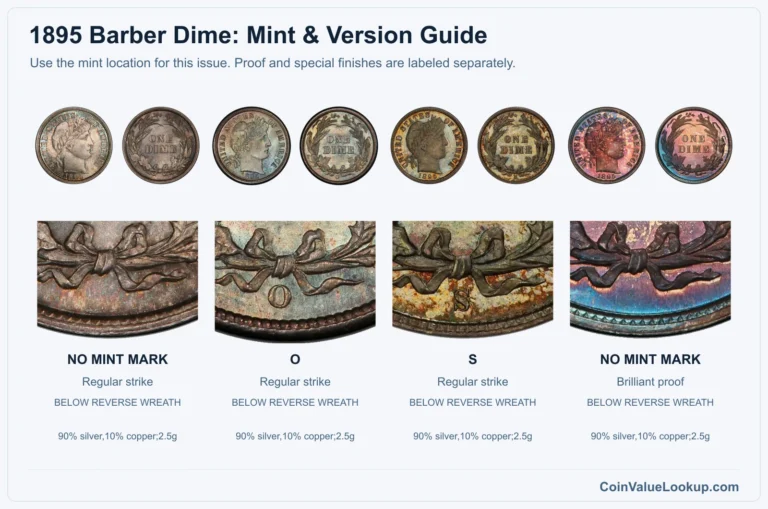
2024 Roosevelt Dime Coin Value: How Much Is It Worth?
Most 2024 Roosevelt dimes you pull from pocket change are worth face value. A USA Coin Book guide lists the Philadelphia or Denver business strike at about $2.50 in MS65, the San Francisco clad proof at $3.08 in PR65, and the silver proof at $14 in PR65.
Sharper grades, pristine proofs and authenticated mint errors each deserve their own comparison.
Fast Way to Identify Your 2024 Roosevelt Dime
The quickest way to start is to upload clear photos of both sides of your 2024 dime. A front-and-back image lets our identifier give you a preliminary read on which version you have, its mintmark and general condition.
That is not a substitute for professional authentication, but it points you in the right direction.
2024 Roosevelt Dime Value
Upload both sides of your 2024 Roosevelt Dime.
Front Obverse
Upload photo
Back Reverse
Upload photo
Which 2024 Roosevelt Dime Versions Are Worth Money?
- Uncirculated 2024-P or 2024-D dimes with full original luster and sharp horizontal torch bands can exceed face value, with the USA Coin Book guide placing MS65 at $2.50.
- The 2024-S silver proof, struck in .999 fine silver, carries a PR65 guide value of $14 and is worth confirming by weight and edge color.
- A well-preserved 2024-S clad proof in original packaging, guided at $3.08 in PR65, is a separate version from the silver proof despite sharing the S mintmark.
Step 1: Identify Your 2024 Roosevelt Dime Mint Mark and Version
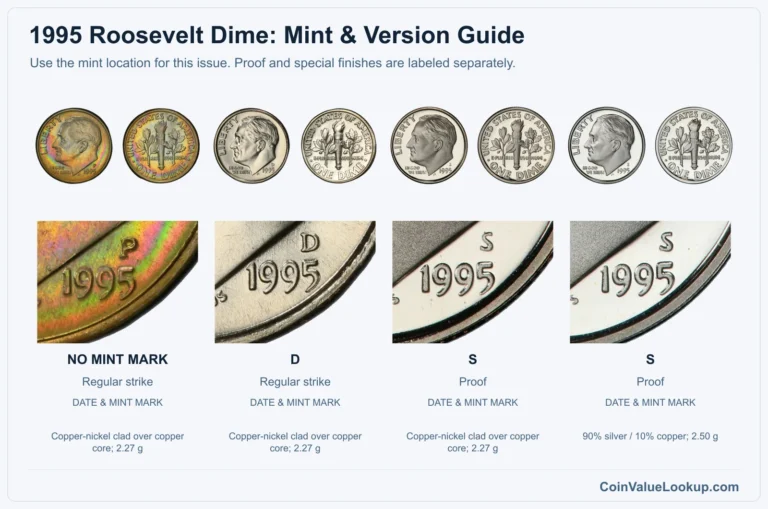
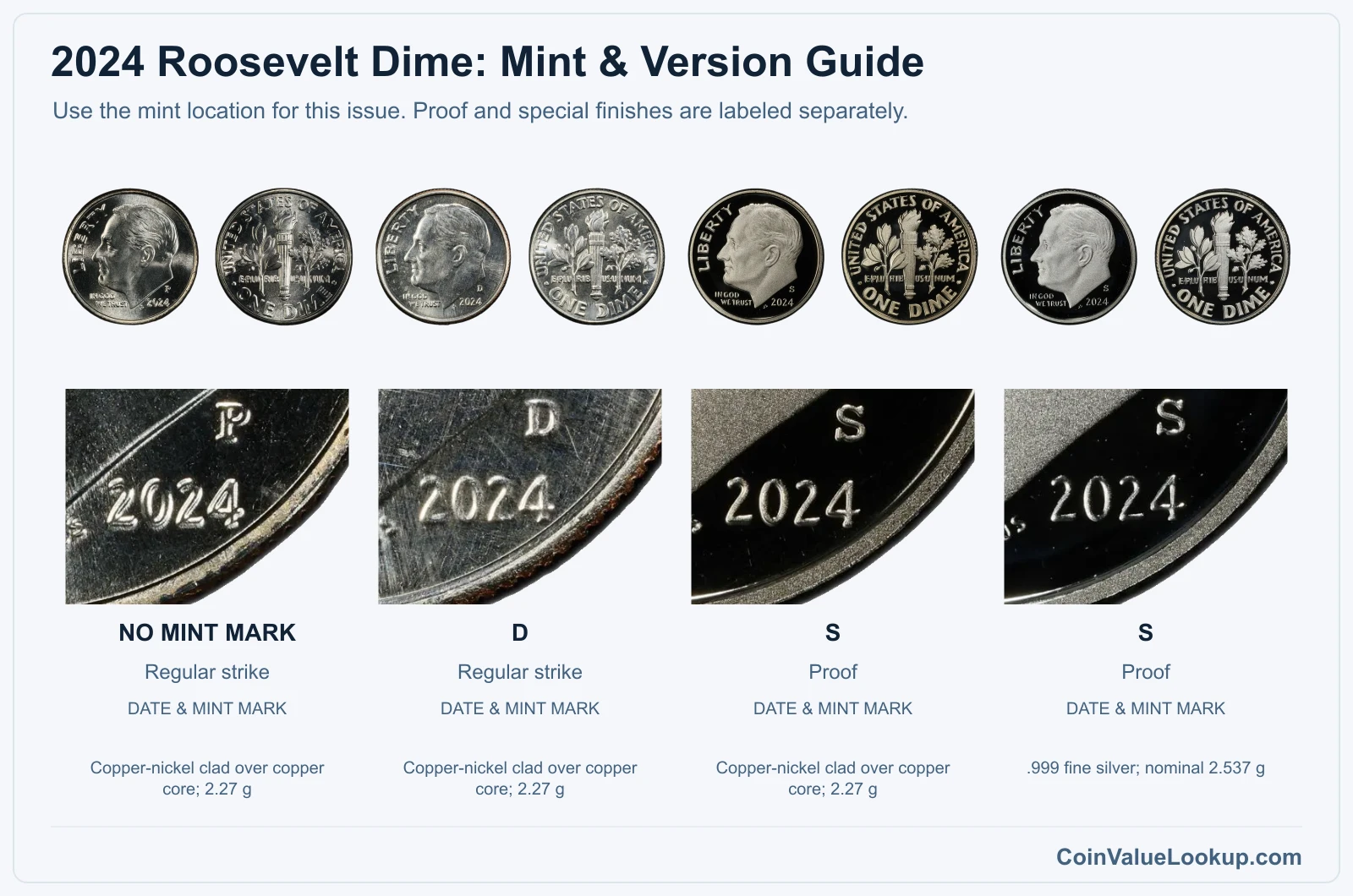
Look at the obverse just below the truncation of Roosevelt's neck for the mintmark: P for Philadelphia, D for Denver, or S for San Francisco. Every 2024 dime carries the Roosevelt portrait on the front and the torch flanked by olive and oak branches on the reverse.
Business strikes from P and D are copper-nickel clad and weigh 2.27 grams. San Francisco produced two distinct proof versions in the same year, and telling them apart matters.
The clad proof also weighs 2.27 grams and contains no silver despite its mirror finish. The silver proof is struck in .999 fine silver and has a nominal weight of 2.537 grams.
If you are trying to figure out whether your S-mint dime is clad or silver, check the edge. A clad coin shows a visible copper-toned stripe between two silvery layers.
A .999 silver proof will have a uniform silver-colored edge. Weighing the coin on a precise scale also helps: 2.27 g versus roughly 2.5 g is a meaningful difference on a coin this small.
Weak detail on a circulated coin does not mean you have a missing mintmark or an error. Compare your coin carefully with a known example before jumping to conclusions.
Step 2: Check Your 2024 Roosevelt Dime Grade
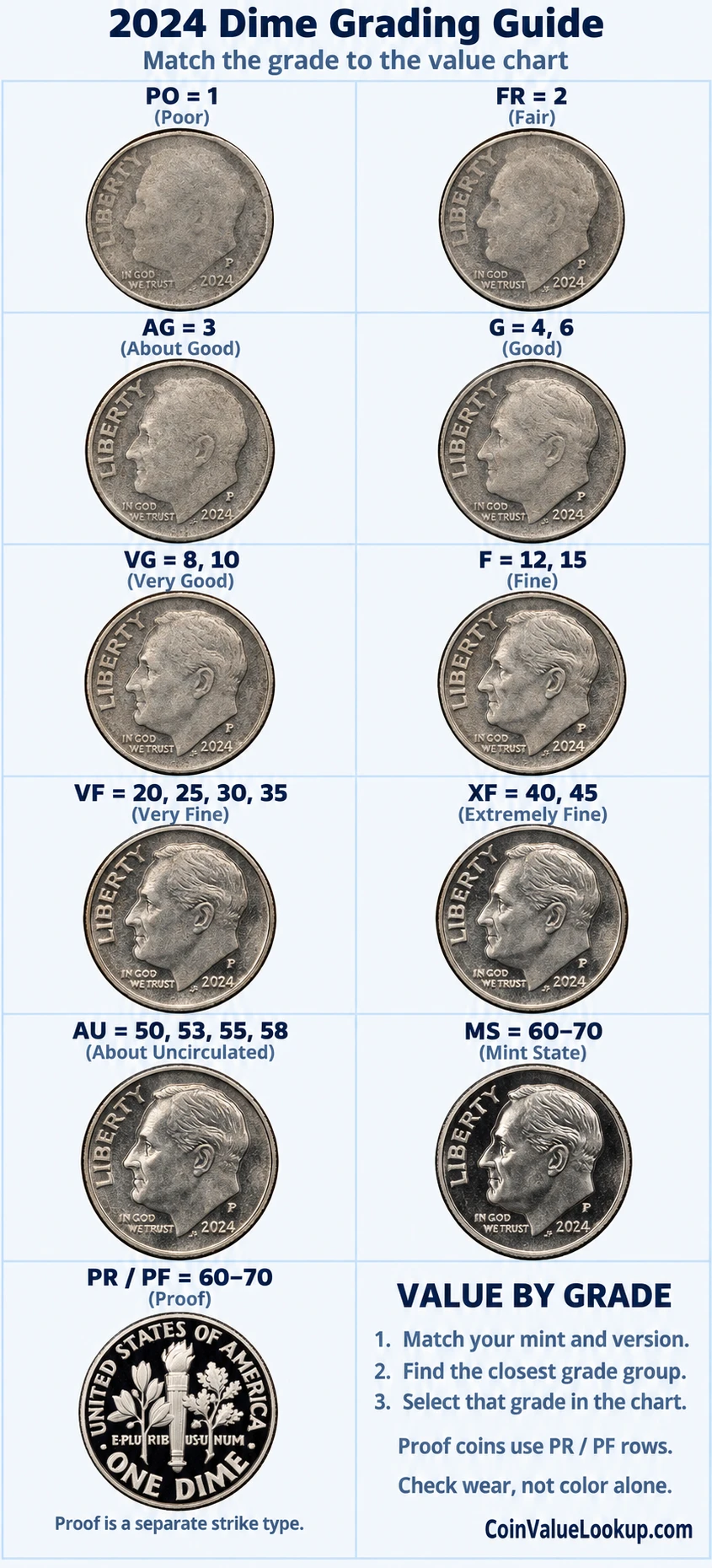
Start with Roosevelt's cheek and jawline. Those are the first high points to show friction, and any smoothing there drops the coin out of mint-state territory.
On the reverse, the horizontal torch bands are the key detail; both pairs need clear separation for a Full Bands designation, which is a strike quality attribute, not an error.
Original luster matters more than raw shininess. A coin that has been cleaned or polished might look bright but will show hairline scratches under magnification.
That kills the grade. Compare your coin side by side with the reference image to judge contact marks and surface preservation.
Proof coins are graded on their own scale. A proof is a special manufacturing finish with mirrored fields, not a grade above Mint State.
Judge proofs for hairlines, haze and any contact marks on those flat reflective surfaces.
Step 3: Check 2024 Roosevelt Dime Value by Mint and Version
2024 Roosevelt Dime — P Business Strike
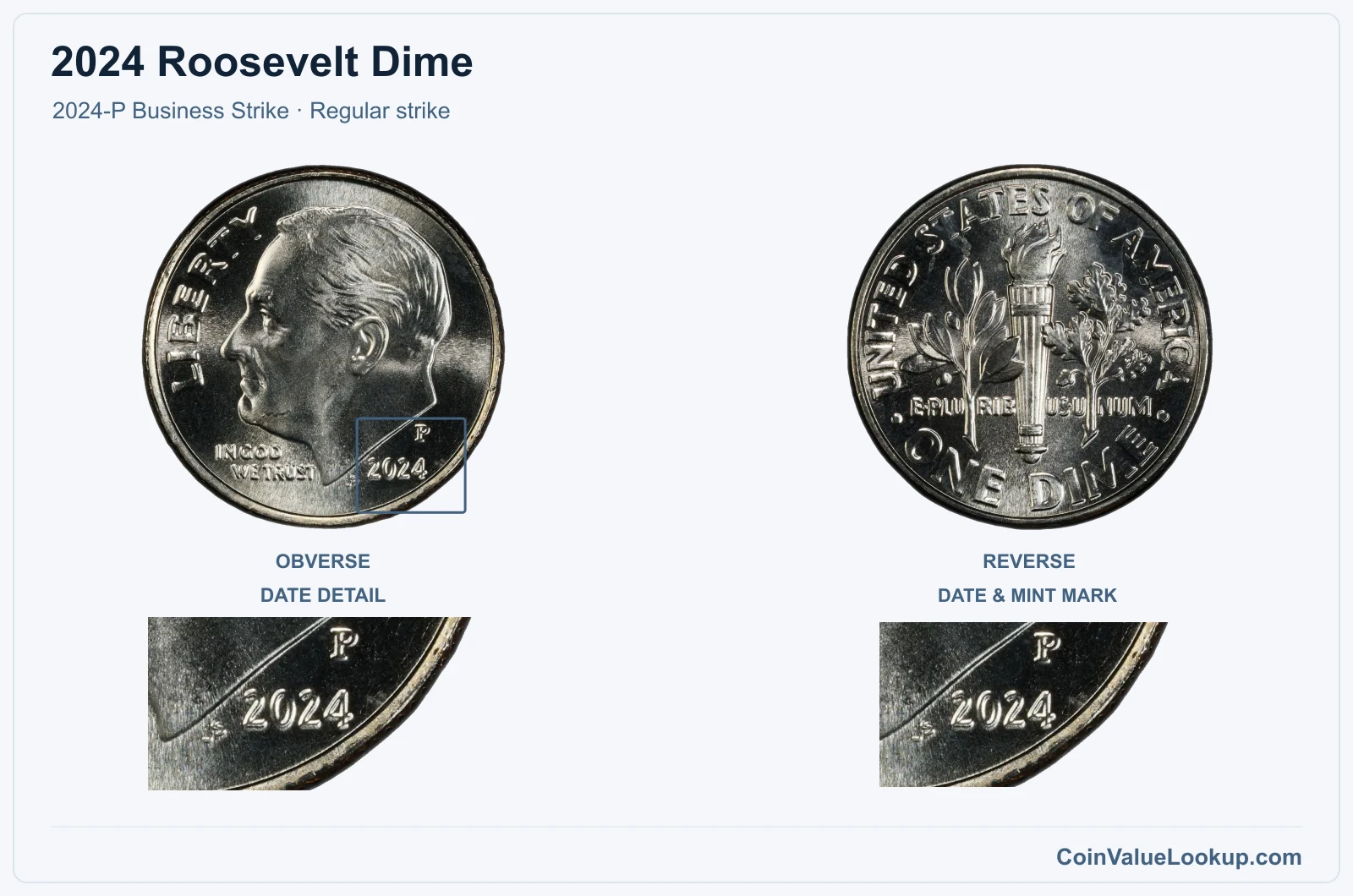
The 2024-P dime was struck in Philadelphia on copper-nickel clad planchets weighing 2.27 grams. You will see a small P mintmark on the obverse.
In typical circulated condition this is a ten-cent coin, no more.
A USA Coin Book guide places the MS65 value at $2.50. To reach that level, the coin needs full original luster, minimal bag marks and no signs of circulation wear on Roosevelt's cheek or the torch bands.
Sharp, well-preserved rolls are the usual source of these.
Range Grade
Price Auction Records Appraisal PO PO 1
—
Coin Identifier FR FR 2
—
Coin Identifier AG AG 3
—
Coin Identifier G G 4
—
Coin Identifier
G 6
—
Coin Identifier VG VG 8
—
Coin Identifier
VG 10
—
Coin Identifier F F 12
—
Coin Identifier
F 15
—
Coin Identifier VF VF 20
—
Coin Identifier
VF 25
—
Coin Identifier
VF 30
—
Coin Identifier
VF 35
—
Coin Identifier XF XF 40
—
Coin Identifier
XF 45
—
Coin Identifier AU AU 50
—
Coin Identifier
AU 53
—
Coin Identifier
AU 55
—
Coin Identifier
AU 58
—
Coin Identifier MS MS 60
—
Coin Identifier
MS 61
—
Coin Identifier
MS 62
—
Coin Identifier
MS 63
—
Coin Identifier
MS 64
—
Coin Identifier
MS 65
—
Coin Identifier
MS 66
—
Coin Identifier
MS 67
—
Coin Identifier
MS 68
—
—
—
MS 69
—
—
—
MS 70
—
—
—
2024 Roosevelt Dime — D Business Strike
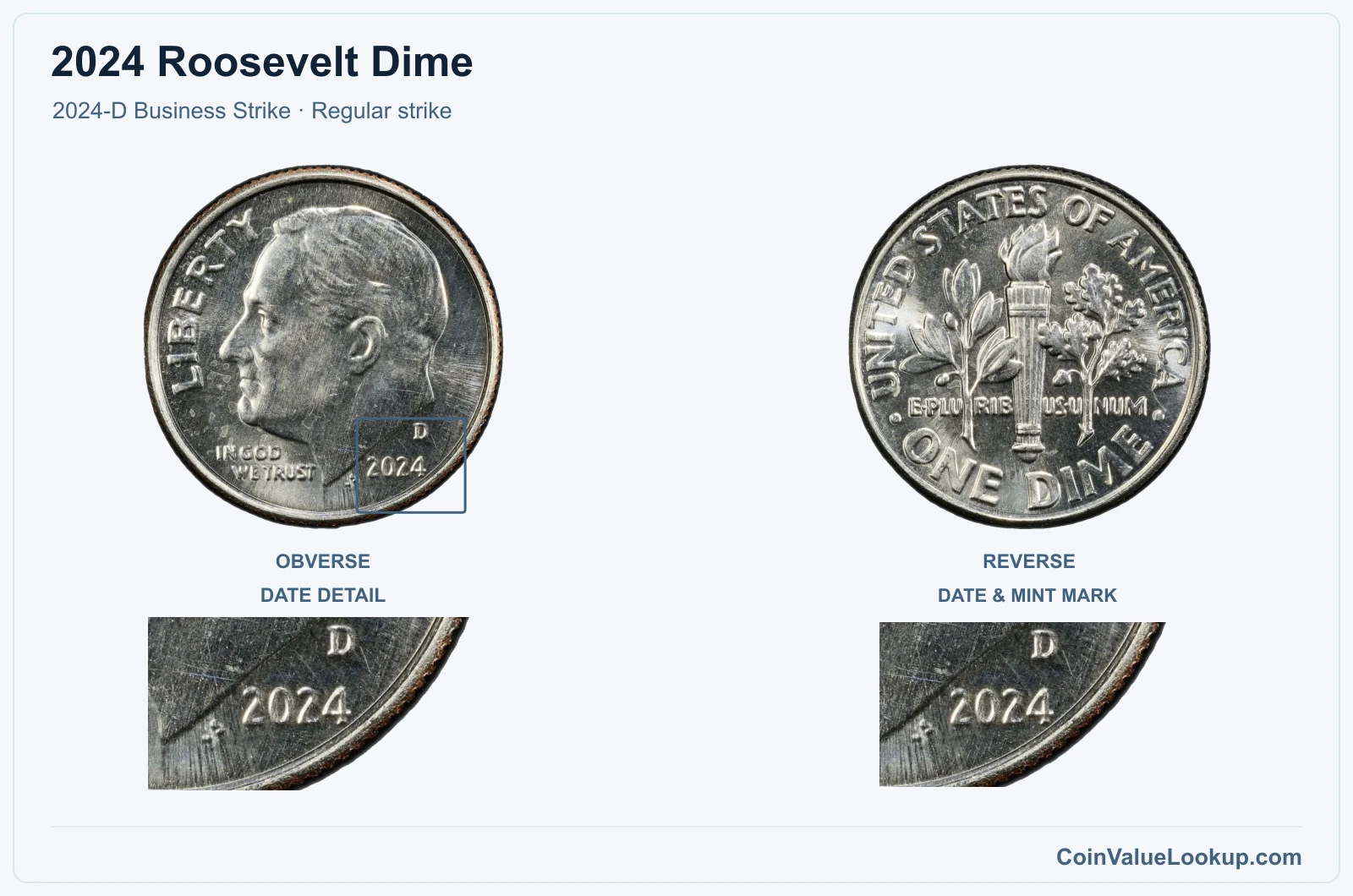
Denver's 2024-D dime is the same copper-nickel clad composition and 2.27-gram weight as its Philadelphia counterpart, distinguished only by the D mintmark on the obverse. Circulated examples are worth ten cents.
Coin Value Lookup is a good starting point if you want to compare your 2024-D dime with other Roosevelt dates and mints. The MS65 guide estimate from USA Coin Book is $2.50, identical to the P-mint version.
Look for strong torch bands and clean surfaces if you are hoping to find one worth setting aside.
Range Grade
Price Auction Records Appraisal PO PO 1
—
Coin Identifier FR FR 2
—
Coin Identifier AG AG 3
—
Coin Identifier G G 4
—
Coin Identifier
G 6
—
Coin Identifier VG VG 8
—
Coin Identifier
VG 10
—
Coin Identifier F F 12
—
Coin Identifier
F 15
—
Coin Identifier VF VF 20
—
Coin Identifier
VF 25
—
Coin Identifier
VF 30
—
Coin Identifier
VF 35
—
Coin Identifier XF XF 40
—
Coin Identifier
XF 45
—
Coin Identifier AU AU 50
—
Coin Identifier
AU 53
—
Coin Identifier
AU 55
—
Coin Identifier
AU 58
—
Coin Identifier MS MS 60
—
Coin Identifier
MS 61
—
Coin Identifier
MS 62
—
Coin Identifier
MS 63
—
Coin Identifier
MS 64
—
Coin Identifier
MS 65
—
Coin Identifier
MS 66
—
Coin Identifier
MS 67
—
—
—
MS 68
—
—
—
MS 69
—
—
—
MS 70
—
—
—
2024 Roosevelt Dime — S Clad Proof
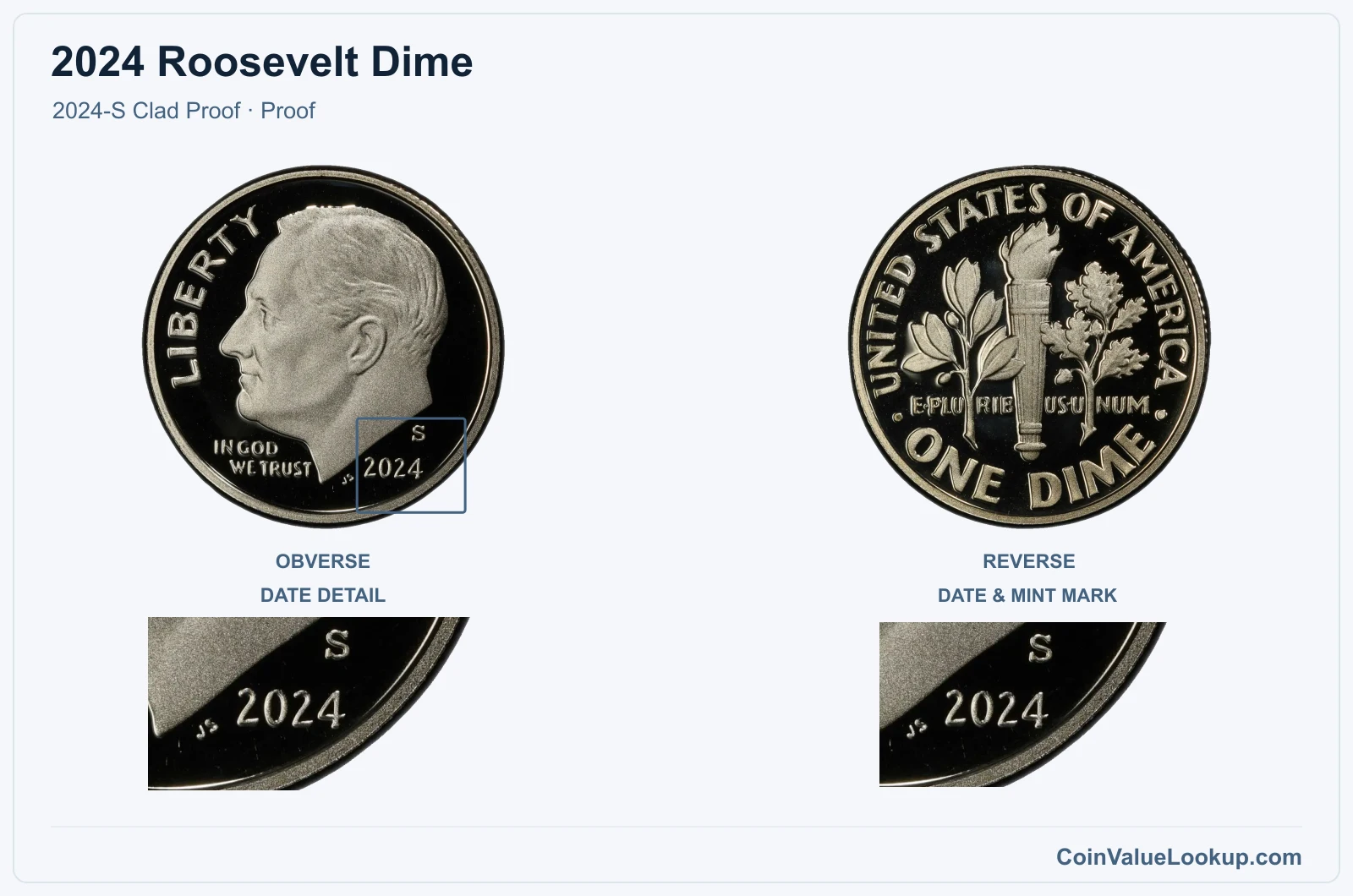
The 2024-S clad proof is struck at San Francisco with polished dies on a copper-nickel clad planchet. It weighs 2.27 grams, the same as a business strike, and contains no silver.
This is an important distinction because many collectors assume every S-mint proof is silver.
Check the edge. If you see a copper-toned layer sandwiched between silvery outer layers, it is clad.
The USA Coin Book guide places the PR65 value at $3.08. These are typically sold in annual proof sets, and coins kept in their original government packaging tend to grade better than those removed and handled.
Range Grade
Price Auction Records Appraisal PR PR 1
—
Coin Identifier
PR 2
—
Coin Identifier
PR 3
—
Coin Identifier
PR 4
—
Coin Identifier
PR 6
—
Coin Identifier
PR 8
—
Coin Identifier
PR 10
—
Coin Identifier
PR 12
—
Coin Identifier
PR 15
—
Coin Identifier
PR 20
—
Coin Identifier
PR 25
—
Coin Identifier
PR 30
—
Coin Identifier
PR 35
—
Coin Identifier
PR 40
—
Coin Identifier
PR 45
—
Coin Identifier
PR 50
—
Coin Identifier
PR 53
—
Coin Identifier
PR 55
—
Coin Identifier
PR 58
—
Coin Identifier
PR 60
—
Coin Identifier
PR 61
—
Coin Identifier
PR 62
—
Coin Identifier
PR 63
—
Coin Identifier
PR 64
—
Coin Identifier
PR 65
—
Coin Identifier
PR 66
—
Coin Identifier
PR 67
—
Coin Identifier
PR 68
—
Coin Identifier
PR 69
—
Coin Identifier
PR 70
—
Coin Identifier
2024 Roosevelt Dime — S Silver Proof
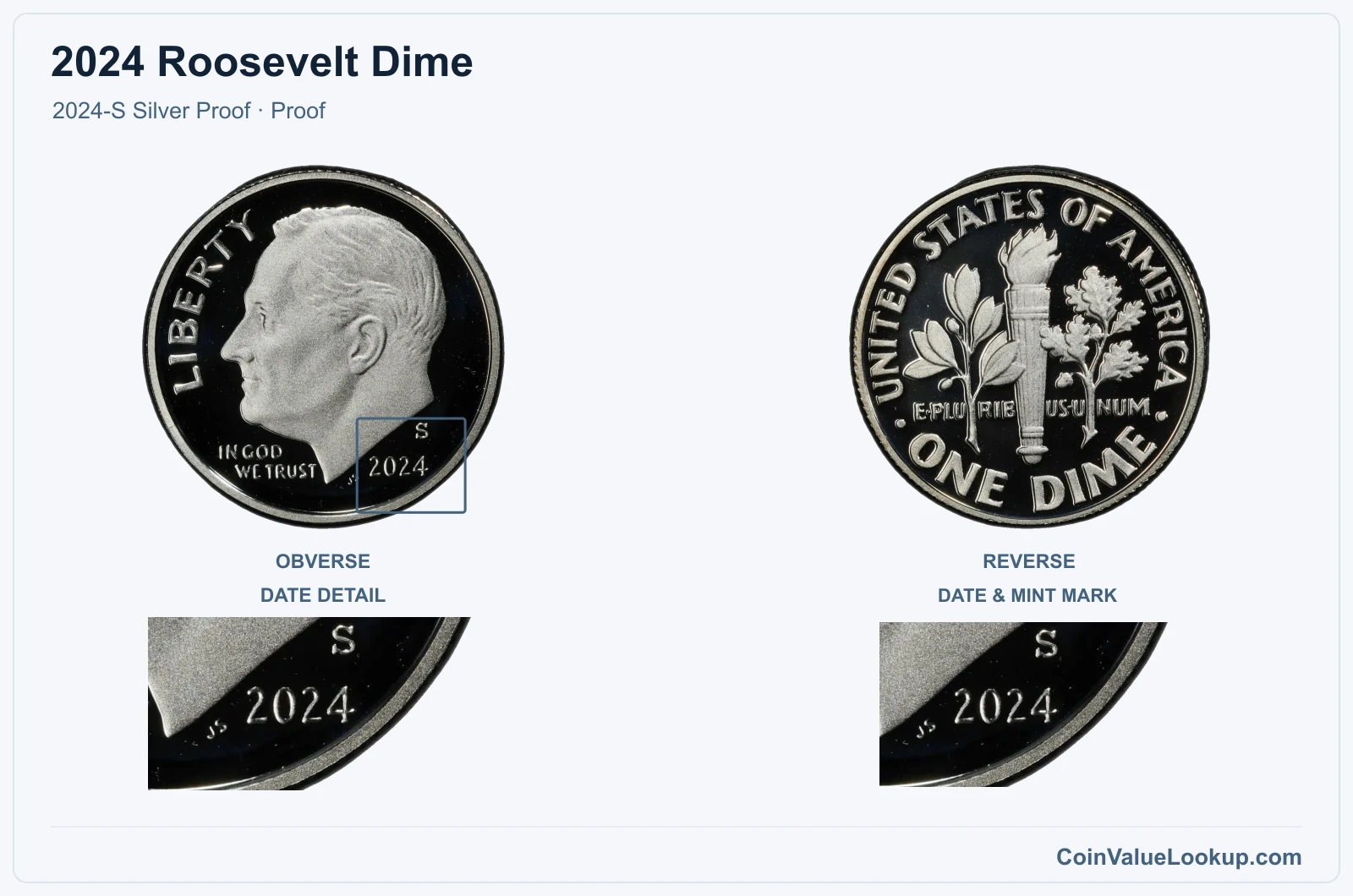
This is the premium version: a 2024-S dime struck in .999 fine silver at San Francisco. It weighs a nominal 2.537 grams, noticeably heavier than the 2.27-gram clad issues, and its edge will appear uniformly silver in color with no copper stripe.
The .999 purity standard began in 2019, replacing the older 90% silver composition used in earlier silver proof sets. Do not apply pre-2019 weights or alloy descriptions to this coin.
The USA Coin Book guide lists PR65 at $14, making it the highest-valued standard issue among 2024 dimes at that grade level. Original mint packaging helps preserve the mirror surfaces these proofs are known for.
Range Grade
Price Auction Records Appraisal PR PR 1
—
Coin Identifier
PR 2
—
Coin Identifier
PR 3
—
Coin Identifier
PR 4
—
Coin Identifier
PR 6
—
Coin Identifier
PR 8
—
Coin Identifier
PR 10
—
Coin Identifier
PR 12
—
Coin Identifier
PR 15
—
Coin Identifier
PR 20
—
Coin Identifier
PR 25
—
Coin Identifier
PR 30
—
Coin Identifier
PR 35
—
Coin Identifier
PR 40
—
Coin Identifier
PR 45
—
Coin Identifier
PR 50
—
Coin Identifier
PR 53
—
Coin Identifier
PR 55
—
Coin Identifier
PR 58
—
Coin Identifier
PR 60
—
Coin Identifier
PR 61
—
Coin Identifier
PR 62
—
Coin Identifier
PR 63
—
Coin Identifier
PR 64
—
Coin Identifier
PR 65
—
Coin Identifier
PR 66
—
Coin Identifier
PR 67
—
Coin Identifier
PR 68
—
Coin Identifier
PR 69
—
Coin Identifier
PR 70
—
Coin Identifier
2024 Roosevelt Dime Error List
1. 2024 Roosevelt Dime — Doubled Die Obverse
A doubled die obverse on a 2024 dime would show consistent doubling of design elements, typically visible as separation or notching on letters, the date, or Roosevelt's profile. The key word is consistent: every affected element shifts in the same direction and by a similar amount.
To check, compare your coin's obverse lettering under magnification with a normal 2024 dime photographed in the same lighting. Machine doubling, which is flat and shelf-like, is far more common and much less desirable.
True hub doubling produces raised, distinct secondary outlines rather than a mushy shelf.
No specific confirmed 2024 doubled die specimen with an adopted price was available for this guide. Value depends on the strength and location of the doubling, the coin's overall condition, and professional authentication.
2. 2024 Roosevelt Dime — Off-Center Strike
An off-center strike happens when the planchet is not properly seated between the dies. The result is a design that is shifted to one side, leaving a blank crescent where no detail was impressed.
The more dramatic the shift and the more of the date that remains visible, the more a collector will care about it.
Do not confuse an off-center strike with a misaligned die, which still shows a complete design but with uneven rim widths. Also rule out post-mint damage where someone physically flattened or bent the coin after it left the press.
No specific confirmed 2024 off-center specimen with an adopted price was available here. Condition, degree of off-center shift, and date visibility all influence what such a coin might bring at individual assessment.
3. 2024 Roosevelt Dime — Die Crack / Die Chip
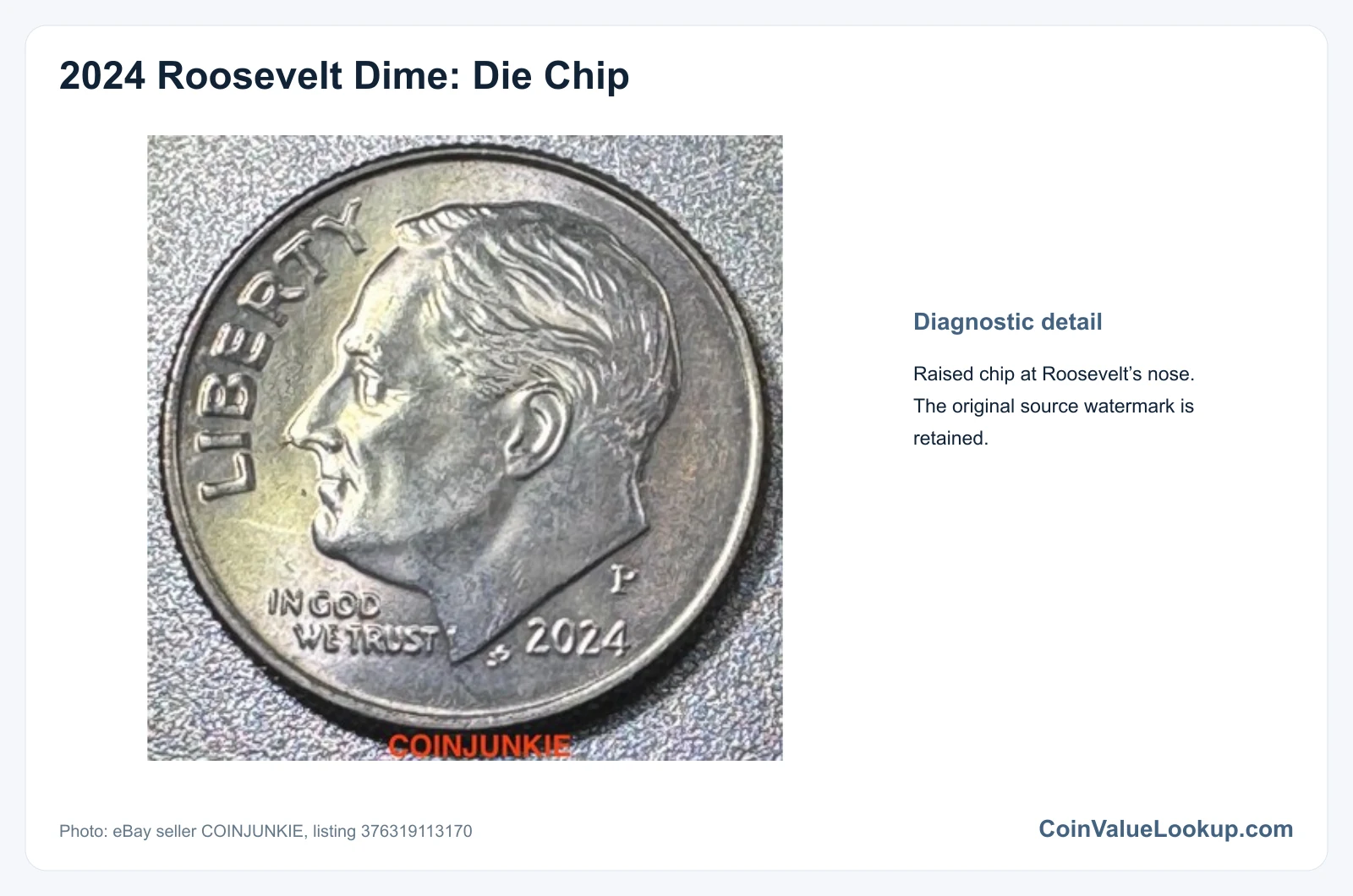
Die cracks and die chips are raised features caused by a failing die. A crack appears as a thin raised line running across the coin's surface, sometimes connecting design elements to the rim.
A die chip shows up as a small raised blob, often inside letters or closed areas of the design.
These are different from scratches, which are incuse, cut into the surface. A die crack or chip is always raised above the field because it represents metal that filled a void in the broken die.
Look at the coin under good side lighting and feel the surface gently.
No confirmed 2024 die chip specimen with an adopted price was available for this entry. The size, location and overall coin condition determine what any individual piece is worth, and professional authentication is the standard approach.
4. 2024 Roosevelt Dime — Struck-Through Error
A struck-through error occurs when foreign material, often grease or debris, sits between the die and the planchet during striking. The result is a localized area where design detail is missing, weak, or shows an impression of whatever was trapped.
Grease-filled dies are the most common variety and usually affect individual letters or small areas. A retained foreign object struck into the surface is less common and typically more interesting to error collectors.
Do not confuse a struck-through area with normal circulation wear, cleaning, or a weakly struck coin. Wear affects high points progressively; a struck-through area can appear in a field or low-relief zone.
No confirmed 2024 struck-through specimen with an adopted price was available. Each piece needs individual assessment based on the type of obstruction, affected area and overall preservation.
5. 2024 Roosevelt Dime — Broadstrike
A broadstrike results when a coin is struck without the retaining collar that normally forms the rim and controls the diameter. The coin spreads outward, producing a wider-than-normal piece with a complete or nearly complete design but no proper raised rim.
Check the edge profile carefully. A broadstruck coin will have a flat, spread edge rather than the defined reeded or plain edge the collar would create.
Roosevelt dimes have a reeded edge, so a smooth or irregular edge combined with an oversized diameter is a strong indicator.
Rule out post-mint flattening, which compresses the design and may look similar at a glance but typically shows distorted detail rather than a cleanly spread strike. No confirmed 2024 broadstrike with an adopted price was found.
Value depends on how complete the design remains and the coin's overall condition.
6. 2024 Roosevelt Dime — Clipped Planchet
A clipped planchet error means the coin blank was incomplete before it was struck. The clip can be curved, straight or irregular, depending on how the blank was cut from the metal strip.
A genuine clip usually produces a corresponding area of weakness in the design on the opposite side of the coin, called the Blakesley effect.
Check the edge carefully. A real clip has smooth, consistent metal flow at the boundary, not tool marks, file lines or corrosion pitting.
If it looks like someone took a pair of snips to it after the fact, it probably is exactly that.
No confirmed 2024 clipped planchet specimen with an adopted price was available. The size and type of clip, the coin's remaining detail and professional verification all matter for individual assessment.
7. 2024 Roosevelt Dime — Lamination / Split Planchet
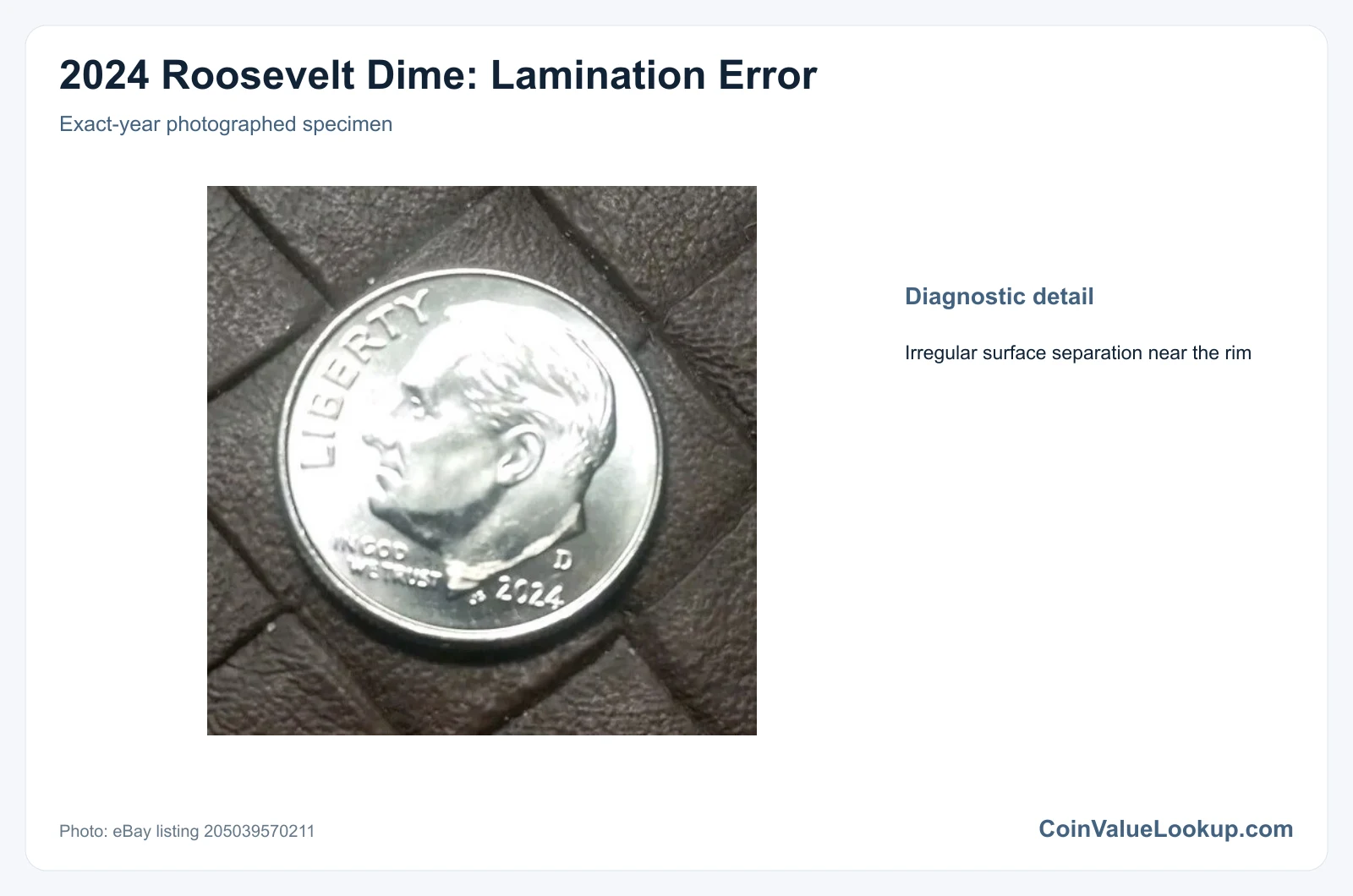
A lamination error shows as peeling, flaking or separation within the metal of the planchet itself. You might see a retained flap of metal that lifts away from the surface, or a missing layer exposing a different-colored area underneath.
These result from impurities or voids trapped in the strip metal before the blank was punched and struck.
Photograph both the affected face and the edge of the coin together. The edge view can reveal whether the separation runs through the interior of the planchet or is only surface-deep.
Do not confuse lamination with post-mint scraping, environmental corrosion or intentional alteration. Genuine lamination follows the contour of the coin and has a natural, layered appearance.
No confirmed 2024 lamination specimen with an adopted price was available. Individual assessment by a professional service is the best path for these.