1822 Capped Bust Half Dollar Coin Value: How Much Is It Worth?
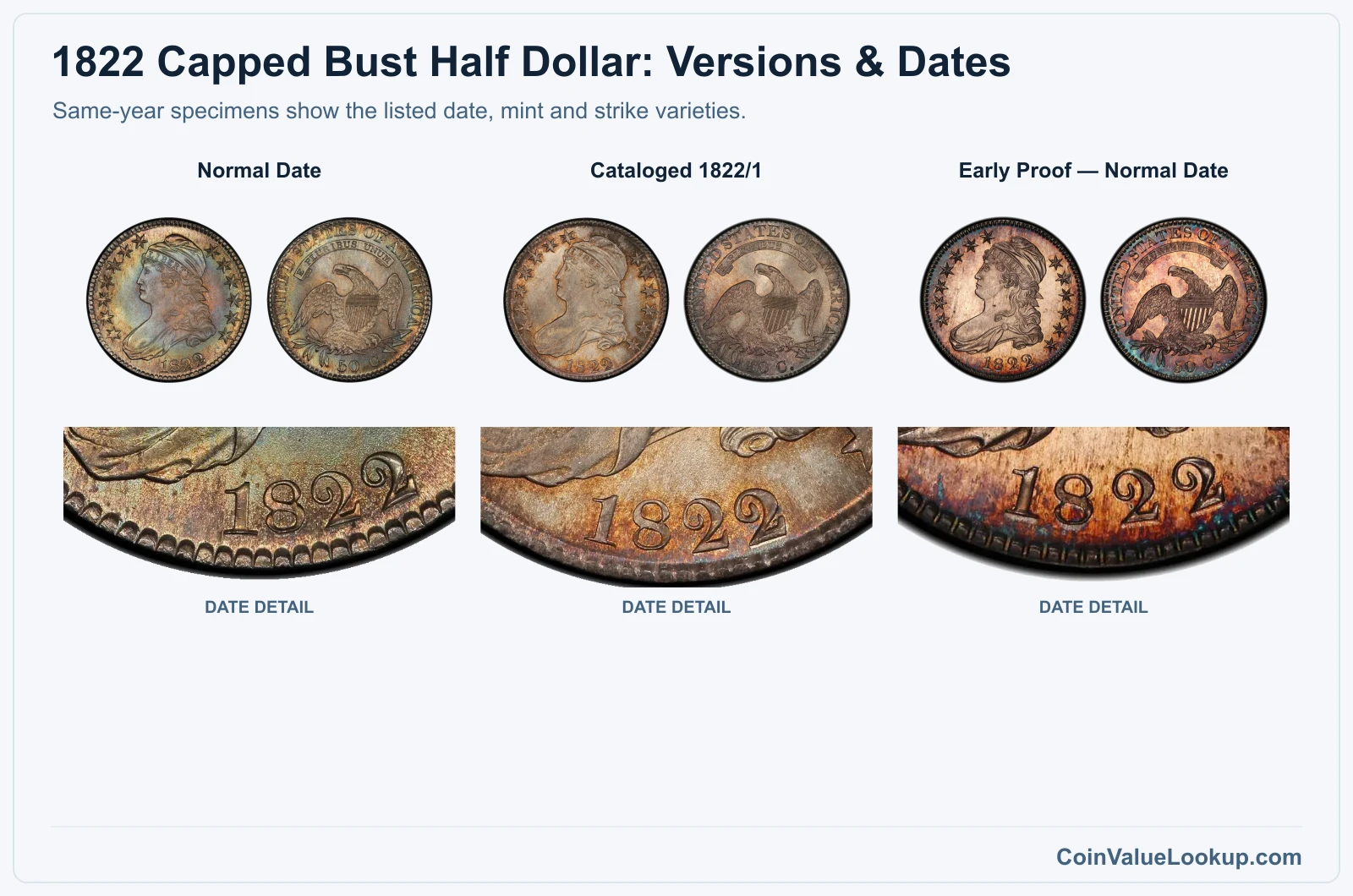
A circulated 1822 Capped Bust Half Dollar in the Normal Date variety runs roughly $106 in Good-4 condition up to around $631 near About Uncirculated-50, based on USA Coin Book retail estimates. Your coin's actual value depends heavily on its grade and which variety it turns out to be — the cataloged 1822/1 commands a meaningful premium, and a rare early Proof is in a different league entirely.
Fast Way to Identify Your 1822 Capped Bust Half Dollar
The quickest way to start figuring out what you have is to upload clear photos of both the front and back of your coin. Our identifier can give you a preliminary read on the year, design type, and likely variety.
It is not a substitute for professional certification, but it is a solid first step before diving deeper.
1822 Capped Bust Half Dollar Value
Upload both sides of your 1822 Capped Bust Half Dollar.
Front Obverse
Upload photo
Back Reverse
Upload photo
Which 1822 Capped Bust Half Dollar Versions Are Worth Money?
- The cataloged 1822/1 variety shows a recut or irregular final digit in the date and carries a significant premium over the Normal Date across all grades.
- An early Proof 1822 half dollar is a rare specialist issue; one graded PR-64 sold for $60,000 at Heritage Auctions in August 2022.
- Straight-graded examples in any variety are worth considerably more than coins with damage or cleaning details.
Step 1: Identify Your 1822 Capped Bust Half Dollar Mint Mark and Version
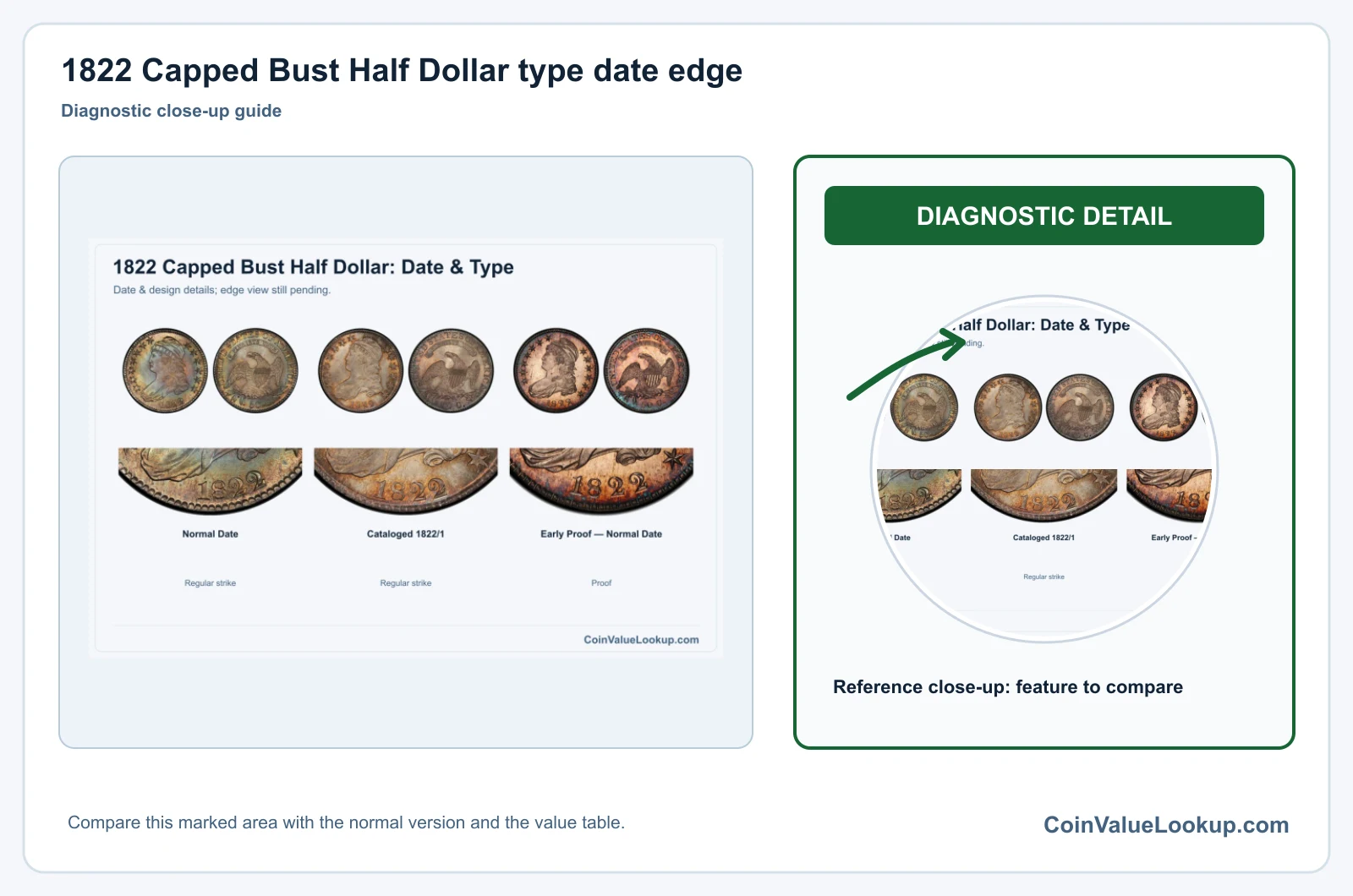
Every 1822 Capped Bust Half Dollar was struck at Philadelphia. There is no mintmark to look for, so do not worry about searching for one.
The obverse shows Liberty facing left, wearing a cap with a ribbon. The reverse displays an eagle holding arrows and an olive branch behind a shield, with "50 C" below.
The edge is lettered: FIFTY CENTS OR HALF A DOLLAR.
The coin is struck in a silver-copper alloy of approximately 89.24% silver, with a nominal weight of 13.48 grams and a diameter of 32.5 mm. A correct weight is consistent with the type but cannot authenticate a coin on its own.
The key identification task is examining the final digit of the date. On the Normal Date, the "2" appears cleanly formed.
On the cataloged 1822/1, that final "2" looks recut or irregularly shaped. Specialists have debated whether this variety truly shows an underlying "1" beneath the "2" or is simply an oddly punched digit.
Regardless of the mechanism, the variety is well-established in major catalogs under the 1822/1 label, and it trades at different prices.
If your coin looks unusually reflective, do not assume it is a Proof. Early Proof attribution requires specialist-level die identification, surface analysis, and provenance evidence.
Shiny or prooflike surfaces on a regular strike do not make it a Proof.
Step 2: Check Your 1822 Capped Bust Half Dollar Grade
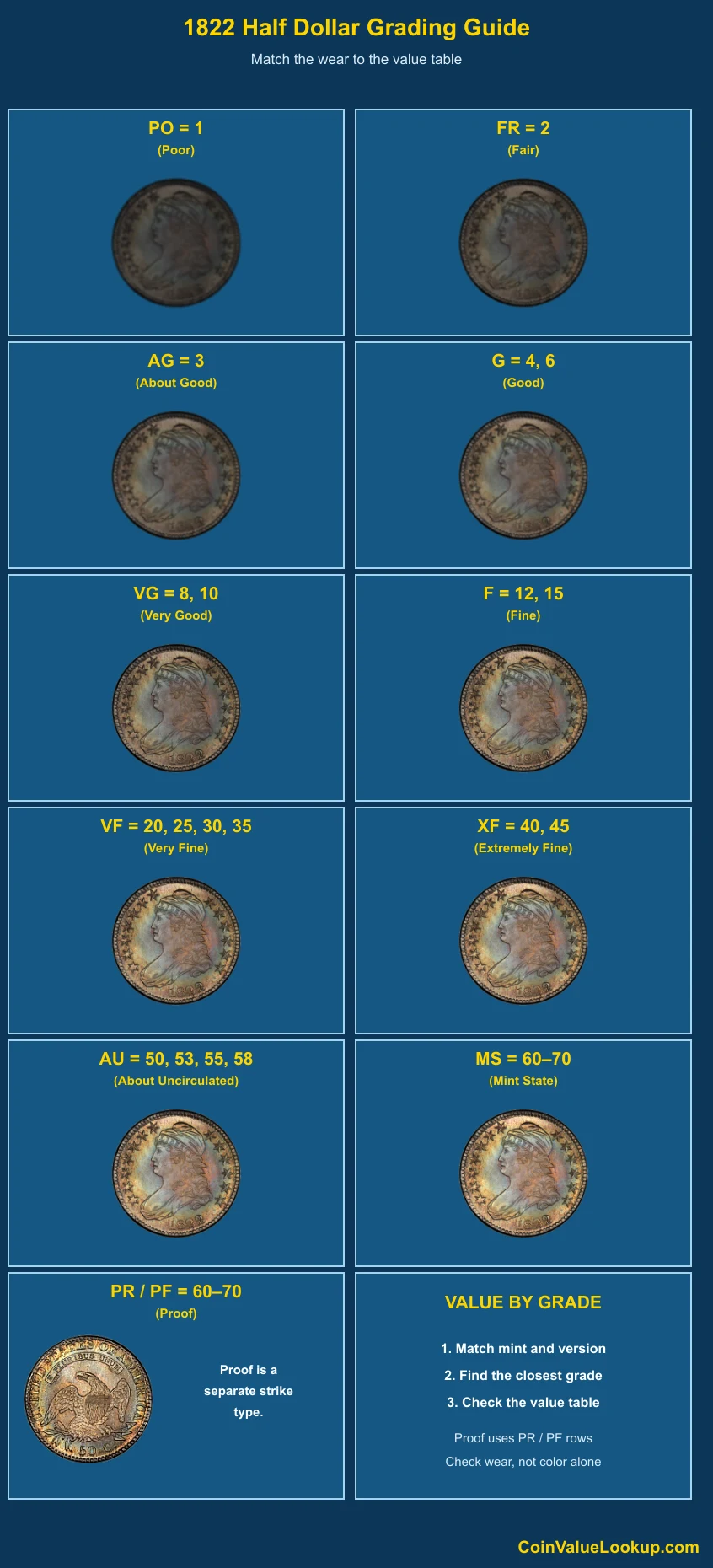
Start at the obverse and check Liberty's hair above her forehead and around her ear. In lower grades like Good-4, those curls are mostly flat and blended together.
By Very Fine-20, you should see distinct separation in the hair strands, though the highest points still show smoothing.
The cheek and cap are next. A coin grading About Uncirculated-50 will have only the faintest friction on these high points, with most original luster still visible in the fields.
Compare your coin to the reference image on this page to gauge where it falls.
On the reverse, look at the eagle's breast feathers and wing tips. These areas wore quickly in circulation, but they could also come weakly struck from the mint.
If the luster around the questionable area is still intact, the softness may be from the original strike rather than wear.
Coins that have been cleaned, holed, tooled, or scratched will receive a "Details" grade from major services, and their values fall well below straight-graded examples. If your coin has an unnatural shine or hairline scratches visible under light, resist any urge to clean it further — that only makes things worse.
Step 3: Check 1822 Capped Bust Half Dollar Value by Mint and Version
1822 Capped Bust Half Dollar — Normal Date
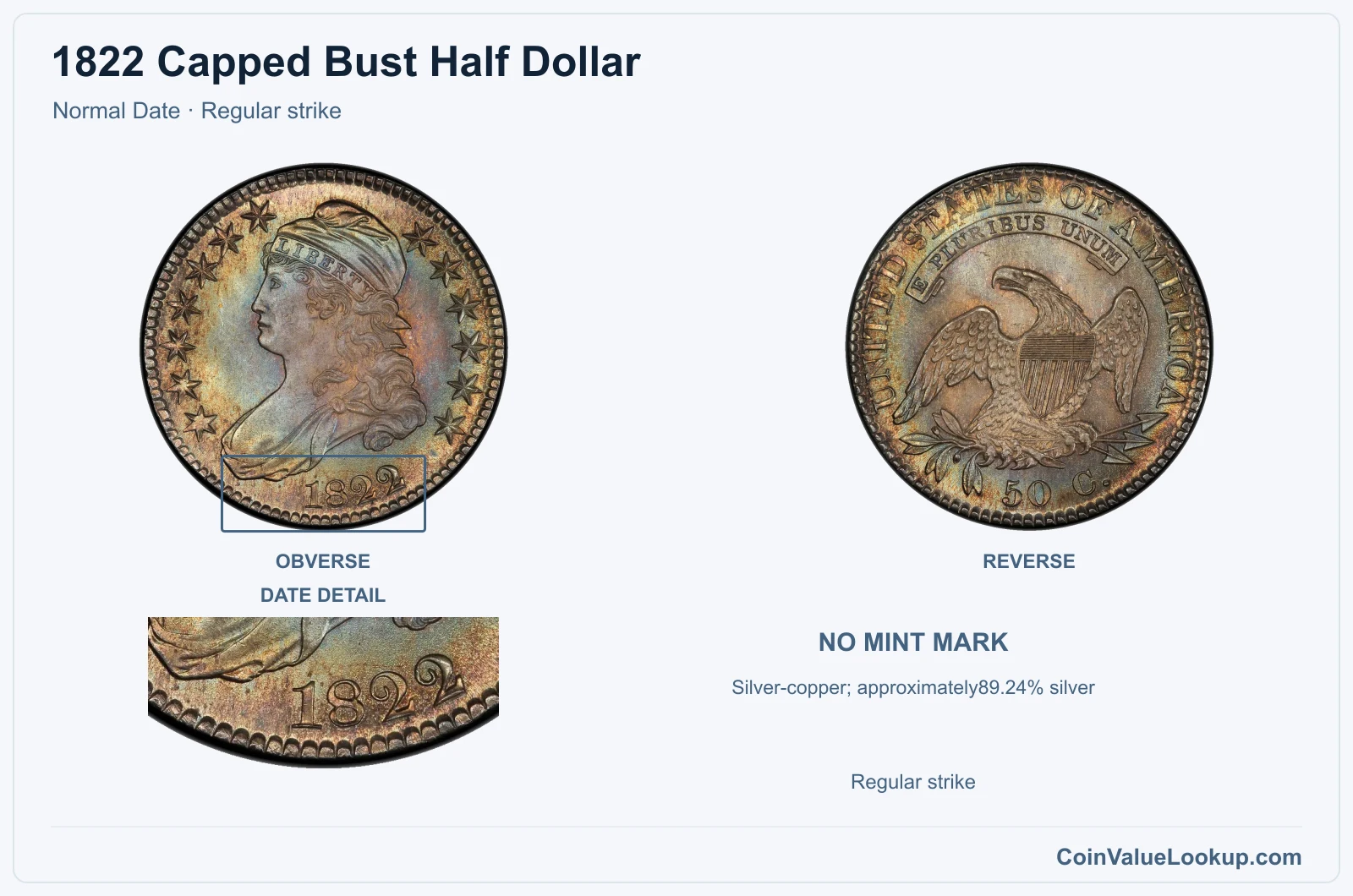
The Normal Date 1822 is the baseline variety. Its final "2" in the date is cleanly formed without the irregularities seen on the cataloged 1822/1.
Before pricing your coin at Normal Date levels, compare that last digit carefully — a small premium is riding on the distinction.
USA Coin Book retail estimates place the Normal Date at about $106 in Good-4, $212 in Very Fine-20, and $631 in About Uncirculated-50. These are guide figures, not guaranteed offers, and actual transaction prices depend on eye appeal, strike quality, and whether the coin grades straight or with details.
Range Grade
Price Auction Records Appraisal PO PO 1
Coin Identifier FR FR 2
—
Coin Identifier AG AG 3
—
Coin Identifier G G 4
—
Coin Identifier
G 6
Coin Identifier VG VG 8
Coin Identifier
VG 10
Coin Identifier F F 12
Coin Identifier
F 15
Coin Identifier VF VF 20
Coin Identifier
VF 25
Coin Identifier
VF 30
Coin Identifier
VF 35
Coin Identifier XF XF 40
Coin Identifier
XF 45
Coin Identifier AU AU 50
Coin Identifier
AU 53
Coin Identifier
AU 55
Coin Identifier
AU 58
Coin Identifier MS MS 60
—
Coin Identifier
MS 61
Coin Identifier
MS 62
Coin Identifier
MS 63
Coin Identifier
MS 64
Coin Identifier
MS 65
Coin Identifier
MS 66
Coin Identifier
MS 67
Coin Identifier
MS 68
—
—
—
MS 69
—
—
—
MS 70
—
—
—
1822 Capped Bust Half Dollar — Cataloged 1822/1
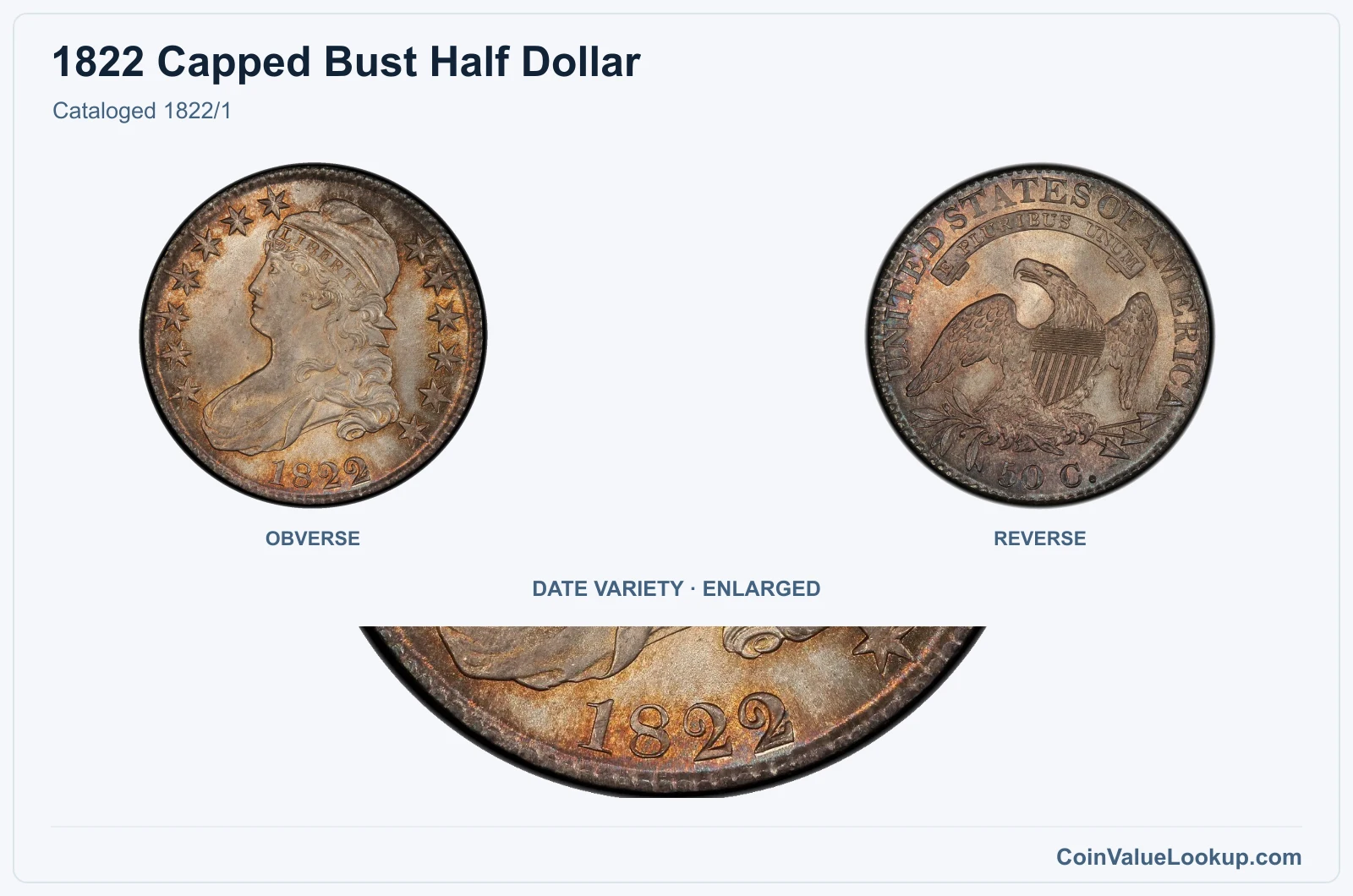
The cataloged 1822/1 is one of the more interesting Capped Bust half dollar varieties. Major services list it under the "1822/1" overdate label, but the story is more nuanced than that name suggests.
Specialists have disputed whether the final digit genuinely conceals an underlying "1" or whether the "2" was simply recut or punched irregularly. What everyone agrees on is that the final digit looks different from the Normal Date — it may appear thicker, oddly shaped, or show traces of a secondary impression.
Coin Value Lookup is a useful starting point if you want to compare this and other Capped Bust half dollar dates and varieties side by side.
USA Coin Book estimates come in noticeably higher than the Normal Date: roughly $142 at Good-4, $300 at Very Fine-20, and $1,363 at About Uncirculated-50. That AU-50 figure is more than double the Normal Date equivalent, so getting the attribution right matters.
Range Grade
Price Auction Records Appraisal PO PO 1
—
Coin Identifier FR FR 2
—
Coin Identifier AG AG 3
—
Coin Identifier G G 4
—
Coin Identifier
G 6
—
Coin Identifier VG VG 8
Coin Identifier
VG 10
Coin Identifier F F 12
Coin Identifier
F 15
—
Coin Identifier VF VF 20
Coin Identifier
VF 25
Coin Identifier
VF 30
Coin Identifier
VF 35
Coin Identifier XF XF 40
Coin Identifier
XF 45
Coin Identifier AU AU 50
Coin Identifier
AU 53
Coin Identifier
AU 55
Coin Identifier
AU 58
Coin Identifier MS MS 60
—
Coin Identifier
MS 61
Coin Identifier
MS 62
Coin Identifier
MS 63
Coin Identifier
MS 64
Coin Identifier
MS 65
Coin Identifier
MS 66
Coin Identifier
MS 67
—
—
—
MS 68
—
—
—
MS 69
—
—
—
MS 70
—
—
—
1822 Capped Bust Half Dollar — Early Proof — Normal Date
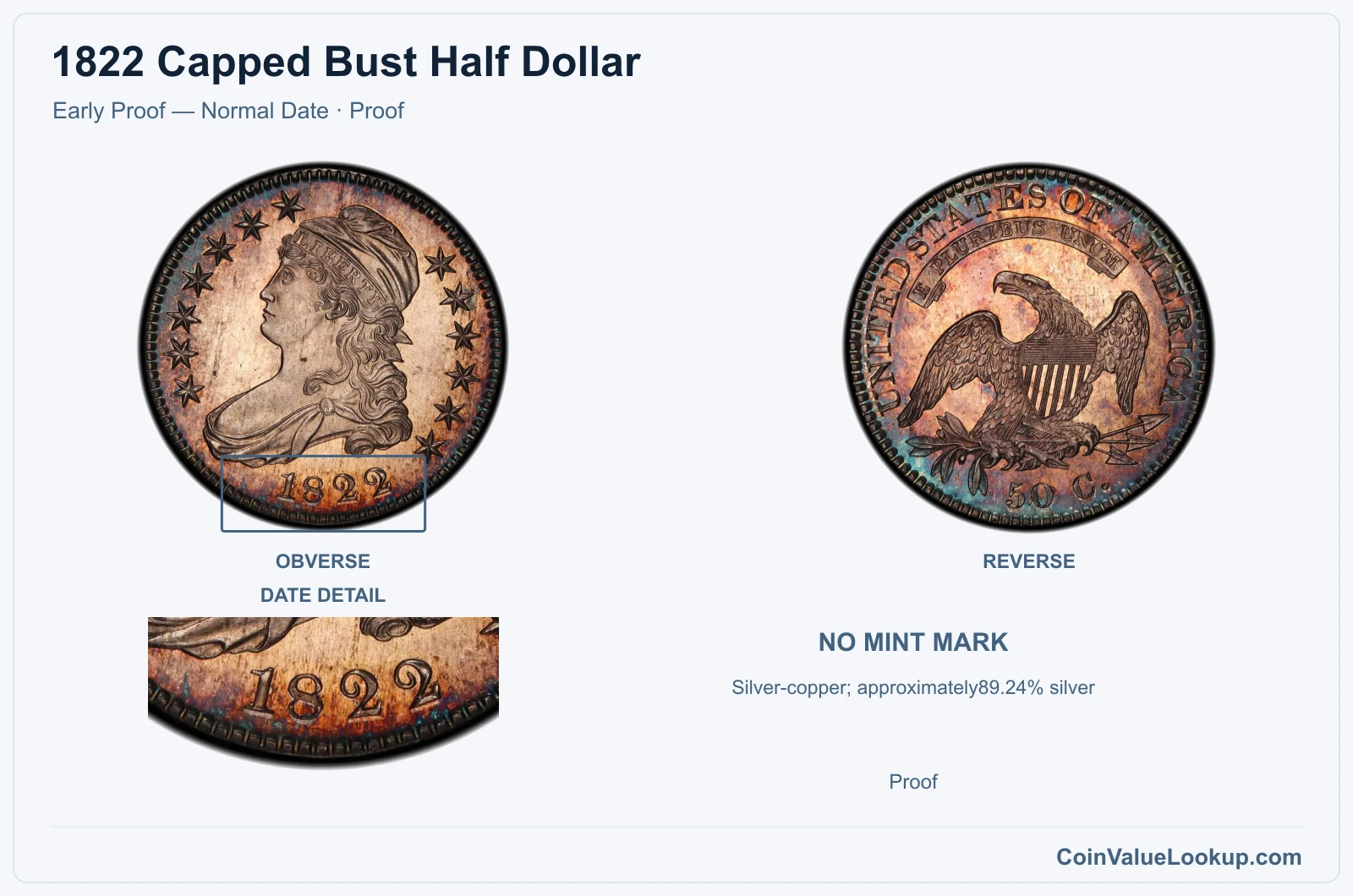
The early Proof 1822 Capped Bust Half Dollar is a rare bird. These were specially manufactured coins, distinct from circulation strikes in their die preparation and surface finish.
Proof here refers to how the coin was made, not a grade above Mint State.
PCGS separately catalogs this issue, and attribution requires specialist-level evidence: die state analysis, surface characteristics consistent with Proof manufacture, and ideally documented provenance. A single historical sale provides context — a PR-64 example realized $60,000 at Heritage Auctions in August 2022.
That is one transaction, not a broad market range, and different grades or provenance histories would command very different figures.
If you think you might have one, professional certification is essential. Do not assume a reflective or well-preserved regular strike is a Proof.
Range Grade
Price Auction Records Appraisal PR PR 1
—
Coin Identifier
PR 2
—
Coin Identifier
PR 3
—
Coin Identifier
PR 4
—
Coin Identifier
PR 6
—
Coin Identifier
PR 8
—
Coin Identifier
PR 10
—
Coin Identifier
PR 12
—
Coin Identifier
PR 15
—
Coin Identifier
PR 20
—
Coin Identifier
PR 25
—
Coin Identifier
PR 30
—
Coin Identifier
PR 35
—
Coin Identifier
PR 40
—
Coin Identifier
PR 45
—
Coin Identifier
PR 50
—
Coin Identifier
PR 53
—
Coin Identifier
PR 55
—
Coin Identifier
PR 58
—
Coin Identifier
PR 60
—
Coin Identifier
PR 61
—
Coin Identifier
PR 62
—
Coin Identifier
PR 63
—
Coin Identifier
PR 64
Coin Identifier
PR 65
—
Coin Identifier
PR 66
—
—
—
PR 67
—
—
—
PR 68
—
—
—
PR 69
—
—
—
PR 70
—
—
—
1822 Capped Bust Half Dollar Error List
1. 1822 Capped Bust Half Dollar — Double / Multiple Strike
A double-struck or multiple-strike 1822 half dollar is a dramatic mint error where the coin received more than one impression from the dies, with the second strike partially displaced. The result is a visibly doubled or overlapping image of Liberty's portrait and the date on the obverse.
This is different from the recut digits seen on the cataloged 1822/1 variety — that is a die-preparation feature, not a striking error. A true double strike will show a complete second impression of major design elements, often with the portrait or lettering shifted noticeably from the first strike.
Also watch out for lookalikes: doubled dies, where the doubling is in the die itself rather than from a second strike, produce a different visual effect. Post-mint damage like contact marks can sometimes mimic doubling to an untrained eye.
No specific price range is available for this error on the 1822 date, as value depends on the severity of the displacement, overall condition, and specialist demand.
2. 1822 Capped Bust Half Dollar — Doubled Edge Lettering
Doubled edge lettering on an 1822 half dollar means the inscribed edge text — FIFTY CENTS OR HALF A DOLLAR — was impressed more than once or with visible overlap, producing duplicated characters along the coin's rim. Since Capped Bust halves received their edge lettering in a separate mechanical step before the obverse and reverse were struck, errors in that process are mechanically distinct from face design issues.
To check, roll the coin slowly on its edge under good light and look for ghost letters or overlapping impressions alongside the primary text. Compare what you see to a known normal example from the same year if possible.
Edge wear, post-mint scrapes, or minor design elements on well-circulated coins can mimic this error. A genuine doubled edge lettering example will show consistent duplication across multiple characters rather than random isolated marks.
No numerical price range is available for this specific error, as value depends on the clarity of the doubling and the coin's overall condition.