1832 Capped Bust Half Dollar Coin Value: How Much Is It Worth?
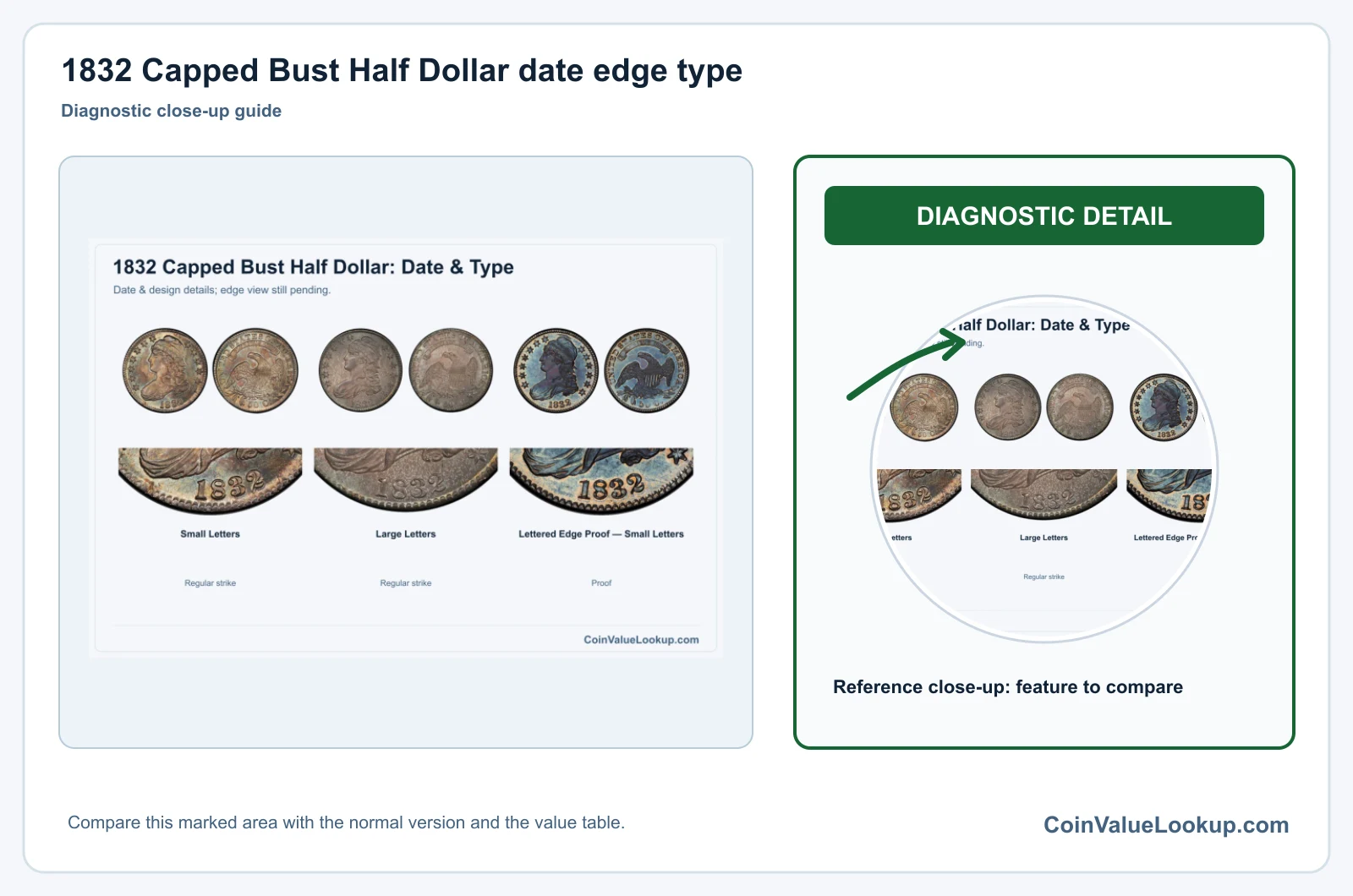
An 1832 Capped Bust Half Dollar in well-worn Good-4 condition carries a guide value around $100, climbing to roughly $487 at About Uncirculated-50 for the Small Letters variety. Grade and the exact reverse lettering version matter a lot here.
Rare Proof strikes and major die varieties sit in a different pricing universe entirely.
Fast Way to Identify Your 1832 Capped Bust Half Dollar
Snap a clear photo of the front and back of your 1832 half dollar and upload both images. Our identifier can give you a preliminary read on which version you likely have — Small Letters or Large Letters — based on the reverse design details.
From there you can zero in on a more accurate value range for your specific coin.
1832 Capped Bust Half Dollar Value
Upload both sides of your 1832 Capped Bust Half Dollar.
Front Obverse
Upload photo
Back Reverse
Upload photo
Which 1832 Capped Bust Half Dollar Versions Are Worth Money?
- Small Letters reverse — guide values from about $100 at G-4 to $487 at AU-50; the more common of the two regular versions but still a silver classic worth checking carefully.
- Large Letters reverse — guide values from about $100 at G-4 up to $517 at AU-50, slightly higher than Small Letters in top circulated grades.
- Lettered Edge Proof (Small Letters) — extremely rare; a single PR-65 example sold for $76,375 at Stack's Bowers in February 2016. Professional authentication is essential.
Step 1: Identify Your 1832 Capped Bust Half Dollar Mint Mark and Version
Every 1832 Capped Bust Half Dollar was struck at Philadelphia, so there is no mintmark to hunt for. The coin is about 32.5 mm across, weighs a nominal 13.48 grams, and is roughly 89.24% silver alloyed with copper.
The obverse shows Liberty wearing a cap, surrounded by stars. The reverse features an eagle with a shield, flanked by olive branch and arrows, with the denomination below.
Check the edge first. It should read FIFTY CENTS OR HALF A DOLLAR in raised lettering.
If the edge is reeded (grooved lines), you have a later type — not this one.
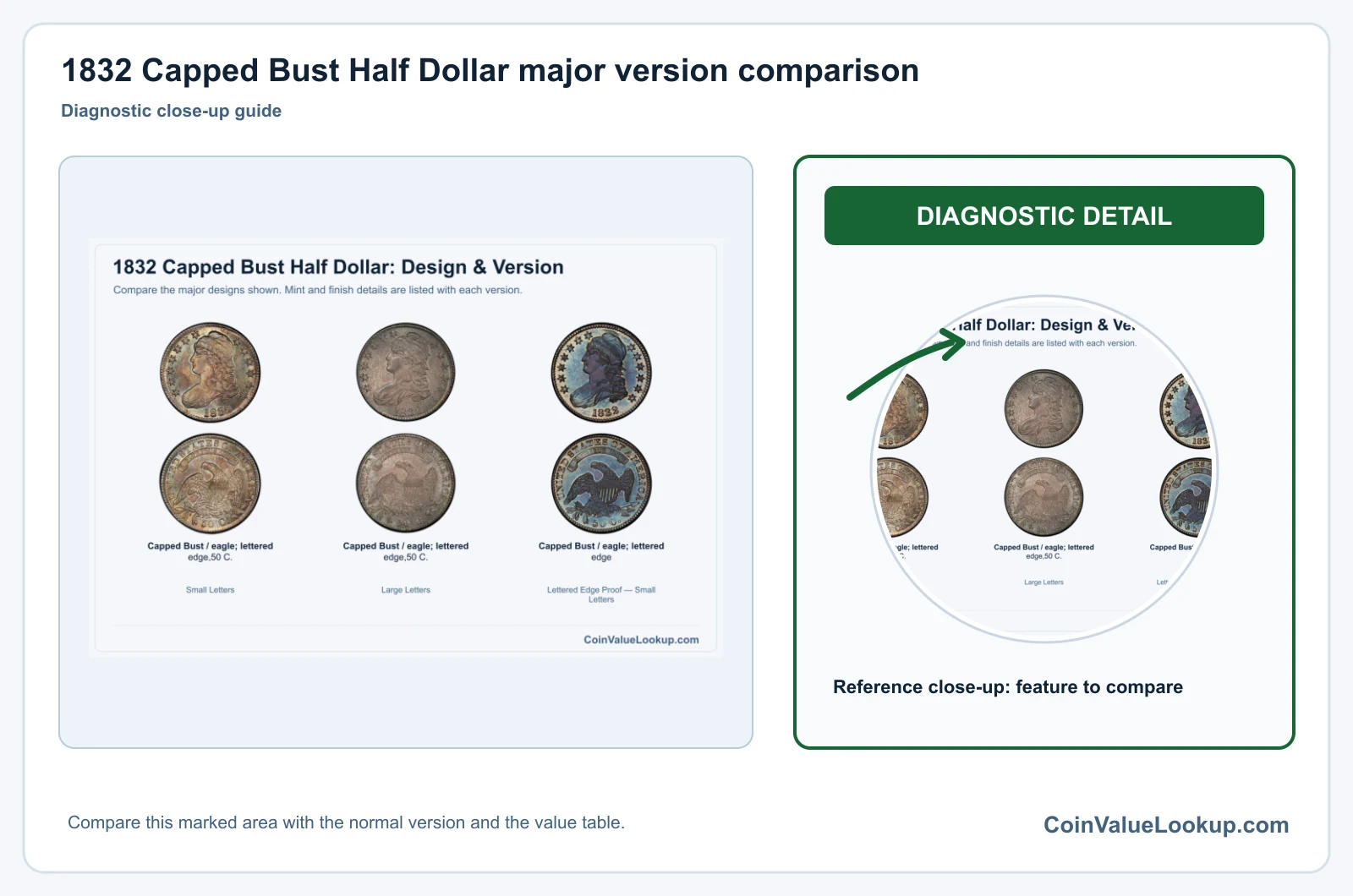
The main fork in the road is reverse letter size. Hold the coin at arm's length and compare the words UNITED STATES OF AMERICA.
Small Letters coins have noticeably thinner, more compact legend text, while Large Letters coins have bolder, wider characters. That single distinction separates the two regular circulation branches.
Proof status is a whole different animal. A shiny surface does not equal a Proof.
Polished or prooflike regular strikes exist, and only professional attribution can confirm a true Proof finish on an 1832 half dollar.
Step 2: Check Your 1832 Capped Bust Half Dollar Grade
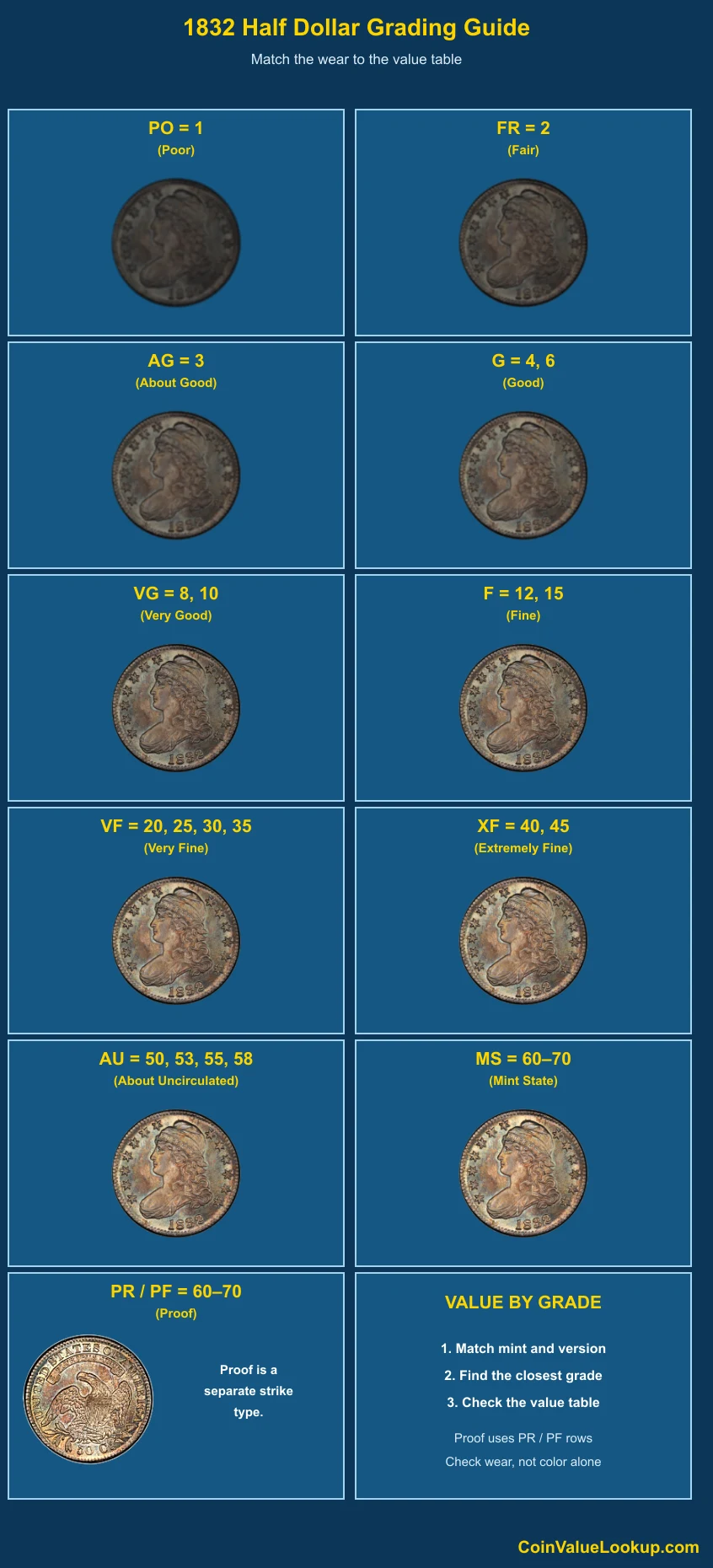
Start with Liberty's portrait. The highest points — the hair above her forehead, the cheek, and the top of the cap — lose detail first.
A coin grading Good-4 will show a clear outline of Liberty but most interior hair detail is gone.
At VF-20, you should see moderate wear on those high points, but major hair strands remain visible. The cap still shows some texture.
Flip it over: the eagle's breast feathers and wing tips will be partly flattened but readable.
AU-50 means only the slightest friction on the absolute peaks, with most original luster still present in protected areas. Compare your coin against the type-matched grading image to calibrate your eye.
Grade both sides independently and go with the lower one. Also note any cleaning, scratches, rim damage, or holes — these reduce value significantly even if the remaining detail looks sharp.
Bright, unnaturally shiny surfaces often indicate past cleaning rather than preservation.
Step 3: Check 1832 Capped Bust Half Dollar Value by Mint and Version
1832 Capped Bust Half Dollar — Small Letters
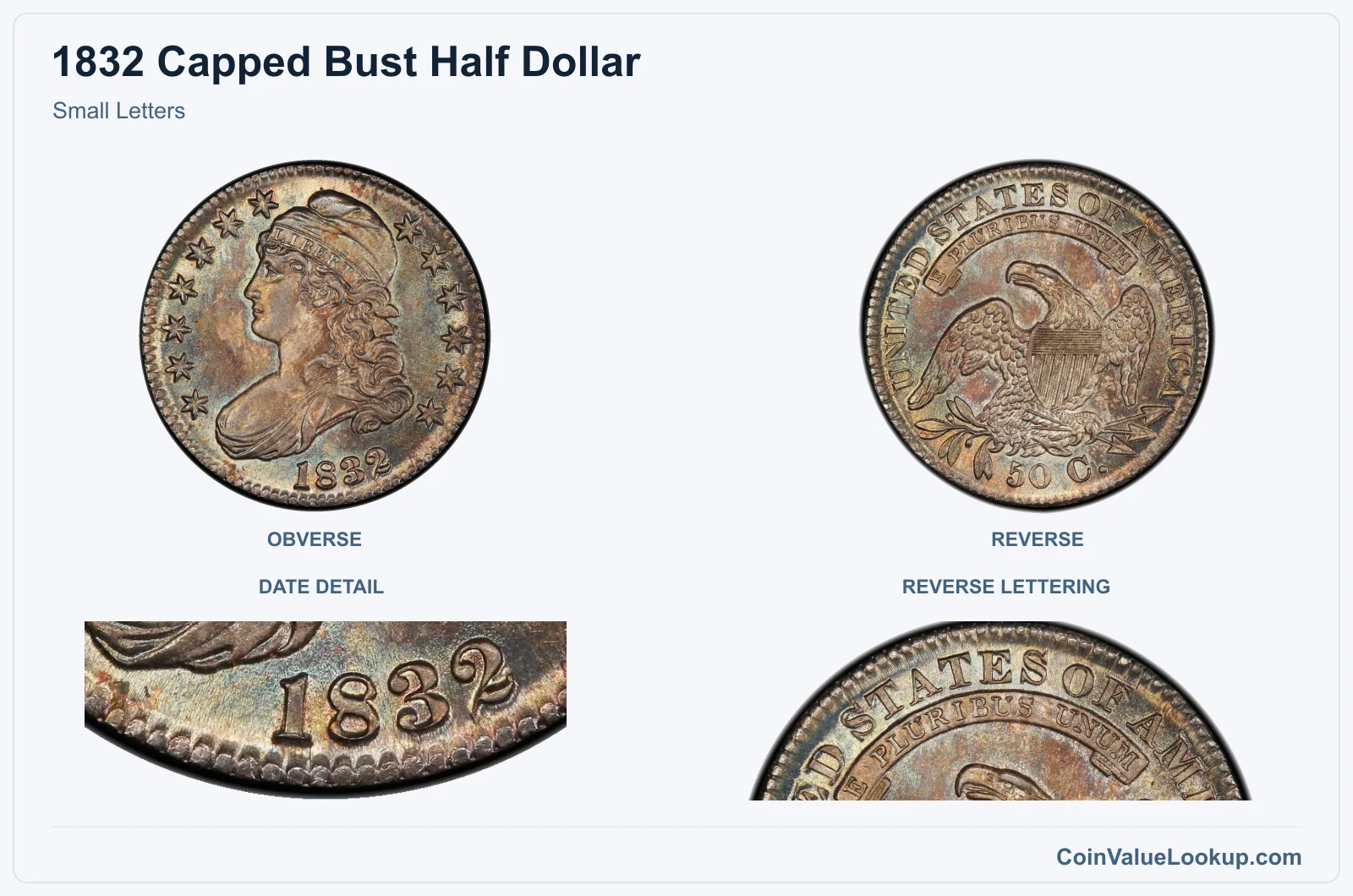
The Small Letters variety is identified by the comparatively thin, compact legend on the reverse. Look at UNITED STATES OF AMERICA and E PLURIBUS UNUM — the characters are narrower and more tightly spaced than on the Large Letters version.
Some late die states of the Small Letters variety show die cracks, which are interesting bonus features but do not create a separate mint issue. They are die-state markers, not distinct varieties for pricing purposes.
USA Coin Book guide estimates place this version at about $100 in G-4, $167 in VF-20, and $487 in AU-50. These are retail guide figures, not guaranteed sale prices.
Your coin's actual value depends on its precise grade, surface quality, and eye appeal.
Range Grade
Price Auction Records Appraisal PO PO 1
—
Coin Identifier FR FR 2
—
Coin Identifier AG AG 3
—
Coin Identifier G G 4
—
Coin Identifier
G 6
—
Coin Identifier VG VG 8
Coin Identifier
VG 10
—
Coin Identifier F F 12
Coin Identifier
F 15
Coin Identifier VF VF 20
Coin Identifier
VF 25
Coin Identifier
VF 30
Coin Identifier
VF 35
Coin Identifier XF XF 40
Coin Identifier
XF 45
Coin Identifier AU AU 50
Coin Identifier
AU 53
Coin Identifier
AU 55
Coin Identifier
AU 58
Coin Identifier MS MS 60
Coin Identifier
MS 61
Coin Identifier
MS 62
Coin Identifier
MS 63
Coin Identifier
MS 64
Coin Identifier
MS 65
Coin Identifier
MS 66
Coin Identifier
MS 67
Coin Identifier
MS 68
—
—
—
MS 69
—
—
—
MS 70
—
—
—
1832 Capped Bust Half Dollar — Large Letters
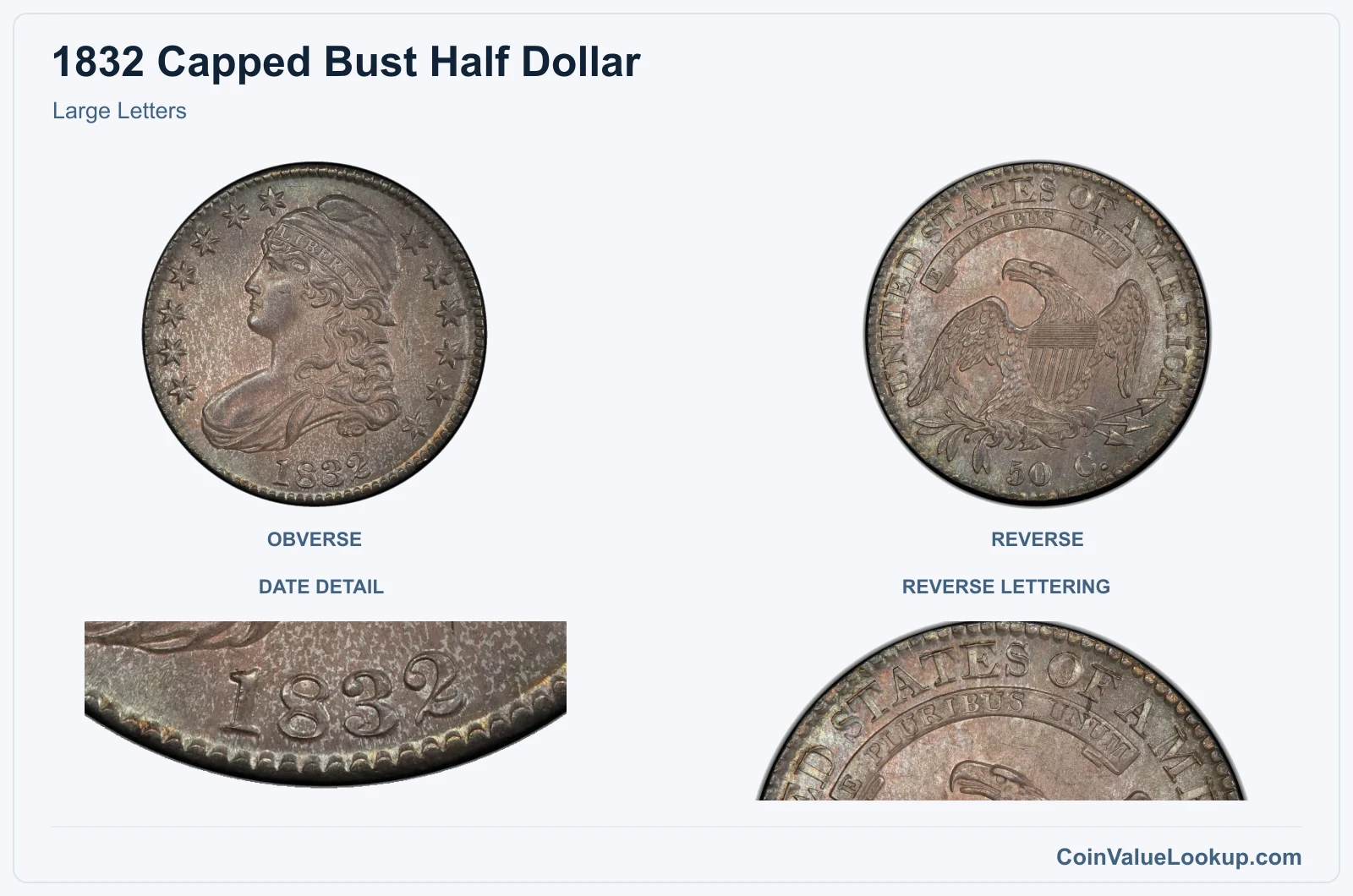
Large Letters coins announce themselves with bolder, wider reverse lettering. Side by side with a Small Letters example, the difference is obvious — individually it can be subtler, so compare reference images carefully.
A recognized die break near the left wing tip appears on some Large Letters specimens. That crack helps confirm the variety when present, but letter size remains the primary identifier whether or not the break shows on your particular coin.
Coin Value Lookup is a good starting point if you want to compare this variety against other Capped Bust half dollar dates and branches.
Guide estimates from USA Coin Book run about $100 at G-4, $152 at VF-20, and $517 at AU-50. The AU-50 figure edges above the Small Letters version, though at lower grades the two track closely.
Range Grade
Price Auction Records Appraisal PO PO 1
—
Coin Identifier FR FR 2
—
Coin Identifier AG AG 3
—
Coin Identifier G G 4
—
Coin Identifier
G 6
—
Coin Identifier VG VG 8
—
Coin Identifier
VG 10
—
Coin Identifier F F 12
—
Coin Identifier
F 15
Coin Identifier VF VF 20
Coin Identifier
VF 25
Coin Identifier
VF 30
Coin Identifier
VF 35
Coin Identifier XF XF 40
Coin Identifier
XF 45
Coin Identifier AU AU 50
Coin Identifier
AU 53
Coin Identifier
AU 55
Coin Identifier
AU 58
Coin Identifier MS MS 60
—
Coin Identifier
MS 61
Coin Identifier
MS 62
Coin Identifier
MS 63
Coin Identifier
MS 64
Coin Identifier
MS 65
—
Coin Identifier
MS 66
—
Coin Identifier
MS 67
—
—
—
MS 68
—
—
—
MS 69
—
—
—
MS 70
—
—
—
1832 Capped Bust Half Dollar — Lettered Edge Proof — Small Letters
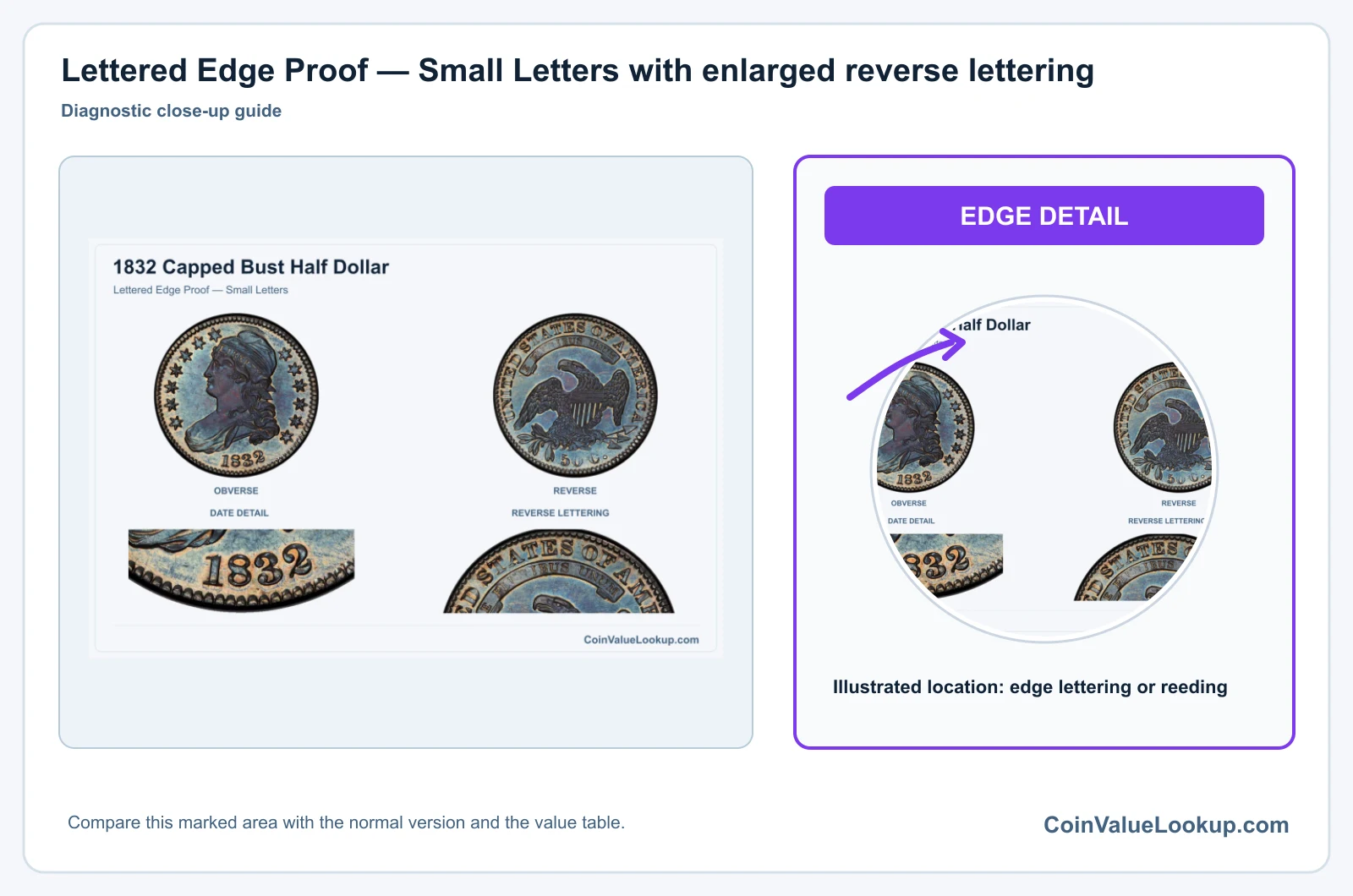
The 1832 Lettered Edge Proof in the Small Letters configuration is a genuine rarity. These were struck with polished dies on specially prepared planchets, producing mirror-like fields and sharp, squared rims that regular strikes simply do not match.
Do not assume your coin is a Proof because it looks shiny. Polished or prooflike circulation strikes exist for this date, and decades of careful storage can preserve luster on a regular coin.
True Proof attribution requires professional examination of surface characteristics, rim geometry, and die finish.
The only confirmed recent sale in the research is a PR-65 specimen that brought $76,375 at Stack's Bowers in February 2016. That is one historical transaction at one grade, not a current market curve.
If you genuinely suspect a Proof, submit the coin to a major grading service before drawing any conclusions about value.
Range Grade
Price Auction Records Appraisal PR PR 1
—
Coin Identifier
PR 2
—
Coin Identifier
PR 3
—
Coin Identifier
PR 4
—
Coin Identifier
PR 6
—
Coin Identifier
PR 8
—
Coin Identifier
PR 10
—
Coin Identifier
PR 12
—
Coin Identifier
PR 15
—
Coin Identifier
PR 20
—
Coin Identifier
PR 25
—
Coin Identifier
PR 30
—
Coin Identifier
PR 35
—
Coin Identifier
PR 55
—
Coin Identifier
PR 60
—
—
—
PR 61
—
—
—
PR 62
—
—
—
PR 63
Coin Identifier
PR 64
—
Coin Identifier
PR 65
Coin Identifier
PR 66
—
Coin Identifier
PR 67
—
—
—
PR 68
—
—
—
PR 69
—
—
—
PR 70
—
—
—
1832 Capped Bust Half Dollar Error List
1. 1832 Capped Bust Half Dollar — Defective Planchet
A defective planchet error means something went wrong with the silver blank before the dies struck it. On an 1832 Half Dollar, this can show up as irregular edges, surface voids, or areas where metal did not flow correctly during striking.
The Rippere collection cataloged an 1832 half dollar with a minor rim planchet defect, graded ANACS XF-45. That confirms this error category exists for the date, though each example varies in severity and location.
When examining your coin, look for disturbances that follow the metal's original surface rather than cutting into it. Post-mint gouges, corrosion pitting, and deliberate metal removal can mimic planchet problems but typically show sharper, more random edges without the surrounding metal-flow context of a genuine pre-strike defect.
No standard price range applies here. The value of a defective planchet coin depends on the error's size, visibility, and the coin's overall condition.
2. 1832 Capped Bust Half Dollar — Die Crack / Die Chip
Die cracks appear as thin raised lines on the coin's surface — metal filled the growing fracture in the steel die during striking. On certain late-state 1832 Small Letters half dollars, a crack runs below the date and across the portrait from roughly star 3 to star 12, with another connecting from star 5 to star 10.
These are well-documented die stages.
Raised lines are the key diagnostic. A genuine die crack sits above the coin's field because metal was forced into the crevice.
Scratches, by contrast, are incuse — they cut down into the surface. Corrosion trails and foreign material stuck to the surface can also fool a quick glance, so use magnification and check whether the line stands proud of the field.
No specific price premium can be quoted without knowing the crack's extent and the coin's grade. Dramatic, well-defined cracks on otherwise attractive coins tend to draw more collector interest than hairline fractures.