1806 Draped Bust Half Dollar Coin Value: How Much Is It Worth?
An 1806 Draped Bust Half Dollar is worth real money regardless of condition. Guide estimates for ordinary circulated examples run from about $300 at G4 to $4,960 at AU50, depending on the specific variety.
Collector demand goes well beyond face value and silver melt — special varieties and higher grades can push values substantially higher.
Fast Way to Identify Your 1806 Draped Bust Half Dollar
Upload clear photos of both sides of your coin and we can help with a preliminary identification of the variety and approximate condition. This is not authentication or certified grading, but it gives you a solid starting point.
Front and back images with even lighting work best, especially for checking the shape of the 6 and the reverse stem detail.
1806 Draped Bust Half Dollar Value
Upload both sides of your 1806 Draped Bust Half Dollar.
Front Obverse
Upload photo
Back Reverse
Upload photo
Which 1806 Draped Bust Half Dollar Versions Are Worth Money?
- Knobbed 6 — Stem Not Through Claw: A rare combination with guide values reaching six figures even in low grades, making it the variety most worth verifying on any knobbed-6 example.
- 6 over Inverted 6: Traces of an upside-down 6 beneath the final digit; guide estimates run from about $457 at G4 to over $10,000 at AU50.
- E over A in STATES: A reverse letter correction with values starting around $879 at G4 and climbing steeply in higher grades.
- 1806/5 — Large Stars: An overdate with a visible underlying 5; guide prices start near $395 at G4 and reach about $5,737 at AU50.
- Knobbed 6 — Small Stars: Slightly scarcer than its Large Stars sibling, with a G4 guide value around $332 versus $300.
Step 1: Identify Your 1806 Draped Bust Half Dollar Mint Mark and Version
Every 1806 half dollar was struck at Philadelphia, so no mintmark is expected — and none should be present. The design is Draped Bust obverse paired with the Heraldic Eagle reverse, with a lettered edge reading FIFTY CENTS OR HALF A DOLLAR.
Nominal specs are about 32.5 mm diameter and 13.48 g weight; weight helps screen out fakes but is not a substitute for proper authentication.
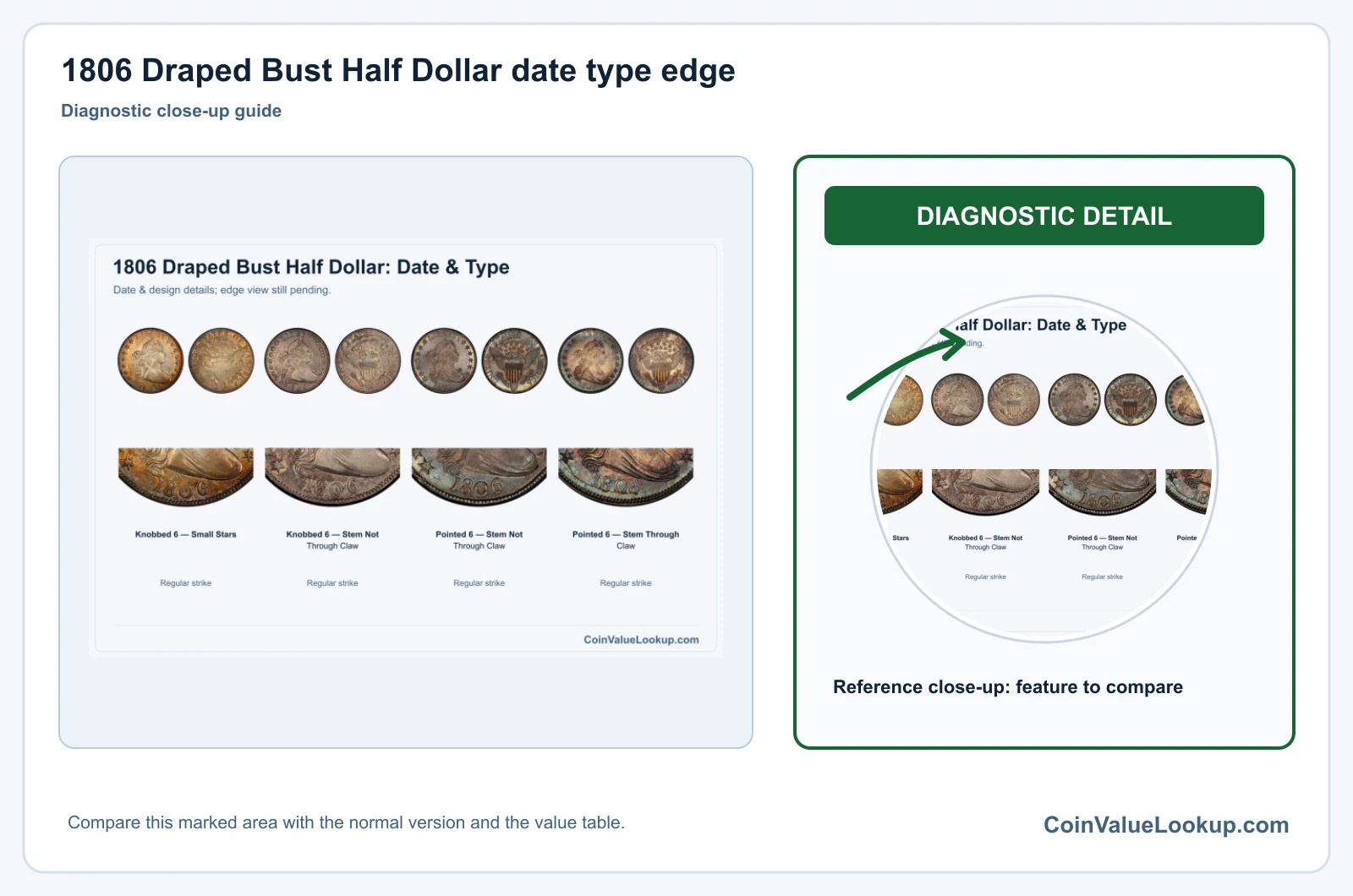
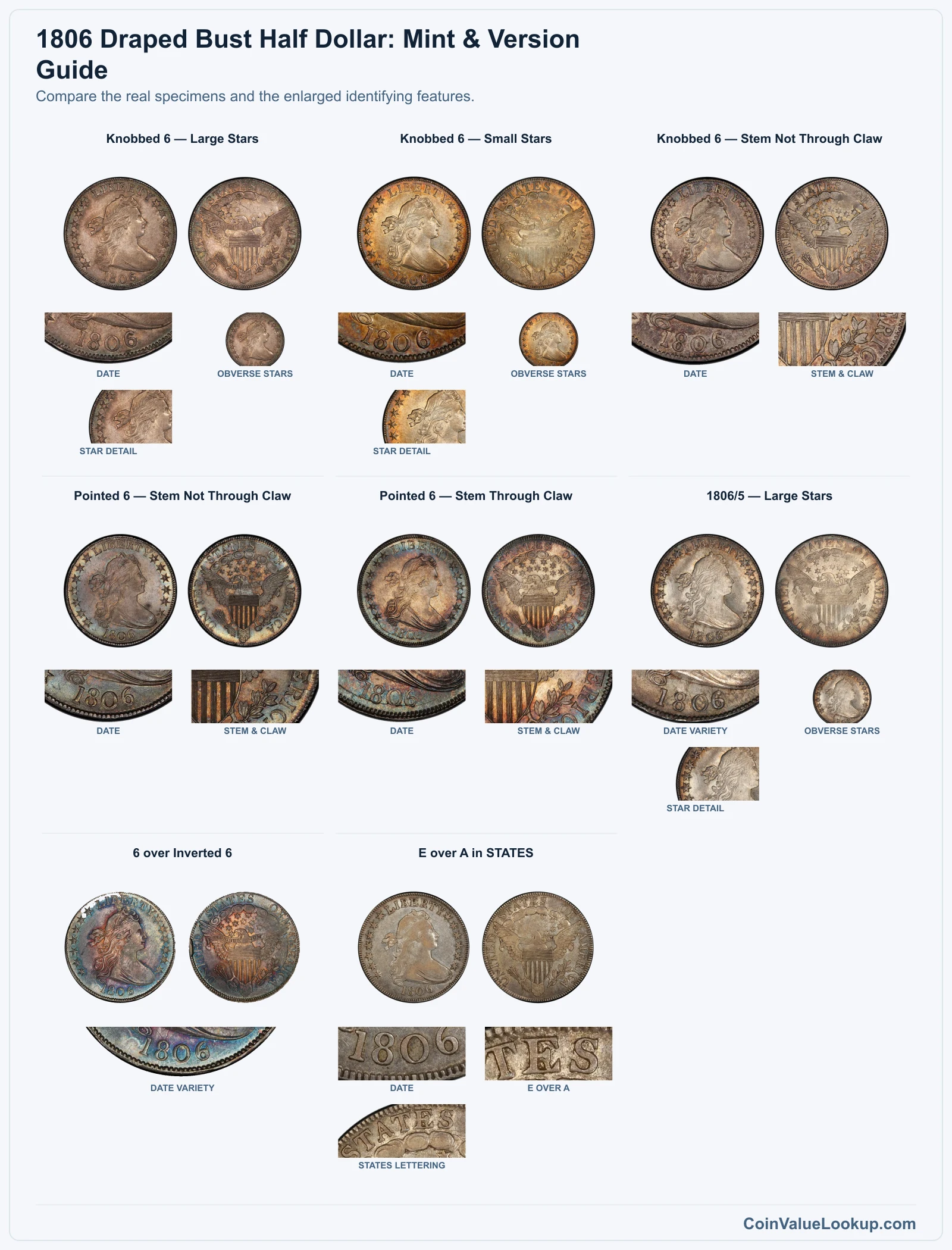
The real identification work is separating eight major varieties. Start with the date digit 6: does its tail end in a round knob, or taper to a point?
That splits the field into Knobbed 6 and Pointed 6 groups. Next, check star size on the obverse — large or small punches — and look under the eagle's claw on the reverse to see whether the olive-branch stem extends through.
Two overdate or over-punch varieties also exist: an 1806/5 with a visible underlying 5 in the date, and a 6 over Inverted 6 where the earlier upside-down digit shows beneath the corrected 6. Finally, inspect the word STATES on the reverse for a corrected E punched over an earlier A.
Step 2: Check Your 1806 Draped Bust Half Dollar Grade
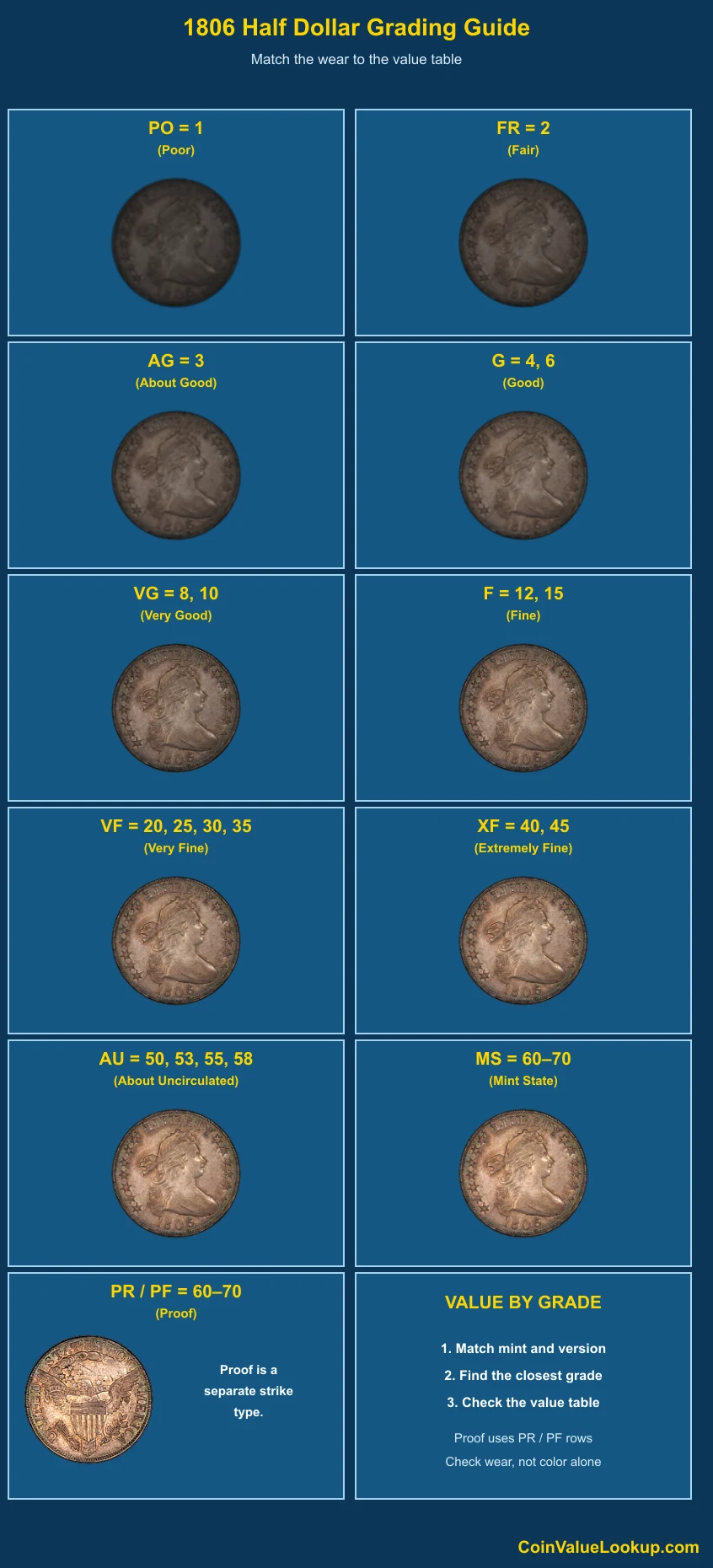
Focus on Liberty's hair detail above the forehead, the cheek contour, and the drapery at the shoulder. These are the first areas to lose definition as the coin circulates.
Compare what you see to known examples of this same Draped Bust type — not modern half dollars, which have completely different relief patterns. The comparison image is your friend here.
On the reverse, check the eagle's breast feathers and wing tips. Some 1806 half dollars left the press with soft strikes in these areas, so missing detail there does not always mean heavy wear.
Look for loss of original luster and actual friction versus incomplete metal flow from a weak strike.
Any coin with cleaning, holes, plugs, tooling, or deep scratches is graded as a "Details" coin and does not follow the normal price curve. A Details-graded piece can still be collectible, but the market treats it very differently from a straight-graded example at the same apparent wear level.
Step 3: Check 1806 Draped Bust Half Dollar Value by Mint and Version
1806 Draped Bust Half Dollar — Knobbed 6 — Large Stars
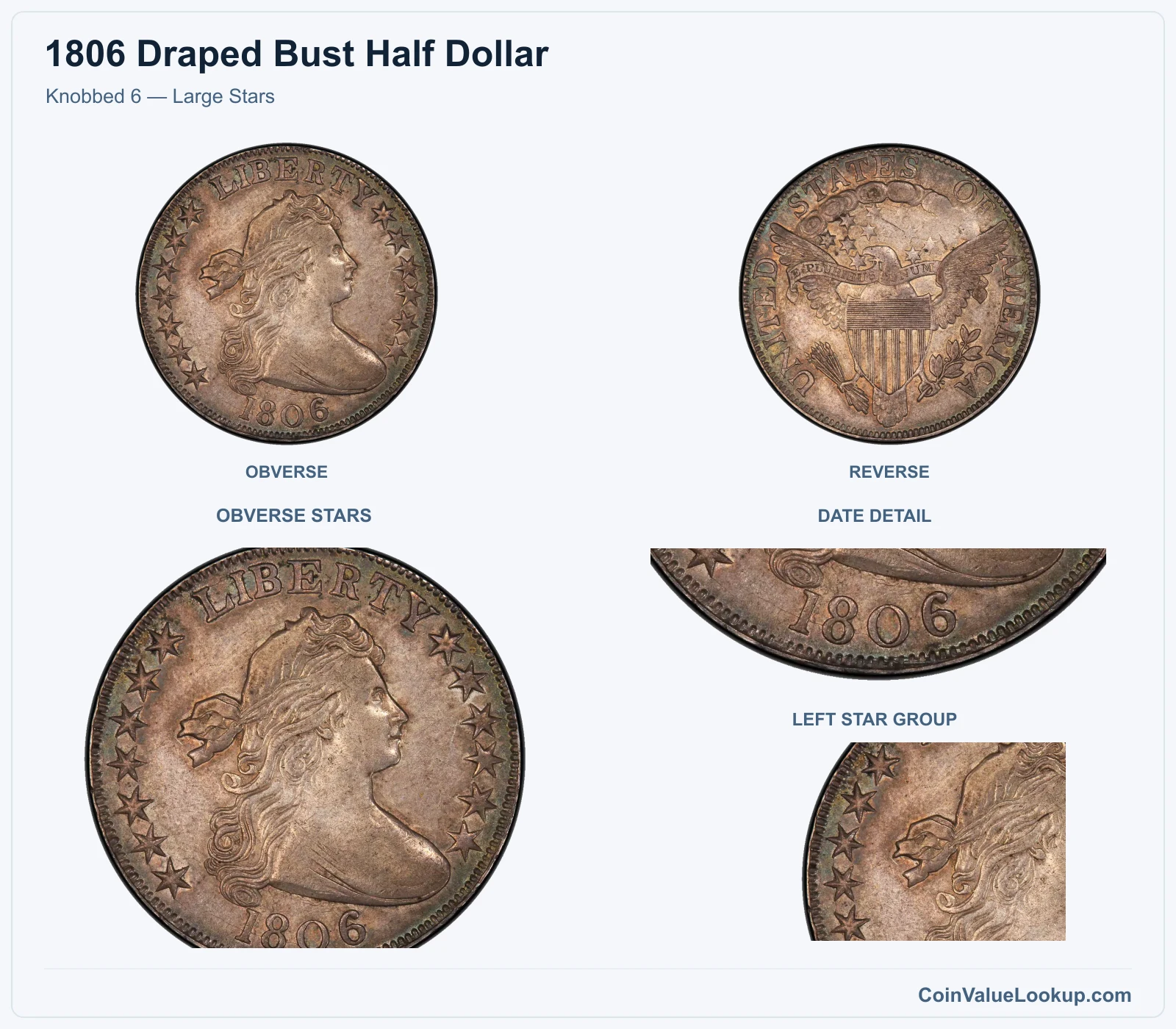
The Knobbed 6 with Large Stars is one of the more available 1806 varieties, but it still commands strong collector interest. Look at the tail of the date digit 6 — it should end in a distinct, rounded knob rather than tapering to a sharp point.
The obverse stars are noticeably larger than those on the Small Stars variety, though you really need a side-by-side comparison or reference images to be sure.
Before you settle on this attribution, magnify the area around the 6 and confirm there is no trace of an underlying 5. If you see remnants of a 5, you have the 1806/5 overdate instead, which carries different pricing.
USA Coin Book guide estimates place this variety at about $300 in G4, $879 in VF20, and $4,960 in AU50.
Range Grade
Price Auction Records Appraisal PO PO 1
—
Coin Identifier FR FR 2
—
Coin Identifier AG AG 3
—
Coin Identifier G G 4
—
Coin Identifier
G 6
—
Coin Identifier VG VG 8
—
Coin Identifier
VG 10
—
Coin Identifier F F 12
—
Coin Identifier
F 15
Coin Identifier VF VF 20
Coin Identifier
VF 25
—
Coin Identifier
VF 30
Coin Identifier
VF 35
—
Coin Identifier XF XF 40
Coin Identifier
XF 45
—
Coin Identifier AU AU 50
—
Coin Identifier
AU 53
Coin Identifier
AU 55
—
Coin Identifier
AU 58
—
—
— MS MS 60
—
—
—
MS 61
—
—
—
MS 62
—
—
—
MS 63
—
—
—
MS 64
—
—
—
MS 65
—
—
—
MS 66
—
—
—
MS 67
—
—
—
MS 68
—
—
—
MS 69
—
—
—
MS 70
—
—
—
1806 Draped Bust Half Dollar — Knobbed 6 — Small Stars
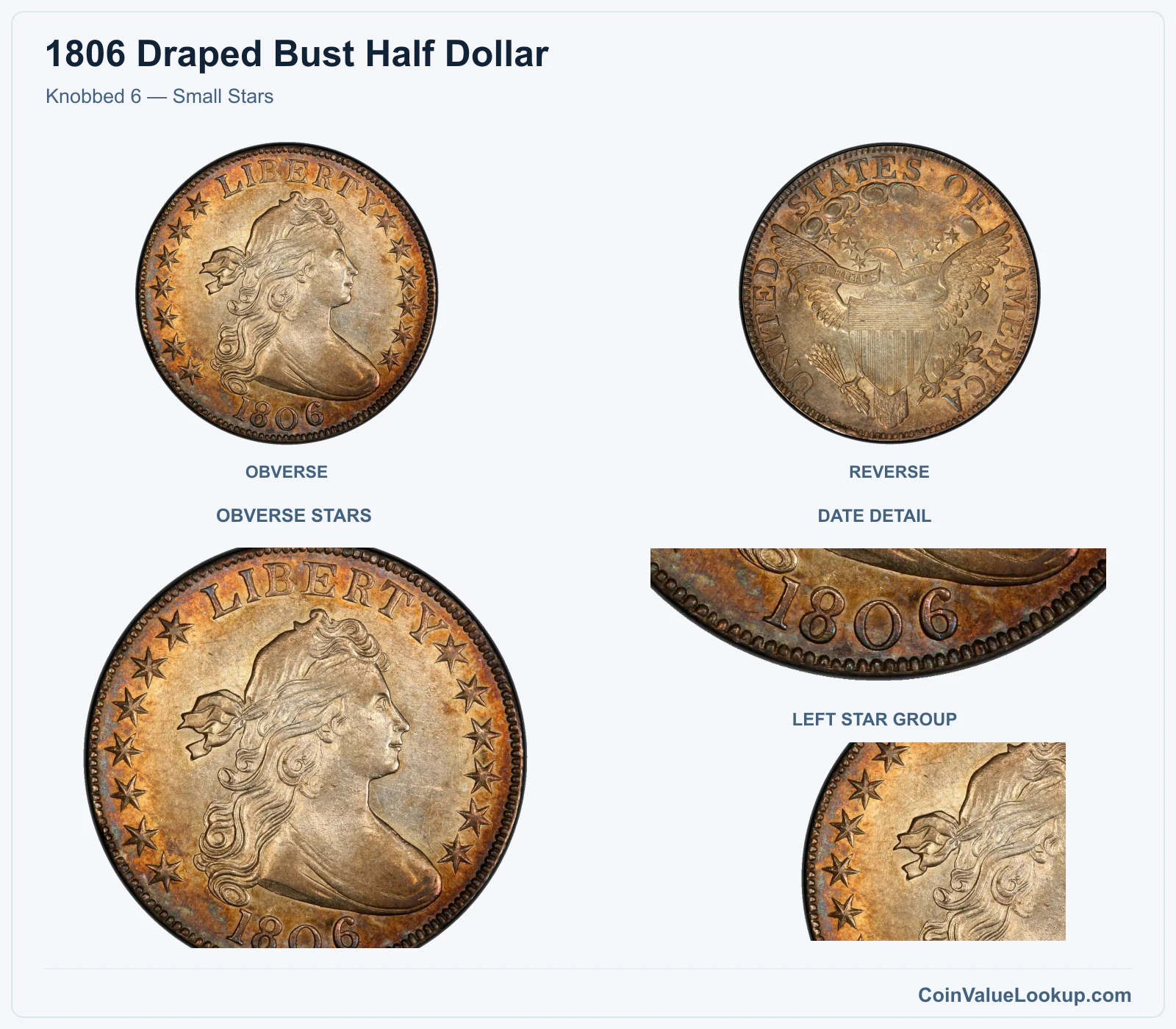
Same knobbed 6 as the Large Stars branch, but paired with smaller star punches on the obverse. The difference is subtle enough that you need equal-scale images of both varieties for a reliable comparison — eyeballing star size in isolation is unreliable.
The Small Stars version is a touch scarcer, reflected in a slightly higher G4 guide value of roughly $332. At VF20 and AU50, the USA Coin Book guide estimates converge with the Large Stars version at about $879 and $4,960 respectively.
Confirm the knob shape first, then compare star size carefully.
Range Grade
Price Auction Records Appraisal PO PO 1
—
Coin Identifier FR FR 2
—
Coin Identifier AG AG 3
—
Coin Identifier G G 4
Coin Identifier
G 6
Coin Identifier VG VG 8
Coin Identifier
VG 10
Coin Identifier F F 12
Coin Identifier
F 15
Coin Identifier VF VF 20
Coin Identifier
VF 25
Coin Identifier
VF 30
Coin Identifier
VF 35
Coin Identifier XF XF 40
Coin Identifier
XF 45
Coin Identifier AU AU 50
Coin Identifier
AU 53
Coin Identifier
AU 55
Coin Identifier
AU 58
Coin Identifier MS MS 60
—
Coin Identifier
MS 61
—
Coin Identifier
MS 62
—
Coin Identifier
MS 63
Coin Identifier
MS 64
—
—
—
MS 65
—
—
—
MS 66
—
—
—
MS 67
—
—
—
MS 68
—
—
—
MS 69
—
—
—
MS 70
—
—
—
1806 Draped Bust Half Dollar — Knobbed 6 — Stem Not Through Claw
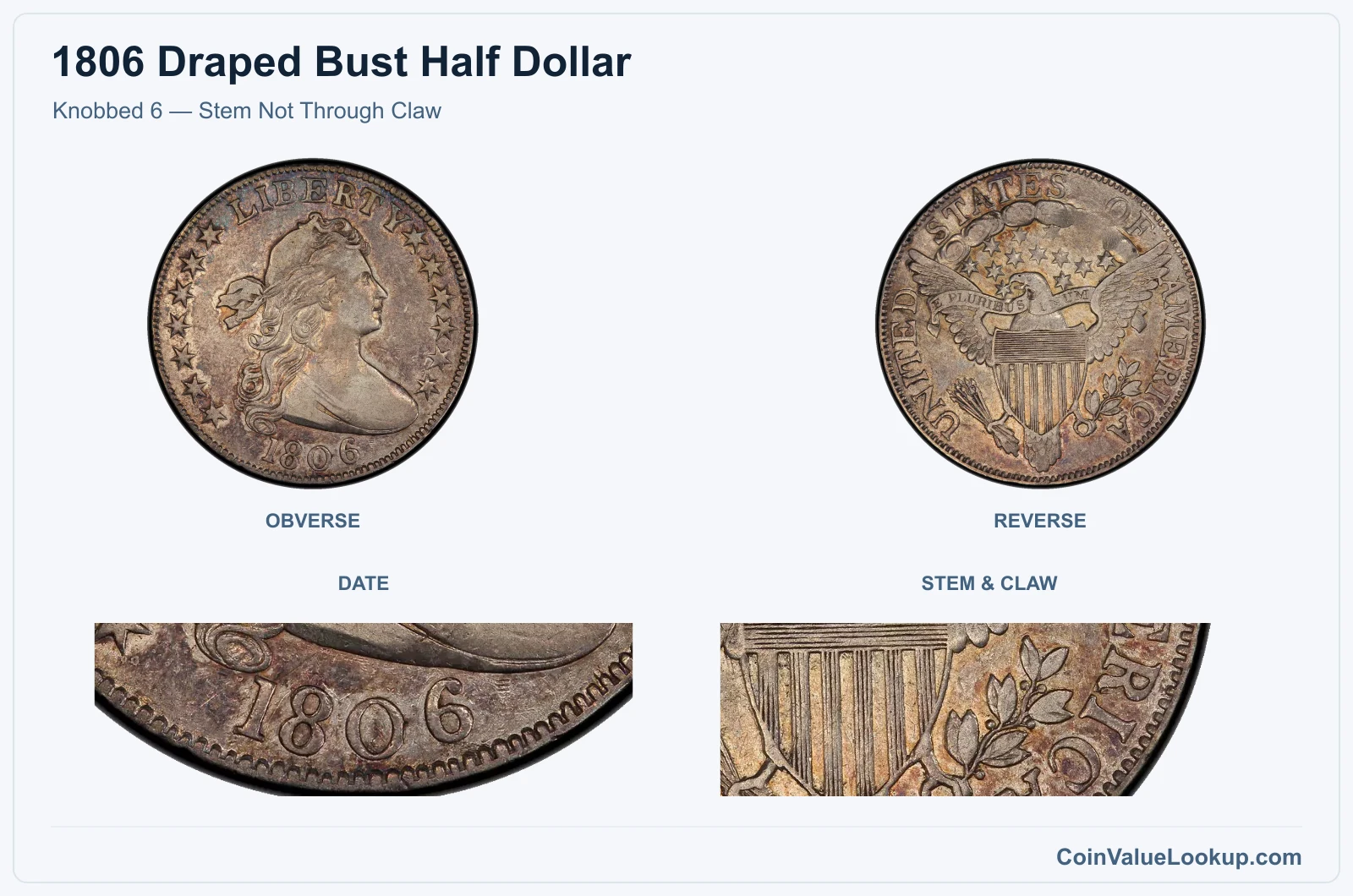
This is the big prize in the 1806 series. It combines the knobbed 6 obverse with a reverse where the olive-branch stem does not extend through the eagle's claw.
That stem detail is the critical diagnostic: on common varieties, a small section of stem is visible below the claw. Here, it simply is not there.
Do not assume you have this coin because the stem area looks worn. On a well-circulated common variety, the stem can be nearly invisible due to wear alone.
Expert attribution is essential before celebrating. The rarity of this combination pushes guide values into extraordinary territory: about $62,610 at G4, roughly $154,767 at VF20, and around $215,960 at EF40 according to USA Coin Book estimates.
If you suspect you have one, professional authentication and grading should be your immediate next step.
Range Grade
Price Auction Records Appraisal PO PO 1
—
Coin Identifier FR FR 2
—
Coin Identifier AG AG 3
—
Coin Identifier G G 4
—
Coin Identifier
G 6
—
Coin Identifier VG VG 8
—
Coin Identifier
VG 10
—
Coin Identifier F F 12
—
Coin Identifier
F 15
—
Coin Identifier VF VF 20
—
Coin Identifier
VF 25
—
Coin Identifier
VF 30
—
Coin Identifier
VF 35
Coin Identifier XF XF 40
Coin Identifier
XF 45
—
—
— AU AU 50
—
—
—
AU 53
—
—
—
AU 55
—
—
—
AU 58
—
—
— MS MS 60
—
—
—
MS 61
—
—
—
MS 62
—
—
—
MS 63
—
—
—
MS 64
—
—
—
MS 65
—
—
—
MS 66
—
—
—
MS 67
—
—
—
MS 68
—
—
—
MS 69
—
—
—
MS 70
—
—
—
1806 Draped Bust Half Dollar — Pointed 6 — Stem Not Through Claw
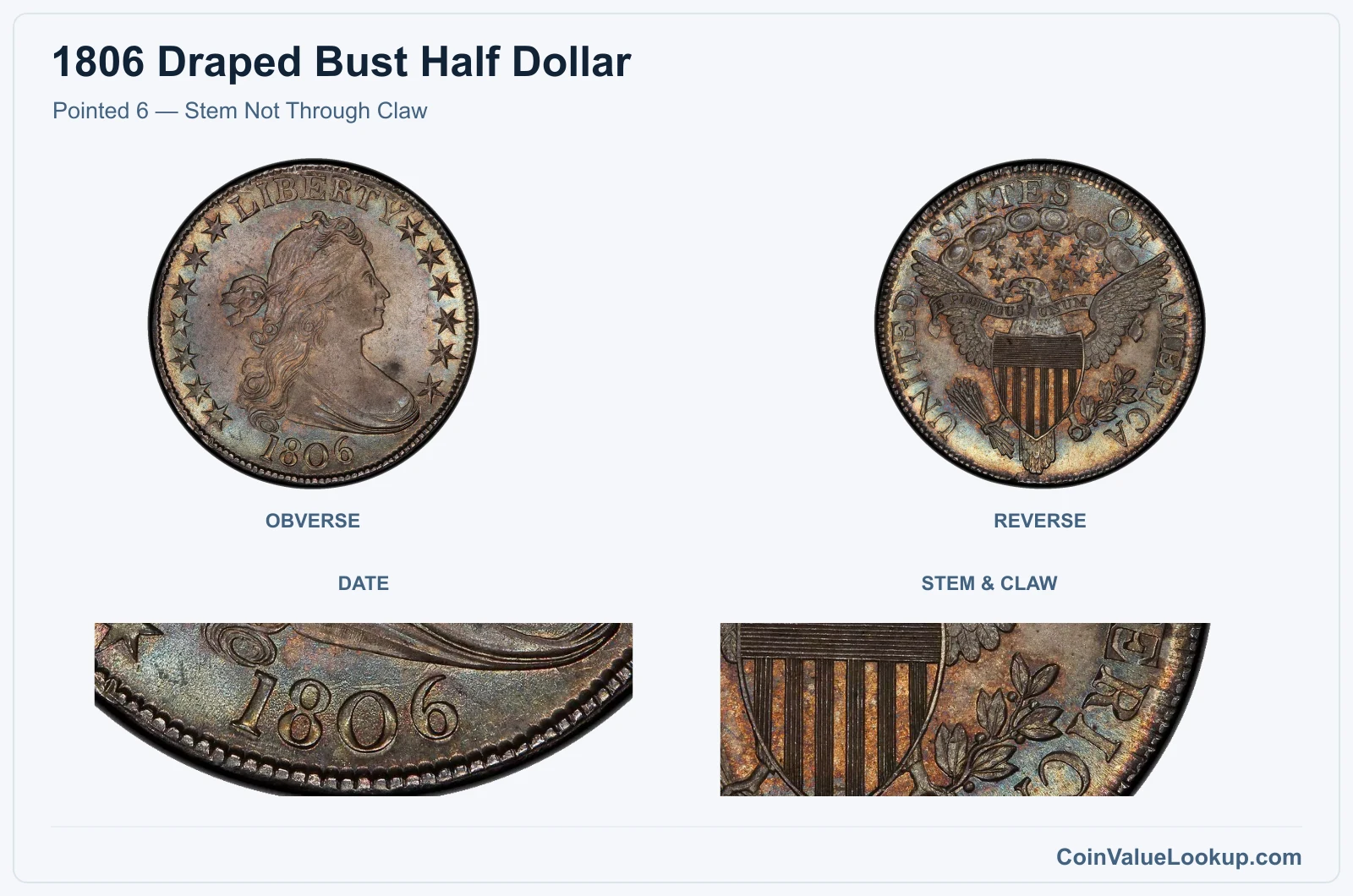
Here the date's 6 tapers to a sharp point rather than ending in a bulbous knob. On the reverse, the olive-branch stem stops at the eagle's claw and does not project below it.
You need to confirm both features: the pointed 6 on the obverse and the missing stem extension on the reverse.
Unlike the Knobbed 6 — Stem Not Through Claw rarity, this pointed-6 version is far more available. USA Coin Book guide estimates place it at about $300 in G4, $879 in VF20, and $3,103 in AU50.
Still a solid coin with genuine collector demand.
Range Grade
Price Auction Records Appraisal PO PO 1
—
Coin Identifier FR FR 2
Coin Identifier AG AG 3
Coin Identifier G G 4
—
Coin Identifier
G 6
Coin Identifier VG VG 8
Coin Identifier
VG 10
Coin Identifier F F 12
Coin Identifier
F 15
Coin Identifier VF VF 20
Coin Identifier
VF 25
Coin Identifier
VF 30
Coin Identifier
VF 35
Coin Identifier XF XF 40
Coin Identifier
XF 45
Coin Identifier AU AU 50
Coin Identifier
AU 53
Coin Identifier
AU 55
Coin Identifier
AU 58
Coin Identifier MS MS 60
—
Coin Identifier
MS 61
Coin Identifier
MS 62
Coin Identifier
MS 63
Coin Identifier
MS 64
Coin Identifier
MS 65
Coin Identifier
MS 66
—
—
—
MS 67
—
—
—
MS 68
—
—
—
MS 69
—
—
—
MS 70
—
—
—
1806 Draped Bust Half Dollar — Pointed 6 — Stem Through Claw
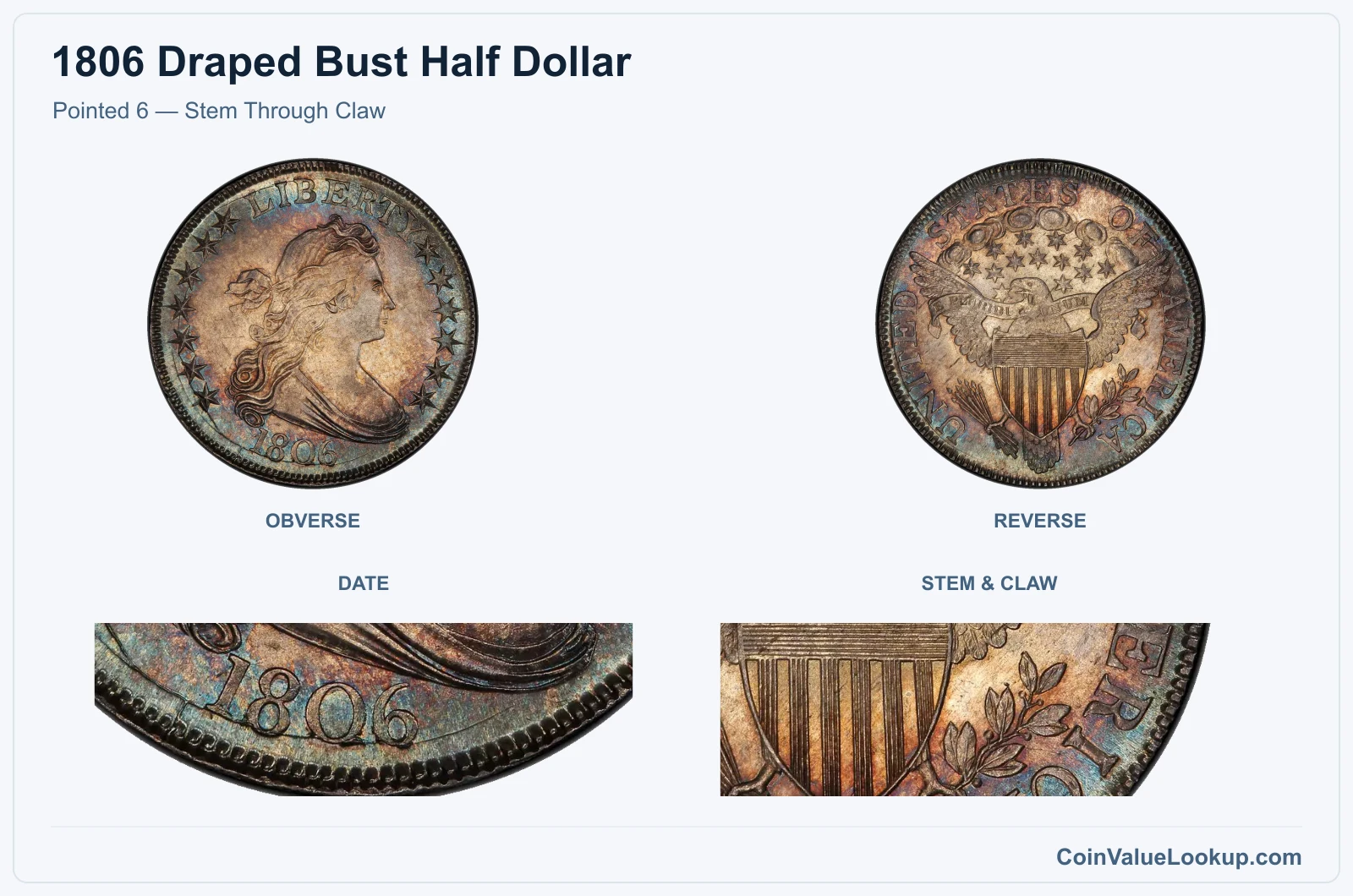
This is the most commonly encountered 1806 half dollar variety. The 6 ends in a point, and the olive-branch stem clearly extends below the eagle's claw on the reverse.
It serves as the baseline against which all the scarcer branches are compared.
Coin Value Lookup can help you look up guide values for this and other early half dollar varieties if you want to explore the broader Draped Bust series.
USA Coin Book guide estimates run about $300 at G4, $879 at VF20, and $3,103 at AU50. Common does not mean cheap — any Draped Bust half dollar in honest, original condition is a serious early American coin.
Range Grade
Price Auction Records Appraisal PO PO 1
Coin Identifier FR FR 2
Coin Identifier AG AG 3
Coin Identifier G G 4
Coin Identifier
G 6
Coin Identifier VG VG 8
Coin Identifier
VG 10
Coin Identifier F F 12
Coin Identifier
F 15
Coin Identifier VF VF 20
Coin Identifier
VF 25
Coin Identifier
VF 30
Coin Identifier
VF 35
Coin Identifier XF XF 40
Coin Identifier
XF 45
Coin Identifier AU AU 50
Coin Identifier
AU 53
Coin Identifier
AU 55
Coin Identifier
AU 58
Coin Identifier MS MS 60
—
Coin Identifier
MS 61
Coin Identifier
MS 62
Coin Identifier
MS 63
Coin Identifier
MS 64
Coin Identifier
MS 65
Coin Identifier
MS 66
Coin Identifier
MS 67
—
Coin Identifier
MS 68
—
—
—
MS 69
—
—
—
MS 70
—
—
—
1806 Draped Bust Half Dollar — /5 — Large Stars
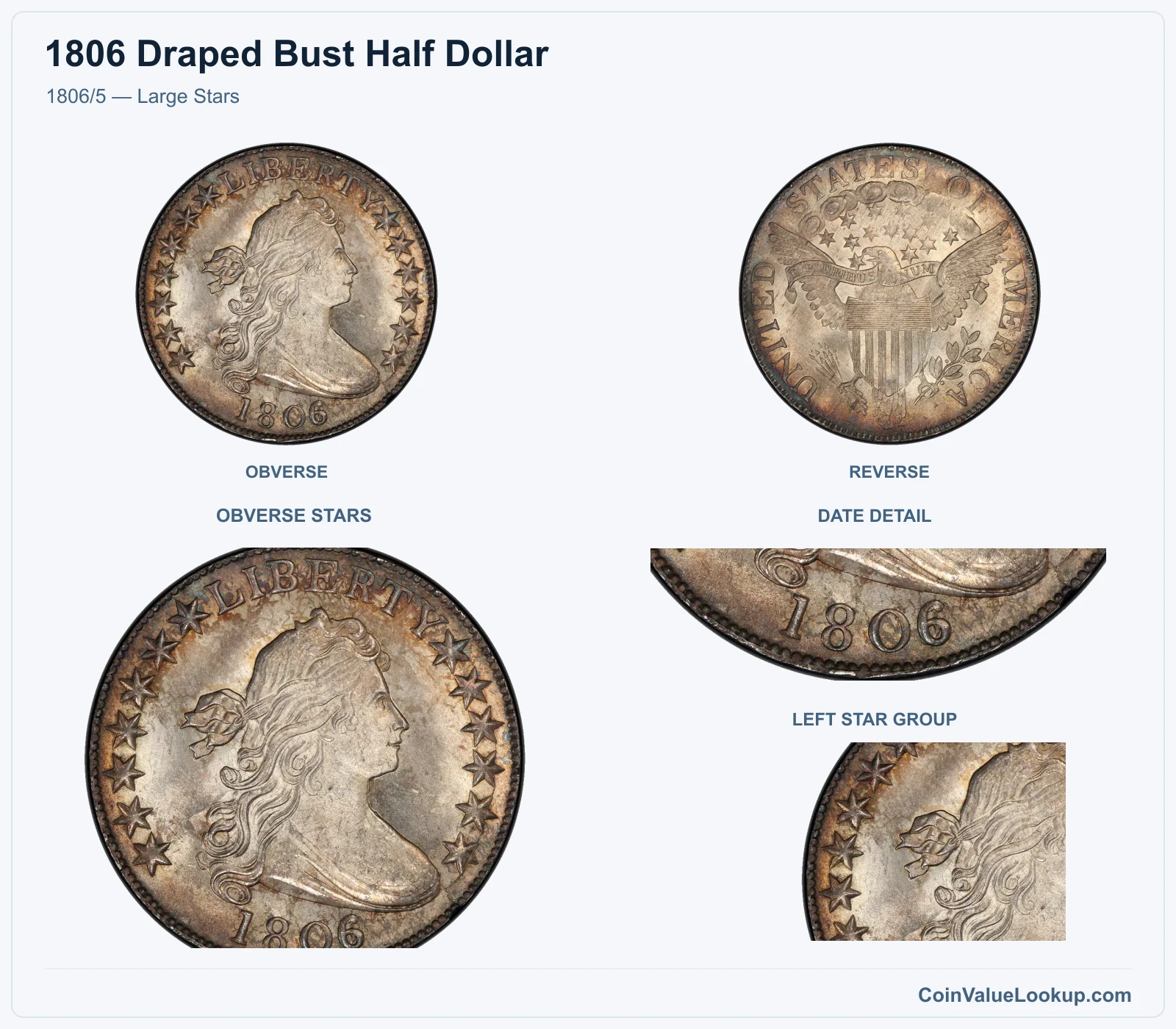
An overdate. Under magnification, you can see the remnants of a 5 beneath the final 6 in the date.
The obverse also carries the large star punches. This is not the same as the ordinary Knobbed 6 with Large Stars, even though the knob shape can look similar — the key difference is that visible underlying 5.
USA Coin Book guide estimates reflect a modest premium: about $395 at G4, $1,146 at VF20, and $5,737 at AU50. Overdates appeal to a dedicated subset of early-type collectors, so demand stays consistent.
A loupe or strong magnifying glass aimed at the junction of the 6 and 5 is all you need to spot it.
Range Grade
Price Auction Records Appraisal PO PO 1
—
Coin Identifier FR FR 2
—
Coin Identifier AG AG 3
—
Coin Identifier G G 4
Coin Identifier
G 6
Coin Identifier VG VG 8
Coin Identifier
VG 10
Coin Identifier F F 12
Coin Identifier
F 15
Coin Identifier VF VF 20
Coin Identifier
VF 25
Coin Identifier
VF 30
Coin Identifier
VF 35
Coin Identifier XF XF 40
Coin Identifier
XF 45
Coin Identifier AU AU 50
Coin Identifier
AU 53
Coin Identifier
AU 55
Coin Identifier
AU 58
Coin Identifier MS MS 60
—
Coin Identifier
MS 61
Coin Identifier
MS 62
Coin Identifier
MS 63
Coin Identifier
MS 64
Coin Identifier
MS 65
—
Coin Identifier
MS 66
Coin Identifier
MS 67
—
—
—
MS 68
—
—
—
MS 69
—
—
—
MS 70
—
—
—
1806 Draped Bust Half Dollar — 6 over Inverted 6
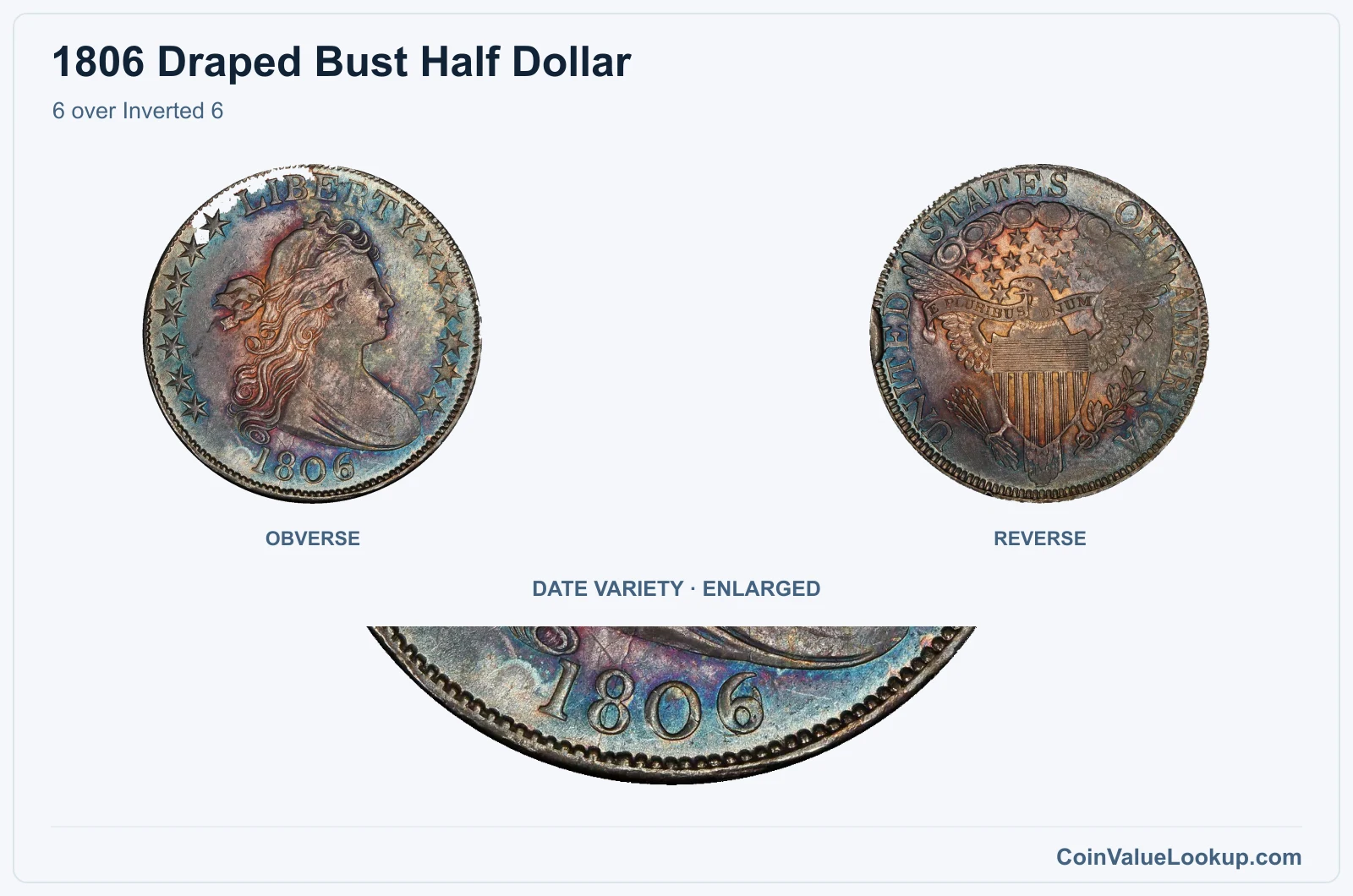
The die cutter initially punched the 6 upside down, then corrected it by punching a properly oriented 6 over the mistake. Under magnification you can see traces of the inverted digit peeking out beneath the final 6.
This is sometimes misidentified as an 1806/9 overdate — it is not a calendar overdate, just a corrected punch on the same die.
This variety carries a clear premium. USA Coin Book guide estimates run about $457 at G4, roughly $1,897 at VF20, and around $10,033 at AU50.
The doubling in the 6 is the sole diagnostic; once you see the ghost of the inverted digit, the attribution is straightforward.
Range Grade
Price Auction Records Appraisal PO PO 1
—
Coin Identifier FR FR 2
—
Coin Identifier AG AG 3
—
Coin Identifier G G 4
—
Coin Identifier
G 6
—
Coin Identifier VG VG 8
Coin Identifier
VG 10
—
Coin Identifier F F 12
Coin Identifier
F 15
Coin Identifier VF VF 20
Coin Identifier
VF 25
Coin Identifier
VF 30
Coin Identifier
VF 35
Coin Identifier XF XF 40
Coin Identifier
XF 45
Coin Identifier AU AU 50
Coin Identifier
AU 53
Coin Identifier
AU 55
—
Coin Identifier
AU 58
Coin Identifier MS MS 60
—
Coin Identifier
MS 61
Coin Identifier
MS 62
Coin Identifier
MS 63
Coin Identifier
MS 64
Coin Identifier
MS 65
—
—
—
MS 66
—
—
—
MS 67
—
—
—
MS 68
—
—
—
MS 69
—
—
—
MS 70
—
—
—
1806 Draped Bust Half Dollar — E over A in STATES
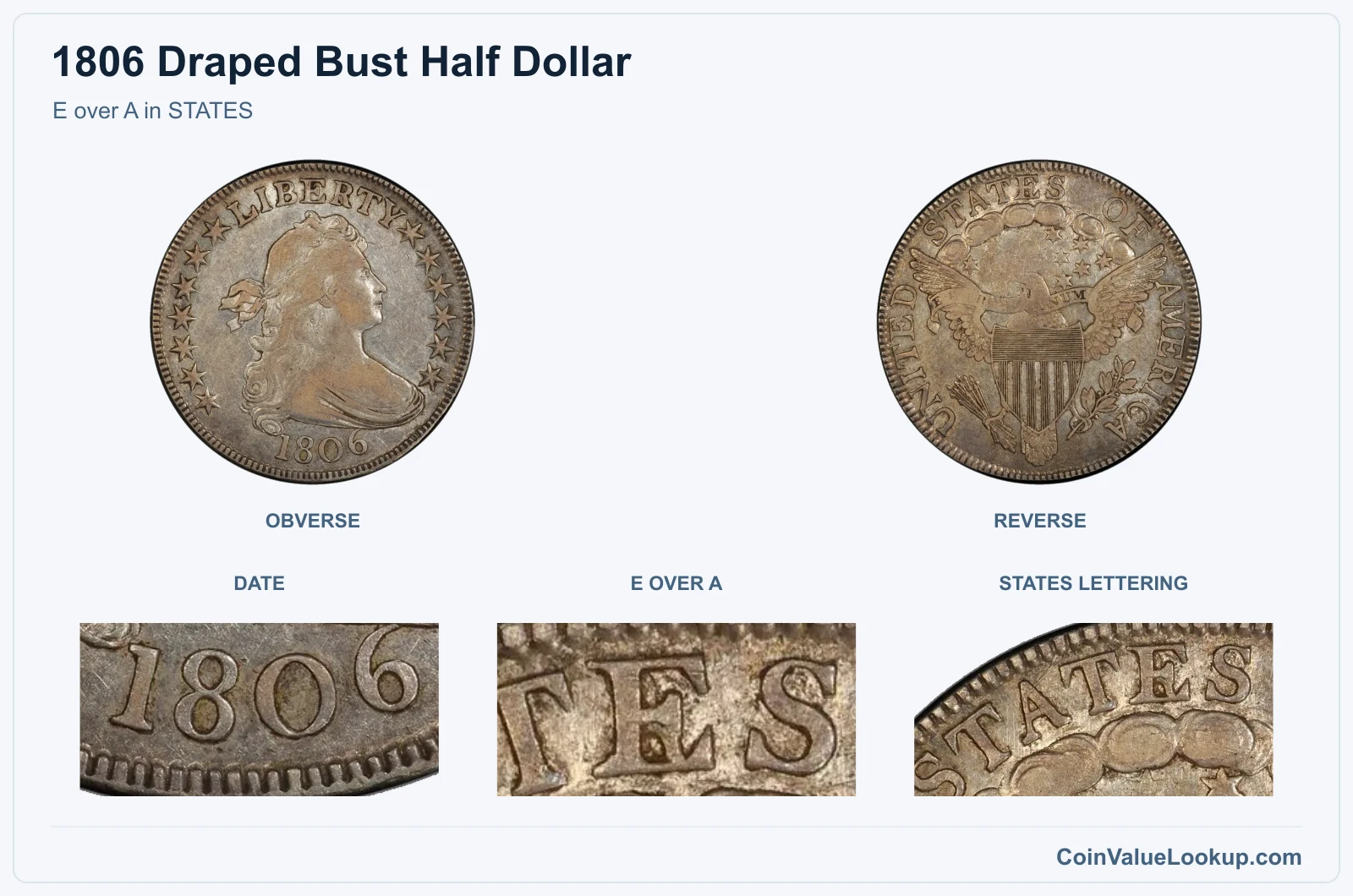
On the reverse, the final E in STATES was punched over an earlier A. You can see remnants of the A's crossbar and legs within the corrected letter.
This is the opposite letter order from the 1795 A-over-E variety, so do not confuse the two — different year, different direction of correction.
Guide values from USA Coin Book are notably strong: about $879 at G4, roughly $5,238 at VF20, and around $14,403 at EF40. The letter correction is visible even on moderately worn coins, which helps explain sustained demand across grades.
A close-up of the E in STATES is all a potential buyer needs to confirm the variety.
Range Grade
Price Auction Records Appraisal PO PO 1
—
Coin Identifier FR FR 2
—
Coin Identifier AG AG 3
—
Coin Identifier G G 4
—
Coin Identifier
G 6
—
Coin Identifier VG VG 8
Coin Identifier
VG 10
Coin Identifier F F 12
Coin Identifier
F 15
—
Coin Identifier VF VF 20
Coin Identifier
VF 25
Coin Identifier
VF 30
Coin Identifier
VF 35
Coin Identifier XF XF 40
Coin Identifier
XF 45
—
—
— AU AU 50
—
—
—
AU 53
—
—
—
AU 55
—
—
—
AU 58
—
—
— MS MS 60
—
—
—
MS 61
—
—
—
MS 62
—
—
—
MS 63
—
—
—
MS 64
—
—
—
MS 65
—
—
—
MS 66
—
—
—
MS 67
—
—
—
MS 68
—
—
—
MS 69
—
—
—
MS 70
—
—
—
1806 Draped Bust Half Dollar Error List
1. 1806 Draped Bust Half Dollar — Off-Center Strike
An off-center strike occurs when the planchet is not properly seated between the dies, producing a displaced design with an unstruck crescent along part of the rim. On an 1806 half dollar, the date must remain visible for the coin to be identifiable and collectible as an error.
This error has been reported on a Pointed 6 with Stem variety. Be careful to distinguish it from post-mint damage — a clipped edge, one-sided die misalignment, or flattening after the coin left the mint can mimic the look.
A genuine off-center strike shows the full design shifted in one direction with a corresponding blank area on the opposite side.
No specific price range has been adopted for this error. Value depends heavily on the degree of off-center displacement, the visibility of the date, and the coin's overall condition.
2. 1806 Draped Bust Half Dollar — Die Break / Cud
A cud is a rim-connected die break that leaves a raised, featureless blob of metal at the edge of the coin where the broken piece of the die could no longer impart detail. On 1806 half dollars, documented examples include breaks above LIB, near UNITE, and near reverse lettering.
Do not confuse a cud with a simple rim dent, corrosion bump, or a small interior die chip that does not reach the rim. A genuine cud connects to the rim and replaces part of the design with a smooth, raised lump.
The break is on the die, so it appears identically on every coin struck from that broken die.
No specific price range has been adopted for this category. The size, location, and overall coin condition all influence collector interest and value.
3. 1806 Draped Bust Half Dollar — Broken Shield Die Break
The Broken Shield die break shows as a raised area of featureless metal across the upper vertical stripes of the heraldic eagle's shield on the reverse. This is an interior die break — meaning it does not connect to the rim — which distinguishes it from a rim-connected cud.
The result is a noticeable patch where shield detail is simply missing, replaced by flat or slightly raised metal.
Do not mistake a worn or weakly struck shield for this error. Normal wear gradually softens stripe detail, while a Broken Shield break produces a distinct, irregular area of missing design that looks nothing like even wear.
Post-mint cuts or scratches across the shield can also fool the unwary.
No specific price range has been adopted. Value depends on the prominence of the break, the coin's grade, and collector demand for the specific die state.