1795 Flowing Hair Half Dollar Coin Value: How Much Is It Worth?
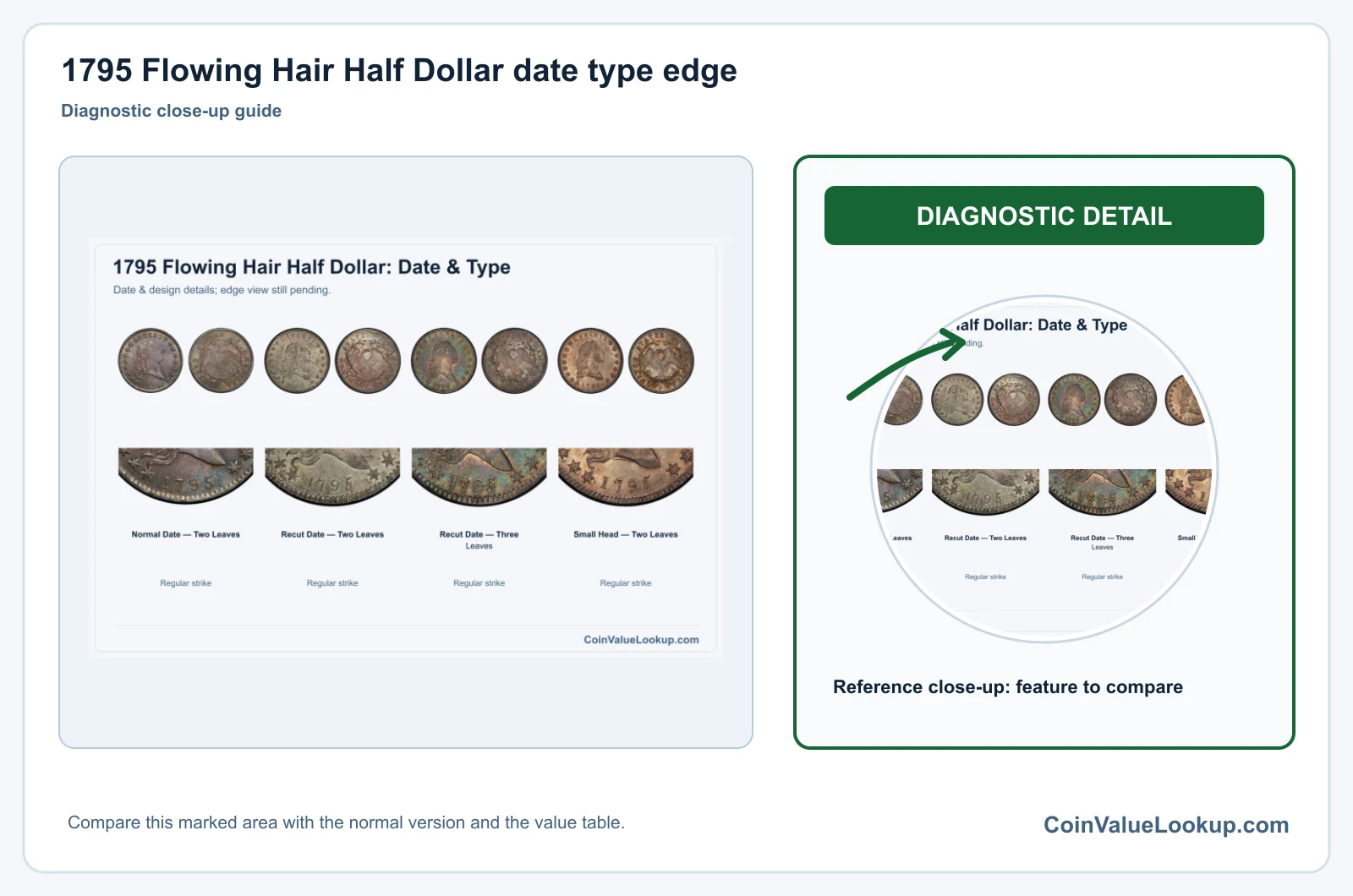
A 1795 Flowing Hair half dollar is one of the earliest United States silver coins, and every surviving example carries serious collector value well beyond its face value or silver content. USA Coin Book guide estimates place the Normal Date — Two Leaves variety at roughly $1,361 in G4 up to about $16,591 in AU50, though special varieties and higher grades can differ substantially.
Fast Way to Identify Your 1795 Flowing Hair Half Dollar
Want a quick read on your 1795 half dollar? Upload clear photos of the front and back, and our identifier can offer a preliminary identification of the variety and approximate condition.
This is not authentication or certification, but it gives you a solid starting point before seeking professional attribution.
1795 Flowing Hair Half Dollar Value
Upload both sides of your 1795 Flowing Hair Half Dollar.
Front Obverse
Upload photo
Back Reverse
Upload photo
Which 1795 Flowing Hair Half Dollar Versions Are Worth Money?
- Normal Date — Two Leaves: the baseline variety, with USA Coin Book guide estimates from about $1,361 at G4 to roughly $16,591 at AU50.
- Recut Date — Two Leaves: doubled date numerals with two leaves under each wing; value depends on authenticated identity and condition.
- Recut Date — Three Leaves: combines recut date digits with three-leaf clusters — both features must be present, not just one.
- Small Head — Two Leaves: a noticeably smaller Liberty portrait confirmed by side-by-side comparison, not perspective or wear.
- A over E in STATES: remnants of the original E visible beneath the corrected A in STATES on the reverse.
- Mint-Inserted Silver Plug: an original weight-adjustment plug placed during production; requires expert attribution and strong provenance.
Step 1: Identify Your 1795 Flowing Hair Half Dollar Mint Mark and Version
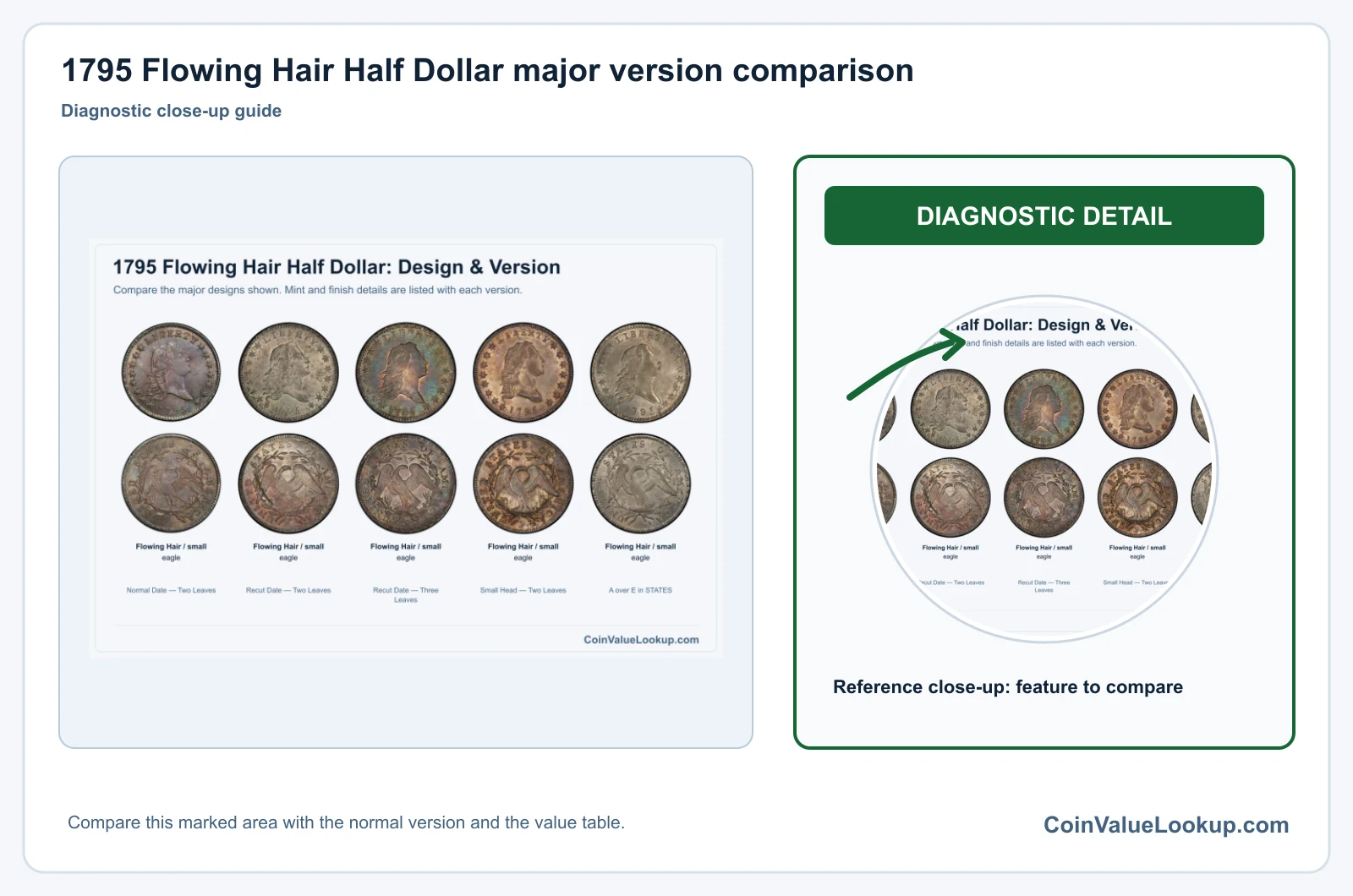
Every 1795 Flowing Hair half dollar was struck at the Philadelphia Mint. There is no mintmark, and that is completely normal — no branch mints existed yet.
Confirm the denomination by checking the lettered edge, which reads FIFTY CENTS OR HALF A DOLLAR.
The design pairs the Flowing Hair obverse with a small eagle reverse. Nominal diameter is about 32.5 mm and weight about 13.48 g; weight can be a screening clue but does not authenticate on its own.
Your main task is separating six identities. Start with the leaves: count the cluster beneath each wing on the reverse.
Two leaves is the common arrangement; three leaves narrows your possibilities. Next, examine the date digits for doubled or recut outlines — extra contours on one or more numerals indicate a recut date die.
Check the reverse legend carefully. In the word STATES, look for remnants of an E hiding beneath the A.
That is the A over E corrected-lettering variety, distinct from ordinary doubling. Also compare Liberty's portrait size against a confirmed reference image to rule in or rule out the Small Head variety.
Finally, inspect the planchet surface for a small circular silver plug inserted at the mint to bring the coin up to the correct weight. A genuine plug requires expert attribution and provenance.
Step 2: Check Your 1795 Flowing Hair Half Dollar Grade
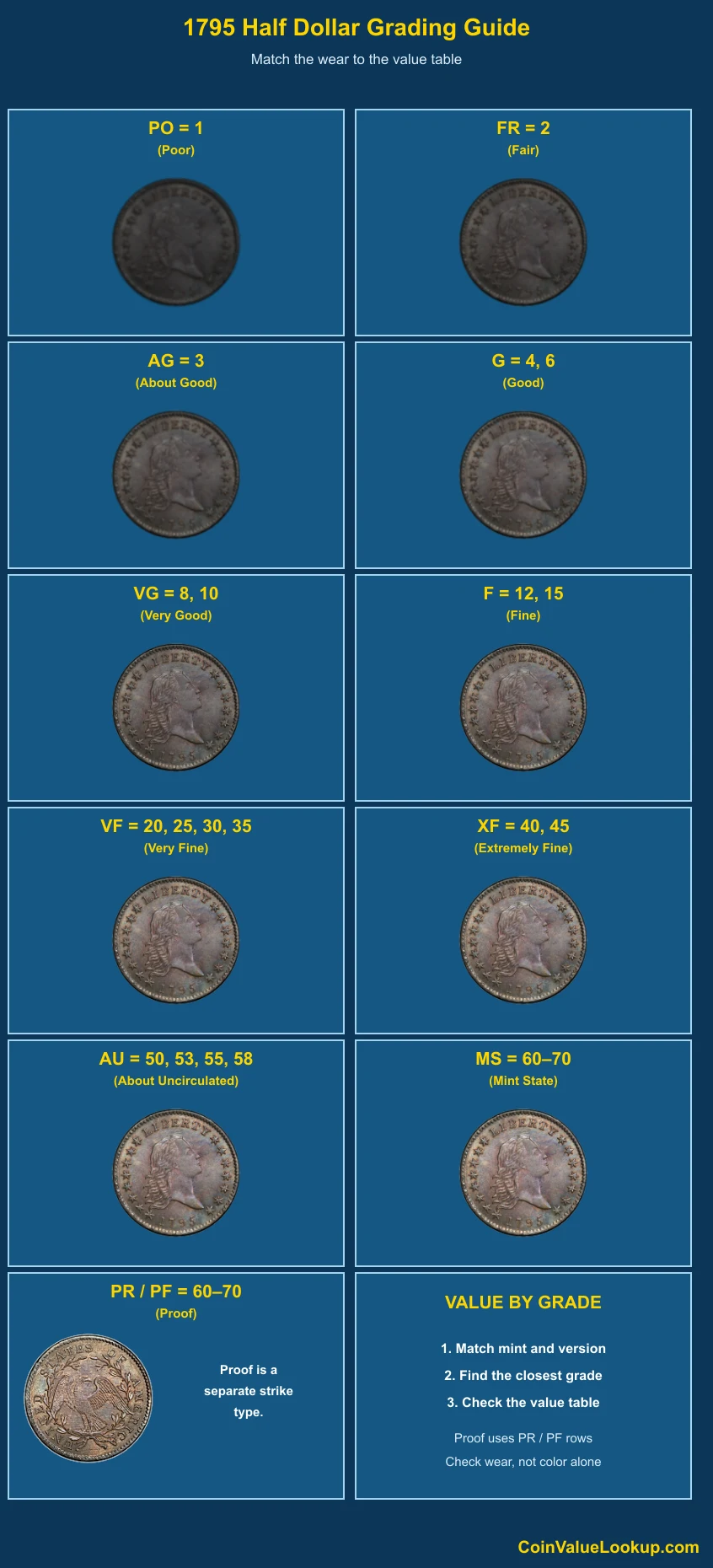
Focus your wear check on Liberty's hair above the forehead, across the cheek, and along the drapery at the shoulder. These are the first places to lose detail.
Compare your coin to the grading image provided — it is the same Flowing Hair type, not a modern design.
On the reverse, examine the eagle's breast feathers and wing detail. Some softness may be original strike weakness rather than wear, so look for a difference between flat areas with intact luster and areas where luster has been lost to contact.
Cleaning, holes, plugs (other than the recognized mint plug variety), tooling, and scratches push a coin into "Details" territory. A Details-graded coin does not follow the same price curve as a straight-graded example, so record surface problems separately from wear.
Step 3: Check 1795 Flowing Hair Half Dollar Value by Mint and Version
1795 Flowing Hair Half Dollar — Normal Date — Two Leaves
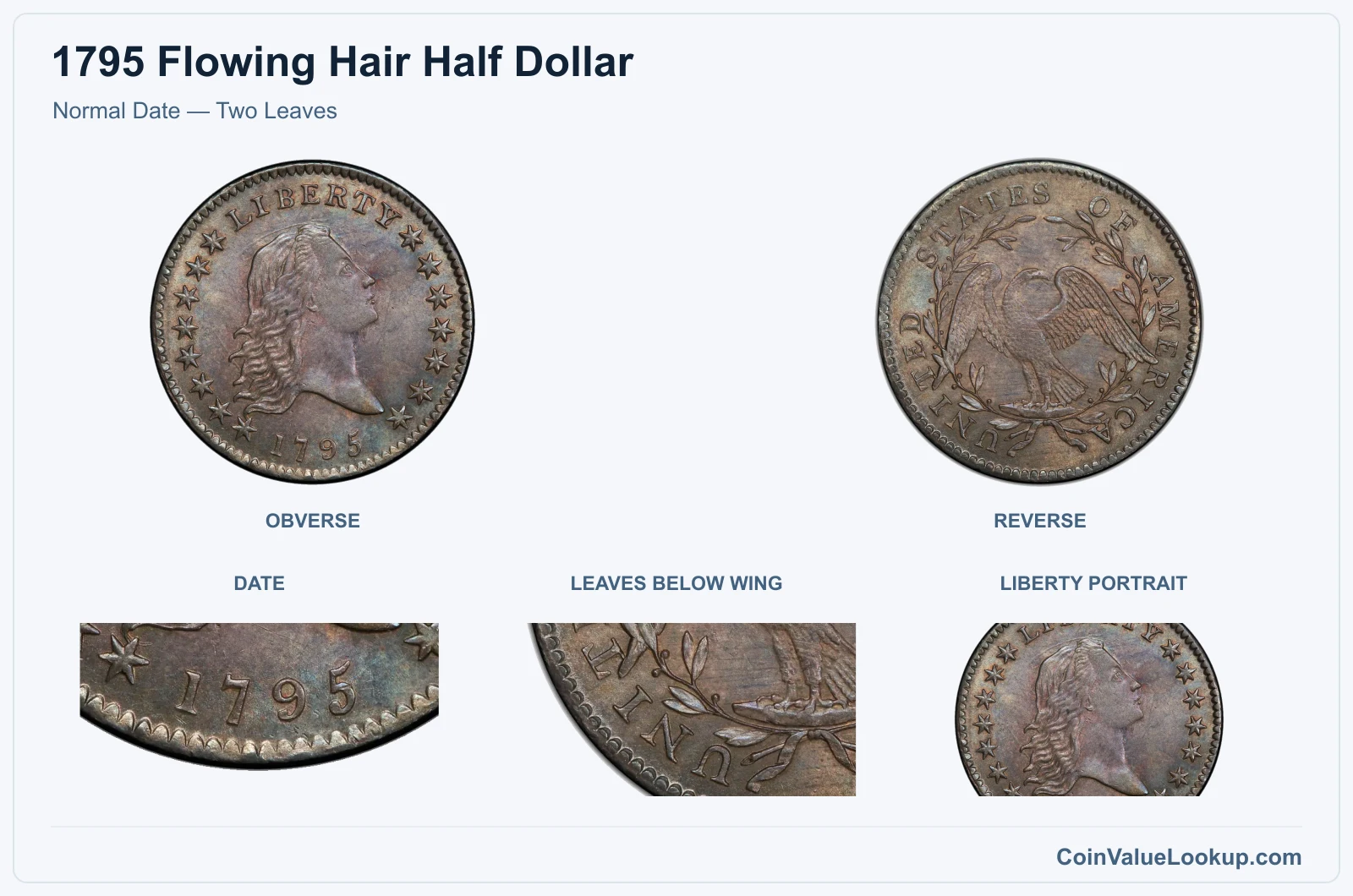
This is the starting point. The Normal Date — Two Leaves half dollar shows a cleanly punched 1795 date and two leaves in the cluster beneath each wing on the reverse.
Before you call yours "normal," rule out every other branch first.
USA Coin Book guide estimates place this variety at approximately $1,361 in G4, around $4,085 in VF20, and about $16,591 in AU50. These are retail guide figures, not guaranteed offers, and actual transaction prices depend on eye appeal and surface quality.
Coin Value Lookup is a useful place to look up guides for other early U.S. silver coins if you are working through a collection or comparing across denominations.
Ordinary-issue reference: Ordinary-issue reference only: The table below shows prices for the 1795 Flowing Hair Half Dollar (regular strike). It does not represent the value of the specific Normal Date — Two Leaves variety or its variety premium. Year, mint, metal and strike type are matched; the specific variety is not priced by this table.
Range Grade
Price Auction Records Appraisal PO PO 1
—
Coin Identifier FR FR 2
Coin Identifier AG AG 3
Coin Identifier G G 4
Coin Identifier
G 6
Coin Identifier VG VG 8
Coin Identifier
VG 10
Coin Identifier F F 12
Coin Identifier
F 15
Coin Identifier VF VF 20
Coin Identifier
VF 25
Coin Identifier
VF 30
Coin Identifier
VF 35
Coin Identifier XF XF 40
Coin Identifier
XF 45
Coin Identifier AU AU 50
Coin Identifier
AU 53
Coin Identifier
AU 55
Coin Identifier
AU 58
Coin Identifier MS MS 60
Coin Identifier
MS 61
Coin Identifier
MS 62
Coin Identifier
MS 63
Coin Identifier
MS 64
Coin Identifier
MS 65
Coin Identifier
MS 66
—
—
—
MS 67
—
—
—
MS 68
—
—
—
MS 69
—
—
—
MS 70
—
—
—
1795 Flowing Hair Half Dollar — Recut Date — Two Leaves
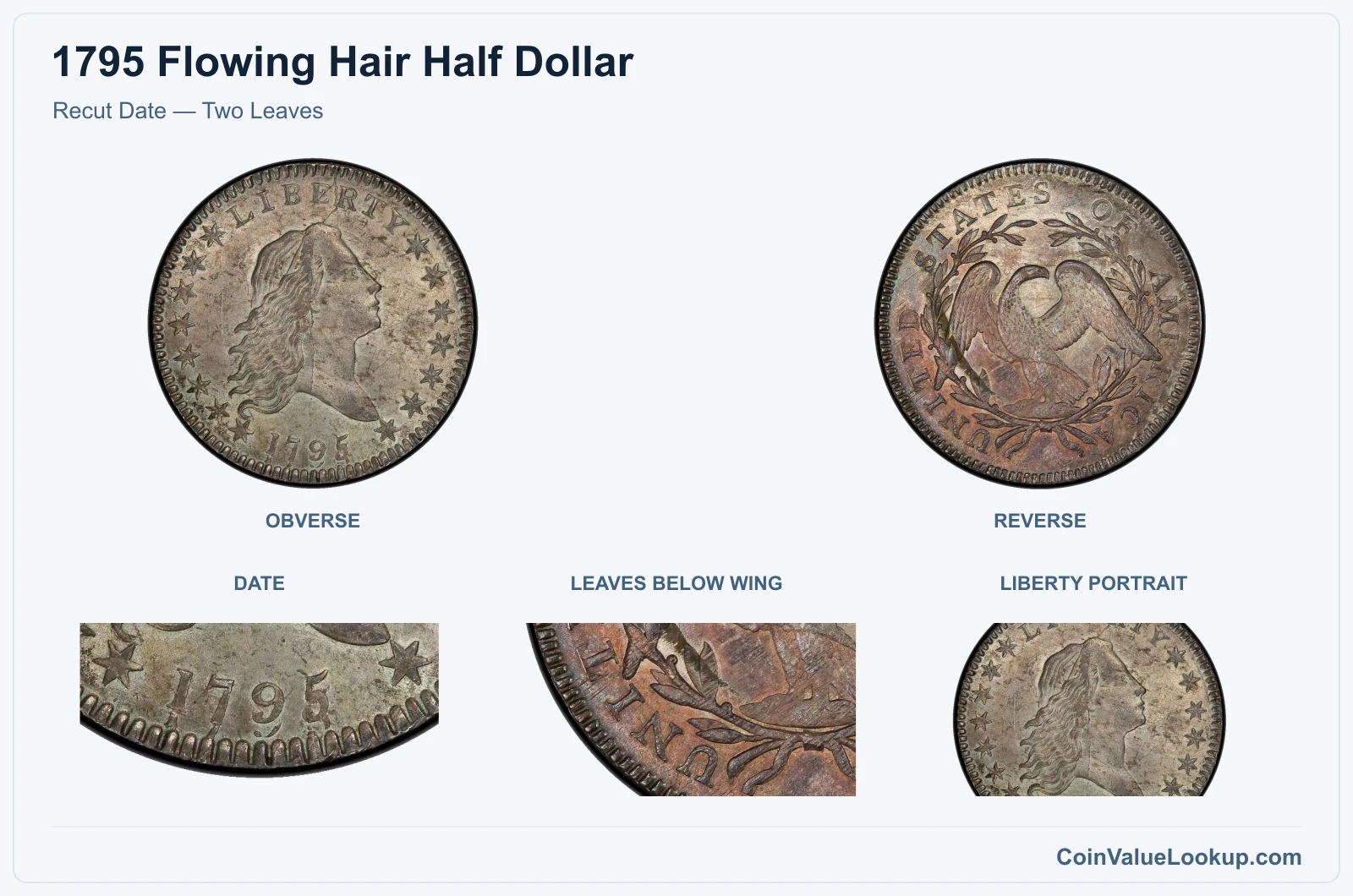
Look at the date digits under magnification. If you see extra contours — shadow lines or doubled edges on one or more numerals — you have a recut date die.
This version pairs that recut date with two leaves beneath each wing.
Not every recut-date die is the same. Different die pairings exist, so a broader recut-date guide should not be applied to every individual coin without proper attribution.
Value depends on the authenticated die identity and the coin's condition. No single numeric range covers them all fairly, so professional assessment is the way to go.
Range Grade
Price Auction Records Appraisal PO PO 1
—
Coin Identifier FR FR 2
—
Coin Identifier AG AG 3
Coin Identifier G G 4
—
Coin Identifier
G 6
Coin Identifier VG VG 8
Coin Identifier
VG 10
Coin Identifier F F 12
Coin Identifier
F 15
Coin Identifier VF VF 20
Coin Identifier
VF 25
Coin Identifier
VF 30
Coin Identifier
VF 35
Coin Identifier XF XF 40
Coin Identifier
XF 45
Coin Identifier AU AU 50
Coin Identifier
AU 53
—
Coin Identifier
AU 55
—
Coin Identifier
AU 58
—
—
— MS MS 60
—
—
—
MS 61
—
—
—
MS 62
—
—
—
MS 63
—
—
—
MS 64
—
—
—
MS 65
—
Coin Identifier
MS 66
—
—
—
MS 67
—
—
—
MS 68
—
—
—
MS 69
—
—
—
MS 70
—
—
—
1795 Flowing Hair Half Dollar — Recut Date — Three Leaves
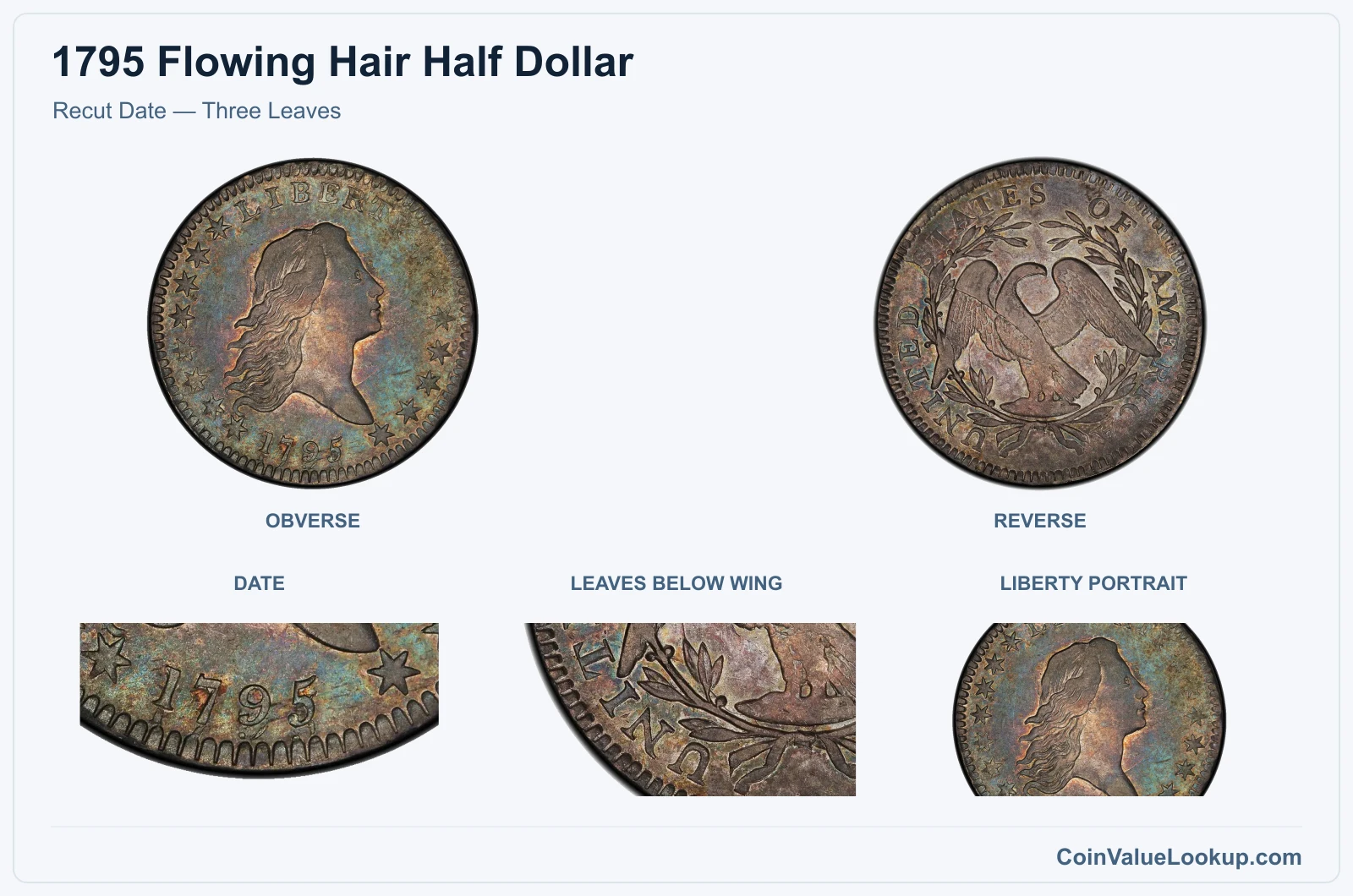
This variety must satisfy two criteria simultaneously. First, the date numerals show recut outlines — the same doubled contours described for the Recut Date — Two Leaves branch.
Second, the leaf clusters beneath each wing contain three leaves instead of two.
Three leaves alone and recut numerals alone describe different varieties. Your coin needs both features confirmed to land here.
Because this is a scarcer combination, value hinges on authenticated identity and condition rather than a standard price table. Have the coin professionally attributed before assuming this classification.
Range Grade
Price Auction Records Appraisal PO PO 1
—
Coin Identifier FR FR 2
Coin Identifier AG AG 3
Coin Identifier G G 4
—
Coin Identifier
G 6
—
Coin Identifier VG VG 8
Coin Identifier
VG 10
Coin Identifier F F 12
Coin Identifier
F 15
Coin Identifier VF VF 20
Coin Identifier
VF 25
Coin Identifier
VF 30
Coin Identifier
VF 35
—
Coin Identifier XF XF 40
Coin Identifier
XF 45
Coin Identifier AU AU 50
—
Coin Identifier
AU 53
—
—
—
AU 55
—
—
—
AU 58
—
—
— MS MS 60
—
—
—
MS 61
—
—
—
MS 62
—
—
—
MS 63
—
—
—
MS 64
—
—
—
MS 65
—
—
—
MS 66
—
—
—
MS 67
—
—
—
MS 68
—
—
—
MS 69
—
—
—
MS 70
—
—
—
1795 Flowing Hair Half Dollar — Small Head — Two Leaves
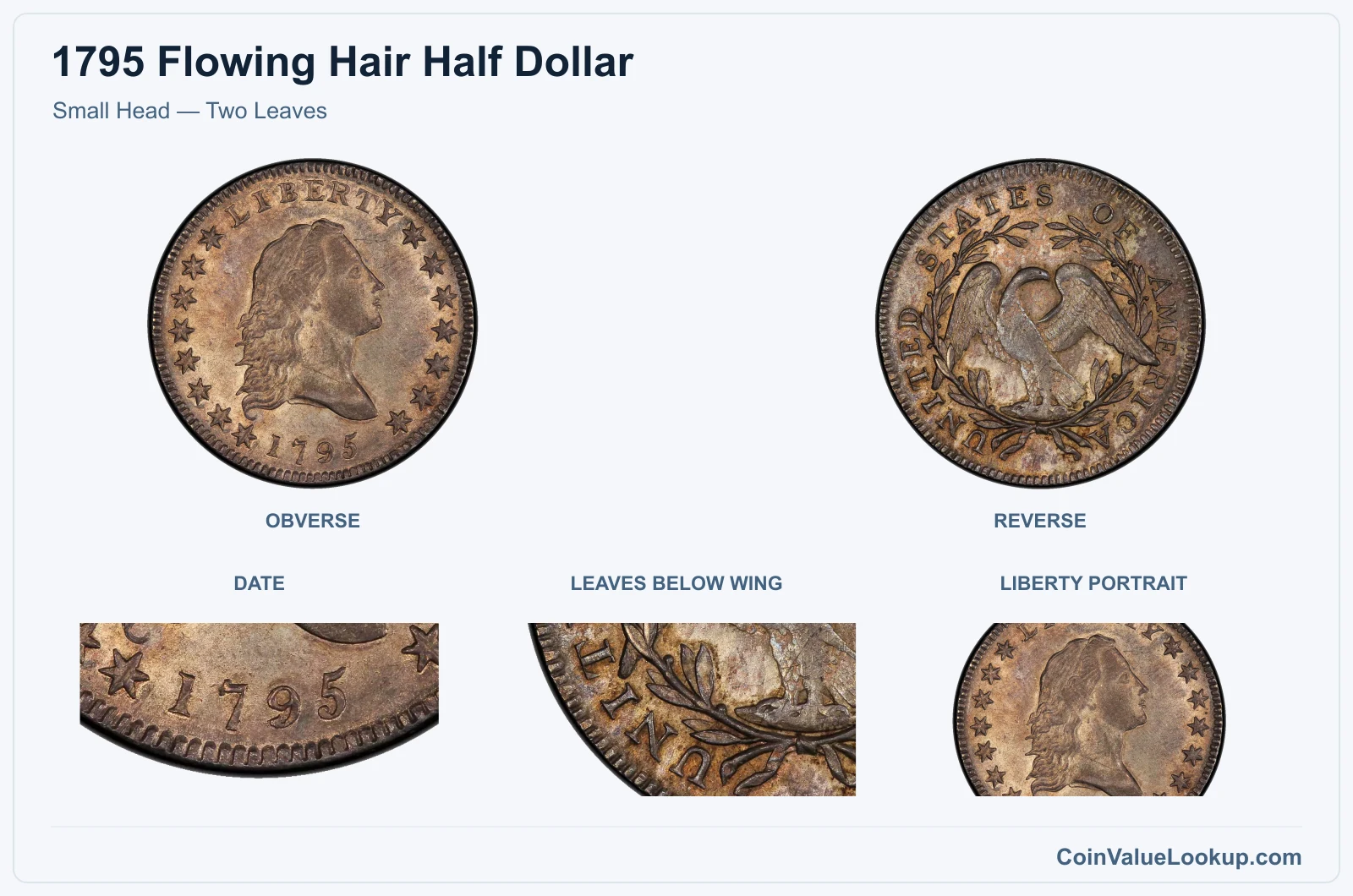
The Small Head variety uses a visibly smaller portrait of Liberty compared to the regular obverse die. The difference is real but subtle enough that wear, photography angle, and wishful thinking can fool you.
Compare your coin side by side with a positively attributed Small Head image at the same scale.
This version carries two leaves beneath each wing on the reverse. Its value depends on authenticated identity and condition; no single adopted price range covers it reliably.
If the head just looks "a little different," that is usually wear or a slightly different die state — not a new variety.
Range Grade
Price Auction Records Appraisal PO PO 1
—
Coin Identifier FR FR 2
—
Coin Identifier AG AG 3
Coin Identifier G G 4
Coin Identifier
G 6
Coin Identifier VG VG 8
Coin Identifier
VG 10
Coin Identifier F F 12
Coin Identifier
F 15
Coin Identifier VF VF 20
—
Coin Identifier
VF 25
—
Coin Identifier
VF 30
—
Coin Identifier
VF 35
Coin Identifier XF XF 40
—
Coin Identifier
XF 45
—
Coin Identifier AU AU 50
—
Coin Identifier
AU 53
—
Coin Identifier
AU 55
Coin Identifier
AU 58
—
Coin Identifier MS MS 60
—
Coin Identifier
MS 61
—
Coin Identifier
MS 62
Coin Identifier
MS 63
—
Coin Identifier
MS 64
—
—
—
MS 65
—
—
—
MS 66
—
—
—
MS 67
—
—
—
MS 68
—
—
—
MS 69
—
—
—
MS 70
—
—
—
1795 Flowing Hair Half Dollar — A over E in STATES
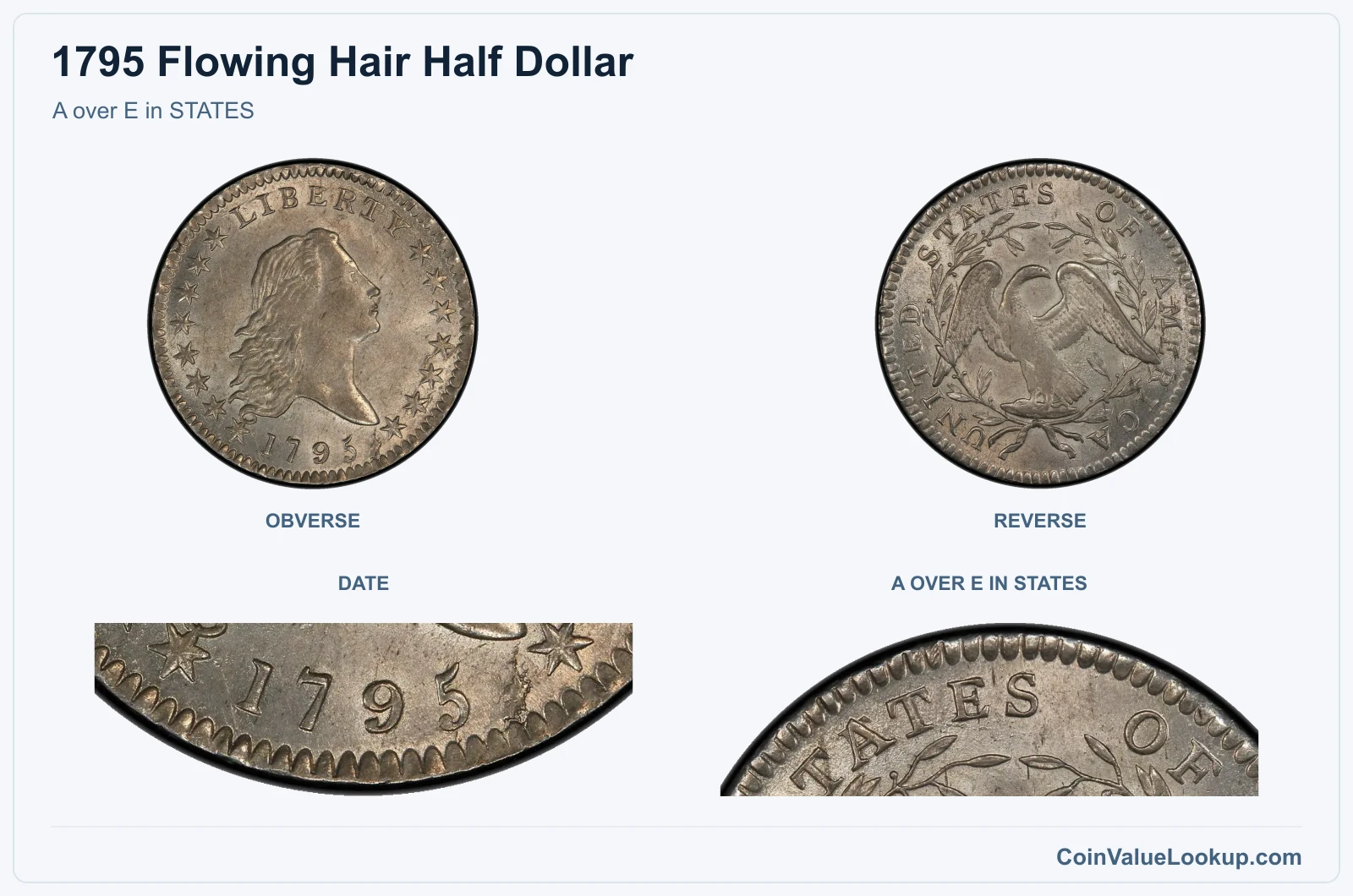
On the reverse, find the word STATES. According to PCGS, the die originally read STETES, and the engraver corrected it by punching A over the erroneous E.
Traces of the underlying E are visible even on well-circulated examples if you know where to look.
This is a corrected-lettering variety with its own valuation — do not treat it as generic doubling or apply a standard doubling premium. Value depends on authenticated identity, the clarity of the remnant E, and overall coin condition.
A coin where the overlettering is bold and unmistakable will naturally attract more interest than one where it is barely detectable.
Range Grade
Price Auction Records Appraisal PO PO 1
—
Coin Identifier FR FR 2
Coin Identifier AG AG 3
—
Coin Identifier G G 4
Coin Identifier
G 6
Coin Identifier VG VG 8
Coin Identifier
VG 10
Coin Identifier F F 12
Coin Identifier
F 15
Coin Identifier VF VF 20
—
Coin Identifier
VF 25
—
Coin Identifier
VF 30
—
Coin Identifier
VF 35
—
Coin Identifier XF XF 40
—
Coin Identifier
XF 45
—
Coin Identifier AU AU 50
—
Coin Identifier
AU 53
—
Coin Identifier
AU 55
—
Coin Identifier
AU 58
—
Coin Identifier MS MS 60
—
Coin Identifier
MS 61
—
Coin Identifier
MS 62
—
Coin Identifier
MS 63
—
Coin Identifier
MS 64
—
Coin Identifier
MS 65
—
—
—
MS 66
—
—
—
MS 67
—
—
—
MS 68
—
—
—
MS 69
—
—
—
MS 70
—
—
—
1795 Flowing Hair Half Dollar — Mint-Inserted Silver Plug
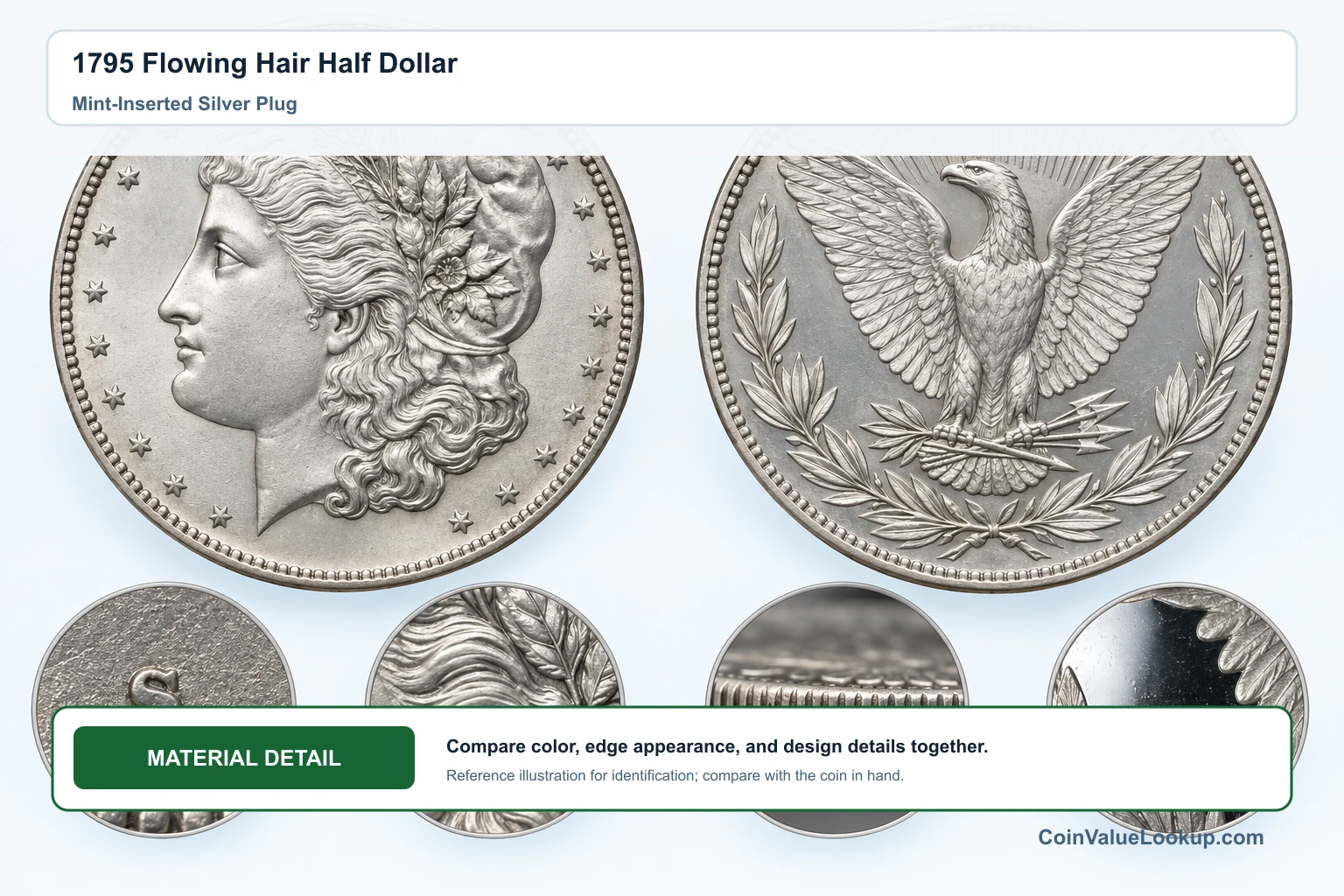
During production, some 1795 half dollar planchets came in underweight. The Mint's solution was to drill a small hole and insert a silver plug to bring the coin up to the correct weight before striking.
The strike then flattened and partially concealed the plug, but it remains visible as a circular patch on the planchet.
Here is the hard part: later owners also plugged coins to fill holes from jewelry use. Separating a genuine mint-inserted plug from a post-mint repair requires expert attribution and documented provenance.
PCGS recognizes this variety separately. No generic normal-date price curve applies.
If you think you have one, professional authentication is not optional — it is the entire ballgame.
Attribution: This table applies specifically to the attributed O-130 Silver Plug variety. A suspected plug needs expert authentication; these values do not apply to an ordinary 1795 half dollar or to a repaired coin.
Range Grade
Price Auction Records Appraisal PO PO 1
—
Coin Identifier FR FR 2
—
Coin Identifier AG AG 3
—
Coin Identifier G G 4
—
Coin Identifier
G 6
Coin Identifier VG VG 8
—
—
—
VG 10
—
—
— F F 12
—
—
—
F 15
—
—
— VF VF 20
—
—
—
VF 25
—
—
—
VF 30
—
—
—
VF 35
—
—
— XF XF 40
—
—
—
XF 45
—
—
— AU AU 50
—
—
—
AU 53
—
—
—
AU 55
—
—
—
AU 58
—
—
— MS MS 60
—
—
—
MS 61
—
—
—
MS 62
—
—
—
MS 63
—
—
—
MS 64
—
—
—
MS 65
—
—
—
MS 66
—
—
—
MS 67
—
—
—
MS 68
—
—
—
MS 69
—
—
—
MS 70
—
—
—
1795 Flowing Hair Half Dollar Error List
1. 1795 Flowing Hair Half Dollar — Die Break / Cud
A die break or cud on a 1795 half dollar appears as a raised, blob-like area along the rim — or sometimes slightly inside the design — where part of the die has fractured and fallen away. On a retained cud, you may still see traces of the original design within the raised lump because the broken die fragment stayed partially in place.
Do not confuse this with a rim dent, localized corrosion, or a small interior die chip. Dents are depressed into the surface; cuds are raised above it.
Corrosion tends to have an irregular, pitted texture rather than a smooth raised platform.
Condition of the error, its size, and visibility all affect how much a cud adds to the coin's value. No single price range covers every example.
2. 1795 Flowing Hair Half Dollar — Die Crack / Die Chip
Die cracks on 1795 half dollars show up as thin, raised lines running across the coin's surface — the opposite of a scratch, which is incised into the metal. One documented example shows raised fractures near the right-hand stars and along the word LIBERTY on an A over E variety coin.
The crack and the corrected letter are separate features; evaluate each on its own merits.
Do not mistake incuse scratches, corrosion lines, or foreign material stuck to the surface for a die crack. A true crack is raised, follows a consistent path, and appears the same under rotation.
The specific crack's length, location, and the coin's overall condition determine any premium. No adopted numeric range applies across all examples.
3. 1795 Flowing Hair Half Dollar — Uniface Strike (Source-Attributed 1795 Reverse)
A reported uniface strike attributed to 1795 shows a fully struck eagle reverse paired with a completely blank opposite face on a silver, lettered-edge planchet. Because there is no obverse date visible, the year is attributed through identification of the reverse die rather than a readable 1795.
The reporting source treats this as a striking error — one side received full pressure while the other did not contact a die — rather than a deliberate die trial. Either way, it is extraordinarily rare.
Be careful with lookalikes. A coin with one face worn smooth, ground off, or poorly reproduced can mimic a uniface strike.
A blank face alone, especially from a photograph, is not enough to confirm this error. Professional in-hand examination is essential.
Value depends on the specific piece, its provenance, and authenticated attribution.