1849 Liberty Seated Half Dollar Coin Value: How Much Is It Worth?
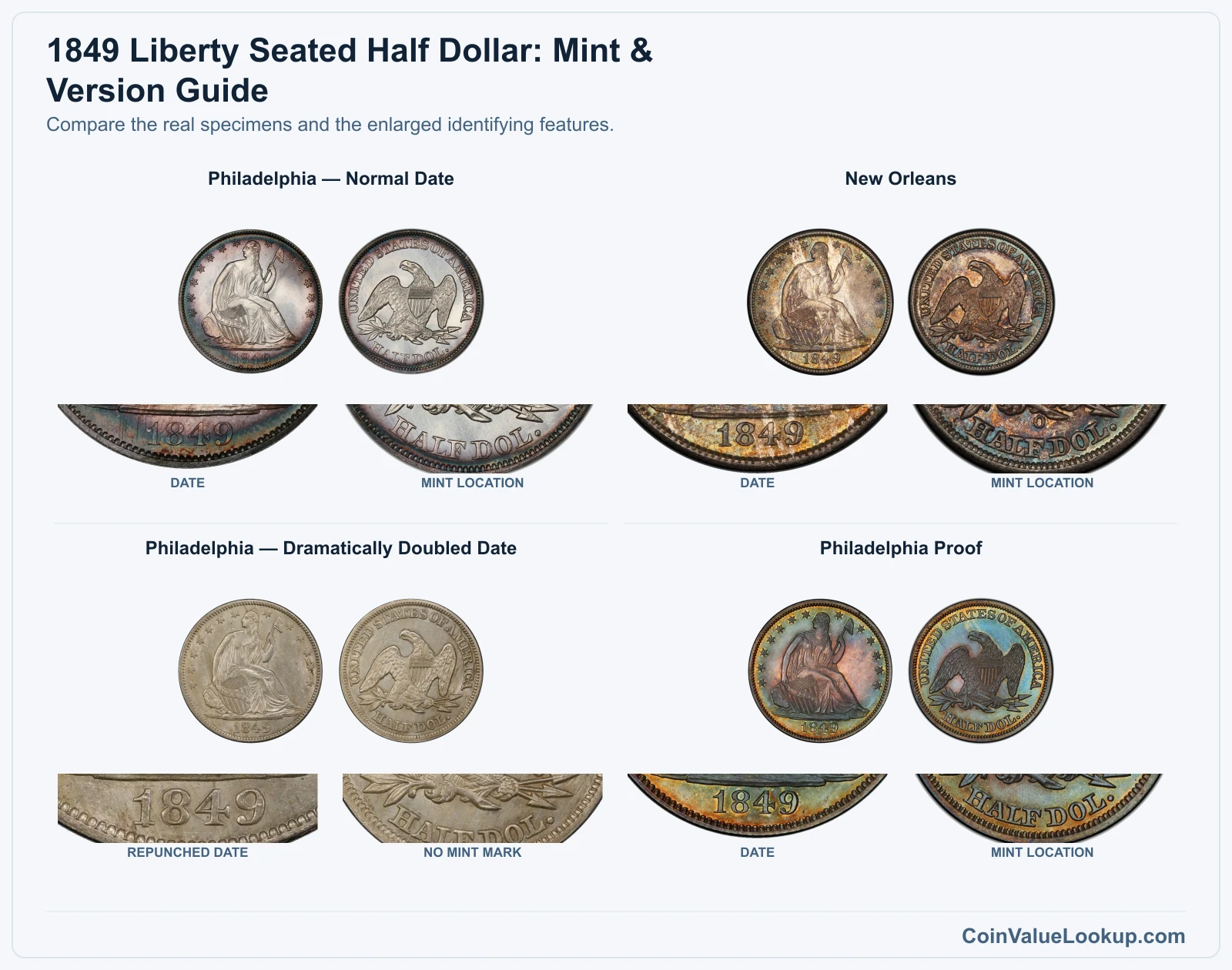
The 1849 Liberty Seated Half Dollar carries real collector value even in well-worn condition. A typical Philadelphia example runs from about $111 in G4 to $632 near AU50 based on guide estimates, while the New Orleans mint and scarce varieties follow different tracks entirely.
Grade, mintmark and version are the three things that determine what yours is actually worth.
Fast Way to Identify Your 1849 Liberty Seated Half Dollar
The quickest way to start figuring out your 1849 half dollar is to upload clear photos of the front and back. Our identifier can offer a preliminary read on your coin's mint, version and approximate condition.
Snap both sides in even lighting, and include the edge if you can.
1849 Liberty Seated Half Dollar Value
Upload both sides of your 1849 Liberty Seated Half Dollar.
Front Obverse
Upload photo
Back Reverse
Upload photo
Which 1849 Liberty Seated Half Dollar Versions Are Worth Money?
- Philadelphia normal date coins guide around $111 at G4 up to $632 at AU50, making even circulated examples worth checking.
- New Orleans (O mint) pieces start lower at about $80 in G4 but climb to roughly $949 at AU50, rewarding sharp survivors.
- The dramatically doubled date variety from Philadelphia has recorded an individual MS64 sale of $9,400 at Heritage in 2014, so inspect your date digits closely.
- Philadelphia Proofs are scarce collectible strikes; one graded PR66 sold for $86,250 at Heritage in 2008.
Step 1: Identify Your 1849 Liberty Seated Half Dollar Mint Mark and Version
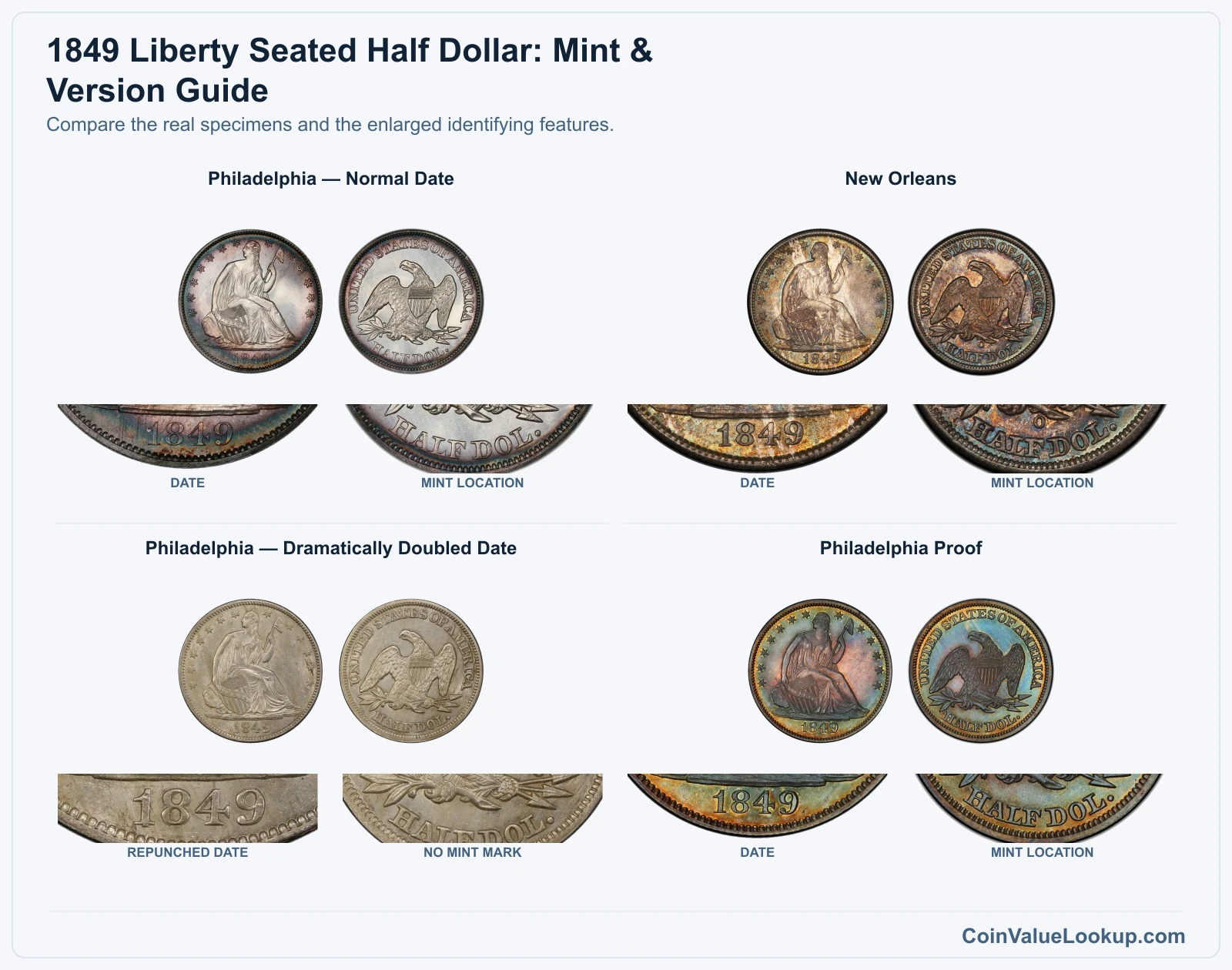
The 1849 half dollar shows a Seated Liberty figure on the obverse and an eagle with HALF DOL on the reverse. There is no IN GOD WE TRUST motto on this date.
The coin is struck in 90% silver with 10% copper and weighs 13.36 grams under the old pre-1853 standard.
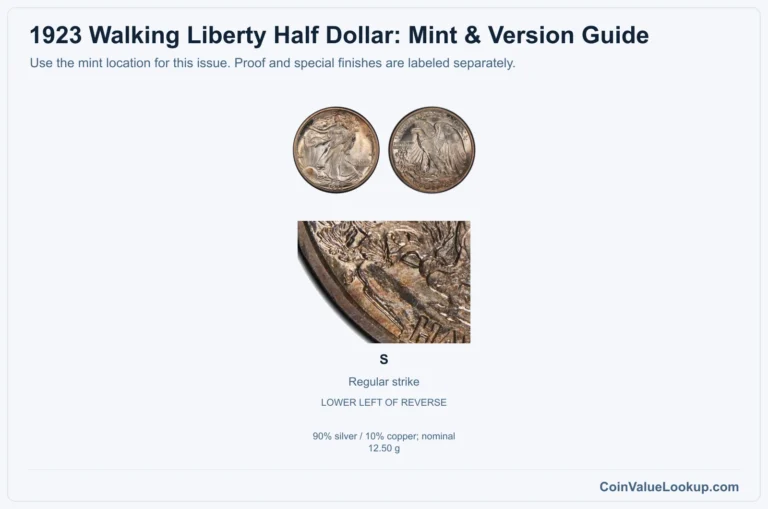
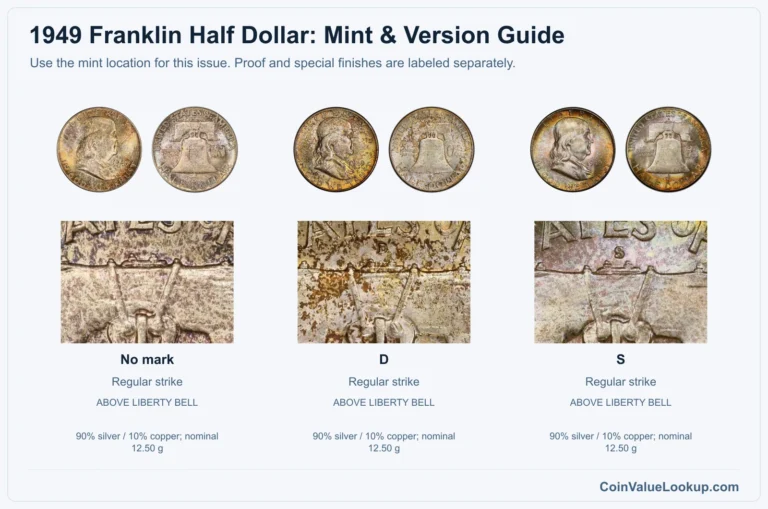
Flip it over and look below the eagle for a mintmark. A small "O" means New Orleans.
No letter at all means Philadelphia.
Three main collectible branches exist for this year: the Philadelphia normal date, the New Orleans issue, and the Philadelphia dramatically doubled date. Proofs also exist as a separate manufacturing type, not simply a high grade or a shiny coin.
Mirror-like fields alone do not make a Proof; the strike characteristics, rim finish and overall presentation all matter.
Step 2: Check Your 1849 Liberty Seated Half Dollar Grade
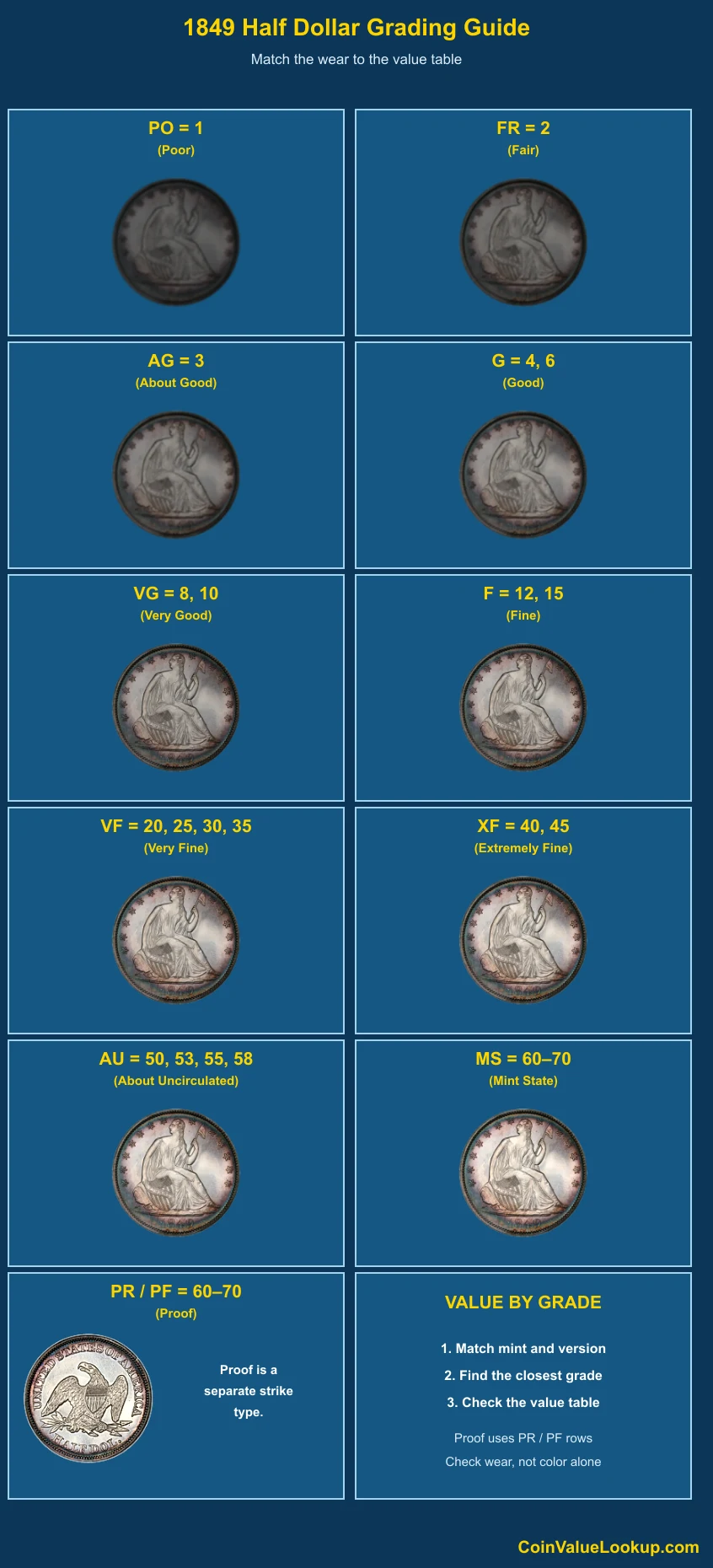
Start with the obverse. Check Liberty's head detail, the breast area, the knee and the shield lines.
On the reverse, examine the eagle's breast feathers, wing tips and claws. Compare what you see to the type-matched reference image.
Flat, mushy centers do not always mean heavy wear. Seated Liberty halves are notorious for weak strikes at the high points.
The difference is that wear also kills luster and smooths surrounding areas, while a strike weakness leaves the luster intact in the flat zone.
Photograph both sides and the edge under good light. Do not clean the coin, even if it looks dark or spotted.
Cleaning almost always lowers the grade a professional service would assign.
Step 3: Check 1849 Liberty Seated Half Dollar Value by Mint and Version
1849 Liberty Seated Half Dollar — Philadelphia — Normal Date
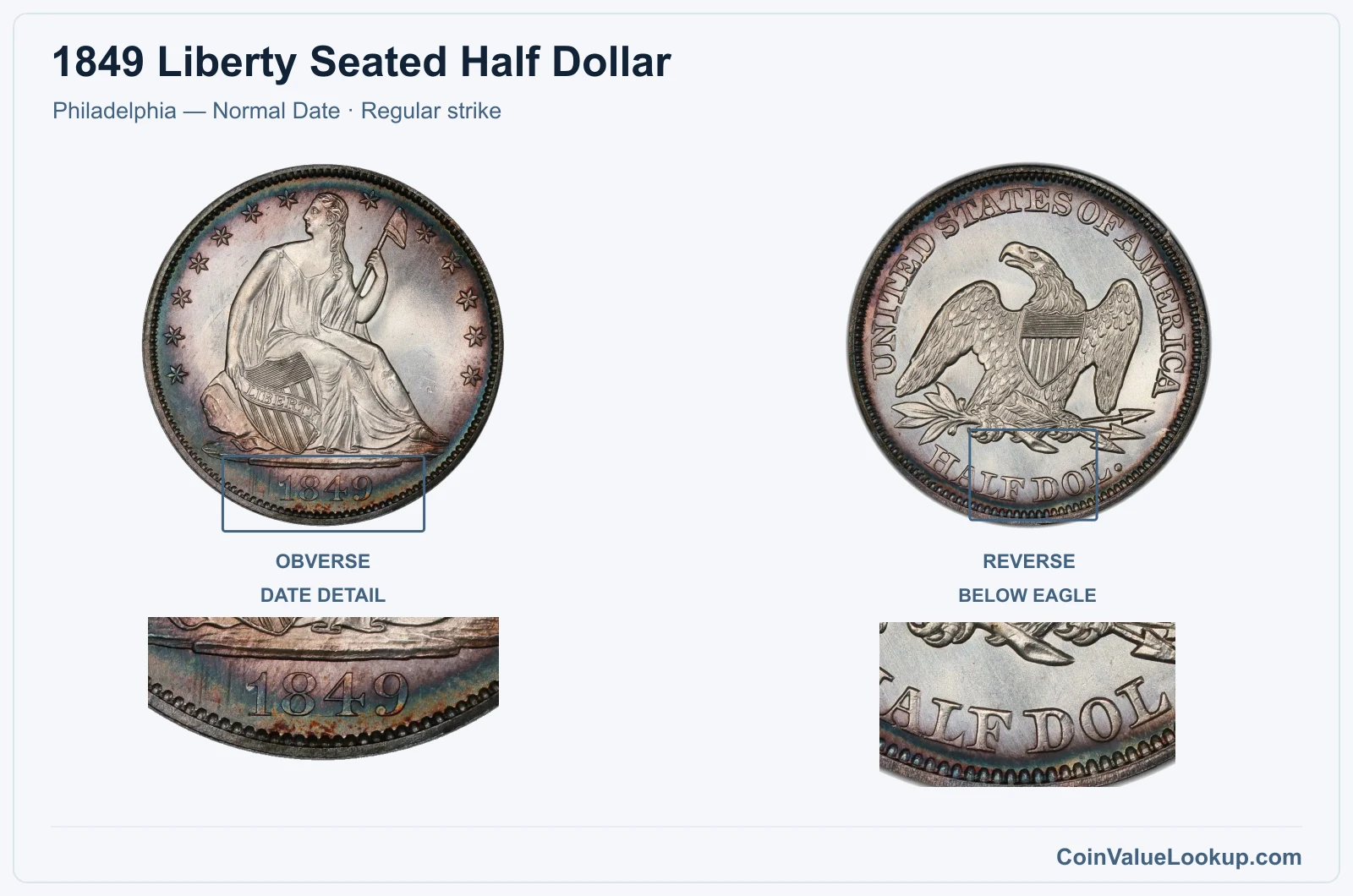
The standard 1849 Philadelphia half dollar carries no mintmark. It uses the Seated Liberty No Motto design without arrows or rays.
Guide estimates place it around $111 in G4, $269 in VF20 and $632 in AU50.
This is the coin most people find when they inherit an 1849 half. Look at the date carefully to make sure it is a normal, single-punched date without leftover digit remnants underneath.
If the numerals are clean with no doubling at the bases, you have the ordinary version.
Range Grade
Price Auction Records Appraisal PO PO 1
—
Coin Identifier FR FR 2
—
Coin Identifier AG AG 3
—
Coin Identifier G G 4
—
Coin Identifier
G 6
—
Coin Identifier VG VG 8
—
Coin Identifier
VG 10
—
Coin Identifier F F 12
—
Coin Identifier
F 15
—
Coin Identifier VF VF 20
Coin Identifier
VF 25
Coin Identifier
VF 30
Coin Identifier
VF 35
Coin Identifier XF XF 40
Coin Identifier
XF 45
Coin Identifier AU AU 50
Coin Identifier
AU 53
Coin Identifier
AU 55
Coin Identifier
AU 58
Coin Identifier MS MS 60
Coin Identifier
MS 61
Coin Identifier
MS 62
Coin Identifier
MS 63
Coin Identifier
MS 64
Coin Identifier
MS 65
Coin Identifier
MS 66
—
—
—
MS 67
—
—
—
MS 68
—
—
—
MS 69
—
—
—
MS 70
—
—
—
1849 Liberty Seated Half Dollar — New Orleans
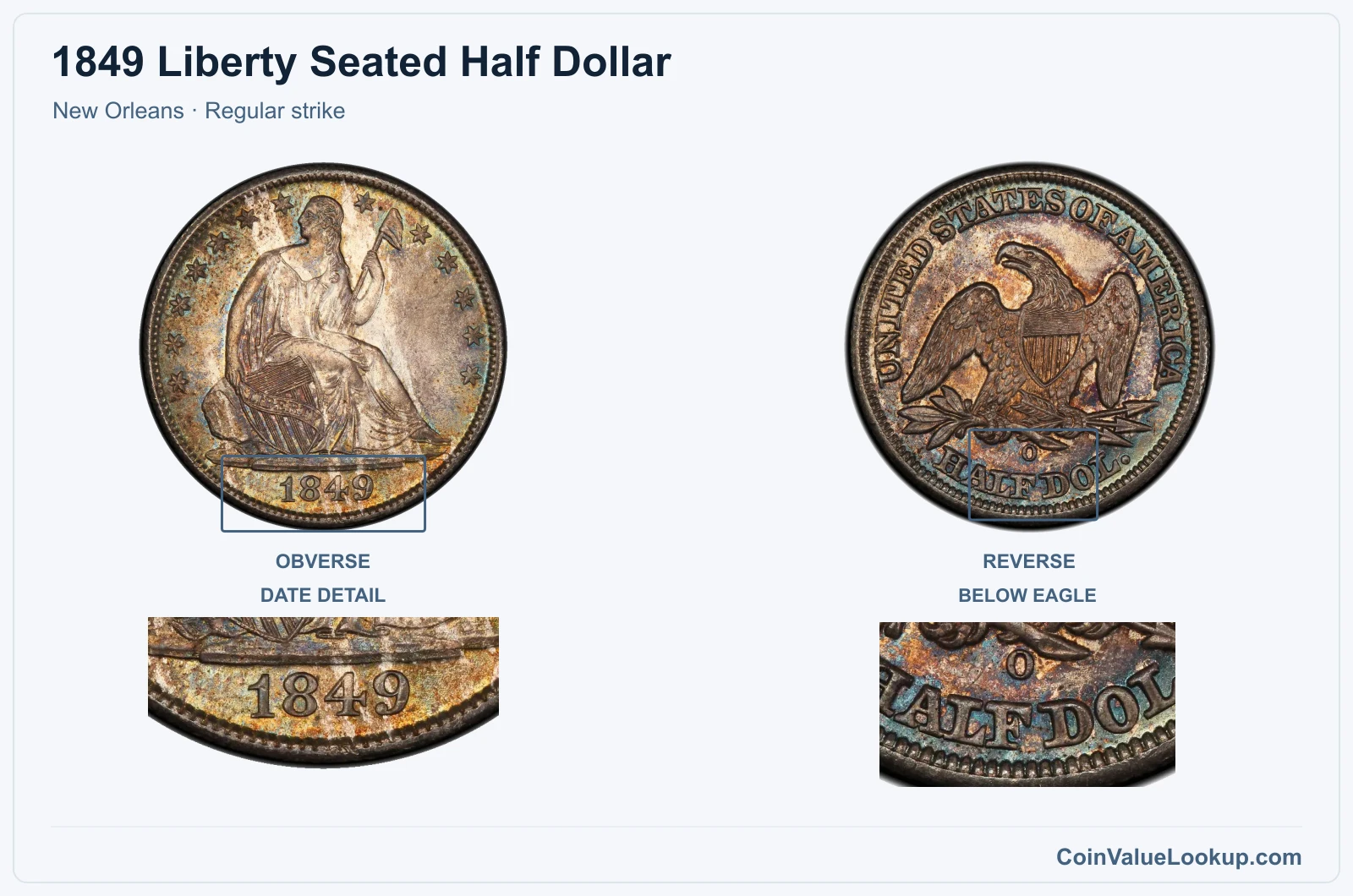
The New Orleans issue carries a small "O" mintmark on the reverse below the eagle. Guide estimates run about $80 in G4, $237 in VF20 and $949 in AU50, so nice examples actually outpace their Philadelphia cousins at the upper end.
Some 1849-O halves display strong die cracks, but cracking alone does not define the normal issue. These cracks are a separate collectible feature.
The key identifier here is simply that reverse O mintmark.
Range Grade
Price Auction Records Appraisal PO PO 1
—
Coin Identifier FR FR 2
—
Coin Identifier AG AG 3
—
Coin Identifier G G 4
—
Coin Identifier
G 6
—
Coin Identifier VG VG 8
—
Coin Identifier
VG 10
Coin Identifier F F 12
Coin Identifier
F 15
Coin Identifier VF VF 20
Coin Identifier
VF 25
Coin Identifier
VF 30
Coin Identifier
VF 35
Coin Identifier XF XF 40
Coin Identifier
XF 45
Coin Identifier AU AU 50
Coin Identifier
AU 53
Coin Identifier
AU 55
Coin Identifier
AU 58
Coin Identifier MS MS 60
Coin Identifier
MS 61
Coin Identifier
MS 62
Coin Identifier
MS 63
Coin Identifier
MS 64
Coin Identifier
MS 65
Coin Identifier
MS 66
—
—
—
MS 67
—
—
—
MS 68
—
—
—
MS 69
—
—
—
MS 70
—
—
—
1849 Liberty Seated Half Dollar — Philadelphia — Dramatically Doubled Date
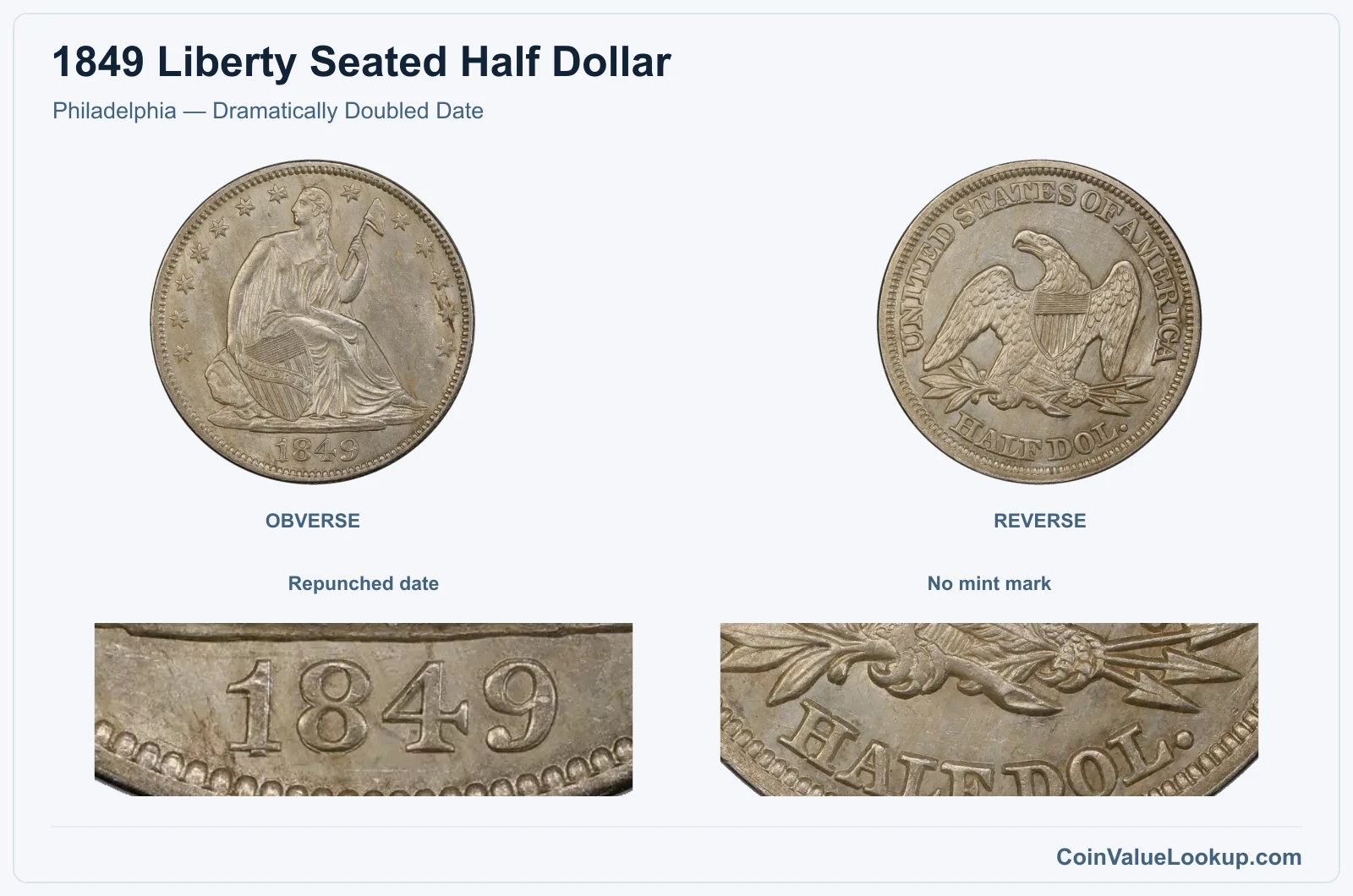
This is where things get interesting for sharp-eyed collectors. The dramatically doubled date variety shows the original digit positions to the left of and below the final date.
Remnants of a misplaced "9" can be spotted in the rock area of the obverse design and even among the dentils near the rim.
This is a repunched date, meaning the date punch was applied more than once in slightly different positions. It is not a doubled die affecting the entire obverse and should not be confused with machine doubling or a full double strike.
An individual example graded MS64 sold for $9,400 at a Heritage auction in 2014. Condition and the clarity of the doubling both influence what a given piece will bring.
Coin Value Lookup is a handy starting point if you want to look up guides for other Seated Liberty dates or denominations while you research your coin.
Ordinary-issue reference: Ordinary-issue reference only: The table below shows prices for the 1849 Liberty Seated Half Dollar (regular strike). It does not represent the value of the specific Philadelphia — Dramatically Doubled Date variety or its variety premium. Year, mint, metal and strike type are matched; the specific variety is not priced by this table.
Range Grade
Price Auction Records Appraisal PO PO 1
—
Coin Identifier FR FR 2
—
Coin Identifier AG AG 3
—
Coin Identifier G G 4
—
Coin Identifier
G 6
—
Coin Identifier VG VG 8
—
Coin Identifier
VG 10
—
Coin Identifier F F 12
—
Coin Identifier
F 15
—
Coin Identifier VF VF 20
Coin Identifier
VF 25
Coin Identifier
VF 30
Coin Identifier
VF 35
Coin Identifier XF XF 40
Coin Identifier
XF 45
Coin Identifier AU AU 50
Coin Identifier
AU 53
Coin Identifier
AU 55
Coin Identifier
AU 58
Coin Identifier MS MS 60
Coin Identifier
MS 61
Coin Identifier
MS 62
Coin Identifier
MS 63
Coin Identifier
MS 64
Coin Identifier
MS 65
Coin Identifier
MS 66
—
—
—
MS 67
—
—
—
MS 68
—
—
—
MS 69
—
—
—
MS 70
—
—
—
1849 Liberty Seated Half Dollar — Philadelphia Proof
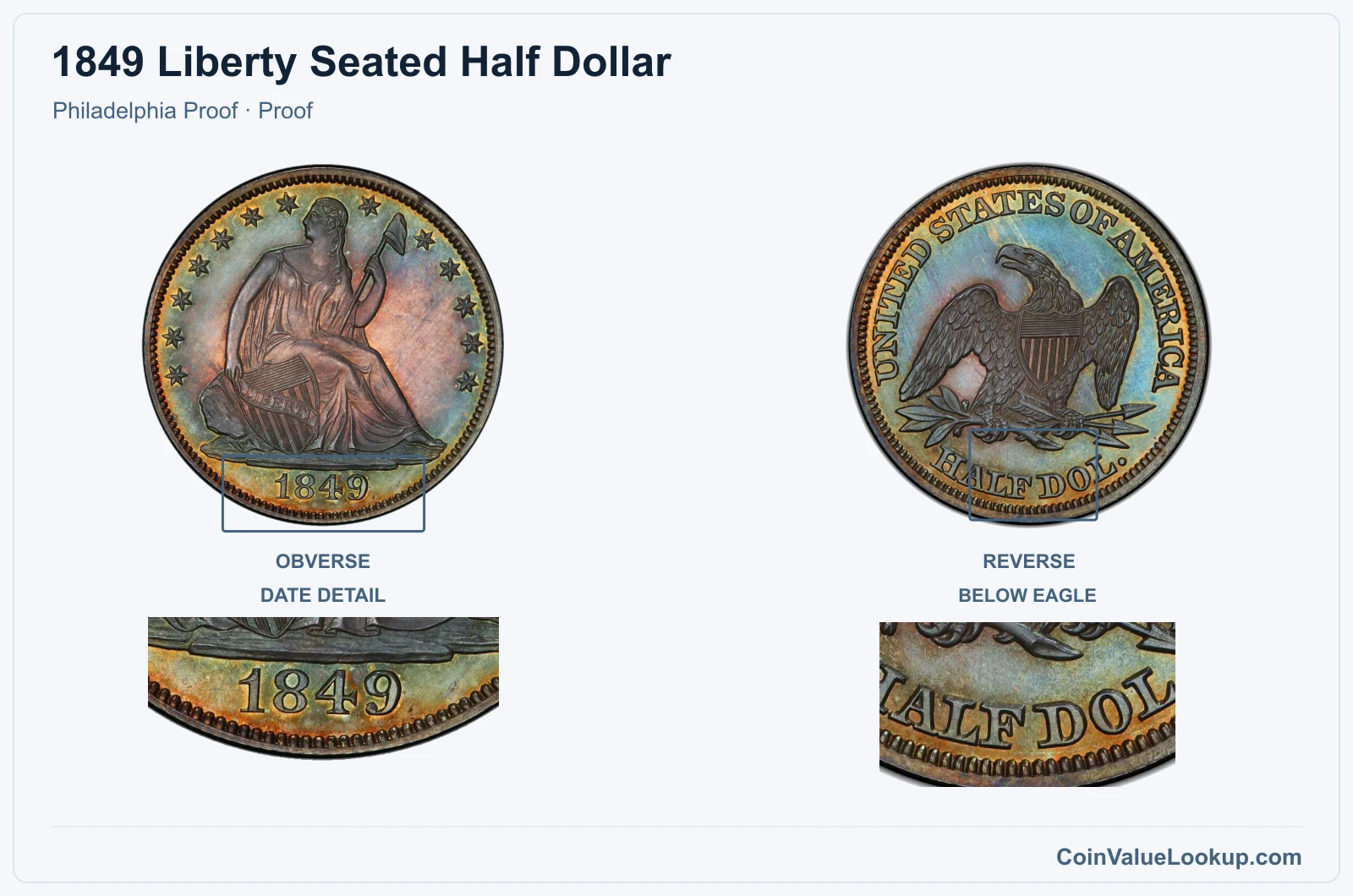
Philadelphia Proof half dollars from 1849 are genuinely scarce collector pieces struck with a different manufacturing process than regular coins. Both sides should show mirror-like reflective fields, sharp rims and full design detail.
CAM and DCAM designations refer to the degree of contrast between frosted devices and mirrored fields, and they fall within this same Proof category.
Do not assume a bright, cleaned circulation strike is a Proof. Professional authentication is important here.
A single PR66 example sold for $86,250 at Heritage in 2008, which tells you the ceiling is extraordinary, but that is one recorded sale, not a market curve you can count on for every Proof.
Range Grade
Price Auction Records Appraisal PR PR 1
—
Coin Identifier
PR 2
—
Coin Identifier
PR 3
—
Coin Identifier
PR 4
—
Coin Identifier
PR 6
—
Coin Identifier
PR 8
—
Coin Identifier
PR 10
—
Coin Identifier
PR 12
—
Coin Identifier
PR 15
—
Coin Identifier
PR 20
—
Coin Identifier
PR 25
—
Coin Identifier
PR 30
—
Coin Identifier
PR 35
—
Coin Identifier
PR 40
—
Coin Identifier
PR 45
—
Coin Identifier
PR 50
—
Coin Identifier
PR 53
—
Coin Identifier
PR 55
—
Coin Identifier
PR 58
—
Coin Identifier
PR 60
—
Coin Identifier
PR 61
—
Coin Identifier
PR 62
—
Coin Identifier
PR 63
—
Coin Identifier
PR 64
Coin Identifier
PR 65
Coin Identifier
PR 66
Coin Identifier
PR 67
—
—
—
PR 68
—
—
—
PR 69
—
—
—
PR 70
—
—
—
1849 Liberty Seated Half Dollar Error List
1. 1849 Liberty Seated Half Dollar — Repunched Date
Repunched dates on 1849 half dollars occur when the date punch was impressed into the die more than once in slightly shifted positions. The diagnostic to look for is remnants of the original digit bases sitting to the left of or below the final date numerals.
On the most dramatic examples, traces of a misplaced "9" appear embedded in the rock detail on the obverse or nestled among the border dentils.
This is not a doubled die obverse. The doubling is limited to the date area because only the date punch moved, not the entire hub.
Machine doubling, which produces flat shelf-like distortion, and post-strike damage to individual digits can both mimic a repunched date at first glance. True repunching shows raised, rounded remnant serifs that match the font of the other numerals.
The value of a repunched date depends on condition, the visibility of the remnant digits and the specific variety involved.
2. 1849 Liberty Seated Half Dollar — Die Crack / Die Chip
Die cracks on the 1849 half dollar appear as thin raised lines running across the coin's surface. On the 1849-O in particular, a crack has been reported running from the rim near star 8 through Liberty's head, face and shoulder and continuing into the arm area.
Reverse cracks also fall into this same general category.
These raised lines follow the path of a fracture that formed in the steel die during use, so they transfer as raised metal on every coin struck from that cracked die. They should not be confused with incuse scratches, which are cut into the surface rather than raised above it, or with corrosion lines and foreign material sitting on top of the coin.
Under magnification, a genuine die crack has a consistent, slightly irregular raised profile that flows naturally across the design. The value of a die crack piece depends on the crack's visibility, the coin's overall condition and collector interest in the specific die state.