1987 Jefferson Nickel Coin Value: How Much Is It Worth?
Most 1987 Jefferson nickels you pull from a jar are worth face value in circulated condition. Uncirculated examples carry modest guide estimates — roughly $0.30 at MS60 up to about $4.27 at MS65, depending on the mint.
San Francisco proofs and confirmed error coins occupy their own price lanes. These guide figures are retail estimates, not guaranteed cash offers for any particular coin.
Fast Way to Identify Your 1987 Jefferson Nickel
Snap a clear photo of the front and back of your 1987 nickel and upload both images here. Our identifier can give you a preliminary read on which mint and version you have.
It will not authenticate errors or assign a certified grade, so think of it as a helpful first step before deeper research.
1987 Jefferson Nickel Value
Upload both sides of your 1987 Jefferson Nickel.
Front Obverse
Upload photo
Back Reverse
Upload photo
Which 1987 Jefferson Nickel Versions Are Worth Money?
- Uncirculated 1987-D nickels in MS65 condition carry a guide estimate around $4.27, the highest base figure among the three regular versions.
- 1987-S proofs are collector strikes with a guide value near $3.62 at PR65; cameo and deep cameo contrast levels are evaluated separately.
- A 1987-P nickel struck on wrong clad stock — a nickel-sized blank cut from quarter-strip material — sold through Heritage Auctions in October 2012 for $1,175 in NGC AU58.
- Doubled die obverse, doubled die reverse, and repunched mintmark varieties have been reported for 1987 nickels; condition and visibility of the doubling affect their individual value.
Step 1: Identify Your 1987 Jefferson Nickel Mint Mark and Version
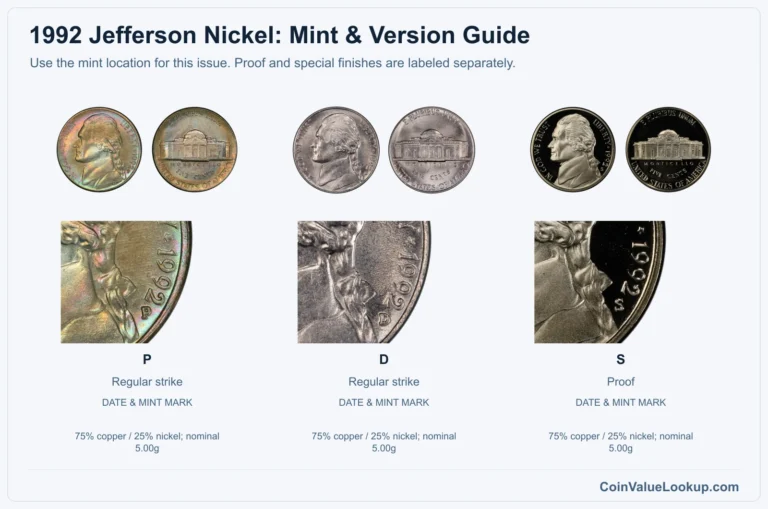
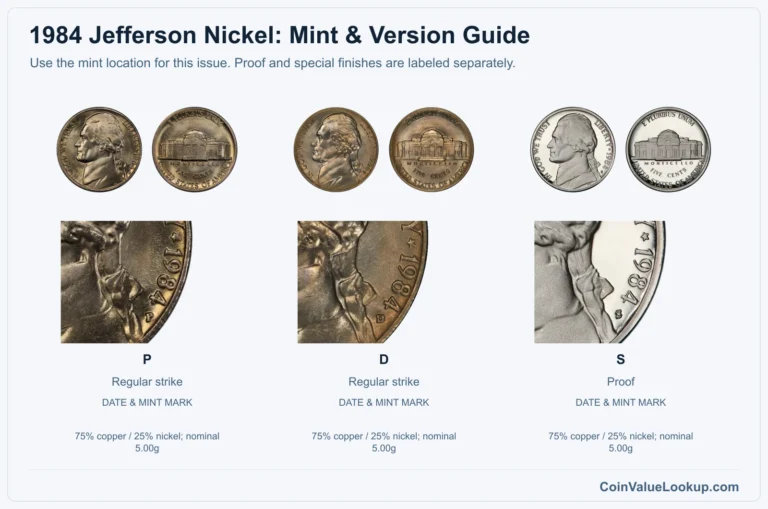
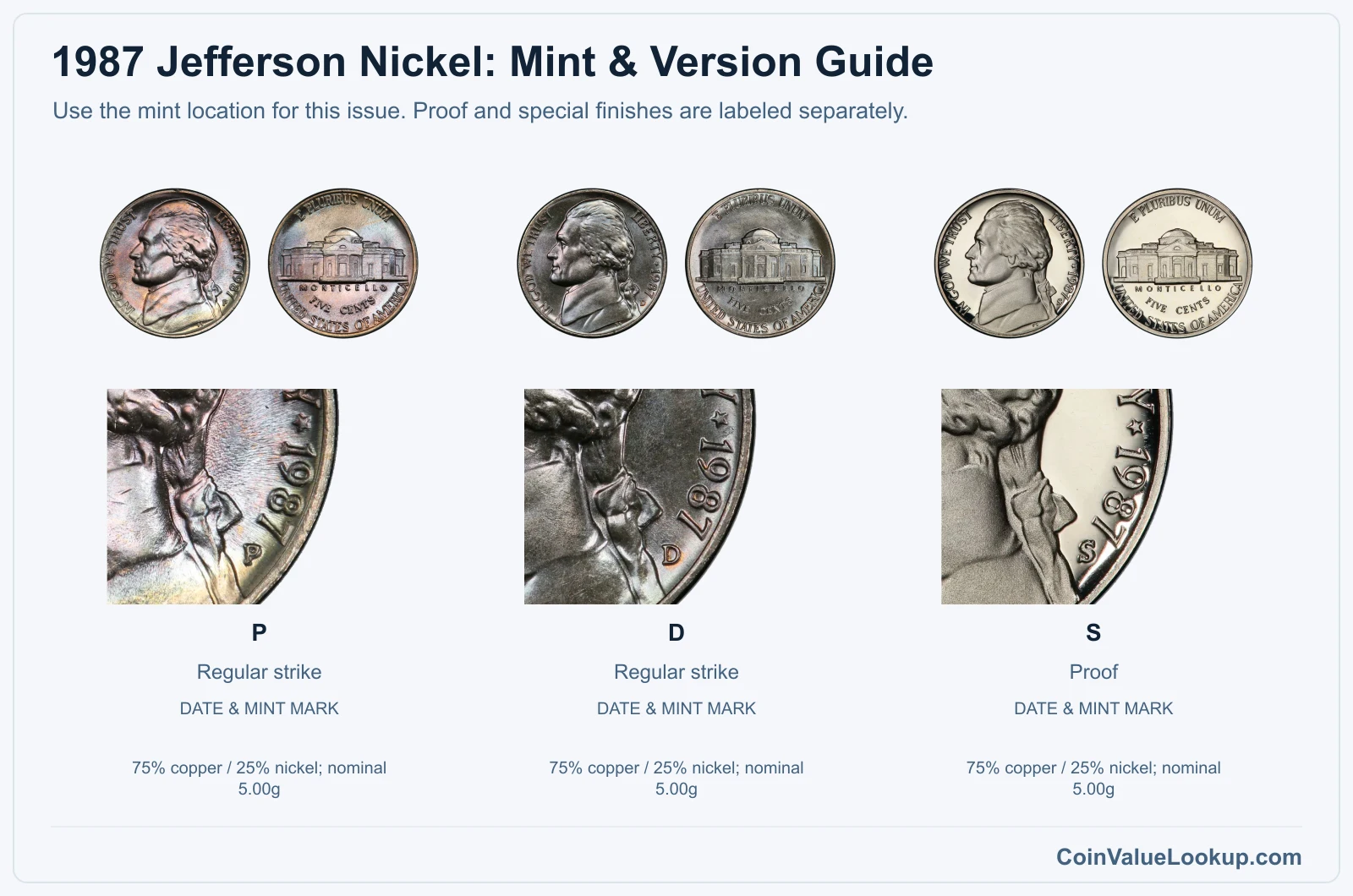
Three versions exist for 1987: the Philadelphia (P) business strike, Denver (D) business strike, and San Francisco (S) proof. Look below the date on the obverse for the mintmark letter.
P and D coins were made for circulation; S coins are proof strikes sold in collector sets.
All three share the same alloy — 75% copper and 25% nickel — weighing about 5 grams with a plain edge and a 21.2 mm diameter. Do not confuse this standard nickel alloy with a clad sandwich; it is a solid homogeneous mix.
Before checking any price chart, confirm your coin's mintmark and finish. A proof has mirror-like fields and sharp edges on the design, while a business strike has a satin or frosty surface.
Material differences, such as an unusual weight or visible layered edge, could signal an error and deserve separate attention.
Step 2: Check Your 1987 Jefferson Nickel Grade
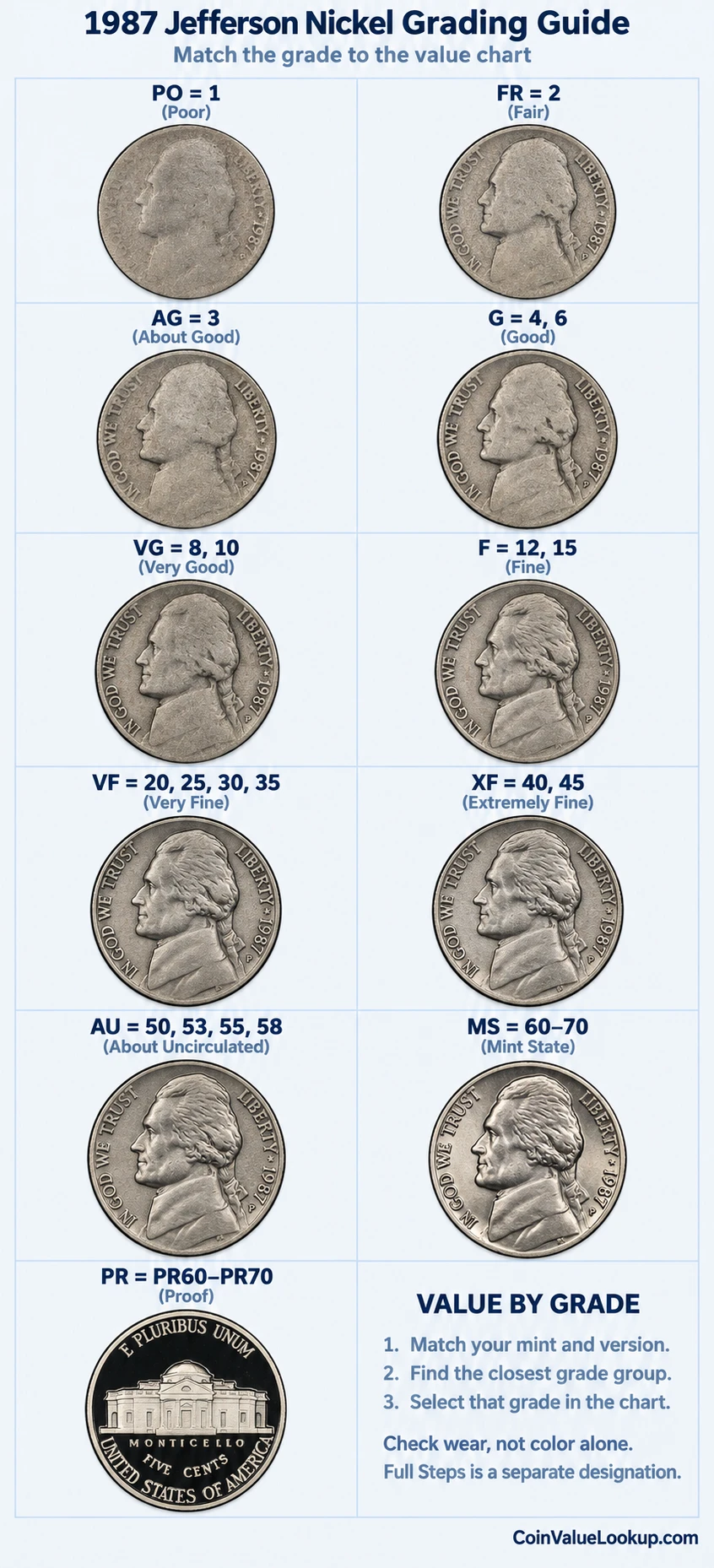
Start with Jefferson's cheekbone and hair detail. On a well-worn coin those areas flatten first, and the original mint luster disappears.
Compare yours to the reference image to gauge how much detail remains.
Monticello on the reverse provides a second checkpoint. The columns, roofline, and steps all lose definition progressively as the grade drops.
Sharp steps on Monticello can indicate strike quality rather than low wear. A coin can look uncirculated yet still have weak steps because of a soft strike.
Certified Full Steps is a separate designation applied to qualifying Mint State business strikes — it is not an error.
For proofs, look at the mirror fields for hairlines and contact marks. Cameo or deep cameo contrast is a distinct filter from the proof grade itself, and each combination carries its own collector market.
Step 3: Check 1987 Jefferson Nickel Value by Mint and Version
1987 Jefferson Nickel — P Business strike
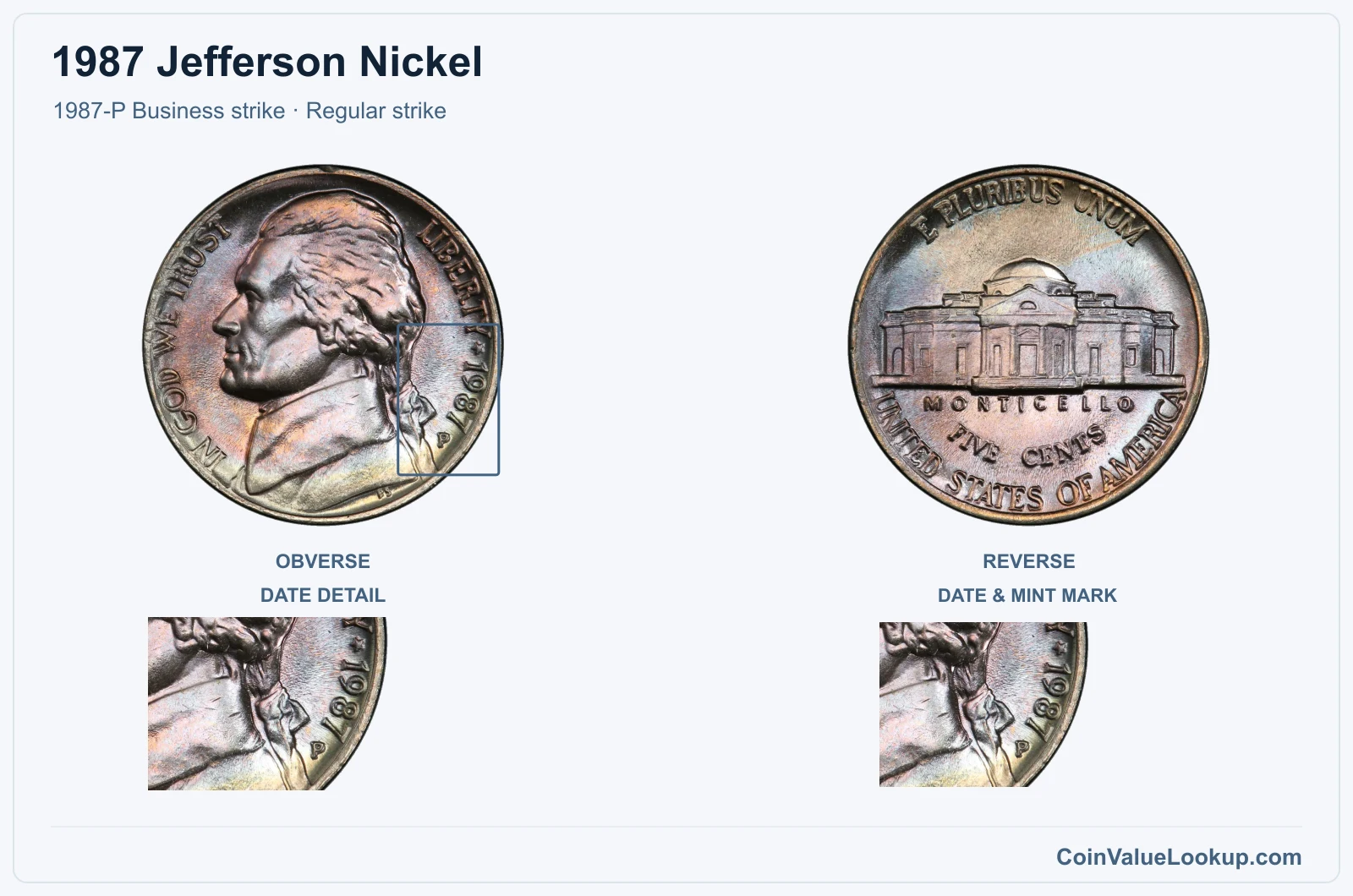
The 1987-P is a standard business strike from the Philadelphia Mint. It carries the normal Jefferson portrait on the obverse and Monticello on the reverse, struck in 75% copper and 25% nickel at about 5 grams.
Guide estimates from USA Coin Book place this coin around $0.30 at MS60 and roughly $3.36 at MS65. Circulated pieces are common enough that they trade at face value.
The P mintmark sits just below the date on the obverse — if yours is worn nearly flat, a magnifier helps.
| Range | Grade | Price | Auction Records | Appraisal |
|---|---|---|---|---|
| PO | PO 1 | — | Coin Identifier | |
| FR | FR 2 | — | Coin Identifier | |
| AG | AG 3 | — | Coin Identifier | |
| G | G 4 | — | Coin Identifier | |
| G 6 | — | Coin Identifier | ||
| VG | VG 8 | — | Coin Identifier | |
| VG 10 | — | Coin Identifier | ||
| F | F 12 | — | Coin Identifier | |
| F 15 | — | Coin Identifier | ||
| VF | VF 20 | — | Coin Identifier | |
| VF 25 | — | Coin Identifier | ||
| VF 30 | — | Coin Identifier | ||
| VF 35 | — | Coin Identifier | ||
| XF | XF 40 | — | Coin Identifier | |
| XF 45 | — | Coin Identifier | ||
| AU | AU 50 | — | Coin Identifier | |
| AU 53 | — | Coin Identifier | ||
| AU 55 | — | Coin Identifier | ||
| AU 58 | — | Coin Identifier | ||
| MS | MS 60 | — | Coin Identifier | |
| MS 61 | — | Coin Identifier | ||
| MS 62 | — | Coin Identifier | ||
| MS 63 | — | Coin Identifier | ||
| MS 64 | Coin Identifier | |||
| MS 65 | — | Coin Identifier | ||
| MS 66 | Coin Identifier | |||
| MS 67 | Coin Identifier | |||
| MS 68 | — | — | — | |
| MS 69 | — | — | — | |
| MS 70 | — | — | — |
1987 Jefferson Nickel — D Business strike
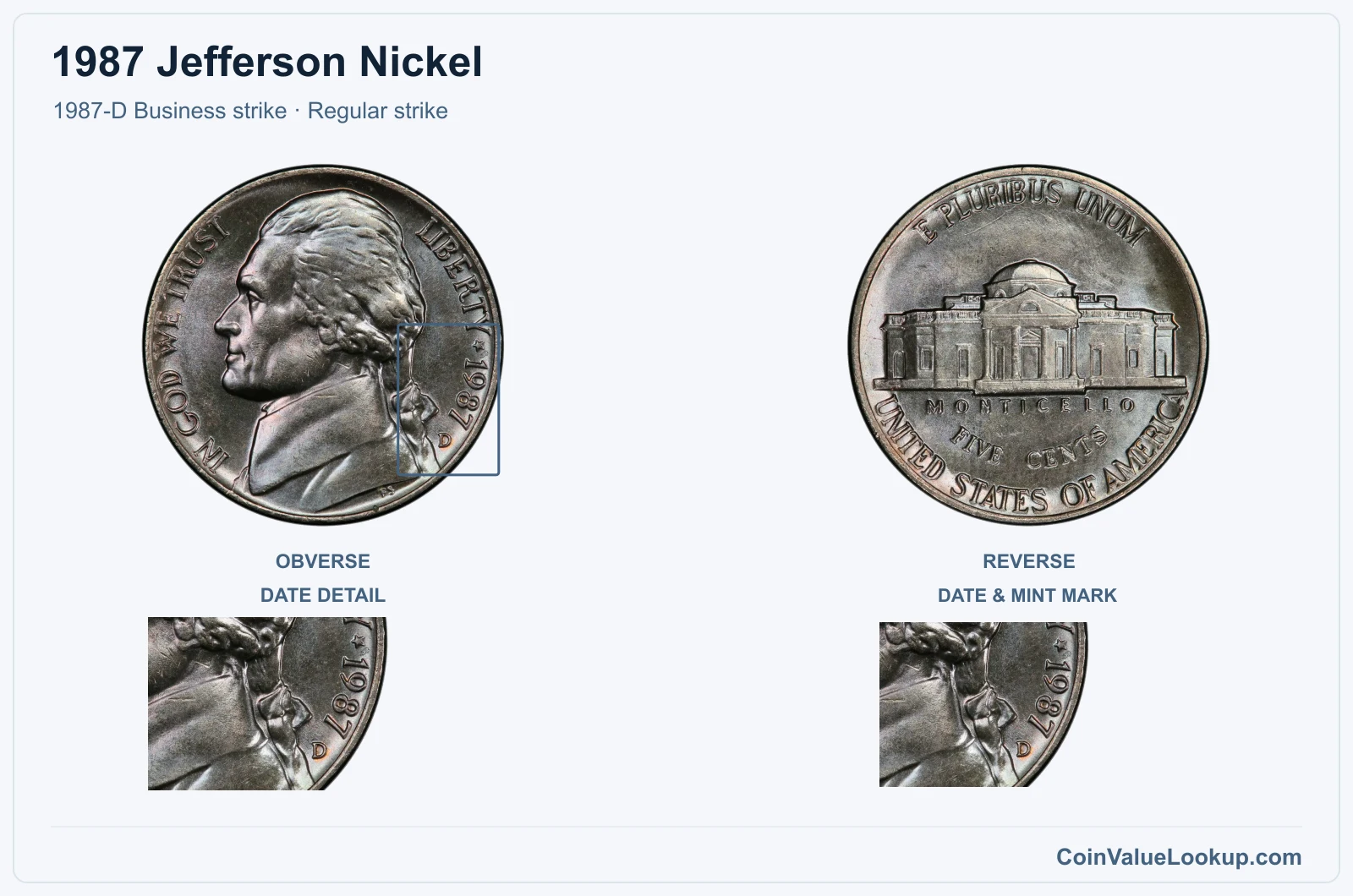
Denver produced its own run of 1987 business-strike nickels, identical in design and alloy to the Philadelphia version. The D mintmark appears below the date.
USA Coin Book guide estimates put the 1987-D at about $0.30 in MS60 and approximately $4.27 in MS65, making it the slightly higher-valued business strike of the two mints at that grade level. As with the P, circulated examples are plentiful and trade at face value.
Coin Value Lookup is a good starting point if you want to compare values across other Jefferson nickel dates and mints quickly.
| Range | Grade | Price | Auction Records | Appraisal |
|---|---|---|---|---|
| PO | PO 1 | — | Coin Identifier | |
| FR | FR 2 | — | Coin Identifier | |
| AG | AG 3 | — | Coin Identifier | |
| G | G 4 | — | Coin Identifier | |
| G 6 | — | Coin Identifier | ||
| VG | VG 8 | — | Coin Identifier | |
| VG 10 | — | Coin Identifier | ||
| F | F 12 | — | Coin Identifier | |
| F 15 | — | Coin Identifier | ||
| VF | VF 20 | — | Coin Identifier | |
| VF 25 | — | Coin Identifier | ||
| VF 30 | — | Coin Identifier | ||
| VF 35 | — | Coin Identifier | ||
| XF | XF 40 | — | Coin Identifier | |
| XF 45 | — | Coin Identifier | ||
| AU | AU 50 | — | Coin Identifier | |
| AU 53 | — | Coin Identifier | ||
| AU 55 | — | Coin Identifier | ||
| AU 58 | — | Coin Identifier | ||
| MS | MS 60 | — | Coin Identifier | |
| MS 61 | — | Coin Identifier | ||
| MS 62 | — | Coin Identifier | ||
| MS 63 | — | Coin Identifier | ||
| MS 64 | Coin Identifier | |||
| MS 65 | — | Coin Identifier | ||
| MS 66 | — | Coin Identifier | ||
| MS 67 | — | — | — | |
| MS 68 | — | — | — | |
| MS 69 | — | — | — | |
| MS 70 | — | — | — |
1987 Jefferson Nickel — S Proof
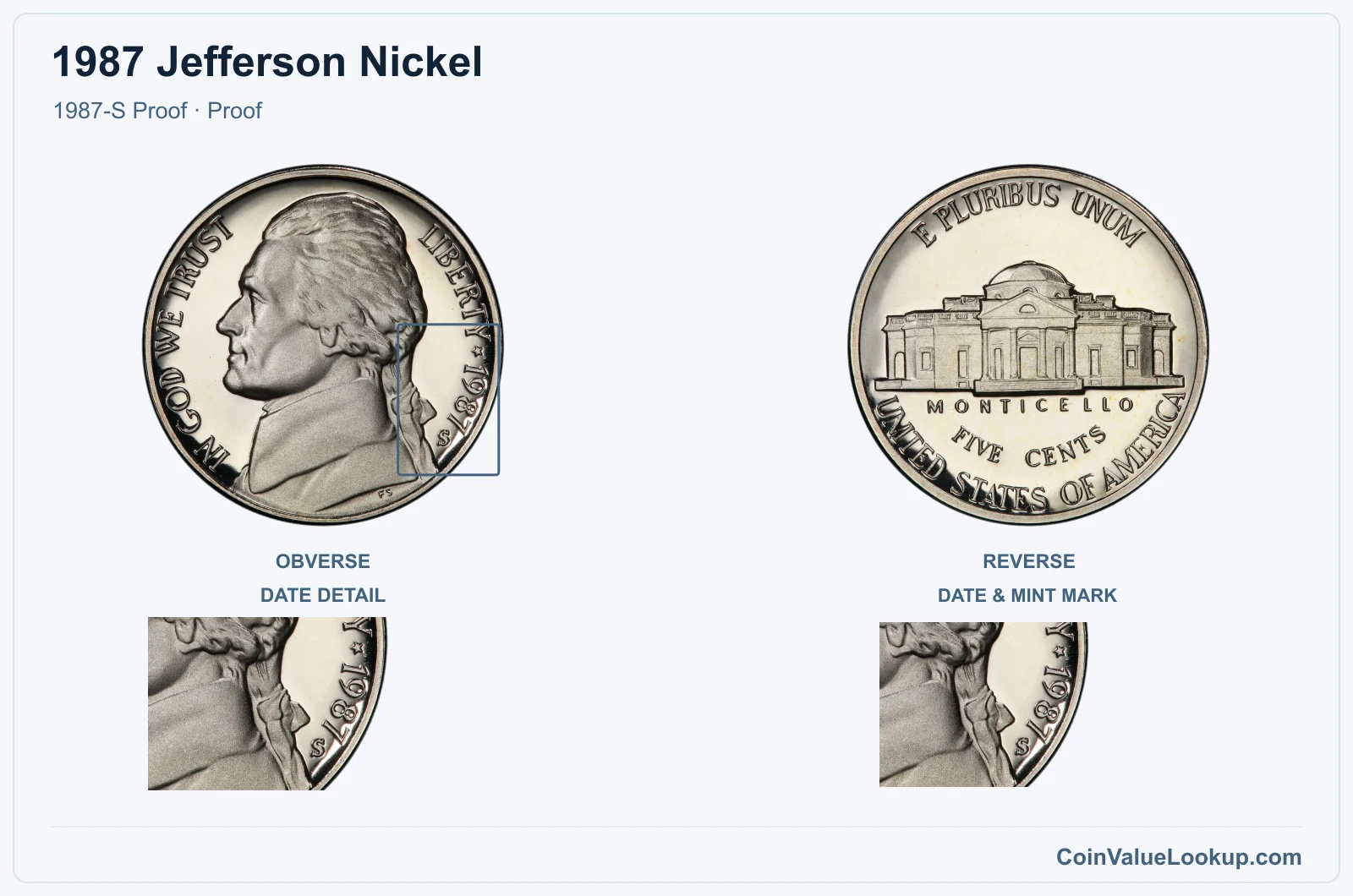
The 1987-S is a proof-only issue struck at the San Francisco Mint for collector sets. It shares the same 75% copper and 25% nickel composition and 5-gram weight but features mirror-like fields and crisp design edges that set it apart from business strikes.
A PR65 example carries a USA Coin Book guide estimate of about $3.62. Cameo and deep cameo designations are separate filters that can affect value, but no automatic deep cameo valuation is supplied here.
If yours has frosted devices over deeply reflective fields, that contrast is worth noting when you seek a professional opinion.
| Range | Grade | Price | Auction Records | Appraisal |
|---|---|---|---|---|
| PR | PR 1 | — | Coin Identifier | |
| PR 2 | — | Coin Identifier | ||
| PR 3 | — | Coin Identifier | ||
| PR 4 | — | Coin Identifier | ||
| PR 6 | — | Coin Identifier | ||
| PR 8 | — | Coin Identifier | ||
| PR 10 | — | Coin Identifier | ||
| PR 12 | — | Coin Identifier | ||
| PR 15 | — | Coin Identifier | ||
| PR 20 | — | Coin Identifier | ||
| PR 25 | — | Coin Identifier | ||
| PR 30 | — | Coin Identifier | ||
| PR 35 | — | Coin Identifier | ||
| PR 40 | — | Coin Identifier | ||
| PR 45 | — | Coin Identifier | ||
| PR 50 | — | Coin Identifier | ||
| PR 53 | — | Coin Identifier | ||
| PR 55 | — | Coin Identifier | ||
| PR 58 | — | Coin Identifier | ||
| PR 60 | — | Coin Identifier | ||
| PR 61 | — | Coin Identifier | ||
| PR 62 | — | Coin Identifier | ||
| PR 63 | — | Coin Identifier | ||
| PR 64 | — | Coin Identifier | ||
| PR 65 | — | Coin Identifier | ||
| PR 66 | Coin Identifier | |||
| PR 67 | — | Coin Identifier | ||
| PR 68 | Coin Identifier | |||
| PR 69 | Coin Identifier | |||
| PR 70 | Coin Identifier |
1987 Jefferson Nickel Error List
1. 1987 Jefferson Nickel — Struck on clad stock
This is one of the more dramatic 1987 nickel errors. A nickel-sized blank was punched from clad quarter strip instead of the usual solid copper-nickel strip.
The telltale sign is visible brown and gray edge banding — layers you should never see on a normal nickel, which is a homogeneous alloy with no sandwich structure.
A 1987-P example graded NGC AU58, weighing 4.22 grams, sold through Heritage Auctions in October 2012 for $1,175. Professional attribution is essential because ordinary edge discoloration, plating, or environmental damage can mimic the layered look.
If your nickel shows unexpected edge layers, weigh it and compare — the lighter-than-normal weight is another clue.
2. 1987 Jefferson Nickel — Double-struck broadstrike
A double-struck broadstrike happens when a coin is struck twice without being properly contained in the collar. The result is an expanded, oversized planchet with distorted marginal lettering and often an unstruck crescent area — in reported 1987-P examples, that blank zone appears near the 5 o'clock position.
This is distinct from die doubling: the entire design shifts between impressions, not just a single element. A 1987-P graded ANACS MS63 sold through Heritage Auctions in July 2004 for $34.
Watch out for coins that have simply been hammered flat after leaving the mint — post-strike damage lacks the crisp secondary impression and proper metal flow of a genuine double strike.
3. 1987 Jefferson Nickel — Cud die break
A cud is a raised, blob-like mass connected to the rim where a piece of the die broke away. Because the broken area can no longer impart design detail, the metal fills the void as a featureless lump.
Location and size matter — a large cud that obscures a key design element is generally more desirable.
A 1987-P nickel with a cud, graded PCGS MS64, sold through Heritage Auctions in May 2021 for $57. Do not confuse a cud with an incuse gouge, corrosion buildup, or foreign metal stuck to the surface.
A genuine cud is always anchored to the rim and replaces the design beneath it cleanly.
4. 1987 Jefferson Nickel — Off-center strike
An off-center strike occurs when the planchet is not properly seated in the collar, so the dies impress the design off to one side. The result is an unstruck crescent on one edge and truncated design on the opposite side.
The percentage of off-center displacement and whether the date remains visible both influence desirability.
A 1987-P example at 35% off-center, graded NGC MS64, appeared in a Heritage Auctions lot alongside other coins. Because it was part of a multi-coin lot, no individual price can be reliably extracted.
Value for any off-center nickel depends on the authenticated identity, the severity of the displacement, and the coin's condition — each piece needs individual assessment.
5. 1987 Jefferson Nickel — Doubled Die Obverse
Doubled die obverse varieties have been reported for the 1987 nickel. The doubling appears as consistent separation or notching on obverse lettering or design elements — not a flat, shelf-like distortion.
To check, compare your coin's obverse legends and date to a known normal 1987 nickel under the same lighting and magnification. Machine doubling is the most common lookalike: it tends to produce flat, shelf-like displacement without the raised, separated profile of a true doubled die.
Reflections and worn-die contours can also fool the eye.
No specific price range is adopted here. Value depends on the visibility of the doubling, the particular die variety, and the coin's overall condition.
Professional attribution is the surest path to confirmation.
6. 1987 Jefferson Nickel — Doubled Die Reverse
Doubled die reverse varieties have also been reported for the 1987 nickel. These show consistent doubling on reverse legends or design contours — for instance, separation in the letters of MONTICELLO or E PLURIBUS UNUM.
Compare your coin's reverse closely to a normal example at matching magnification. Machine doubling produces a flat, mushy look rather than crisp raised separation.
Random nicks and corrosion can also mimic doubling at a glance.
No numerical price range is adopted. The value of any doubled die reverse depends on how visible the doubling is, which specific die pair produced it, and the coin's grade.
Authentication by a recognized service is the reliable way to confirm and market a DDR.
7. 1987 Jefferson Nickel — Repunched Mintmark
A repunched mintmark variety has been reported specifically for the 1987-D nickel. This occurs when the mintmark punch was applied more than once in slightly different positions, leaving a visible remnant of the first impression alongside the final D.
Inspect the D mintmark below the date under magnification. Look for a secondary outline, notch, or partial letter that does not match normal die wear.
Machine doubling around the mintmark, small die chips, and corrosion can all produce similar-looking artifacts, so comparison to a confirmed normal 1987-D at the same magnification is important.
No specific price range is adopted. The value of a repunched mintmark depends on visibility, the exact variety, and condition.
Third-party attribution provides the strongest confirmation.