1912 Liberty Nickel Coin Value: How Much Is It Worth?
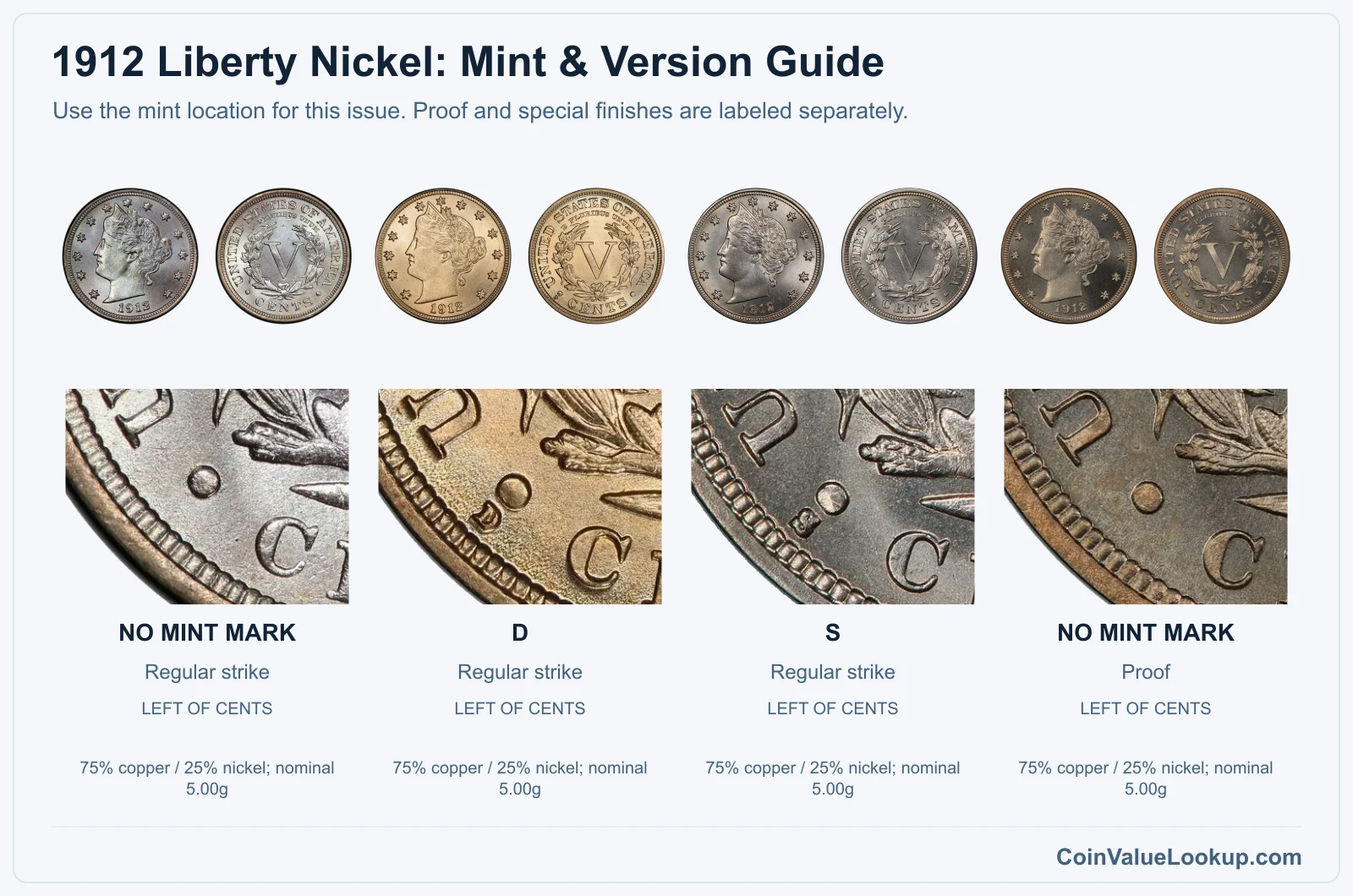
The 1912 Liberty Nickel is a standout year in the series because it is the only date that saw production at all three mints: Philadelphia, Denver, and San Francisco. A typical Philadelphia business strike runs about $2.50 in G4 up to around $154 in MS63, per USA Coin Book guide estimates.
The San Francisco issue is a key date, starting near $163 even in well-worn G4 condition. Proofs from Philadelphia anchor around $344 in PR63.
Fast Way to Identify Your 1912 Liberty Nickel
The quickest way to get a preliminary identification of your 1912 Liberty Nickel is to upload clear photos of both the front and back. That lets us check for a mintmark, assess general condition, and flag anything unusual.
Make sure the reverse is well-lit so the area left of CENTS is visible, since that is where the D or S mintmark sits on branch-mint coins.
1912 Liberty Nickel Value
Upload both sides of your 1912 Liberty Nickel.
Front Obverse
Upload photo
Back Reverse
Upload photo
Which 1912 Liberty Nickel Versions Are Worth Money?
- The 1912-S (San Francisco) is a key date in the Liberty Nickel series, with guide values starting around $163 in G4 and climbing to roughly $2,257 in MS63.
- The 1912-D (Denver) commands a premium over Philadelphia, listed near $3.62 in G4 and about $498 in MS63.
- Philadelphia proofs in PR63 condition carry a guide estimate around $344, well above a comparable business strike.
- High-grade original-surface coins from any mint can bring strong premiums; luster and eye appeal matter a great deal at the MS63 level and above.
- Several error types, including off-center strikes, clipped planchets, and doubled die obverse, have been reported for 1912 nickels and are worth inspecting for.
Step 1: Identify Your 1912 Liberty Nickel Mint Mark and Version
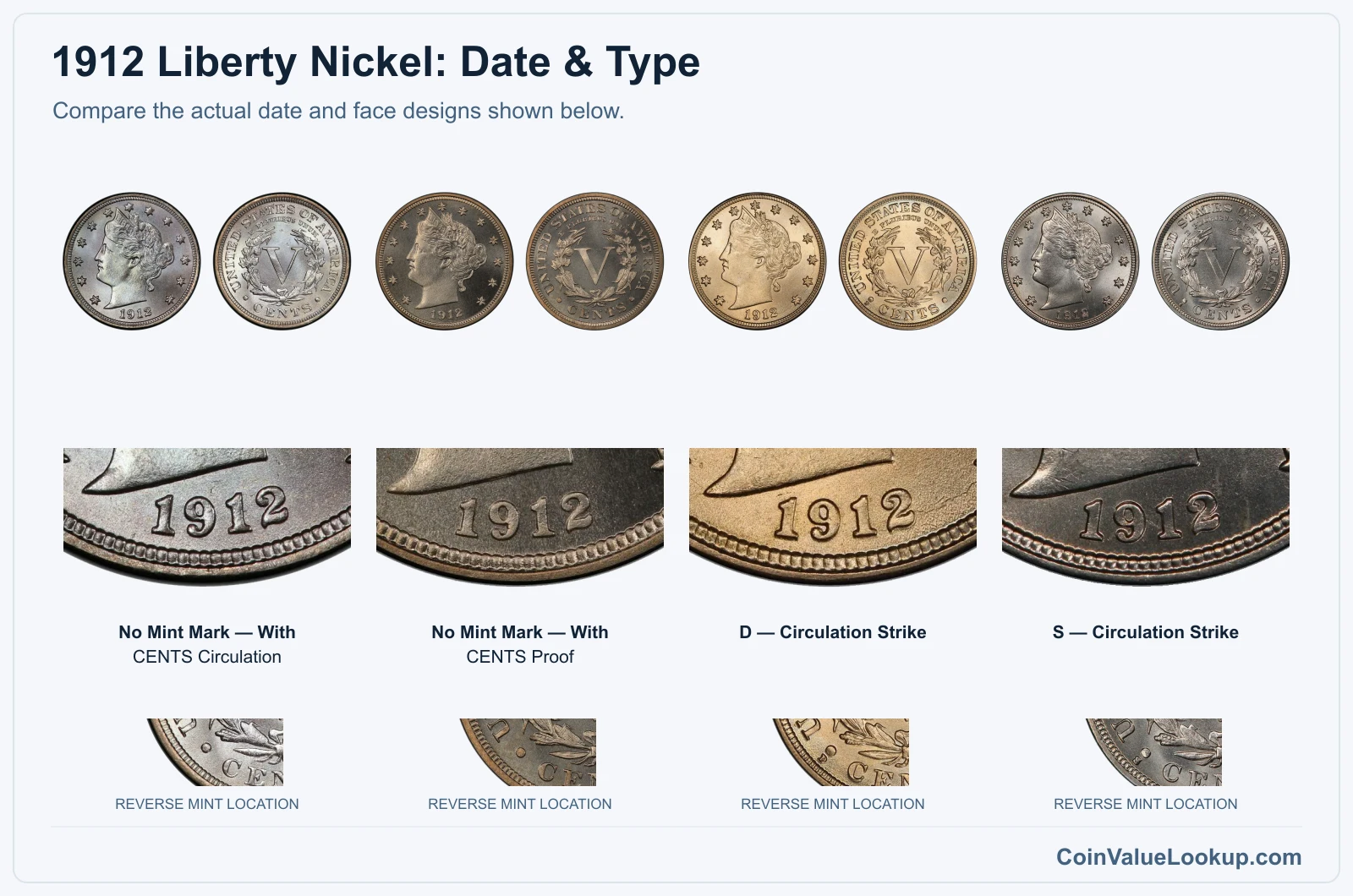
All 1912 Liberty Nickels are struck in 75% copper and 25% nickel, weigh about 5 grams, measure 21.2 mm across, and have a plain edge. The With CENTS reverse design is the only type for this year.
Philadelphia coins carry no mintmark. Denver pieces show a small "D" and San Francisco pieces show a small "S," both located to the left of the word CENTS on the reverse.
Tilt the coin under a light to catch it; on worn examples the mintmark can blend into the wreath detail.
Because the San Francisco coin is a key date worth considerably more, altered mintmarks do exist. If you see an S that looks off, wobbly, or too sharp compared to the surrounding detail, professional authentication is a smart move.
No branch-mint proofs were made, and there is no regular silver issue for this year.
Step 2: Check Your 1912 Liberty Nickel Grade
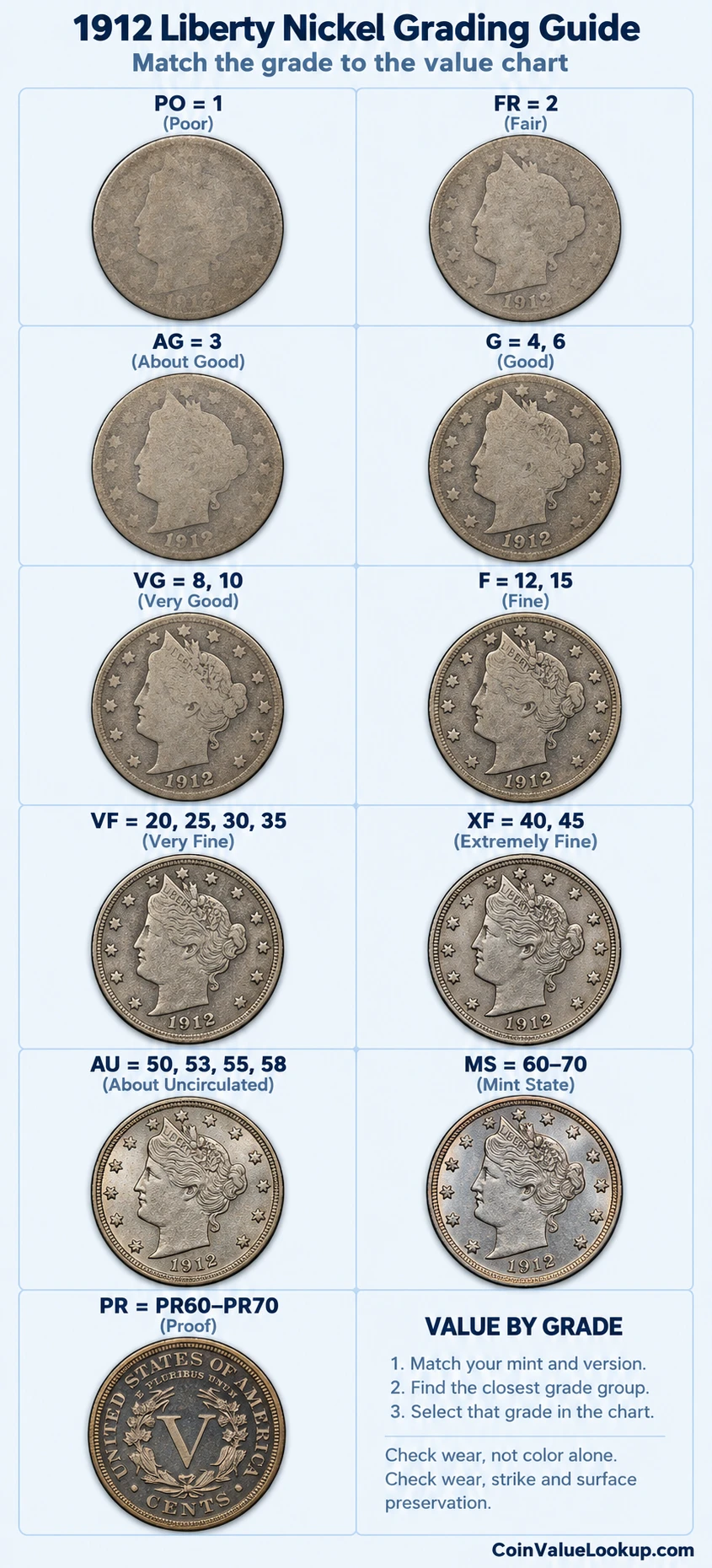
Start with the obverse. The word LIBERTY on the coronet is the first place to check.
On a well-circulated coin, some letters merge or vanish entirely. Below that, look at the high points of the hair curls above the ear and across the cheek; these wear first.
Flip to the reverse. The ear of corn and the wreath details lose sharpness as the grade drops.
But be careful: strike weakness in these same areas is common on Liberty Nickels and does not mean the coin circulated.
For mint-state pieces, judge luster, contact marks, and overall eye appeal. A coin with full, unbroken cartwheel luster but mushy corn detail may simply be weakly struck, not worn.
Compare your coin with the reference image to calibrate your eye.
Proof is a method of manufacture, not a grade above Mint State. Proof Liberty Nickels have mirrored fields and sharply detailed rims.
Inspect for hairlines from old cleanings, which can severely reduce a proof's desirability. When in doubt, compare rim and field texture against known proof examples.
Step 3: Check 1912 Liberty Nickel Value by Mint and Version
1912 Liberty Nickel — No Mint Mark — With CENTS Circulation
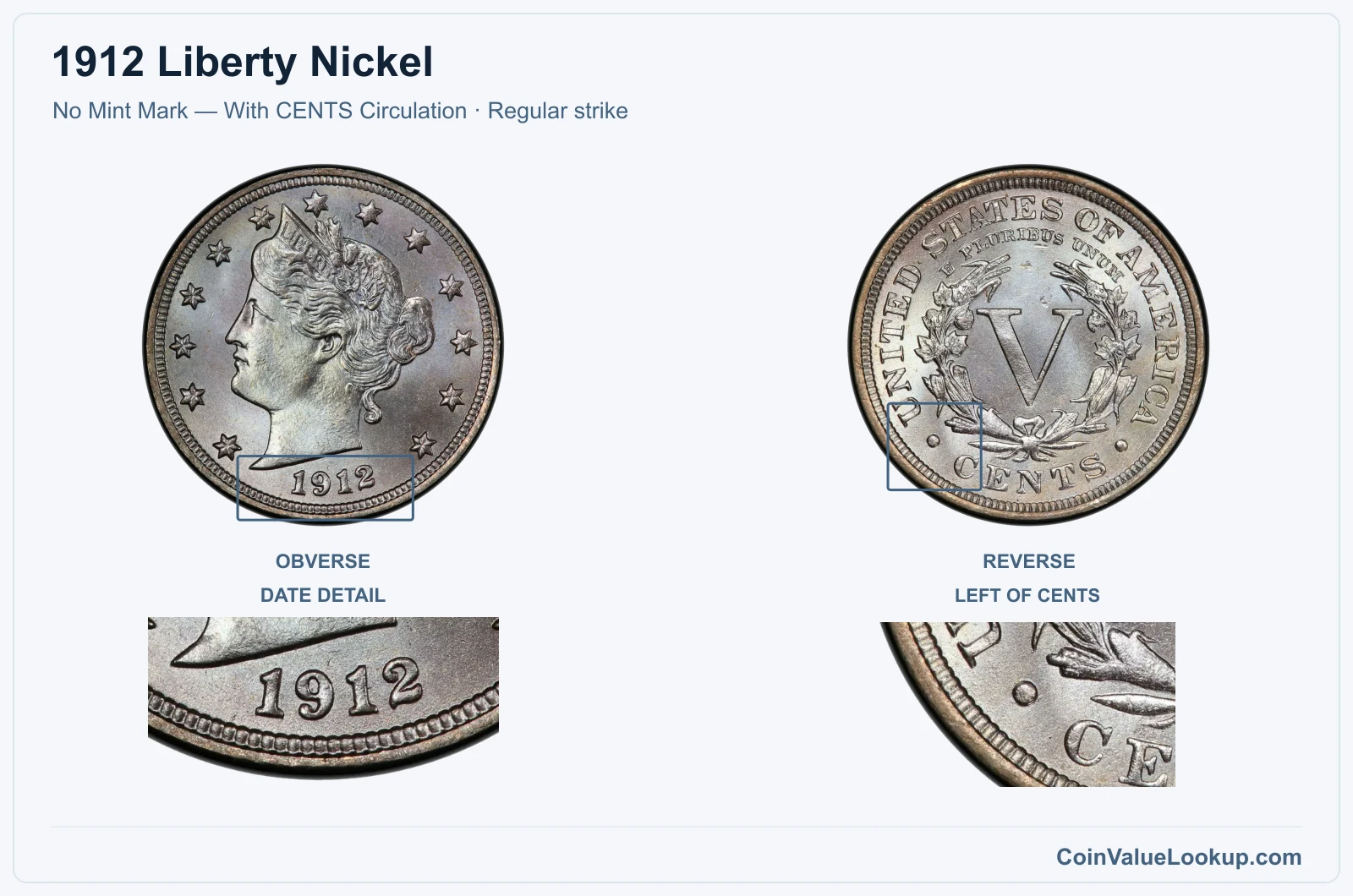
The 1912 Philadelphia business strike is the most common version of this date. It has no mintmark anywhere on the coin.
USA Coin Book lists a guide estimate of about $2.50 in G4 and roughly $154 in MS63.
Most survivors you will encounter are well-worn, in the G4 to VF range. Mint-state examples with strong luster exist but demand careful inspection for cleaned or whizzed surfaces, which destroy original texture.
Look for even, unbroken cartwheel luster across both faces as a positive sign.
Range Grade
Price Auction Records Appraisal PO PO 1
—
Coin Identifier FR FR 2
—
Coin Identifier AG AG 3
—
Coin Identifier G G 4
Coin Identifier
G 6
—
Coin Identifier VG VG 8
—
Coin Identifier
VG 10
—
Coin Identifier F F 12
—
Coin Identifier
F 15
—
Coin Identifier VF VF 20
—
Coin Identifier
VF 25
—
Coin Identifier
VF 30
—
Coin Identifier
VF 35
—
Coin Identifier XF XF 40
Coin Identifier
XF 45
Coin Identifier AU AU 50
Coin Identifier
AU 53
—
Coin Identifier
AU 55
Coin Identifier
AU 58
Coin Identifier MS MS 60
—
Coin Identifier
MS 61
Coin Identifier
MS 62
Coin Identifier
MS 63
Coin Identifier
MS 64
Coin Identifier
MS 65
Coin Identifier
MS 66
Coin Identifier
MS 67
—
Coin Identifier
MS 68
—
—
—
MS 69
—
—
—
MS 70
—
—
—
1912 Liberty Nickel — No Mint Mark — With CENTS Proof
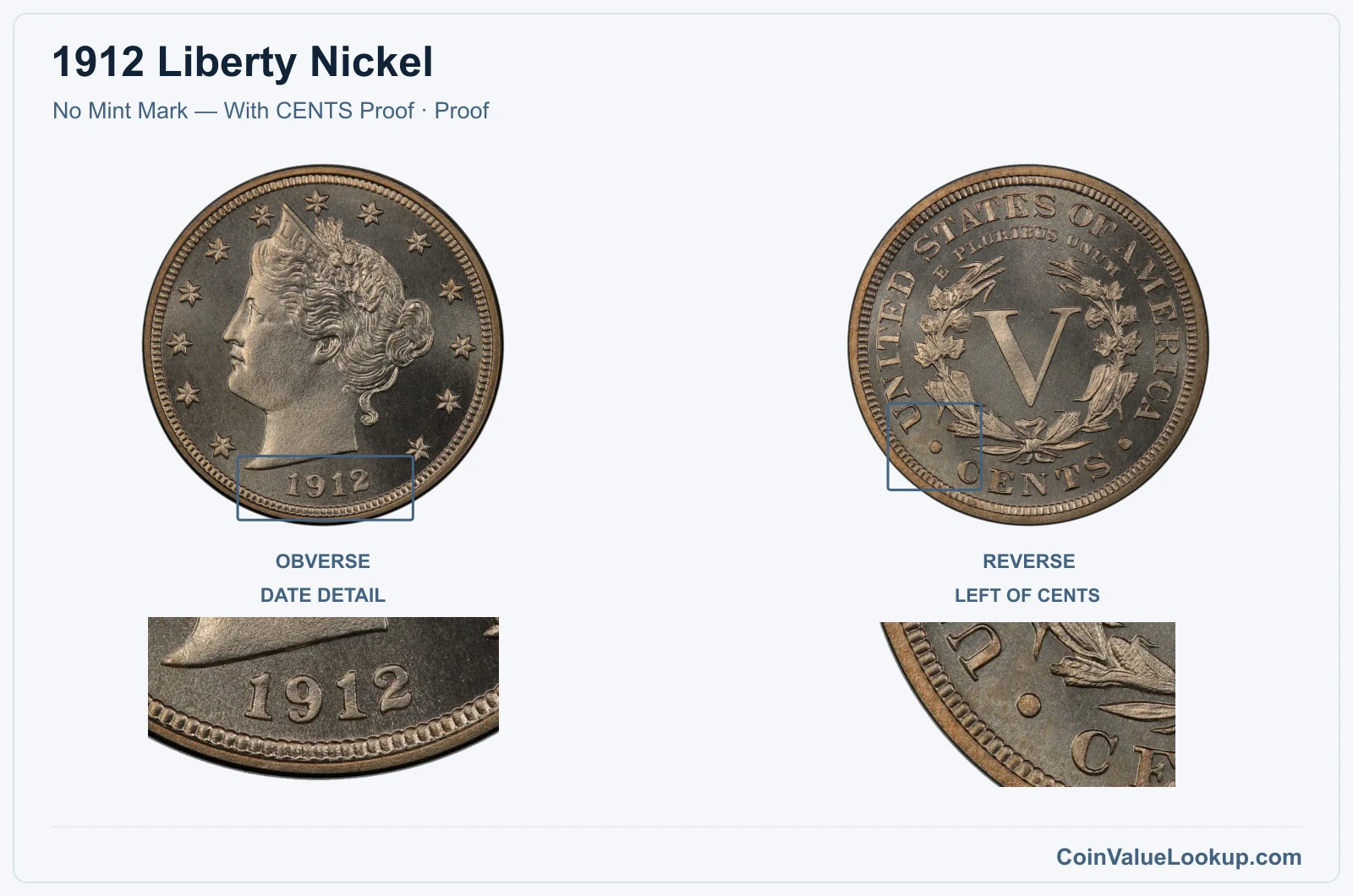
Philadelphia also produced proof Liberty Nickels in 1912, and these are the only proofs for the year. No Denver or San Francisco proofs exist.
The USA Coin Book guide places a PR63 example at about $344.
Proofs have deeply mirrored fields and squared-off rims that look distinctly different from a business strike, even a fresh one. Hairlines from improper storage or old cleanings are the biggest threat to value.
When photographing, show both faces and try to capture the reflective field alongside the rim detail so the proof character is visible.
Coin Value Lookup is a good starting point if you want to compare guide values across different Liberty Nickel dates and versions before deciding on a next step.
Range Grade
Price Auction Records Appraisal PR PR 1
—
Coin Identifier
PR 2
—
Coin Identifier
PR 3
—
Coin Identifier
PR 4
—
Coin Identifier
PR 6
—
Coin Identifier
PR 8
—
Coin Identifier
PR 10
—
Coin Identifier
PR 12
—
Coin Identifier
PR 15
—
Coin Identifier
PR 20
—
Coin Identifier
PR 25
—
Coin Identifier
PR 30
—
Coin Identifier
PR 35
—
Coin Identifier
PR 40
—
Coin Identifier
PR 45
—
Coin Identifier
PR 50
—
Coin Identifier
PR 53
—
Coin Identifier
PR 55
—
Coin Identifier
PR 58
—
Coin Identifier
PR 60
—
Coin Identifier
PR 61
Coin Identifier
PR 62
Coin Identifier
PR 63
Coin Identifier
PR 64
Coin Identifier
PR 65
Coin Identifier
PR 66
Coin Identifier
PR 67
Coin Identifier
PR 68
Coin Identifier
PR 69
—
—
—
PR 70
—
—
—
1912 Liberty Nickel — D — Circulation Strike
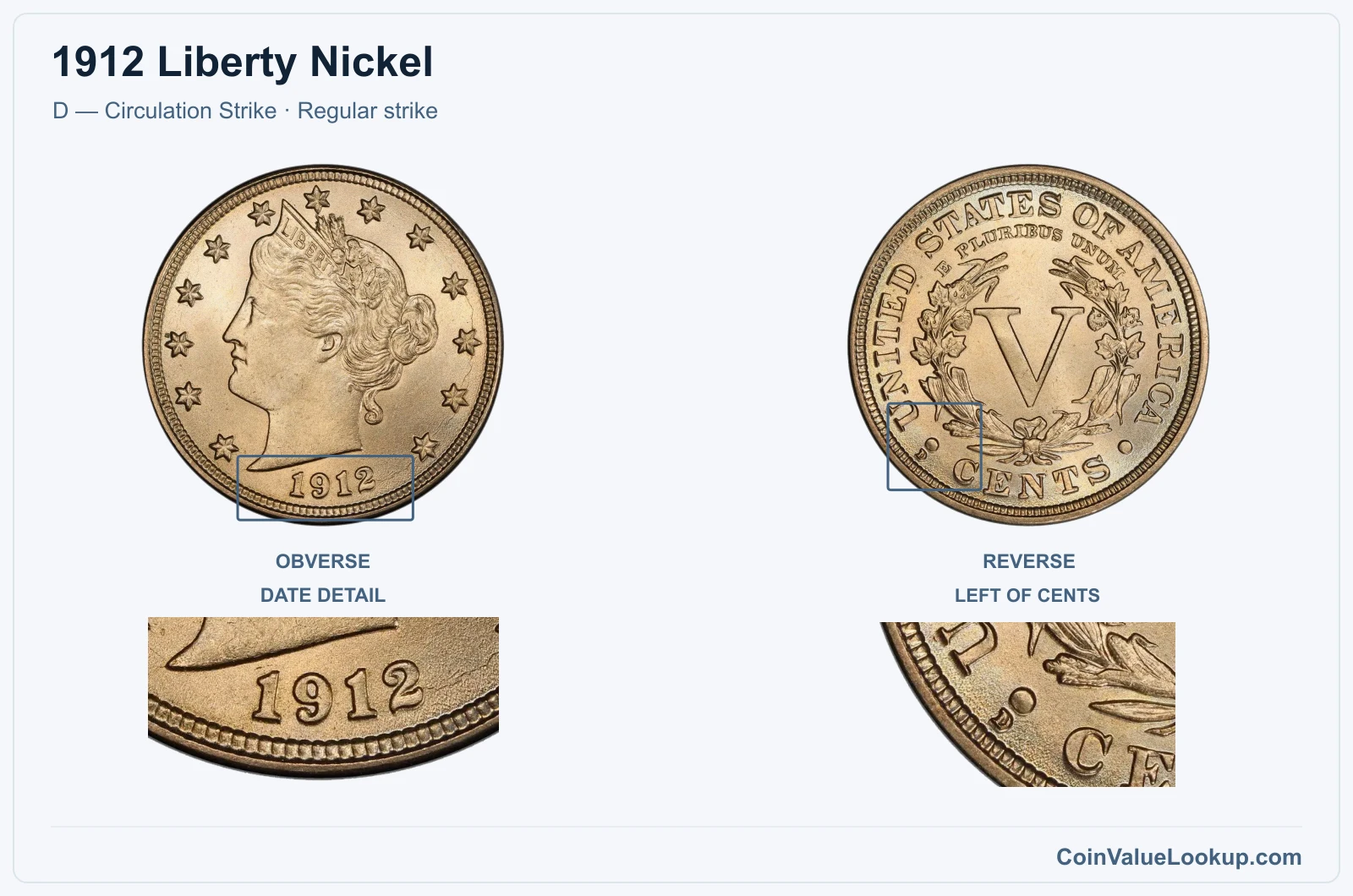
The 1912-D is one of only two branch-mint Liberty Nickels ever made. A small "D" sits to the left of CENTS on the reverse.
USA Coin Book estimates about $3.62 in G4 and around $498 in MS63.
That MS63 figure is more than three times the Philadelphia equivalent, reflecting lower mintage and collector demand for the Denver issue. On a heavily worn coin, confirm the mintmark under magnification before assuming you have a D.
No Denver proofs were struck.
Range Grade
Price Auction Records Appraisal PO PO 1
—
Coin Identifier FR FR 2
—
Coin Identifier AG AG 3
—
Coin Identifier G G 4
Coin Identifier
G 6
—
Coin Identifier VG VG 8
—
Coin Identifier
VG 10
—
Coin Identifier F F 12
Coin Identifier
F 15
—
Coin Identifier VF VF 20
—
Coin Identifier
VF 25
—
Coin Identifier
VF 30
—
Coin Identifier
VF 35
—
Coin Identifier XF XF 40
Coin Identifier
XF 45
Coin Identifier AU AU 50
Coin Identifier
AU 53
Coin Identifier
AU 55
Coin Identifier
AU 58
Coin Identifier MS MS 60
Coin Identifier
MS 61
Coin Identifier
MS 62
Coin Identifier
MS 63
Coin Identifier
MS 64
Coin Identifier
MS 65
Coin Identifier
MS 66
Coin Identifier
MS 67
Coin Identifier
MS 68
—
—
—
MS 69
—
—
—
MS 70
—
—
—
1912 Liberty Nickel — S — Circulation Strike
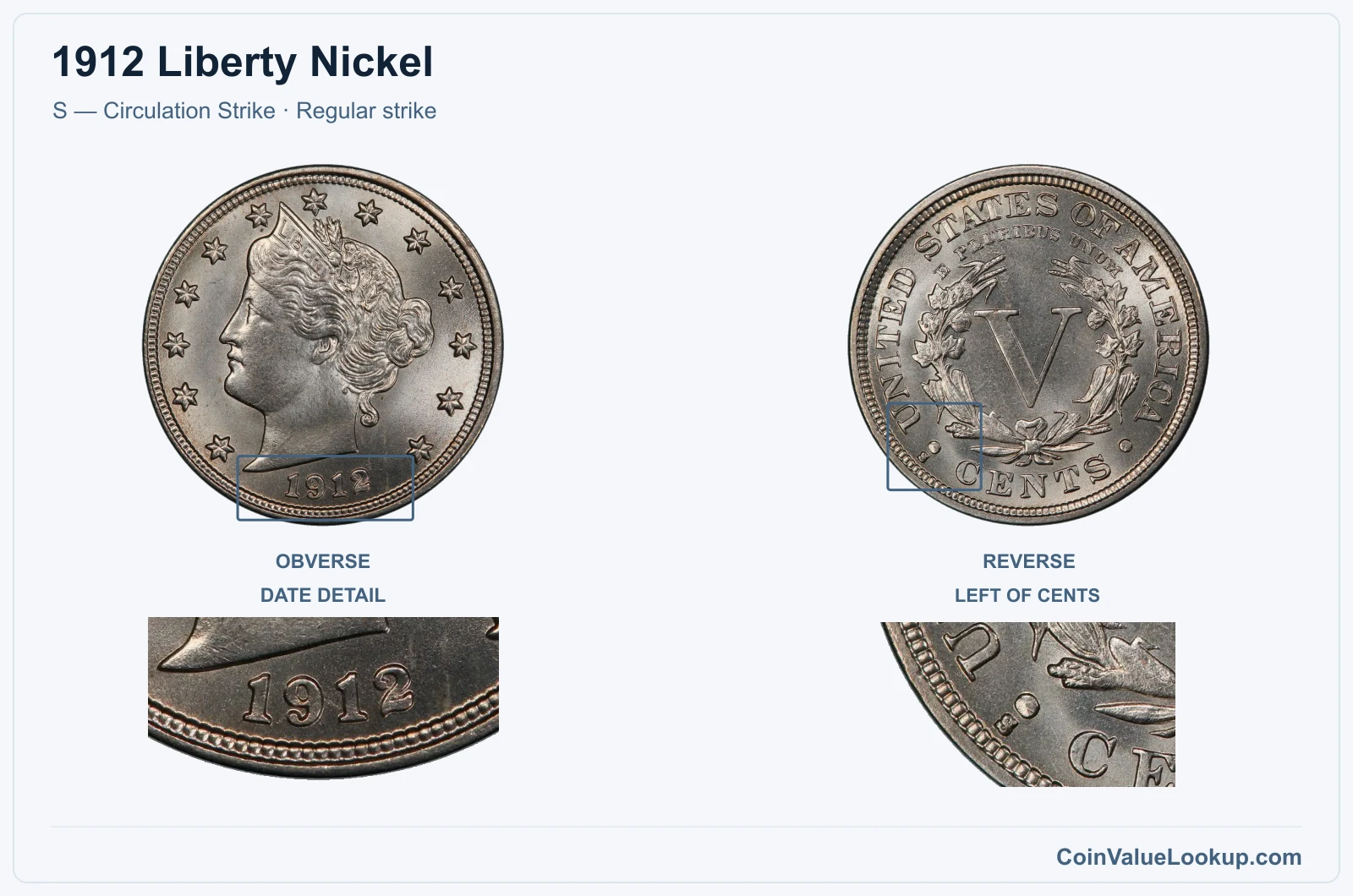
This is the one everybody hopes to find. The 1912-S is a genuine key date in the Liberty Nickel series, and 1912 is the only year San Francisco struck this denomination.
A small "S" appears to the left of CENTS on the reverse.
USA Coin Book guide estimates start at roughly $163 in G4 and reach about $2,257 in MS63. Because of that value, altered mintmarks are a real concern.
Coins where a mintmark has been added or changed from a D sometimes appear. Look for disturbed metal around the letter, tooling lines, or a mintmark that seems too sharp relative to surrounding detail.
Professional authentication is recommended for any 1912-S you are considering buying or selling.
Range Grade
Price Auction Records Appraisal PO PO 1
—
Coin Identifier FR FR 2
—
Coin Identifier AG AG 3
Coin Identifier G G 4
Coin Identifier
G 6
Coin Identifier VG VG 8
Coin Identifier
VG 10
Coin Identifier F F 12
Coin Identifier
F 15
Coin Identifier VF VF 20
Coin Identifier
VF 25
Coin Identifier
VF 30
Coin Identifier
VF 35
Coin Identifier XF XF 40
Coin Identifier
XF 45
Coin Identifier AU AU 50
Coin Identifier
AU 53
Coin Identifier
AU 55
Coin Identifier
AU 58
Coin Identifier MS MS 60
Coin Identifier
MS 61
Coin Identifier
MS 62
Coin Identifier
MS 63
Coin Identifier
MS 64
Coin Identifier
MS 65
Coin Identifier
MS 66
Coin Identifier
MS 67
—
—
—
MS 68
—
—
—
MS 69
—
—
—
MS 70
—
—
—
1912 Liberty Nickel Error List
1. 1912 Liberty Nickel — Off-Center Strike
An off-center strike happens when the planchet is not properly seated between the dies, producing a displaced design with an unstruck crescent of blank metal along one edge. On a 1912 Liberty Nickel, you want the date to remain fully visible; without it, attributing the coin to this year becomes difficult and value drops sharply.
The percentage of off-center shift and the amount of visible design both affect desirability. Condition matters too: a sharp off-center with clean surfaces is more appealing than one that is also heavily worn.
Do not confuse an off-center strike with a clipped planchet, one-sided die misalignment, or post-mint damage like flattening from a vise. The genuine error shows a complete, evenly displaced impression, not random distortion.
2. 1912 Liberty Nickel — Clipped Planchet
A clipped planchet error occurs when part of the blank is missing before the coin is struck. You will see a curved, straight, or ragged absence of metal along the edge.
A useful confirmation is design weakness on the side of the coin opposite the clip, caused by incomplete metal flow during striking.
Compare the edge texture at the clip boundary to the rest of the rim. A genuine clip usually shows a smooth, natural break consistent with the original blank, not the rough texture of a file or cutting tool.
Coins with filed notches, deliberate edge cuts, or corrosion-eaten rims can look superficially similar. The value of a genuine clipped planchet depends on its size, the coin's overall condition, and how much design remains visible.
3. 1912 Liberty Nickel — Lamination / Split Planchet
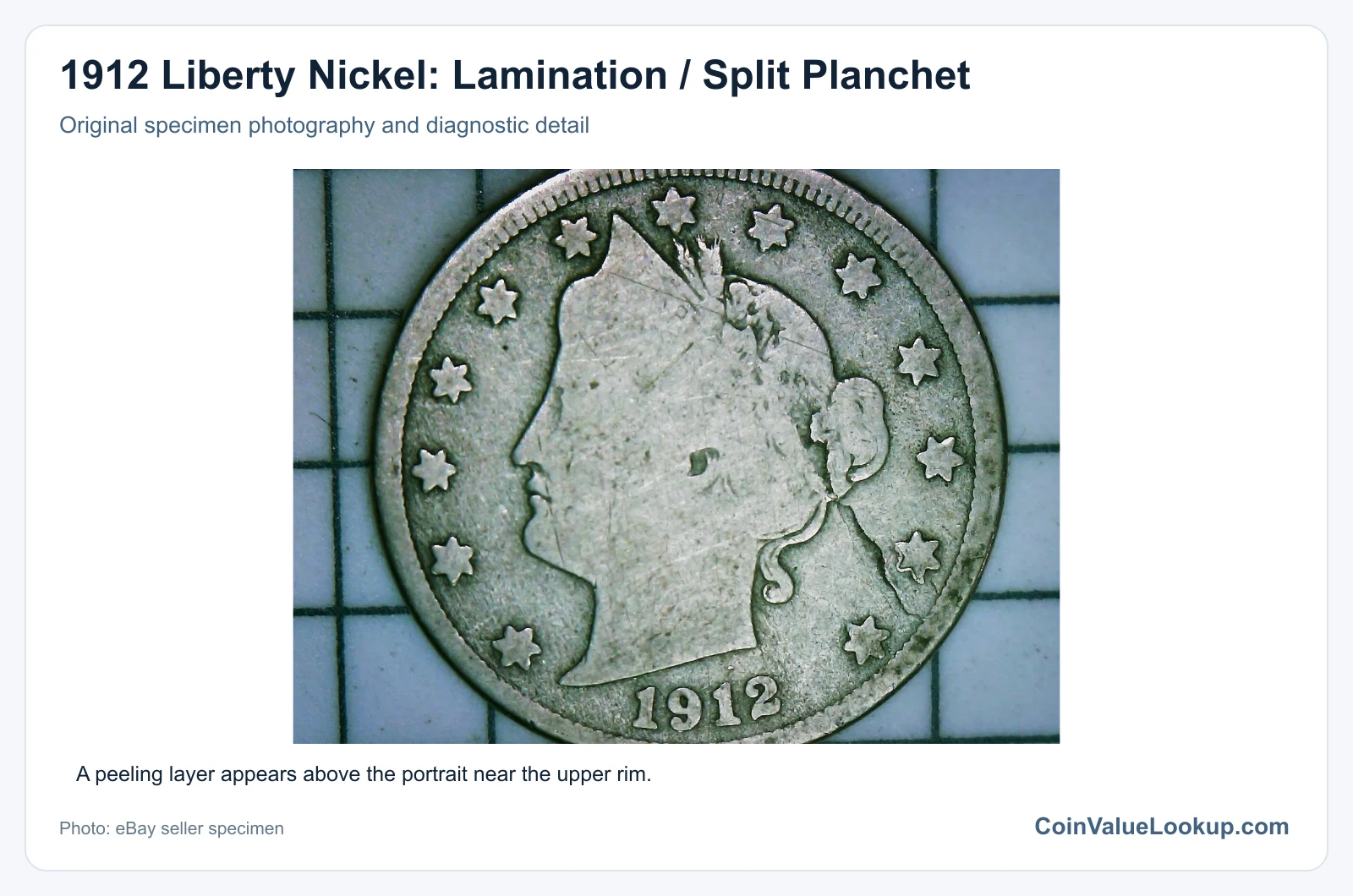
Lamination errors show up as peeling metal, a retained flap, or a visible split within the coin's alloy. On a 1912 Liberty Nickel, you might see a thin layer lifting away from one face or a crack running parallel to the surface.
Photograph both the affected face and the edge together so the depth and extent of the separation are clear. This helps distinguish a genuine lamination from surface scraping, corrosion, or deliberate cutting.
The size and location of the lamination affect its interest to collectors. A large, dramatic flap across a key design element draws more attention than a tiny peel near the rim.
Condition of the rest of the coin matters as well. No specific price range is established here; individual assessment is needed.
4. 1912 Liberty Nickel — Struck-Through Error
A struck-through error occurs when foreign material, such as grease, cloth fiber, or a metal fragment, sits between the die and the planchet during striking. The result is a localized depression or incomplete design element where the obstruction blocked the impression.
On a 1912 Liberty Nickel, look for a distinct indentation that does not match normal wear patterns. A grease-filled die tends to produce a smooth, shallow blank area, while a retained foreign object may leave a more irregular impression.
The main lookalikes are ordinary wear, scratches, old cleaning marks, and weak strikes from tired dies. The key difference: a struck-through has a specific, bounded shape that does not follow the coin's overall wear pattern.
Value depends on visibility, size, and the coin's condition.
5. 1912 Liberty Nickel — Die Crack / Die Chip
Die cracks appear as thin, raised lines on the coin's surface, transferred from fractures in the steel die. Die chips are small raised blobs where a tiny piece of the die face broke away.
Both are mint-made and appear on the coin as raised features, not incuse ones.
On a 1912 Liberty Nickel, run your fingernail across a suspected crack. A genuine die crack feels raised; a scratch feels incuse (cut into the surface).
Corrosion or foreign material stuck to the coin can mimic a raised line, but these usually lack the sharp, consistent profile of a true crack.
Minor die cracks are common on late-die-state coins and have modest collector interest. Larger, more dramatic cracks or those affecting lettering tend to draw more attention.
Value depends on severity and the coin's overall grade.
6. 1912 Liberty Nickel — Die Break / Cud
A cud is a specific type of die break where a piece of the die rim breaks away, leaving a raised, featureless blob that connects to the coin's rim. The affected area shows no design detail because that section of the die was simply missing.
To identify one on a 1912 Liberty Nickel, look for a raised lump at the rim with a clear boundary where the normal design resumes. It should be uniform and flat-topped, not lumpy like a rim dent or corrosion buildup.
An interior die chip, by contrast, sits away from the rim and is usually smaller. Rim dents from post-mint contact are incuse (pushed in), not raised.
A genuine cud's value depends on its size, location, and the coin's condition.
7. 1912 Liberty Nickel — Doubled Die Obverse
A doubled die obverse results from a misalignment during die manufacturing, producing consistent doubling on design elements across every coin struck by that die. On a 1912 Liberty Nickel, check the obverse lettering, stars, and date for separation or notching that appears uniform and directional.
The critical distinction is between a true doubled die and machine doubling. Machine doubling is flat, shelf-like, and occurs during striking, not die making.
It is far more common and far less valuable. A genuine doubled die shows rounded, raised secondary images with distinct separation.
Reflections under certain lighting angles and worn die contours can also mimic doubling. Compare your coin to a known normal example under the same light.
Value depends on the strength of the doubling, the coin's condition, and which design elements are affected.