1876 Shield Nickel Coin Value: How Much Is It Worth?
The 1876 Shield Nickel is the last regular circulation strike in the series before production halted for two full years. A well-worn example in G4 condition runs about $56 according to USA Coin Book retail estimates, while an MS63 business strike climbs to roughly $407.
Proof specimens in PR63 sit around $468. These are guide estimates, not guaranteed sale prices, and actual value depends on the specific coin's condition and authenticity.
Fast Way to Identify Your 1876 Shield Nickel
Upload clear photos of both the front and back of your 1876 Shield Nickel for a preliminary identification. Good lighting and a straight-on angle help distinguish proof surfaces from business strikes and reveal any doubled lettering or shield-line oddities.
This step is not a substitute for professional authentication, but it gives you a solid starting point.
1876 Shield Nickel Value
Upload both sides of your 1876 Shield Nickel.
Front Obverse
Upload photo
Back Reverse
Upload photo
Which 1876 Shield Nickel Versions Are Worth Money?
- The 1876 is the final circulation-issue Shield Nickel; 1877 and 1878 were proof-only, giving this date historical weight in the series.
- Proof specimens command a premium — around $468 at PR63 per USA Coin Book — so correctly distinguishing a proof from a business strike matters.
- Doubled or tripled die obverse varieties are reported for this year and can carry a premium tied to visibility and condition.
- The Bleeder shield-line variety, where vertical lines extend into the horizontal bands, is a distinct die variety worth checking under magnification.
- Repunched date examples exist and are a separate collectible category from doubled-die errors.
- Die cracks and die chips appear on some 1876 dies and can add collector interest depending on size and location.
Step 1: Identify Your 1876 Shield Nickel Mint Mark and Version
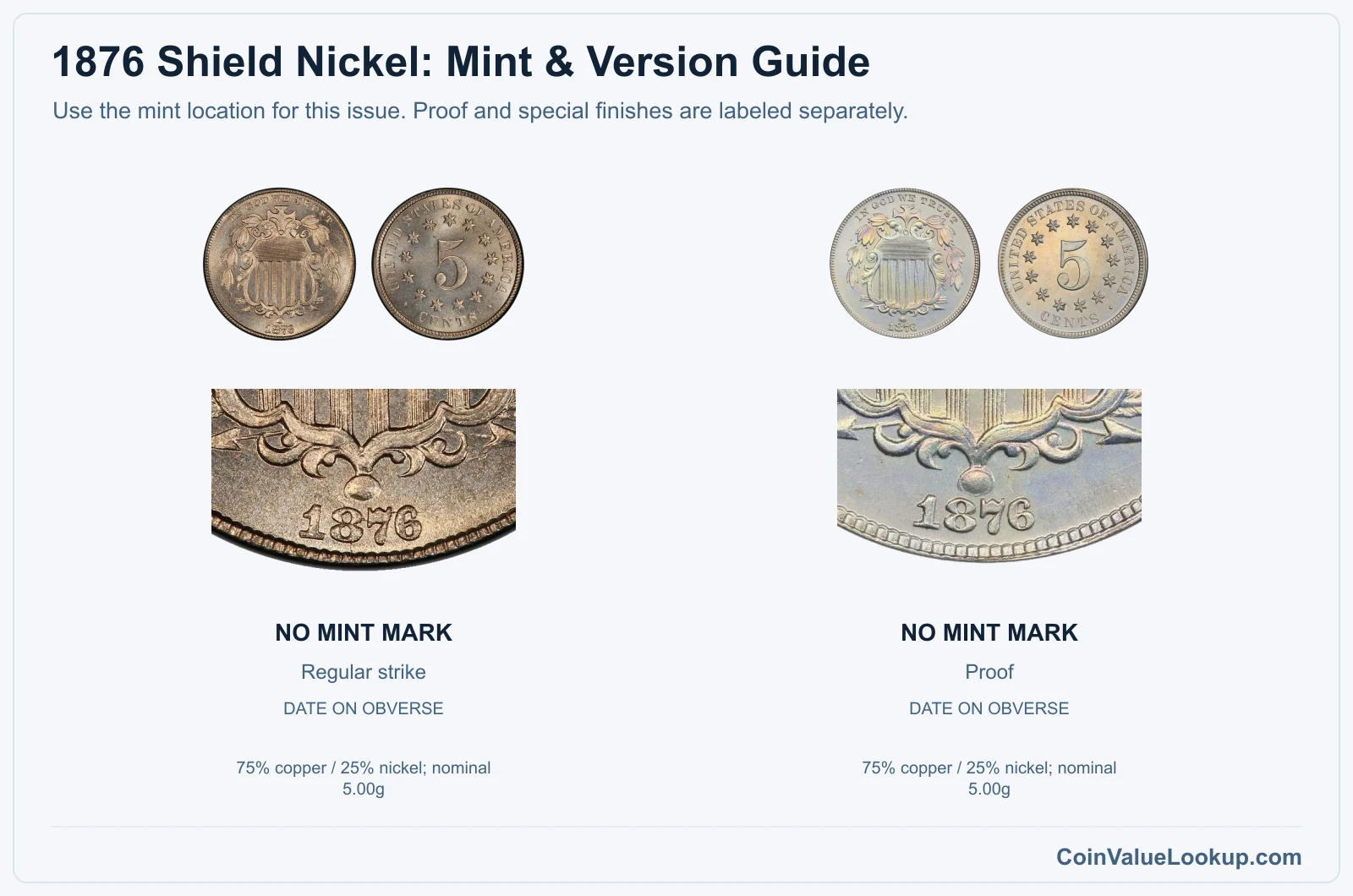
Every 1876 Shield Nickel was struck at the Philadelphia Mint. There is no mintmark, and the absence of a mint letter is completely normal — not an error.
The coin is copper-nickel, 75% copper and 25% nickel, weighing about 5 grams with a 20.5 mm diameter and a plain edge. No silver version exists for this date.
The design is the "No Rays" type, which replaced the earlier rays-between-stars reverse in 1867. After 1876, the Shield Nickel became a proof-only issue in 1877 and 1878, making the 1876 the final year you could pull one out of pocket change.
Two main branches matter here: business strikes and proofs. Both look similar at first glance, so surface quality and edge sharpness are your best clues.
Proofs typically show squared-off rims and mirror-like fields when original surfaces survive. A few error categories — doubled or tripled die obverse, repunched date, die cracks, and the Bleeder shield-line variety — are reported for this year and deserve a close look under magnification.
Step 2: Check Your 1876 Shield Nickel Grade
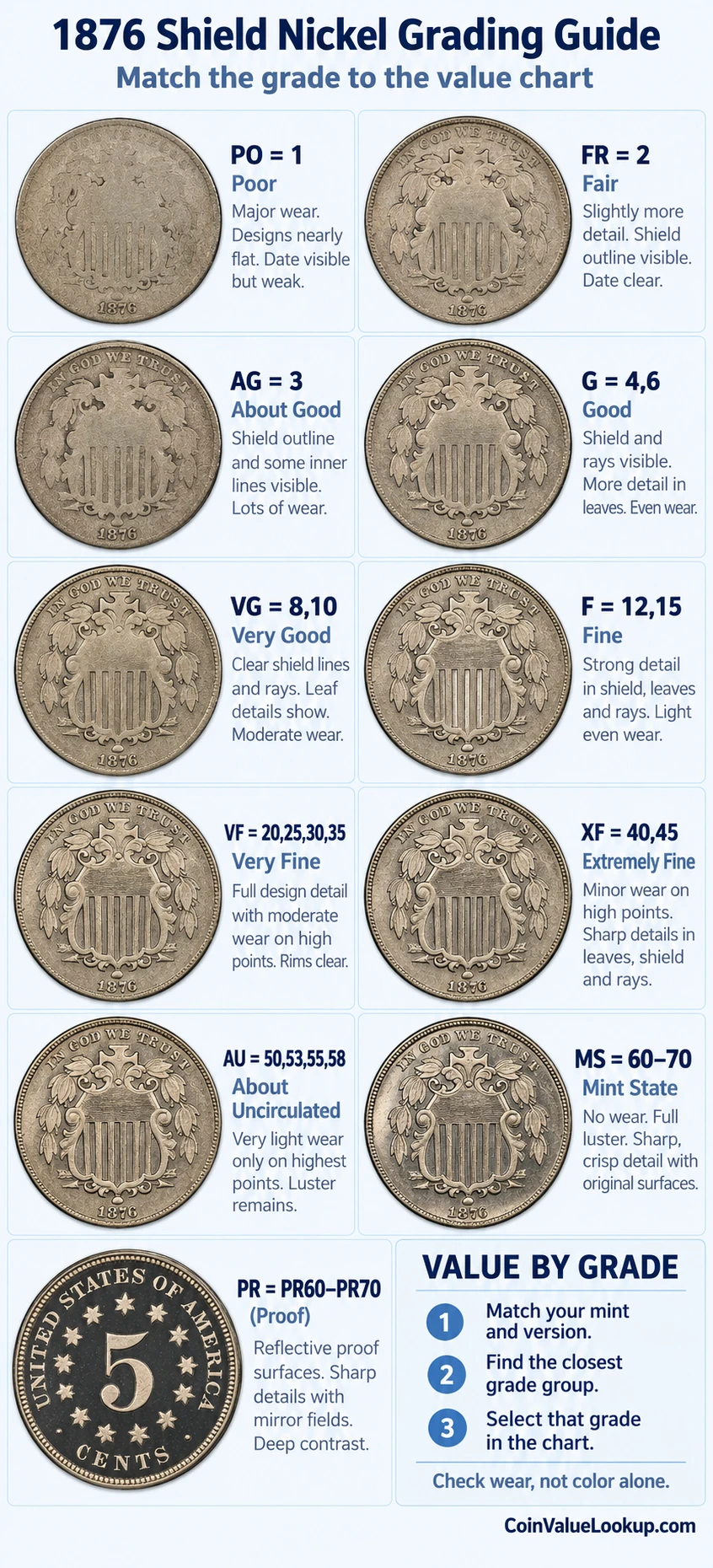
Start by examining the shield on the obverse. The horizontal bands across the shield and the cross at center lose detail first as wear sets in.
On well-circulated pieces, the leaves flanking the shield go flat and merge. A coin grading around G4 will show a clear outline but most interior shield detail is gone.
Weak strikes can fool you. Some 1876 nickels left the press with soft shield lines or mushy star points even though they never circulated.
Compare both sides carefully before assuming wear — if the fields still show original cartwheel luster, it may be strike-related softness rather than genuine friction.
Proofs need a different eye entirely. Look for preserved mirror surfaces, fine hairlines from old cleaning or storage, and consistent sharpness across every design element.
A proof that has been spent will still show squared rims and a different surface texture than a business strike of the same grade. Use the comparison image to judge your coin against known grade benchmarks.
Never clean your coin. Harsh cleaning or environmental damage require separate, usually lower, valuation.
Step 3: Check 1876 Shield Nickel Value by Mint and Version
1876 Shield Nickel — No Mint Mark — Circulation Strike
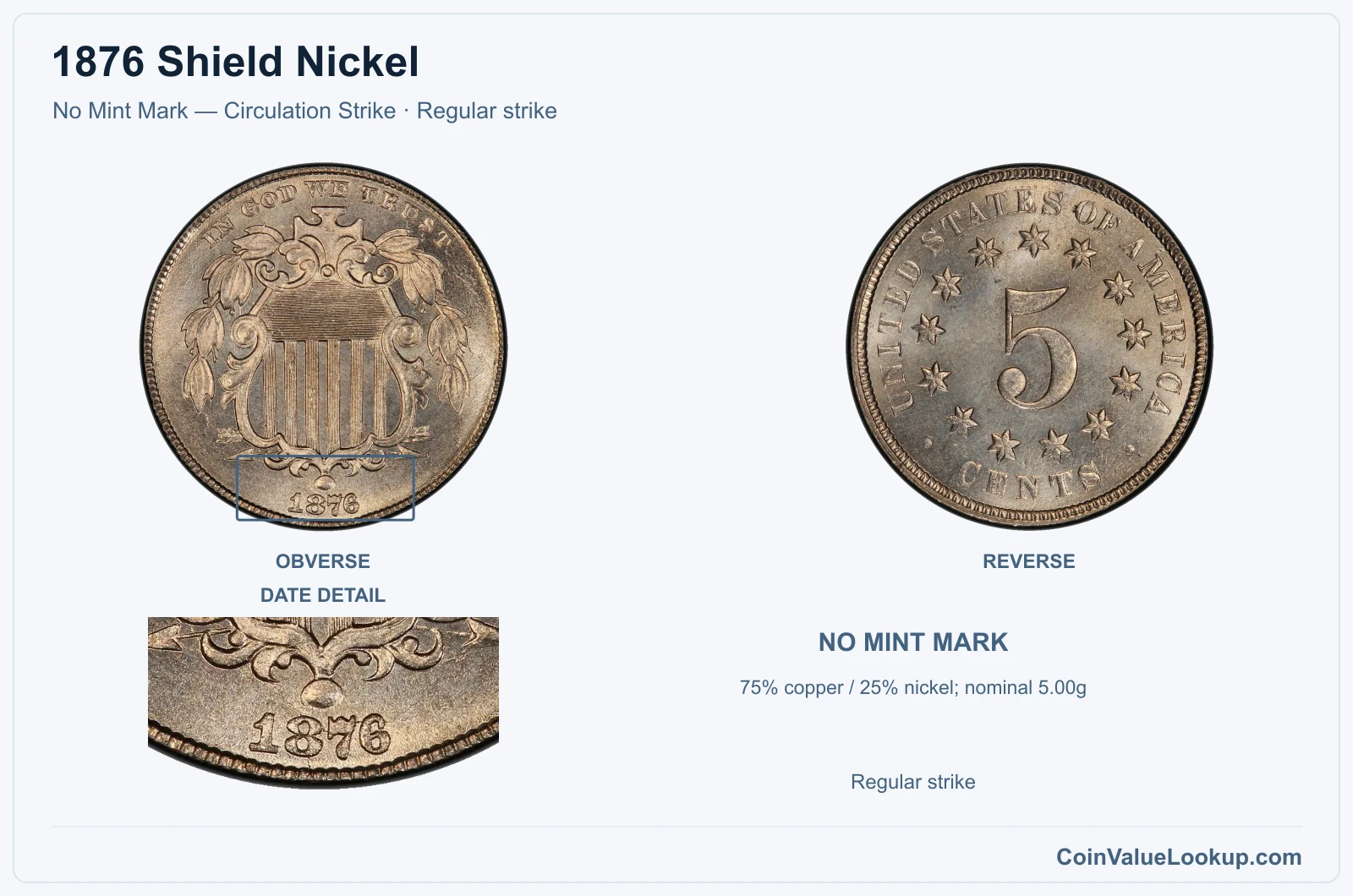
The standard 1876 Shield Nickel business strike was produced at Philadelphia with no mintmark. It weighs about 5 grams in copper-nickel and carries the No Rays reverse design used from 1867 onward.
USA Coin Book places a G4 example at roughly $56 and an MS63 around $407.
This is the last year Shield Nickels entered general circulation. After 1876, the Mint shifted to proof-only production for two years, so finding an 1876 in high grade with original surfaces is a legitimate pursuit.
Watch for the doubled or tripled obverse die and the Bleeder shield-line variety, both reported specifically for this date.
Range Grade
Price Auction Records Appraisal PO PO 1
—
Coin Identifier FR FR 2
—
Coin Identifier AG AG 3
Coin Identifier G G 4
—
Coin Identifier
G 6
—
Coin Identifier VG VG 8
—
Coin Identifier
VG 10
Coin Identifier F F 12
—
Coin Identifier
F 15
Coin Identifier VF VF 20
Coin Identifier
VF 25
Coin Identifier
VF 30
Coin Identifier
VF 35
Coin Identifier XF XF 40
Coin Identifier
XF 45
Coin Identifier AU AU 50
Coin Identifier
AU 53
Coin Identifier
AU 55
Coin Identifier
AU 58
Coin Identifier MS MS 60
Coin Identifier
MS 61
Coin Identifier
MS 62
Coin Identifier
MS 63
Coin Identifier
MS 64
Coin Identifier
MS 65
Coin Identifier
MS 66
Coin Identifier
MS 67
—
—
—
MS 68
—
—
—
MS 69
—
—
—
MS 70
—
—
—
1876 Shield Nickel — No Mint Mark — Proof
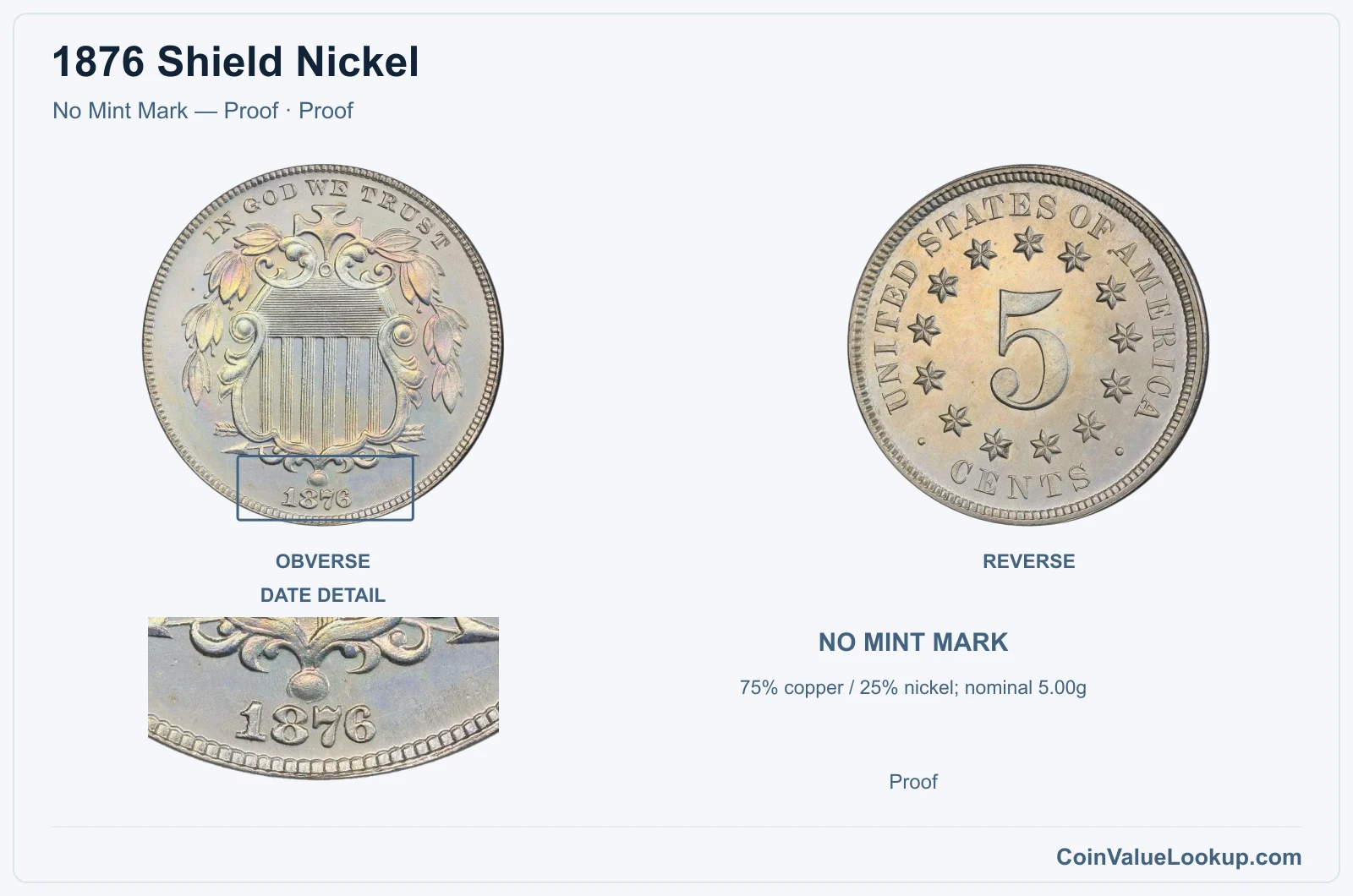
Philadelphia also struck dedicated proof 1876 Shield Nickels for collectors. A PR63 example runs about $468 per USA Coin Book estimates.
These proofs share the same copper-nickel composition and No Rays design as their business-strike siblings, but the surfaces are different — expect squared rims, mirror-like fields, and sharper overall detail when original surfaces survive.
Coin Value Lookup is a useful place to browse nickel guides and compare your coin's details against known types. Two sentences of careful rim and field inspection will tell you more than a dozen assumptions.
Cameo contrast, where frosted devices stand out against mirrored fields, is a separate designation matter. The key first step is confirming the coin is actually a proof and not just a well-preserved business strike.
Look at the rim profile and field texture under good light before drawing conclusions.
Range Grade
Price Auction Records Appraisal PR PR 1
—
Coin Identifier
PR 2
—
Coin Identifier
PR 3
—
Coin Identifier
PR 4
—
Coin Identifier
PR 6
—
Coin Identifier
PR 8
—
Coin Identifier
PR 10
—
Coin Identifier
PR 12
—
Coin Identifier
PR 15
—
Coin Identifier
PR 20
—
Coin Identifier
PR 25
—
Coin Identifier
PR 30
—
Coin Identifier
PR 35
—
Coin Identifier
PR 40
—
Coin Identifier
PR 45
—
Coin Identifier
PR 50
—
Coin Identifier
PR 53
—
Coin Identifier
PR 55
—
Coin Identifier
PR 58
—
Coin Identifier
PR 60
—
Coin Identifier
PR 61
Coin Identifier
PR 62
Coin Identifier
PR 63
Coin Identifier
PR 64
Coin Identifier
PR 65
Coin Identifier
PR 66
Coin Identifier
PR 67
Coin Identifier
PR 68
—
—
—
PR 69
—
—
—
PR 70
—
—
—
1876 Shield Nickel Error List
1. 1876 Shield Nickel — Doubled / Tripled Die Obverse
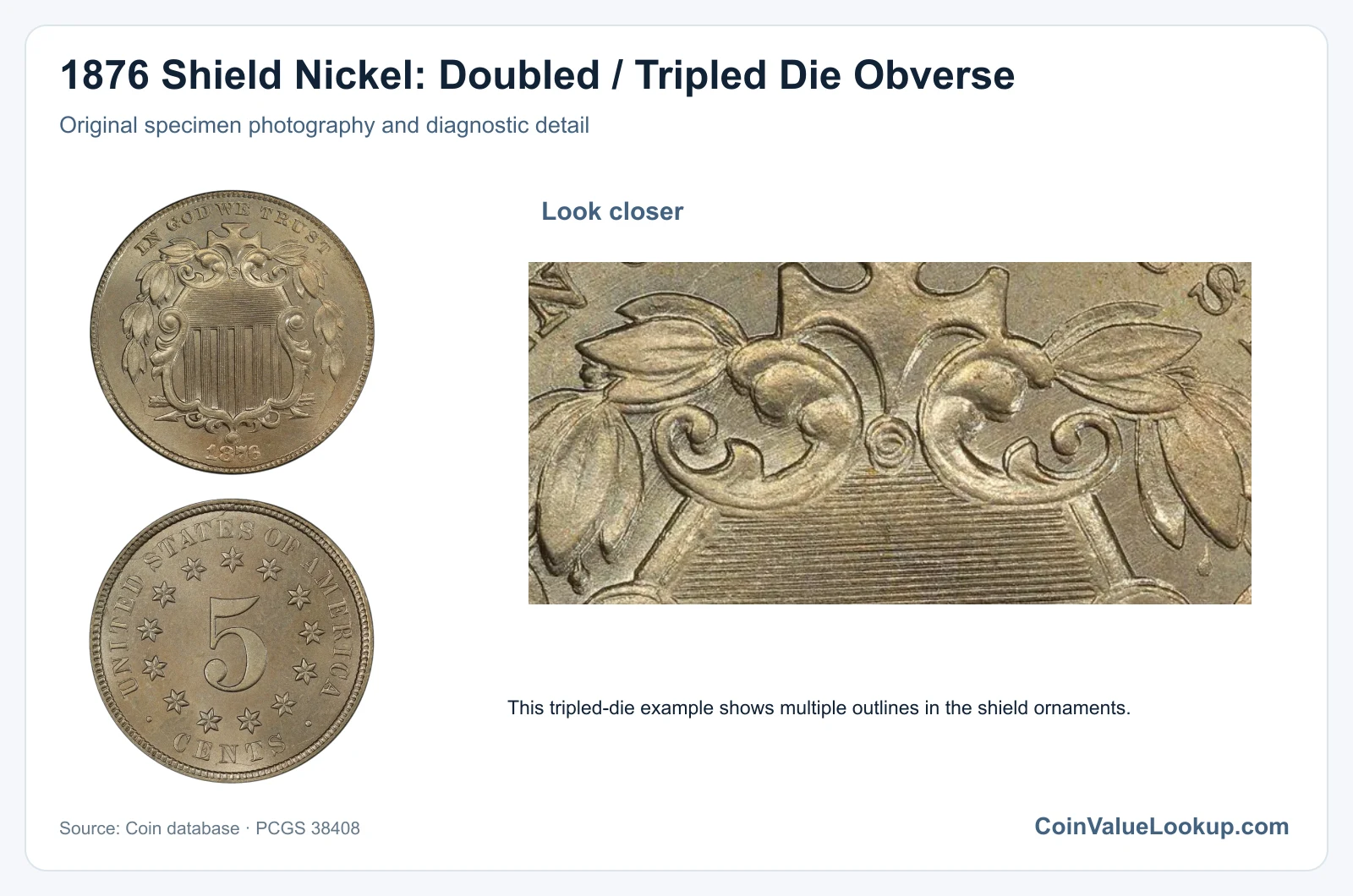
A doubled or tripled die obverse on the 1876 Shield Nickel shows consistent separation or notching on obverse lettering and design elements. Under magnification, compare suspect letters against a normal 1876 — genuine hub doubling produces uniform extra outlines that follow the same direction across multiple design points.
The distinction from machine doubling matters. Machine doubling tends to create flat, shelf-like distortions on one side of the design, while a true doubled die shows rounded, raised secondary images.
Reflections from lighting or worn die contours can also mimic doubling at a casual glance.
No specific price premium is adopted here because value depends heavily on the visibility of the doubling and the coin's overall condition. A strong, obvious example in higher grades will naturally attract more collector interest than a subtle one on a worn coin.
2. 1876 Shield Nickel — Repunched Date
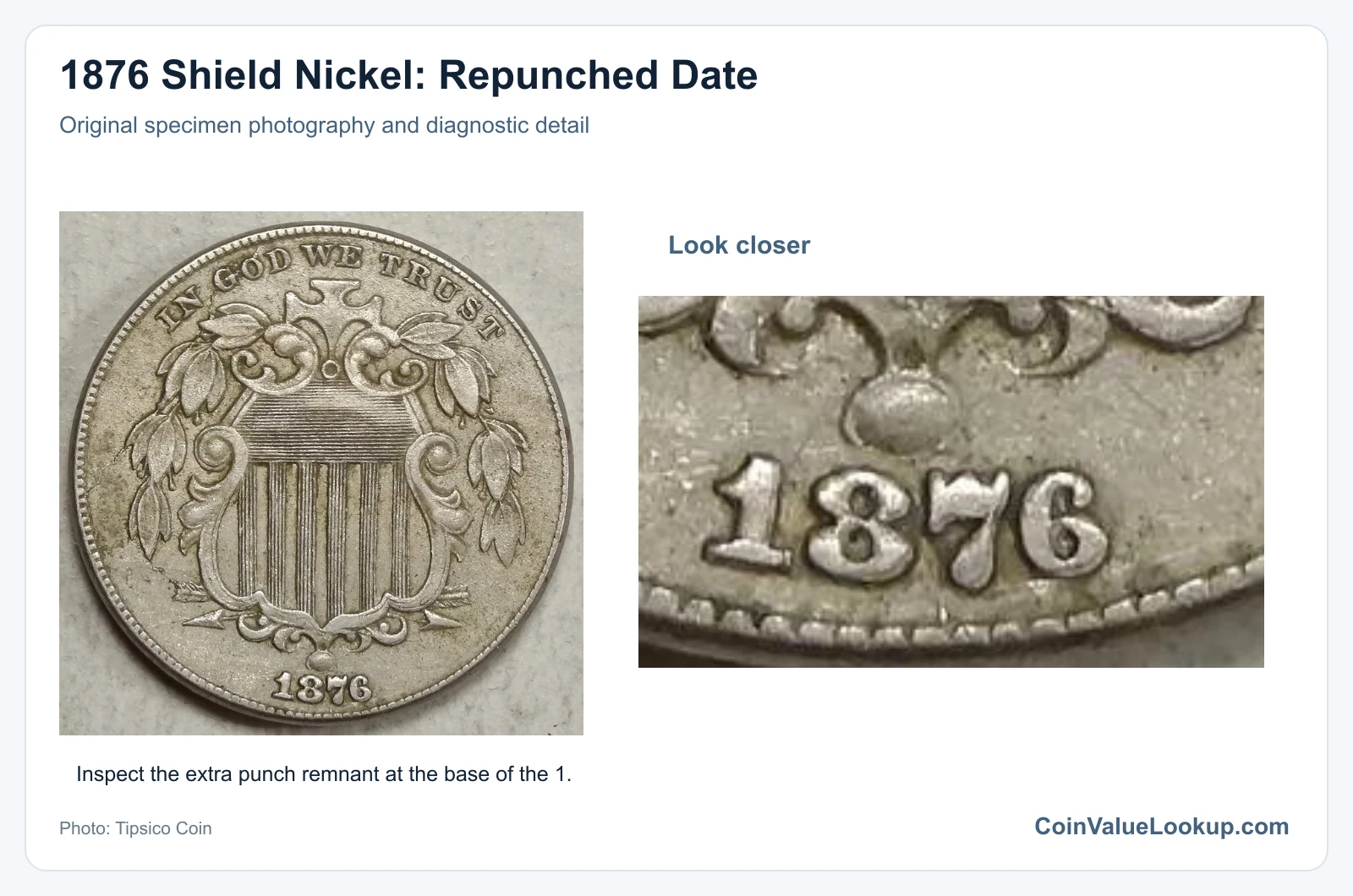
Repunched date varieties on the 1876 Shield Nickel show remnants of an earlier date-punch position beside or beneath the final numerals. You are looking for traces of a misaligned first impression — perhaps a ghost of the "1" or "6" slightly offset from where the digit ended up.
This is a separate category from a doubled die obverse. A repunched date involves the physical date punch being applied more than once in slightly different positions.
A doubled die, by contrast, affects the entire obverse design through a misaligned hub impression.
Don't confuse a damaged or corroded date area with a genuine repunch. Post-mint hits and environmental wear can create marks near the digits that superficially resemble a second impression.
Consistent remnant shapes matching the numeral forms are the key diagnostic. No specific price data is adopted for this variety; value depends on clarity and the coin's grade.
3. 1876 Shield Nickel — Die Crack / Die Chip
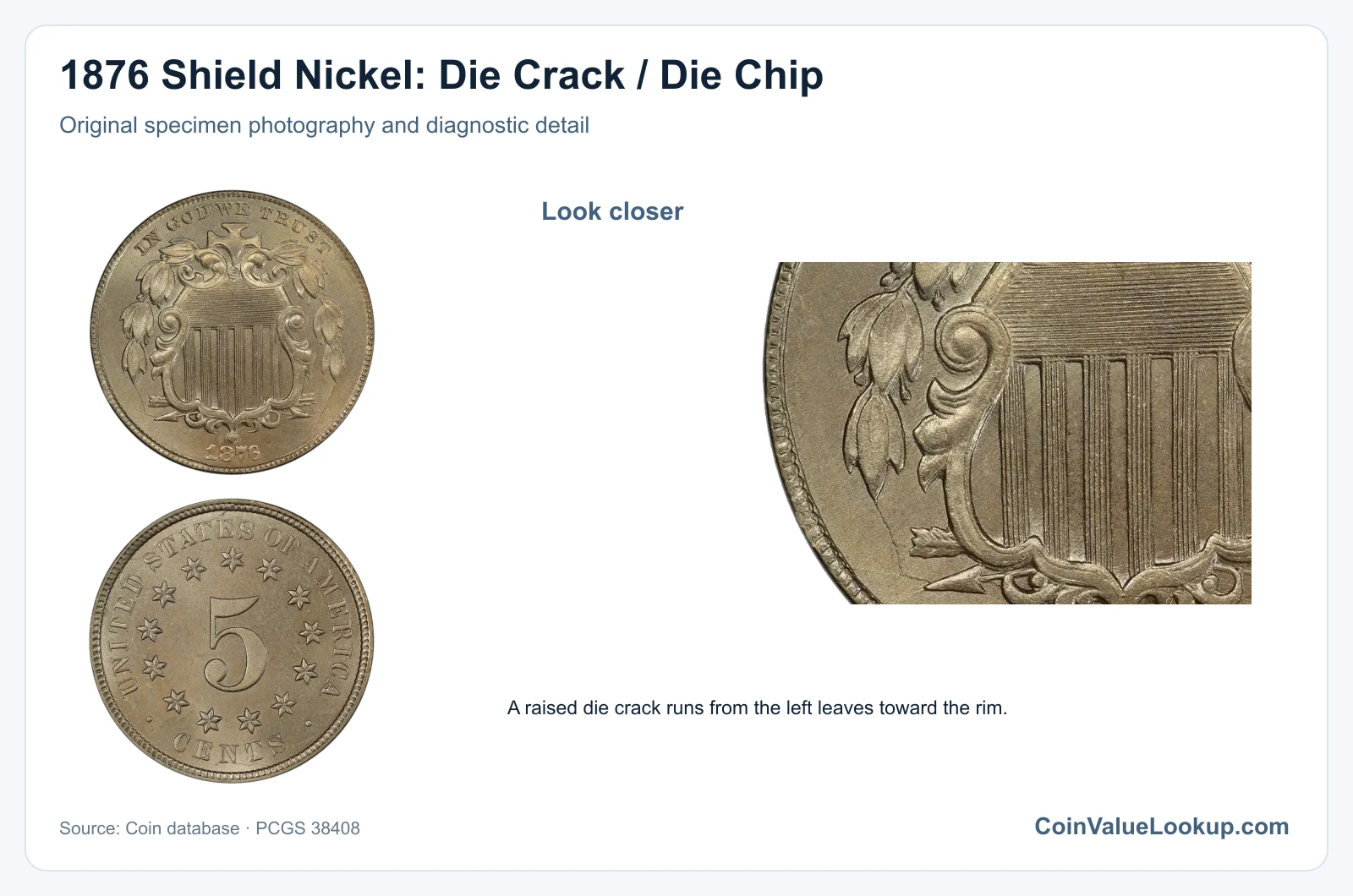
Die cracks on the 1876 Shield Nickel appear as raised lines running across the coin's surface, created when a working die fractured under repeated striking pressure. A die chip is a smaller raised blob where a piece of the die face broke away.
Both leave raised, not incised, marks on the finished coin.
To tell a genuine die crack from a scratch, remember: cracks are raised above the field because metal flowed into the gap in the die. Scratches and corrosion lines are typically incuse — pressed into the surface.
A large die crack that connects to the rim may qualify as a "cud," which is a distinct and generally more collectible form.
Foreign material stuck to a coin can also mimic a small raised feature, so inspect the texture carefully. No adopted price range exists for die cracks on this date; premiums depend on the crack's size, location, and the coin's overall condition.
4. 1876 Shield Nickel — Bleeder Shield-Line Variety
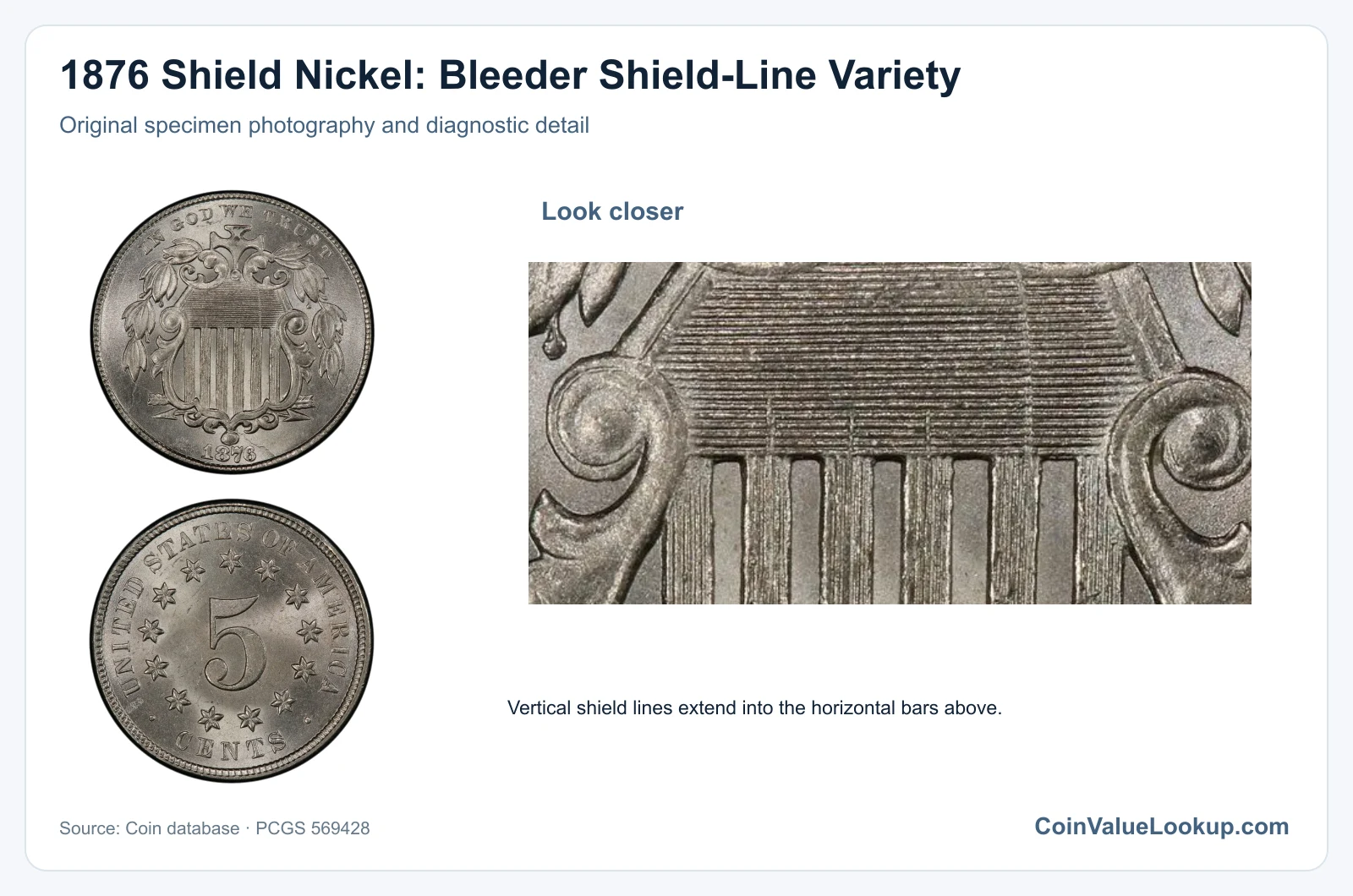
The Bleeder shield-line variety is specific to the Shield Nickel's obverse design. On a normal coin, the vertical shield lines stop cleanly where they meet the horizontal bands.
On a Bleeder, those vertical lines extend upward into the horizontal bands, as if they are "bleeding" through.
This is a die variety, not post-mint damage. The effect will be consistent across all examples struck from the same die.
Compare the suspect area against a known normal 1876 under matching magnification — the difference should be visible and repeatable in the same shield region.
Don't mistake incuse scratches or weakly struck horizontal bands for a Bleeder. Scratches will look incised and irregular; a genuine Bleeder shows raised, evenly spaced extensions of the vertical lines.
No specific price data is adopted for this variety, but condition and clarity of the bleeding lines are the main factors driving collector interest.