1838 Liberty Seated Quarter Coin Value: How Much Is It Worth?
The 1838 Liberty Seated quarter is an early issue in a long-running series, and values reflect that age. A guide estimate places a well-worn example around $70 in G4, while a clean MS63 business strike can reach roughly $4,950.
Authenticated proofs occupy a completely different price tier. Condition, originality, and correct identification matter more than hope here.
Fast Way to Identify Your 1838 Liberty Seated Quarter
Upload clear photos of both the front and back of your 1838 quarter for a preliminary identification. This helps confirm whether you have a Seated Liberty or a Capped Bust design, spot obvious damage, and point you toward the right value range.
Good lighting and a steady hand go a long way.
1838 Liberty Seated Quarter Value
Upload both sides of your 1838 Liberty Seated Quarter.
Front Obverse
Upload photo
Back Reverse
Upload photo
Which 1838 Liberty Seated Quarter Versions Are Worth Money?
- Business strikes in original, problem-free condition command strong premiums, with guide values climbing from about $70 at G4 to $4,950 at MS63.
- Authenticated 1838 Philadelphia proofs are extremely rare specialist coins; a PCGS PR63 example sold for $381,875 in January 2013.
- The No Drapery design is specific to 1838–1839 and visually distinct from later Seated quarters, giving it series-entry appeal.
- Clipped planchet errors on this date are documented and worth checking for, though individual value depends on authenticated identity and severity.
Step 1: Identify Your 1838 Liberty Seated Quarter Mint Mark and Version
First, confirm the date reads 1838 and the obverse shows a seated Liberty figure, not the earlier Capped Bust design. These are two entirely different coin types, each with its own value guide, so mixing them up leads to wrong numbers fast.
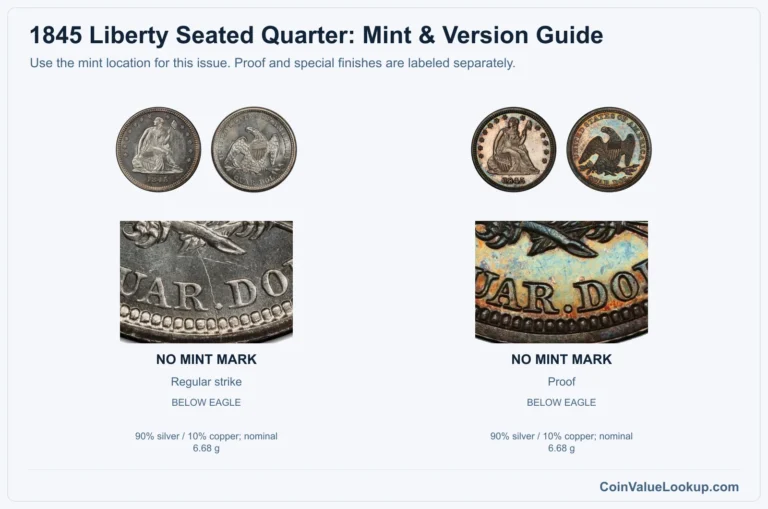
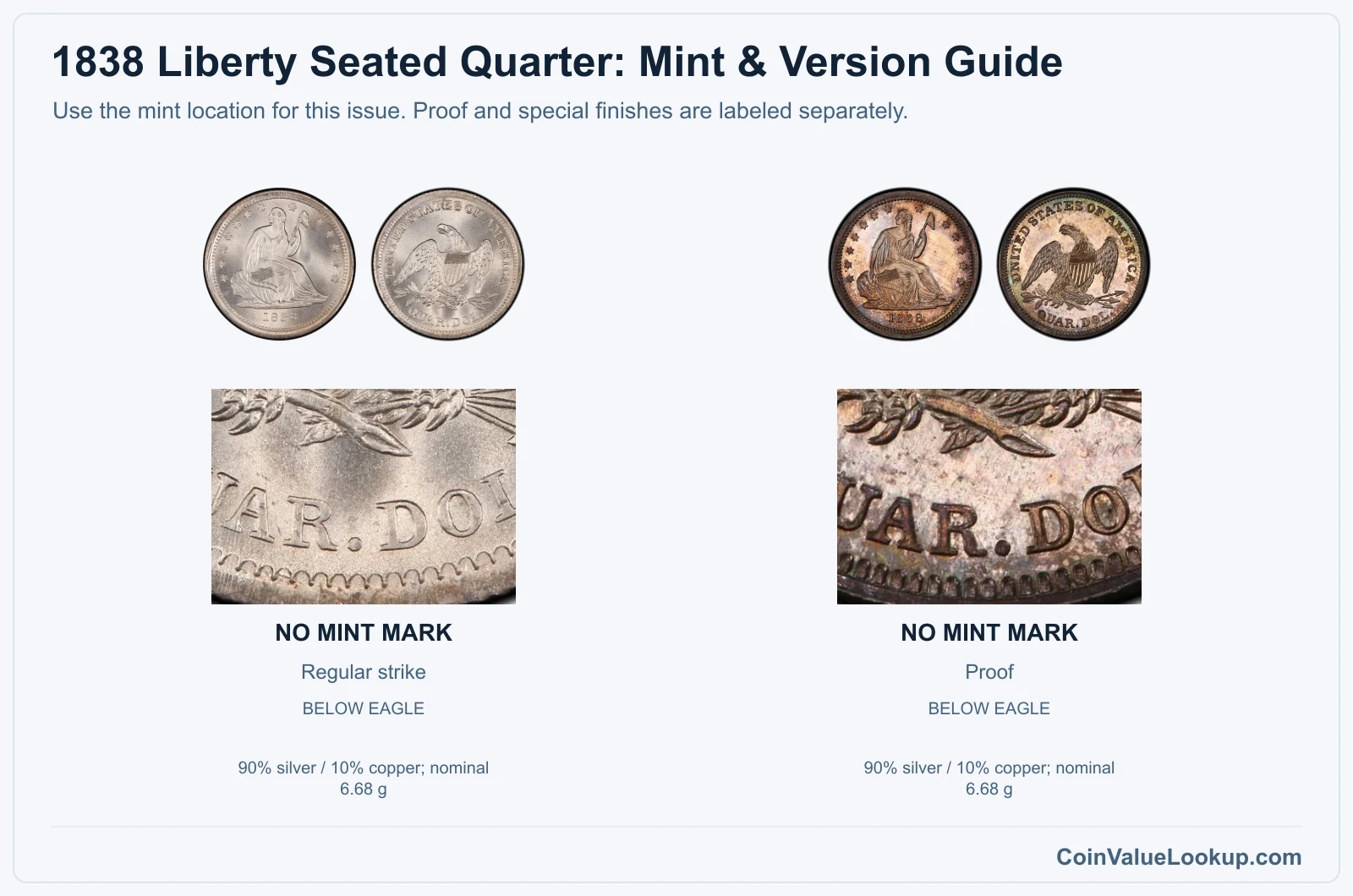
Philadelphia-struck 1838 quarters carry no mintmark. If you see a small "O" on the reverse beneath the eagle, that indicates New Orleans production, but for the Seated quarter series, 1838 is a Philadelphia-only date.
The 1838 Seated quarter is the "No Drapery" variety, meaning Liberty's elbow lacks the fold of fabric added in later years. Composition is 90% silver and 10% copper, with a nominal weight of 6.68 grams and a diameter of about 24.3 mm.
Significant wear can reduce the weight slightly, so a light coin is not automatically a fake.
If your coin shows a bust portrait facing left instead of a seated figure, you likely have the 1838 Capped Bust quarter, which is covered on a separate page entirely.
Step 2: Check Your 1838 Liberty Seated Quarter Grade
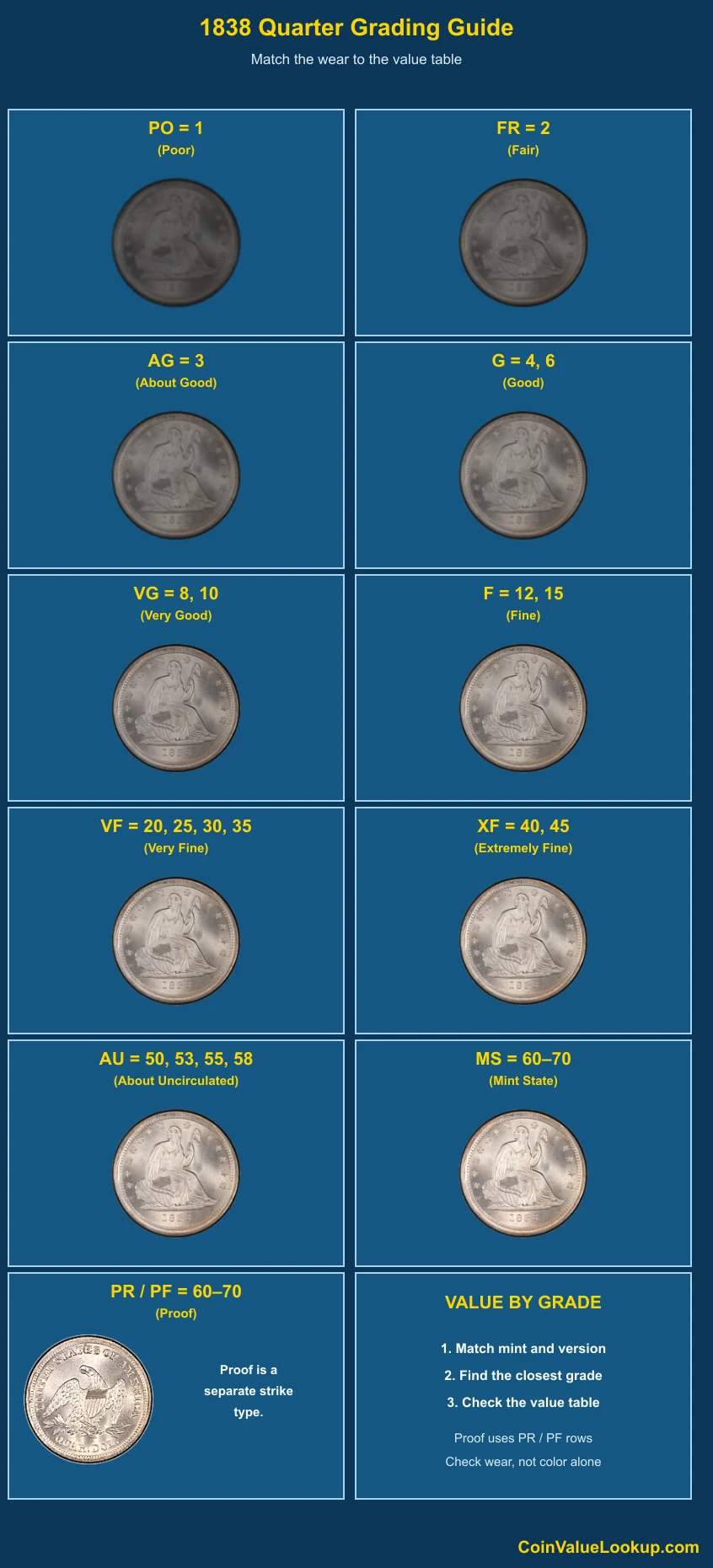
Start with Liberty's head, breast, and knee on the obverse. These areas wear first, so flatness there tells you the coin has seen real circulation.
Check the shield lettering too, but a mushy shield alone does not pin down a grade because some 1838 quarters were weakly struck to begin with.
On the reverse, look at the eagle's breast feathers, wing detail, and claws. Strong feather definition with original luster suggests a higher grade.
Faded feathers with smooth, even loss point to honest wear.
Use the comparison image to judge where your coin falls. Remaining luster and surface continuity help separate a weakly struck coin from a genuinely worn one.
A weak strike still shows mint luster in protected areas; a worn coin does not.
Hairlines from cleaning, smoothed fields, holes, or green environmental damage all reduce value regardless of remaining detail. And a shiny, mirror-like surface does not make a coin a proof.
Early proof attribution requires expert die-pair analysis and provenance, not just a reflective look.
Step 3: Check 1838 Liberty Seated Quarter Value by Mint and Version
1838 Liberty Seated Quarter — Philadelphia Business Strike
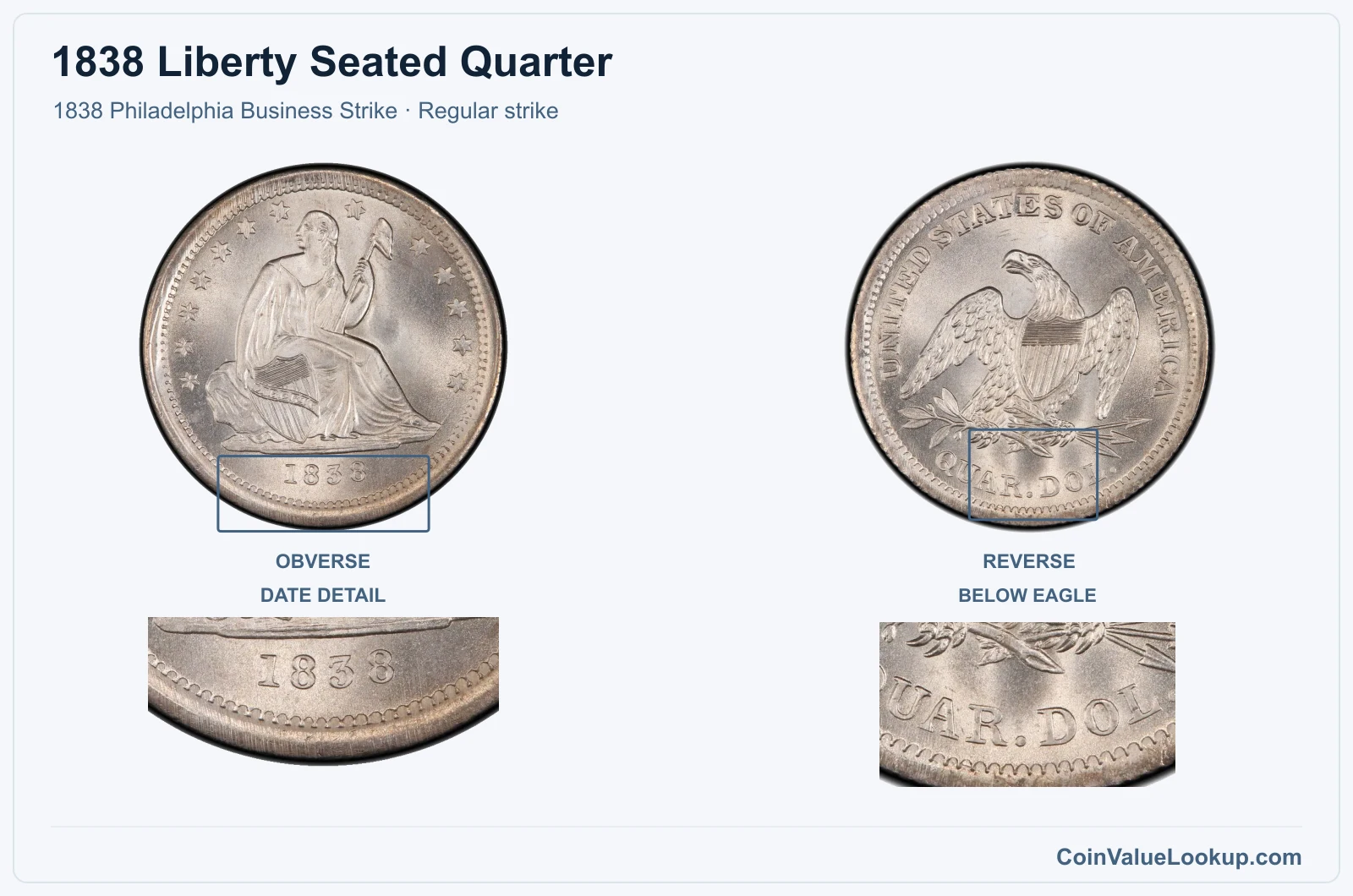
This is the standard 1838 Philadelphia business strike, featuring the Seated Liberty obverse and eagle reverse with no motto. It uses the No Drapery design, so Liberty's elbow area is bare of the extra fabric fold seen on later dates.
No mintmark appears anywhere on the coin.
USA Coin Book guide estimates place this version at about $70 in G4, around $226 in VF20, and approximately $4,950 in MS63. Those are retail guide figures, not guaranteed sale prices.
Original, uncleared surfaces and full detail push values up; cleaning or damage pulls them down hard.
Coin Value Lookup is a good starting point if you want to compare this quarter's guide values with other dates in the Seated Liberty series. It can help you zero in on the right denomination and year quickly.
| Range | Grade | Price | Auction Records | Appraisal |
|---|---|---|---|---|
| PO | PO 1 | — | Coin Identifier | |
| FR | FR 2 | — | Coin Identifier | |
| AG | AG 3 | — | Coin Identifier | |
| G | G 4 | — | Coin Identifier | |
| G 6 | — | Coin Identifier | ||
| VG | VG 8 | — | Coin Identifier | |
| VG 10 | — | Coin Identifier | ||
| F | F 12 | — | Coin Identifier | |
| F 15 | Coin Identifier | |||
| VF | VF 20 | Coin Identifier | ||
| VF 25 | Coin Identifier | |||
| VF 30 | Coin Identifier | |||
| VF 35 | Coin Identifier | |||
| XF | XF 40 | Coin Identifier | ||
| XF 45 | Coin Identifier | |||
| AU | AU 50 | Coin Identifier | ||
| AU 53 | Coin Identifier | |||
| AU 55 | Coin Identifier | |||
| AU 58 | Coin Identifier | |||
| MS | MS 60 | — | Coin Identifier | |
| MS 61 | Coin Identifier | |||
| MS 62 | Coin Identifier | |||
| MS 63 | Coin Identifier | |||
| MS 64 | Coin Identifier | |||
| MS 65 | Coin Identifier | |||
| MS 66 | Coin Identifier | |||
| MS 67 | Coin Identifier | |||
| MS 68 | Coin Identifier | |||
| MS 69 | — | — | — | |
| MS 70 | — | — | — |
1838 Liberty Seated Quarter — Proof Philadelphia
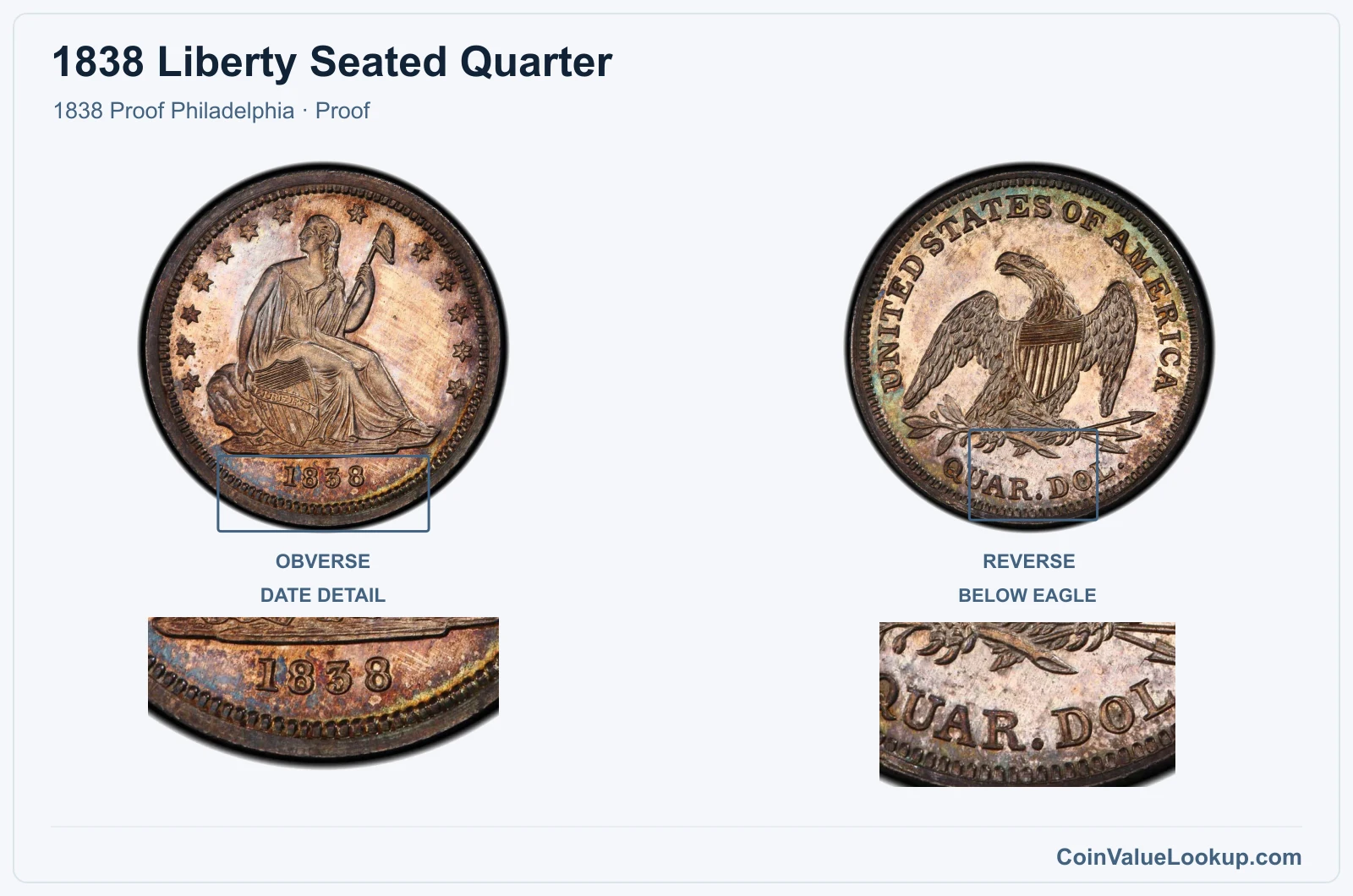
The 1838 proof is a rare early Philadelphia striking made with specially prepared dies and planchets. Like the business strike, it is the No Drapery design in 90% silver, but proofs show sharply defined details and typically mirror-like fields that differ from even the best uncirculated business strikes.
Do not assume your coin is a proof because it looks shiny. A reflective business strike is not sufficient for proof attribution.
Genuine 1838 proofs require expert die-pair comparison, surface analysis, and ideally documented provenance. Third-party certification from a major grading service is essentially mandatory for this claim to hold weight in the market.
For context, a PCGS PR63 example sold for $381,875 at auction in January 2013, as cited by PCGS. That is an exceptional historical result for an exceptionally rare coin, not a routine price point.
If you genuinely suspect you have one, professional authentication is the only responsible next step.
| Range | Grade | Price | Auction Records | Appraisal |
|---|---|---|---|---|
| PR | PR 1 | — | Coin Identifier | |
| PR 2 | — | Coin Identifier | ||
| PR 3 | — | Coin Identifier | ||
| PR 4 | — | Coin Identifier | ||
| PR 6 | — | Coin Identifier | ||
| PR 8 | — | Coin Identifier | ||
| PR 10 | — | Coin Identifier | ||
| PR 12 | — | Coin Identifier | ||
| PR 15 | — | Coin Identifier | ||
| PR 20 | — | Coin Identifier | ||
| PR 25 | — | Coin Identifier | ||
| PR 30 | — | Coin Identifier | ||
| PR 35 | — | Coin Identifier | ||
| PR 40 | — | Coin Identifier | ||
| PR 45 | — | Coin Identifier | ||
| PR 50 | — | Coin Identifier | ||
| PR 53 | — | Coin Identifier | ||
| PR 55 | — | Coin Identifier | ||
| PR 58 | — | Coin Identifier | ||
| PR 60 | — | Coin Identifier | ||
| PR 61 | — | Coin Identifier | ||
| PR 62 | — | Coin Identifier | ||
| PR 63 | Coin Identifier | |||
| PR 64 | — | — | — | |
| PR 65 | — | — | — | |
| PR 66 | — | — | — | |
| PR 67 | — | — | — | |
| PR 68 | — | — | — | |
| PR 69 | — | — | — | |
| PR 70 | — | — | — |
1838 Liberty Seated Quarter Error List
1. 1838 Liberty Seated Quarter — Clipped Planchet
A clipped planchet on an 1838 Seated No Drapery quarter shows a small missing segment along the rim where the blank was incompletely punched during preparation. The clip creates a curved absence at the edge, and the coin's design may show slight distortion or weakness near that area.
Look at both sides carefully. The clip boundary should appear original to the blank, not like a later cut or gouge.
A post-mint rim nick or filing job will usually show different metal texture or sharp tool marks. Also, the separately documented 1838 Capped Bust off-center coin is a different type entirely and should not be confused with this Seated Liberty error.
One documented example is an ANACS F12 Details 1838 Seated No Drapery with a rim clip. No specific sale price is available for that piece.
Value depends on the authenticated identity, the coin's overall condition, and how severe the clip is, so individual assessment by a grading service is the practical path to pricing.