1849 Liberty Seated Quarter Coin Value: How Much Is It Worth?
An 1849 Liberty Seated quarter can be worth anywhere from roughly $70 in well-worn Good-4 condition to over $26,000 for a select New Orleans mint example in MS63, based on USA Coin Book guide estimates. The mint of origin matters enormously here.
A Philadelphia coin and a New Orleans coin sit in completely different value brackets, and proofs occupy their own category entirely. Original, undamaged surfaces are key to reaching these figures.
Fast Way to Identify Your 1849 Liberty Seated Quarter
The quickest way to get a preliminary identification of your 1849 Seated quarter is to upload clear photos of both the front and back. This lets the design, date and mintmark be checked against known versions.
Snap the images in good lighting with the coin flat, and avoid glare from plastic holders.
1849 Liberty Seated Quarter Value
Upload both sides of your 1849 Liberty Seated Quarter.
Front Obverse
Upload photo
Back Reverse
Upload photo
Which 1849 Liberty Seated Quarter Versions Are Worth Money?
- The 1849-O (New Orleans) business strike is far scarcer than its Philadelphia counterpart, with guide estimates starting around $1,683 in G4 and reaching $26,784 in MS63.
- Philadelphia business strikes are more affordable, with guide values near $70 in G4, $132 in VF20 and $2,042 in MS63.
- 1849 Philadelphia proofs exist but require individual assessment by authenticated identity and condition rather than a standard price-guide lookup.
Step 1: Identify Your 1849 Liberty Seated Quarter Mint Mark and Version
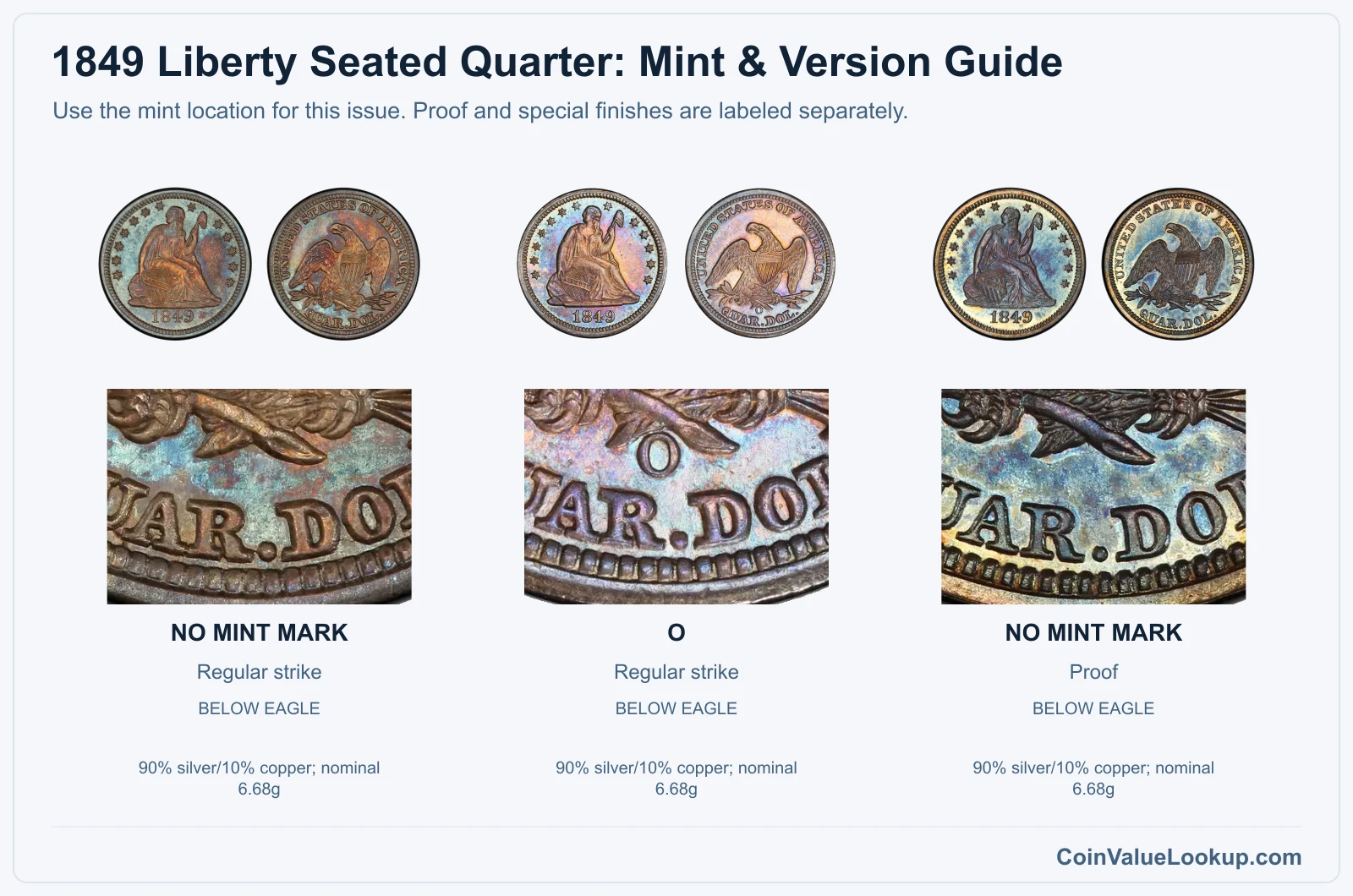
The 1849 Seated Liberty quarter shows Liberty seated on the obverse and an eagle without a motto on the reverse. This is the pre-1853 heavy standard, so the coin should weigh about 6.68 grams in 90% silver and 10% copper, with a diameter of roughly 24.3 mm.
Flip the coin over and look below the eagle for a mintmark. No letter means Philadelphia.
An "O" means New Orleans. San Francisco did not strike quarters until 1855, so you will not find an S on this date.
These two mints represent very different markets. A Philadelphia strike and a New Orleans strike are not interchangeable when looking up value, so confirm that mintmark before checking any price guide.
Early Philadelphia proofs also exist and require separate assessment from regular business strikes.
Step 2: Check Your 1849 Liberty Seated Quarter Grade
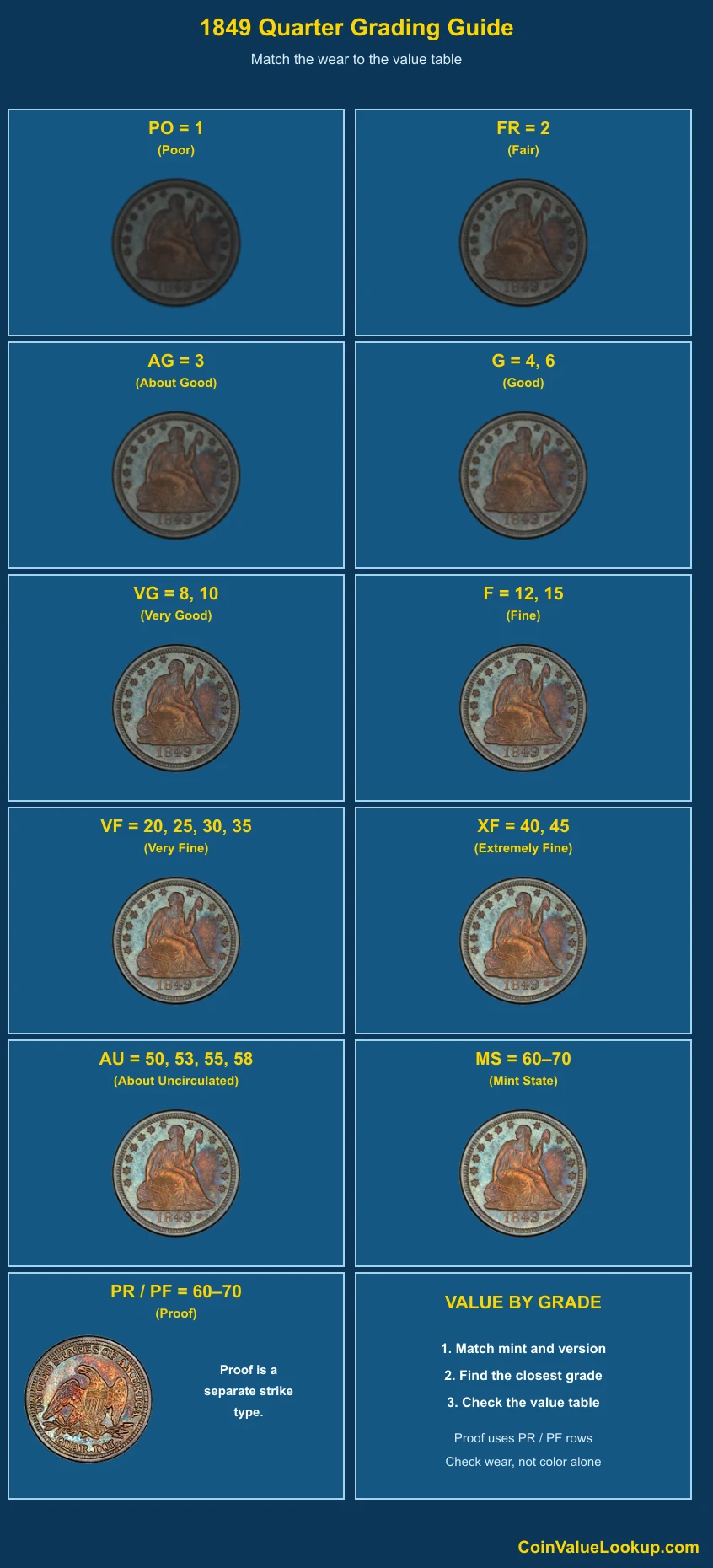
Start with Liberty on the obverse. In higher grades, the detail in her head, the lines across her breast and knee, and the lettering on her shield should be sharp and complete.
As wear increases, these areas flatten first.
On the reverse, check the eagle's breast feathers, wing detail and claws. A coin in Good-4 will have a visible outline of Liberty and a readable date but little interior detail.
By VF-20, moderate wear is present on the high points while protected areas retain sharpness.
Do not confuse a weak strike with wear. Some 1849 quarters left the press with soft detail on the stars or head, and that is a production characteristic, not circulation damage.
Compare your coin to the reference image to see how genuine wear looks versus original softness.
Hairlines from old cleaning, rim dings, corrosion and polishing all reduce value regardless of how much design detail remains. Brightness alone does not prove a coin is mint state or proof; genuine luster has a distinctive cartwheel quality that cleaning destroys.
Step 3: Check 1849 Liberty Seated Quarter Value by Mint and Version
1849 Liberty Seated Quarter — Business Strike
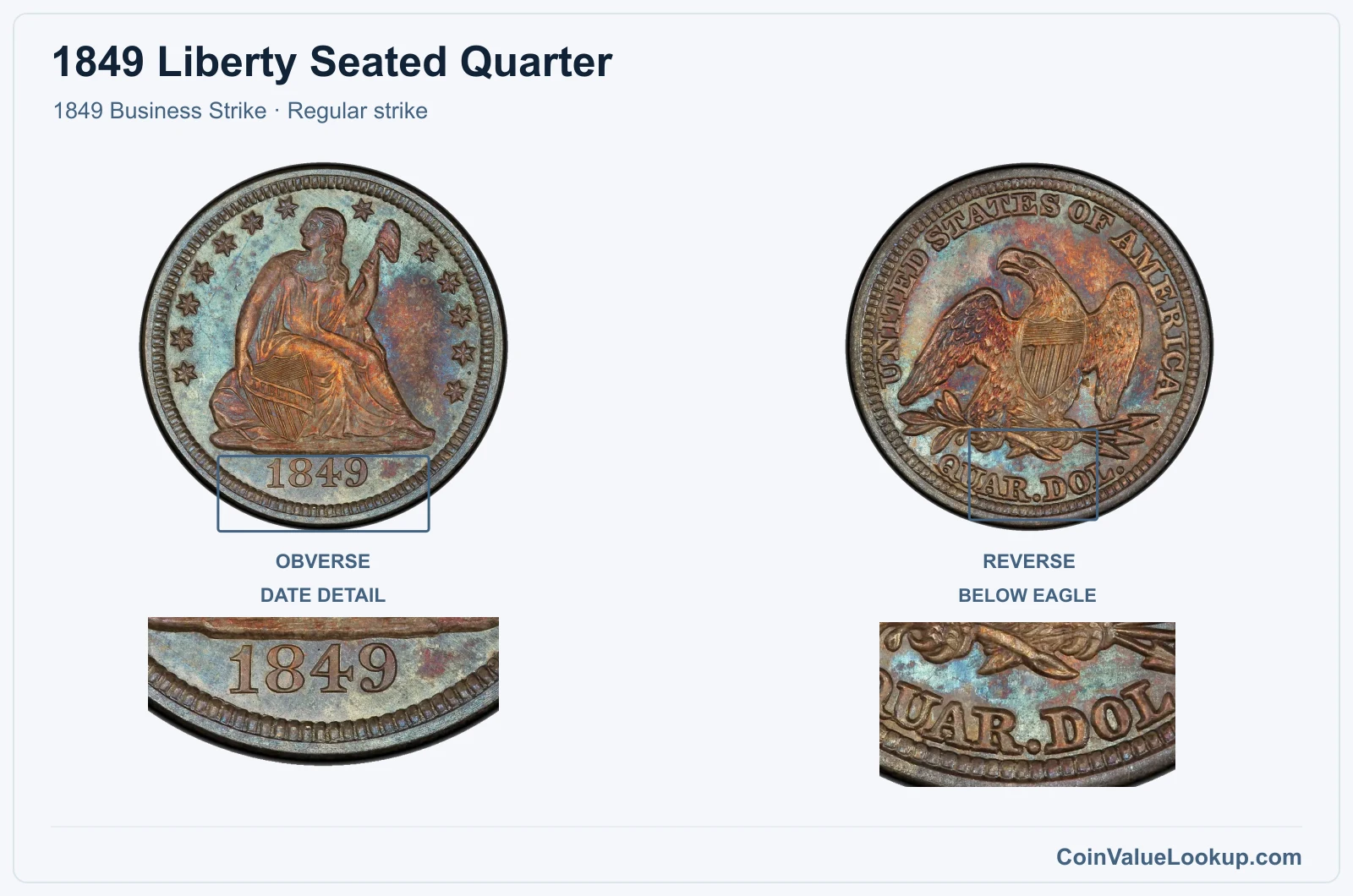
The 1849 Philadelphia business strike carries no mintmark. It is the most commonly encountered version of this date, struck in 90% silver at the old heavy standard of about 6.68 grams.
USA Coin Book guide estimates place it near $70 in G4, $132 in VF20 and $2,042 in MS63.
Those figures assume original, problem-free surfaces. Cleaned or damaged coins trade below these benchmarks, sometimes well below.
If your coin has no mintmark beneath the eagle, this is the row to reference, not the O-mint figures.
| Range | Grade | Price | Auction Records | Appraisal |
|---|---|---|---|---|
| PO | PO 1 | — | Coin Identifier | |
| FR | FR 2 | — | Coin Identifier | |
| AG | AG 3 | — | Coin Identifier | |
| G | G 4 | Coin Identifier | ||
| G 6 | — | Coin Identifier | ||
| VG | VG 8 | — | Coin Identifier | |
| VG 10 | — | Coin Identifier | ||
| F | F 12 | — | Coin Identifier | |
| F 15 | Coin Identifier | |||
| VF | VF 20 | Coin Identifier | ||
| VF 25 | Coin Identifier | |||
| VF 30 | Coin Identifier | |||
| VF 35 | Coin Identifier | |||
| XF | XF 40 | Coin Identifier | ||
| XF 45 | Coin Identifier | |||
| AU | AU 50 | Coin Identifier | ||
| AU 53 | Coin Identifier | |||
| AU 55 | Coin Identifier | |||
| AU 58 | Coin Identifier | |||
| MS | MS 60 | — | Coin Identifier | |
| MS 61 | Coin Identifier | |||
| MS 62 | Coin Identifier | |||
| MS 63 | Coin Identifier | |||
| MS 64 | Coin Identifier | |||
| MS 65 | Coin Identifier | |||
| MS 66 | — | — | — | |
| MS 67 | — | — | — | |
| MS 68 | — | — | — | |
| MS 69 | — | — | — | |
| MS 70 | — | — | — |
1849 Liberty Seated Quarter — Proof
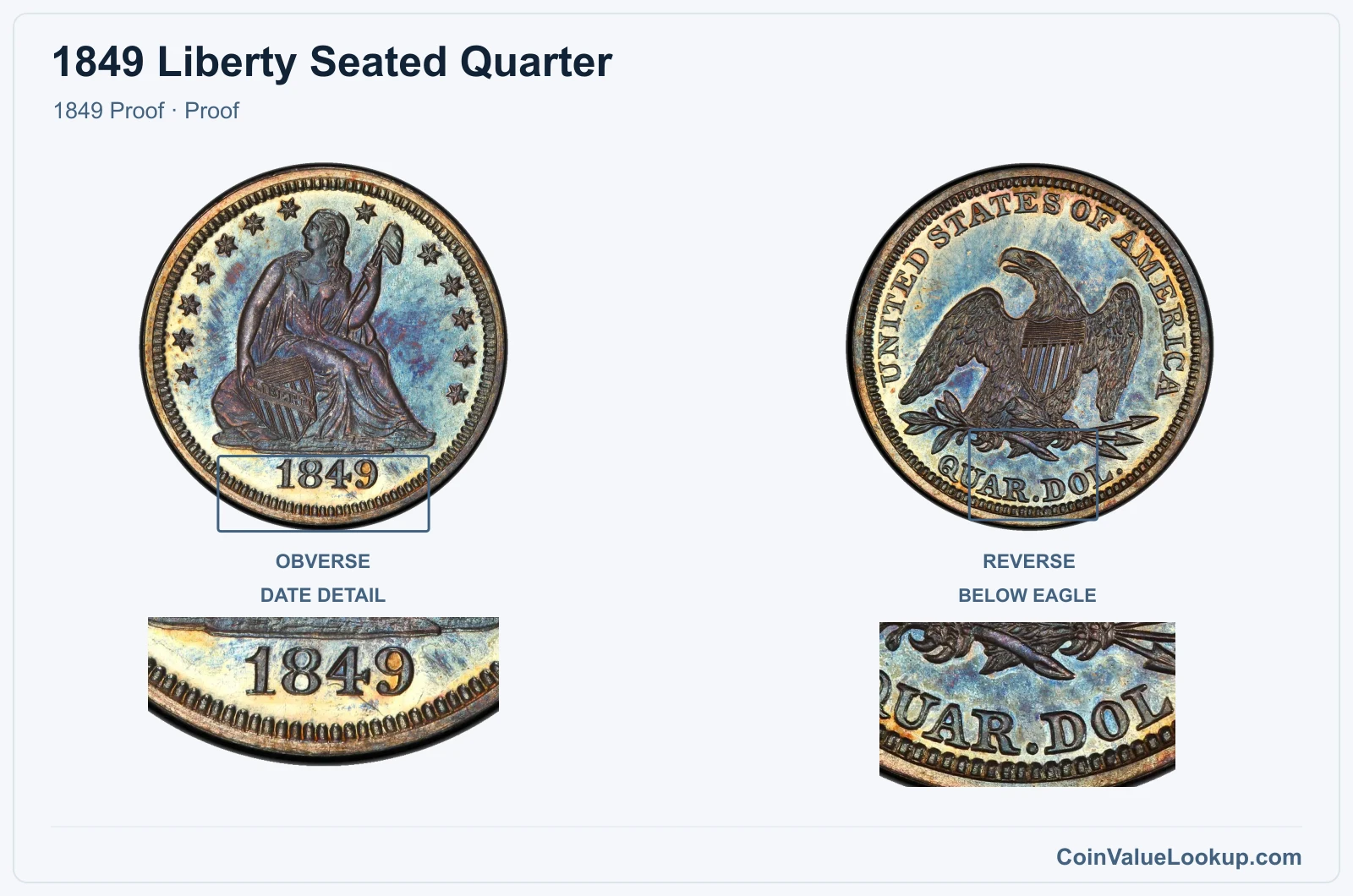
Philadelphia also produced proof Seated quarters dated 1849. These carry no mintmark, just like the business strikes, so telling them apart requires careful examination of surface quality, strike sharpness and edge characteristics rather than a simple letter check.
No supported guide price is adopted for this issue. Each proof example needs individual assessment based on authenticated identity, condition and any die characteristics present.
Reflectivity alone does not confirm proof status; genuine early proofs show specific die preparation signatures that differ from a well-preserved business strike. Professional authentication is the practical path here.
Coin Value Lookup is a useful starting point when you need to look up guides for other dates and denominations in the Seated Liberty quarter series.
| Range | Grade | Price | Auction Records | Appraisal |
|---|---|---|---|---|
| PR | PR 1 | — | Coin Identifier | |
| PR 2 | — | Coin Identifier | ||
| PR 3 | — | Coin Identifier | ||
| PR 4 | — | Coin Identifier | ||
| PR 6 | — | Coin Identifier | ||
| PR 8 | — | Coin Identifier | ||
| PR 10 | — | Coin Identifier | ||
| PR 12 | — | Coin Identifier | ||
| PR 15 | — | Coin Identifier | ||
| PR 20 | — | Coin Identifier | ||
| PR 25 | — | Coin Identifier | ||
| PR 30 | — | Coin Identifier | ||
| PR 35 | — | Coin Identifier | ||
| PR 40 | — | Coin Identifier | ||
| PR 45 | — | Coin Identifier | ||
| PR 50 | — | Coin Identifier | ||
| PR 53 | — | Coin Identifier | ||
| PR 55 | — | Coin Identifier | ||
| PR 58 | — | Coin Identifier | ||
| PR 60 | — | Coin Identifier | ||
| PR 61 | — | Coin Identifier | ||
| PR 62 | — | Coin Identifier | ||
| PR 63 | Coin Identifier | |||
| PR 64 | Coin Identifier | |||
| PR 65 | Coin Identifier | |||
| PR 66 | Coin Identifier | |||
| PR 67 | — | — | — | |
| PR 68 | — | — | — | |
| PR 69 | — | — | — | |
| PR 70 | — | — | — |
1849 Liberty Seated Quarter — O Business Strike
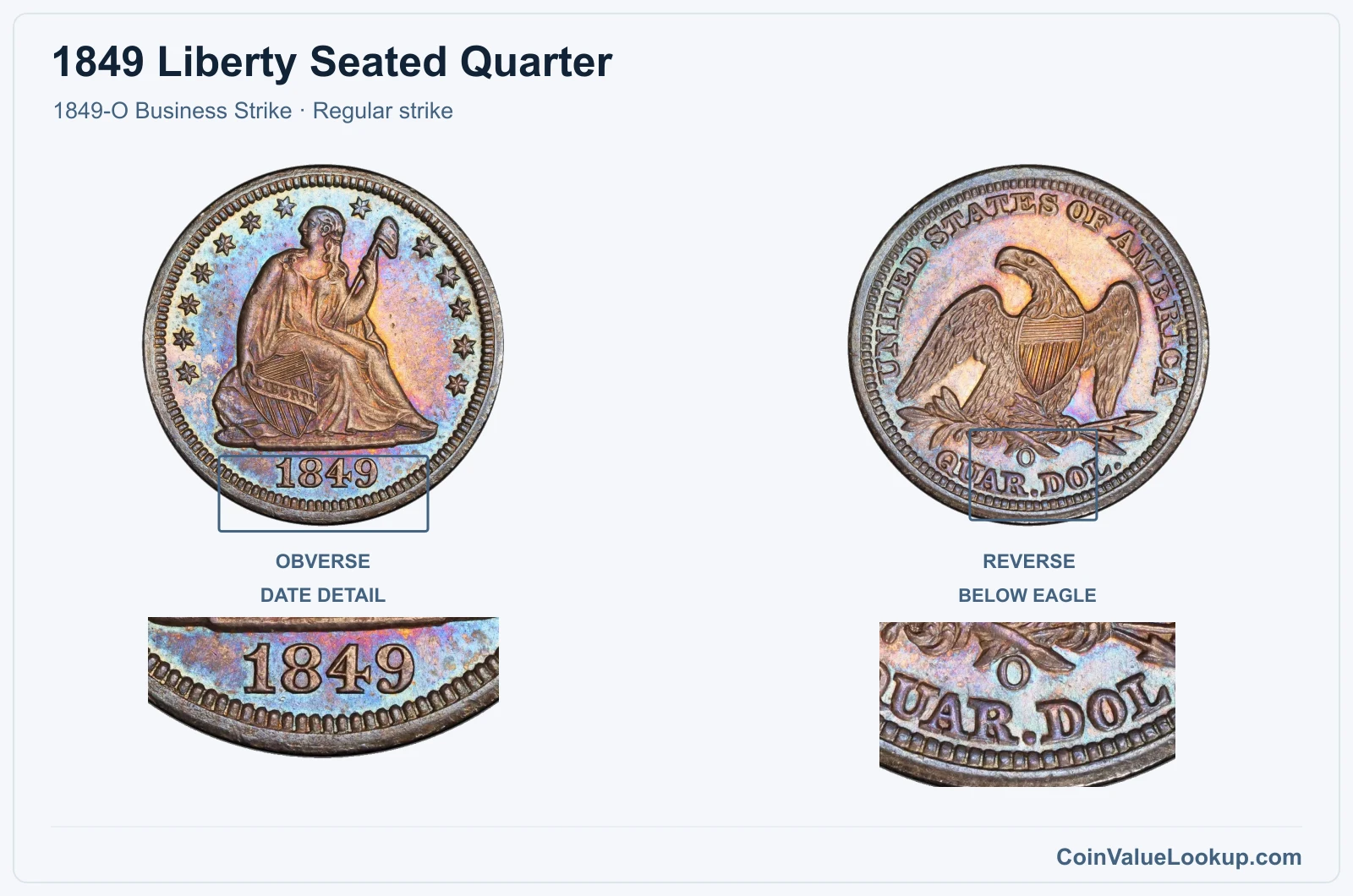
The 1849-O is the coin that makes people double-check their mintmark. Look for the small "O" on the reverse below the eagle.
New Orleans production for this date was far more limited, and the market reflects it.
USA Coin Book guide estimates start around $1,683 in G4, rise to $4,078 in VF20 and reach $26,784 in MS63. That is a massive jump over the Philadelphia version at every grade level.
Do not accidentally price an O-mint coin using Philadelphia figures or vice versa; the difference is not subtle.
This is also 90% silver at the pre-1853 heavy standard of approximately 6.68 grams. Original surfaces without cleaning or tooling are critical at these price levels.
| Range | Grade | Price | Auction Records | Appraisal |
|---|---|---|---|---|
| PO | PO 1 | Coin Identifier | ||
| FR | FR 2 | Coin Identifier | ||
| AG | AG 3 | Coin Identifier | ||
| G | G 4 | Coin Identifier | ||
| G 6 | Coin Identifier | |||
| VG | VG 8 | Coin Identifier | ||
| VG 10 | Coin Identifier | |||
| F | F 12 | Coin Identifier | ||
| F 15 | Coin Identifier | |||
| VF | VF 20 | Coin Identifier | ||
| VF 25 | Coin Identifier | |||
| VF 30 | Coin Identifier | |||
| VF 35 | Coin Identifier | |||
| XF | XF 40 | Coin Identifier | ||
| XF 45 | Coin Identifier | |||
| AU | AU 50 | Coin Identifier | ||
| AU 53 | Coin Identifier | |||
| AU 55 | Coin Identifier | |||
| AU 58 | Coin Identifier | |||
| MS | MS 60 | — | Coin Identifier | |
| MS 61 | — | Coin Identifier | ||
| MS 62 | — | Coin Identifier | ||
| MS 63 | Coin Identifier | |||
| MS 64 | Coin Identifier | |||
| MS 65 | — | — | — | |
| MS 66 | — | — | — | |
| MS 67 | — | — | — | |
| MS 68 | — | — | — | |
| MS 69 | — | — | — | |
| MS 70 | — | — | — |
1849 Liberty Seated Quarter Error List
1. 1849 Liberty Seated Quarter — Obverse and Reverse Die Cracks
Die cracks have been documented on 1849 Philadelphia business strikes. The diagnostic example, recorded by Heritage Auctions, shows a network of peripheral cracks on the reverse along with a faint crack running under the date on the obverse.
These cracks appear as thin raised lines on the coin's surface because metal fills the fracture in the die during striking.
Coins struck from the same cracked die will share the same crack pattern, so matching the location is important. Do not confuse raised die cracks with incuse scratches, which are cut into the surface rather than raised above it.
A minor die crack does not automatically add a premium. No supported numerical value has been adopted for this particular variety.
The high-grade price of the host coin itself should not be mistaken for a die-crack premium. Individual assessment based on the severity, visual appeal and authenticated identity of the piece is the appropriate approach.