1923 Standing Liberty Quarter Coin Value: How Much Is It Worth?
The 1923 Standing Liberty Quarter is a 90% silver coin that draws attention from collectors for its design and scarcity, especially in higher grades. Guide estimates range from $23.00 to $4,079.00 depending on mint, condition and the specific version you hold.
Not every 1923 quarter falls at the top of that span — mint location and wear level matter enormously.
Fast Way to Identify Your 1923 Standing Liberty Quarter
The quickest way to start figuring out what your 1923 quarter is worth is to upload clear photos of the front and back. Our identifier can offer a preliminary read on your coin's version and condition from those images alone.
Snap both sides in even lighting, and avoid shadows across the date or mintmark area.
1923 Standing Liberty Quarter Value
Upload both sides of your 1923 Standing Liberty Quarter.
Front Obverse
Upload photo
Back Reverse
Upload photo
Which 1923 Standing Liberty Quarter Versions Are Worth Money?
- 1923-S: USA Coin Book guide estimates reach $4,079.00 at MS63 and $321.00 even at G4, making the San Francisco mint the key version this year.
- 1923 Philadelphia: More affordable in circulated grades (G4 around $23.00), but climbs to $321.00 at MS63 — still worth grading carefully if your coin has strong luster and detail.
Step 1: Identify Your 1923 Standing Liberty Quarter Mint Mark and Version
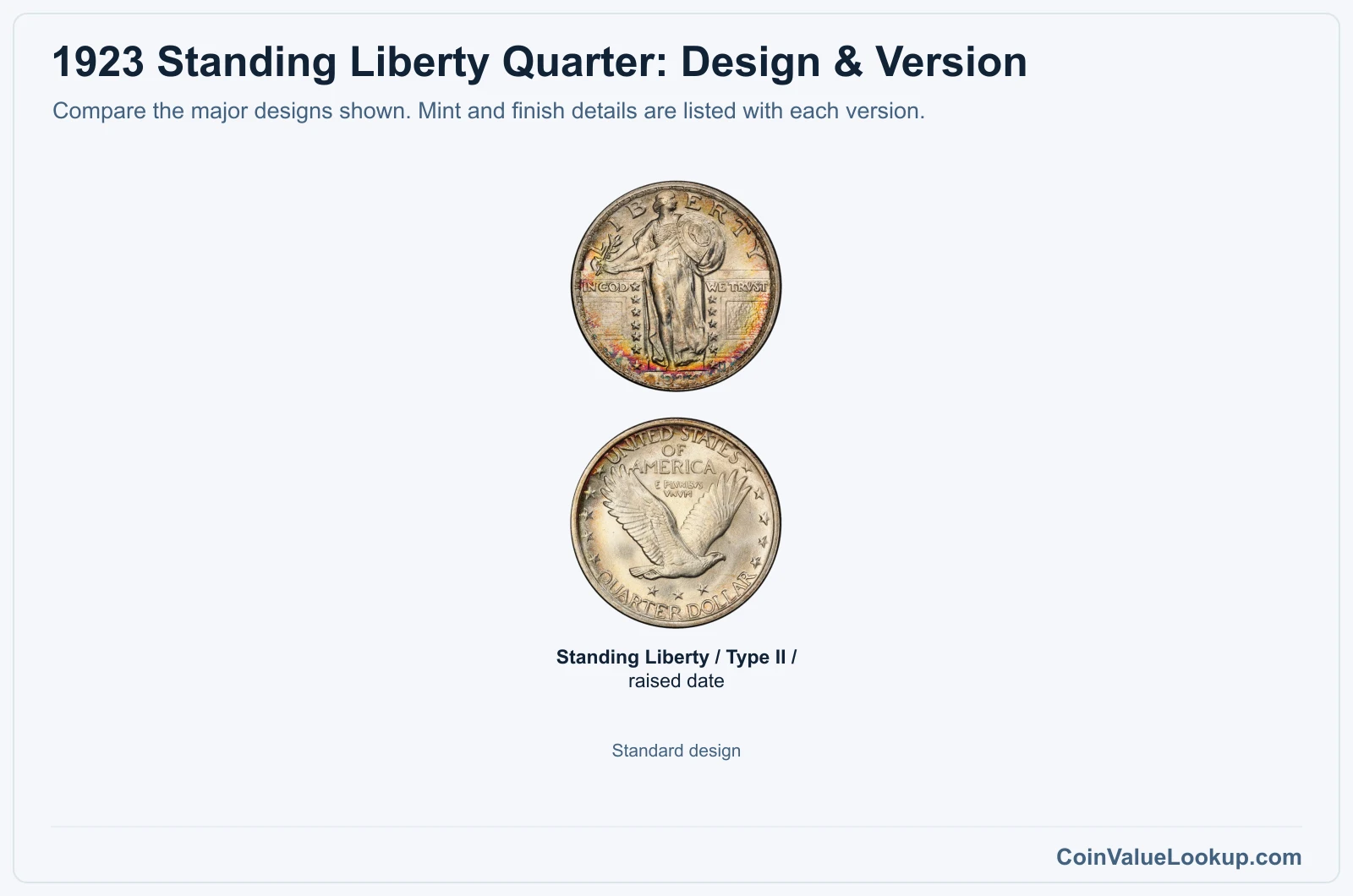
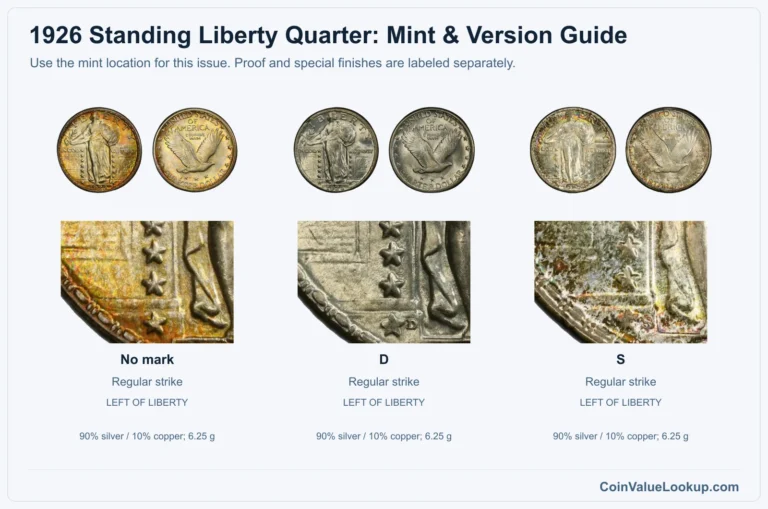
Two versions exist for this year: the 1923 (Philadelphia) and the 1923-S (San Francisco). Philadelphia coins carry no mintmark at all.
On the 1923-S, a small "S" appears on the obverse near the left base of the wall where Liberty stands.
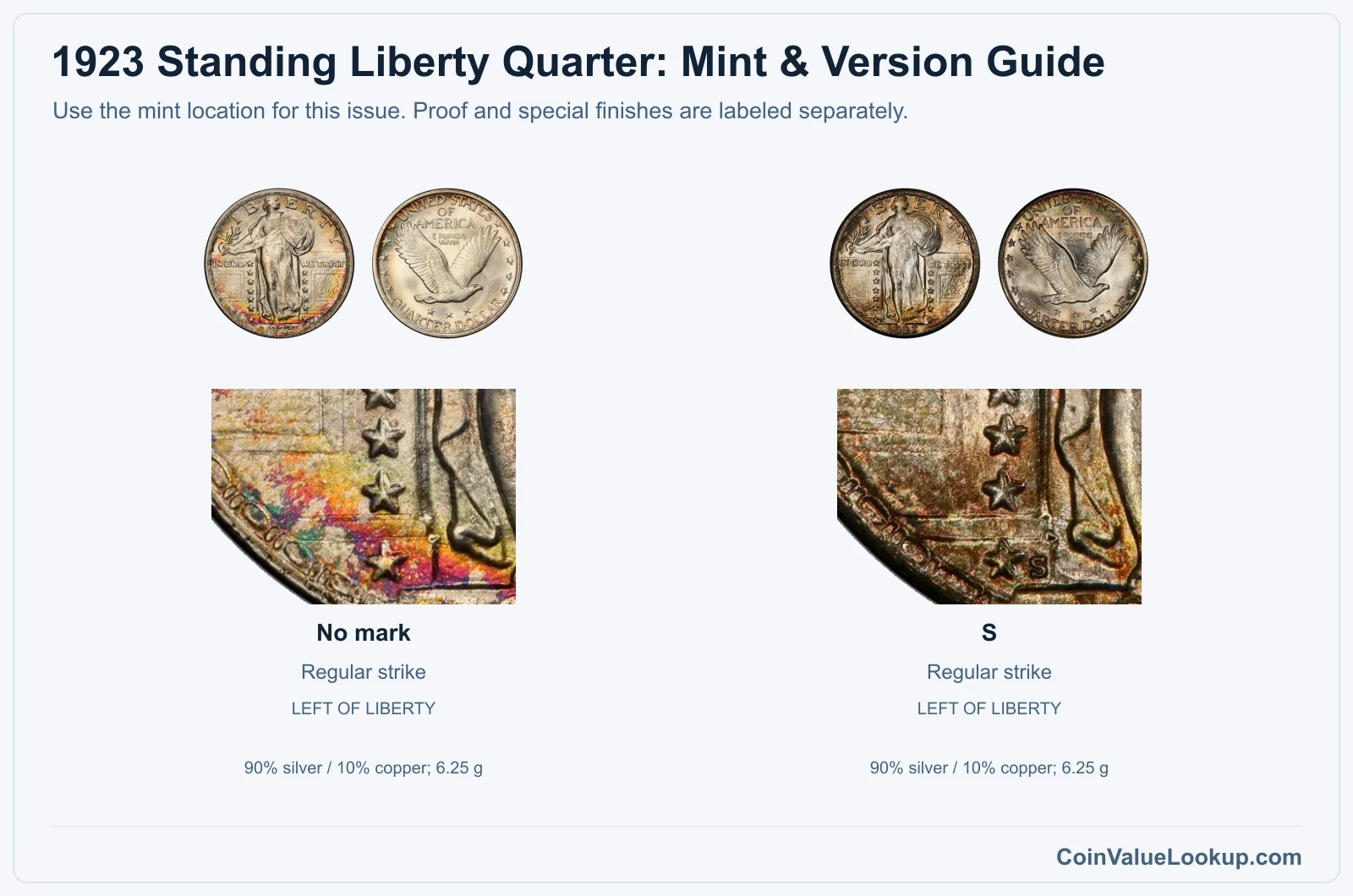
Both are Type II Standing Liberty Quarters, which means Liberty wears a coat of protective chain mail on her chest and three small stars appear beneath the eagle on the reverse. If you see an exposed breast and no stars below the eagle, you have a Type I from an earlier year — not a 1923.
The date on both 1923 versions is raised, not recessed. The recessed-date change came in 1925 to reduce date wear.
Each coin weighs 6.25 grams and is struck in 90% silver with 10% copper.
Step 2: Check Your 1923 Standing Liberty Quarter Grade
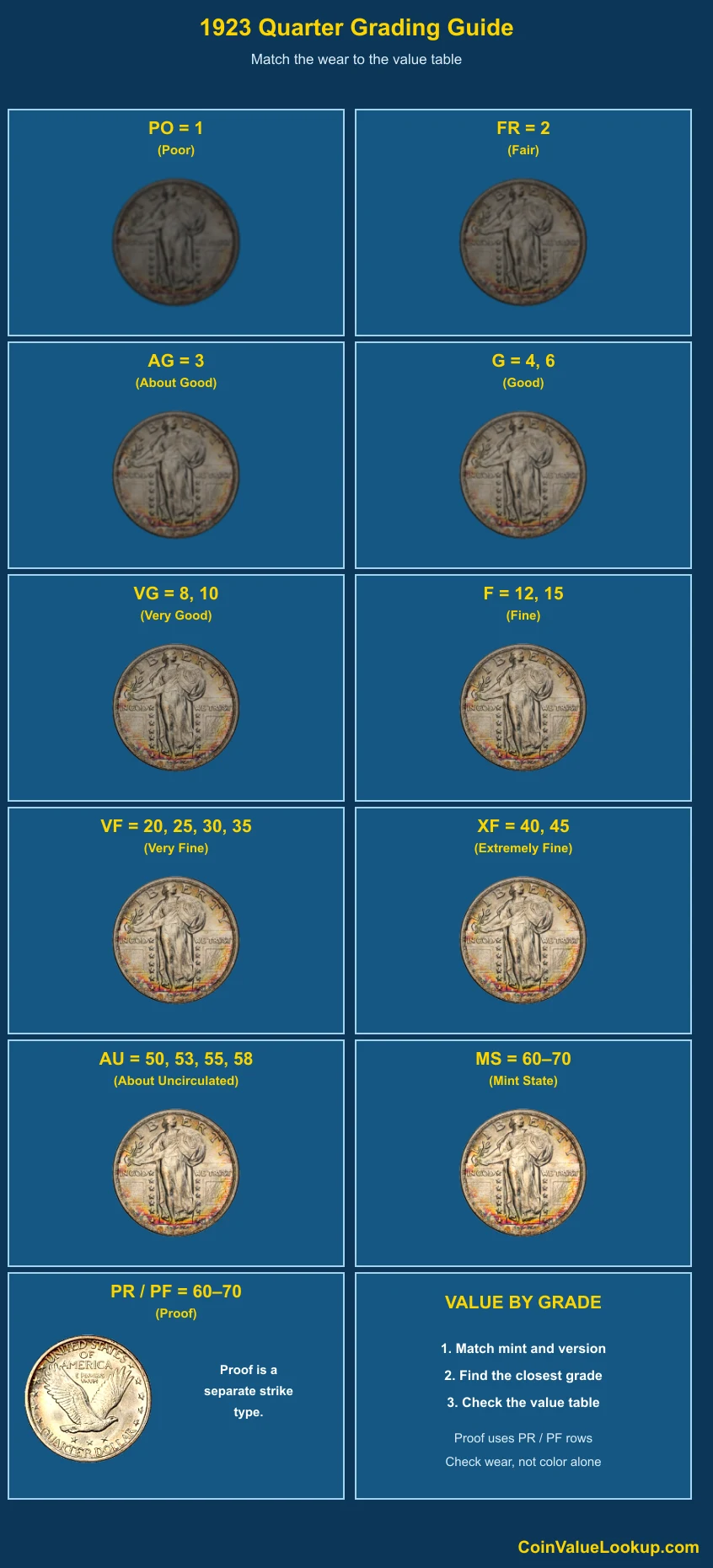
Start by checking Liberty's head — the hair detail, especially above her forehead, is the first area to lose definition from circulation. Then look at her breast area (under the chain mail), the central shield and her forward knee.
On the reverse, the eagle's breast feathers and wing tips show wear early.
Compare your coin against the grading comparison image to match it with a grade. A coin in Good-4 shape will have a flat silhouette with little interior detail.
Mint State coins retain full luster across the fields with no wear on the high points.
Don't confuse strike quality with grade. A weakly struck coin can look worn even if it never circulated.
"Full Head" is a designation for strike sharpness — three full leaves visible in Liberty's headband — and is separate from the overall grade. Likewise, a bright coin is not automatically uncirculated; heavy cleaning removes original surfaces and typically reduces value.
Step 3: Check 1923 Standing Liberty Quarter Value by Mint and Version
1923 Standing Liberty Quarter
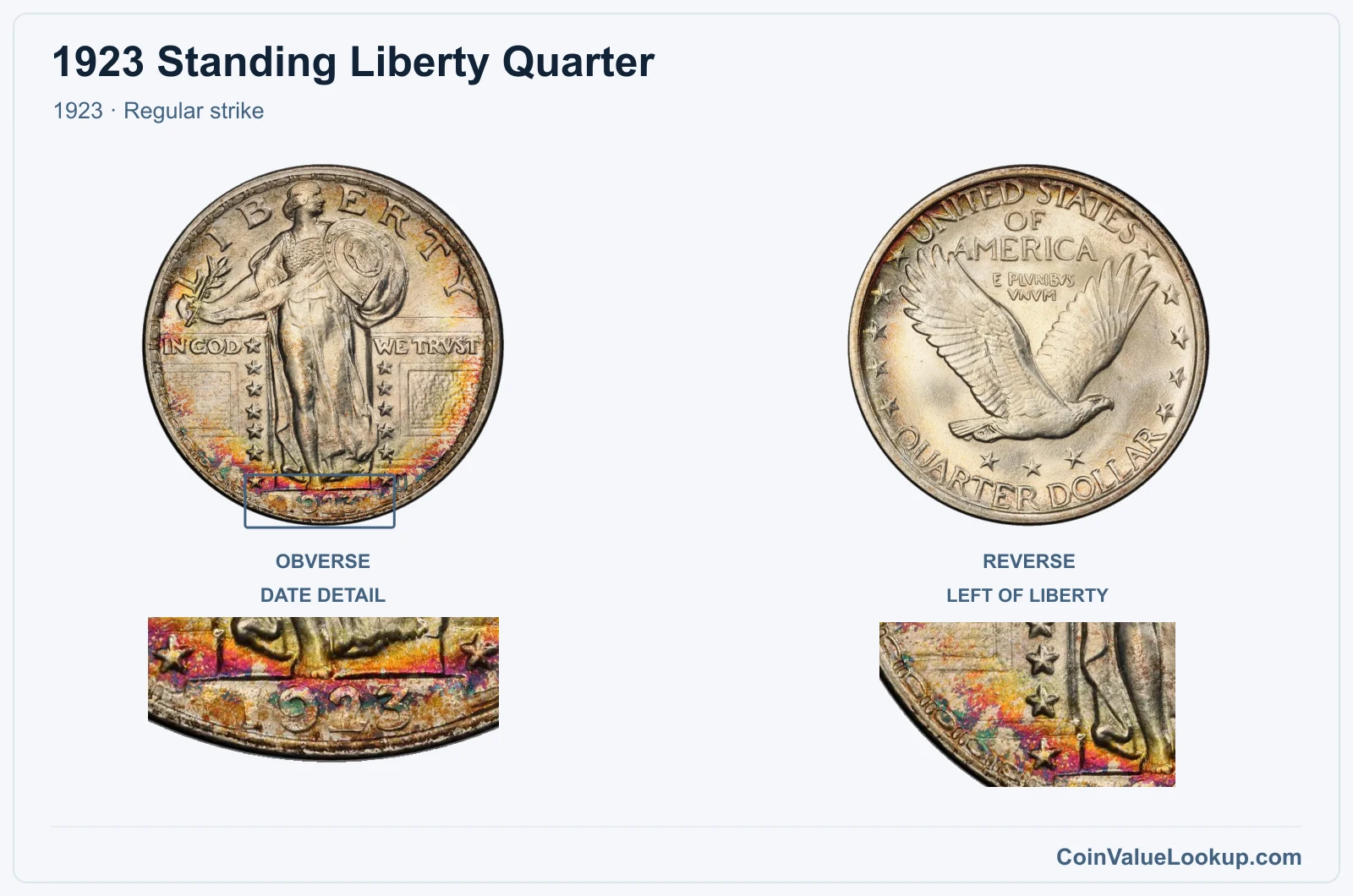
The 1923 Philadelphia quarter has no mintmark. It is a Type II Standing Liberty design with a raised date, chain mail on Liberty's chest and three stars below the eagle on the reverse.
This is the more common of the two 1923 issues and trades for considerably less than its San Francisco sibling.
USA Coin Book guide estimates place this version at about $23.00 in G4, $194.00 in MS60 and $321.00 in MS63. These are guide estimates, not guaranteed sale prices.
Before comparing grades, confirm you have original surfaces — coins that have been cleaned, scratched or damaged typically fall below guide figures regardless of the detail remaining.
Coin Value Lookup is a handy starting point if you want to look up other dates or denominations in this series while you research your coin.
Range Grade
Price Auction Records Appraisal PO PO 1
—
Coin Identifier FR FR 2
—
Coin Identifier AG AG 3
—
Coin Identifier G G 4
—
Coin Identifier
G 6
—
Coin Identifier VG VG 8
—
Coin Identifier
VG 10
—
Coin Identifier F F 12
Coin Identifier
F 15
Coin Identifier VF VF 20
—
Coin Identifier
VF 25
Coin Identifier
VF 30
—
Coin Identifier
VF 35
—
Coin Identifier XF XF 40
Coin Identifier
XF 45
Coin Identifier AU AU 50
Coin Identifier
AU 53
Coin Identifier
AU 55
Coin Identifier
AU 58
Coin Identifier MS MS 60
—
Coin Identifier
MS 61
Coin Identifier
MS 62
Coin Identifier
MS 63
Coin Identifier
MS 64
Coin Identifier
MS 65
Coin Identifier
MS 66
Coin Identifier
MS 67
Coin Identifier
MS 68
—
—
—
MS 69
—
—
—
MS 70
—
—
—
1923 Standing Liberty Quarter — S
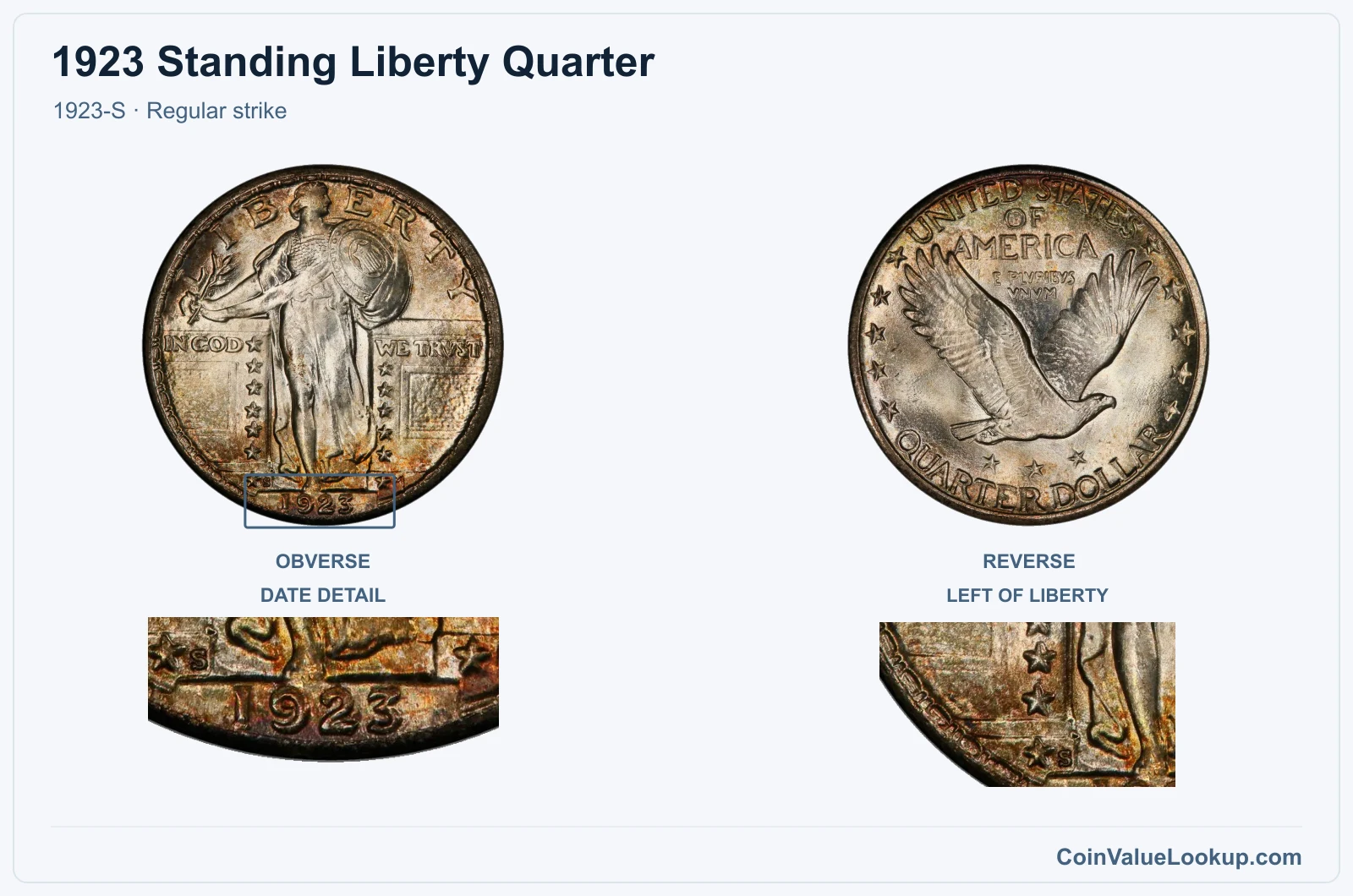
The 1923-S carries a small "S" mintmark on the obverse, near the left base of the wall. Same Type II design, same raised date, same 90% silver composition at 6.25 grams — but a much tougher coin to find in decent shape.
USA Coin Book guide estimates for the 1923-S run $321.00 at G4, $3,094.00 at MS60 and $4,079.00 at MS63. Even a well-worn example holds meaningful value.
That steep jump from circulated to uncirculated grades reflects how few survive with original surfaces and strong strikes.
Match the mintmark carefully — a corroded or damaged area near the base of the wall can sometimes be misread. Cleaning or environmental damage will pull the coin below these guide figures, and Full Head designation applies only if the strike was strong enough to show three complete leaves in Liberty's headband.
Range Grade
Price Auction Records Appraisal PO PO 1
—
Coin Identifier FR FR 2
—
Coin Identifier AG AG 3
Coin Identifier G G 4
Coin Identifier
G 6
Coin Identifier VG VG 8
Coin Identifier
VG 10
Coin Identifier F F 12
Coin Identifier
F 15
Coin Identifier VF VF 20
Coin Identifier
VF 25
Coin Identifier
VF 30
Coin Identifier
VF 35
Coin Identifier XF XF 40
Coin Identifier
XF 45
Coin Identifier AU AU 50
Coin Identifier
AU 53
Coin Identifier
AU 55
Coin Identifier
AU 58
Coin Identifier MS MS 60
—
Coin Identifier
MS 61
Coin Identifier
MS 62
Coin Identifier
MS 63
Coin Identifier
MS 64
Coin Identifier
MS 65
Coin Identifier
MS 66
Coin Identifier
MS 67
Coin Identifier
MS 68
—
—
—
MS 69
—
—
—
MS 70
—
—
—
1923 Standing Liberty Quarter Error List
1. 1923 Standing Liberty Quarter — Clashed Dies
A die clash happens when the obverse and reverse dies strike each other without a planchet between them. The result is ghostly traces of the opposite design impressed into each die, which then transfer onto every coin struck afterward.
On a 1923 Standing Liberty Quarter, look for faint outlines of the eagle on Liberty's side or traces of Liberty's figure on the eagle side, positioned where the opposing design would naturally align.
These marks differ from random scratches or contact marks because they follow the geometry of the opposite die. Scratches go in arbitrary directions, while clashed impressions mirror the expected opposing design elements.
No specific price data is available for this variety; value depends on how visible the clash is, overall coin condition and collector demand for the particular die pair.
2. 1923 Standing Liberty Quarter — Lamination / Split Planchet
Lamination errors occur when the planchet metal separates internally, creating a peeling flap, a missing layer or a visible crack within the alloy itself. On a 1923 Standing Liberty Quarter, this can appear as a thin strip of silver lifting away from the surface or a shallow void where metal has broken off.
To document one properly, photograph both the affected face and the coin's edge together — the separation often extends through the rim. This distinguishes a genuine lamination from surface corrosion, deliberate scraping or a coin that someone physically cut.
Corrosion tends to be pitted and uneven, while a lamination follows the internal structure of the metal.
No specific price data is available. Value depends on the size, visibility and location of the flaw, plus the coin's overall condition.
3. 1923 Standing Liberty Quarter — Off-Center Strike
An off-center strike occurs when the planchet is not seated properly between the dies, shifting the entire design to one side and leaving a blank crescent on the opposite edge. This error has been reported for the 1923-S Standing Liberty Quarter specifically.
The key diagnostic is that unstruck crescent — it should be smooth and uniform, not jagged or filed. A clipped planchet creates a curved bite from the blank stage, while post-mint flattening produces uneven distortion.
One-sided die misalignment can look similar but usually keeps the full rim intact on one side.
The date must remain visible for the coin to be attributed to 1923, which directly affects collectibility. No adopted price data is available; value depends on the percentage off-center, date visibility and the coin's preservation.
4. 1923 Standing Liberty Quarter — Doubled Die Obverse
A doubled die obverse on a 1923 Standing Liberty Quarter shows consistent doubling on obverse design elements — letters, the date or parts of Liberty's figure. The doubling results from a misaligned hub impression during die production, so it appears uniform across every coin from that die.
To spot it, compare your coin's obverse lettering and design elements with a normal 1923 quarter under the same lighting. Look for clear separation or notching on letter edges rather than a flat, shelf-like distortion.
Machine doubling — caused by die bounce during striking — tends to produce flat, shelflike shadows and is far less collectible.
Reflections or worn die contours can also mimic doubling, so tilt the coin under a single light source. No adopted price is available for this variety; value hinges on the strength and location of the doubling and overall coin condition.
5. 1923 Standing Liberty Quarter — Die Crack / Die Chip
Die cracks and die chips show up as raised lines or small raised blobs on the coin's surface. They come from fractures in the steel die, which fill with metal during striking.
On a 1923 Standing Liberty Quarter, look for thin raised lines running across the fields or through design elements, or small raised lumps (chips) where a piece of the die surface broke away.
A crack that connects to the rim and produces a larger raised blob is called a cud — these tend to draw more collector interest. Interior die chips are smaller and more common.
Both are raised above the surface, which separates them from incuse scratches, corrosion pitting or foreign material stuck to the coin.
No specific price data is available. Value depends on the size and prominence of the crack or chip, its location on the design and the coin's overall grade.