1938 Washington Quarter Coin Value: How Much Is It Worth?
A 1938 Washington quarter is a 90% silver coin that carries real value even in well-worn condition. Circulated examples from either mint start around $16.43 in Good-4 condition, while uncirculated pieces graded MS65 can reach roughly $202 to $247 depending on the mint.
Philadelphia proofs from this year carry a separate premium, with PR65 examples estimated near $290. There was no Denver mint issue for 1938, so you are looking at Philadelphia or San Francisco strikes, plus Philadelphia proofs.
Fast Way to Identify Your 1938 Washington Quarter
Want a quick read on what you have? Upload clear photos of the front and back of your 1938 quarter, and our identifier can offer a preliminary take on which mint and version you are holding.
It is not a substitute for professional authentication or certified grading, but it is a solid starting point before you dig deeper.
1938 Washington Quarter Value
Upload both sides of your 1938 Washington Quarter.
Front Obverse
Upload photo
Back Reverse
Upload photo
Which 1938 Washington Quarter Versions Are Worth Money?
- The 1938 Philadelphia business strike in MS65 is estimated around $247 by a published guide, reflecting the jump from circulated to fully original uncirculated surfaces.
- The 1938 Proof, struck only at Philadelphia with mirror-like fields, is estimated near $290 in PR65, a distinct collectible separate from regular strikes.
- The 1938-S San Francisco issue in MS65 is estimated around $202, and even circulated examples carry a base silver-content floor.
- A Doubled Die Obverse variety exists on the 1938 Philadelphia quarter, with doubling visible on IN GOD WE TRUST, and authenticated examples require individual assessment for value.
Step 1: Identify Your 1938 Washington Quarter Mint Mark and Version
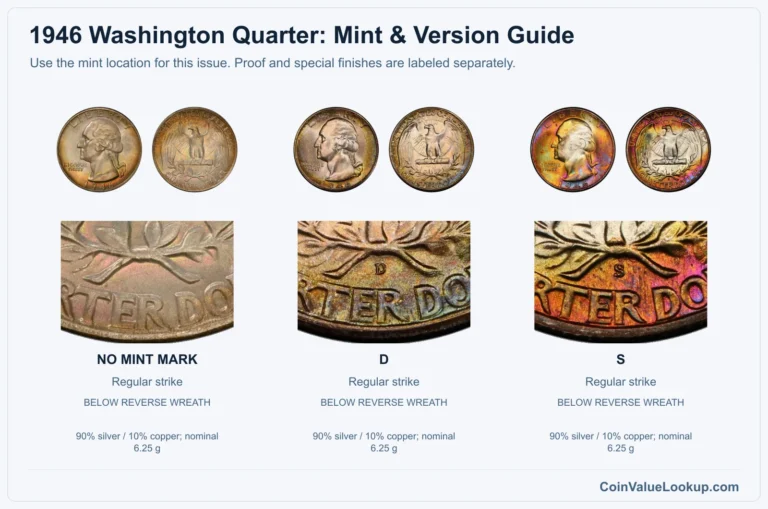
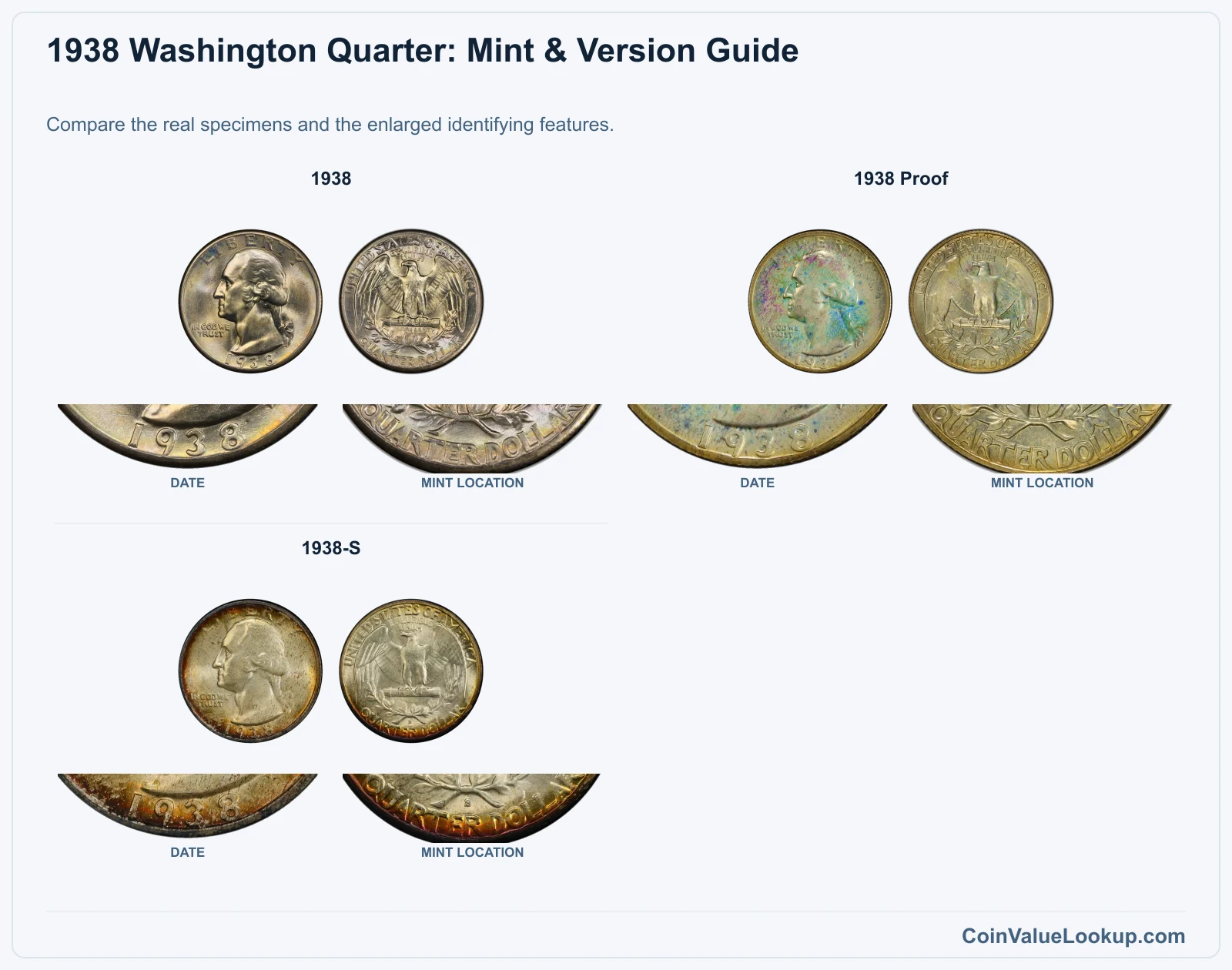
Start with the date on the obverse, which should read 1938. Then flip the coin over and look just below the wreath tie on the reverse.
If you see a small "S" there, you have the San Francisco issue. If that spot is blank, it is a Philadelphia strike.
There is no Denver mintmark for 1938. A blank mintmark area is completely normal for Philadelphia coins of this era, not a sign of an error or omission.
The coin should be 90% silver and 10% copper, weigh about 6.25 grams, and measure roughly 24.3 mm across. Check the edge: it should be reeded with no copper-colored stripe visible.
If you see a sandwich of layers, you are looking at a later clad quarter, not a 1938 silver issue.
Step 2: Check Your 1938 Washington Quarter Grade
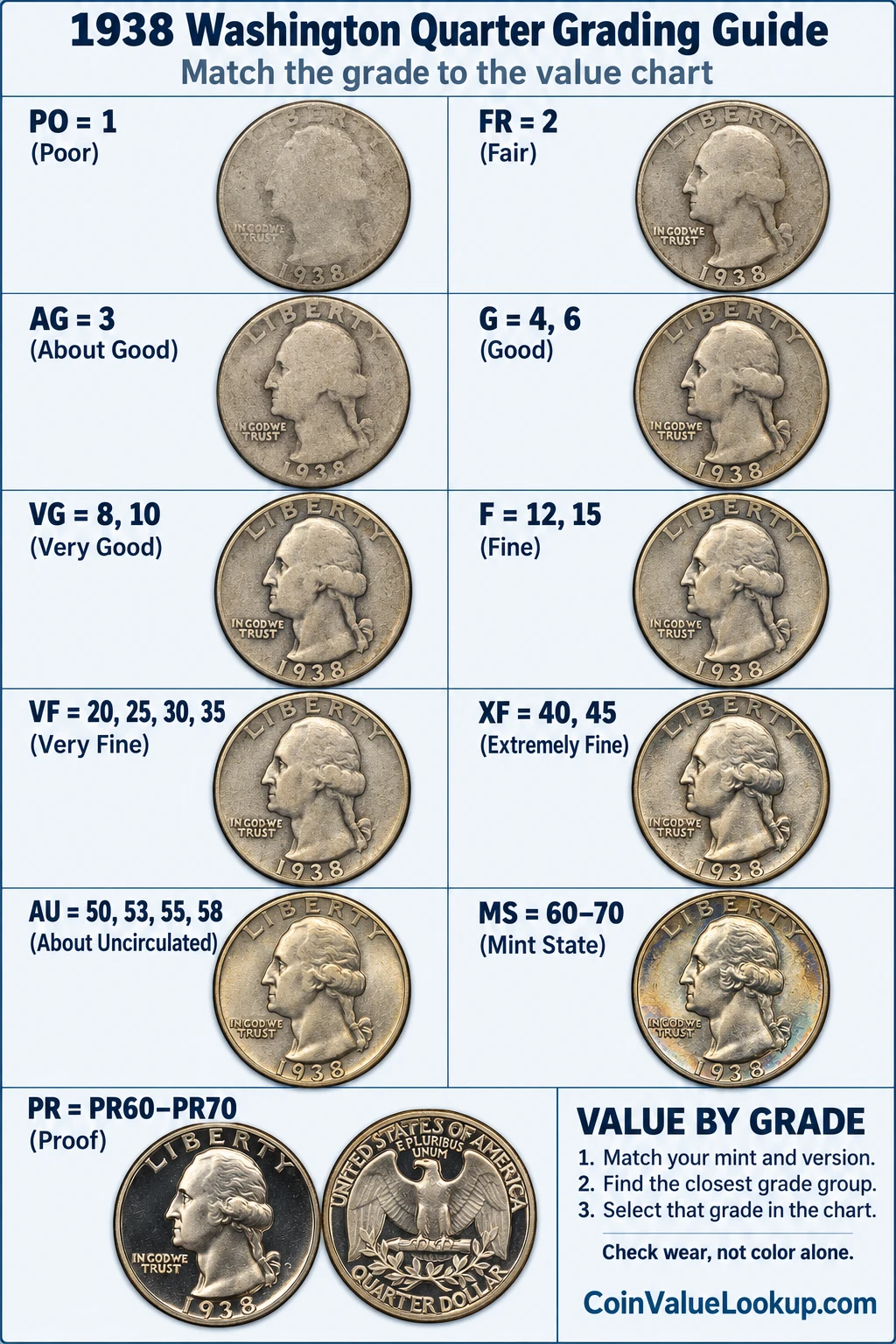
Focus on the hair detail above Washington's ear first. On a lightly worn coin, the individual strands begin to merge and the luster breaks up there before anywhere else.
The cheek and jawline flatten next, so compare those areas against the reference image.
On the reverse, examine the eagle's breast feathers and the tops of the wings. These high points lose definition in lockstep with the obverse wear.
Do not confuse a weakly struck coin with a worn one. A weak strike looks soft but retains original mint luster in the flat areas, while genuine wear interrupts that luster and leaves smooth, slightly darker metal.
Hairlines from cleaning, rim nicks, and artificial shine can all fool you into overgrading, so look carefully before assuming a high grade from brightness alone.
Step 3: Check 1938 Washington Quarter Value by Mint and Version
1938 Washington Quarter
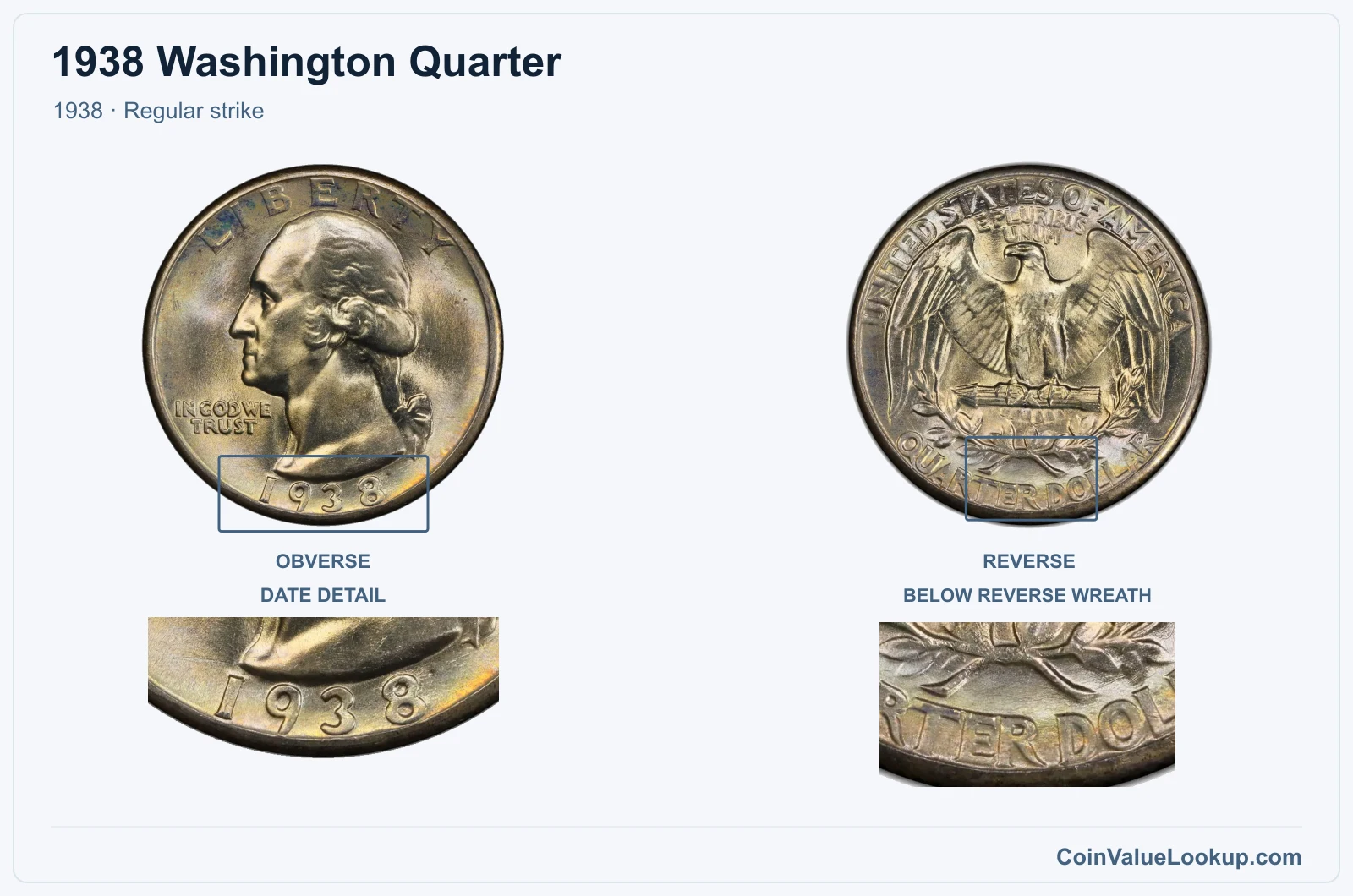
The 1938 Philadelphia quarter carries no mintmark. Look below the wreath on the reverse and confirm that spot is blank.
Production was lower than many surrounding years, but that alone does not make every circulated piece a standout rarity.
In G4 condition, guide estimates place this coin around $16.43. Jump to MS60 and you are looking at roughly $131.
A fully original MS65 example is estimated near $247 by USA Coin Book. The big value gap between circulated and uncirculated tells you that preserving original surfaces matters far more than simply owning one.
| Range | Grade | Price | Auction Records | Appraisal |
|---|---|---|---|---|
| PO | PO 1 | — | Coin Identifier | |
| FR | FR 2 | — | Coin Identifier | |
| AG | AG 3 | — | Coin Identifier | |
| G | G 4 | — | Coin Identifier | |
| G 6 | — | Coin Identifier | ||
| VG | VG 8 | — | Coin Identifier | |
| VG 10 | — | Coin Identifier | ||
| F | F 12 | — | Coin Identifier | |
| F 15 | — | Coin Identifier | ||
| VF | VF 20 | — | Coin Identifier | |
| VF 25 | — | Coin Identifier | ||
| VF 30 | — | Coin Identifier | ||
| VF 35 | — | Coin Identifier | ||
| XF | XF 40 | — | Coin Identifier | |
| XF 45 | — | Coin Identifier | ||
| AU | AU 50 | — | Coin Identifier | |
| AU 53 | — | Coin Identifier | ||
| AU 55 | Coin Identifier | |||
| AU 58 | Coin Identifier | |||
| MS | MS 60 | — | Coin Identifier | |
| MS 61 | — | Coin Identifier | ||
| MS 62 | Coin Identifier | |||
| MS 63 | Coin Identifier | |||
| MS 64 | Coin Identifier | |||
| MS 65 | Coin Identifier | |||
| MS 66 | Coin Identifier | |||
| MS 67 | Coin Identifier | |||
| MS 68 | Coin Identifier | |||
| MS 69 | — | — | — | |
| MS 70 | — | — | — |
1938 Washington Quarter — Proof
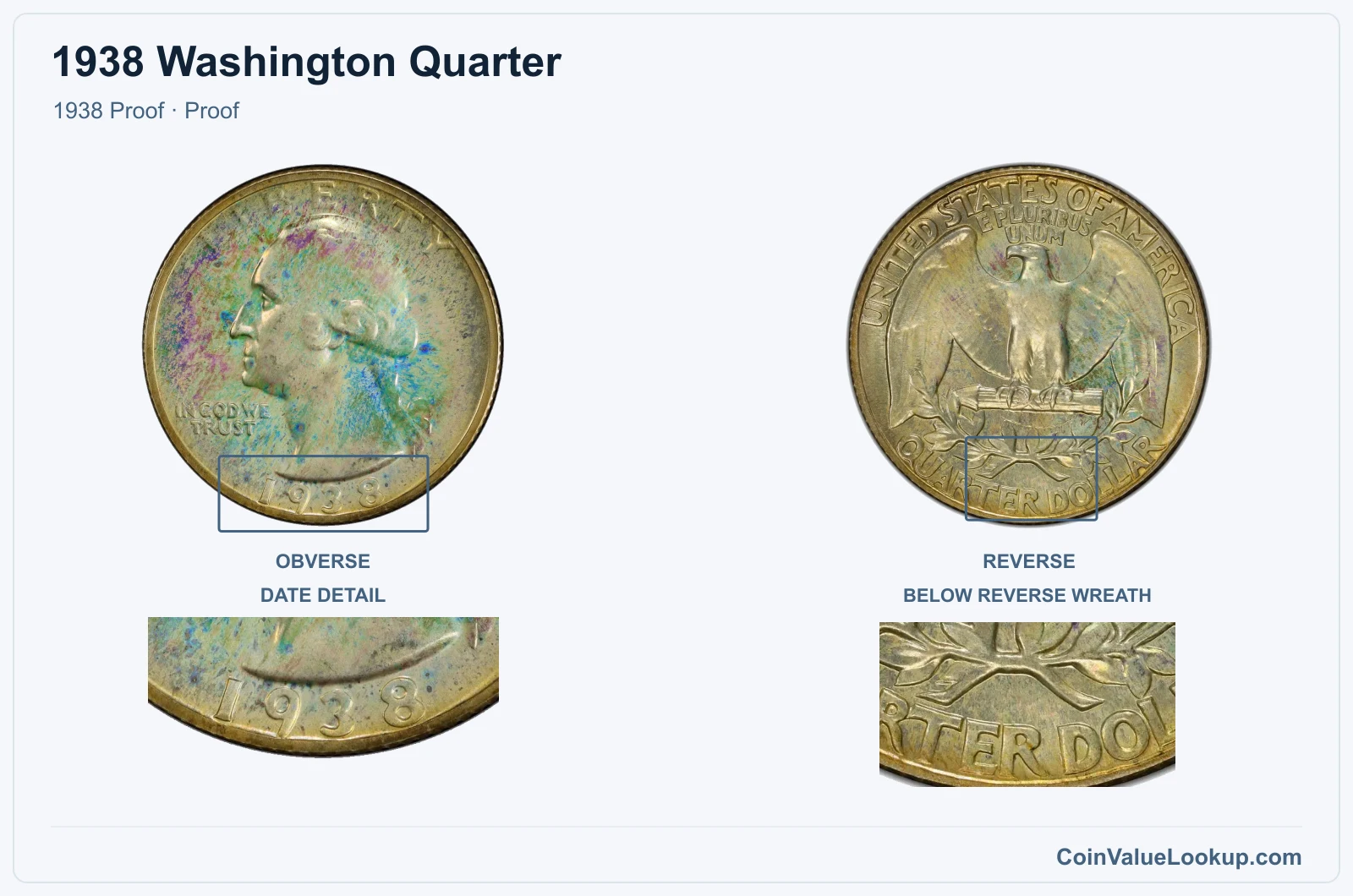
Philadelphia also produced proof quarters in 1938. These were struck with polished dies on polished planchets, producing mirror-like fields and crisp, fully struck detail that business strikes rarely match.
A proof is a method of manufacture, not a grade above Mint State.
In PR65, a published guide estimate sits around $290. That is a meaningful premium over even a high-grade business strike from the same mint.
Be careful: a cleaned or polished circulation coin can look shiny, but it lacks the deep, liquid reflectivity of genuine proof surfaces. If your coin spent time in a pocket or a register, it is not a proof regardless of how much it gleams.
Coin Value Lookup is a good place to start if you want to compare this proof against values for other years in the Washington quarter series.
| Range | Grade | Price | Auction Records | Appraisal |
|---|---|---|---|---|
| PR | PR 1 | — | Coin Identifier | |
| PR 2 | — | Coin Identifier | ||
| PR 3 | — | Coin Identifier | ||
| PR 4 | — | Coin Identifier | ||
| PR 6 | — | Coin Identifier | ||
| PR 8 | — | Coin Identifier | ||
| PR 10 | — | Coin Identifier | ||
| PR 12 | — | Coin Identifier | ||
| PR 15 | — | Coin Identifier | ||
| PR 20 | — | Coin Identifier | ||
| PR 25 | — | Coin Identifier | ||
| PR 30 | — | Coin Identifier | ||
| PR 35 | — | Coin Identifier | ||
| PR 40 | — | Coin Identifier | ||
| PR 45 | — | Coin Identifier | ||
| PR 50 | — | Coin Identifier | ||
| PR 53 | — | Coin Identifier | ||
| PR 55 | — | Coin Identifier | ||
| PR 58 | — | Coin Identifier | ||
| PR 60 | Coin Identifier | |||
| PR 61 | Coin Identifier | |||
| PR 62 | Coin Identifier | |||
| PR 63 | Coin Identifier | |||
| PR 64 | Coin Identifier | |||
| PR 65 | Coin Identifier | |||
| PR 66 | Coin Identifier | |||
| PR 67 | Coin Identifier | |||
| PR 68 | Coin Identifier | |||
| PR 69 | — | — | — | |
| PR 70 | — | — | — |
1938 Washington Quarter — S
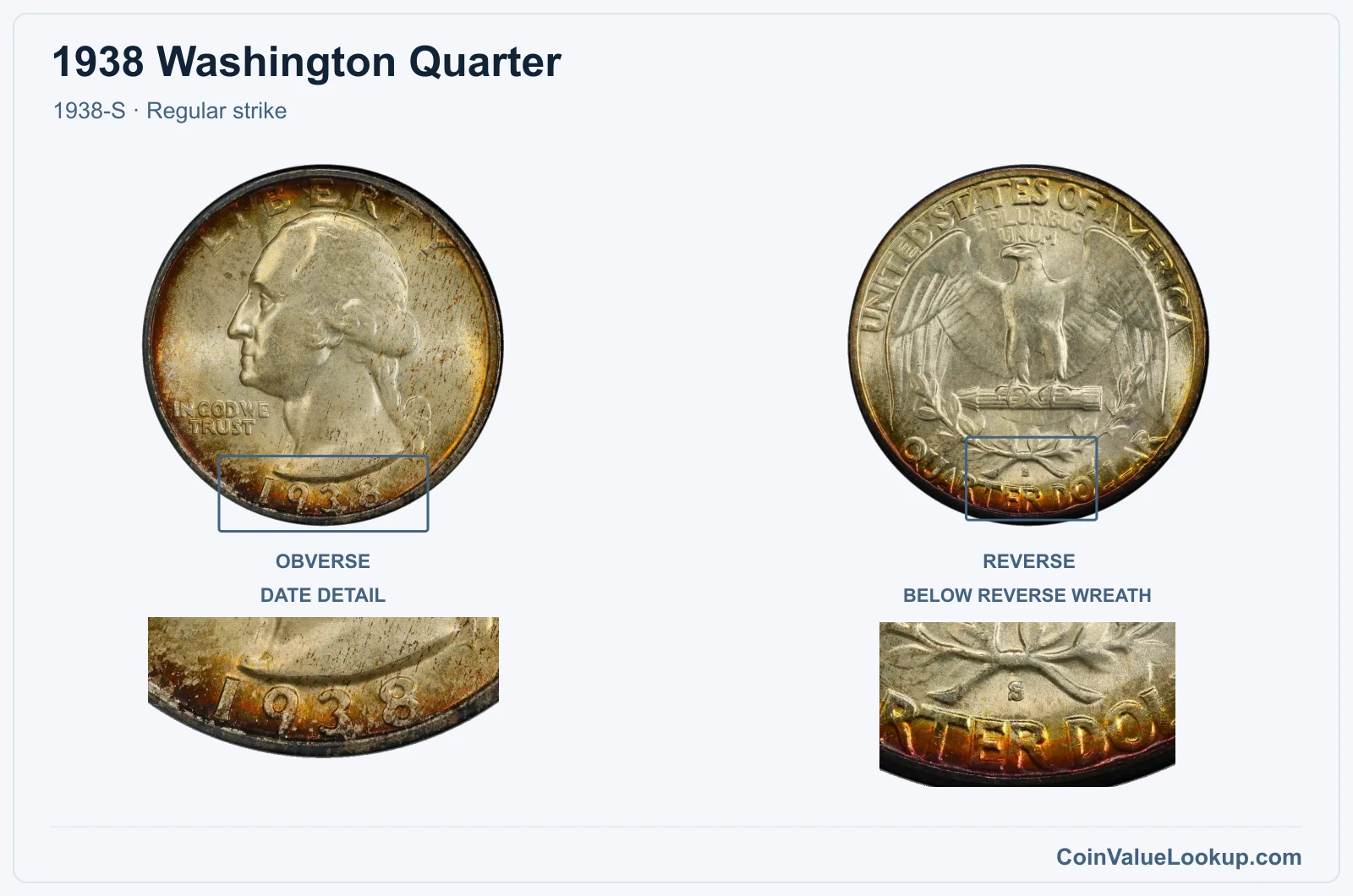
The 1938-S is the San Francisco business strike, identifiable by the small "S" mintmark sitting just below the wreath bow on the reverse. If you need a loupe to see it, that is normal; these mintmarks were not meant to be billboard-sized.
Guide estimates from USA Coin Book put a G4 example at about $16.43, an MS60 at roughly $140, and an MS65 around $202. The MS65 figure is a bit lower than the Philadelphia business strike in the same grade, so mint identity matters when you are comparing values.
All 1938 quarters carry the 90% silver baseline, which provides a floor even for heavily worn coins.
| Range | Grade | Price | Auction Records | Appraisal |
|---|---|---|---|---|
| PO | PO 1 | — | Coin Identifier | |
| FR | FR 2 | — | Coin Identifier | |
| AG | AG 3 | — | Coin Identifier | |
| G | G 4 | — | Coin Identifier | |
| G 6 | — | Coin Identifier | ||
| VG | VG 8 | — | Coin Identifier | |
| VG 10 | — | Coin Identifier | ||
| F | F 12 | — | Coin Identifier | |
| F 15 | — | Coin Identifier | ||
| VF | VF 20 | — | Coin Identifier | |
| VF 25 | — | Coin Identifier | ||
| VF 30 | — | Coin Identifier | ||
| VF 35 | — | Coin Identifier | ||
| XF | XF 40 | — | Coin Identifier | |
| XF 45 | — | Coin Identifier | ||
| AU | AU 50 | — | Coin Identifier | |
| AU 53 | — | Coin Identifier | ||
| AU 55 | Coin Identifier | |||
| AU 58 | Coin Identifier | |||
| MS | MS 60 | — | Coin Identifier | |
| MS 61 | — | Coin Identifier | ||
| MS 62 | Coin Identifier | |||
| MS 63 | Coin Identifier | |||
| MS 64 | Coin Identifier | |||
| MS 65 | Coin Identifier | |||
| MS 66 | Coin Identifier | |||
| MS 67 | Coin Identifier | |||
| MS 68 | — | — | — | |
| MS 69 | — | — | — | |
| MS 70 | — | — | — |
1938 Washington Quarter Error List
1. 1938 Washington Quarter — Doubled Die Obverse
NGC identifies a Doubled Die Obverse on the 1938 Philadelphia quarter. The doubling is visible on the motto IN GOD WE TRUST.
To check for it, use magnification and look for raised, duplicated lettering on those words. Genuine die doubling produces a second set of raised relief that is part of the die impression itself, not a flat shelf or smear.
The most common lookalike is machine doubling, which leaves flat, shelf-like distortions without true raised secondary relief. Wear, scratches, and post-strike damage can also mimic doubling at a glance, so compare your coin against a known normal example under the same lighting.
No specific price range is adopted for this variety. Value depends on authenticated identity, the severity of the doubling, and the coin's overall condition, so individual assessment by a professional grading service is the practical path if you believe you have one.