1959 Washington Quarter Coin Value: How Much Is It Worth?
A 1959 Washington quarter is a 90% silver coin worth at least around $16.43 in well-worn grades, based on USA Coin Book guide estimates. Mint State examples from Philadelphia or Denver top out around $34 at the MS65 level for ordinary business strikes.
Proofs, the scarce Type B reverse variety, and authenticated mint errors fall outside that ordinary range and can be worth considerably more. All values depend on condition, version, and the coin's silver content, which fluctuates with the metal market.
Fast Way to Identify Your 1959 Washington Quarter
The quickest way to start figuring out what you have is to upload clear photos of both sides of your 1959 quarter. Snap the front and back under even lighting, avoiding glare on the fields.
Our identifier can provide a preliminary identification of your coin's version and general condition from those images, helping you decide whether closer inspection or professional grading is worthwhile.
1959 Washington Quarter Value
Upload both sides of your 1959 Washington Quarter.
Front Obverse
Upload photo
Back Reverse
Upload photo
Which 1959 Washington Quarter Versions Are Worth Money?
- The 1959 Type B reverse is a Philadelphia circulation strike with a proof-style reverse hub, identifiable by separated E and S in STATES; a Heritage example sold for $900 at MS66+ in February 2018.
- A 1959 Philadelphia quarter struck on a nickel planchet brought $805 in MS65 at Heritage in March 2006, making wrong-planchet errors among the most dramatic finds for this date.
- High-grade MS65 business strikes from either Philadelphia or Denver carry a guide value around $34, well above the melt value of worn examples.
- Proof issues in PR65 condition carry a guide estimate of about $26, and cameo or deep cameo contrast can affect desirability separately.
- A double-struck example with a second strike roughly 60% off-center is archived by Heritage in PCGS MS63; such dramatic multi-strike errors are scarce for any date.
Step 1: Identify Your 1959 Washington Quarter Mint Mark and Version
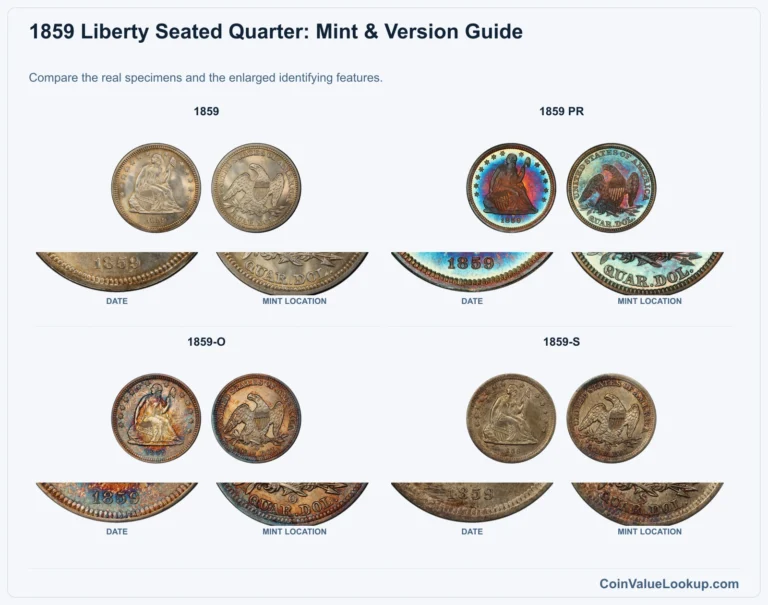
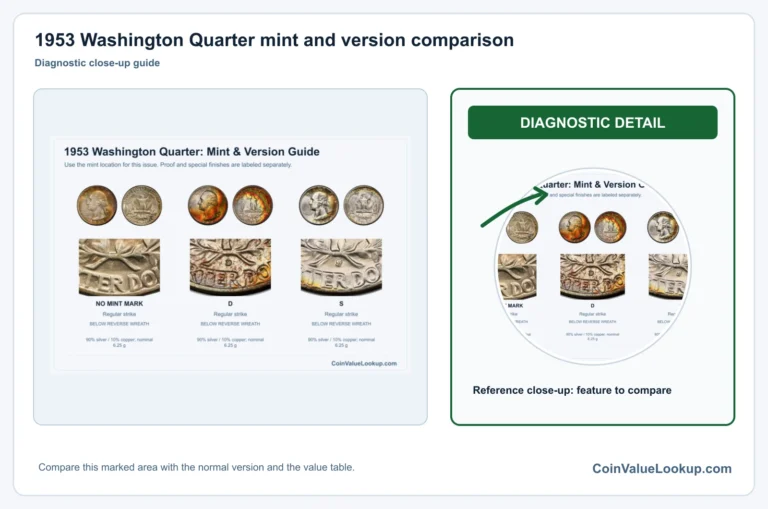
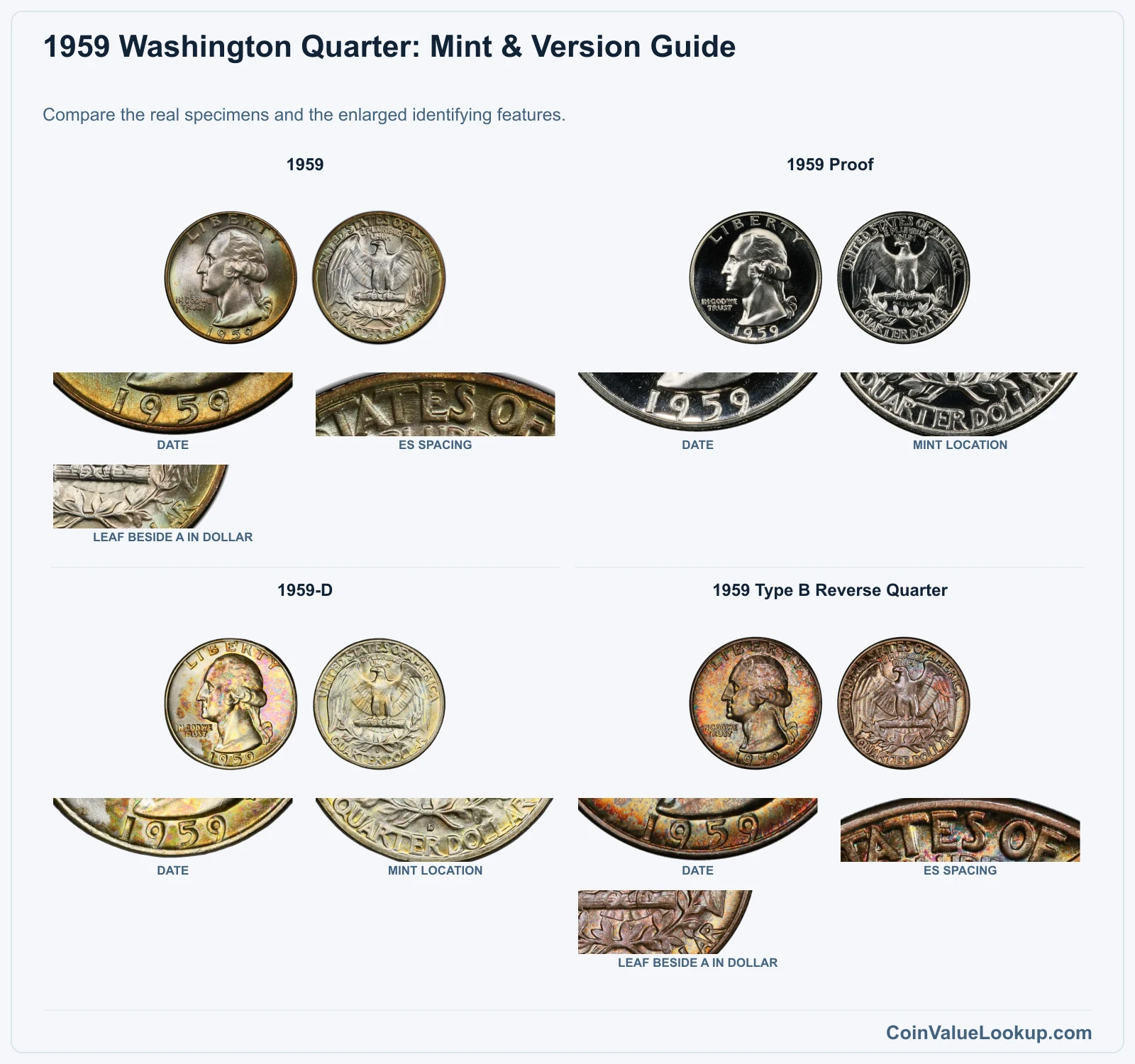
Look at the obverse for the date, 1959, below Washington's bust. Flip the coin and check directly below the wreath on the reverse for a small "D" mintmark.
If there is no letter there, your coin was struck in Philadelphia. That blank space is normal for Philly quarters of this era.
Every standard 1959 quarter is 90% silver and 10% copper, weighing about 6.25 grams and measuring roughly 24.3 mm across. This applies to business strikes and proofs alike.
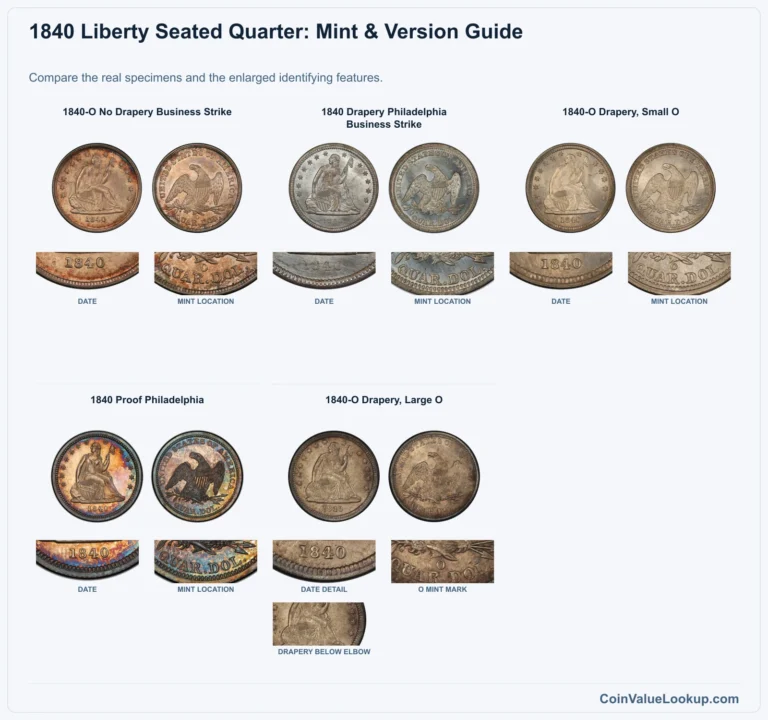
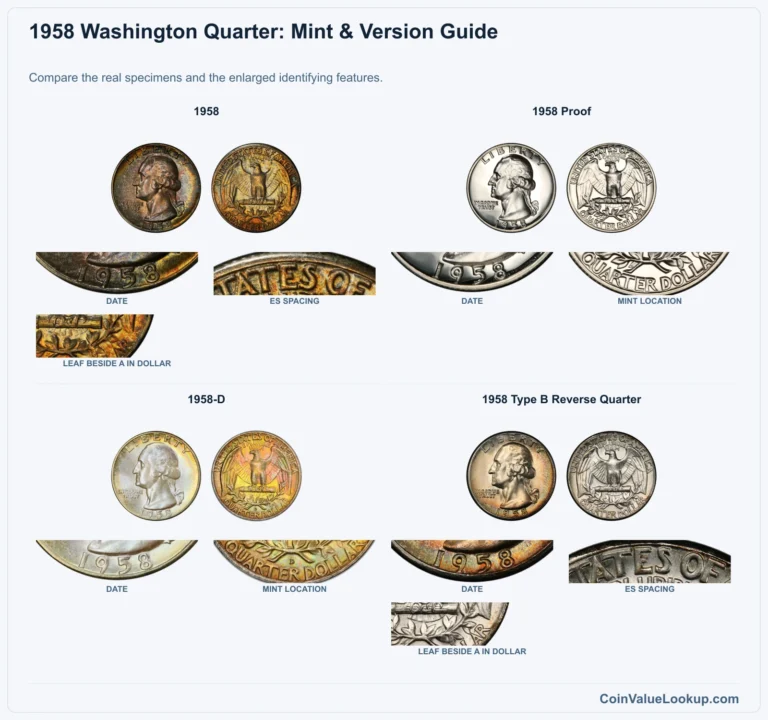
There are four main versions to sort out. Philadelphia and Denver business strikes are the common ones.
Philadelphia also produced proof coins with mirrored fields, typically sold in proof sets. The fourth version is the Type B reverse, a Philadelphia circulation strike that used a proof-style reverse hub.
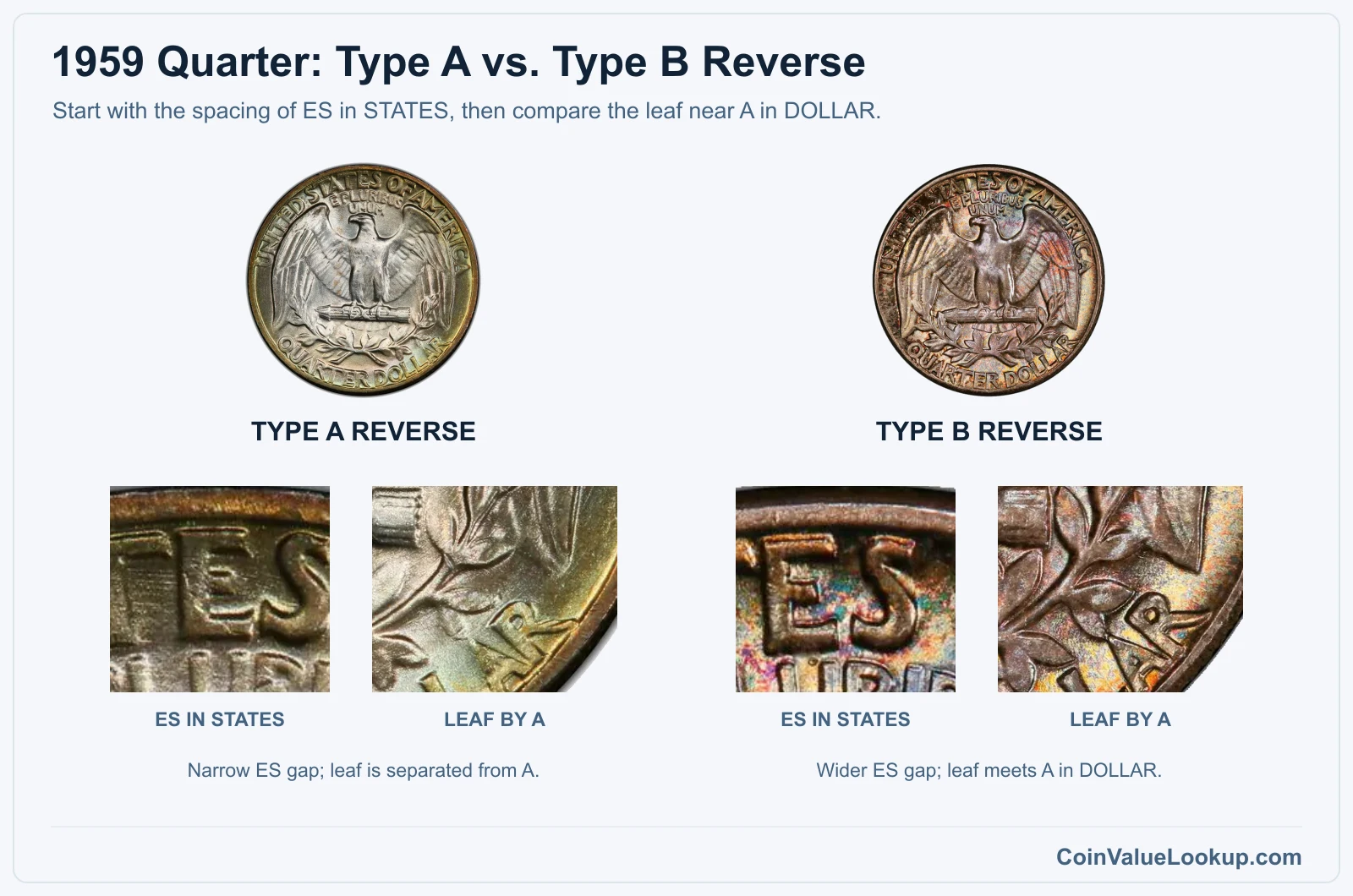
To spot it, magnify the letters E and S in "STATES" on the reverse. On a normal circulation coin, those letters nearly touch.
On a Type B, they are clearly separated. A regular proof coin with that same letter spacing is simply a proof, not the Type B variety.
Coin Value Lookup is a good starting point if you want to look up guides for other dates and denominations in the Washington quarter series.
Step 2: Check Your 1959 Washington Quarter Grade
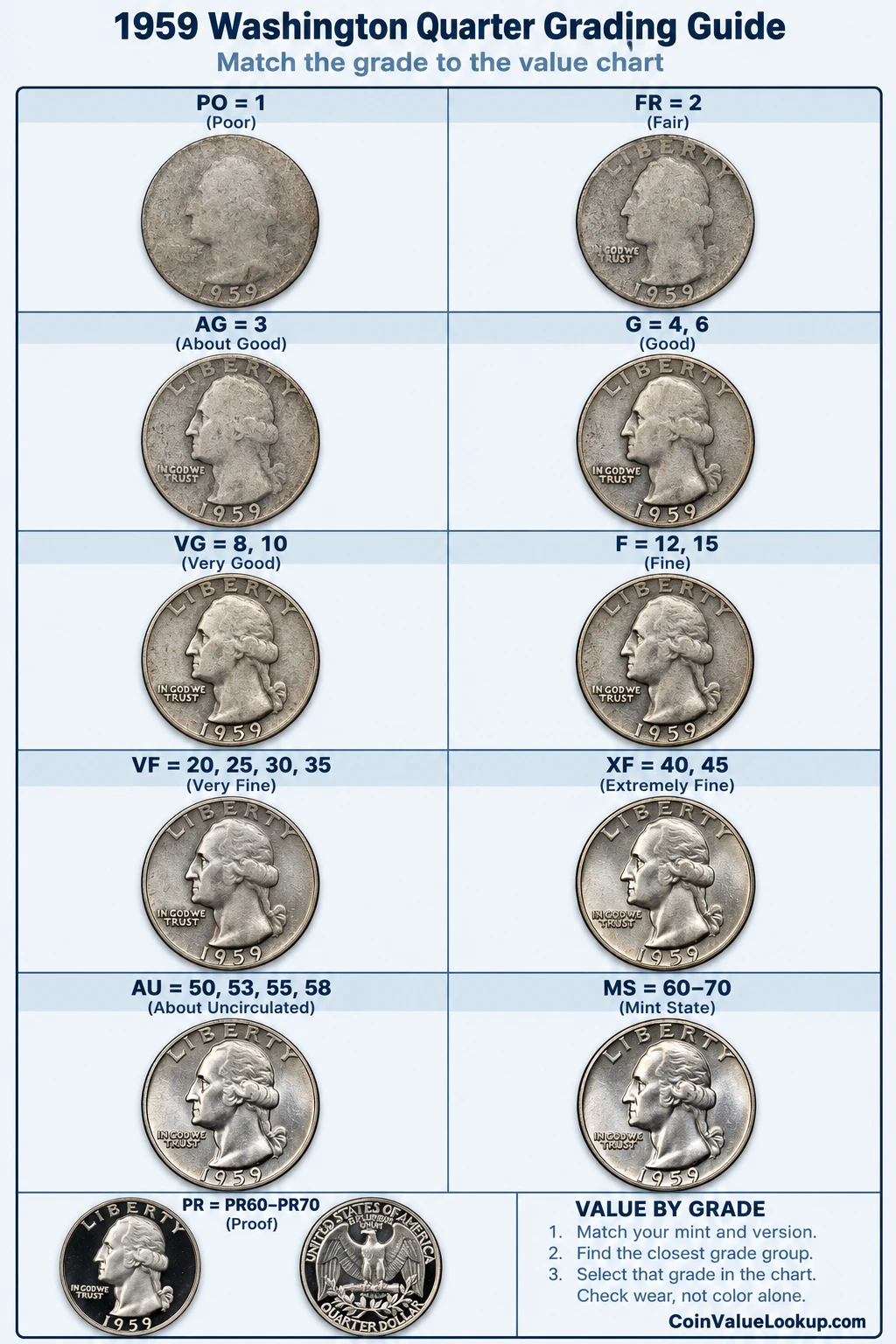
Start on the obverse. Washington's cheekbone, jawline, and the hair detail directly above his ear are the first places to lose sharpness.
Even light friction will dull the luster on the cheek before anything else disappears.
On the reverse, check the eagle's breast feathers and the tops of the wings. Weak feather detail can mean wear, but it can also mean a soft strike, so compare luster patterns.
A weakly struck coin still shows unbroken cartwheel luster in the fields; a worn coin does not.
Look for cleaning hairlines under angled light. They show up as fine parallel scratches across the fields, often most visible on the open areas around the portrait.
Contact marks, bag scuffs, and rim dings all reduce the grade too.
For proofs, the contrast between mirrored fields and frosted devices is a designation, not an upgrade past Mint State. A PR65 with heavy hairlines is still PR65 regardless of how pretty the cameo contrast looks.
Use the comparison image to calibrate your eye against known grade benchmarks.
Step 3: Check 1959 Washington Quarter Value by Mint and Version
1959 Washington Quarter
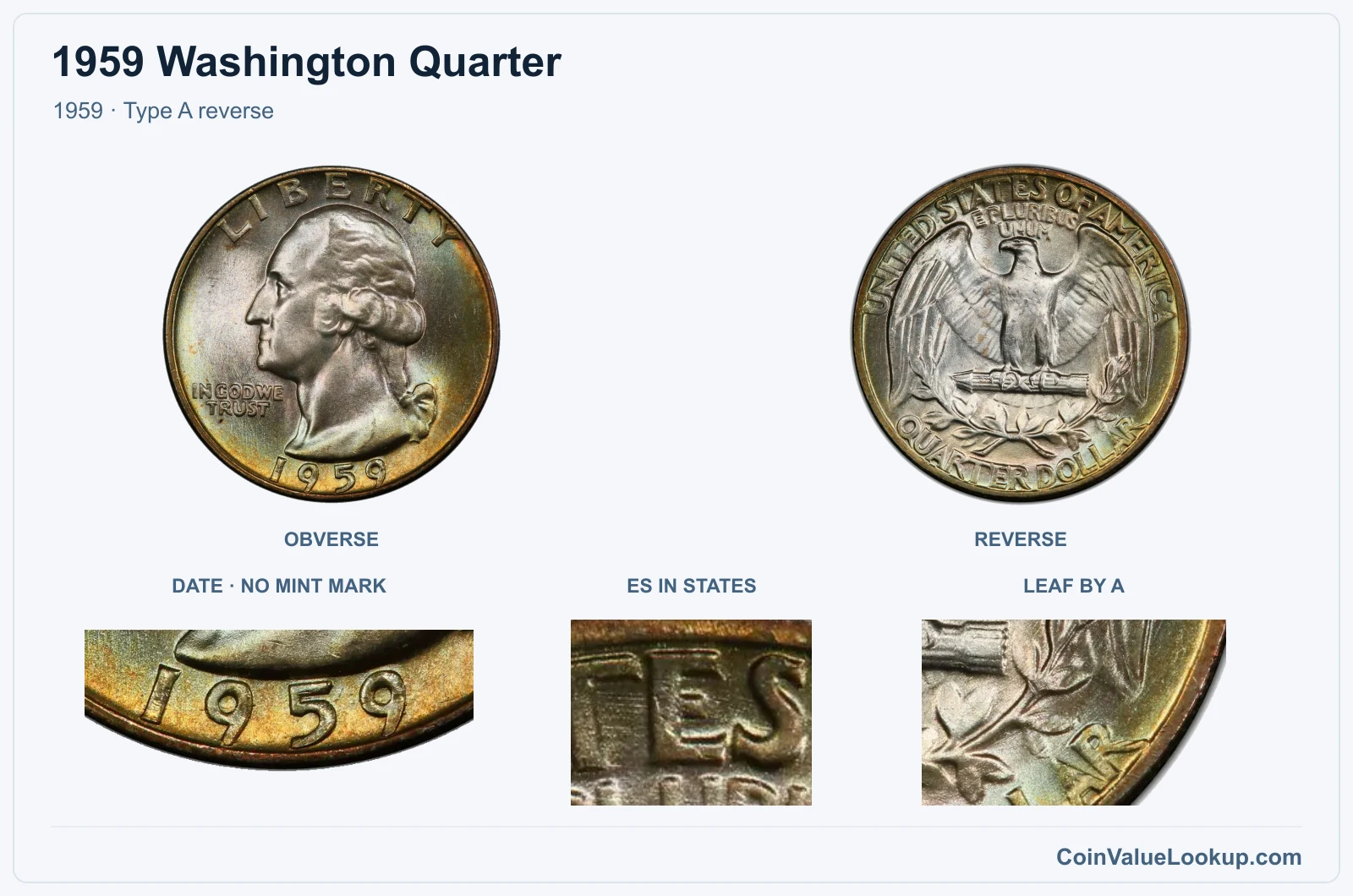
The 1959 Philadelphia quarter has no mintmark below the reverse wreath. It is a standard business strike on a 90% silver planchet.
USA Coin Book guide estimates place a Good-4 example at about $16.43, an MS60 around $20, and an MS65 near $34. These are retail guide figures, not guaranteed offers, and they shift with the silver market.
When evaluating surfaces, look for original mint luster rather than cleaning-induced shine. Gem examples exist in both brilliant white and naturally toned surfaces.
Toning alone does not automatically add a premium. This version uses the ordinary Type A circulation reverse; if the E and S in STATES nearly touch, you have the standard coin.
| Range | Grade | Price | Auction Records | Appraisal |
|---|---|---|---|---|
| PO | PO 1 | — | Coin Identifier | |
| FR | FR 2 | — | Coin Identifier | |
| AG | AG 3 | — | Coin Identifier | |
| G | G 4 | — | Coin Identifier | |
| G 6 | — | Coin Identifier | ||
| VG | VG 8 | — | Coin Identifier | |
| VG 10 | — | Coin Identifier | ||
| F | F 12 | — | Coin Identifier | |
| F 15 | — | Coin Identifier | ||
| VF | VF 20 | — | Coin Identifier | |
| VF 25 | — | Coin Identifier | ||
| VF 30 | — | Coin Identifier | ||
| VF 35 | — | Coin Identifier | ||
| XF | XF 40 | — | Coin Identifier | |
| XF 45 | — | Coin Identifier | ||
| AU | AU 50 | — | Coin Identifier | |
| AU 53 | — | Coin Identifier | ||
| AU 55 | — | Coin Identifier | ||
| AU 58 | — | Coin Identifier | ||
| MS | MS 60 | — | Coin Identifier | |
| MS 61 | — | Coin Identifier | ||
| MS 62 | — | Coin Identifier | ||
| MS 63 | Coin Identifier | |||
| MS 64 | Coin Identifier | |||
| MS 65 | Coin Identifier | |||
| MS 66 | Coin Identifier | |||
| MS 67 | Coin Identifier | |||
| MS 68 | — | — | — | |
| MS 69 | — | — | — | |
| MS 70 | — | — | — |
1959 Washington Quarter — Proof
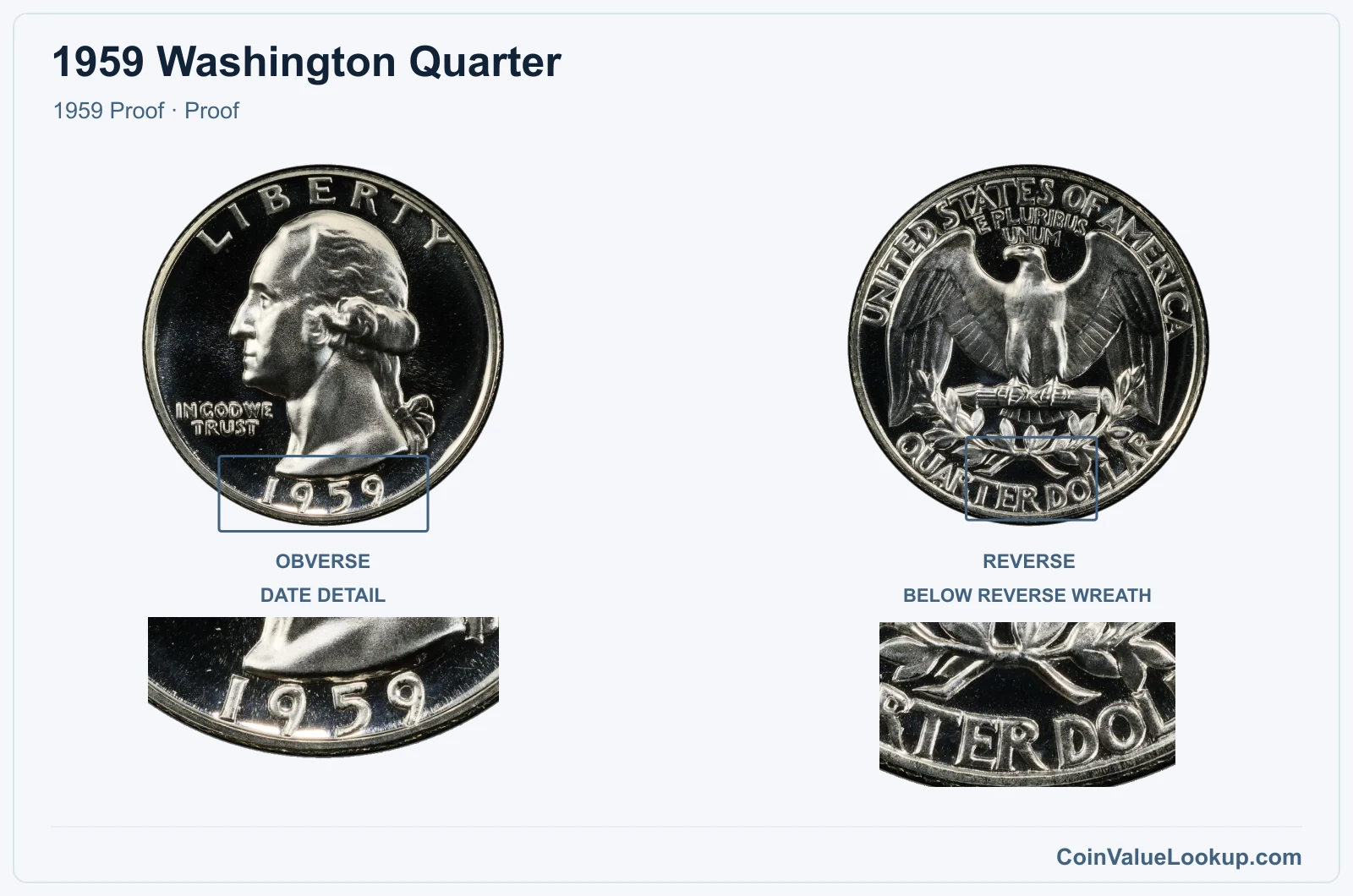
Philadelphia also struck proof quarters in 1959, using the same 90% silver composition. These coins have mirrored fields and sharply detailed devices, produced with specially prepared dies and planchets.
A PR65 example carries a USA Coin Book guide estimate of about $26.
Proof contrast levels such as Cameo and Deep Cameo are separate designations applied by grading services. Do not confuse a proof finish with a higher grade than Mint State; they are different manufacturing methods, not a ranking above MS.
Hairlines from mishandling are the most common issue with proof survivors and will limit the grade even when contrast looks strong.
| Range | Grade | Price | Auction Records | Appraisal |
|---|---|---|---|---|
| PR | PR 1 | — | Coin Identifier | |
| PR 2 | — | Coin Identifier | ||
| PR 3 | — | Coin Identifier | ||
| PR 4 | — | Coin Identifier | ||
| PR 6 | — | Coin Identifier | ||
| PR 8 | — | Coin Identifier | ||
| PR 10 | — | Coin Identifier | ||
| PR 12 | — | Coin Identifier | ||
| PR 15 | — | Coin Identifier | ||
| PR 20 | — | Coin Identifier | ||
| PR 25 | — | Coin Identifier | ||
| PR 30 | — | Coin Identifier | ||
| PR 35 | — | Coin Identifier | ||
| PR 40 | — | Coin Identifier | ||
| PR 45 | — | Coin Identifier | ||
| PR 50 | — | Coin Identifier | ||
| PR 53 | — | Coin Identifier | ||
| PR 55 | — | Coin Identifier | ||
| PR 58 | — | Coin Identifier | ||
| PR 60 | — | Coin Identifier | ||
| PR 61 | — | Coin Identifier | ||
| PR 62 | — | Coin Identifier | ||
| PR 63 | — | Coin Identifier | ||
| PR 64 | — | Coin Identifier | ||
| PR 65 | Coin Identifier | |||
| PR 66 | Coin Identifier | |||
| PR 67 | Coin Identifier | |||
| PR 68 | Coin Identifier | |||
| PR 69 | Coin Identifier | |||
| PR 70 | — | — | — |
1959 Washington Quarter — D
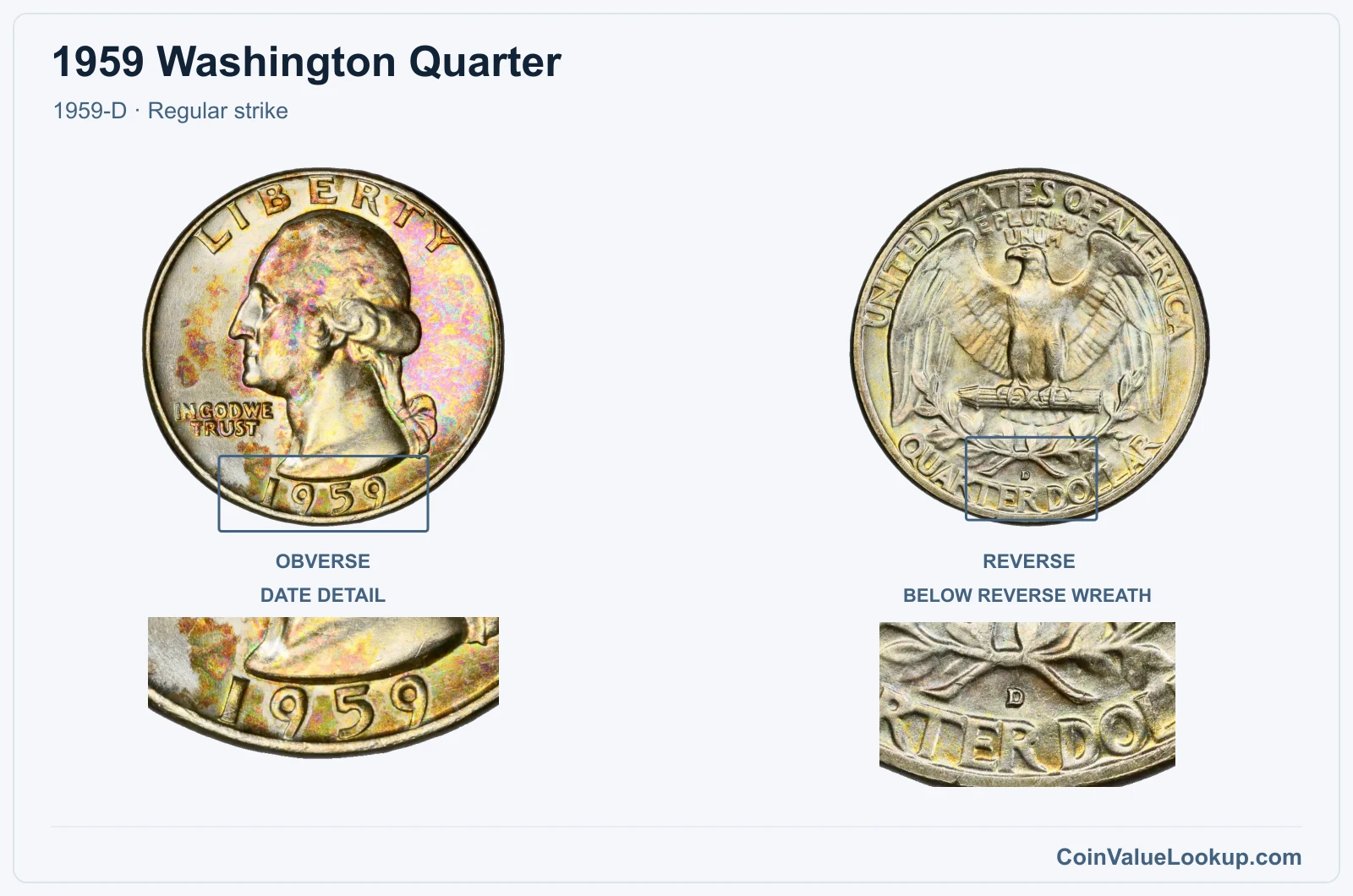
The Denver issue carries a small "D" mintmark below the wreath on the reverse. Same 90% silver composition, same design, same weight.
Guide estimates from USA Coin Book match the Philadelphia business strike: about $16.43 in G4, $20 at MS60, and $34 at MS65.
Denver quarters are common in circulated grades. Finding one with full original luster and minimal bag marks is the challenge.
Compare the mintmark carefully; it should be a single clean punch. Any signs of secondary impressions around the D could indicate a repunched mintmark variety worth investigating further.
| Range | Grade | Price | Auction Records | Appraisal |
|---|---|---|---|---|
| PO | PO 1 | — | Coin Identifier | |
| FR | FR 2 | — | Coin Identifier | |
| AG | AG 3 | — | Coin Identifier | |
| G | G 4 | — | Coin Identifier | |
| G 6 | — | Coin Identifier | ||
| VG | VG 8 | — | Coin Identifier | |
| VG 10 | — | Coin Identifier | ||
| F | F 12 | — | Coin Identifier | |
| F 15 | — | Coin Identifier | ||
| VF | VF 20 | — | Coin Identifier | |
| VF 25 | — | Coin Identifier | ||
| VF 30 | — | Coin Identifier | ||
| VF 35 | — | Coin Identifier | ||
| XF | XF 40 | — | Coin Identifier | |
| XF 45 | — | Coin Identifier | ||
| AU | AU 50 | — | Coin Identifier | |
| AU 53 | — | Coin Identifier | ||
| AU 55 | — | Coin Identifier | ||
| AU 58 | — | Coin Identifier | ||
| MS | MS 60 | — | Coin Identifier | |
| MS 61 | — | Coin Identifier | ||
| MS 62 | — | Coin Identifier | ||
| MS 63 | Coin Identifier | |||
| MS 64 | Coin Identifier | |||
| MS 65 | Coin Identifier | |||
| MS 66 | Coin Identifier | |||
| MS 67 | Coin Identifier | |||
| MS 68 | — | — | — | |
| MS 69 | — | — | — | |
| MS 70 | — | — | — |
1959 Washington Quarter — Type B Reverse Quarter
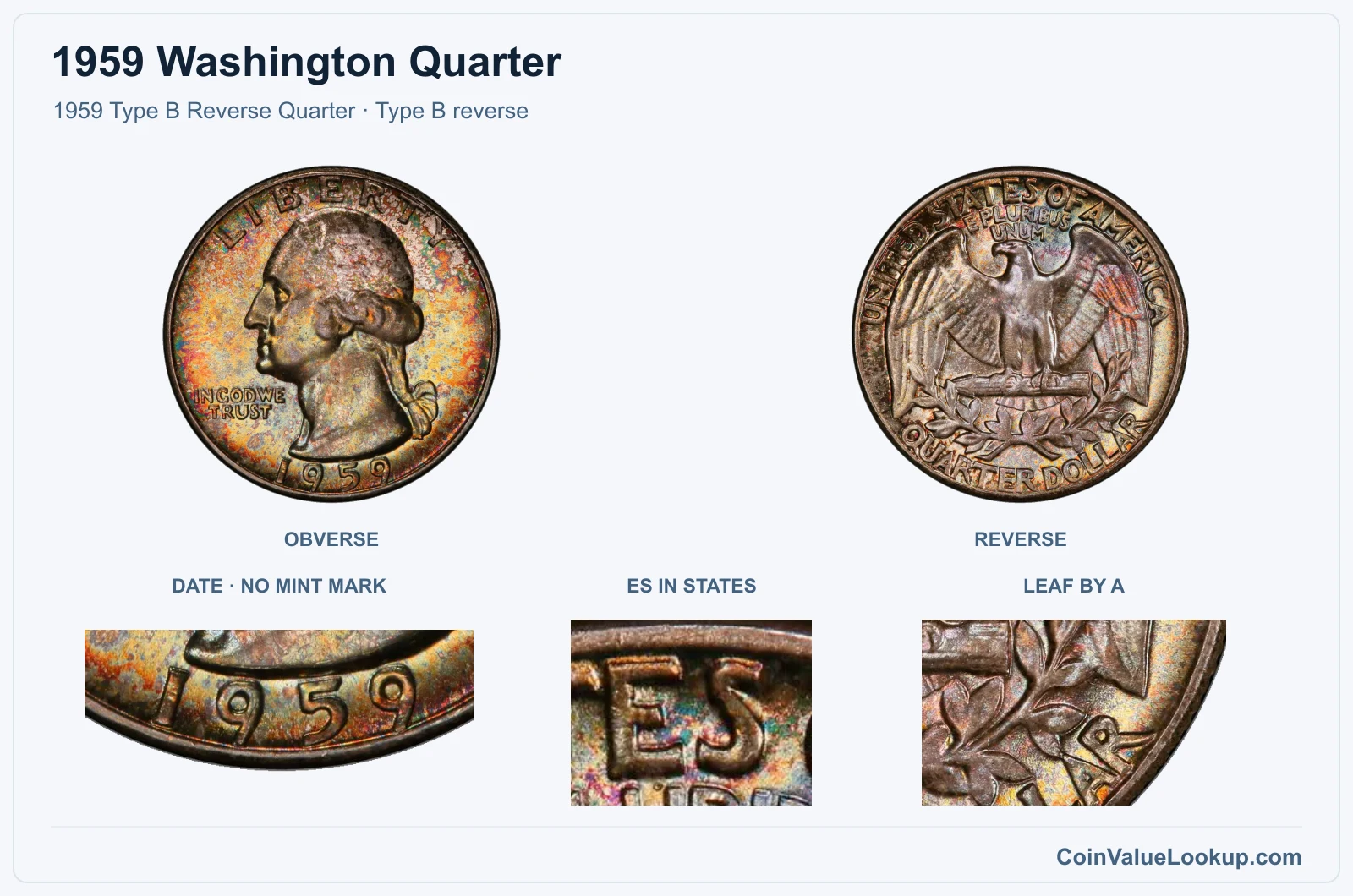
This is the one that gets collectors reaching for a loupe. The 1959 Type B reverse is a Philadelphia business strike that was made using a proof-style reverse hub rather than the normal circulation hub.
The key diagnostic is the gap between the letters E and S in "STATES" on the reverse. On an ordinary 1959 quarter, those two letters nearly touch.
On the Type B, they are visibly separated.
Confirm that the coin has business-strike surfaces, meaning satiny or frosty luster rather than mirrored fields. A standard proof coin naturally has the separated ES because it uses the proof hub, so proofs are not this variety.
A Heritage auction in February 2018 saw an MS66+ example sell for $900. That is a single historical result at a high grade, not a price you can assume for every Type B in every condition.
Still, even lower-grade confirmed examples attract collector interest because the variety is not widely known.
Range Grade
Price Auction Records Appraisal PO PO 1
—
Coin Identifier FR FR 2
—
Coin Identifier AG AG 3
—
Coin Identifier G G 4
—
Coin Identifier
G 6
—
Coin Identifier VG VG 8
—
Coin Identifier
VG 10
—
Coin Identifier F F 12
—
Coin Identifier
F 15
—
Coin Identifier VF VF 20
—
Coin Identifier
VF 25
—
Coin Identifier
VF 30
—
Coin Identifier
VF 35
—
Coin Identifier XF XF 40
—
Coin Identifier
XF 45
—
Coin Identifier AU AU 50
—
Coin Identifier
AU 53
—
Coin Identifier
AU 55
—
Coin Identifier
AU 58
—
Coin Identifier MS MS 60
—
Coin Identifier
MS 61
—
Coin Identifier
MS 62
—
Coin Identifier
MS 63
—
Coin Identifier
MS 64
Coin Identifier
MS 65
Coin Identifier
MS 66
Coin Identifier
MS 67
—
—
—
MS 68
—
—
—
MS 69
—
—
—
MS 70
—
—
—
1959 Washington Quarter Error List
1. 1959 Washington Quarter — Struck on a Nickel Planchet
A 1959 Philadelphia quarter struck on a five-cent nickel planchet is a dramatic wrong-planchet error. The smaller blank could not fill the quarter dies completely, so peripheral inscriptions, especially QUARTER DOLLAR, are distorted or partially missing.
Central details like Washington's portrait may appear surprisingly intact because the metal flowed outward from the center during striking.
An ANACS MS65 example sold for $805 at Heritage in March 2006. That is one recorded sale at one grade, not a universal price.
Be cautious with look-alikes. Post-mint damage such as cutting, grinding, or hammering can make a normal quarter appear undersized.
A genuine wrong-planchet strike shows consistent metal flow patterns and strike-made surfaces across the entire coin. If the edges look filed or the design appears scraped rather than naturally incomplete, it is almost certainly altered.
2. 1959 Washington Quarter — Type B Reverse Variety
The Type B reverse variety on a 1959 Philadelphia circulation quarter results from a proof-style reverse hub being used for business strikes. The diagnostic is straightforward: magnify the space between E and S in "STATES." On the normal circulation reverse, the letters nearly touch.
On the Type B hub, they are clearly separated.
This must be confirmed on a coin with business-strike surfaces. Mirrored proof fields mean you have a regular proof, not the variety.
Also rule out mechanical doubling, which can spread letters apart but leaves a flat shelf and affects multiple areas inconsistently rather than showing a clean, uniform hub difference.
A Heritage sale in February 2018 recorded $900 for an MS66+ example. That is one historical result for a high-grade piece, not a baseline for every specimen.
3. 1959 Washington Quarter — Double Struck, Second Strike 60% Off-Center
A 1959 Philadelphia quarter exists that was struck twice, with the second impression displaced roughly 60% off-center. The result is two overlapping sets of design elements, a shifted rim, and repeated legends at different angles.
It is visually unmistakable.
Heritage Auctions lists an MS63 example graded by PCGS in their archive as lot 91875, though no separate realized price is stated for that individual coin.
Do not confuse a double-struck coin with a single off-center strike. A single off-center hit shows one impression shifted from the blank's center.
A genuine double strike shows two distinct, complete or near-complete impressions at different positions. Also distinguish this from die doubling, which is a flat, shelf-like effect contained within a single strike.
Post-mint damage like hammering can mimic displacement but will lack proper strike-flow characteristics.
4. 1959 Washington Quarter — Repunched Mintmark
A repunched mintmark variety has been reported for the 1959-D Washington quarter. This occurs when the mintmark punch was applied more than once in slightly different positions, leaving traces of the earlier placement visible around or beneath the final D.
Under magnification, look for remnants of a second D to the north, south, east, or west of the primary punch. The doubling should be consistent and die-made, not wobbly or irregular.
Do not confuse a genuine repunched mintmark with machine doubling, which creates a flat shelf around the letter, or with die chips and corrosion that can distort the mintmark area. Value depends on the specific variety, how visible the repunching is, and the coin's overall condition.
Professional attribution can help confirm what you are seeing.
5. 1959 Washington Quarter — Doubled Die Obverse
A doubled die obverse variety has been reported for the 1959 Washington quarter. Doubled dies are created during hub-to-die production when a misaligned second impression leaves consistent doubling across parts of the design.
Compare the obverse lettering and design elements against a normal 1959 quarter under the same magnification and lighting. Look for separation, notching, or a secondary contour on letters or date digits that appears uniform and repeatable, not random.
Machine doubling is the most common impostor. It produces a flat, shelf-like displacement rather than the rounded, raised profile of a true doubled die.
Reflections under certain lighting can also create an illusion of doubling. Condition and the strength of the visible doubling both affect what a confirmed example might be worth.
6. 1959 Washington Quarter — Clipped Planchet
Clipped planchet errors have been reported for 1959 Washington quarters. A clip occurs when the blank is punched from strip metal that overlaps a previously punched hole or the edge of the strip, producing a missing curved, straight, or irregular section.
Look for a characteristic area of missing metal along the rim. Genuine clips often show a weakness in the design directly opposite the missing portion, called the Blakesley effect, caused by reduced striking pressure.
The edge at the clip should show original planchet texture rather than tool marks.
Filed notches, deliberate edge cuts, and corrosion-related loss can mimic a clip. If the missing area shows rough filing marks or irregular corrosion pitting rather than smooth, natural planchet flow, the coin was likely altered after it left the mint.
Value depends on clip size, type, and overall grade.
7. 1959 Washington Quarter — Doubled Die Reverse
A doubled die reverse variety has been reported for the 1959 Washington quarter. Like its obverse counterpart, this results from a misaligned second hubbing impression during die manufacture, producing consistent doubling on reverse design elements.
Examine the reverse legends and eagle design under magnification, comparing directly against a known normal coin. True hub doubling shows raised, rounded secondary contours on affected areas.
The doubling should repeat in the same direction across the affected zone.
Machine doubling is again the main look-alike. It tends to be flatter and may show a slightly different spread pattern across different parts of the coin.
Random nicks, corrosion, or wear can also blur letter edges in ways that superficially resemble doubling. Condition and doubling clarity both influence what a confirmed example could be worth.